


Eighth Grade - MATH
3: Math
Unit 2: Proportions
Lesson 5
Proportional Relationship Equations
Students are given an Art in Proportion project that directs them to scale a small grid image into a larger grid where each small square matches four squares in the big grid (a 2× enlargement), with step-by-step copying to maintain shape. The lesson repeatedly describes ‘‘making it bigger or smaller without changing its shape'' and ‘‘enlarge an image using a consistent ratio,'' and the parent notes say students practice maintaining equal ratios while enlarging an image. An optional video and Life Application section discuss how scaling and proportional relationships are used to estimate true sizes (e.g., dinosaurs), reinforcing dilation concepts.
Unit 3: Expressions
Lesson 7
Rise Over Run
Students draw right triangles on coordinate grids between pairs of lattice points, count the rise and run for each triangle, and compute slopes by simplifying rise/run ratios. They set up proportions comparing rise/run values for different triangles (e.g., 2/2 = 4/4) and answer yes/no questions about whether the triangles are similar. Multiple activity pages ask students to record rises, runs, slopes, and to decide triangle similarity by checking proportional side ratios.
Unit 6: Geometry
Lesson 1
Congruence and Similarity
Students are taught the definition of similar shapes as having equal angles and proportional sides and learn to compute and use a scale factor to find missing side lengths. Students practice identifying corresponding parts and writing correspondence statements (for example AB → DE and ∠C → ∠F) even when shapes are rotated, flipped, or resized. The materials mention rigid motions (flips, turns, slides) and include an origami activity that has students fold the same shape from different-sized paper to explore size changes while preserving shape.
Lesson 3
Reflections
Students practice reflecting points, line segments, and entire shapes across the x-axis, y-axis, y = x, and y = -x using both the Perpendicular Distance Method and coordinate formulas; they plot vertices, label images (A → A'), and verify that reflected figures are congruent. Students use a digital graphing tool to drag points and observe coordinate changes under reflection, and the Parent Plan lists describing effects of dilations, translations, rotations, and reflections using coordinates. The lesson includes multiple activities where students apply reflection rules to every vertex and connect the reflected points to form images.
Lesson 6
Dilations
Students are taught that a dilation changes size but preserves shape and angles and that the image is similar to the original (several statements define dilation and similarity). Students practice identifying dilations by checking that corresponding x- and y-coordinates are multiplied by the same scale factor and perform dilations on the coordinate plane by multiplying coordinates and plotting new points. Students calculate new side lengths with new length = original length × scale factor and solve for unknown lengths or scale factors in problems and answer keys.
Lesson 7
Sequences of Transformations
Students perform and label sequences that include dilations and rigid motions in worked examples (Example 1 and Example 2 show dilation then translation and dilation then rotation). Multiple student activity pages require students to apply translations, rotations, reflections, and dilations in sequence on coordinate grids (problems 1–8). The "What Happened?" activity explicitly asks students to examine two shapes and choose or write the sequence of transformations that maps the original to the image, and the answer key gives specific sequences for those mappings.
Lesson 8
Triangles and Transversals
Students are taught the Angle-Angle (AA) similarity rule and practice deciding whether pairs of triangles are similar (Activity 2 and the Triangle Angles student page). The unit includes multiple tasks and quiz items that require finding scale factors, identifying dilations, and describing sequences of transformations (e.g., reflect then translate; dilation then reflect) to map one figure to another. Several problems ask students to map triangles on coordinate grids using dilation and rigid motions and to state the sequence (Day 3 quiz problems and answer key).
Lesson 11
Unit 6 Test
The Parent Plan explicitly states that students should "understand that a two-dimensional figure is similar to another if the second can be obtained from the first by a sequence of rotations, reflections, translations – followed by a dilation" and that students should "describe the sequence of moves that connects them." Multiple Student Activity Page problems require students to identify dilations and scale factors (e.g., exercises asking "Is this a dilation?" and to determine the scale factor), perform dilations and then translations or reflections (e.g., dilate then translate 2 right and 3 up; dilate by 0.5 then reflect across the y-axis), and determine rotation/translation/reflection rules that map one triangle to another. Several problems ask students to reflect across y = x, reflect across axes, rotate 90° or 180°, and to give the transformation rule that maps an original figure to its image (e.g., problems asking for the rotation rule mapping ΔABC to ΔA'B'C').
Final Project
Abstract Art Gallery
Students draw shapes on a coordinate grid and perform specific rigid transformations: they reflect a polygon across an axis, rotate a polygon 90° clockwise about the origin, and translate a polygon using a rule (e.g., right 4, up 2). Students perform a dilation about the origin by a factor of 3 and transfer both original and dilated figures to tracing paper, using different colors to distinguish them. The student activity pages ask students to identify two shapes that are similar and to choose two shapes that are congruent and similar, reinforcing recognition of similarity and congruence.
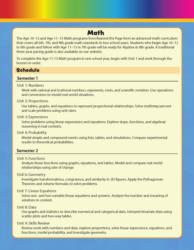
Unit 9: Semester Exams
Lesson 7
Geometry Review
The Parent Plan explicitly states that students should "understand that a two-dimensional figure is similar to another if the second can be obtained from the first by a sequence of rotations, reflections, translations – followed by a dilation". Activity 1 has multiple student tasks on similarity and dilations: finding scale factors between similar triangles, dilating Triangle LMN by a factor of 3 about the origin, and deciding whether depicted transformations are dilations (with scale factor and enlargement/reduction). Activity 2 has student tasks that require applying and identifying rigid transformations (reflections, translations, rotations) and identifying a rotation that maps one triangle to another, showing practice with the non-dilation parts of the required sequences.
Lesson 10
Semester Exam
Students perform individual rigid transformations: they translate a square (problem 11, T_{1,-3}), reflect a point across the y-axis (problem 12, A(5,10)→A'(−5,10)), and rotate a point 90° clockwise about the origin (problem 13, B(−3,4)→B'(?)). Students also perform translations of a triangle (problem 14) and answer a dilation question (problem 15 asks whether a dilation by factor 3 is rigid or non-rigid). The answer key and images show specific mapped points and transformed shapes (e.g., squares and triangles labeled A,B,C and A',B',C'), giving concrete examples of individual transformations.