


Ninth Grade - ELA
1: Semester 1

Unit 1: Lord of the Flies
Lesson 2
Life on the Island
Activity 2 explicitly states that independent clauses can be joined by a semicolon and gives a clear example: "Jack wanted to be the group's leader; most of the boys voted for Ralph." The independent/dependent clause practice directs students to identify clauses and Part II asks students to write a sentence containing two independent clauses, with an answer-key example showing a semicolon linking two independent clauses ("Ralph found a shell in the weeds; Piggy identified it as a conch.").
Unit 3: Grammar, Part I
Lesson 1
Parts of Speech
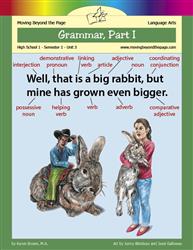
Students are explicitly taught the punctuation topic: the lesson states they will "learn the rules for when and how to use commas, colons, and semicolons." The lesson gives a concrete rule for conjunctive adverbs: "The formula for using a conjunctive adverb is independent clause + semicolon + conjunctive adverb + comma + independent clause." These statements directly explain the semicolon + conjunctive adverb construction.
Lesson 6
Colons and Semicolons
Students read explicit rules that a semicolon separates two closely related independent clauses and that the formula for using a semicolon with a conjunctive adverb is: independent clause + semicolon + conjunctive adverb + comma + independent clause (Activity 2 and "Things to Know"). Students complete practice sentences that require inserting semicolons, including examples with conjunctive adverbs (e.g., "The committee discussed our budget for hours; however, they did not reach a decision"; Option 1 and its Answer Key). In the Great Punctuation Trial writing activity, students must write an opening statement that includes one example joining two independent clauses and one example joining two independent clauses with a conjunctive adverb + comma, then read and defend those examples aloud.
Final Project
Wrapping Up
Students are asked in Part III, question 14 to "Describe two situations where you could correctly use a semicolon," which prompts explicit explanation of semicolon use. The answer key lists accepted uses including "separating two closely related independent clauses" and "joining two independent clauses with a transitional word/phrase (or conjunctive adverb)." Part IV, question 18 requires students to insert a semicolon before the conjunctive adverb in the sentence corrected as "Brendan fell off his skateboard many times; nevertheless, he kept practicing...," providing a concrete application. The punctuation section (Part IV) also instructs students to insert semicolons among other punctuation marks, offering direct practice opportunities.
Unit 5: Nonfiction
Lesson 3
The Taliban
The lesson text itself uses a semicolon in the explanatory sentence: "The word talib means 'student' in Pashto, the language of the Pashtun people; the plural form is taliban." The lesson also instructs students to avoid choppy sentences and to "use transitional words and phrases to smoothly link your thoughts," and it directs students to consult The Only Grammar Book (pp. 159-161) for a list of transitional words and phrases.
Lesson 10
Learning from the Past
Students read prose that contains an explicit example of a semicolon: "Elie Wiesel was a Nobel-Prize winning author who died in 2016; he was 87 years old." The Parent Plan also references attending to the norms and conventions of writing, which broadly relates to punctuation conventions.
Lesson 11
A Boy's Story
Students read at least one explicit example of a semicolon linking two independent clauses in the provided material: "His face evinced confidence; his smiles disappeared before they were completed." The semicolon appears in the vocabulary answer sentences that students are directed to read and use. Students therefore encounter semicolon punctuation in context while working with the text and vocabulary items.
Semester Exam
Semester Exam
Students are asked to correct grammar and punctuation errors that include a sentence needing a semicolon with a conjunctive adverb: the corrected answer shows "I really wanted to stay up and finish my book; nevertheless, I decided to turn out the light and go to sleep." The grammar paragraph text also shows semicolon usage with a conjunctive adverb ("Commas can be confusing; however there are several online cites..."). The Studying guidance tells students to "be clear on when to use the punctuation covered (commas, parentheses, dashes, colons, semicolons)," directing review of semicolon use.
2: Semester 2

Unit 1: Ender's Game
Lesson 10
View from Valentine
The vocabulary entry for albedo contains a semicolon: "albedo: the level of reflectiveness of a surface, particularly the surface's capacity to reflect the sun; ice has a very high albedo while a black t-shirt has a very low albedo." This shows a correct instance of a semicolon linking two related independent clauses within the lesson text.
Unit 2: Grammar, Part II
Lesson 1
Review of Grammar, Part I
Students are asked to insert needed commas and semicolons in Option 1's "Punctuation and Grammar" activity, and the answer key explicitly shows semicolons joining independent clauses (e.g., "Unfortunately, it never snowed while I was visiting; nevertheless, it was still cold..."). The "Conjunctive adverbs" matching card also provides model sentences using a semicolon plus a conjunctive adverb ("I wanted to go; nevertheless, I stayed home."). Option 2 requires students to create paragraphs that require commas and semicolons and to state the rules that apply for each punctuation mark.
Lesson 3
Sentence Fragments and Run-on Sentences
The lesson explicitly lists putting a semicolon between two independent clauses as one way to correct run-on sentences and gives an example correction that uses a semicolon: "I was sweating a lot; I had not brought a towel or a bottle of water." The run-on section also presents semicolons as an option alongside splitting into sentences or using a comma plus a coordinating conjunction (FANBOYS). The student activity asks learners to correct run-ons in a paragraph, which can be done by inserting a semicolon between independent clauses.

Unit 3: Informational Texts
Lesson 9
Writing about History
Students read primary-source testimony that includes at least one clear semicolon example: Robert Brent's account contains the sentence, "I am twenty-four years old; was born on the Arkansas river," which shows a semicolon linking clauses. Primary-source transcripts and other quoted materials throughout the lesson present authentic punctuation that students encounter while comparing firsthand and secondary accounts.