


Ninth Grade - ELA
1: Semester 1

Unit 1: Lord of the Flies
Lesson 3
Paths in the Jungle
Students are asked to read and annotate an article and to "identify the author's thesis and supporting points," with a Student Activity Page that has spaces for "Author's main argument/thesis" and "Key points that support the thesis." Students are instructed to record their reactions, "evaluate the writer's view and their reactions and decide their final opinion," and to use annotation codes (e.g., question marks for ideas they doubt). The activity prompts students to mark supporting evidence with stars or highlights and to fill a graphic organizer to organize claims and personal responses.
Lesson 6
Symbolism, Part 1
Students are directed in Activity 1 to choose among listed interpretations for symbols (e.g., Piggy's glasses, the conch) and to "back up [their] explanation with support from the text," requiring them to cite evidence to support claims. The Student Activity Page and journal prompt ask students to record actions and quotes from characters to indicate effects on one another and the island, which has students use textual evidence to justify interpretations. The wrap-up and prompts encourage students to "perform [their] own evaluation" and think critically about interpretations, prompting analytic justification of claims.
Lesson 8
Defects of Human Nature
Students are asked to choose themes that support Golding's stated major theme and to "support those choices by referring to details from the novel" (Option 1 and Option 2 activities). Students must write 3–4 sentence explanations about how a chosen minor theme supports the major theme, and parent notes describe students providing examples from the novel to justify theme selections. The activities require students to cite textual details to back interpretive claims about themes.
Final Project
Now You Have the Conch
Students are directed to develop a thesis (the claim) and to gather and cite specific passages as support (Brainstorming pages; Outline/Essay Organizer). The rubric and checklist emphasize evaluating support—e.g., the rubric's "Support" criteria and the editor pages ask whether details support the thesis and whether the thesis is supportable. The Parent Plan skills include "Cite strong and thorough textual evidence" and the "Things to Know" section mentions revising for "errors in logic."
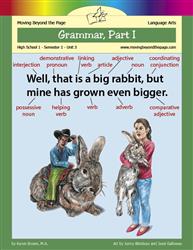
Unit 3: Grammar, Part I
Lesson 6
Colons and Semicolons
Students prepare formal opening statements for the semicolon and the colon, using the listed claims and providing examples (one joining independent clauses, one with a conjunctive adverb, one with a complex list for the semicolon; a list, a quotation, and an explanatory example for the colon). Students present those statements aloud in a courtroom format and answer judge questions that require them to explain rules and provide example sentences as evidence. The Parent Plan explicitly directs students to explain rules, demonstrate examples, and defend their reasoning verbally.

Unit 4: Poetry
Final Project
Poetry
The "Provide Your Opinion" project asks students to read pro and con articles about Bob Dylan's Nobel Prize and to read some of Dylan's lyrics, then "consider both sides of the debate" and write a one-page, double-spaced response asserting whether Dylan deserved the prize and explaining their reasons. The task directs students to use the provided supportive and critical articles as sources and to give credit if they use other writers' arguments or quotations. Students are explicitly asked to evaluate arguments in order to form and justify their own position.
Unit 5: Nonfiction
Lesson 6
A Day Like Any Other
Students are instructed to use the APE strategy (Answer, Prove, Extend) to analyze decisions Malala or her father made, including providing specific examples and quotations from the text in the 'Prove' step. Students choose scenarios about why characters acted as they did and write an answer that incorporates part of the question and textual support. Students also discuss whether the decision was a good one and explain their opinion, using evidence from the book.
Lesson 7
Life in England
Students are asked in Activity 1 to compare how the book and the filmmaker's video differ, taking notes on specific claims such as the role Malala's father played in her decision to enter public life and the filmmaker's suggestion that media coverage may have affected the attack. The parent plan supplies explicit contrasting claims (the filmmaker's implication that the father pushed Malala versus Malala's statement that she acted of her own free will) for students to consider and discuss. Wrapping-up questions ask students to evaluate whether Malala's father or the media bear responsibility, prompting students to weigh competing explanations.
Lesson 8
Civil Rights
Students read substantial persuasive text (Martin Luther King Jr.'s "Letter from Birmingham Jail") and answer guided questions asking them to identify the most persuasive argument and explain why it was effective. Students complete a "Just and Unjust Laws" double-entry diary in which they underline excerpts, state whether they agree with Dr. King's reasoning, and write their own opinions. Students complete a pros/cons graphic organizer ("Reasons for the March/Reasons Against the March") weighing arguments for and against children participating in the Birmingham march.
Lesson 9
Civil Disobedience
Students read and analyze multiple excerpts from Thoreau and King, comparing passages side-by-side and marking overlapping ideas. Students explain areas of agreement and disagreement in writing (e.g., filling the "Overlapping Ideas" column and answering prompts about who they agree with and why). Homework asks students to read excerpts from "Civil Disobedience" and answer targeted questions that require citing Thoreau's reasons and claims (e.g., why Thoreau lacks confidence in government and how people should respond to unfair taxes). The Parent Plan explicitly lists skills such as drawing evidence from texts and determining an author's point of view and rhetorical use.
Lesson 12
Running from War
Students are asked to use the APE strategy where they must "Prove" their answer by selecting and integrating a quotation from the text to support a claim, which requires using textual evidence. Students respond to discussion questions that ask whether the author's explanation of his photographic memory is believable and whether the boys' narrow escapes are believable, which asks them to evaluate the credibility of specific claims. In Activity 2 students compare the accuracy of their own memories with an eyewitness claim in the book, practicing judgment about the reliability of a reported account.
Lesson 13
Child Soldier
The Parent Plan explicitly lists delineating and evaluating arguments and specific claims as a skill for this lesson. In the "Truth about Memoirs" activity, students are asked to write a journal response weighing supporters' and detractors' claims about the accuracy of Beah's memoir, citing possible timeline discrepancies and differing interpretations of evidence. The "Different Accounts" activity requires students to compare what the book says with what Beah says in a video, to record examples or quotes from each source, and to discuss differences in claims and explanations.
Lesson 14
Rehabilitation
Students are asked to re-read the lieutenant's speech and the RUF soldier's conversation and to consider whether the lieutenant's analysis is accurate, then write a response citing examples or quotations (Activity 1, Option 2). In Activity 1, Option 1 students complete a comparative worksheet marking whether the government army committed specific war crimes and provide supporting examples/quotations from the text. The Parent Plan also lists the targeted skill explicitly: delineate and evaluate arguments and specific claims in a text and assess reasoning and evidence.
Lesson 15
A New Life
Students analyze authors' use of rhetoric and purpose by answering questions on the Comparing Memoirs page that ask what each author wants to persuade readers to believe and whether the style is effective. Students practice judging persuasive effectiveness when they consider whether each memoir successfully convinces readers (e.g., "Was the writer effective in persuading you?"). The Parent Plan explicitly lists a skill students practice: determining an author's point of view or purpose and analyzing how the author uses rhetoric to advance that purpose.
Final Project
Expository Essay
Students are instructed to locate and evaluate appropriate online sources (e.g., favoring .edu/.gov sites, avoiding Wikipedia) and to use a K-N-S chart and the "Audience, Purpose, and Sources" activity to assess the usefulness of sources. They must choose three key, relevant facts to support a thesis, document those facts with in-text citations and a Works Cited page, and the rubric's Support criteria require facts to be backed by carefully researched sources and presented correctly. The lesson directs students to refine a thesis based on research and to select the most pertinent facts, implying attention to relevance and sufficiency of evidence.
Semester Exam
Semester Exam
Students review the Nonfiction unit and are asked to understand differences among quoting, paraphrasing, and summarizing and to explain relationships among authors (e.g., how Thoreau influenced Martin Luther King, Jr.). In Part IV Discussion, students must describe the controversy about accuracy in A Long Way Gone and explain how memoir genre matters, and they must use essays and speeches (e.g., Wiesel) to discuss the importance of writing about the horrors of war. The answer key explicitly frames the A Long Way Gone task as evaluating whether Beah's claims were accurate and how readers judge truth in memoir.
2: Semester 2

Unit 1: Ender's Game
Lesson 3
Science Fiction
The "Questions to Discuss" section presents several of Graff's broad pronouncements and asks students to react to each one, prompting them to note oversimplification and possible misinformation (e.g., that no single person invented the wheel or light). Prompts explicitly tell students they may accuse Graff of lying or point out that his claims lack supporting evidence (for instance, noting he says "for all we know," indicating uncertainty about the enemy). Students are asked to consider how Graff's statements might be used to manipulate Ender, which invites identification of misleading or manipulative reasoning.
Lesson 5
Movement and Time
Students are prompted to consider how to determine whether authority figures tell the truth in the "Ideas to Think About" section. The "Questions to Discuss" asks students to evaluate Dink's claim that the buggers have been destroyed and the government lies, to consider whether Graff might know or suspect this, and to decide what Ender should do—tasks that ask students to weigh competing claims and possible motives.
Lesson 6
Performance Is Personal
Students are prompted to evaluate competing claims when they discuss Dink's assertion that there is no bugger threat and whether the I.F. stirs fear to retain power, asking directly, "Do you think he is on to something?" The Text Structure activity asks students to explain how opening conversations show conflicting opinions of authority figures and to provide textual examples, which requires identifying specific claims and contrasting viewpoints. The Competing Commanders activity has students choose three criteria, score each commander, and justify rankings, which asks students to form evaluative claims about commanders' leadership.
Lesson 8
Flies and Self-Loathing
Students are prompted to evaluate Ender's self-perception—"The reader should evaluate Ender's actions, rather than simply accept Ender's perception of his own actions"—and discuss whether Ender can evaluate himself objectively. The lesson asks students to review "Ender's perception of his own actions and why they may or may not be reliable and accurate." Homework and discussion questions require students to justify answers (e.g., whether Colonel Graff is pushing Ender too hard), prompting students to support claims with reasons.
Lesson 11
Thud, Whump, Huut
Students are asked explicitly to consider how to determine whether authority figures tell the truth (Ideas to Think About) and to answer why the authorities lie to Ender (Reading question #4), which asks them to evaluate motives and claims. In the adaptation activities, students compare book passages to movie or comic scenes, note omitted or changed information, and judge whether those omissions compromise the original meaning (Comic Adaptation activity and Option 1 directions). Students are also prompted to discuss which version of a scene is more effective and why, requiring them to weigh evidence from two sources.
Lesson 12
Campbell's Comparisons
Students are prompted to discuss and evaluate characters' claims in the Questions to Discuss (e.g., Dink's claim that the I.F. stokes fear to control society and Mazer's justification for destroying the buggers), which requires them to consider motives and reasoning. Students redo an issues survey and compare pre- and post-reading answers, explaining what in the novel changed their views and citing examples. The parent plan also directs students to provide examples from the novel that influenced their opinions, encouraging use of textual evidence in discussion.
Lesson 13
The Enemy's Gate Is Down
Students are asked to consider whether to believe the I.F. when they claim the buggers are a threat and to reflect on how to determine whether authority figures tell the truth. The Discovering Subplots activity asks students to list unanswered questions and moments of mystery or tension in Graff's subplot, prompting scrutiny of characters' claims and motives. Students read and summarize a Forbes article about leadership lessons from Ender's Game, then connect those claims to their own experiences.

Unit 3: Informational Texts
Lesson 2
Outliers
Students are asked to analyze how Gladwell defines "outlier" and to explore the rhetorical strategies (including analogy) he uses to develop that idea (Activity 1 and the Parent Plan skills list). The Parent Plan explicitly asks students to "determine an author's point of view or purpose" and to "analyze how the author unfolds an analysis or series of ideas," which directs students to delineate claims and the order of supporting points. Homework questions ask students to explain causal claims (e.g., why the birthday cutoff affects hockey success) and to explain the "Matthew Effect," requiring students to trace the book's explanatory claims.
Lesson 4
The 10,000 Hour Rule
Students are asked to summarize Sections 1–3 and to answer specific analysis questions about how Bill Joy's case is introduced, why he is omitted in Section 2, and how Section 3 adds to understanding the 10,000-hour claim (Looking Closely worksheet). The Parent Plan lists skills students should practice, including citing strong textual evidence, analyzing how an author's ideas or claims are developed, and determining an author's point of view and rhetorical choices. Activity 2 and the homework require students to track specific opportunities in Gladwell's examples and to create a visual that links those details to the chapter's bigger ideas.
Lesson 5
Harlan, Kentucky
Students are asked to cite strong and thorough textual evidence and to draw evidence from informational texts (Skills section), which requires them to locate and use text-based support. Students answer comprehension questions that ask them to explain findings (e.g., explain the University of Michigan experiment and why the jury did not convict), which requires describing claims and supporting details from the text. The homework and wrapping-up prompts ask students to take notes and reflect on cultural influences, prompting students to use textual and researched information to support their reflections.
Lesson 6
The Ethnic Theory of Plane Crashes
Students read Gladwell's chapter and a critical blog post (Activity 4) and are asked to identify the blog author's primary objections to Gladwell's claims. In Activity 5 Option 1, students prepare an oral summary of the article's main objections and answer questions about which objections are strongest, whether they trust the blog author's information, and whether the article changes their view of Gladwell's conclusions. In Activity 5 Option 2, students complete a chart noting each criticism, how Gladwell responded, and evaluate how effective those responses were and which criticisms he did not address.
Lesson 7
Rice Paddies and Math Tests
Students are asked to draw and cite textual evidence (Parent Plan skills list: "Draw evidence..." and "Cite strong and thorough textual evidence") and to determine central ideas and analyze how the author unfolds ideas. Students must create an infographic synthesizing a concept from the chapters (e.g., why Asian students learn to count faster) which requires selecting and condensing claims and supporting details. Discussion and homework questions prompt students to evaluate Gladwell's views (e.g., the 10,000-hour rule, the idea that there is no self-made man) and to explain how those views differ from their prior understanding.
Lesson 8
With Malice Toward None
Students read Lincoln's "Second Inaugural Address" and are asked to identify rhetorical strategies (tone, organization, word choice) and to analyze how those strategies advance the speaker's purpose. The student activity asks learners to select quotes from the speech, name the literary device (parallelism, antithesis, allusion), and explain the device's intended effect on the audience. The Parent Plan lists skills requiring students to determine an author's point of view or purpose, analyze a central idea and its development, analyze how an author's ideas or claims are developed and refined, and cite strong textual evidence.
Lesson 9
Writing about History
The Parent Plan lists as a skill: "Assess the extent to which the reasoning and evidence in a text support the author's claims" and "Evaluate a speaker's point of view, reasoning, and use of evidence and rhetoric, identifying any fallacious reasoning or exaggerated or distorted evidence." Activity 1 requires students to match secondary-source claims to supporting primary-source excerpts and to note differences/consistencies, prompting evaluation of evidence relevance. Activity 2 ("Primary Falsehoods") directs students to read Chivington's testimony, identify inaccuracies or lies, and consider motives, and Option 2 asks students to write an editorial using facts from the accounts to support counterclaims.
Lesson 10
Science Writing
Students are asked to complete an "Investigating Claims in Science Writing" page that requires them to explain how the author supports two specific claims ("Noncontact forces are invisible" and "Centripetal force is often called a fictitious force"). The activity prompts students to analyze the methods the author uses to explain terms (highlighting, explanation, example, illustration) and to judge whether the booklet is appropriate for a middle-school audience. The Parent Plan explicitly lists skills for students to "cite specific textual evidence," "assess the extent to which the reasoning and evidence an author presents supports his or her scientific analysis," and "assess the extent to which the reasoning and evidence in a text support the author's claim."
Lesson 12
Logical Fallacies
Students define key terms (premise, non-sequitur) and learn names and definitions of common fallacies (straw man, ad hominem, bandwagon, slippery slope, hasty generalization, false dilemma). Students complete activities that require identifying fallacies in short examples and a Fallacy Bank, match examples to labels, and fill in vocabulary from videos. Students analyze real speeches (Andrew Jackson, political examples) by highlighting weak arguments, labeling the type of fallacy, and explaining why the reasoning or support is flawed; they also research hasty generalization and false dilemma and practice distinguishing correlation from causation.
Final Project
Argumentative Research Essay
Students are taught to evaluate sources' credibility and content (author qualifications, publisher, purpose, bias, accuracy, relevance, currency) in Part 5 (Credibility and Content). Students watch and discuss videos on misleading statistics and graphs (Simpson's Paradox, scale manipulation, cherry-picking) to assess evidence reliability. In Parts 3–6 and the "Present the Evidence" activity, students locate multiple high-quality sources, note contradictory evidence, record opposing claims, and reflect on how each piece of evidence influences their thinking and thesis.

Unit 4: Drama
Lesson 5
Act II
Students are instructed to write reader-response paragraphs using the APE method, with an explicit Prove step that directs them to "Provide evidence to support your answer. Use specific examples and quotations from the text." Students respond to Hansberry excerpts by answering questions that require them to interpret claims in those quotations and explain which characters or ideas they describe. In homework, students listen to songs and answer "What does this song say about the American Dream?" which asks them to state a claim about the song's message and support it.
Lesson 14
Modern Retelling
Students are directed to write an informal three-paragraph analysis with a thesis and three supporting paragraphs, and to "prove your point by providing specific examples from the two productions." The lesson's APE method instructs students to Answer a question, Prove with specific examples, and Extend by explaining significance, which requires using evidence drawn from the film and Globe production. The Student Activity Page asks students to record specific differences (character portrayal, major changes, use of setting, use of color) to support later claims.
Semester Exam
Semester Exam
The Informational Texts review (Day 2) tells students to study how writers persuade using logos, pathos, and ethos and to learn what logical fallacies are. Multiple choice and short-answer exam items ask students to identify specific fallacies (e.g., ad hominem, straw man, bandwagon), appeals (ethos/pathos), and to explain mitigated speech and counterarguments. Discussion prompts ask students to evaluate Malcolm Gladwell's Outliers—deciding whether it is primarily informational or persuasive and to consider criticisms and the author's rhetorical methods. Other tasks ask students to evaluate source credibility and to explain why a counterargument is useful, which requires judging evidence and claims.