


Sixth Grade - ELA
• Literacy
1: Environment and Cycles
Unit 1: Weather and Climate
Lesson 1
Weather and Climate
Students read specified pages and are directed to "start filling in the definitions for your 'Weather Words' booklet," which requires them to identify word meanings from the text. Activity 2 instructs students to find the vocabulary list in the booklet and "neatly copy the definition" for each word as presented in the reading and the book's glossary. The Parent Plan repeats that students will fill in definitions and provides model definitions (weather, climate, meteorologist, air mass, air pressure, predict, forecast, humidity, barometer, anemometer).
Lesson 2
Temperature and Seasons
Students are asked to read pages 8-15 and fill in definitions for the "Lesson 2" section of their "Weather Words" booklet, with explicit vocabulary items listed (temperature, thermometer, evaporate, heat index, wind chill, water vapor). The parent plan provides model definitions and the activities require students to record and use terms (e.g., reading thermometers, noting heat index and wind chill in the weather journal). The "Model the Seasons" and journal activities ask questions that prompt students to explain where the Sun's rays are most direct and what the temperature is usually like in those areas, reinforcing domain vocabulary in context.
Lesson 3
Wind and Air Pressure
Students are asked to fill in definitions in a "Weather Words" booklet as they read and are given a list of domain-specific vocabulary (high pressure, low pressure, wind, precipitation, front, occluded) to define. The reading-and-question section directs students to read pages about wind and then answer comprehension questions that require understanding those terms in context (e.g., explaining what happens in a low pressure system). Activities also introduce and label technical terms (anemometer, wind direction, wind chill) and require students to use those words when recording observations in a weather journal.
Lesson 4
Humidity
The lesson explicitly defines domain-specific terms such as "relative humidity," "hygrometer," "wet/dry bulb," and "heat index" in the Things to Know and Things to Review sections. Students build and use a wet/dry bulb hygrometer, record wet and dry bulb temperatures, and use a provided Relative Humidity chart to determine the relative humidity from those readings. Students also use a Heat Index chart to convert temperature and relative humidity into a "feels like" heat index and answer chart-based questions that require understanding those terms.
Lesson 5
Precipitation
Students are instructed to use the "Water Cycle Notes" page and to "write the definitions for the following words" as they watch a video, and to fill in definitions in the "Weather Words" booklet while reading pages 35-45. The lesson asks students to identify types of precipitation (rain, snow, sleet, hail, freezing rain) and provides explicit definitions in the "Things to Know" and Parent Plan sections (e.g., condense, sleet, hail, drought, water cycle). Students complete charts and diagrams (My Environment's Water Cycle) that require labeling components and examples, linking vocabulary to contextual examples in text and diagrams.
Lesson 6
Clouds
Students are asked to fill in definitions for cloud vocabulary in their "Weather Words" booklet (stratus, cumulus, cirrus, nimbus) and are given model definitions to guide them. Students research and record descriptions, altitude, type of weather, and identification clues on a Cloud Chart using book pages and provided websites. Students use a cloud identification flowchart, cut-and-sort cloud images by altitude, and record cloud identifications and forecasts in a weather journal, applying vocabulary in context.
Lesson 7
Wild Weather
Students are directed to read pages 62–68 and "fill in the definitions" for the "Lesson 7" section of a "Weather Words" booklet, with an explicit list of target terms (thunderstorm, blizzard, tornado, hurricanes) and sample definitions. The materials point students to a glossary (tornado in the glossary) and instruct them to use the reading while completing the booklet. The Wild Weather Search activity and the student worksheet require students to describe causes, results, and survival tips using domain vocabulary from the reading.
Lesson 8
Geography and Climate Change
Students read and use written climate descriptions to cut out and match each description with the correct climate zone on the map key. Students read labels and short definitions for air masses and global winds and then color, place, and label those features on the map. Students watch videos and read brief explanatory text about jet streams and ocean currents and then use that vocabulary to add and explain those features on their maps.
Lesson 9
Climate Change
Students are instructed to read pages 75-80 and "fill in the definitions for the 'Lesson 9' section of your 'Weather Words' booklet," explicitly naming global warming, fossil fuels, and greenhouse gas. The activities require students to use those terms when recording observations (e.g., discussing how heat is trapped in the greenhouse experiment) and when labeling and describing NASA climate maps (e.g., carbon dioxide, sea ice, sea level).
Final Project
Presenting My Weather and Climate
Students review and use the "Weather Words" booklet and Unit Review Sheet to study definitions. Students label the water cycle using a provided word box and answer test items that ask what instruments measure (barometer, anemometer, thermometer, hygrometer) and to define terms such as relative humidity, transpiration, occluded front, and cloud types. Students also complete rubric-guided presentation planning in which they must explain how they gathered data and describe patterns using domain vocabulary.

Unit 1: The Wanderer
Lesson 1
Charting the Course
The lesson provides explicit sailing vocabulary with definitions (e.g., grommet, boom, outhaul, dinghy, fore, mizzen, helm) and a 'Sailing Terminology' list. Students are given a labeled 'Parts of a Sailboat' diagram (hull, keel, rudder, boom, mainsail, jib, mast, etc.) and directions to review terms and draw connections between terms and boat components. Instructions tell students to refer to the diagram and terminology as they read The Wanderer to understand crew communication and actions aboard the boat.
Lesson 2
Preparations
The Parent Plan explicitly lists "Determine the meaning of unfamiliar vocabulary words by using context clues or a dictionary," and the Vocabulary Activity directs students to use page references to find how each word is used in the book. The matching task requires students to read words in context and choose definitions, and the follow-up options (write a paragraph using all vocabulary words or create a picture dictionary) require students to apply word meanings in writing and illustration. The wrap-up asks students to review meanings and use each word in context.
Lesson 6
Marine Life
Students are provided a vocabulary list with definitions (including the domain-specific term "sextant") and page references. Students are instructed to locate the words on the pages provided and read the vocabulary words within the context of a sentence. Students cut out cards and play a Vocabulary Memory game to match words to their definitions and later review the definitions. A stated skill directs students to select key vocabulary critical to the text and apply appropriate meanings as necessary for comprehension.
Lesson 7
The Storm
Students are asked to identify quotes from the novel as either personification or simile and to record what is being personified or the two things being compared, showing direct work with meaning of phrases in context. Students complete a table with example quotes (e.g., "The waves raced across the ocean's surface") and provide explanations of whether each is simile or personification and why. Students also write original similes and personification sentences describing the ocean, practicing interpretation and use of figurative language.
Lesson 8
Changes
Students read Chapters 51–60 and answer comprehension questions that ask them to interpret language in context (for example, the prompt asking what Sophie meant by the metaphor about things being "hidden under the floorboards" and the question about Cody's quote). The lesson also provides a direct vocabulary note ("Articles are words used to signal the presence of a noun") and asks students to review examples of prepositional phrases and their parts. Students are asked to restate and summarize information when exploring informational materials and to locate England and Ireland on a map as part of research.
Lesson 9
Land Ho!
The 'Things to Know' section explicitly defines 'theme' as "The main idea, underlying meaning, or lesson of a literary work." Several activities ask students to identify themes and "provide evidence from the book to support both themes," and to list ways characters changed as a result of the voyage, requiring students to apply the definition to the text.
Final Project
Character Lapbook and Test
Students are asked to review vocabulary words and "make sure you can use them correctly in a sentence," which prompts practice with word meaning and usage. The test includes items that require students to use specific words in sentences (e.g., "Use the word 'badger' in a sentence" and "Use the word 'capricious' in a sentence"). Students also must record quotes with page numbers and explain why the quote is meaningful, which requires attending to how words and phrases function in context.

Unit 2: Geography and Landforms
Lesson 1
Maps of All Kinds
The "Things to Know" section defines domain-specific map vocabulary (e.g., political map, topographical map, key/legend) so students encounter explicit definitions. In Activity 1 students label maps and write what each map shows, requiring them to match vocabulary terms to visual examples and describe meanings. In Activity 3 students choose which of five maps fits specific scenarios, applying map-related vocabulary to real-use contexts.
Lesson 2
What Is Geography?
The lesson explicitly lists domain vocabulary under "Things to Know" (physical geography, human geography, equator, latitude lines, longitude lines, Prime Meridian, globe, scale, cartography) and provides definitions for many of these terms on student activity pages. Activity 1 requires students to match vocabulary terms to definitions (Set 1 with self-check symbols and Set 2 that directs students to use the book's glossary or an online dictionary). The lesson instructs students to read specific pages of The Geography Book and to study the vocabulary cards for the end-of-unit test, reinforcing word-definition practice.
Lesson 3
Landforms
Students read textbook pages and are explicitly asked to define domain-specific terms (island, isthmus, peninsula, strait, bay, fjord) on the "Where Land and Sea Meet" activity pages and to write a sentence and real-world example for each term using National Geographic. Activities also ask students to answer "What is erosion?" and to explain how a delta is formed using information from The Geography Book and videos. The "Things to Review" section directs students to review definitions of key terms like continental drift, valley, erosion, and delta.
Lesson 6
Interacting with the Land
The "Things to Know" section defines key terms such as natural resources, renewable resources, and non-renewable resources, giving students explicit definitions. Activity 2 asks students to categorize items on a "Renewable and Non-Renewable Resources" page, requiring students to apply those vocabulary meanings. The Student Activity Page and Parent Plan prompt students to identify and label categories (Water, Sources of Energy, Rocks & Minerals, Plants, Animals) and to review vocabulary terms.
Lesson 7
Water Everywhere
Students read assigned pages from The Geography Book and answer factual questions that use domain terms (e.g., questions identifying the four major oceans and asking what a river is and where it empties). The "Things to Know" section explicitly defines domain vocabulary such as watersheds and lists terms like municipal systems, private wells, aquifers, sewer and septic systems. Student activity pages and web research tasks require students to locate and record terms for their local watershed and household water source, exposing them to domain-specific vocabulary in context.
Lesson 8
World Map - Part I
Students answer a direct vocabulary question asking "What does 'a cappella' mean, and how did the real Von Trapp family use it?", requiring them to determine the meaning of that term as used in the text. Students label and use domain terms (Himalayan Mountains, Yellow River, Trans-Siberian Railroad, oil and gas, Great Wall of China, Moscow, Beijing) on a world map and add symbols to a Map Key, practicing recognition of geography-specific vocabulary. Students are asked to look up information and images for a postcard project, which requires encountering and interpreting words and phrases in external texts about geographic features.
Lesson 9
World Map - Part II
The lesson explicitly defines democracy and dictatorship when introducing Korea: "one part is a democracy, meaning the people elect their leaders. The other part is a dictatorship, which means that the country is governed by a ruler with total power." Students read assigned pages and answer comprehension questions that require understanding domain-specific terms such as colonization, natural resources (oil and gas), Panama Canal, and nuclear weapons. The Postcard research activity directs students to look up physical features and information online, which requires encountering and using history/social-studies vocabulary in context.
Final Project
Local Geography Book
Students are directed to focus on key vocabulary terms, review the Unit Review Sheet, and make notecards for bolded terms. Test questions explicitly ask students to define domain-specific terms (e.g., "What is erosion?", "What is continental drift?", differences between renewable and nonrenewable resources). Students are asked to write brief summaries of key concepts in their own words, and to use written descriptions and activity pages that require using geography vocabulary.

Unit 2: The People of Sparks
Lesson 1
The City of Ember
Students are asked to locate definitions in the dictionary and, when there is more than one definition, read the word in context on the provided page and select the definition that makes sense. Students complete a vocabulary chart with columns for Definition, Illustration, and Sentence and are instructed to review definitions several times and verbally use each word in a sentence with a parent. The activity pages list specific words (e.g., scornful, inclined, ecstasy, deprivation, thermodynamics, exploit) and require students to record context-appropriate meanings and produce sentences using each word.
Lesson 5
Roamers
Students are asked directly, in Question #1, to define what a "roamer" is and to explain how the people "buy" the objects the roamers bring, with the provided answer explaining barter. The Things to Know box gives a direct definition of "debate," which students can use to understand that term as it is used in the activities. The Parent Plan prompts discussion of the community's economic system and the term "currency," asking students to contrast trading goods and services with a money-based system.
Lesson 8
Unfairness
The lesson lists target vocabulary and instructs students to read each vocabulary word in context and use a thesaurus to find an appropriate synonym. The Student Activity Page requires students to record a synonym and write the 'Clues in Context' that helped them determine meaning. The answer key explicitly ties specific contextual cues (e.g., similes, punctuation, surrounding sentences) to word meanings.
Lesson 9
Conflict
Students are asked directly to define a term in Question #2: "What is revenge?" with an expected answer that explains the meaning in context. The "Things to Know" section defines grammatical terms such as "Conjunctions" and "independent clause," providing explicit word-meaning instruction. Activities require students to combine sentences and to sequence events, which uses and reinforces understanding of sentence-level words and phrase relationships.
Unit 3: Our Changing Earth
Lesson 1
The Rock Cycle
Students read pp. 90-91 of a science text and watch a video that introduce and use domain-specific terms such as magma, igneous, metamorphic, and sedimentary. The "Things to Know" section explicitly defines magma and describes how the three rock types form. Students also use the Rock Science Kit brochure to find rock names and research those rocks online, and they apply these terms when categorizing specimens on the "Categorizing Rocks" sheet.
Lesson 2
Inside the Earth
Students read assigned pages and answer questions that require defining and explaining terms (for example, naming the four layers of the Earth and locating the lithosphere and asthenosphere). The lesson's "Things to Know" section gives explicit definitions for lithosphere, asthenosphere, mantle, crust, and plate tectonics that students can reference. Activities (model building and lab write-ups) require students to label, describe, and explain those domain-specific terms as they create and present their models and results.
Lesson 4
Earthquakes and Moving Plates
Students are given explicit vocabulary in the "Things to Know" section (seismologists, plate boundaries, faults, epicenter) and are asked to "Review the definition of epicenter and the differences between faults and plate boundaries." Students are assigned reading (pp. 34-39 and 42-43) and answer comprehension questions that require knowing domain terms (e.g., seismograph; Richter magnitude scale; tsunamis). Several parent prompts also ask students to explain differences between P and S waves and to describe causes and effects using the vocabulary provided.
Lesson 5
Metamorphic and Sedimentary Rocks
Students read assigned pages and answer direct questions that require defining domain-specific terms (e.g., "What is lithification?" and "What are strata?"). Activities ask students to classify and describe metamorphic and sedimentary textures (foliated, non-foliated, clastic, non-clastic) and to explain processes like cementation, which requires using text information to determine word meanings. The student pages provide spaces for written observations and definitions, prompting students to extract meanings from the readings and experiments.
Lesson 6
Weathering
Students read assigned pages and answer direct questions asking for definitions (e.g., "What is frost wedging?" and "What is chemical weathering?"). The Things to Know section gives explicit definitions of weathering, biological weathering, and the composition of soil that students are expected to learn. Student activities require students to explain observations and write conclusions that use and apply these domain-specific science terms.
Lesson 7
Erosion
Students are assigned to read pages 72–75 of Nitty Gritty Planet Earth and then answer comprehension questions, including "What are ventifacts?" and identifying ways gravity causes erosion. The lesson's "Things to Know" and "Parent Plan" sections present and define domain vocabulary such as weathering, erosion, deposition, and ventifacts. Activities ask students to design experiments and create flip books or journals that require applying and describing these terms in context.

Unit 3: Short Stories
Lesson 3
The Dog of Pompeii
The lesson explicitly defines and gives practice for the literary term "irony," asking students to write three more examples and reflect on ironic situations. Activity 3 directs students to "locate words and phrases" that describe Pompeii from Tito's point of view, which requires attending to language used in the text. Day 2 research asks students to learn about Pompeii and Mount Vesuvius, exposing them to history/social-studies domain vocabulary (e.g., volcano, eruption, archaeologists) through reading and fact recording.
Lesson 4
Rip Van Winkle
Students are asked to locate and record words and phrases the author uses to describe the Catskill Mountains (Activity 1), which requires identifying language in the text. In Activity 3 students study and apply transitional words and phrases (for example, however, therefore) when revising run-on sentences, practicing how those words function in context. Activity 4 asks students to read a poem version and consider how its language differs from the short story, which involves attending to word and phrase choices.
Lesson 5
Zlateh the Goat
Students are given explicit definitions for vocabulary such as narrator, omniscient, detached observer, and sentence fragment in the "Things to Know" section. Students are also provided direct explanations of Hanukkah/dreidel vocabulary: the Hebrew letters (nun, gimel, hay, shin), the Yiddish meanings for those letters, and the note that the dreidel represents four kingdoms (Babylon, Persia, Greece, Rome). The reading questions refer to story language (e.g., Zlateh's single word) which points students to consider meaning in the narrative.
2: Force and Power

Unit 1: Slavery and the Civil War
Lesson 1
Antebellum America
The lesson explicitly defines domain-specific terms in the "Things to Know" section (antebellum with Latin roots; Industrial Revolution; immigration; slavery; cash crop). The map explanation of ratios gives a clear example of a domain-specific quantitative term (ratio) and how to interpret it in the text. Activities ask students to write five words describing each region and to incorporate those words on brochure "General Description" pages, and the plan repeatedly instructs that the child should understand the vocabulary terms for the lesson.
Lesson 2
Slavery
Students are given a labeled list of dialect spellings with modern equivalents (e.g., "de" = the, "dat" = that) and are instructed to read the WPA slave narratives aloud so they can hear and understand words as used in the texts. The lesson defines and explains domain-specific terms "primary sources" and "secondary sources" in the "Things to Know" and asks students to read both types of texts and note differences. Students are directed to read first-hand accounts and to continue adding notes to activity pages as they encounter unclear words and phrases.
Lesson 3
Disunion and the Start of the Civil War
Students are asked to interpret the meaning of Abraham Lincoln's phrase "A house divided against itself cannot stand" (Question #1), which requires determining the meaning of a phrase as used in the text. The lesson explicitly defines the domain-specific term "secession" in the "Things to Know" section. Reading assignments and comprehension questions require students to use these meanings to explain why Southern states seceded and how secession led to war.
Lesson 5
The Wartime Experience
The lesson explicitly defines domain-specific terms in the "Things to Know" section (e.g., "Sutlers were civilian merchants..." and "A haversack or knapsack was used to carry a soldier's food..."). Student activity pages list historical vocabulary (hardtack, sutler, haversack, mess kit) and the Pack Your Haversack activity asks students to choose and weigh those items. Students also read chapters in A History of US that use this vocabulary and answer comprehension questions about the wartime experience.
Lesson 6
Major Battles of the Civil War
Students are asked to answer specific comprehension questions that require defining domain terms, for example QUESTION #3 asks students to explain what the Virginia and the Monitor were (identifying ironclad ships). The Civil War Map and activity pages require students to locate and label battles by name (e.g., Antietam/Sharpsburg, Gettysburg) and to mark outcomes, which requires recognition of domain-specific place names and battle terms. The Things to Know section defines the Emancipation Proclamation, giving students a target vocabulary item to understand in historical context.
Lesson 7
The Homefront Experience
Students are given an explicit definition of the term "inflation" in the "Things to Know" and again in Activity 1, where inflation is explained as an increase in prices and a drop in the value of currency. Students read Chapters 22–24 of A History of US and answer comprehension questions, exposing them to domain-specific terms such as "Union blockade," "Confederacy," "Vicksburg," and "Cemetery Hill." The lesson also explains the effect of the Union blockade on Southern prices, which provides contextual meaning for that domain-specific phrase.
Lesson 8
Gettysburg and Beyond
Students read the Declaration of Independence, the Emancipation Proclamation, and the Gettysburg Address and are instructed to highlight important ideas or powerful phrases in each document. Students use a three-circle Venn diagram to organize and show which ideas appear in each document, comparing overlapping language and themes. Parent guidance indicates students should notice and may identify domain-specific phrases such as "freedom," "divine Providence," and "all men are created equal."
Lesson 9
End of War and Reconstruction
Students are instructed to read the texts of the 13th, 14th, and 15th Amendments and to "determine their meaning." The Student Activity Page prompts students to "Restate this amendment in your own words" and to answer "Why do you think this amendment was important?". The activity explicitly tells students to have a dictionary handy to look up unfamiliar terms and to ask for clarification if passages remain unclear.
Final Project
Remembering the Civil War
Students are asked to work with domain-specific terms on the unit test (e.g., drawing lines connecting terms like "cotton plantations," "factories," "Union," and "Confederacy" to North or South) and to answer multiple-choice and open-ended questions that use historical vocabulary (e.g., Emancipation Proclamation, amendments). Students create Exhibit Cards and write 2–3 sentence explanations for topics (Antebellum America, Slavery, Secession, Major Battles, etc.), which requires them to use and explain vocabulary related to the Civil War. The museum or documentary project requires students to plan sections on specific historical topics and to narrate or label items, encouraging use of domain-specific language in explanations and presentations.

Unit 1: Bull Run
Lesson 1
Background on the Civil War
The lesson explicitly defines domain-specific terms in the Things to Know and Day 2 sections (for example, primary source, secondary source, secede/secession, occupation, and secessionist). Students read authentic primary-source diary entries and a prisoner journal that use historical vocabulary and archaic spelling/grammar, and are asked to compare perspectives and identify facts versus opinions. Activity instructions and parent notes prompt students to use provided definitions and to refer to their notes when doing map, timeline, and research activities.
Lesson 3
Joining the Ranks
The lesson explicitly defines the term "propaganda" in the "Things to Know" section, giving students a clear vocabulary entry to use. Activity 2 asks students to record three factual statements and three opinion statements from a historical speech and to identify at least two statements that could be propaganda, requiring students to apply the term to text. A Parent Plan discussion question asks students to explain the meaning of a figurative passage about "secessionists' swaddling clothes," prompting students to interpret meaning of a phrase in its historical context.
Lesson 6
The Battle Begins
The lesson defines the domain-specific term morale explicitly: "Morale refers to whether the soldiers' spirits were high or low," and asks students to discuss why soldiers need to keep up morale. "Things to Know" and the misused verbs activities present direct instruction about verb meanings and usage (lay/lie, sit/set) and provide practice exercises asking students to choose and insert correct verb forms. The Civil War Music pages supply historical context and names (e.g., Julia Ward Howe, Patrick Sarsfield Gilmore) that expose students to domain-related vocabulary in a text.
Lesson 7
Fleeing and Death
The lesson includes a direct question asking students to interpret a phrase from the text (Question #3: "A victory? Indeed it was for death upon his pale horse") and provides an answer explaining its meaning. Activity 1 asks students to reread specific pages and "cite evidence from the book" to describe Toby's feelings, requiring use of textual context. The lesson repeatedly uses domain-specific historical terms (e.g., "Confederate Army," "Union Army," "Battle of Bull Run") in reading and discussion prompts.
Unit 2: Force and Motion
Lesson 1
Force and Motion Basics
Students read pages 1-5 and the timeline on pages IV-V and complete the "Talking About Force and Motion" activity where they match vocabulary words (inertia, mass, gravity, friction, velocity, force, etc.) to definitions. The activity explicitly directs students to use the glossary on pages 85-86 to find meanings and the answer key lists precise definitions for each domain-specific term. Parent guidance and the student activity page emphasize reviewing and using these vocabulary terms throughout the unit.
Lesson 2
Forces
Students read Chapter 1 and answer comprehension questions that require identifying forces (e.g., Q1 asks for magnetism and gravity; Q2 asks students to name multiple forces acting on a book). The 'Things to Know' section provides explicit definitions for contact force, non-contact force, normal force, applied force, frictional force, tension, spring force, and air resistance. Activities like the Force Scavenger Hunt and Book Buddies require students to apply those domain-specific terms to real-world examples and experiments.
Lesson 3
Gravity
Students read Chapter 2 and answer targeted questions asking them to explain terms (e.g., QUESTION #1 asks whether mass and weight are the same and requires an explanation). The lesson provides explicit definitions in "Things to Know" (gravity, mass, weight) and directs students to "Things to Review: Vocabulary related to gravity and air resistance." Multiple activities prompt students to use and apply those terms (e.g., explaining results of drops, parachute tests, and calculating weight on other planets).
Lesson 4
Laws of Motion
Students are given explicit vocabulary definitions in the "Things to Know" section (inertia, momentum, velocity, acceleration, f=ma, force, balanced/unbalanced forces) and are asked to read Chapter 3 and watch a video. The reading-and-questions prompt asks students to explain Newton's first law in their own words and to define inertia and contrast balanced vs. unbalanced forces. Poster and marble activities require students to restate laws in their own words and to draw or describe scenarios that demonstrate the meaning of those terms in context.
Lesson 5
Magnetism
Students are given explicit domain-specific definitions in the "Things to Know" section (e.g., magnetism, magnetic field, electromagnet). Students are directed to read Chapter 4 and web sections and answer content questions that use technical terms (e.g., tesla, magnetic poles). The lesson also includes a "Things to Review - Magnetism vocabulary" prompt and activities that require students to label poles and mark field lines, reinforcing use of specific vocabulary.
Lesson 6
Buoyancy
Students read Chapter 5 and answer comprehension questions that require explaining Archimedes' use of water displacement and why humans float, showing engagement with vocabulary in context. A ‘Things to Know' section gives explicit definitions for buoyancy, volume, density, displacement, and pressure, and students are asked directly "What is density?" and to use terms displacement, volume, density, and mass/weight in explanations. Lab activities require students to measure mass and displaced water, compute density (density = mass ÷ volume), and record and interpret those domain-specific terms in their data tables and write-ups.
Final Project
Force and Motion Stations
Students are directed to study the "Unit Review Sheet" that compiles information and definitions and to write vocabulary on index cards to quiz themselves. The unit test and quizzes require students to match terms to definitions and to write short-answer definitions for terms such as mass, volume, density, and inertia. Station planning and sample activity pages ask students to record "Takeaway" notes that could include definitions or explanations of concepts.

Unit 2: Albert Einstein
Lesson 1
Who Is Albert Einstein?
The parenthetical definition of physics ("The study of forces, such as gravity and magnetism, that you can't see or the study of the principles by which the universe is governed.") gives students an explicit meaning for a domain-specific term. A discussion prompt asks students to interpret Einstein's quote ("Imagination is more important than knowledge"), which requires students to determine the meaning of a phrase in context. The text names domain-specific terms such as "universal gravitation" and "three laws of motion," which exposes students to history/science vocabulary.
Lesson 2
Einstein, The Boy
Students are given a "Things to Know" list that defines key vocabulary (boisterous, radioactivity, bohemian, exasperated, prodigy, bravado, synchronicity). Students complete a "Chapters 1-6 Vocabulary" activity where they match each word to its definition and insert each vocabulary word into sentences taken directly from the book. The Parent Plan lists the skill of monitoring expository text for unknown words by using word, sentence, and paragraph clues to determine meaning, indicating students are prompted to use contextual clues.
Lesson 3
University Days and Beyond
Students are directed to learn Latin and Greek roots using the Beyond Roots Set 1 cards, play games (Memory, Root Recall, Go Root!), and take online quizzes (Set 1 A and B) to demonstrate knowledge of root meanings. The materials instruct students to review Set 1 roots and to retake quizzes if they score below 80%, providing repeated practice with morphemes that convey word meaning. The lesson twice references "Roots found on the Beyond Roots Set 1 cards" and asks students to use those cards to learn several roots and their meanings.
Lesson 4
Research and Discovery
Students are given a list of vocabulary words and their definitions in the "Things to Know" section and are asked to review those definitions. Students complete a vocabulary crossword (Activity 3) using definition clues and a provided word bank, and are prompted to use each word in a sentence during review. The Parent Plan and skills list prompt use of metacognitive strategies and dictionary use to extend vocabulary.
Lesson 5
The Professor
Students are instructed to "Know the meanings of the roots in Beyond Roots Set 2" and to practice those roots by playing Memory/Root Recall/Go Root! games and by taking online Set 2 quizzes until they score 80% or higher (Activity 3). The Parent Plan explicitly lists student skills to recognize and understand Greek and Latin roots, use this knowledge to analyze the meaning of complex words, and determine meanings of grade-level academic English words derived from Latin and Greek roots.
Lesson 7
War
The lesson explicitly directs students to learn "the meanings of words formed from Latin and Greek roots" and to practice with Beyond Roots Set 3 cards through games and online quizzes (Activity 5), including a requirement to score 80% on the A quiz before attempting B. The wrap-up also instructs students to "Review the meanings of the roots on the Set 3 Beyond Roots card." Additionally, the web activity "The Power of Tiny Things" asks students to complete a quiz to better understand the equation E=mc², which addresses meaning in a science domain.
Lesson 8
Peace
Students are asked to identify a synonym for Einstein's name (Question #1 asks what his name is a synonym for, answered 'Genius'), and Question #2 has students explain a phrase-related idea (why his work is 'least understood' and noting ideas are 'mind-bending'). Day 2 includes a Beyond Roots activity where students review roots and their meanings, combine card sets, play a roots game, and take an online quiz that tests root meanings. Option 2 asks students to provide examples from the biography that demonstrate elements like how the person affects others, which requires interpreting words/phrases in the text to support answers.
Final Project
Biography Scrapbook
Students are asked twice to include at least three Latin or Greek root words in their writing: once in the Part 2 letter task ("include at least three Latin or Greek root words you learned in the unit") and again in the Part 5 journal entry ("Include at least three Greek or Latin root words in your entry"). The Parent Plan reiterates that students should use words with Latin or Greek roots in both the letter and the journal. The project also requires students to conduct research from multiple sources, which may expose them to discipline-specific vocabulary.

Unit 3: World Wars I and II
Lesson 1
World War I Begins
The lesson asks students to interpret an author's phrase directly (Question #2 asks what the author means by "the spark that lit this ready tinder?"), requiring them to determine meaning from context. The Things to Know section defines domain terms "primary source" and "secondary source," and parent prompts ask students to decide whether photographs are primary or secondary, which requires applying those vocabulary meanings. Activities list and reading include domain-specific terms (machine guns, U-boats, Zeppelins, trench foot) that students must read about and use when describing technology and trench life.
Lesson 2
In the Trenches and on the Homefront
The lesson explicitly defines the term "propaganda" in the "Things to Know" section and asks Question #1 for students to identify examples (posters, songs, literature) that sway opinions. Question #3 asks students to interpret the phrase "Mum's the word" in context and provides the contextual meaning related to wartime secrecy. Several items (e.g., "homefront," "primary sources," "medical officer") appear in the text and in questions/activities that require students to consider their meanings in historical context.
Lesson 3
The End of World War I
Students read primary and secondary texts (Where Poppies Grow and Hakim's chapters) that contain domain-specific terms (e.g., "hard peace," "self-determination," "League of Nations," "intercept"). The Treaty of Versailles student activity page explicitly lists key parts of Wilson's Fourteen Point Plan (including "a 'peace without victory'," "self-determination," and "formation of a League of Nations") and asks students to compare how the treaty was similar or different. Question prompts ask students to explain why leaders sought a "hard peace" and why soldiers could not reveal locations in letters, which requires students to interpret phrases in context.
Lesson 4
World War II Before U.S. Involvement
Students are assigned chapters 26–29 of Joy Hakim's book and asked specific content questions, including one that defines anti-Semitism and its consequences (QUESTION #2). The 'Things to Know' section tells students to 'Know what blitzkrieg was' and to 'Understand the differences among democracy, fascism, and communism,' and the World Leaders activity asks students to label each leader's 'Form of Government.' Students must use the reading to list reasons for or against U.S. entry into the war in the 'Dear Mr. President' activity, which requires understanding domain terms in context.
Lesson 5
Mobilizing for War
Students are asked directly to define the domain-specific term "blitzkrieg" in Question #1, requiring them to determine its meaning in a historical context. Students are instructed to underline or highlight words or phrases in Roosevelt's December 8 speech and to answer questions that ask what Roosevelt meant by calling December 7 "a date which will live in infamy" and which adjectives he used to describe the attack. Students also analyze words on World War II posters with prompts such as "Words on the poster" and "What does the artist want you to do after seeing the poster?"
Lesson 6
Wartime Skills
Students are assigned specific historical readings (pages 139-152) and are given a "Things to Know" section that names and briefly describes domain-specific terms (e.g., Enigma machine, Purple code, Navajo code, Nisei). The Navajo Code activity provides an alphabet list with Navajo words and literal translations and directs students to translate their names using those mappings. The review prompts ask students to explain how the Navajo code worked and why it was difficult to break, which requires attention to word-to-word correspondences.
Lesson 8
War in Europe
Students are instructed in Activity 3 to review A History of US and choose listed domain-specific vocabulary (e.g., blitzkrieg, Allies, enigma) and write definitions on the Radio Vocabulary page. The Radio Script Vocabulary page requires students to list the vocabulary, identify a theme connecting the terms, write a broadcast script using all selected terms and at least two events, and practice and perform the script for a parent. The parent guidance asks parents to listen for correct use of vocabulary and to ask students to define any words that are not clear from context, and the lesson explicitly tells students to 'know the vocabulary terms from Activity 3 thoroughly.'
Final Project
A World War II Board Game
Students are asked vocabulary-style questions on the unit test (multiple-choice items include defining terms such as "Blitzkrieg" and identifying nicknames like "Little Boy"), and the answer key shows correct definitions. Students must create 36 question-and-answer cards using unit materials and any research, which requires them to select and use World War II–specific vocabulary across the categories Europe, Pacific, and U.S. homefront. The review instructions tell students to reread the "Things to Know" sections and reading materials, which exposes students to domain-specific language they will need for the test and game cards.

Unit 3: Number the Stars
Lesson 1
Background on Denmark and World War II
The lesson provides a targeted vocabulary list with definitions (contempt, sabotage, surge, Axis/Allies, German-occupied, neutral, dictator, anti-Semitic). Students are instructed to study the words, write each word on a card, and play a vocabulary game to identify words from definitions. The lesson asks students to color-code a map of Europe by categories (Axis, Allied, German-occupied, Neutral), requiring use of domain-specific terms, and the Parent Plan skill statement explicitly directs students to select key vocabulary critical to the text and apply meanings for comprehension.
Lesson 2
Soldiers on Every Corner
The Introducing the Lesson section defines what it means for one country to "occupy" another and explains the actions of "occupiers," giving students an explicit account of those domain-specific terms. Discussion questions and writing activities repeatedly use terms such as "occupation," "soldiers," and "occupiers," asking students to explain reasons for soldiers on corners and to describe how life changes under occupation.
Lesson 3
The Button Shop
Students are given an explicit definition of "propaganda" in the Things to Know section. In Activity 2, students analyze WWII-era propaganda posters, attend to techniques and messages, and are asked to summarize each poster's message and design their own persuasive poster. Student activity pages include translations of German phrases and ask learners to interpret and discuss the intended messages and symbolism in posters and passages.
Lesson 7
Run!
Students are asked in Activity 1 to rewrite a paragraph using editing abbreviations (Ww, Wdy, Pron), which requires them to identify incorrect words (e.g., "accept" marked Ww to be corrected to "except") and pronoun errors (e.g., "Her and Ellen" marked Pron). The answer key explicitly shows word-choice and pronoun corrections, and the student activity asks them to edit the paragraph to improve clarity and correctness. The proofreading tasks require students to choose correct word forms and revise wordy phrasing based on how words are used in the passage.
Lesson 8
Little Red Riding Hood
The lesson explicitly defines a literary term: "When an author parallels two ideas or events, she draws a connection between their parts and points out their similarities," and students are instructed to read two versions of Little Red Riding Hood and use a graphic organizer to show similarities and differences with Annemarie's story. The Character Sketch and comparison activities require students to cite examples from the text to support traits and parallels, which involves interpreting phrases in context.
Final Project
Think-Tac-Toe
The Number the Stars test asks students to circle the sentence where the word "contempt" is used correctly and to "Use the word intricate correctly in a sentence," providing direct tasks that require students to interpret and apply word meanings. The test also includes questions that require students to distinguish usage in context (e.g., choosing which sentence demonstrates correct meaning). Additionally, editing-symbol questions require recognition of editorial vocabulary and symbols.
3: Change

Unit 1: Matter
Lesson 2
Introduction to Metals
Students are given explicit definitions in the "Things to Know" section (e.g., definitions of metals, luster, malleable, brittle) and are directed to read topical pages in the book. In Activity 1 and the student activity chart, students must identify and record whether each metal has luster, is malleable, is heavy or light, and is magnetic. In the "Metals, Metalloids, and Nonmetals" chart students must circle vocabulary-based descriptors (shiny/dull, malleable/brittle, conduct heat/electricity) to characterize metals.
Lesson 3
Introduction to Metalloids
Students read specified pages and insets and answer explicit questions about vocabulary (for example, QUESTION #3 asks what 'radioactive' means). The "Things to Know" section defines domain terms such as "radioactive" and explains "semiconductors," and students are directed to reread those insets to learn meanings. Activities require students to fill in a mini-book and write a poem using metalloid vocabulary, which asks them to use and record domain-specific words.
Lesson 4
Introduction to Nonmetals
Students read specific textbook pages (53, 68-69, 77-78, 82) that present domain-specific vocabulary (nonmetals, halogens, noble gases, metalloids) and are asked content questions about those terms (e.g., How are nonmetals and halogens alike?). The "Things to Know" section explicitly defines halogens and noble gases, and students are instructed to fill in a "Metals, Metalloids, and Nonmetals" activity page using properties vocabulary (luster, malleability, conductivity). Students also research a gaseous element and report three things they learned, which requires using and applying domain-specific terms.
Lesson 6
Classifying by Density
Students are given explicit definitions in the "Things to Know" section for mass, volume, and density and answer direct questions (e.g., Question #1 asks "What is volume?"). Students apply and use domain-specific terms in tasks: they complete the Density Demonstration and "Will It Float?" activities, draw molecular packing to show "more dense" vs "less dense," and solve Density Puzzles using a periodic table that lists element densities. In Activity 2 students rewrite the density riddle and verbally explain the difference between weight and density, demonstrating use of the vocabulary in explanation and presentation.
Lesson 7
Classifying by Magnetic Properties
Students read assigned pages from the book and answer comprehension questions that reference magnetic concepts. The Things to Know section gives explicit definitions of ferromagnetic, paramagnetic, and diamagnetic vocabulary. In activities, students copy and label diagrams showing atomic alignment, list examples of magnetic classes, and complete a periodic table-based classification, requiring use of the domain terms.
Lesson 8
Classifying by Conductivity
Students read domain-specific vocabulary and definitions in the 'Things to Know' section (e.g., "Conductivity means the ability to transmit energy...", "An insulator is...", "Semiconductors...", "Superconductors..."). Students read linked articles and pages about elements (tungsten, yttrium) and answer direct comprehension questions, including Question #2 which asks "What is a conductor?" and requires students to state the definition. Students complete activities that require them to observe and record which materials conduct electricity or heat and then draw conclusions, reinforcing the meaning of terms like conductor, insulator, and semiconductor.

Unit 1: Tuck Everlasting
Lesson 1
Getting Ready
Students are given an explicit list of eight vocabulary words with parts of speech, definitions, and contextual sentences (Activity 1). Students create a Vocabulary Picture Dictionary and are instructed to try to recall a word's meaning before turning the page to check it against the provided sentence and definition. The Parent Plan and Skills section explicitly state that students will "use context (e.g., in-sentence restatement) to determine or clarify the meaning of unfamiliar or multiple-meaning words."
Lesson 5
At Home with the Tucks
Students are given an explicit definition of the word "juxtapose" and are asked to locate words and phrases the author uses to juxtapose the two homes. Students practice identifying and labeling adjectives and other parts of speech in sentences drawn from the text, and are asked to put quotation marks around words and phrases taken directly from the book. Activities require students to record words and phrases from the text and to explain contrasts using the author's language.
Lesson 7
Fishing
The lesson provides a labeled vocabulary list with definitions (apprehension, constable, parlor, revulsion, prostrate, gentility) and directs students to write a summary that includes those vocabulary words, requiring students to use the words in context. The lesson also asks students to identify similes and metaphors from the text and to write their own, and the Parent Plan lists "Explain how figurative language contributes to text," which has students analyze meaning of phrases used in the book.
Lesson 9
The Plan
The Parent Plan directs students to use each of the vocabulary words (from lesson 7) orally in a sentence and to review definitions and discuss how each word is used. Students read historical material (the Ponce de León account) and two Norse myths about magical waters, which exposes them to domain-related terminology. The lesson also includes a web link to an article about the Fountain of Youth that students can read.
Lesson 10
The Water and the Toad
The lesson explicitly defines a literary term: "An epilogue is like an extra chapter that comes at the end of a book...", which students encounter and can learn directly. The lesson also instructs students to "review the vocabulary words learned," and includes activities (e.g., selecting a meaningful quote, author interview) where vocabulary awareness may be needed.

Unit 2: Civil Rights
Lesson 1
Life Under Segregation
The lesson includes a "Things to Know" section that gives formal definitions of domain-specific terms such as civil rights, prejudice, discrimination, racism, and segregation. Activities require students to write definitions in their own words (Option 1 and Option 2), classify scenarios by selecting which term(s) apply, and list or invent examples of each term. The reading assignment (pp. 4–7) and the video are paired with questions that ask students to identify instances of segregation in text and images (e.g., places that were segregated).
Lesson 4
Sit-Ins and Freedom Rides
The lesson explicitly defines domain-specific terms in the "Things to Know" section, giving definitions for "nonviolent," "direct action," "civil disobedience," and "Freedom Rides." The Student Activity Page asks students to answer prompts such as "What is nonviolence?" and "What is direct action?" and to provide examples and non-examples, requiring students to state and apply meanings. The wrapping-up and review directions instruct students to review their "Nonviolence & Direct Action" page, reinforcing vocabulary use and understanding.
Lesson 6
Martin Luther King, Jr.
Students read a portion of Martin Luther King Jr.'s "I Have a Dream" speech and are asked to "think about what King means in this speech" and to perform or memorize part of it. The lesson asks students to explain the "dream" from King's speech (question #2) and to "remember the concepts of non-violence, direct action, and civil disobedience" and be able to explain how King's work drew on those concepts. Activities prompt students to consider which parts of the speech are most powerful or moving and to practice a dramatic reading or recitation.
Lesson 8
Conducting Your Research
The lesson tells students to ask for clarification when an interviewee uses a term they do not understand ("If the interviewee says something you don't understand, be sure to ask for clarification..."). Students are directed to jot down things they want to ask about later and to ask good follow-up questions when interviewees say something interesting, which prompts them to probe meanings in spoken accounts. The research notes section has students read sources to answer research questions and record information from those sources with citations, requiring students to interpret text to extract relevant information.
Final Project
Presenting Your Research
The lesson instructs students to "review critical vocabulary terms" as part of preparing for the unit test and includes explicit test questions asking for definitions of "nonviolent direct action" and "civil disobedience." The unit test items also require students to identify examples of those terms (multiple choice and short-answer prompts) and to match domain-specific events and concepts with dates or categories. The answer key provides definitions and model responses, showing students are expected to determine and use the meanings of history/social studies vocabulary in their responses.

Unit 2: Roll of Thunder, Hear My Cry
Lesson 1
School's In
Students are given an explicit vocabulary list with definitions (concession, raucous, dubious, formidable, caravan, discourse, wheedle, reprimand) and page references. Students practice matching words to definitions and to contextual sentences in two game options (Option 1 and Option 2) that include sentences with underlined vocabulary and sentences with blanks to fill. Directions ask students to review the words, use each word correctly in a sentence orally, and to note vocabulary on activity pages tied to chapters of the novel.
Lesson 2
A Visitor
Students are given a Dialect Guide that lists regional words and provides plain-language meanings (e.g., "Ain't = is not," "Ya'll = you all") and are instructed to use that sheet "as you read to help you understand some of the more challenging words or phrases used by the characters." The Special Notes and Wrapping Up direct students to discuss and define historically loaded terms such as "lynching" and to consider the Civil Rights Movement context. The Mississippi research activities require students to find and record historical events and state facts, exposing them to history/social-studies content and related vocabulary during research.
Lesson 4
T.J.
Students are given explicit definitions of domain-specific terms: the "Things to Know" section defines mortgage and interest and gives the formula I = P × r × t. The Introducing the Lesson section explains sharecropping and the historical context of land ownership for African Americans. The Interest & Mortgage activity asks students to calculate interest using the provided formula and to review definitions of loans and mortgages.
Lesson 5
The Market
The lesson provides an explicit definition of "Jim Crow laws" in both the "Things to Know" and Activity 2 paragraphs, giving students the domain-specific vocabulary and its historical meaning. The Student Activity noun cards include history-related terms (e.g., "Mississippi," "the Depression," "Wallace store," "night men") that expose students to subject-specific words. The activity to watch the Jim Crow video and discuss it with a parent prompts students to engage with historical vocabulary in context.
Lesson 7
Christmas
The Parent Plan lists as a skill: "Determine the meaning of unfamiliar vocabulary words by using context clues and/or a dictionary." Activity 1 directs students to select eight unknown words from Chapters 7–12, read each word in context, and locate definitions in a dictionary before creating a crossword. Wrapping Up and Things to Review instruct students to review the vocabulary, recognize meanings, and use the words in context.
Lesson 8
Taking a Stand
Students are given an explicit definition of "boycotting" in the "Things to Know" section and read a description of the Montgomery Bus Boycott, including that the boycott led to a Supreme Court ruling that desegregated buses. In Activity 2 students read the "Integrated Bus Suggestions" primary-source style page and are asked to underline and explain the most important suggestions, exposing them to domain-specific terms like "integration," "non-violence," and seating etiquette. The lesson also directs students to read chapters and track instances of discrimination, which exposes them to historical vocabulary in context.
Lesson 9
Papa's Accident
Students read an explicit definition of sharecropping in the "Things to Know" and Activity 1 sections that explains how families farm land for a landowner in exchange for a percentage of crop sales. Students are directed to watch a linked video about sharecropping in the American South and to observe images of homes, clothing, and facial expressions to understand the life of sharecroppers. Students must produce a diagram or find an image and write a quote, and then explain the agricultural production system of sharecropping to a sibling or parent, demonstrating understanding of the term.
Final Project
Unit Test and Presentation for Change
Students are instructed to "read over the vocabulary words and definitions" from earlier lessons and to review vocabulary for the end-of-unit test. The end-of-unit test asks students to define terms (e.g., sharecropper, boycott), to pick the sentence that uses "reprimand" correctly, and to use a selected vocabulary word in a sentence. Students are also told to make note cards of vocabulary and to study the "Things to Know" sections.

Unit 3: Chemical Change
Lesson 2
Elements, Compounds, and Mixtures
Students read assigned pages and answer comprehension questions that require using terms like pure substance, mixture, and compound (Reading and Questions section). The "Things to Know" section gives explicit definitions for domain-specific vocabulary (atom, molecule, compound, mixture, solution, solute, alloy, pure substance). Hands-on activities (Gumdrop Chemistry and the model table) require students to build models, label formulas, and classify items as elements or compounds, applying vocabulary in concrete tasks.
Lesson 3
Physical Changes
Students are instructed to define seven phase-change terms (freeze, boil, evaporate, melt, sublimation, condensation, deposition) on the Phase Changes activity page and to label arrows showing how each term is used to describe state changes. Students must use information from assigned chapters (Chapters 4–6 and pages referenced) to fill in a States of Matter table and the activity sheets, pulling definitions and descriptions directly from the text. The answer key and parent notes explicitly list definitions and page references, and the Phase Changes directions tell students to use a glossary or dictionary to define terms.
Lesson 4
Chemical Changes
Students read assigned pages and answer direct vocabulary questions such as "What are reactants? What are products?" The "Things to Know" section defines precipitate, exothermic, and endothermic, and several activities (Prepare a Precipitate, It's a Gas!, Color Shift) ask students to observe phenomena and write conclusions that identify and explain these terms. Activity sheets include prompts for hypotheses, observations, and conclusions that require students to use and explain domain-specific vocabulary (e.g., precipitate, gas production, color change).
Lesson 5
Acids and Bases
Students are asked to read specific pages and answer questions that require knowing domain vocabulary (e.g., Question #3 directs students to the glossary for the definitions of acid and base). The Things to Know and Things to Review sections state and prompt review of definitions for pH, acid, base, litmus paper, and hydrogen ions. The Household pH activity and the Valence card exercises require students to use and record meanings of terms (pH values, acids vs. bases) when predicting, testing, and explaining results.
Final Project
Demonstrating the Concepts
Students are instructed to write definitions on index cards (definition on one side, answer on the other) and to review "Things to Know" and "Reading and Questions," which requires them to study and recall word meanings. Posters and presentations must "address the specific chemistry concepts and terms each experiment demonstrates," so students must identify and explain domain-specific vocabulary in their posters. The unit test and quiz questions ask for definitions and use of terms (e.g., pH, precipitate, chemical change), requiring students to determine meanings and apply them in answers.

Unit 3: The Giver
Lesson 1
The Community
Students are given a targeted vocabulary list with definitions ("Things to Know") and an explicit skill goal to "Select key vocabulary critical to the text and apply appropriate meanings as necessary for comprehension." Students fill out vocabulary cards that require definition, part of speech, synonyms/antonyms, and a sentence, and they play a Vocabulary Cube game that prompts them to give definitions, use words in a sentence, and identify parts of speech. Students are also instructed to use a dictionary to complete blank cards, reinforcing word-meaning work.
Lesson 2
Baby Gabriel
The lesson explicitly defines "A utopian society is a perfect society" in the Things to Know section, giving students a direct vocabulary meaning. Question #4 asks students to state what a "Release Ceremony" is, requiring them to identify the meaning of a term as used in the text. The Reading and Questions task also asks students to record words or phrases to describe Jonas on a timeline, prompting students to attend to specific language from the chapters.
Lesson 3
The Ceremony of Twelve
Students are given an explicit definition distinguishing a rule from a law in the "Things to Know" section and are prompted in parent/teacher notes to discuss that difference. Students are asked to record words or phrases that describe Jonas on a timeline and to label and describe ceremonies (Naming Ceremony, Ceremony of Seven, Eight, etc.) when creating the "Timeline of Change." The Community Rules & Laws activity asks students to read rule statements and explain positive/negative effects and their reasoning, which requires some understanding of the terms used.
Lesson 4
The Selection
The lesson includes a focused activity ("Euphemisms in The Giver") that lists specific euphemisms (Nurturer, Release, Replacement child, etc.) and directs students to record the actual meanings or to predict meanings when not explicitly revealed. The Student Activity Page and accompanying instructions ask students to identify euphemisms from the chapters they read and fill in actual meanings, and the Parent Plan provides an answer key that shows the intended meanings. The reading task also directs students to record words or phrases that describe Jonas on a timeline, encouraging attention to word/phrase usage in context.
Lesson 5
Memories
Students are given a list of target vocabulary with definitions (excruciating, descent, admonition, assuage, obsolete, lethargy) and directed to read the words in context on the referenced pages. Students complete Vocabulary Web organizers in which they use a dictionary to record each word's definition, part of speech, syllabication, roots/prefixes/suffixes, and write a sentence using the word. The Parent Plan skills explicitly instruct students to use a dictionary, glossary, or thesaurus to determine meanings, syllabication, pronunciations, alternate word choices, and parts of speech.
Lesson 8
Love
The Rules for Capitalization section defines abbreviations and acronyms and provides a list of acronyms (AWOL, CIA, DNA, NAACP, USSR, etc.) with directions to pick four and "write out what each acronym stands for" using a dictionary or the Internet. The activity pages explicitly instruct students to look up meanings of acronyms and to write their expansions on the worksheet. The capitalization materials also include brief definitions of "Abbreviation" and "Acronym," supporting students' work with those terms.
4: Systems and Interaction

Unit 1: North and South America
Lesson 2
North America Economies
Students are presented with explicit definitions in the "Things to Know" section for economics, natural resources, capital resources, and human resources. Students answer guided questions after videos that ask for meanings (e.g., "What is economics?", "What are renewable resources?", "What are capital resources?"). In Activity 1 students apply those vocabulary terms by categorizing real-world industries (lumber, automobiles, oil) into natural, capital, and human resources on the activity page.
Lesson 3
The Cultures of North America
The lesson text defines and uses domain-specific terms in context—for example, it states "Remembrance Day is an official holiday... to commemorate the sacrifices of military personnel and civilians" and explains El Día de los Muertos as families preparing altars and visiting grave sites. The Remembrance Day student activity page includes informative text about the significance of poppies and references John McCrae's poem "In Flanders Fields," providing contextual information for the symbol. Activity 3 asks students to research an American holiday and to explain why it is celebrated, which requires students to interpret and use domain-related vocabulary in context.
Lesson 5
Governments in Latin America
Students encounter explicit, domain-specific vocabulary with definitions in the "Things to Know" section (autocracy, oligarchy, democracy, direct democracy, representative democracy, aristocracy, theocracy). Students complete activities that require them to match terms to definitions and provide country examples on the Student Activity Page. The Parent Plan and activities direct students to review and practice these vocabulary terms (Option 1/Option 2 matching and review for the unit test).
Lesson 6
Economic Systems of Central and South America
The lesson provides explicit definitions of domain vocabulary in the "Things to Know" section (industry, agriculture, exports, imports) and prompts a review of those definitions in "Things to Review." Students are asked to use these terms in activities such as filling charts in Activity 1 and researching aspects of a country's economy in Activity 4, which requires applying those words when describing agriculture, natural resources, industry, and imports/exports. The scavenger hunt and collage activities also require students to identify and label economic products using domain-specific terms.
Final Project
Embassy Reception or Trivia Game
Students are asked to review and be able to define specific vocabulary such as economics, natural resources, capital resources, and human resources and to make flashcards or study guides. The unit test includes direct items that require defining those terms and matching government-type terms to their definitions. The Option 2 trivia project requires students to write and answer at least ten questions focused on political and/or economic systems, which requires use of domain-specific vocabulary in questions and answers.

Unit 1: Esperanza Rising
Lesson 1
Tragedy in Mexico
Students read the informational text What Was the Great Depression (pp. 1–81) and answer explicit questions that require defining and explaining key historical terms (e.g., "What were shantytowns?", reasons for the Great Depression, Roosevelt's three "R"s). The lesson's "Things to Know" and vocabulary sections provide definitions for historical terms (Great Depression, table of contents) and a Spanish vocabulary list with translations. Activity 2 directs students to create Spanish/English flash cards and study domain-specific Spanish words from the novel.
Lesson 4
Los Angeles
Students read an explicit definition of the Dust Bowl in the "Things to Know" section and are asked to describe the Dust Bowl and how it affected farming families in the Great Plains. Activity 2 explains the term "Okies" and situates it in historical context, and students are directed to read related pages and gather quotes from documentary videos about the Dust Bowl. The wrap-up and discussion questions repeatedly use and require students to refer to these domain-specific terms (Dust Bowl, Okies, migrant workers).
Lesson 6
Papa's Roses
Students are given a explicit Spanish vocabulary list with English translations (arroz, gracias, ándale, reina, tormenta, Feliz Navidad, por favor) in the "Things to Know" and on the "More Spanish Vocabulary" student page. In Activity 1 students write vocabulary words into quote bubbles and cut-and-paste labels onto a pictured domestic scene, matching Spanish words to objects and speech. The lesson directs students to review the definitions of the Spanish words and to share or label items on the answer-key image.
Lesson 8
Christmas
Students are asked to choose one of Cesar Chavez's quotes, write it down, and "explain its meaning in their own words," which requires them to determine the meaning of words and phrases in a historical text. The Line Locator activity asks students to copy short passages and explain why they are important or examples of good writing, prompting students to interpret language as it is used in the chapter. These tasks involve students analyzing the meaning of text passages and quoted language.
Lesson 9
The Strike
The lesson explicitly defines the term "strike" for students: "A strike is when a group of workers agree to stop working because they are protesting practices they feel are unfair in the workplace." Students are asked to listen to first-hand interviews about life in migrant camps and to "Examine each reason above and then record information from the book that could support the reasons," which connects domain content (labor, wages, working conditions) to textual examples. The Commonly Confused Words activity has students choose correct word forms and write sentences using those words, providing practice with word meanings and usage.

Unit 2: Cells
Lesson 1
Microscopes and Cells
Students read assigned pages (pp. 4–7 and a section on p. 28) that include domain-specific terms and answer content questions that use terms like "prokaryotic." The lesson explicitly defines key words in the "Things to Know" section (e.g., "Magnification means enlarging the visual size of something," "A cell is the basic units of life...") and directs students to "Review the definitions of magnification and cell." Students also label magnification levels on the "Ready for Close Ups!" activity page, which reinforces use of the term "magnification."
Lesson 2
Animal Cells
Students are provided with a 'Things to Know' list that defines domain-specific terms (organelles, nucleus, cell membrane, cytoplasm, mitochondrion, ribosomes, DNA, Golgi apparatus, microtubules, multicellular, unicellular, paramecium). Students read pages 8-13 of a text and answer direct questions about word meanings and functions (e.g., what the mitochondrion does; what the nucleus does). Students label or draw an animal cell and must correctly name organelles on the diagram and use those terms in observations, comparisons, and presentations.
Lesson 3
Plant Cells
Students read specified pages of a text and answer direct comprehension questions that ask for definitions (for example, Question #3 asks "What is photosynthesis?"). Students label or draw a plant cell and must apply vocabulary by naming organelles (cell wall, chloroplasts, vacuole, nucleus, mitochondria, etc.). The wrap-up and review explicitly direct students to review definitions of vacuole, chloroplasts, and cell wall, and students must justify material choices when planning a 3D model, linking words to physical representations.
Lesson 4
Systems of Plant and Animal Cells
Students are given explicit definitions of key domain words (system, tissues, organs, organ systems, dermal/ground/vascular tissue, nucleus, mitochondria, chloroplasts) in the "Things to Know" section. Students practice applying those terms by matching factory jobs to organelles in the "Cells as a Factory" activities and by labeling/identifying specialized cells in reading questions and the Virtual Electron Microscope identification task. Students also use vocabulary when sketching and describing the four levels of organization in the digestive or cardiovascular system.
Lesson 6
Classifying Life
Students read explicit definitions in the "Things to Know" section (e.g., Domain, Eukarya, prokaryotic vs. eukaryotic) and answer comprehension questions that require using those terms (e.g., differences between prokaryotic and eukaryotic cells; naming the four main kingdoms). Students apply vocabulary by creating a "Poetry of Classification" using taxonomic ranks and by labeling animals with their scientific names on the collage, which requires correct use of domain-specific terms.
Final Project
Cells and Life on Earth
Students are instructed to review the "Things to Know" and "Reading and Questions" sections and to "write down any definitions" on index cards and quiz themselves or be quizzed by a parent. The tests and activities require students to label organelles, define functions (e.g., what chloroplasts create, levels of classification), and answer short-answer and multiple-choice questions that use domain-specific vocabulary. The "Four Kingdoms" sheet prompts students to categorize features (e.g., "one cell?" "make their own food?"), which has students apply biological terms to specific examples.

Unit 2: The Tree That Time Built
Lesson 5
Amphibians and Reptiles
Students are given explicit definitions for the terms "dash" and "imagery" and asked to review and explain the difference between a hyphen and a dash. Students identify and record figurative language from poems (they record a simile from "Earthworm" and metaphors from "Rainforest") and analyze how dashes are used in selected poems (students must copy lines with dashes and explain their function). Several activities require students to insert dashes correctly in sentences and to explain how dashes clarify or define meaning in context.
Lesson 7
Birds
Students are asked to identify words and phrases that create images and to find examples of poetic devices (metaphor, simile, personification, imagery, alliteration) on the 'Analyzing a Poem' page. Students must explain what words/phrases convey tone and interpret a specific line from D.H. Lawrence, requiring them to determine meaning of a phrase in context. Activities also ask students to note puzzling or fascinating parts and explain theme, which involves interpreting language usage within the poems.
Lesson 9
Preservation
Students are asked to reread "Earth's Bondman" and "list some words or phrases from the poem and describe how they convey tone and meaning," which requires interpreting words/phrases in context. The lesson asks students to identify poetic devices and figurative language (metaphor, personification, imagery, alliteration) and to record examples of poetic language from poems they select. The "Things to Review" section prompts students to describe poetic language techniques and give examples, reinforcing practice in deriving meaning from word choice and figurative phrases.
Final Project
Poetry Lapbook
Students are asked to create flashcards for terms and information they do not know and to study vocabulary related to poetry for a unit test. Students answer multiple-choice test items that require identification of poetic and punctuation terms (e.g., rhyme, personification, alliteration, metaphor, imagery, lyric, narrative, poetic license, ellipsis). Students also apply punctuation choices in sample sentences on the test, demonstrating practice determining word/phrase function in brief contexts.

Unit 3: Incas, Aztecs, and Maya
Lesson 1
Incas, Aztecs, and Maya History and Geography
Students read DKfindout! Maya, Incas and Aztecs pp. 4-11, exposing them to domain-specific vocabulary in historical context. The "Things to Know" section explicitly defines key terms such as "empire," "civilization," and "Mesoamerica." The timeline text also defines and labels the Preclassical, Classical, and Postclassical eras and provides dates that students add to their timeline.
Lesson 2
Daily Life of the Incas, Aztecs, and Maya
Students read pp. 12-21 of the text and answer questions that require comprehension of domain-specific terms (for example QUESTION #4 names 'chinampas' and asks students to describe farming methods). In Activity 2 students use a Word Box (Emperor, Princess, Ordinary People, Clan Group, Chief Wife, High Priest, Wives) to label an Incan society pyramid and paste matching descriptions, requiring them to match social‑structure terms to their meanings. The student pages prompt use of culturally specific vocabulary when students fill blanks about housing, chores, agriculture, and diet.
Lesson 3
Three Cities
Students read assigned pages and answer Question #1 asking why Tenochtitlan was called a "floating city," which requires interpreting that phrase as used in the text. Students encounter domain-specific terms (for example, canals, thatched roofs, Sun Stone, Kukulkan, mortar-less stone construction) in the readings and in the linked video and web descriptions. Students match city names and civilizations and write three words or phrases describing each city, which requires using and applying city- and history-related vocabulary in context.
Lesson 4
Sharing Knowledge in Ancient Civilizations
Students are given explicit domain vocabulary and definitions (e.g., "glyphs - drawn symbols," "A codex is a folded book...," description of the Mayan number symbols) in the Things to Know section. Students read assigned pages and answer factual questions that require identifying quipu and describing Maya writing systems. Students practice applying domain vocabulary by translating Arabic numbers into Mayan numerals and are asked in review to explain how the Mayan number system works.
Lesson 6
Warfare and Gold
Students read assigned pages about the Maya, Incas, and Aztecs and answer direct questions that require interpreting meanings in context (for example, the question "What did gold mean to the Incas?"). The student activity pages list and label domain-specific items (knife, club, javelin, headdress, shield, axe, bow and arrow) that students identify and sort by importance. The answer key explicitly defines a technical term parenthetically ("smelted (melted) the gold nuggets"), providing a direct vocabulary explanation.
Lesson 7
The Incas
Students are presented with domain-specific terms and definitions (e.g., "Artisans were trained...", explanation of quipus as "knotted ropes and strings" and why Incas freeze-dried food) in the Things to Know and question sections. Students answer a direct vocabulary question (Question #3 asks "What is a specialized worker?"), and the Student Activity Pages label technical steps and tools (spindle, whorl, loom, dye) that require understanding of those terms. The Quipu activity asks students to read examples showing how knots represent hundreds, tens, and ones and to complete practice problems using that system.
Lesson 8
The Maya and the Aztecs
Students complete a Vocabulary Match in the "The Mayan Empire" activity where they match domain-specific terms (The Golden Age, Ulama, Hieroglyphics, Astronomy) to their definitions, directly practicing word-meaning identification. Students sort and label phrases on the Aztec Children activity page (e.g., naming ceremony, stretching ceremony, graduation from school) to appropriate life stages, applying cultural vocabulary in context. Students add timeline cards with historical names and terms (Quetzalcoatl, Acamapichtli) to a timeline, reinforcing the meanings and historical usage of those proper nouns.
Lesson 9
History and Archaeology
Students are given explicit vocabulary definitions in the "Things to Know" section (e.g., "artifact" and "archaeologist"). Students read assigned pages and answer comprehension questions that use domain vocabulary (e.g., questions about archaeologists, conquistadors, and the fall of empires). Activities require students to label and sort quotes by the motivations "Gold, Glory, and God" and to record descriptive words and details about an Incan artifact on the Incan Archaeology page.
Final Project
Time Machine
Students are asked to review the "Things to Know" sections and "vocabulary" as part of studying for the unit test and the Unit Review Sheet is provided for review. Students complete unit test questions (both multiple-choice and open-ended) that require knowledge of domain-specific terms such as glyphs, quipu, and descriptions of government, religion, and festivals. Students are prompted to use DKfindout! Maya, Incas, and Aztecs and previous lessons as sources when completing journal entries and test responses, implying use of domain vocabulary in context.

Unit 3: Secret of the Andes
Lesson 1
The Andes Mountains
Activity 3 directs students to look up each vocabulary word in the dictionary and to use context clues from sentences taken from the book to identify the correct definition. The vocabulary page provides domain-related words (minstrel, sentinel, beckon, hinder, chasm, idle, plaited, precipice) and example sentences from the text for students to analyze. Students must write the chosen definitions as clues and keep the crossword to review meanings as they read The Secret of the Andes.
Lesson 4
The Journey
Students are asked to explain the phrase "the people are of two bloods" in the parent discussion questions and to identify that it means Incan and Spanish ancestry. In Question #3 students explain the place name Condor Kuncca by interpreting its description ("It sits like an eagle's nest on the crest of a rock cliff"), showing they derive meaning of a phrase/place-name from context. The lesson's skill prompts and the "Ideas to Think About" question ask students to analyze how locations, landforms, and climates influenced cultures, which requires using and understanding domain-related terms in context.
Lesson 5
New Sights
Students are asked to interpret Chuto's description of the truck (Question #2) and to reread and personify nonliving things, which requires interpreting figurative language. The skills list asks students to "support by referencing the text to determine effectiveness of figurative language," directing students to use textual evidence to analyze word/phrase use. The verbal phrases activity has students identify and use gerund, infinitive, and participial phrases, which has students analyze how multi-word phrases function in context.
Lesson 7
The Temple
The lesson explicitly teaches transition words and phrases, describing their functions (e.g., when, where, why transitions) and lists typical sequence and time transitions. Students are asked to underline all time or sequence-related words or phrases in an Aztec Creation Myth passage, practicing identification of those words in context. The Incan Myths activity presents history/social-studies vocabulary (e.g., Inti, Pachacuti, Temple of the Sun, winter solstice) within narrative texts that students read and retell.
Lesson 8
The City
The Student Activity Page explicitly lists transition word categories (time, cause-effect, addition/comparison, contrast, example) and provides a directions prompt requiring students to use those transitions to link paragraphs and show relationships in a book review. The writing activity asks students to use time, cause-effect, and contrast/comparison transitions to show sequence and relationships, which requires students to apply the meanings of those words/phrases. The lesson text also contains history/social-studies terms (conquistadors, Pizarro, smallpox, temples, religious conversion) that students encounter in context while reading about the Spanish conquest of the Inca.
1: Semester 1

Unit 1: Egypt and Mesopotamia
Lesson 1
Civilizations
Students are instructed to read pages 6–7 of Ancient Civilizations that describe common features of civilizations, providing exposure to domain-specific language. The "Things to Know" section explicitly defines the term "civilization" and lists related terms and concepts such as agriculture, ruling government, social classes, and writing systems. In Activity 1 students handle and place labels (ruler; priests, nobles, and government officials; artists, scribes, and craftspeople; farmers, unskilled workers, and slaves) on a social-structure diagram, which requires recognition of those domain terms.
Lesson 2
Archaeology
Students read pages that introduce archaeology and artifacts and are given explicit definitions in the "Things to Know" section (e.g., "Archaeology is the study of human history..." and "An artifact is an object made by a person"). The reading and question set references domain-specific terms (radiocarbon dating, CT scanners, sonar, GPS, geophysical survey) and students must record and describe artifacts using terms like material, age, and use in the Analyzing Artifacts activity pages. Online dig links and field-note resources are provided so students encounter authentic historical/archaeological vocabulary in context.
Lesson 3
Mesopotamia
The lesson explicitly defines Mesopotamia by explaining the Greek roots for the word ('middle' and 'river') and clarifies BC/AD versus BCE/CE equivalence, giving students direct meaning for those domain-specific terms. Pre-reading tasks ask students to read headings and sub-headings and to examine captions and images before reading, which prompts students to infer what topics and possibly unfamiliar terms will mean from context. Activity 4 and other sections introduce domain vocabulary (e.g., cuneiform, Hammurabi's Code, potter's wheel) in context while students copy symbols or compare laws.
Lesson 6
Daily Life in Egypt
Students are directed to re-read pages 14-15 and answer questions that include defining domain vocabulary (QUESTION #2 asks "What is hieroglyphics?" with an explicit answer). The lesson asks students to list how the Nile was used (QUESTION #1 and the "The Nile" activity), which requires understanding terms like irrigation, papyrus, and transportation in historical context. Activity 2 has students create hieroglyphic writing, using symbol-to-sound mappings from provided web resources, engaging them with domain-specific vocabulary and writing systems.
Final Project
Expedition or Web-based Tour
Students are explicitly told to "pay special attention to the vocabulary terms" when studying for the unit test (Activity 1). The unit test asks vocabulary- and term-based questions (e.g., identify which civilization used cuneiform and hieroglyphics; "What are archaeologists?"; "What was the code of Hammurabi?"). The project activities require students to label rivers and describe artifacts, which uses domain-specific terms (Nile, Tigris, Euphrates, artifact types) in responses.
Unit 1: The Hydrosphere
Lesson 1
The Hydrosphere and the Nature of Water
The lesson explicitly defines domain-specific terms in the "Things to Know" section (hydrosphere, polarity, cohesion, adhesion, surface tension). Students are asked to label and mark these terms in models (draw or build a water molecule and label positive/negative regions) and to use the vocabulary when explaining observations (e.g., "How does polarity help explain what you observed?" and answers linking polarity to cohesion and surface tension). Investigation pages require students to record observations and explain them using these vocabulary words (e.g., explain why pepper floats and what happens when soap is added).
Lesson 2
Density, Salinity, and Water Behavior
Students encounter explicit vocabulary definitions in the "Things to Know" section (density, mass, volume, salinity, physical vs. chemical change) and are instructed that density = mass/volume. Multiple student tasks require using those terms in context: answering reading questions about what affects water density, explaining where dissolved salt 'went,' and deciding whether dissolving salt is a chemical or physical change. Activity 3 has students measure mass and volume and calculate density using the formula, applying the vocabulary to interpret results and explain patterns.
Lesson 3
Oceans and Ocean Currents
Students read Chapter 3 and answer targeted questions that require understanding terms like thermohaline circulation and upwelling. Students are given explicit definitions in the "Things to Know" section (current, thermohaline circulation, upwelling, density) and are asked to apply those terms when explaining processes. Students use domain vocabulary in hands-on tasks (labeling salinity, placing ocean current arrows, and noting where warm water rises and cold water sinks).
Lesson 4
Freshwater and Groundwater
Students are given an explicit vocabulary list in "Things to Know" that defines terms such as groundwater, permeable layer, impermeable layer, aquifer, zone of saturation, water table, zone of aeration, and runoff. Student tasks require students to label their model with those terms and to include vocabulary on the Activity Page (checkboxes list the domain terms). The curriculum also directs students to "Review the vocabulary words" and asks them to use labels and explanations in the model and written response questions.
Lesson 5
Aquatic Ecosystems
The lesson provides explicit vocabulary entries in the "Things to Know" section (biosphere, estuary, brackish water, biodiversity) and a direct comprehension question asking "What is biodiversity?". Student tasks require applying domain terms: students label organisms as producer/consumer/decomposer, classify factors as biotic or abiotic, and answer questions that use vocabulary in context (e.g., "Is this a biotic or abiotic factor?", "What resource is changing?"). Multiple activities (food chain/pyramid, food web, and estuary game) require students to use and reason with technical terms while explaining cause-and-effect relationships.
Lesson 7
Weathering and Erosion
Students read assigned text and answer direct questions that ask for definitions and comparisons (e.g., "What is erosion?" and "How is chemical weathering different from mechanical weathering?"). The Things to Know section provides explicit definitions for domain vocabulary (weathering, mechanical weathering, chemical weathering, erosion, deposition, sediments) that students are asked to use. Activity pages require students to label diagrams, use at least two vocabulary words in explanations, and apply those words when describing observations and mapping erosion and deposition.
Lesson 8
Water Pollution
Students are given explicit definitions in the "Things to Know" section for terms such as "agricultural runoff," "hypoxia," and "eutrophication," and the reading questions require students to define and explain those terms (e.g., Question #1 asks "What is hypoxia?"). Activities and student pages require students to use those vocabulary words in context when analyzing graphs, explaining how pollutants affect dissolved oxygen, and describing agricultural runoff in their models and observations. The lesson also asks students to construct explanations and answers that use domain-specific vocabulary as evidence.
Lesson 9
Water Treatment, Conservation, and Clean Water
The lesson includes a 'Things to Know' list that defines domain-specific terms such as filtration, sedimentation, treatment, chlorination, wastewater, conservation, and stewardship. Students are asked a direct vocabulary question (QUESTION #1: What is chlorination?) that requires them to state the meaning of a term. Multiple student activity pages prompt students to describe processes (e.g., 'Which particles begin to sink?' and 'How did your filter remove particles from the water?') and to use vocabulary in explanations and reflections about filtration and sedimentation.
Final Project
Local Water Investigation
Students are directed to review words in bold and use the Review Page and flashcards to reinforce key vocabulary before the unit test. The unit test includes a matching exercise where students match scientific terms (e.g., salinity, cohesion, polarity) to their definitions. Students must also write an explanation of the water cycle using at least five specified terms, requiring them to apply domain-specific vocabulary in context.

Unit 1: The Pearl
Lesson 1
Steinbeck
The lesson's Activity 2 provides a Vocabulary page that lists words with definitions and includes the original example sentence from The Pearl for each word (covey, incandescence, almsgiver, subjugation, consecrated, clamber, intercession, petulant). Students are instructed to write their own sentence for each vocabulary word, paying careful attention to the word's part of speech, and to review the words daily for an end-of-unit test. The vocabulary pages include the book sentence alongside the definition, so students see each word used in context before producing their own usage.
Lesson 3
The Pearl
Students read Chapter 2 and answer a question asking about Steinbeck's repeated phrases (e.g., "vagueness of a dream," "things of the imagination") and their effect on the reader, requiring students to interpret phrase meaning and nuance. Students complete a Verbs and Adjectives chart by locating strong verbs and vivid adjectives in the second paragraph of Chapter 2, and they respond to parent-discussion prompts that ask them to interpret figurative comparisons (e.g., "for the minds of people are as unsubstantial as the mirage of the gulf").
Lesson 5
Songs
Students are asked to explain the simile in the opening sentences of Chapter 3, describing what Steinbeck means by comparing the town to a colonial animal. Activity 3 directs students to locate and label at least three stylistic devices (similes, metaphors, imagery, irony) and provides definitions for these devices, requiring students to interpret phrases in context. The wrap-up and Things to Review prompt students to "Review the vocabulary words for the story" and to read through their log of language devices, reinforcing attention to word/phrase usage in the text. Activity 2 asks students to write songs using stylistic devices, which requires them to choose words and phrases that convey specific meanings and cultural nuance.
Lesson 6
For Sale
The Parent Plan lists as a skill: "Determine the figurative meaning of phrases and analyze how an author's use of language creates imagery, appeals to the senses, and suggests mood," which asks students to interpret phrase meaning. Students are instructed to "be on the lookout for any effective stylistic devices" while reading Chapter 4 and to list them in a journal. Activity 2 directs students to brainstorm multiple symbolic meanings for the pearl, and "Things to Know" defines a symbol, supporting interpretation of phrases in context.
Lesson 9
Parables
Students are directed in Activity 1 to copy sentences and underline prepositional, appositive, and verbal phrases and to label how each verbal phrase functions (gerund, infinitive, participial). Students are provided a Grammar Review chart that defines phrase types and shows how phrases function as parts of speech. The Parent Plan asks students to explain the definition of each vocabulary word or use each one correctly in a sentence, prompting some vocabulary-focused practice.
Final Project
Think-Tac-Toe
Students complete a Part A vocabulary activity in which they fill in missing words from a provided vocabulary bank (covey, incandescent, almsgiver, subjugation, consecrated, clamber, intercession, petulant) into context sentences, requiring them to use sentence context to select meanings. The wrap-up questions use the word "subjugation" in a discussion prompt about empowering people groups, which asks students to consider its implications and use in a broader social context. The parent plan and directions also instruct students to "review the vocabulary words," signaling explicit student practice with word meanings.

Unit 2: Africa Today
Lesson 1
Overview of Africa
Students are directed to read Geography of the World pages 204-207, which exposes them to domain-specific terms about African geography and peoples. Students label and color a large map and are explicitly asked to name and place geographic vocabulary such as the Nile River, Sahara Desert, Lake Victoria, Mount Kilimanjaro, rivers, deserts, and oceans. A parent note also explains the meaning and contemporary status of the anthropological term "Negroid," providing an explicit definition students can be told if they ask.
Lesson 7
Southern Africa
Students read assigned textbook pages about southern African countries and answer a question that defines the term apartheid (Question #2). Students complete a Venn diagram activity in which they write words and phrases about 'Apartheid in South Africa' and 'Segregation in the United States,' producing vocabulary in those historical contexts. In Activity 4, students are instructed to use textbook definitions (pages 270-271) to write definitions of different systems of government in their own words and then classify countries by those terms.
Final Project
African News Report
The lesson explicitly asks students to study "vocabulary terms" (Parent Plan) and to record background information using domain-specific headings such as "Environmental and natural resources," "Political system," "Economic system," and "Cultures" on the Final Project Notes pages. Rubrics for the newspaper, broadcast, and lapbook require accurate use of those content-specific terms, and the unit test includes an item asking "What was apartheid?" which assesses knowledge of a discipline-specific term. The News Report Citation page also directs students to include bibliographic vocabulary (author, title, date, URL) when citing sources.

Unit 2: The Atmosphere
Lesson 1
What Is the Atmosphere?
Students are given explicit vocabulary and definitions in the "Things to Know" section (e.g., atmosphere, trace gases, gases like nitrogen/oxygen/carbon dioxide). Students answer targeted reading questions that require explaining vocabulary in context (e.g., "Explain why scientists say that air is matter" and "Why is it important that air is considered matter?"). Activity pages prompt students to label and use domain-specific terms (e.g., label where energy is absorbed, reflected, and converted; draw interactions between atmosphere, hydrosphere, lithosphere, biosphere).
Lesson 2
Layers of the Atmosphere
Students are given a 'Things to Know' list and image charts that define and describe domain-specific terms (troposphere, stratosphere, mesosphere, thermosphere, exosphere, ozone layer) and their functions. Activity pages require students to record altitude, temperature, unique characteristics, and importance for each layer and to sort real-world phenomena into layers using evidence from Chapter 2.
Lesson 4
Energy from the Sun
The lesson explicitly defines domain vocabulary in the "Things to Know" section (radiation, absorption, reflection, albedo) and explains how those words relate to surface heating. Student tasks require use of those terms: the Analyze Your Data and Explain Your Thinking prompts ask students to answer using the words absorption, reflection, and energy. Activities (Surface Heating & Albedo Investigation and Mapping Energy on Earth) ask students to describe patterns using the vocabulary and fill tables that connect words to observations.
Lesson 5
Heat Transfer in the Atmosphere
Students are given explicit definitions for domain vocabulary (radiation, conduction, convection, air currents, sea breeze, land breeze) in the "Things to Know" and answer key sections. Students complete the "Identifying Heat Transfer" worksheet and other activities that require them to decide whether scenarios illustrate radiation, conduction, or convection and to explain how energy is moving. Students read Chapter 5 and answer direct questions (e.g., name the three main ways heat energy moves; explain how energy from the Sun can create wind) that require applying vocabulary meanings in context.
Lesson 6
Wind and Global Circulation
Students are asked to read Chapter 6 and answer questions that require explaining terms (e.g., "What is the Coriolis effect?" and "Why is the Jet Stream important to meteorologists?"). The lesson provides explicit domain vocabulary with definitions in "Things to Know" (wind, Coriolis effect, Trade Winds, Jet Stream) and asks students to label and use those terms on maps and models (draw and label Trade Winds, add the Jet Stream, explain wind movement). Activities require students to explain and apply those terms in context (draw curved surface paths, describe how wind patterns move heat, moisture, and storms).
Lesson 7
Air Masses and Weather Systems
Students encounter explicit domain vocabulary with definitions in the "Things to Know" section (e.g., air masses, fronts, tornado, hurricane, Doppler radar, satellite, blizzard, wind shear). Students are asked to use a weather map key and identify cold, warm, stationary, and occluded fronts, which requires applying the meanings of domain-specific terms and symbols. Case study and activity questions (Weather Front Investigation, Severe Storms Case Study, It's Snowing!, Your Weather at Home) require students to use terms like air masses, fronts, rotation, and wind shear to explain storm formation and to make predictions.
Lesson 8
Human Impact on the Atmosphere
The lesson includes an explicit vocabulary list and definitions in the "Things to Know" section (carbon footprint, climate change, fossil fuels, renewable energy, stewardship). Students read Chapter 8 and analyze texts and graphs that repeatedly use domain-specific terms (e.g., carbon dioxide, greenhouse gases, emissions, fossil fuels) in the Climate Data Analysis and Designing Solutions activities. Student questions and answer keys require students to use those terms to explain trends and causes (e.g., linking fossil fuel combustion to rising CO2 and temperature).
Final Project
Atmosphere Escape Room Challenge
Students are directed to review bolded vocabulary and use a linked Review Page and flashcards to study key terms. Students complete activities that require matching layers of the atmosphere with descriptions, labeling diagrams (e.g., rising/sinking air currents), and answering multiple-choice items that define terms like humidity and condensation. Students create and solve puzzles that use scientific terms (e.g., troposphere, global winds) where answers lead to next clues, reinforcing word-meaning connections in context.

Unit 2: A Girl Named Disaster
Lesson 2
Sickness
The Parent Plan lists the skill "Determine the meaning of unfamiliar vocabulary words using context clues." Activity 1 directs students to create a Vocabulary Picture Dictionary where they paste the sentence from the book on the back of each word and glue the actual definition, draw a symbol, and write their own sentence. The lesson provides a list of vocabulary words with page references and definitions and instructs students to review and practice recalling words and definitions using the sentences and symbols.
Lesson 8
Survival
The lesson explicitly defines the words "calabash" and "drafting" in the "Things to Know" section, giving students direct vocabulary meanings. Students encounter multiple references to the calabash in the activities (decorate a calabash, image labeled CALABASH) that connect the term to real-world use. The activity asks students to consider ways Nhamo uses natural materials, which references domain-related vocabulary in context.
Lesson 10
A Rude Awakening
The lesson explicitly tells students to "Review the vocabulary words from the book with your child," indicating an activity involving vocabulary. The "Things to Know" section defines the term "storyboard," providing an explicit meaning for a domain-specific term. Students must design postcards or storyboards that "reflect what you know about the geography of the island" and "accurately reflect the culture of Nhamo's village, the geography of the land, and Nhamo's struggle for survival," which invites use of content-related vocabulary.
Lesson 11
Out with the Old
Students read Chapters 34–38 and take the role of Real-life Connector, which asks them to find connections between the book and other times and places throughout history. In the Questions to Discuss, students are explicitly asked what the author means by the word "imprint," and the text provides a definition for that term. These items show students attending to word meaning in context and making historical connections to the text.
Lesson 12
A New Beginning
The Student Activity Page includes a Word Box with vocabulary (belligerently, sated, protruding, profound, riveted, precarious, pariah, constrict) and three sentences where students must fill blanks using those words. The directions and unit-study reminders tell students to "review all the vocabulary words... making sure you know their definitions and that you can use them effectively in a sentence." The unit test answer key shows the correct usage of the vocabulary words in context sentences, providing models for meaning in use.

Unit 3: Australia and Oceania
Lesson 1
The Rainbow Serpent
Students read passages that define and describe key terms: the text explicitly refers to the "oral tradition" and explains that this collection of shared knowledge is handed down for generations. Students read explanatory passages about archaeologists and artifacts (e.g., archaeologists "unearthed artifacts" and studied them to piece together history). Students encounter culturally specific vocabulary such as "Dreamtime" with contextual explanation of its role in Aboriginal belief and Q&A items that reference "land bridge" and the "last Ice Age."
Lesson 3
Australia and Papua New Guinea
Students read assigned pages about Australia and Papua New Guinea and answer guided questions, including Question #3 which asks students to define the word "aboriginal" and provides the meaning "from the beginning." Students also choose and use attention-grabbing words and phrases when they write a poster or radio advertisement about the Australian economy, practicing selection of vocabulary for a specific audience. The Life Application suggests students look up and compare Australian words with American words, prompting vocabulary exploration.
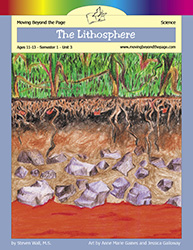
Unit 3: The Lithosphere
Lesson 1
Shifting, Drifting, and Spreading
Students are instructed to "read the definition of 'scientific theory' in the first paragraph and consider how the everyday use of the word is different than its use in science," prompting comparison of word meanings. The Things to Know section provides explicit definitions for domain-specific terms (e.g., lithosphere, asthenosphere, isostasy, continental drift, mid-ocean ridges). The reading questions require students to state meanings (e.g., "What is isostasy?", "What is continental drift?", "What is the lithosphere?"), and parent prompts ask students to explain differences in word usage.
Lesson 4
Seismic Waves
Students are given explicit domain vocabulary in the "Things to Know" section (definitions of seismic waves, body waves, P-waves, S-waves, and surface waves). Students must read Chapter 3 and watch a video and then answer text-based questions that require use of those terms (e.g., differences between P- and S-waves; focus vs. epicenter). In the activities students must describe how a seismograph works or explain earthquake hazards, requiring them to use and apply the technical vocabulary in their responses and designs.
Lesson 5
Earthquake and Volcano Research
Students are asked to read Chapter 4 and answer vocabulary questions such as "What is the difference between magma and lava?" The lesson's "Things to Know" section explicitly defines a volcano, magma, and lava and lists types of volcanoes, and the "Things to Review" prompts students to review those terms. The student activity pages and wrap-up require students to record and present information using domain-specific geological vocabulary.
Lesson 6
Geologic Time
Students read Chapter 5 and answer comprehension questions that require understanding domain terms (e.g., distinguishing relative age and absolute age). Students are given explicit definitions to review for vocabulary such as geologic time, relative age, fossils, and index fossils. Students create and explain a rock-layer model and must describe features (layers, fossils, folds, erosion) using those terms when they share with a parent.
Final Project
Our Lithosphere and Pedosphere
Students are prompted to define domain-specific terms directly (e.g., an activity page asks: "Define the lithosphere"). The unit test includes short-answer items that require students to explain differences and meanings (e.g., differences between lithosphere and asthenosphere; what the pedosphere is; body waves vs surface waves). The final-project rubric and answer key list required vocabulary explanations (layers of the Earth, lithosphere, tectonic plates, rock cycle terms, soil pH/texture), which students must write and demonstrate in their booklet.

Unit 3: The Hobbit
Lesson 1
Bilbo Baggins
Students are given a targeted vocabulary list (flummoxed, audacious, inquisitive, desolate, stratagems, ominous, recompense, eminent) and provided definitions on the Student Activity Page. Students practice word knowledge through the Vocabulary Cube tasks (e.g., "RECITE THE DEFINITION," "NAME A SYNONYM OR ANTONYM," "USE CORRECTLY IN A SENTENCE") and play a game that requires identifying definitions, parts of speech, synonyms/antonyms, and using words in sentences. The Parent Plan explicitly lists the skill "Determine the meaning of unfamiliar vocabulary words using context clues (LA)."
Lesson 4
Gollum
Students are given explicit definitions in the "Things to Know" section for "thesaurus," "runes," and "runic alphabets." Students use an Anglo-Saxon Runes chart to write a note in runes and decode messages, practicing mapping symbols to alphabetic letters. Students are directed to use a thesaurus to find synonyms and antonyms while creating and revising riddles, and to review vocabulary words and explain definitions from memory.
Lesson 6
Skin-Changer
Students are asked directly to define a term from the text with Question #1: 'What is a skin-changer?' which requires them to determine a word's meaning as used in the chapter. The lesson instructs students to 'Review the vocabulary words for the book' and includes an Editing Sentences activity in which students correct word spelling and usage. The parent plan also asks parents to check that students used figurative language techniques, reinforcing attention to word choice and meaning in descriptive writing.
Lesson 10
The Dragon
The lesson explicitly defines the domain-specific term "consumerism" in the "Things to Know" section and directs students to "Review vocabulary words" in the wrap-up. The editing activity has students copy and correct sentences, distinguishing confusing word pairs (e.g., "lightning" vs. "lightening," "heavyweight" vs. "heavy weight") and noting American vs. British spelling ("pretense"/"pretence"). Activity 2 asks students to analyze greed and power in historical and modern contexts, which could require use of relevant social-studies vocabulary.
Final Project
Responding to Literature
Students complete vocabulary-in-context exercises (Part III) that ask them to choose the correct word (flummoxed, desolate, recompense, etc.) to fill sentences taken from the novel. Students are instructed to review and study the vocabulary words for the unit test and to 'use the correct vocabulary word in the sentences from the book.'

Unit 4: Ancient Asia
Lesson 1
The Caste System of Ancient India
Students are presented with explicit domain-specific definitions in the "Things to Know" section (reincarnation, karma, dharma, caste/varnas, Brahmans, Kshatriyas, Vaisyas, Sudras, Untouchables). Students read texts and answer comprehension questions that require use of those terms (e.g., a question asking how someone could achieve a more favorable rebirth references karma and reincarnation). Students complete activities that require applying these terms—such as the "Comparing Hinduism and Buddhism" table and Option 2 graphic organizers where students place beliefs like the Eightfold Noble Path and nirvana in the correct religion and explain caste roles.
Lesson 2
Life and Culture in Ancient India
Students are given explicit domain vocabulary in the "Things to Know" section, which defines Sudras, Srenis, outcastes/dasas, Sanskrit, and the Vedas. Students are asked to read specified pages and answer direct content questions that require explaining terms (e.g., "Why is Sanskrit called an Indo-European language?" and "What are the Vedas?"). The Website Review and poem activities require students to describe and summarize art/literature content, which asks them to use and convey domain-specific words in their own sentences.
Lesson 3
Life in Ancient China
Students are given a direct definition of the term "dynasty" in the "Things to Know" section and are asked content questions that require explaining domain-specific concepts such as the "Mandate of Heaven." In Reading and Questions students answer explicit questions about the meaning of historical concepts (e.g., Mandate of Heaven) and explain features of Chinese writing (characters vs. alphabet). In Activity 5 students copy five sections of the Tao Te Ching, illustrate each section, and write in their own words what the passage says about wealth, which requires interpreting words and phrases in context.
Lesson 5
Life in Ancient Japan
Students read pages 1–17 of Life in Ancient Japan and answer direct questions that require defining domain terms (for example, Question #2 asks how the Jomon people got their name and Question #3 asks what the uji were). Activity 2 asks students to write who the uji, emperors, noble families, and shoguns were, when they held power, and what they did, which requires determining the meanings and roles of those historical terms. The parent/answer-key material explicitly supplies or expects students to use vocabulary like shogun, uji, Yamato, and specific resource terms when completing map and trade activities.
Lesson 6
Culture in Ancient Japan
Students read pages 18-31 of Life in Ancient Japan and answer direct vocabulary questions (e.g., QUESTION #2 asks 'What is kanji?' and QUESTION #3 asks 'What is a haiku?'). Activity 2 requires students to fill a table (or Venn diagram) describing Shinto, Buddhism, and Confucianism, prompting them to explain domain-specific terms and beliefs in their own words. Activity 3 has students list cultural components that traveled from China to Japan (including 'Chinese writing,' 'paper,' 'the tea ceremony'), reinforcing the meanings of historically specific vocabulary in context.
Final Project
Puppet Show or Presentation
The Parent Plan asks students to "study maps, vocabulary terms, 'Things to Know,' and activity pages," and the unit test requires students to answer questions that use domain-specific terms (e.g., Silk Road, uji, Sudra) and to match belief descriptions to belief systems. The multimedia slide and puppet-show options require students to include and explain information about social structure, rulers, cultural exchange, and religious beliefs, which requires use of history/social-studies vocabulary. The rubrics and scripts require students to write and present content-specific information, implying students will use and demonstrate understanding of domain vocabulary.

Unit 4: A Single Shard
Lesson 1
Korea
Students are asked to "determine the meaning of unfamiliar vocabulary words using context clues" in the Skills section and complete an activity titled "Vocabulary Words in Context" where they read definitions and insert vocabulary into a paragraph. The Student Activity Page directs students to use the provided vocabulary list (urchin, insolence, emissary, etc.) and place words into blanks that describe scenes and actions, practicing use in sentences. The Wrapping Up and Parent Plan sections ask students to review definitions daily and to use each word in a sentence, reinforcing word-meaning practice.
Lesson 5
The Royal Emissary
The Wrapping Up Parent Plan asks students to explain what Tree-ear means by the phrase "The work of a human, the work of nature; clay from the earth, a branch from the sky," which asks students to determine the meaning of a phrase as used in the text. The pottery sequencing activities require students to work with domain-specific terms (e.g., glaze, kiln, incise, potter's wheel) when they order steps and describe the process, so students must use contextual understanding of those vocabulary items to complete the task.
Lesson 7
Opportunity
Students are asked to define and discuss the word "opportunity" (Things to Know and the Parent Plan prompt asking what an "opportunity" means). Students practice vocabulary review and are instructed to use vocabulary words correctly in sentences (Things to Review and the Wrap Up note). Students correct and rewrite sentences that include vocabulary and word forms (Sentence Correcting activity that requires fixing words like "emissary's" and "irritable").
Lesson 8
Korean Pottery
The lesson explicitly defines a domain-specific term: the "Things to Know" section states, "Celadon is a pale, jade-green glaze applied to pottery." Activity 2 directs students to read web pages (Met, Asia Society, Wikipedia, Korean-Arts) that describe celadon and show examples of ancient Korean pottery. The Kimchi Pot activity asks students to match a color to celadon and to look carefully for examples of celadon on museum pages, requiring them to notice how the term is used in descriptions of artifacts.
Lesson 9
Words of Wisdom
Students read Crane-man's quotes on the Student Activity Page and are directed to "explain each of Crane-man's quotes" in their own words, requiring them to determine the meaning of phrases like "read the world itself" and "the same wind that blows one door shut often blows another open." The lesson explicitly defines the word "Wisdom" in the "Things to Know" section and asks students to make up or translate Korean proverbs and explain their meanings to a younger child. Students also read Chapters 9 and 10 and answer comprehension questions about characters' motives and actions, which involves interpreting words and phrases in context.
Final Project
Comparison and Contrast Writing
Students are asked in Part B of the end-of-unit test to use specific vocabulary words (insolence, connoisseur, skepticism) in sentences related to the novel, which requires knowing and applying word meanings. Students are told to review vocabulary words and are directed to a flashcard website to study and practice those words. Students answer a content question that requires knowing a domain-specific term (celadon) about pottery glaze, showing some attention to specialized vocabulary tied to the text's cultural content.

Unit 5: Asia Today
Lesson 6
East Asia and Japan
Students are assigned to read pages 174-187 of Geography of the World and answer comprehension questions, including QUESTION #1 which asks why Tibet is called "the roof of the world" and gives an explicit explanation interpreting that phrase. The comparison activities (Ancient and Modern China/Japan) require students to record information about government, economy, and culture using domain-specific terms (e.g., emperors, one-party state, Silk Road) and an answer key lists those domain terms. The rice production activity asks students to create a flow chart or poem using information from the text, which requires interpreting process-related vocabulary from the reading.
Lesson 7
Mainland Southeast Asia
The lesson explicitly defines domain-specific vocabulary in the "Things to Know" section, giving clear definitions for natural resources, capital resources, and human resources. Student activities require students to categorize economic activities as "Natural Resource-Based" versus "Other Economic Activities" (Option 1 and Option 2), which asks students to apply those vocabulary terms. The Parent Plan and Answer Key also use and list related terms (deforestation, industrialization, slash-and-burn) that students encounter in readings and activities.
Lesson 8
Maritime Southeast Asia
Students are given explicit definitions for some domain-specific terms: the "Things to Know" section defines "maritime" as "connected with the sea," and Question #2 defines "Wallace's Line" as an imaginary biogeographic boundary. Question #1 and its answer also describe what typhoons do (high winds and flooding), which provides meaning for that domain-specific term in context. Students read pages 196-201 and answer targeted questions that reference and use these terms.
Lesson 9
The Indian Ocean
The lesson explicitly defines the domain-specific term "atoll" in the Things to Know section: "An atoll is a circular-shaped coral reef growing around an underwater volcano." The reading assignment (pages 202-203) and Question #1 provide content and an answer that use domain vocabulary (e.g., "coral," "limestone skeletons," "marine polyps") and ask students to explain how coral islands are formed. The Environmental Threats activity asks students to describe impacts (pollution, monsoons, tourism) using geographic vocabulary from the text.
Final Project
A Tour of Asia
Students are asked to review "vocabulary terms" and "Things to Know" before the unit test, and the unit test includes direct vocabulary items (for example, a multiple-choice question asking "What is an atoll?" and questions about monsoons, taiga, and fossil fuels). Students must use domain-specific terms in written responses on the test (explaining how natural environments influence culture) and are prompted to "use words and phrases that will make travelers excited" when writing their tour book. The project requires students to record government, economy, natural environment, population facts and current events, which involves working with social-studies vocabulary.

Unit 5: Earth Cycles and Systems
Lesson 1
Matter and Energy
Students are asked to define key terms: the Skills section explicitly asks them to define matter and energy and to differentiate types of energy, and the "Things to Know" section provides definitions (energy, radiant energy, electromagnetic energy, matter, cycle). Students perform the cookie mass activity and answer questions that require them to apply the definition of "matter" (e.g., determining whether the cookie remains matter as it is broken apart and whether matter is created or destroyed). Students watch a video about the Sun and answer comprehension questions that ask for the source and forms of the Sun's energy, requiring use of domain-specific vocabulary.
Lesson 5
Carbohydrates, Plants, and Energy
The lesson provides explicit definitions of domain-specific vocabulary in the "Things to Know" section (e.g., carbohydrates, complex carbohydrate, chemical bond, starch, cellulose). Students are prompted to analyze the word parts of photosynthesis (photo + synthesis) in the Wrapping Up section, which directs them to consider the meaning of that term. The Student Activity Page and reading assignments require students to use terms such as carbohydrates, starch, and producers when making predictions and recording explanations for the potassium iodide test.
Lesson 6
Intro to Earth's Cycles
The lesson explicitly defines two terms in the "Things to Know" section: "An ecosystem is a community of organisms..." and "Something that is periodic repeats at regular intervals." The Reading and Questions include domain-specific vocabulary (e.g., photosynthesis, nitrifying/denitrifying bacteria, evaporation, condensation) that students must read about and answer questions on. The student activity pages show element cards with labels like "Carbon," "Atomic Number," and "Atomic Mass," exposing students to technical vocabulary tied to the cycles.
Lesson 7
Oxygen Production and Life
Students are presented with domain-specific vocabulary and short definitions in the "Things to Know" section (e.g., reservoir, depletion, cellular respiration, glucose). Activity pages label and require students to work with vocabulary terms (e.g., PHOTOSYNTHESIS, CELLULAR RESPIRATION, H2O Water, CO2 Carbon Dioxide, Carbohydrate (glucose), Diatomic Oxygen Molecule) and provide spaces to fill in equations and responses that use those terms. Questions and scenario responses ask students to explain relationships using the terms (e.g., explain how photosynthesis produces oxygen and how respiration uses oxygen).
Lesson 8
The Carbon Cycle
Students are presented with explicit vocabulary definitions in the "Things to Know" and parent plan sections (e.g., decomposition, detritus, detritivore, carbon store, decomposers). Students read assigned pages in Exploring Ecology and answer comprehension questions that require use of those terms (e.g., explaining why decomposers are important for carbon cycling). Activity pages (Observing Decomposition, Decomposer Observations) require students to identify and record decomposers and to describe decomposition processes using domain vocabulary.
Lesson 10
Energy, Food Chains, and Food Webs
Students are presented with explicit domain vocabulary and definitions in the "Things to Know" section (e.g., direct/indirect relationship, ecological community, food web, food chain, abiotic). Students are asked to use and organize terms such as producers, primary/secondary/tertiary consumers, photosynthesis, and respiration when they build food chains and a local food web. Activity prompts require students to label processes between organisms, write out photosynthesis and respiration equations, and include cycling of carbon, water, and nitrogen in their graphics.
Lesson 11
The Nitrogen Cycle
Students read targeted text sections and a linked interactive on the nitrogen cycle and are given explicit vocabulary in the "Things to Know" (definitions for soil fertility, fertilizer, equilibrium, leaching, eutrophication). Student activity pages include a Word Box, labeled stages (nitrification, ammonification, nitrogen fixation, denitrification), chemical formulas, and fill-in-the-blank prompts that require students to supply and match domain-specific terms. The Answer Key and activity instructions direct students to identify, label, and color-code atoms and to explain nutrient roles, reinforcing word meanings in context.
Final Project
A Sustainable Farm
Students complete a matching activity (terms 1–11) where they match domain-specific vocabulary (e.g., autotrophs, heterotrophs, decomposers, photosynthesis, leaching) to definitions. Students answer multiple-choice questions that require knowing specific science terms (e.g., evapotranspiration, condensation, sublimation, abiotic factor) and order events that use vocabulary within explanatory sentences about the water, carbon, and nitrogen cycles. Students must label diagrams and write explanations for the water, carbon, and nitrogen cycles on their farm display, using and applying cycle-related vocabulary in context.

Unit 5: Independent Study
Lesson 1
Independent Study Introduction
Students read a domain-specific article about the Dakota Access Pipeline and complete a Point of View chart that asks them to identify how different stakeholders view the pipeline. The lesson text explicitly defines the term "stakeholder" as "a person who has an interest, involvement, or investment in the success or failure of something," which students encounter and can use when analyzing perspectives. Students are asked to find sources, record information, and summarize viewpoints for use in an argumentative essay and presentation.
Lesson 2
Bias and Propaganda
Students read two historical news articles ('Sir Sam Steps Down!' and 'Hughes Fired from Cabinet') and are asked to examine word choice and tone when comparing portrayals of the same event. Students are given direct definitions of key terms like "bias" and "propaganda" and are asked to identify named propaganda techniques (e.g., bandwagon, card-stacking, glittering generalities) in texts and advertisements. Students record examples of specific words and phrases (for example, "Sir Sam," "incompetent," "noble sons," "shady deals") as evidence of bias or propaganda.
2: Semester 2

Unit 1: Greece and Rome
Lesson 1
Early Greece
Students read pages 22–23 and answer comprehension questions that use domain-specific terms (e.g., Minoan, Mycenaean, citadel, Trojan War). The lesson explicitly defines some historical vocabulary: it explains BC/AD versus BCE/CE and gives a definition of "fresco" in the "Things to Know" section. Students also label places on a map and create products (a Mycenaean merchant sign, a maze based on the Minotaur), which require recognizing and using content-specific terms.
Lesson 2
Ancient Greece
Students encounter and are asked to use domain-specific vocabulary that is explicitly defined in the materials (e.g., "Hoplites were Greek foot soldiers," "they fought in a rectangular formation called a phalanx," and "Democracy means 'people's power'"). The lesson text names and explains specialized terms related to naval warfare (trireme, and the four tactics: periplous, rake, ram, diekplous) and identifies "ostraka" as pottery shards used to cast votes. Students practice applying these terms in tasks such as labeling maps, creating models of triremes and demonstrating naval tactics, and comparing systems of government in written diary or chart activities.
Lesson 3
Everyday Life in Ancient Greece
The Things to Know section explicitly defines the literary term: "A monologue is a lengthy speech by a single character in a play," giving students a direct vocabulary definition. In Activity 1 (Voices of Greek Gods) students are instructed to write a monologue that "include[s] the god or goddess's name and the concepts and symbols associated with him or her," which requires using domain-specific vocabulary about deities and symbols in context. The readings and questions require students to read pages and web links that contain history/social-studies terms (e.g., Oracle, festivals, roles of women, education), so students encounter domain-specific words in informational text.
Lesson 4
The Hellenistic World
Students are assigned to read pages 46-47 that introduce terms like Macedonia and the Hellenistic Age. The "Things to Know" section defines the Hellenistic Age and the reading/questions include Q4 asking students to explain why the period is called the Hellenistic Age, including the etymology from Hellas. Students are also asked comprehension questions that require understanding of those domain-specific terms in context.
Lesson 5
Ancient Rome and the Roman Republic
Students encounter and read explicit domain vocabulary and short definitions in the Things to Know and Parent Plan sections (terms such as patricians, plebeians, Senate, consuls, Twelve Tables, republic, dictator). The reading-and-questions section asks students comprehension questions that use those terms (e.g., asking what a republic is and what the Senate's role was). Activity pages and timeline cards require students to use those terms when describing events (e.g., adding "Punic Wars," "The Twelve Tables," and "Caesar Crossed the Rubicon" to a timeline).
Lesson 6
The Roman Empire
Students read assigned pages and web sections and answer explicit questions that ask for meanings of domain-specific terms (Question #1 asks what name Octavian came to be known as and what the name means; Question #2 asks what S.P.Q.R. stands for; Question #4 asks what "Romanization" was; Question #5 asks what the Pax Romana was). The reading directions also tell students to "pay attention to how Augustus expanded and ruled" and to understand what the Pax Romana was, directing them to locate meaning in the texts they read.
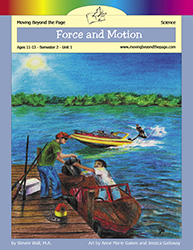
Unit 1: Force and Motion
Lesson 1
Force
Students are given an explicit vocabulary list in the "Things to Know" section that defines force, contact/noncontact forces, gravity, friction, tension, normal force, air resistance, electromagnetism, and the nuclear forces. In the "Name That Force" and "Fundamental Forces" activity pages students cut out cards, match descriptions to terms, and paste labels onto diagrams, requiring them to connect word meanings to images and short descriptions. The reading questions and Target Practice tasks ask students to identify which force is acting in a situation and to explain why (e.g., Q2 asks which noncontact force they are experiencing and why), and students label forces on diagrams and create diagrams showing directions and relative magnitudes of forces.
Lesson 3
Graphing Motion
Students are given explicit definitions in the "Things to Know" and review lists for terms such as constant, deceleration, displacement, velocity, and acceleration. Students apply those terms when plotting and interpreting displacement-time and velocity-time graphs, calculating velocities and accelerations, and answering questions about motion. Students are prompted to create stories and match graph points to real-world events using the domain vocabulary, and answer keys model the meanings (e.g., straight line = constant velocity, negative acceleration = deceleration).
Lesson 4
Speed, Velocity, and Acceleration
Students are given explicit definitions (e.g., "velocity is the rate of change of the position..." and "acceleration is the rate of change of the velocity...") in the "Things to Know" and Q&A sections. Questions ask students to explain differences between vector vs. scalar, speed vs. velocity, and velocity vs. acceleration, and students must read pages 16–19 and take a quiz. Activities require students to use domain-specific terms (average velocity, average acceleration, elapsed vs. lap time, displacement) to perform calculations and create graphs.
Lesson 5
Centripetal Force and Terminal Velocity
Students read text that includes explicit definitions ("Things to Know") for centripetal force, centrifugal force, frame of reference, and terminal velocity. Students answer guided questions that require use of those terms (e.g., comparing feather and hammer, explaining whether gravity is constant, and distinguishing centripetal vs. centrifugal force). In activities students must apply and explain vocabulary in context: the accelerometer activity asks students to "Explain" observations using Newton's laws and the bucket swing activity asks students to describe forces from two frames of reference using the words centripetal and centrifugal.
Final Project
Demonstrating Newton's Laws
Students match domain-specific terms to definitions on the unit test (Matching section) and identify scientific terms from clue statements in the "WHAT AM I?" section. Students read and use the Mini-Golf Labels (each label defines a concept such as inertia, friction, F=ma) and are instructed to place and explain those labels in the mini-golf holes. Students create comic strips and answer short-answer prompts (e.g., differences between speed and velocity, mass and weight) that require them to use and explain the meaning of vocabulary in context.

Unit 1: Greek Myths
Lesson 1
Ancient Greece
The Parent Plan explicitly states students will "Use knowledge of Greek, Latin, and Anglo-Saxon roots and affixes to understand content-area vocabulary" and "Determine the meaning of grade-level academic English words derived from Latin, Greek, or other linguistic roots and affixes." Activity 2 (Beyond Roots II) directs students to sort Set 1 root cards, play matching and recall games (Memory, Root Recall, Go Root!), and take an online quiz to learn and check the meanings of roots (for example, geo = earth, -logy = science of). Students also read pages 9–15 of D'Aulaires' Book of Greek Myths (a content-area text) and complete a Greek-alphabet decoding activity that reinforces Greek language forms.
Lesson 2
The Gods and Goddesses
Students locate vocabulary words in the text (Activity 3) and read each word in context before matching the word to a definition and a motion. Students create folded vocabulary strips with the word on one flap and the definition beneath, and then practice the motions and say the words aloud. The Parent Plan and Activity 5 explicitly direct students to use Greek and Latin roots (Beyond Roots II cards and root quizzes) to understand content-area vocabulary.
Lesson 3
The Stories
Students are asked to "spend a few minutes reviewing the vocabulary words" learned in a prior lesson, and the Go Greek activity requires students to read aloud and memorize cards that contain domain-specific terms and descriptions (e.g., trident, lyre, god of the sea). Students also read and correct words in the Sentence Editing activity (for example, correcting "mischievious" to "mischievous" and "kwiver" to "quiver"), exposing them to vocabulary in context. The student activity pages present symbols and short descriptive phrases that place terms in a historical/mythological context.
Lesson 4
Minor Gods, Nymphs, Satyrs, and Centaurs
Students are assigned the Beyond Roots II Set 2 cards, play vocabulary games (Memory, Root Recall, Go Root!), and take an online Set 2 A quiz; the Things to Review section explicitly tells students to review Set 2 roots and their meanings. Students read pages 70–107 containing domain-specific terms (e.g., Prometheus, Pandora, nymphs, satyrs, centaurs, constellation) as part of the myths and answer comprehension questions about those stories. The sentence-editing activity has students copy and correct sentences that include vocabulary such as "nymphs," "constellation," and proper nouns like "Artemis" and "Orion."
Lesson 5
Mortal Descendants of Zeus
Students read the Perseus text (pages 114–122) and answer comprehension questions that use terms from the story (e.g., oracle, Medusa, Pegasus, sea monster). Students complete a 'Conventions of a Myth' activity page that prompts them to identify and label terms such as hero, gods/goddesses, monster, problem, maiden, and helpers. Students also engage with the Beyond Roots II card games and quizzes, which practice word roots and vocabulary knowledge.
Lesson 6
Vainglorious Kings
Students are asked to 'look through the Beyond Roots II Set 3 cards' and play Root Recall/Go Root games and then take the Set 3 A and B quizzes, which practices roots and word meanings. The lesson repeatedly instructs students to 'review the vocabulary words' and 'review the Beyond Roots Set 3 roots and their meanings.' The sentence-editing activity requires students to recognize and correct word usage (e.g., devoured) and punctuation, which engages attention to word form and meaning.
Lesson 7
The Trojan War
Students engage in explicit vocabulary work through the Beyond Roots II activity where they "review the roots and their meanings," combine card sets, play Go Root!, and take the Beyond Roots II, All Sets, A and B quizzes that ask them to identify root meanings in words. The lesson repeatedly instructs students to "review vocabulary words, character cards, and the roots and meanings from the Beyond Roots II game," and to "review vocabulary, god and goddess cards" in preparation for the unit test.
Final Project
A New Twist on an Ancient Myth
Students are asked to study and review specific vocabulary words and root meanings (e.g., indomitable, cavorted, medi, trans) and to use three of the five vocabulary words correctly in sentences on the unit test. Students complete a Part III Roots matching activity that requires them to match root words to English meanings. Students match gods and goddesses with their descriptions (Aphrodite, Zeus, Hades, etc.), which asks them to identify domain-specific terms and meanings related to mythology.

Unit 2: The Middle Ages
Lesson 1
Introduction to Medieval Europe
Students read pages 1–14 and answer guided questions about the time periods and causes of feudalism, which requires them to use the text to understand terms like "Middle Ages." The "Things to Know" section gives explicit definitions of "Middle Ages," "medieval," and "feudalism," providing direct vocabulary related to history/social studies. In the feudalism activity students use a word box (lords, serfs, peasants, counts, soldiers) to fill a pyramid organizer, and in the map activity students label historical groups and place them on a map, requiring use of domain-specific names.
Lesson 2
Monarchs
The lesson provides explicit definitions of domain-specific terms (e.g., "A monarchy is a form of government…" and "Common law requires that accused persons be tried by jury") and states the function of the Magna Carta ("outlined the rights and liberties of English subjects and described the limits on the powers of the king"). In Option 2, students create word clouds from the Magna Carta and other political documents and answer questions about which words stand out and which groups or ideas the text focuses on, which engages students with vocabulary from primary historical texts.
Lesson 3
Knights and Warfare in the Middle Ages
Students read assigned chapters that contain domain-specific terms (e.g., stirrups, chivalry, squire, siege tower, trebuchet, battering ram) and answer comprehension questions such as explaining why stirrups were important. Students plan a siege using descriptions of weapons (pages 28-30 and 42-45) and physically cut out and place labeled siege weapon and soldier pieces, requiring them to use those terms. The Castle Defense Game asks students to roll or play cards labeled with attack and defense terms and to decide which defenses defeat which attacks.
Lesson 4
Castles and Feasts
Students read pages 49-64 which include domain-specific vocabulary about castles (for example, the Things to Know section defines the keep and explains tapestries). Activity instructions ask students to place specific castle features (keep, Great Hall, bedchambers, garderobes) on a floor plan and to design a tapestry showing social classes or warfare, requiring use of medieval terms. The Life Application and Questions sections use terms like trencher, potage, and mock mead, exposing students to additional domain-specific words.
Lesson 5
Village and City Life
Students read pages 65-90 that include domain-specific terms (e.g., parish, tithe, guild, journeyman, apprentice, garderobe, sumptuary laws) and answer comprehension questions about those concepts (Questions 1–4). In Activity 4 students must write 'Help Wanted' ads that require use of trade vocabulary and explanations of terms like journeyman and apprentice. The Personal Hygiene activity and its answer key provide definitions/descriptions of medieval terms and practices (e.g., garderobe, chamberpot) that students compare to modern vocabulary and practices.
Lesson 6
Religion in Medieval Life
Students are asked directly to define domain-specific terms in Question #2, which asks "What were holy relics and why were medieval Christians interested in them?" The "Dissent and the Church" activity page prompts students to answer "Who were they?" and explain why groups like heretics, Jews, Cathars, pagans, and people accused of witchcraft were considered dangerous, requiring students to identify and explain those historical terms. The Medieval Pilgrimage activity asks students to describe benefits for specific groups (e.g., pilgrims, ampullers), which requires understanding those domain-specific words as they are used in the text.
Lesson 7
Monasteries
Students are assigned readings (pages 105-114) that describe monks' lives and roles, which include domain-specific terms such as "Divine Office," "scriptorium," and "Gothic" architecture. Guided questions ask students to "Describe the Divine Office" and to "Describe the Gothic style of architecture," requiring students to explain the meaning of those phrases as used in the text. The diary activity asks students to imagine and describe observing monks working in the scriptorium, prompting use of text-based vocabulary in writing.
Lesson 8
The End of the Medieval Era
Question #1 explicitly asks students, "What does the word 'Renaissance' mean, and why was that name given to the time period following the Middle Ages?" and the provided answer defines "Renaissance" as "rebirth." The "Things to Know" section also names the period after the Middle Ages as the Renaissance, giving an explicit usage of the term. The wrapping up lists several domain-specific terms (serfs, vassals, lords, barons, monarch, monks, apprentices, bishops, priests, Pope), exposing students to history/social studies vocabulary.
Final Project
A Medieval Fair or Map
Students are prompted to review vocabulary in the "Things to Know" sections and to study terms for the Unit Test. The Unit Test asks students to define feudalism (short answer) and to match tradesmen with their tasks, which requires knowing domain-specific vocabulary. Students must use and explain terms such as feudalism, guilds, monastery, Crusades, and Magna Carta in their final presentations (scripts or map walk-throughs).

Unit 2: Light and the Eye
Lesson 2
Translucence and Shadow
Students read informational sections and answer vocabulary-focused questions (e.g., explaining how transparent and translucent materials differ and distinguishing umbra and penumbra). The lesson provides a labeled "Things to Know" list that defines terms such as opaque, transparent, translucent, umbra, and penumbra, and students use those definitions in Activity 1 and the reading questions. Students also read a sundial article and identify the domain-specific term "gnomon."
Lesson 3
Refraction and Lenses
Students read specified pages in Light and the Eye and answer direct comprehension questions asking for meanings of terms (e.g., "What is refraction?" and differences between reflection and refraction). The Things to Know and Things to Review sections provide explicit definitions for refraction, lens, concave, and convex that students are expected to learn. In activities (magic tricks, lens demonstrations, and the camera obscura) students must explain observations using those vocabulary terms and complete the "Shhh! Here's How It's Done" explanation sheet using diagrams or written explanations.
Lesson 5
Animal Eyes
Students read an article about animal eyesight and answer comprehension questions, which engages them with domain vocabulary in context (e.g., Questions #1 and #2). The "Things to Know" section provides explicit definitions of key terms such as "predators," "prey," and "binocular vision," and students are asked to review and discuss the definition of binocular vision. In activities, students record observations and discuss how binocular vision helps predators and prey, linking terms to observable function.
Lesson 6
Color and Perception
Students are asked to re-read assigned pages and answer direct questions that require defining terms from the text (for example, "What is the visible spectrum?" and questions about why rocks appear different colors and how additive colors work). The lesson's "Things to Know" and parent-plan sections list and explain domain-specific vocabulary (visible spectrum, wavelength, absorb/reflect, scattering, additive colors), and students write observations and explanations using those terms in activity write-ups. Several activity pages prompt students to describe observations and explain phenomena in their own words, requiring use of the scientific vocabulary from the readings.
Final Project
Tools of the Eye
Students are asked to define and explain specific terms in the unit test (e.g., "What does it mean if an object is opaque?" and "What is refraction?"). Students must explain science principles that make their tool work on the project pages and in the rubric, requiring use of domain vocabulary (e.g., retina, refraction) when describing how the tool changes vision. The directions ask students to reread the "Things to Know" and "Reading and Questions" sections to remember and answer content, which prompts recall and use of key words from the text.

Unit 2: Tales from the Middle Ages
Lesson 1
Medieval Times
The lesson provides an explicit definition for 'manor' in the "Things to Know" section, giving students a direct vocabulary explanation. The Feudalism section explains and names domain-specific roles and terms (peasants, serfs, slaves, lords, vassals, knights) and describes their relationships, so students encounter historical vocabulary in context. The Answer Key and activity pages list and reinforce domain words (plow, mill, tunics, serfs, etc.) that students read and use when completing map observations and written perspectives.
Lesson 2
Beetle
Students are instructed to "determine the meaning of unfamiliar vocabulary words using context clues" and to "read the vocabulary words in context" (Parent Plan and Activity 2). Students read contextual sentences for words and complete a crossword using those words, with an answer key provided. The curriculum connects vocabulary to the book's medieval setting (words like threshing, casks, penning) and asks students to review definitions and consult a dictionary if needed.
Lesson 4
Special Delivery
Students are asked to review the vocabulary words for the novel and to read the definition and say the word. The parent guide instructs an adult to read the words and ask the child to provide the correct definitions. The lesson also includes a brief definitional note ("Things to Know - A ballad is a narrative set to music"), which names and defines a term used in the unit.
Lesson 7
An Angel or a Saint
Students encounter domain-specific vocabulary and concepts in the Farm Animals section (words and ideas such as livestock, serf, manor, manure, sheering, calf) and are asked to read monologues in Good Masters! Sweet Ladies!! that highlight the role of domesticated animals. The lesson explicitly defines the historical custom 'Heriot' and explains that domesticated animals were crucial to the medieval economy in the Things to Know and Farm Animals paragraphs. Students are prompted to write explanations of how animals influenced medieval economics and to discuss the relationship between peasants and animals, which requires working with related vocabulary.
Lesson 11
Village Life
Students are asked in the "More Homophones" activity to choose three homophone pairs, write definitions for each word, identify the part of speech, and use each word in a sentence, which requires determining word meanings and usages. The "Spotting Errors" paragraph describes a medieval festival with terms such as jousting knights, minstrels, glass-blowers, and blacksmiths, so students read domain-related vocabulary while correcting grammatical errors. Students also read pages 42-65 of Good Masters! Sweet Ladies! and complete a "Cast of Characters" chart, exposing them to context-rich historical monologues.
Final Project
Life in the Middle Ages Think-Tac-Toe
Students are asked to review a specified vocabulary list and "review the vocabulary words" before the unit test, which directs them to focus on word meanings. Students complete Part I: Vocabulary on the unit test by filling blanks in sentences using words such as pockmarked, gluttony, casks, threshing, and teeming, requiring them to determine appropriate words from sentence context. Students create and use a "Story Cube" with six Middle Ages-related vocabulary words to generate a creative story, applying domain-specific terms in a contextual activity.

Unit 3: The Age of Discovery
Lesson 4
The Consequences of Contact
Students read pages 36–51 and answer questions that require them to use domain terms (for example, Question #2 asks about cows, pigs, and epidemics and requires students to explain immunity and disease transmission). In Option 1 (Contact and Loss) students are given the term "mortality rate (the percentage of people who died)" and perform calculations multiplying population estimates by mortality rates. In Activity 1 students categorize and label exchanges (Diseases, Foods, Animals, Wealth) and place specific historical terms such as "smallpox," "tobacco," and "gold" on arrows between regions.
Lesson 5
Copernicus and Changes in Science
Students read passages from Newton at the Center that introduce domain-specific terms like scientific method and heliocentric; the Things to Know section explicitly defines the scientific method (observation, prediction, experimentation, and measurement) and heliocentric (sun-centered) system. Students answer comprehension questions that require use of those terms (e.g., naming Copernicus' discoveries and describing Bacon's idea of science). Activity 4 asks students to draw diagrams of the medieval and Copernican models, which requires students to apply meanings of terms such as orbit and sun-centered in a representation.
Lesson 6
Galileo
Students are directed to "read the definitions in bold print throughout the text," which requires them to attend to and use glossary/inline definitions. The reading questions ask students to define domain-specific vocabulary directly (e.g., "What is inertia?" and identifying that projectiles travel in a "parabola"). In Option 2 students read primary-source trial documents and answer questions about scriptural references and the Church's language, which requires interpreting words and phrases in historical texts.
Lesson 7
Isaac Newton
Students read explanatory text that defines key terms (e.g., the Things to Know entry defining the Enlightenment and Newton's discoveries) and answer comprehension questions drawn from Newton at the Center (for example, identifying Descartes' idea that influenced Newton). Student activity pages ask them to state meanings and functions of domain terms (e.g., "What does a telescope do?", "What does a microscope do?") and the Barometer page requires students to locate and interpret "barometric pressure" in a weather forecast.
Final Project
Discovery Research Project
Students are directed to review the "Things to Know" sections for important facts and vocabulary and to study vocabulary for the unit test. The unit test (Option 1) includes a multiple-choice/descriptive item that asks students to define a key term related to scientific advancement, and matching items require correct identification of explorers and related terms. Essay tips tell students to underline important words in prompts and pay attention to verbs when interpreting essay questions.

Unit 3: The Solar System
Lesson 1
The Latest View of Our Solar System
Students are asked to interpret the meaning of a phrase from the Foreword when they answer Q2 about what Dr. Gingerich means by saying Copernicus "invented the solar system," which requires determining meaning as used in the text. Students are given explicit definitions of domain vocabulary in the "Things to Know" section (light year, orbit, planet). Students apply vocabulary in context by describing planets using prompts (size, what they're made of, density, surrounded by objects) and by sorting and labeling planets in the Planetary Categories activities.
Lesson 3
Earth, the Third Planet
Students are given explicit domain vocabulary in the "Things to Know" section (definitions of axis, use of Earth days/years, and super-Earths). Student activity pages list domain-specific terms (Diameter, Density, Orbital/Rotational period, Moons, Rings, etc.) that students must locate or fill in. Questions ask students to answer items that require understanding terms such as orbital period and axial tilt (e.g., "What is Earth's orbital period?" and "What is Earth's degree of tilt on its axis?").
Lesson 4
Satellites and Telescopes
The lesson provides explicit definitions in the "Things to Know" section for terms such as satellite, geostationary orbit, topographic map, spectral analysis, and reflectance curves. Students are directed to read NASA and university texts and answer questions that require using terms like geostationary and polar orbit. The Topographic Map activity asks students to apply spectral analysis and match colors to reflectance curves, requiring use of domain-specific vocabulary in a task.
Lesson 5
Meteorites and the Moon
Students read pages 23-24 in a nonfiction book and answer a comprehension question that asks how meteors and meteorites differ, requiring attention to vocabulary in context. Students are given explicit definitions in the "Things to Know" section (meteoroid, meteor, meteorite; natural satellite; tidal bulge) and are asked to review those definitions at the end. Students also respond to directed questions about causes (e.g., what causes the tidal bulge) that require understanding domain-specific terms.
Lesson 7
Gas Giants
Students are given an explicit definition: "A gas giant is a large planet made mostly of frozen hydrogen and helium," which they read and can record. Students read text that uses domain-specific terms (e.g., ammonia hydrosulfide, rings, orbital period, rotational period, density) and answer comprehension questions that require understanding those terms. Students complete activity pages (Planetary Passport and board game cards) that ask them to supply and compare values for terms such as diameter, distance from the Sun, hours in a day, rings, and composition. Students create posters or stories that require them to describe atmospheric composition and geographic features using vocabulary from the reading.
Lesson 9
Men on the Moon and Beyond
Students are given explicit short definitions in the "Things to Know" section (e.g., the Apollo program, NASA, and the International Space Station) and answer comprehension questions that require recognizing those terms (e.g., identifying what happened July 20, 1969, and naming the space shuttle). Students also encounter domain-specific vocabulary on activity pages and worksheets (for example, cochlear implant parts: microphone, speech processor, transmitter/receiver/stimulator, electrode array) and are asked to record technologies and skills gained from the space program.

Unit 3: The Prince and the Bard
Lesson 1
Introduction to The Little Prince
Students read the author's biography and answer Question #1 asking why the writer used the word "prestigious" repeatedly, and the lesson explicitly defines "prestigious" as "having a strong reputation for greatness." Students also encounter and are asked to define and use vocabulary for persuasion techniques (glittering generalities, flattery, dares, promises) through matching, examples, and writing activities.
Lesson 2
Meeting the Little Prince
Students are given explicit word meanings in the Things to Know section where apparition and edification are defined. Students are instructed to review the definitions of apparition and edification in the Things to Review/Parent Plan sections, reinforcing those vocabulary meanings. Students read Chapters I–VI and therefore encounter these words in context within the text.
Lesson 3
The Flower and Other Planets
The lesson explicitly defines 'acclamations' and explains what an ellipsis is in the "Things to Know" section. Students are asked to find instances of ellipses in Chapters I–XII, note chapter and page numbers, write the sentence, and explain the use or effect of the ellipses (Option 2). In Activity 1 students cut apart sentence blocks and reconstruct paragraphs by replacing omitted text with ellipses, practicing how ellipses change or condense meaning in context.
Lesson 4
Earth and Other Planets
The lesson explicitly defines the word "ephemeral" in the "Things to Know" section and again prompts students to "Review the definition of ephemeral." Students also encounter domain-related words in the reading and editing task (e.g., "geographer," "geographies," "businessman," "lamplighter"), and the sentence-editing activity has them work directly with those words in context. The writing and discussion prompts require students to describe planets and inhabitants, which uses vocabulary drawn from the assigned chapters.
Lesson 5
Making Friends on Earth
Students are asked directly to explain what it means to be "tamed" (Question #1), requiring them to determine the meaning of that word/phrase as used by the little prince and the fox. Students are asked to interpret the fox's line "Anything essential is invisible to the eyes" (Question #3), which asks them to determine the meaning of a figurative phrase in context. The materials explicitly define the word "monotonous" in "Things to Know" and prompt students to review that definition, showing direct vocabulary attention.
Lesson 6
Saying Goodbye
The lesson explicitly defines the literary term foreshadowing in the "Things to Know" section and asks students to "Review what foreshadowing means." The parent plan and wrap-up discussion questions prompt students to identify whether the author foreshadowed the ending and how (referencing the snake earlier in the book). The sentence-editing activity exposes students to vocabulary words (e.g., extraordinary, monotonous) that they must correct in context.
Lesson 7
Introduction to Shakespeare
Students are asked to restate confusing lines in today's English and focus on overall meaning (question about strategy for understanding Shakespeare). Students identify meanings of Early Modern English words like "thou" and "thy." Students complete activities that require using brackets to define or briefly clarify underlined archaic words in original Shakespearean excerpts, and are instructed to look up unknown words in a dictionary and annotate quotations with clarifications (Part I and Part II activities).
Lesson 9
Puck's Pranks
Students read Act 2, Scene 2 to Act 3, Scene 2 in a modern translation and are invited to look at the original wording, which exposes them to Shakespearean expressions. Students are asked to explore expressions that are still used today and to review what an expression is. In Activity 1, students must read a PDF of famous Shakespearean phrases and write a poem or short story using at least four of those phrases. Students also share their writing aloud and have a parent try to identify the Shakespearean phrases used.
Lesson 12
Tragic Love
The lesson explicitly defines two vocabulary items in the "Things to Know" section (pestilence and presage) and provides a vocabulary list with definitions (prestigious, apparition, edification, acclamations, ephemeral, monotonous, pestilence, presage). Activity 2 asks students to choose 2–3 vocabulary words from the unit and create a persuasive message using them. Parent/teacher notes prompt review of the definitions and instruct students to include quotations in Activity 1, which highlights attention to word choice.
Final Project
Love Letters
Students are asked in Part B to use the vocabulary words presage, acclamation, and ephemeral in sentences related to The Little Prince, A Midsummer Night's Dream, and Romeo and Juliet. The answer key directs students to consult the master vocabulary list for definitions and to ensure correct usage. The unit also asks students to include "important quotes" and to record evidence and quotes about characters, which requires attending to word choice within the texts.

Unit 4: Elizabethan Europe
Lesson 1
Europe at the Time of Elizabeth's Birth
Students encounter domain-specific terms presented with definitions in the "Things to Know" section (e.g., "Protestant Reformation," "Renaissance") and in the reading focus (pages titled "The Reformation and a Europe Split in Two"). The Q&A includes explicit explanations of key terms and concepts (for example, QUESTION #2 explains what indulgences were and QUESTION #3 contrasts Catholic and Luther's views on salvation). Student activities repeatedly use and require understanding of terms such as indulgences, sacraments, purgatory, Protestant, and Catholic in tasks like comparing views, role-playing consequences of religious differences, and writing a biographical poem about Martin Luther.
Lesson 2
The Renaissance and Elizabeth's Childhood
Students read Chapter 2 and the "Things to Know" section that explicitly explains domain-specific terms such as "Renaissance," "secular," and "humanism," and describes developments like the printing press and the Silk Road. Students encounter and use these terms in comprehension questions (e.g., about Renaissance study topics) and in content activities (timeline, map, and gallery) that repeatedly reference vocabulary like Marco Polo, Italian Renaissance, printing press, and Scientific Revolution.
Lesson 3
Becoming Queen
The lesson provides explicit domain-specific meanings for symbols and items (e.g., lists showing pansies = thoughts, rosemary = remembrance, pearls = purity, purple = royalty) and asks students to plan a coronation gift using those meanings. The student activity pages define blackwork embroidery and give concrete guidance about its stitches and patterns, and the "Things to Know" note identifies Nine Men's Morris and blackwork embroidery. Students are prompted to reread passages about the coronation and to write about the meaning of their symbolic gift, applying the provided vocabulary of symbols.
Lesson 4
Religious Turmoil
Students read Chapter 5 of Elizabeth I and answer comprehension questions that require explaining domain-specific terms and concepts such as the Act of Uniformity, the papal bull that excommunicated Elizabeth I, and the Puritan idea of "the elect." Students also read an Elizabethan text on page 65 and are invited to "experience the language of the time," exposing them to historical vocabulary and phrasing. The timeline and map activities reinforce historical terms (e.g., Protestant, Catholic, Act of Uniformity) in context as students place events and color-code religious affiliations.
Lesson 5
International Affairs
The lesson includes direct questions that ask students to explain domain-specific terms: Question #3 asks "What were privateers and what did they do for Elizabeth I?" and Question #4 asks "What was the Triangular Trade?", requiring students to state meanings from the reading. The "Things to Know" section gives a definition of the Counter-Reformation that students can use to determine meaning in context. The student activity and answer key label trade categories (e.g., "Manufactured Goods," "New World Goods"), which asks students to match and use historical vocabulary in the mapping activity.
Final Project
An Elizabethan Lapbook
Students are asked to define the Renaissance on a mini-book page, which requires them to state the meaning of a domain-specific term. Students create Historical Events mini-books in which they write 1–2 sentence summaries of events such as the Protestant Reformation and the Scientific Revolution, and they create a Triangular Trade mini-book explaining trade flows and why the trade was important. Students also label maps and create a Family Album and timeline that require using and applying historical names and terms.

Unit 4: Technological Design
Lesson 1
What Is Technology?
Students read explicit definitions in the "Things to Know" section for domain-specific terms (artifact, hardware, methodology, technique, system of production, social-technical system). Students then apply those definitions in Activity 1 by categorizing a list of items (e.g., camera, car assembly plant, electronic mail, statistical analysis) into the four vocabulary-based categories and justify placements using the provided key and parent prompts.
Lesson 2
Technological Innovator
The lesson includes explicit definitions for perspective and proportion in the "Things to Know" section, giving students direct vocabulary explanations. Students are asked to read texts (pages 1-22 of the assigned book) and answer comprehension questions that reference terms like proportions and perspectograph. Activity 1 asks students to sort inventions into four categories (Artifacts or hardware, Methodology or technique, Systems of production, Social-technical systems), which requires interpreting domain-specific labels while completing the chart.
Lesson 3
Meaningful Technological Designs
The lesson provides explicit definitions in the "Things to Know" section for benefit, meaningful, and harmful, so students read and are given word meanings. Students are asked to research historical devices (barometer, dynamite, motion picture, air conditioner) and to write explanatory paragraphs and reports, which will require encountering and using domain-specific terms such as patents, nitroglycerin, diatomaceous earth, vitascope, and lithography. The answer key and activity prompts include these specialized vocabulary items and direct students to use web links and keywords to find information.
Lesson 4
Necessity vs. Luxury
The lesson gives explicit definitions for "necessity" and "luxury" and lists the four domain labels (artifact or hardware, methodology or technique, system of production, social-technical system) that students must use. Student activities require learners to label 20th- and 21st-century items with those domain terms and decide whether each item is a necessity or a luxury. The activity pages ask students to explain why a technology is a necessity or luxury, requiring them to use those vocabulary terms in context.
Lesson 5
Necessity Is the Mother of Invention
Students are given explicit definitions in the "Things to Know" section for key terms such as innovation, proportion, scale, and linear perspective. Students are asked to read specified pages of the Maxine Anderson book and to "familiarize yourself with the innovations presented," and the Wrapping Up and Parent Plan sections prompt students to "keep in mind what each one means" and to consider how proportion and scale influenced design. Activities require students to apply those domain-specific terms when creating paints, drawing perspective, or building an anemometer.
Lesson 6
Da Vinci's Inventions
The lesson provides explicit definitions in the "Things to Know" section for domain-specific terms such as "scientific principle," "risk," "benefit," "design constraint," and "testing protocol." Students are asked to use those terms on Student Activity Pages (Parachute, Ornithopter, Helical Air Screw) where they must label, rate, and provide evidence under headings like "Scientific Principles" and "Testing Protocols." The "Standards" rubric further defines the presence/absence of those vocabulary concepts and directs students to apply those definitions in evaluations.
Lesson 7
Contemporary Design Approaches
Students are asked to "Review the definitions of the following terms: scientific principle, risk, benefit, design constraint, and testing protocol," and student activity pages require them to use those categories (Scientific Principles, Risks, Benefits, Constraints/Limitations, Testing Protocols) to rate and provide evidence for contemporary designs. Activities direct students to research historical development of inventions (vacuum cleaner, television, computer) using linked readings, which will expose them to domain-specific vocabulary in context. The Engineering on a Budget activity asks students to research and describe solutions, requiring them to use and apply the listed terms in their written responses.
Lesson 8
Engineering
Students are given explicit definitions in the "Things to Know" section (e.g., "Engineering is the application of science..." and "Manufacturing is the production..."). The Parent Plan lists a skill to "Explore evidence that technology has many definitions" which directs students to examine different meanings of technology. Students are also asked to reread selected pages from Amazing Leonardo da Vinci Inventions, providing a content text in which they could encounter domain-specific vocabulary.
Final Project
Final Exam and Model Bridge
Students are prompted in Focus 1 and the unit test to define and give examples of categories (artifact/hardware, methodology, system of production, social-technical system). Focus 4 asks students to read pages about da Vinci's camera obscura and to explain terms such as Scientific Principles, Risks, Benefits, Constraints/Limitations, and Testing Protocols. Focus 5 and Focus 6 require students to list and briefly describe the steps of the engineering and modeling processes, which asks them to explain domain-specific terms and procedures. The final project asks students to give a brief history of their bridge type, which requires using historical vocabulary in context when reporting.

Unit 4: Newton at the Center
Lesson 1
Features of Non-Fiction
Students read specified pages about Newton and answer questions that require interpreting the historical term "natural philosopher" versus "scientist" and explaining Francis Bacon's meaning of science (observation, experimentation, proofs/scientific method). Students highlight and then write definitions for named non-fiction features (e.g., table of contents, index, headings, graphics) and are directed to note bold words as vocabulary to remember. The Parent Plan explicitly lists bold words as indicating key concepts or vocabulary, and the activity asks students to fill in definitions for each feature.
Lesson 2
Newton and Math
The lesson explicitly lists and defines domain-specific words in the "Things to Know" section (eccentric, obstinate, hokum, feign, annus mirabilis). Multiple reading instructions ask students to note "unfamiliar words" as they read and to include page numbers for those words. The materials also tell students to use a dictionary if unsure about a word's part of speech and to "review the definitions" in the Things to Review section.
Lesson 3
Newton and Light
Students are asked to take notes while reading pages 164-171 on information they think may be important and on unfamiliar words they come across. Students are given a definition for the domain-specific term 'corpuscles' in the "Things to Know" section and are told to review that definition in "Things to Review." Students are prompted to monitor comprehension as an explicit skill in the Parent Plan skills list.
Lesson 4
Newton and Motion
The lesson provides explicit vocabulary in the "Things to Know" section, defining inertia, force, and nemesis and restating Newton's three laws. Students are instructed to highlight or take notes on unfamiliar words as they read pages 172–183 and to review the definitions of key terms. The Parent Plan lists a skill to "analyze the characteristics of informational works: chapter headings, bolded words, index, table of contents," which directs students to use text features that can help locate or clarify word meanings.
Lesson 5
Newton's Contemporaries
Students are directed to read Chapter 18 and the sidebar and to "highlight in the book or take notes including page numbers... on information you think may be important and unfamiliar words you come across," which requires noticing unfamiliar vocabulary. The Parent Plan lists monitoring comprehension as a skill and the "Things to Know" box calls out the speed of light (a domain-specific term). Students answer comprehension questions about the text, demonstrating engagement with content where vocabulary appears.
Lesson 6
Math and Science Take Flight
Students are instructed to read Chapter 21 and take notes on information they find important and on unfamiliar words they encounter, which prompts identification of vocabulary in context. The lesson explicitly provides definitions in "Things to Know" for Bernoulli's principle and the word ingenious and asks students to review these definitions. The Parent Plan lists monitoring comprehension as a skill and directs review of the vocabulary items at the end of the lesson.
Lesson 7
Using Newton's Work
Students are asked to note "unfamiliar words" as they read and to take notes including page numbers, which directs them to identify vocabulary in context. The "Things to Know" section provides explicit definitions for several terms (e.g., temperature, element, conservation laws, prescient), giving students direct word-meaning information. The lesson directs students to use Simple Machines Vocabulary cards and discussion questions to test understanding, and the parent plan lists "Monitor comprehension" and "Identify, use, and understand" vocabulary-related skills.
Final Project
Lobby for Newton
Students are asked in Activity 6 (Part B) to choose three vocabulary words (eccentric, ingenious, nemesis, feign, obstinate, hohum) and use them in a single sentence about Newton. Activity 4 and Day 2 instruct students to use at least two vocabulary words from the unit when writing their essay. The Parent Plan and answer key refer students to a "master vocabulary list" for definitions, indicating explicit vocabulary items tied to the unit.

Unit 5: Modern Europe
Lesson 2
Scandinavia and Finland
The "Things to Know" section provides explicit definitions of social-studies vocabulary such as "material culture," "non-material culture," "cultural diffusion," "cultural invention," and "cultural innovation." Students are instructed to read textbook pages about Norway, Denmark, Sweden, and Finland and then use those definitions to identify cultural elements and determine whether cultural changes resulted from diffusion, invention, or innovation. Activity and Quick Guide pages prompt students to write examples of material and non-material culture and to label cultural changes with diffusion/invention, requiring students to apply domain-specific vocabulary to the text they read.
Lesson 3
The British Isles
Students read assigned pages (pp. 87–90) and complete activity pages that ask them to identify and define domain-specific terms such as MP, House of Lords, the three parts of Parliament, constituencies, and Royal Assent. The UK Parliament options (PDF or video) include explicit questions that require students to determine how MPs are chosen, what select committees are, and what Parliamentary ping pong means. The student activity pages for the U.K. and Ireland also require students to record forms of government, official languages, and other domain vocabulary from the readings or videos.
Lesson 4
The Low Countries, Germany, and France
Students are assigned to read pages 91-99 of a geography text and complete 'Quick Guide' pages for the Netherlands, Germany, and France, requiring them to record terms like population, official language(s), form of government, geography and climate, and how resources influence the economy. Students are asked to identify a cultural change and state whether it occurred by diffusion or invention/innovation, which requires understanding domain-specific terms. In the environmental-news option, students must find, summarize, and cite three news articles about European environmental policies and practices, using and reproducing vocabulary from those texts.
Lesson 6
Switzerland and Austria
Students read short informational texts about Switzerland, Austria, the Alps, and international organizations and complete activities that use domain-specific terms (for example: "humanitarian aid," "Geneva Conventions," "prisoners of war," "tuberculosis," "diffusion," "invention and innovation"). Students match scenarios to the International Committee of the Red Cross, United Nations, and WHO, which requires applying the meanings of organization-related vocabulary to specific situations. Students answer prompts about cultural change and identify whether changes are due to diffusion or invention/innovation, engaging with social-studies vocabulary in context.
Lesson 7
Slovenia, Croatia, Belarus, Baltic States
Students cut out, fold, and use government vocabulary cards that pair terms (e.g., democracy, executive branch, bicameral legislature, monarchy, dictatorship) with written definitions and play games that require reading a definition and naming the matching term or reading a term and providing its definition. Students complete activities that require them to write descriptions of government structures (e.g., fill-in pages for Belarus, Norway, and a third country; Venn diagram comparing governments) using those domain-specific terms. The Soviet History activity asks students to read source material and answer questions that require understanding vocabulary related to historical governance and cultural policies.
Lesson 8
Central Europe
Students are assigned to read pages 114-119 of a geography text and to complete "Quick Guide" activity pages for Poland, the Czech Republic, and Hungary, which require them to use domain-specific terms such as population, official language(s), form of government, geography and climate, and natural resources. Activity pages prompt students to distinguish material and non-material culture and to explain a cultural change by identifying whether it resulted from diffusion or internal innovation, which requires understanding those vocabulary terms. The Central European Folk Music activity asks students to identify instruments and describe mood and musical adjectives, engaging them with domain-related vocabulary in context.
Lesson 10
Southeast Europe
Students are assigned readings (pages 124-131) that contain domain-specific social studies vocabulary and are asked to fill in Quick Guide entries for Romania and Greece based on those readings. The skills list explicitly asks students to "explain the term socialization" and to "explain that cultures change in three ways: cultural diffusion, invention, and innovation," and activity prompts ask students to identify whether a cultural change occurred by diffusion or invention/innovation. Latitude and longitude activities require students to use geographic vocabulary (latitude, longitude, capital names, coordinates) in context.
Final Project
A Quick Guide to Europe
Students are asked to "review all of the definitions and concepts in the 'Things to Know' section," indicating they will study domain-specific vocabulary. The unit test asks students to choose among cultural innovation, diffusion, or invention in a scenario and to mark items as material or non-material culture, requiring application of social-studies vocabulary. Students must write a paragraph describing a cultural tradition and state whether it is material or non-material, using domain terms in a written context.

Unit 5: Energy
Lesson 3
Electricity
Students read Chapter 2 and answer direct comprehension questions that require defining domain-specific words and phrases (e.g., identifying electrons as the particle that causes electricity and explaining static vs. current electricity and AC vs. DC). The lesson provides explicit definitional text in the "Things to Know" section (terms such as electricity, circuit, electromagnet, electromagnetic induction, turbine) and an explanatory "How does it work?" for the lemon battery. Students create and use vocabulary cards and complete a word-bank fill-in activity ("Inside a Power Plant") that asks them to place technical terms into a textual description of a power plant.
Lesson 4
Radiant Energy
Students are presented with explicit definitions in the "Things to Know" section (e.g., electromagnetic radiation, photon, solar energy, photovoltaic cell, semiconductor). The Answer Key and activity materials define spectrum categories (radio, microwave, infrared, visible, ultraviolet, X-ray, gamma) and describe their uses. Student tasks require labeling, ordering, and coloring the electromagnetic spectrum boxes and answering content questions based on Chapter 10 and the provided diagrams, which expose students to domain-specific vocabulary in context.
Lesson 6
Nuclear Power
Students read Chapter 7 and a supporting chart and are asked direct comprehension questions that require defining domain-specific terms (QUESTION #1 asks "What is nuclear fission?"). The "Things to Know" section gives explicit definitions of nuclear fusion, nuclear fission, control rods, and describes how a reactor generates electricity. Activities and parent discussion prompts ask students to explain how a nuclear power plant works and to compare fusion and fission, which requires using and applying those vocabulary terms in context.
Lesson 8
Powering Our World
Students are given explicit definitions of technical terms: the lesson defines a "power grid" in the Things to Know section and explains the abbreviation "MW" (megawatts) with conversions and an example. Students read assigned chapters and the simulation's Description and Quick-Start Guide, where they must identify substations, power plants, and energy sources on a model grid, encountering domain vocabulary in context. Students complete an advantages/disadvantages chart for energy sources, requiring them to use and record technical vocabulary associated with electricity generation.

Unit 5: British Poetry
Lesson 2
Voice and Rhyme
Students are given explicit definitions such as "Sonnets have fourteen lines written in iambic pentameter" and "Munificence is a synonym for generosity," and the lesson tells students to "review the definition of munificence and the structure and purpose of a sonnet." The lesson also defines "muses" as usually women, goddesses, or emotions that inspire poets, which directly teaches specific word meanings. Students encounter these definitions in the Things to Know and the Things to Review sections.
Lesson 3
Graphic Elements
The Things to Know section explicitly defines 'mete,' 'azure,' and 'blank verse,' and the Things to Review/Wrapping Up instruct students to review those definitions. Activity 2 asks students to choose a favorite poetic line and a prose statement from a non‑fiction biography of Prince Albert that expresses the same idea, requiring students to interpret the meaning of poetic phrases and match them to prose expressions. The Student Activity Pages prompt students to identify lines that illustrate graphic and phrasing choices, which requires close reading of specific words and phrases in the poem.
Lesson 4
Figurative Language
The lesson provides explicit definitions of vocabulary and figurative terms (turbid, cloying, connotation, metaphor, simile, idiom, personification, onomatopoeia). Students read chapters on Matthew Arnold and Christina Rossetti and answer questions that require identifying similes and personification (e.g., listing similes from "Dover Beach" and identifying what is personified in "Winter: My Secret"). The Write a Poem activity asks students to consider connotation when choosing words, applying word meaning to their own writing.
Lesson 5
Allusions
Students are given explicit definitions for the words "facade" and "armistice" in the "Things to Know" section and asked to "review the definitions" in "Things to Review." Students answer questions that require determining meaning of phrases and references in texts, e.g., identifying mythological and biblical images Yeats alludes to in "The Second Coming" and explaining how the repeated line "Still falls the rain" represents constant bombing. The lesson also explains what allusions are and notes Stillwell's use of three words from Dr. Faustus to create an allusion.
Lesson 7
Themes
The lesson explicitly defines several vocabulary items in the "Things to Know" section (juxtapose, villanelle, elegy), so students read and are given meanings for words as used in poetry. Students read chapters about Auden and Thomas and answer comprehension questions, which requires understanding words and phrases in those poetic texts. The wrap-up and review sections ask students to review the definitions listed and to discuss themes, reinforcing the provided vocabulary.
Final Project
Autobiography of a Poet
Students are asked to define and explain literary terms on the unit test (Part A asks for a definition and application of personification and an explanation of iambic pentameter, and a comparison of metaphors and similes). Part B of the test requires students to write lines of poetry using at least three given vocabulary words (munificence, mete, azure, turbid, cloying, façade, armistice, juxtapose), which requires knowing those words' meanings. The timeline activity connects poets to historical events and uses domain-specific historical terms (e.g., Act of Union, armistice, Republic of Ireland), giving students opportunities to place vocabulary in a historical framework.
1: Semester 1

Unit 1: Revolution
Lesson 1
Founding of the Colonies
Students read informational text and review a "Things to Know" section that defines domain terms (for example: "Proprietary colonies were colonies in which an Englishman owned the land and governed the colony"). The lesson's Q&A and reading include explanations of domain-specific vocabulary and concepts such as the "Triangle Trade," indentured servants, and "royally-appointed governors." The mapping activity requires students to use the term "royal colony" when recording founding and royal-colony dates, exposing students to historical vocabulary in context.
Lesson 2
Southern Colonies
Students are given explicit definitions distinguishing 'indentured servants' and 'enslaved people' in Activity 2, with clear explanations of labor terms and legal status. In Activity 1 students are instructed to read a 1584 primary account and are told that English spelling was not standardized and that reading aloud may help make sense of archaic words and phrasing. Students read domain-specific texts (We Were There, Too! passages and National Park Service articles) that use history/social studies vocabulary such as Virginia Company, charter, tobacco cultivation, and Middle Passage.
Lesson 3
The Middle and Northern Colonies
Students read and reread the Mayflower Compact and answer direct questions about its purpose and what the signers agreed to do (Option 2 questions asking for the Compact's stated purpose and the signers' commitments). In Option 1 students create and analyze a word cloud from the Mayflower Compact, predict prominent words, observe which words stand out, and interpret which ideas were most important. Students also review a detailed table of the founding of the 13 colonies and complete a Venn diagram comparing reasons (religious freedom vs. profit), which requires interpreting reason-related phrases in historical context.
Lesson 4
Daily Life in the Colonies
Students read Chapters 3 and 4 of Great Colonial Projects You Can Build Yourself!, which contain domain-specific vocabulary (for example: bodices, stays, petticoats, paniers, doublet, tricorn hat, wattle-and-daub). Students answer comprehension questions about clothing materials and household goods (e.g., What materials could be used to make clothing?), and complete the "Colonial Goods" activity page in which they identify sources for items such as wool, horseshoes, and furniture. The props/costume projects require students to work with and recognize historical clothing and trade terms as they create items for a living-history performance.
Lesson 5
Town and Country
The "Things to Know" section explicitly defines domain vocabulary such as "subsistence crops (crops grown to provide food or other necessary supplies for their own families)" and "cash crops (crops grown to sell for money)." Reading questions and answers require students to interpret terms from the text (e.g., "springhouse" as a food storage method and uses of milk for butter, cheese, puddings). The Student Activity Page and Parent Plan provide occupation names with descriptions (blacksmith, cooper, apothecary, etc.) that students must use when they describe and rank colonial jobs.
Lesson 6
Leading Up to Revolution
Students are asked explicitly to understand the phrase "taxation without representation" in the Discussion Questions, with a parent note explaining the meaning. The "Things to Know" section defines domain-specific terms and events (e.g., non-importation, Sugar Act, Stamp Act, Tea Act, Coercive/Intolerable Acts) and describes their effects. In Activity 2 students must fill a table explaining what each act or policy did and why colonists objected, which requires interpreting the meaning and purpose of those domain-specific terms in historical context.
Lesson 8
Fighting the War
Students read multiple history texts (e.g., accounts of Sybil Ludington, Deborah Sampson, Joseph Plumb Martin) that contain domain-specific terms such as Continental Army, privateer, Minute Men, militia, encampment, and alliance. Students answer comprehension questions and complete brochures that ask about differences (e.g., how Minute Men differed from the militia) and causes/effects (e.g., factors at Saratoga, role of French forces), which require understanding those words and phrases in context. Activities ask students to summarize events and explain impacts, tasks that implicitly require deriving word and phrase meaning from the historical passages.
Final Project
Living History
Students complete a matching section that asks them to pair colonial occupations (apothecary, chandler, cooper, blacksmith, miller) with their work, which requires knowledge of domain-specific vocabulary. The "Name That Colony" and "Time Machine" test items ask students to interpret historical clues and descriptions (e.g., founded by Separatists; identify a cash crop and describe its cultivation), requiring them to understand words and phrases as used in historical contexts. Short-answer prompts (e.g., describe acts by the British government that colonists found intolerable) ask students to explain the meaning and impact of policy terms within the social studies domain.

Unit 1: Atoms
Lesson 1
Invisible Matter
Students are given a clear "Things to Know" list with definitions for domain vocabulary (atom, element, matter, structure, function, property, system). Students complete a Vocabulary activity where they create illustrations for each term, cut apart word/definition cards, and play matching/Memory games to learn and recite definitions. The activity also asks students to use ideas from Activity 1 (boiling water experiment) to connect vocabulary to observed phenomena, providing contextual usage of the terms.
Lesson 2
Atomic Structure
Students are given a "Things to Know" list and explicit definitions for terms (atomic model, nucleus, electron, neutron, neutral, proton) that they can read and use. Students complete Activity 4: Vocabulary Review by cutting out vocabulary cards, matching each term with an illustration, and optionally writing definitions on the back of each card in the Activity Extension. Students watch the linked video and answer comprehension questions that require identifying where particles are located and their charges, applying the vocabulary in context.
Lesson 3
Properties of Matter I
Students are given explicit definitions in the "Things to Know" section for domain terms such as conductivity, ductile, luster, malleable, and periodic table. Students read assigned pages in Eyewitness Chemistry and answer comprehension questions that require understanding and using those domain-specific words (for example, identifying characteristics of metals: conduct, malleable, ductile). Students complete the Element Characteristics activity page, making predictions and recording observations that use the vocabulary to classify materials as malleable, ductile, conductive, or having luster.
Lesson 6
The Recurring (Periodic) Table of Elements
The lesson provides explicit definitions of domain-specific terms: the "Things to Know" list defines atomic mass, electron configuration, and metalloid, and separate passages explain proton, electron, and neutron. Student tasks require use of that vocabulary (e.g., Activity 4 asks students to "use the vocabulary you have learned" and to include terms in a visual aid). The Carbon Example graphic and the activity pages ask students to identify and record atomic number, atomic mass, and numbers of protons/electrons, reinforcing the technical meanings of those terms.

Unit 1: Abigail Adams
Lesson 1
Getting to Know Abigail Adams
The lesson provides a targeted vocabulary list (confidences, lucrative, wistfully, foreboding, affliction, fortitude, entail) with definitions and example sentences taken from the book (with page references). Students are instructed to review the list, circle words they know, and then write a letter using five or all seven vocabulary terms in context, underlining or bolding each term. Parent and activity instructions require checking that each vocabulary term is used correctly in context.
Lesson 2
John and Abigail Adams
Students read a paragraph (Option 2) in which sentence 3 explicitly explains the Writs of Assistance, giving a clear definition of that history-specific term. Students are asked to use the book's Reference Notes and Bibliography to identify the sources for quoted material, and the text explains endnote reference numbers and citations. The "Things to Know" section defines terms related to writing and citations (e.g., topic sentence, supporting sentences, citation), which students encounter and must use in activities.
Lesson 4
Continental Congress
Students are asked in Activity 2 to review a list of vocabulary terms drawn from Abigail Adams: Witness to a Revolution and to mark each word as confident, maybe, or unfamiliar. For unfamiliar or maybe words, students must look up the word (in Lesson 1 or a dictionary), write a definition in their own words, and use the word in a sentence. The Skills and Parent Plan sections explicitly state that students will "determine or clarify the meaning of unknown and multiple-meaning words or phrases" and "acquire and use accurately grade-appropriate general, academic, and domain-specific words and phrases."
Lesson 5
Remember the Ladies
Students are asked to read and closely analyze primary-source letters from Abigail and John Adams (Activity 1 Options 1 and 2) and to summarize the main topics and note interesting points from those texts. The lesson instructs students that reading older texts aloud can make meaning clearer when language differs from modern English and asks students to look for specific places in the letters that provide evidence to answer analytic questions. Option 2 prompts students to consider context, content, point of view, and connections—categories that require interpreting words and phrases within their historical context.
Lesson 6
Separation
Students are given a list of eight vocabulary words with brief definitions (protocol, abolish, destitute, sedition, apprehension, abhorrence, disconsolate, impudence). Students complete a vocabulary crossword that uses those words and clues tied to the provided definitions, and the activity page instructs them to look up unfamiliar words. The Parent Plan explicitly lists acquiring and using domain-specific words as a skill students will practice.
Lesson 8
Genre
Students are given explicit definitions of multiple genre terms in the "Things to Know" section (e.g., historical fiction, myth, satire, graphic novel). Students complete a "Matching Genres" activity that requires them to read book descriptions and use those genre definitions to categorize each proposal. In Activity 2 students must choose a genre and rewrite a scene accordingly, which requires applying the meanings of genre-related vocabulary to their writing choices.
Lesson 10
Presidential Politics
The Parent Plan lists acquiring and using domain-specific words and phrases as a learning goal. The reading questions and answer key include vocabulary explained in context (for example, QUESTION #3 explains 'palsy' as causing hands to shake, and QUESTION #2 uses the term 'Minister to the Netherlands'). The Federalists and Republicans activity asks students to compare terms such as 'federal government,' 'states,' 'elites,' and party endorsements, which requires engagement with history/social studies vocabulary.
Lesson 11
Later Life
Students read Chapters 21 and 22 of Abigail Adams: Witness to a Revolution and answer comprehension questions, including QUESTION #1 asking "What did the Sedition Act do?", which requires students to determine the meaning and effect of a domain-specific historical term. Students are also instructed to "turn to the index" and "look up descriptions and images" of Peacefield and the President's House, requiring them to read and interpret historical descriptions and labels in nonfiction text.
Final Project
A One-Person Play
The unit test includes a vocabulary section where students fill in blanks using a provided word list (abolish, disconsolate, destitute, imprudence, foreboding, fortitude, entail, sedition), requiring them to choose words to match sentence contexts. The study guide explicitly prompts students to list and make notes on "All of the vocabulary terms covered in previous lessons." The paragraph analysis asks students to interpret the role and meaning of a quoted sentence from Abigail Adams's letters. The play project requires students to quote at least one primary source and to "explain anything that the audience may not be familiar with," which asks students to clarify historical wording in context.

Unit 2: Civics
Lesson 1
The Origins of American Government
Students read primary historical texts with challenging, domain-specific language (selections from the Magna Carta, the Mayflower Compact, and the English Bill of Rights) and are asked to identify and cut out phrases to sort into categories (limits, rights, responsibilities). Students highlight or underline passages using color codes for limits/rights/responsibilities and write whose powers or duties each passage defines. Students summarize sections of the Articles of Confederation in their own words and answer questions about purpose, key ideas, and whether power is given to the federal government, states, or people.
Lesson 2
The Constitutional Convention
Students encounter and are given meanings for domain-specific terms: the "Things to Know" section defines the Great Compromise and the Three-Fifths Compromise, and Activity 3 quotes and explains the term "faction" from Federalist No. 10. Students are assigned to read primary and secondary texts (e.g., the Archives article and Federalist No. 10) where those terms appear. Activities ask students to use those terms in tasks: researching Federalists/Anti-Federalists, brainstorming modern factions and policies, and preparing an Anti-Federalist speech that uses concepts like "bill of rights," "tyranny," and state vs. federal power.
Lesson 3
The Constitution of the United States
Students read the Constitution section-by-section and are asked to determine the purpose of each section and record at least two key points per section (Activity 1). In Option 1 of Activity 2, students match real-world scenarios to specific amendments, requiring them to interpret the meaning of those amendments. The student pages and answer key label parts of the document (Preamble, Article I–VII, Amendments) and give brief explanations (e.g., Article I "explains the legislative branch"), which prompts students to connect domain-specific terms with their functions.
Lesson 4
The Executive Branch
Students read primary-source texts (George Washington's Inaugural and Farewell Addresses) and answer an interpretive question asking "What do you think Washington meant when he wrote...," requiring them to determine phrase meaning from context. Students review Article II and several Amendments and answer specific questions such as the meaning and limits of "reprieves or pardons," the definition/purpose of the "State of the Union," and who is eligible to serve as president, which requires extracting domain-specific vocabulary from constitutional text. Activity pages ask students to identify and label cabinet departments and to explain roles (e.g., "commander-in-chief," "Department of Justice"), engaging them with history/social-studies vocabulary in context.
Lesson 5
The Legislative Branch
Students encounter and are asked to use domain-specific terms: the "Things to Know" section defines Congress, the House, the Senate, and the lawmaking approval process. The Q&A explains terms such as "bill," "introduce legislation," and "pocket veto." Activities require students to read Article I and linked explanatory webpages, create a flow chart or song that includes committee referral, votes, presidential sign/veto/pocket veto options, and to read an actual bill and "summarize, in your own words" what the bill is designed to do.
Lesson 6
The Judicial Branch
Students read primary and explanatory texts (Article III and the White House page) that include domain-specific terms related to the judiciary. Students complete self-checking quizzes in the Federal Judicial Center activity and play iCivics games, which require choosing appropriate courts and using terms like appeals, civil, and criminal. Students complete the Landmark Cases and Checks and Balances activity pages that require them to identify and use terms such as judicial review, precedent, veto, appoint, impeach, and pardon.
Lesson 8
Local Government
The "Things to Know" section defines and uses domain-specific terms such as county, municipal government, board of commissioners, mayor, ordinance, and services. In Activity 1 and the student pages, students are prompted to name local offices, describe "important elected positions," and record web addresses/phone numbers, requiring use of those terms. The "Whom Would You Call" page lists scenarios (e.g., permits, zoning ordinance, wastewater treatment) that require students to identify relevant local-government offices and vocabulary.
Lesson 9
Citizenship
Students are asked to read U.S. Citizenship and Immigration Services materials and "think about what each of these rights and responsibilities might mean in daily life," prompting them to interpret civic terms in context. The Skills list explicitly asks students to "Define and give examples of unalienable rights" and to "summarize rights guaranteed in the Bill of Rights," which requires working with domain-specific vocabulary. In Activity 2 and the Action Plan, students must use party and government websites to summarize positions and the roles of executive and legislative branches, requiring them to understand and use history/social-studies vocabulary in their summaries.
Final Project
Government Lapbook
Students are instructed to review the "Things to Know" sections and to memorize terms and concepts as part of studying for the unit test. Students answer test items that require understanding domain-specific vocabulary—for example, circling rights in the Bill of Rights, true/false items using terms like "pocket veto," and matching landmark court cases to the precedents they established. Students must explain mini-book contents and answer questions about government structures and citizens' rights when they present their lapbook.

Unit 2: Chemical Reactions
Lesson 1
Atomic Theory and Chemical Formulas
Students are given explicit vocabulary definitions in the Things to Know and Things to Review sections (e.g., "Atomic theory," "closed system," "conservation of mass"). Students are shown and asked to use a Legend and Observation Guide with codes (C, NC, I, D, R, NR, etc.) when recording experimental observations. Students are directed to read specific pages of Eyewitness Chemistry that contain domain-specific vocabulary for review.
Lesson 3
Understanding Reactions
Students are given explicit definitions and examples of domain-specific vocabulary (e.g., "subscript" vs "coefficient," "synthesis," "decomposition," "displacement," "electrolysis," "sodium hydroxide/lye," "chlorine gas"). Students practice applying those meanings by counting atoms before and after reactions, balancing chemical equations, and identifying reaction types on the Student Activity Page. Images and parent notes restate vocabulary in context (e.g., 2H2O → 2H2 + O2 and 2H2O + 2NaCl → H2 + Cl2 + 2NaOH) so students must use word/phrase meanings to interpret and draw molecular models.
Lesson 4
Combustion and Extinguishers
Students are given explicit definitions in the "Things to Know" section for terms such as combustion, absorbent, capillary action, oxidation, endothermic, and exothermic. The Reading and Questions section asks students to identify meanings directly (e.g., "What is combustion?", "What is phlogiston?", "What is oxidation?"), requiring them to state vocabulary meanings. The activity pages and answer key reinforce vocabulary use by asking students to label parts of the fire triangle and classify reactions as endothermic or exothermic.
Lesson 5
Acids and Bases
The lesson explicitly defines domain-specific terms in the "Things to Know" section (acid, base, ion, neutral, pH) and students read text (pp. 42-45) that uses those terms. The Reading and Questions ask students to state that acids release hydrogen ions and that the pH scale measures acidity/basicity, requiring attention to vocabulary in context. Activities ask students to label a pH scale, record observed colors, and estimate pH ranges, which has students apply domain terms to interpret experimental results.
Lesson 6
Physical and Chemical Properties, Part I
Students are given explicit definitions in the "Things to Know" section (physical change, chemical change, catalyst, specific heat, chemical reactivity) and are asked to use those definitions to categorize processes in Activity 1. In Activity 2 and the student pages, students label states of matter (s, l, g) for reactants and products and interpret chemical formulas and process names to decide meanings in context. Activities 3 and the periodic table pages require students to identify element names and roles (metal, nonmetal) from symbols, applying domain-specific vocabulary.
Lesson 7
Physical and Chemical Properties, Part II
Students are given explicit definitions for domain-specific terms (e.g., "Electrical conductivity," "Electrolysis," "Magnetism," "Solubility," "solute," "solvent," and "solution") in the Things to Know and excerpts. Students read contextual explanations (the Electrical Conductivity Excerpt and circuit/electrolysis descriptions) that use these terms in application. Activities require students to apply vocabulary to tasks (building a battery, creating a circuit, classifying elements using a periodic table, and recording solubility observations).
Lesson 10
Synthetic or Natural?
Students are asked to read specified pages in Eyewitness Chemistry and answer questions that require defining domain terms (e.g., "What is vulcanization?" and "What is Bakelite?"). The lesson provides a "Things to Know" list that gives explicit definitions (natural substance, synthetic substance, value judgment, toxicity, antipyretic, analgesic, etc.) which students are instructed to review. Students apply these definitions in Activity 1 by categorizing common items as natural or synthetic and in Activity 2 by using the term value judgment to evaluate substances.

Unit 2: Animal Farm
Lesson 6
Comrade Napoleon
The lesson explicitly defines the literary term "satire" in the "Things to Know" and Activity 1 sections, and students read Chapter 5 of Animal Farm where satire is relevant. Students are directed to research the Russian Revolution and fill in roles and connections for historical figures, which exposes them to history/social-studies vocabulary (e.g., emperor, revolution, centralized power, propaganda). The pronoun activity also presents and labels grammatical terminology (subjective, objective, possessive).

Unit 3: The Antebellum West
Lesson 1
America in 1800
Students read the Preface from A History of Us and answer Question #1 asking for the origin of the term antebellum, tracing it to Latin roots. Students respond to Question #4 asking what the phrase "pursuit of happiness" means for a nation and in their own life, requiring them to determine phrase meaning from context. The "Things to Know" section gives definitions of antebellum and explains the Bank of the United States, providing domain-specific history vocabulary for students to use.
Lesson 2
The Early Presidents
Students read primary historical texts (Thomas Jefferson's First Inaugural Address and John Quincy Adams's Independence Day speech) and are asked to summarize each paragraph and select sentences that summarize paragraphs, which requires comprehension of phrases in context. In the comparison activity, students are explicitly asked to "Write down words used by the author to describe the nation," prompting them to locate and note specific words/phrases from the texts. The lesson also directs students to read older texts aloud to aid understanding, signaling attention to interpreting language as used in historical documents.
Lesson 5
The War of 1812
Students are directed to read bold passages of the Monroe Doctrine and "summarize each of those bold-type sections in your own words," which requires paraphrasing meaning from the text (Activity 3). Students read four short essays about the War of 1812 and then complete a comparison chart or write a review from a specific perspective, which requires interpreting domain-specific phrases in historical context. The "Things to Know" section explicitly states key domain vocabulary (e.g., "stalemate" and a brief explanation of the Monroe Doctrine).
Lesson 6
The Trail of Tears
Students read primary-source texts (Andrew Jackson's message and Chief John Ross's letter) and are instructed to record arguments in their own words, which requires understanding words and phrases in context. The lesson explicitly tells students they "may find it helpful...to look up any words that are unfamiliar to you in a dictionary." The Parent Plan lists domain-specific terms (e.g., spoils system, Indian Removal Act, Manifest Destiny) that students are expected to discuss or describe, indicating exposure to history/social-studies vocabulary.
Lesson 7
Border Conflict and the Mexican War
Students are asked directly "What did 'manifest destiny' mean?" and provided an answer defining the term as the U.S. destiny to expand coast to coast. The Things to Know section explicitly defines Manifest Destiny, and students read chapters of a history text where that term and related ideas appear. In the Alamo activity students must choose a direct quote from Enrique Esparza and write an explanatory sentence about what his memories convey, which requires interpreting language from a primary-source text.

Unit 3: Energy and Matter
Lesson 1
Introducing Energy
The lesson explicitly introduces and defines domain-specific vocabulary (e.g., conduction, convection, radiation, energy storage, potential energy, matter, mechanism) in the "Things to Know" and image captions. Students are asked to read texts (sections from What Is Energy?, image captions, and activity instructions) that use those terms and to answer comprehension questions related to their meanings (e.g., questions about energy storage, types of energy transfer, and how solar panels work). The Student Activity Page and activities require students to apply vocabulary when recording hypotheses, justifications, and explanations of experimental results.
Lesson 2
Convection and Conduction
Students are asked to read Sections 3 and 4 and "pay specific attention to the idea of conservation" and "be aware of the terms associated with energy," prompting attention to vocabulary in context. Questions #1–#5 require students to state meanings for Law of Conservation of Energy, thermal equilibrium, conduction, convection, and dissipation. Activities instruct students to "remember the definition of conduction as you proceed" and to explain which set-up heated faster and why, requiring use of vocabulary to interpret experimental results.
Lesson 8
Energy Sources and Sustainability
The lesson provides explicit definitions for domain-specific terms (fossil fuel, non-renewable, renewable, sustainability, inexhaustible) that students read and can reference. In Activity 1, students sort cue cards into renewable/non-renewable piles and are challenged to determine which renewable resources are inexhaustible, including explaining questionable categorizations. In Activity 2 and the wrap-up, students read texts/websites, complete pros-and-cons charts, record and interpret data, and must explain and defend recommendations using the vocabulary introduced.
Final Project
Harnessing the Wind
Students are given explicit vocabulary lists (e.g., conduction, convection, potential energy, kinetic energy, efficiency, renewable, inexhaustible) in the study guide and instructed to review and familiarize themselves with these terms. Students must apply vocabulary on the final exam by writing the term that matches examples of energy transfer, explaining gasoline as stored energy, and answering multiple-choice and short-answer questions about wave and energy terms. Students also summarize turbine processes in their own words or diagrams and explain sustainability terms, which requires using science-specific vocabulary in context.

Unit 3: Einstein Adds a New Dimension
Lesson 1
Expository Writing
Students learn that nonfiction books often include a glossary and that sidebars can contain definitions of unfamiliar terms, and the lesson explicitly defines terms like "copyright" and "caption." In the index activity, students practice choosing search terms (e.g., selecting "forces" rather than "atoms" or "weak nuclear forces") and judge which index entries help them find specific topics. The sidebar activity asks students to match sidebar colors with functions, including that green sidebars define terms in the text.
Lesson 2
Descriptive Writing
The Parent Plan lists as a skill: "Determine the meaning of symbols, key terms, and other domain-specific words and phrases as they are used in a specific scientific or technical context." The student reading instructions direct students to read sidebars, captions, and text-box definitions in the book, and the reading selection includes margin definitions and text boxes that students are told to read. These elements show students will encounter domain-specific words and provided definitions while reading.
Lesson 3
The Curies' Discoveries
Students complete Activity 1 "Three Questions Vocabulary," where they write a definition, a synonym/simile, and an example sentence for specific terms (e.g., radioactivity, cathode ray, pitchblende, crystal). The parent plan and skill list explicitly instruct students to determine the meaning of domain-specific words, to use sidebar green-text definitions from the book, and to write definitions in their own words (with dictionary/thesaurus support if needed). The activity directions require students to consult the text pages referenced and show understanding by producing synonyms and example usages.
Lesson 4
Process Writing
Students read chapters and answer comprehension questions that require defining domain-specific terms (for example, Question #1 asks "What is quantum mechanics?" and provides a definition). The Option 2 planning page asks students to list "Terms or concepts that need explanation," prompting identification of vocabulary from the text. The Parent Plan skills explicitly expect students to "use precise language and domain-specific vocabulary" when writing, which requires attention to word meaning and correct usage.
Lesson 5
Envisioning Fission
Students are asked to take notes on what E=mc² means and to record what a nuclear chain reaction is (Reading And Questions: take notes on the important concepts; Chapter 24 notes). The Chapter 23 timeline and activity require students to identify and record key scientific events and concepts from each year, which necessitates understanding domain-specific scientific terms. The Internet-research tasks ask students to judge whether passages are "understandable," which prompts them to read for meaning in nonfiction texts.
Lesson 6
Cause and Effect Writing
Students are asked to identify the scientific phrase for the atomic bomb (Question #3) and to explain why U-238 could not be used for fission (Question #4), which requires understanding domain terms such as nuclear fission, isotope, and chain reaction. The assigned readings and questions repeatedly use domain-specific vocabulary (e.g., nuclear fission, Manhattan Project, U-235, particle accelerator, ether) that students must reference in their answers. Writing and discussion prompts require students to use scientific examples from the book and to cite page numbers for specific information, encouraging use of content vocabulary in context.
Lesson 7
Relativity
Students are asked to look up specific domain-specific terms (fissile material, uniform motion, frame of reference, relativity, invariant), write definitions in their own words, and provide examples or drawings for each term. Students complete a "Domain-Specific Vocabulary" activity page that requires them to determine meanings from the text and produce illustrative examples or pictures. Students design a poster that requires use and definition of at least three domain-specific terms and asks them to define unfamiliar terminology for a target audience.
Lesson 9
Avoiding Plagiarism
Students answer a direct question asking "What is redshift?" using the text on p. 331, requiring them to determine the meaning of a technical term from context. Students read the definition of "luminosity" on p. 337 and choose the best paraphrase from three options, practicing interpretation of a domain-specific vocabulary word. Paraphrasing guidance instructs students to preserve technical terminology and to rewrite sentence structure, which requires them to determine the meaning of words and phrases as used in the source text.
Lesson 10
Problem and Solution Writing
Students read assigned pages that contain domain-specific technical terms (supernova, pulsar, quasar, black hole) and are told they will "find out what they mean." Students respond to comprehension questions that require defining or explaining those terms (e.g., causes of a supernova, what an event horizon is, what a supermassive black hole is, and why Type 1a supernovas are valuable). The reading and question tasks require students to extract and state meanings of specialized vocabulary from the text.
Lesson 11
Citing Sources
Students read chapters from The Story of Science and answer direct questions asking them to define domain-specific terms such as "bit" and "qubit" and to explain Boolean search operators, requiring them to determine word meanings from the text. Students are given explicit definitions for research-writing vocabulary (parenthetical citation, Works Cited, caption) in the Things to Know section and then practice applying citation vocabulary in Part I (identifying correct/incorrect parenthetical citations) and Part II (creating Works Cited entries).
Final Project
Research Paper
Students are prompted to learn and use domain-specific vocabulary: the Skills list explicitly includes "Determine the meaning of symbols, key terms, and other domain-specific words and phrases as they are used in a specific scientific or technical context." The Unit Test Review lists science terms (e.g., ether, wave-particle duality, quantum mechanics) and instructs students to use the index to look up unfamiliar terms. The unit test and review include questions asking for definitions or explanations of terms (e.g., "What is an 'ether'?" and a short-answer item to explain the importance of domain-specific vocabulary).

Unit 4: Antebellum America
Lesson 1
North and South, 1820
Students read a 'Things to Know' section that defines domain-specific terms such as antebellum, the Erie Canal, the cotton gin, Lowell mills, the Underground Railroad, and the abolition movement. Students answer content questions that use those terms (for example, Question #2 asks how the cotton gin changed cotton production and Question #1 asks about risks/benefits of building the Erie Canal). Students complete a Venn-diagram activity comparing North and South, which requires understanding and using those history-related vocabulary words.
Lesson 2
The Rise of Capitalism
Students read primary and secondary historical texts (pages from Joy Hakim and Jackson's veto message) and are asked to analyze those texts. The word-cloud activity has students identify the most prominent words from Jackson's veto and infer the big issues from those prominent words. The sorting activity asks students to categorize statements (e.g., "The Bank helped stabilize the money supply," "The Bank unfairly favors northern interests") as supporters' or opponents' views, which requires understanding key historical terms and phrases. The "Things to Know" section directly defines domain terms such as "the Bank of the United States" and "protective tariff."
Lesson 3
Technology and Infrastructure
Students are given explicit definitions in the "Things to Know" section, which defines "infrastructure" and explains the "Industrial Revolution," providing direct domain-specific vocabulary explanations. Students read Chapter 18 of a history text and answer guided questions that reference nineteenth-century inventions and urban features (for example, the "vertical railroad"/elevator and other innovations), exposing them to domain vocabulary in context. The assembly-line and textile activities use terms like "assembly line," "factory," and "mill girl," which students must apply when writing diary entries, creating advertisements, or discussing productivity.
Lesson 4
Immigration and Migration
Students read a short explanatory statement in "Things to Know" that defines the Underground Railroad and explains the cause of the Irish Potato Famine, giving direct meanings for those domain-specific terms. Students are assigned Chapter 19 of a history text and prompted to read accompanying titles and descriptions for images, and they work with a census table listing places of birth and labels (e.g., "Total Foreign"), which exposes them to history/social-studies vocabulary in context. The student activities require interpreting images and data, which bring students into contact with domain-specific words and phrases.
Lesson 5
Education and Women's Rights
Students read Chapters 21-24 of a history text and answer comprehension questions that require interpreting language in context. Question #4 asks students to explain what Sojourner Truth meant by repeatedly asking, "A'n't I a woman?", which asks students to determine the meaning and rhetorical effect of a phrase as used in the text. Question #1 contrasts terms used to describe schooling for girls (e.g., needlework, music, painting versus philosophy, logic, grammar, history), which requires students to recognize domain-specific vocabulary related to education.
Lesson 6
Art and Literature
Students are asked to interpret a quoted phrase from Herman Melville—"From my twenty-fifth year I date my life"—and explain what they think the author meant, requiring them to determine meaning from context. Students read poems by Transcendentalist writers and are prompted to identify examples that illustrate values like intuition, independence, and the goodness of nature, which requires interpreting words and phrases within poetic texts. The lesson also provides a clear definition of the term "Transcendentalism" in the Things to Know section, giving domain-specific vocabulary and its meaning.
Lesson 7
The Agrarian Economy and Slavery
Students are asked to explain the meaning of key historical terms and concepts in the reading questions (e.g., Question #1 asks them to explain the 1808 law, Question #3 asks what the Fugitive Slave Law dictated, and Question #4 asks what the Underground Railroad was). The lesson provides an explicit definition of a domain-specific term in the Things to Know section ("Those who opposed slavery were called abolitionists") and asks students to describe the role and impact of the cotton gin in Activity 1, which requires understanding the term "cotton gin" and related industrial vocabulary. Activity 2 and the Stages of Cotton Production pages require students to work with domain-specific terms (e.g., harvesting, ginning, spinning, textile mills) as they compare processes across eras.
Lesson 8
Building Tensions
Students are asked to read chapters of a history text and answer comprehension questions that require defining domain-specific terms (for example, the question "What is popular sovereignty?" and the question about the Dred Scott decision). The lesson's "Things to Know" section provides explicit definitions of key terms such as "secession" and a brief explanation of the Kansas-Nebraska Act, giving students direct access to meanings of history-specific vocabulary. The reading-and-questions section asks students to explain political positions (Republican Party opposition to expansion of slavery), which requires understanding vocabulary and phrases used in the historical text.

Unit 4: Biochemistry
Lesson 1
Introduction to Biological Chemistry
The lesson includes an explicit "Things to Know" section that defines domain-specific terms (e.g., biochemistry, organic compound, covalent bond, allotropes, carbon cycle, photosynthesis, cellular respiration). Students are directed to read excerpts and use those definitions to complete Activity 1 (identify characteristics of carbon), Activity 3 (compare allotropes and identify which image represents a carbon compound), and Activity 4 (read about the carbon cycle and create a flow chart), which requires using vocabulary from the text.
Lesson 4
Feedback
Students read explicit definitions for domain-specific terms (stability, equilibrium, homeostasis, feedback, tonicity) in the "Things to Know" and lesson explanations. Students apply those word meanings in tasks that require labeling solutions as hypertonic/hypotonic/isotonic, predicting water flow and cell shape, and explaining scenarios about hunger, fever, and hypothermia using terms like ghrelin, peptide YY, leptin, hyperthermia, and hypothermia. The Osmosis in Action and Cell Feedback activities ask students to use vocabulary to complete tables and make claims, evidence, and justifications.
Lesson 5
Exposure and Feedback
The "Things to Know" section provides explicit definitions for domain-specific vocabulary (e.g., chemical agent, cytotoxic, dose, lachrymatory, potency, pulmonary, toxicity, vesicant). Activity 1 requires students to cut out vocabulary boxes and match each vocabulary term to an illustration, reinforcing word meanings through a matching task. Activity 2 instructs students to look up any unfamiliar terms or abbreviations while researching chemical agents, prompting students to determine word meanings from external texts and resources.
Lesson 7
Immune Response, Part II
Students are given a labeled vocabulary list (macrophage, pathogen, antigens, T-cells, B-cells, antibodies, B-memory cells) and asked to understand those terms before or after watching the video. Students label illustrations and identify T-cell types, draw and annotate a B-cell with Y-shaped antibodies, and complete true/false items that require rewriting false statements to be correct. Option 2 asks students to define each of nine terms in their own words, create illustrations for each term, and summarize the immune process in a list or flow chart, using text and video as sources.
Final Project
Analyzing Your Food Journal
Students are asked to review explicit vocabulary lists (e.g., autotroph, covalent bond, photosynthesis; amino acids, carbohydrates, lipids, proteins; feedback, homeostasis) and to "be familiar" with those terms. Students complete matching tasks on the unit test that require pairing descriptions with biomolecules (e.g., amino acids → protein; fatty acids → lipids), demonstrating application of word meanings. Students identify hormones and responses in a table (hunger → ghrelin; fullness → peptide YY, leptin), which requires understanding domain-specific terminology in context.

Unit 4: Adventures of Huckleberry Finn
Lesson 1
Introduction to Mark Twain and the Novel
Students complete Activity 3 where they read 10 vocabulary words from Chapters 1–21 in context and select the best definition, with instructions to use a dictionary if needed. The Parent Plan explicitly lists as a skill: "Determine the meaning of words and phrases as they are used in a text, including figurative and connotative meanings; analyze the impact of specific word choices on meaning and tone." Students also examine dialect through activities (watching a video or reading PBS material) and read historical articles about slavery and slave codes, exposing them to domain-specific terms like "abolitionist" and "slave codes."
Lesson 3
What is Narrative Writing I
Students are asked to analyze word choice and connotation (for example, comparing 'clever' and 'smart') and to consider how Twain's use of the 'n word' impacts reading. Students examine quoted lines from Chapters 8–11 and record what those quotes reveal about characters, which requires interpreting the meaning and emotional force of the words and phrases used. The activities ask students to explain what quotes reveal and to show (through writing) characters' feelings using dialogue and descriptive language, which involves attending to specific words and phrasing.
Lesson 7
Persuasive Writing
The Parent Plan explicitly lists the skill of determining the meaning of words and phrases and analyzing word choice. The lesson introduces using context clues or a dictionary to figure out unfamiliar words and provides a Vocabulary Words page with definitions "based on how they are used in the story." Students are instructed to write sentences using each vocabulary word correctly and are challenged to relate those sentences to the novel.
Lesson 10
Figures of Speech
Students read Chapters 33–36 of Huckleberry Finn and complete a "Figurative Language in the Novel" page in which they identify expressions from the text and label the type of figurative language. Students complete Activity 2 by underlining different types of figurative language in Fred's letter using color codes and produce examples on student activity pages for puns, hyperbole, oxymoron, similes, and idioms. The Parent Plan and Skills sections explicitly state that students will "interpret figures of speech (e.g., verbal irony, puns) in context" and "demonstrate understanding of figurative language, word relationships, and nuances in word meanings."
Lesson 11
Mark Twain's Influence
Students are asked to analyze dialect and figurative language in both Huck Finn and recorded slave narratives (Activity 2: "Makes notes about the dialect used. Compare/contrast it to the dialects used in the novel." and "Make note of any figurative language you hear."). The warm-up and Activities prompt students to consider Twain's use of plain language and dialect and to explain how that language affects readers (Ideas to Think About; Activity 1). Activity 3 asks students to use and identify specific figures of speech (idiom, irony, hyperbole, etc.), which requires understanding words and phrases in context.
Lesson 12
The Movie Adaptation
Students are asked to "take notes as you watch the film, observing... language, setting, or dialect of the novel," and to "consider why you think these changes were made." The lesson repeatedly prompts students to compare and contrast the novel and movie, including noting how dialogue or language was altered by directors and actors. The review questions and discussion prompts ask students to describe how the movie was similar to or different from the book, which can include differences in language use.
Final Project
Cultural Biography
Students are asked to use three vocabulary words in sentences related to a character on the Cultural Biography poster and to pick three vocabulary words on the unit test and use each in a sentence. The Story Blocks task requires students to write sentences using six different vocabulary words from the book on the faces of a block. The lesson also has students write an expository sentence about something learned about slavery or dialect and includes review of vocabulary words during study time.

Unit 5: Civil War
Lesson 2
Moving Toward War
The lesson explicitly defines the term "secession" in the Things to Know section, giving students a direct domain-specific vocabulary definition. In Reading and Questions, students are asked what Lincoln meant by secession being the "essence of anarchy" and are told to look up "anarchy" in the dictionary if unsure, prompting students to determine word meaning from context and reference sources. Students also interpret usages of terms like "secession" and "anarchy" when answering guided reading questions about Lincoln's position.
Lesson 3
The Start of the War
Students are directed to read Jefferson Davis's inaugural address and, after each paragraph, "write the meaning of the paragraph in their own words," which requires interpreting wording and phrasing in context. Students read excerpts from Abraham Lincoln's first inaugural address and must evaluate which speech would appeal to different historical figures, requiring interpretation of phrases and ideas. The activities require students to take concise notes and summarize main ideas from primary-source texts, which involves processing the language and meaning of the passages.
Lesson 4
Early Days of the War
Students read domain-specific historical texts (pages 18–29 of Fields of Fury) and answer comprehension questions that require explaining terms and plans from the reading (for example, Question #2 asks students to briefly describe the "Anaconda Plan"). Students identify technological vocabulary when completing the student activity page (the First and Second Battles of Hampton Roads prompt asks about "New technology" and the answer key names "ironclad warships"). Students also complete battle-card prompts that ask them to note outcomes and significance, which requires them to interpret meaning of phrases in the historical context.
Lesson 7
Gettysburg and Beyond
Students read assigned pages of Fields of Fury and answer specific questions that require interpreting domain-specific terms (e.g., QUESTION #2 asks why Minie balls were so dangerous). Students discuss and answer guided questions about vocabulary and phrases from the film and readings such as how the telegraph changed communication, how the Emancipation Proclamation changed northerners' views, and what Sherman meant by "total war." Students also explain the meaning of the phrase "a rich man's war but a poor man's fight" in Question #3, directly working with a historically specific phrase.
Lesson 8
The War's End
Students are directed to read pages 74-89 and answer content questions that require defining domain-specific terms (for example, QUESTION #3 asks, "What was the role of the Freedmen's Bureau?" and QUESTION #4 asks, "What were the Black Codes?"). The Student Activity Pages and review sections repeatedly use and require understanding of history vocabulary (e.g., Reconstruction, 13th/14th/15th Amendments, Emancipation Proclamation, secession, Petersburg) as students complete battle-card prompts and the Reconstruction point-of-view exercise.
Final Project
Civil War Card Game
Students match named campaigns and plans (The Anaconda Plan, The Peninsular Campaign, The Shenandoah Campaign, The March to the Sea) to their descriptions on the activity page, requiring them to connect domain-specific labels with their meanings. Students answer multiple-choice and short-response questions that use historical terms (Fort Sumter, Fugitive Slave Act, 54th Massachusetts Regiment, carpetbaggers), and they read and announce card titles (Spies, Capture, Free Win) aloud during gameplay. The unit test and matching exercises require students to demonstrate understanding of those terms in context.

Unit 5: Microbiology and Cell Theory
Lesson 2
Introduction to Plant and Animal Cells
Students are given explicit definitions in the "Things to Know" section for terms such as organelle, eukaryote, mitochondrion/mitochondria, cell wall, vacuole, chloroplast, and pigments. Students read pages 22-25 and answer comprehension questions that require understanding of these terms (e.g., questions about the role of vacuoles, the purpose of chloroplasts and mitochondria, and differences between plant and animal cells). Students label, color, cut out, and place organelles on plant and animal cell diagrams, practicing identification and use of domain-specific vocabulary in activities.
Lesson 3
The Structures of Eukaryotic Cells
Students read explicit definitions in the "Things to Know" section (e.g., definitions for cilia, cytoskeleton, flagellum, ribosomes, osmosis, equilibrium, homeostasis). Students practice identifying organelle names from written descriptions on the "Match It Up!" pages and answer direct questions that ask for functions (e.g., "What is the function of the cytoskeleton?" and "What is the purpose of a lysosome?"). Students apply domain vocabulary in context when they complete the "Which Way Will Water Move?" activity, using the meaning of osmosis and concentration to predict water movement.
Lesson 4
Protists
The lesson gives explicit definitions in the "Things to Know" section (protists, microorganism, microbiology) and states that the student will "learn about vocabulary associated with different protists." The Reading and Questions use domain-specific terms (e.g., heterotroph, pseudopods, cilia, flagella, chloroplasts) that students must read about and answer content questions on. Activity 2 has students label a chart (yes/no) for organelles and answer questions about the significance of nucleus, cell membrane, mitochondrion, and chloroplasts, which requires recognizing and using vocabulary.
Lesson 6
Understanding Microbes
Students read specified sections of the "Viral Attack" article, watch the "Flu Attack!" video, and examine the "Inside Viruses" illustrations, then answer comprehension questions that require understanding terms such as genome, capsid, nucleus, and immune system. The image of an enveloped virus labels spike proteins, envelope, capsid, and genetic material, and the "Things to Know" section gives brief definitions for "virus" and "micrometer," providing domain-specific vocabulary for students to use. Activity 2 asks students to research and evaluate the "characteristics of life," which requires interpreting words like reproduce, organelles, and replicate in context to support a reasoned conclusion.
Lesson 7
Specialized Cells
Students read texts that use domain-specific science vocabulary (e.g., specialization, organelles, contractile filaments, nucleus, biceps, triceps) and one term is explicitly defined: "Specialization is the adaptation of an organism or part of an organism to a specific function or condition." Students are asked to ‘‘pay attention'' to differences in cell features and to research a chosen cell, which requires them to encounter and use domain vocabulary in context and to look up meanings during the research activity.
Lesson 8
Mitosis
Students are given explicit definitions in the "Things to Know" section for terms such as mitosis, mother cell, daughter cell, chromosomes, interphase, prophase, metaphase, anaphase, spindle, and telophase. Students read assigned pages and watch a video and then answer questions (for example, explaining the difference between mitosis and cytokinesis) that require use of those domain-specific terms. Students label and number stages on a coloring sheet and create clay models that they must label, which practices identifying and using the vocabulary in hands-on tasks.
Lesson 9
Biological Hazards and Infectious Disease
Students read explicit definitions of key terms (parasites, contagions, mutagens, carrier, vector) in the "Things to Know" and activity pages. Students cut out vocabulary cards and match images to the corresponding terms in Activity 2, requiring them to choose meanings that fit pictured examples. Students use the vocabulary in Activity 3 by reading a diagnosis table (Cold, Flu, Strep, Nasal Allergies) with causes labeled (virus, bacteria, reaction) and applying those terms to identify the patient's illness and explain treatment.
Final Project
Outbreak Prevention
Students are given explicit vocabulary lists and definitions (Things to Know: glycoprotein, hypoxia, phosphoprotein, RNA) and a Study Guide vocabulary list (cell, cytoplasm, ribosomes, prokaryote, eukaryote, etc.) for review. The Unit Test and activity pages require students to label images and to define infection vocabulary from a word box (Parasites, Contagions, Mutagens, Carrier, Vector) and the answer key provides those definitions. Activities ask students to use vocabulary when diagnosing the mystery illness (identifying virus vs. bacteria) and when explaining prevention strategies, showing use of domain-specific terms in context.

Unit 5: Elijah of Buxton
Lesson 1
Introduction to the Novel
Students are given a targeted vocabulary activity (Activity 2) that lists specific words (commence, daft, truck patch, vile, smarting, brogans, flimflam, plaits) with definitions and instructs them to study meanings and illustrate each word. The "Things to Know" and Day 2 materials explicitly define domain terms such as the Underground Railroad and flashback, and students are asked to explain what the Underground Railroad was and how it worked. Students also encounter these words in the assigned reading (Chapters 1–2) and are prompted to use and discuss them in follow-up activities (e.g., journal, speech, and discussion questions).
Lesson 2
The Preacher
Students read paired primary-source passages by George Fitzhugh and Frederick Douglass and are asked to analyze word choice: they are instructed to circle vivid adjectives in Douglass's passage and to underline the verb repeated most often and consider why it is repeated. The Fitzhugh paragraph includes a footnote that defines the term "despotism," giving at least one explicit domain-related vocabulary definition. Sentence-editing tasks and the prompt to note "strong and vivid verbs and adjectives" also direct students to attend to specific word meanings and connotations.
Lesson 3
Creating a Character
Students are asked to explain the meaning of the idiom "familiarity breeds contempt" in the Questions to Discuss, and the lesson defines "An idiom or a proverb" in the Things to Know section. Students read Chapters 5 and 6 of Elijah of Buxton, where they encounter domain-related terms and historical-context language (e.g., settlement, settlers, recaptured, slavery) and dialectal phrases quoted from characters.
Lesson 4
Tone and Mood
Students are asked to identify specific words that create Elijah's tone and to provide examples from the text in the "Tone of Elijah of Buxton" activity, and to list words or images that contributed to their mood in the "Mood of Elijah of Buxton" chart. The lesson provides a "Tone Words and Mood Words" handout and a video link to guide students' attention to authors' word choices. In the "Accounts of Slavery" activity students read primary-source excerpts and images and write words or brief phrases explaining what they learned from those texts and images.
Lesson 5
Colorful Language
Students are asked to identify and interpret six figures of speech (idiom, pun, hyperbole, simile, personification, metaphor) in examples drawn from Elijah of Buxton (Figures of Speech activity and answer key). Activity 1 asks students to analyze precise words and phrases and sensory language, prompting them to explain why verbs like "slapped," "grabbed," and "mashed" were chosen and what senses particular passages invoke. The Parent Plan skills explicitly list "Determine the meaning of words and phrases as they are used in a text, including figurative and connotative meanings; analyze the impact of specific word choices on meaning and tone."
Lesson 6
Symbolism
The Parent Plan lists "Consult general and specialized reference materials (e.g., dictionaries, glossaries, thesauruses) ... to determine or clarify its precise meaning or its part of speech," indicating students will use reference tools. The Precise Language section and activities instruct students to use a thesaurus to choose precise descriptive words and to rewrite lyrics or descriptions using more specific vocabulary. The Things to Review prompts students to define a symbol and to give a precise word to describe the weather, which asks students to produce word meanings.
Lesson 7
The Importance of Education
Students are instructed to determine word meanings from context: the Skills section explicitly tells students to "Use context (e.g., the overall meaning of a sentence or paragraph; a word's position or function in a sentence) as a clue to the meaning of a word or phrase." The Student Activity Page asks students to read passages from Elijah of Buxton with italicized vocabulary and write definitions they infer from context, then compare with the provided definitions. The lesson connects vocabulary work to historical/social studies content (words like buckboard, posse, and references to slavery and Frederick Douglass) so students practice decoding words embedded in a history-related text.
Lesson 10
Allusions and Authors
The Student Activity Page directs students to write 2–3 sentences explaining an allusion's origin and connection to Elijah of Buxton, with an explicit example (Elijah's name as a biblical allusion). The Allusions section defines allusion and provides multiple literary and biblical examples (e.g., Pinocchio, Scrooge, Good Samaritan, Achilles, Joshua/Jericho, Mark 6:33–44) and includes the relevant biblical passages for students to read. Guided questions ask students to analyze specific allusions in the novel (the Liberty Bell, Jericho walls, "den of vipers") and the Answer Key explains the historical/biblical meanings students are expected to connect to the text.
Lesson 11
Story Reflections
Students are given explicit definitions for literary terms in the "Things to Know" section (conflict, climax, theme), so they encounter meanings for those words. The reading questions and answers use historically relevant words and phrases such as "chained slaves," "slavers," and "freedom," which students must read and respond to. The Parent Plan and theme activity list examples that include history-related vocabulary (e.g., "Liberty Bell," "enslavement," "newly freed people"), and students are asked to record instances that develop the theme of freedom.
Final Project
Personal Narrative
Students complete an identification section in which they match names and terms (e.g., Frederick Douglass, Underground Railroad, Buxton, posse) with their descriptions, directly connecting domain terms to meanings. Students are asked to choose seven vocabulary terms from the unit and define them in their own words on the unit test. Students must also use two vocabulary words from the unit correctly in their composed personal narrative, and the rubric explicitly checks for use of unit vocabulary.
2: Semester 2

Unit 1: History of Your State
Lesson 1
Your State's Natural History
Students are directed to read domain-specific web pages (e.g., "Physiographic Provinces," National Geographic biomes) and to use information from the introductions to describe features of their geologic province. Students must identify and write the name(s) of their state's geologic province(s), label biome(s) on a state map, and use terms such as "geologic province," "biome," and "ecosystem" when completing activity pages and field/visual journals. Activity prompts ask students to describe how a major feature was formed based on the introductory paragraphs they read.
Lesson 3
Native Populations
The lesson explicitly defines the word "indigenous" in the "Things to Know" section: "Indigenous means native to a place." Students are asked to research historical and modern information about tribes, which exposes them to domain-specific terms such as "reservation," "recognized by the federal government," and period labels like "colonial period" and "antebellum." The Research activity requires students to answer prompts (e.g., where they lived, how communities were organized) that will require understanding or using these history/social-studies terms.

Unit 1: Genetics and DNA
Lesson 1
The Importance of DNA
Students read specified pages about DNA and genes and are explicitly told to "pay attention to specific terms associated with genetic material and the role of the genetic code." The "Things to Know" section provides explicit definitions for trait, genetics, heredity, variations, genes, and DNA. The reading-and-questions section asks content questions that require understanding of those terms (for example, questions about the structure of DNA, alleles, and how DNA forms chromosomes).
Lesson 2
Inheritance
Students are given explicit definitions for domain vocabulary (allele, dominance, recessive, homozygous, heterozygous, inheritance) in the introductory and "Things to Know" sections. Students read assigned pages and answer questions that use those terms (e.g., describing Mendel's conclusions about dominant and recessive traits). Students apply the vocabulary in hands-on activities by labeling Parent and Sibling charts and by using coin flips to generate allele combinations and record TT/Tt/tt outcomes.
Lesson 3
Generations, Probability, and Change
The lesson explicitly defines domain-specific terms (probability, generation, genotype, phenotype, Punnett square, pedigree, homozygous, heterozygous, dominant, recessive) in the "Things to Know" and Parent Plan sections. Students use those terms in activities and questions (coin-toss analyses, pedigree questions, Punnett square problems) that require applying the vocabulary to interpret diagrams and calculate percentages. The Answer Keys show expected use of the vocabulary in responses (e.g., identifying heterozygous parents, dominant vs. recessive outcomes).
Lesson 4
Reproduction and Change
Students read targeted text sections and answer direct vocabulary questions (e.g., questions asking "What does haploid mean? Diploid?" and "What are genes?"/"What are chromosomes?"). The lesson provides explicit definitions in the "Things to Know" sections (somatic cells, gametes, chromosomes, meiosis, crossing over, recombinant chromosomes) and an Answer Key that models correct meanings. Activity 4 requires students to match vocabulary cards with definitions, and multiple activity pages prompt written explanations of domain-specific terms.
Lesson 6
Diversity and Adaptation
Students are given explicit vocabulary definitions in the "Things to Know" section (e.g., adaptation, biodiversity, natural selection, genetic variation, genome, genetic mutation, population, species). Students are directed to "use definitions to support their choices" when they cut out descriptions and classify them as variation or adaptation. Activity pages require students to apply word meanings to sort statements (e.g., "Polar bears have thick fur" vs. "Some polar bears are left handed") and to record and interpret results in the Bird Beak Experiment using provided vocabulary and values.
Lesson 7
Inheritance and Environment
Students are given explicit definitions in the "Things to Know" section for terms such as "disease," "genetic transmission," "biological inheritance," and "incomplete dominance." Students read pages 88–93 of a genetics text and answer comprehension questions about genetic mutations and single-gene versus multifactor disorders, requiring them to interpret vocabulary in context. Activities (Investigating Disease, The Influence of Environment, Incomplete Dominance) require students to use and record domain-specific vocabulary (e.g., sickle cell, hemochromatosis, incomplete dominance) while completing charts and Punnett squares.
Lesson 8
Cloning
Students are given explicit definitions (e.g., "Cloning is a process that produces a genetically identical copy...") in the "Things to Know" section and encounter domain-specific terms (reproductive cloning, gene therapy, DNA fingerprinting, stem cells) in the assigned reading (pages 98-107) and linked resources. Students must explain technical ideas in written responses (questions ask about genetic disease testing, gene therapy challenges, and potential cloning applications) and produce a brochure that must "very briefly explain how the animal cloning process works," requiring use of vocabulary. Discussion prompts ask students to list pros and cons and explain legal and ethical positions, which requires them to interpret and apply domain-specific terms.
Final Project
A New Organism
Students are asked to review vocabulary cards and make cue cards for unit terms and a long list of key terms (homozygous, genotype, phenotype, DNA, alleles, mutation, adaptation, natural selection, etc.) is provided. The unit exam includes direct questions asking students to define terms (e.g., "What is phenotype?") and the answer key supplies definitions. Students must use those terms when completing activities (recording genotypes, filling tables, and using Punnett squares) and the project instructions explicitly tell students to be familiar with phenotype, genotype, dominant, recessive, heterozygous, and homozygous before designing their creature.

Unit 1: The House of the Scorpion
Lesson 1
Cloning
Students read multiple informational articles about cloning and are instructed to create note cards that answer specific questions such as "What is cloning?" and "What are the two different ways to clone?", requiring them to identify and record the meanings of scientific terms (e.g., cloning, DNA) in their own words or as quotations. Students are provided explicit definitions for rhetorical vocabulary (pathos, ethos, kairos, counterargument) in the "Things to Know" section and must identify and label these persuasive strategies in sample paragraphs. Students are asked to cite sources and paraphrase or quote text accurately, which requires attention to the wording and meaning of phrases from sources.
Lesson 2
Revising and Editing
The lesson includes a listed set of vocabulary words with definitions and two explicit vocabulary activities (pose a toy scene and write analogies) that require students to practice meanings. The Skills section explicitly states that students will "Determine or clarify the meaning of unknown and multiple-meaning words or phrases based on grade 8 reading and content" and to "Acquire and use accurately grade-appropriate general academic and domain-specific words and phrases." The Parent Plan and Wrapping Up sections instruct students to review and discuss the vocabulary terms.
Lesson 3
Cast of Characters
Students are asked directly to explain vocabulary in Question #2: "What does Matt learn about his origins as a clone? What are eejits?" The provided answer defines eejits as people implanted with a chip that programs them and explains Matt's origin as a clone made from El Patrón's skin and developed inside a cow. The Wrapping Up and discussion prompts return to the concept of eejits and clones, asking students to think about their implications.
Lesson 4
Rhetorical and Logical Fallacies
The lesson provides explicit definitions of terms (fallacy, loaded terms, caricature, leading questions, false assumption, incorrect premise) in the "Things to Know" section. Students are instructed to read the "Human Cloning" essay and underline instances of those terms (loaded terms, caricatures, leading questions, false assumptions, incorrect premises) using a color-coded scheme. The parent key maps specific phrases from the essay to the listed categories, showing students must match language in context to the vocabulary labels.
Lesson 5
Arguing the Issue
Students are asked to "Review the definitions of the logical and rhetorical fallacies," and the Student Activity Pages list fallacy categories (Loaded Terms, Caricatures, Leading Questions, False Assumptions, Incorrect Premises). In Activity 1 students read two essays about cloning and are prompted to record each author's main arguments and "record any logical or rhetorical fallacies you find." In Activity 2 students draw fallacy cards and must use those fallacies to support given arguments, practicing application of the vocabulary.
Lesson 6
Societal Comparisons
The lesson explicitly gives definitions for key terms: the "Things to Know" section defines a utopia and a dystopia, and "Things to Review" reiterates reviewing those definitions. Activities ask students to identify features of dystopian societies and compare Opium to the United States, which uses the terms utopia/dystopia in context. The Parent Plan also provides example vocabulary-related explanations (e.g., references to "opium" and the "pact") that students might discuss.
Lesson 8
Family Crest
Students are instructed to create an index card for each listed vocabulary word, find each word in the dictionary, and write the word and its part of speech. The directions tell students to use the sentences taken from the book to determine which definition and part of speech to record when multiple meanings exist. The Parent Plan and Skills section explicitly require consulting general and specialized reference materials and verifying preliminary determinations of meaning.
Lesson 12
El Día de los Muertos
Students are asked to study "vocabulary terms from Lessons 2 and 8" as part of unit test preparation, which indicates explicit attention to vocabulary. The Student Activity Page provides definitions and explanations for El Día de Los Muertos customs and symbols (e.g., altars, skulls, dates of celebration), exposing students to domain-specific cultural vocabulary. Reading questions reference specific words from the text (for example, laudanum in Question #1) and ask students to explain events and descriptions that require understanding of those terms.
Lesson 13
Unit Test and Essay Reflections
Students are asked to define four words from a provided list (disconsolately, furtively, harangued, rite, welter, creosote, aristocrat, purgatory, brine) in their own words on a Student Activity Page. The Parent Plan explicitly states students should "determine the meaning of words and phrases as they are used in a text, including figurative and connotative meanings" and to "analyze the impact of specific word choices on meaning and tone." Several short-answer pages require students to respond in complete sentences, which provides opportunities to use and demonstrate understanding of vocabulary in context.

Unit 2: Industrialization, Urbanization, and Immigration
Lesson 1
Urbanization and Migration
Students are given an explicit definition of the Great Migration in the "Things to Know" section, naming and describing the mass relocation of African Americans to northern cities. Students read a short biography "Charles Denby: Bound North" and primary-source letters from migrants that include domain-specific terms (e.g., references to sharecropping, wages, discrimination, and the Chicago Defender). Students are asked to write a two-paragraph migrant letter or commentary on Jacob Lawrence's paintings, tasks that require working with historical vocabulary in context.
Lesson 4
New Industries
The lesson explicitly defines domain-specific terms in the "Things to Know" section, telling students that "sweatshop" is a negative term for an unduly dangerous or difficult work environment and that "robber barons" implied unfair business practices. Students read texts and answer questions about sweatshop workers (Rose Cohen, Joseph Miliauskas) that use these domain terms. Activities ask students to brainstorm positives and negatives of industrial leaders and to role-play conversations about sweatshop work, requiring students to use the vocabulary in discussion and writing.
Lesson 5
Immigration
The Things to Know section explicitly defines "push factors" and "pull factors," and Activity 1 directs students to read immigrant letters and record evidence of push and pull factors on the activity page, requiring them to use those domain terms in context. The Nativism section uses the term nativism/Americanization and describes behaviors and concerns (fear of job loss, language differences, pressure to learn English), which lets students infer the meaning of those domain-specific concepts. Activity 2 asks students to read Klan documents and complete a "Reasons for Joining the Ku Klux Klan" page, engaging students with historically specific vocabulary in primary-source context.
Lesson 7
Politics
The lesson includes an explicit parenthetical definition of "fraternal organization" that explains the term for students. Students read the Populist Party platform with domain-specific terms (e.g., "graduated income tax," "free and unlimited coinage of silver," "unionize," "government regulation or ownership of railroads") on the Activity 2 page. Student tasks ask learners to write explanations for why listed groups might support Populist policies, which requires using or understanding those domain-specific terms in context.
Final Project
A Dramatic Performance or Scrapbook
Students are prompted on the Character Planning page to consider "push" and "pull" factors when answering why a character moved, directly engaging with that domain-specific vocabulary. The Unit Test includes a short-answer question asking students to explain "push factors" and "pull factors," and a multiple-choice question asking for the meaning of the "Great Migration," requiring students to determine meanings of those historical terms. The provided answer key defines push and pull factors, indicating students are expected to produce or recognize those definitions.

Unit 2: Living Organisms
Lesson 2
Structure and Stability
Students are asked to "fill in the definitions" on the "Parts of a Tree" activity page using provided web resources, directly engaging them in defining domain-specific terms (cambium, sapwood, phloem, etc.). Students label and/or create diagrams of a tree and a cross-section of the trunk, applying those vocabulary terms to real diagrams. The Parent Plan also provides explicit definitions that students are expected to learn and use.
Lesson 3
Plant Reproduction
Students are given an explicit vocabulary list (Things to Know) that defines terms such as fitness, gametes, pollen, ovules, embryo, endosperm, germination, plumule, epicotyl, hypocotyl, radicle, cotyledons, and testa. Students read pages 32-35, answer comprehension questions, label seed and flower diagrams, and create models or presentations that require them to apply and use those domain-specific terms. Student activity pages ask learners to write sentences describing seed parts, label drawings from observation, and use vocabulary when explaining fertilization and germination.
Lesson 4
Biotic and Abiotic Factors
The lesson explicitly defines the domain-specific terms "biotic factors" and "abiotic factors" in the Things to Know section. Students read a short rainforest passage and complete a chart in Activity 2 identifying three abiotic and three biotic factors from the text and describing their impacts. In Activity 1 and the Student Activity Pages, students record predictions and daily observations using the vocabulary (soil type, light amount, water amount), applying the terms to real experimental contexts.
Lesson 5
Nutrition
Students are assigned to read specific pages (Life Processes, pp. 24–27) and answer comprehension questions that reference domain-specific terms (e.g., chloroplast, photosynthesis, digestion, ruminant). Students are directed to "look over Part I of the 'Photosynthesis' page to see what terms to look for" and to watch a video and fill out a worksheet, prompting them to identify and use vocabulary from the text. Students label parts of a chloroplast diagram and answer targeted questions (e.g., Why is chloroplast green?), which requires applying word meaning to explain concepts.
Lesson 6
Respiration
Students are directed to read pages 12–15 and to "Look up the word breathing in a dictionary or online" and then explain the difference between respiration and breathing. The lesson supplies explicit definitions (e.g., respiration, anaerobic respiration, ATP) in the "Things to Know" and asks students to label diagrams and answer vocabulary-focused questions about these terms. Students also record and compare chemical equations for fermentation and respiration, reinforcing domain-specific scientific vocabulary through activities.
Lesson 7
Stimulus and Response
Students are given explicit definitions of key terms ("stimulus," "taxis," and "tropism") in the "Things to Know" section and are asked to read pages that use these domain-specific words. Students are instructed to jot down definitions of phototropism, geotropism, and hydrotropism while watching a video and to identify anatomical terms (anterior, posterior, clitellum) when performing earthworm activities. Students record and use these terms on activity pages (Light Response, Gravity Response, Plant Geotropism) and in data tables and graphs.
Lesson 8
Behavior
Students are given explicit definitions of domain-specific terms (conditioning, spatial learning, trial-and-error, imitation, imprinting, habituation, sensitization) in the "Things to Know" section. Students read text pages and then apply those vocabulary words by labeling scenarios in Activity 1 (e.g., identifying habituation, spatial learning, conditioning, trial-and-error). Students also must use and explain vocabulary in Part II questions (e.g., whether imprinting is instinctive or learned, differences between imitation and mimicry) and when writing summaries or posters in Activity 2.
Lesson 9
Ecological Relationships
Students complete explicit vocabulary activities (Option 1 and Option 2) that require them to match terms to definitions or pictures, cut out and pair cards in a Memory-type game, or create index cards with words on one side and definitions or pictures on the back. Students are instructed to write their own definitions in pencil then check and revise them against a Review Sheet or the provided Answer Key. Student Activity Pages present domain-specific words (e.g., parasitism, mutualism, predation, biotic/abiotic factors) alongside definitions and illustrations for matching exercises, and the Answer Key lists precise definitions for comparison.

Unit 2: Watership Down
Lesson 1
Preparing to Read
Students are given sentences from Watership Down and asked to choose the definition and part of speech that best fits each word in that context (e.g., culvert, warren, reconnoiter). Students complete a Vocabulary Cube by writing the word, its definition, an alternate definition, the part of speech, a synonym, and the word in a sentence. Students practice recall and contextual meaning by playing a dice-style game with the cubes that asks them to identify words from definitions, give definitions from words/sentences, or name words that share a part of speech.
Lesson 2
Foreshadowing
The "Things to Know" section explicitly defines foreshadowing and symbol, giving students direct vocabulary to use. The "Foreshadowing and Symbolism" activity asks students to read passages and describe what is being foreshadowed and what symbols stand for, requiring interpretation of phrases in context. The "Rabbit Research" graphic organizer prompts students to record scientific terms (e.g., scientific name, behavior, reproduction) from a provided article, engaging them with domain-specific vocabulary in a research task.
Lesson 3
An Epic Journey
Students are directed to use the Lapine Glossary at the back of Watership Down and a provided list of English words borrowed from other languages, and to write sentences or a short poem using at least 10 borrowed or Lapine words, underlining those words. The Parent Plan lists the skill to "Identify common words or word parts from other languages that are used in written English," prompting students to recognize foreign-derived vocabulary. The activity text gives definitions and examples (e.g., Hruddud described as onomatopoeic and a list of borrowed words with meanings) that students can use when working with these words.
Lesson 4
Comparing Rabbits
The lesson provides a labeled "Latin Roots, Prefixes, and Suffixes" worksheet and an explicit list of Latin roots and suffixes (e.g., dolere, ducere, -itude, -able). Students are instructed to "write a definition for each italicized word based on its roots, prefix, and suffix and the context of the passage," with example sentences containing words like indolence, latitude, precipitous, prudence, undulated, and inducement. The parent notes reiterate that students are to determine word meanings using roots/prefixes/suffixes and context and to discuss the meanings they determined.
Lesson 5
Quotes and Creatures
The Parent Plan Skills explicitly instruct students to "determine the meaning of words and phrases as they are used in a text, including figurative, connotative, and technical meanings" and to "analyze the impact of specific word choices ... including analogies or allusions to other texts." In Activity 1 students research chapter-opening quotations, explain the culture and time period of the quoted works, identify important themes, and explain how each quote relates to the events and theme of the chapter, which requires interpreting allusions and meanings in context. In Activity 2 students research terms like producer, consumer, herbivore, and carnivore and use those technical terms to build a food web, practicing domain-specific vocabulary in context.
Lesson 6
Dramatic Irony
Students practice determining word meanings by analyzing Latin and Greek roots and affixes and using sentence context, then confirming hypotheses with dictionary definitions (Activity 1: Latin Roots and Affixes). The student worksheet lists root meanings (e.g., dolore = to suffer, ducere = to lead into, unda = wave) and asks students to hypothesize definitions for words such as indolent, condolence, educate, undulate, redundant, and inundate before recording the dictionary definitions. Directions explicitly instruct students to use root meanings and context to hypothesize word meanings and then look up the actual definitions.
Lesson 7
Rabbit Societies
The Parent Plan lists skills that ask students to use context as a clue to word meaning, consult reference materials, and verify a preliminary determination of a word's meaning. Activity 1 (Vocabulary: Multiple Meanings) asks students to read passages from Watership Down, write a brief definition of an italicized word from context, then look up and record two dictionary definitions and star the one that matches the passage. The Student Activity Pages provide multiple excerpts with spaces for "Definition from context" and two "Dictionary Definition" entries for each target word.
Lesson 9
Characters
Students are taught the concepts of denotation and connotation in the "Things to Know" section and with the relaxed vs. lazy example, explicitly linking word meaning and associated sense. In Activity 1 students read passages with italicized words (e.g., run/bolt, strange/marvelous, punt/raft, wild/savage) and are asked to compare and write the connotative and denotative meanings. The student activity pages require students to use context from the passages to describe how each word is used and what associations it evokes.
Lesson 10
Setting
The Parent Plan lists a skill that students will "use common word origins to determine the historical influences on English word meanings," which explicitly involves analyzing word meaning. Activity 2 asks students to draw a map and "Label the names of landforms, such as rivers, mountains, and deserts," requiring use of domain-specific geographic vocabulary. The Student Activity Page includes labeled features (green jungle, watering hole, Simbaya Mountains), giving students concrete terms to work with.
Lesson 11
Conflict and Escape
The lesson explicitly provides definitions for literary terms (Things to Know lists the four common types of conflict and the Activities include a plot diagram with labels such as exposition, rising action, climax, falling action). Activity 1 asks students to choose a type of conflict and create a plot diagram, which requires students to use and apply the provided vocabulary. The review prompts and parent sections reiterate and ask students to consider how theme and conflict are developed, reinforcing those terms.
Lesson 12
Dramatic Enactment
The lesson explicitly tells students that "using knowledge of the meanings of parts of words can help you determine the meanings of new or unfamiliar words." The Parent Plan skill lists "Use common, grade-appropriate Greek or Latin affixes and roots as clues to the meaning of a word" and Activity 1 (Root Charade) has students act out Latin roots and name English words that use those roots. The lesson also includes a review of specific Latin roots and example English words that derive from them.
Lesson 13
A Fantasy Story
Students make and study flash cards that pair Latin roots, prefixes, and suffixes with their meanings and are instructed to use these to study word meanings. Students complete vocabulary activities and a unit test with fill-in-the-blank sentences that require choosing words to fit contextual sentences. Students answer questions about denotation and connotation and explain how English words connect to Latin roots, indicating practice in determining meanings of words and phrases as used in texts.

Unit 3: The Great Depression and World War II
Lesson 1
The 1920s
Students read assigned pages and answer explicit vocabulary/history questions such as "What is isolationism?" (answered as "The desire to have your country stay out of world affairs.") and "What was the Kellogg-Briand Pact?" (answered as a pact banning wars). The Things to Know section provides a concise definition of the Harlem Renaissance and describes its cultural vocabulary (writers, musicians, activists). The activity questions ask students to identify problems in Germany and explain why the Nazi Party appealed to people, requiring students to interpret historical phrases and concepts in context.
Lesson 2
The Great Depression
The lesson includes domain-specific vocabulary and brief definitions in the "Things to Know" section (e.g., "Dust Bowl," "New Deal," and the stock market crash of 1929) that students read. Day 2 directs students to read textbook and first-person accounts about the Great Depression and answer content questions that reference terms like Dust Bowl, sharecropper, and riding the rails. The photo-analysis activities and research option prompt students to use search terms such as "Dust Bowl," "sharecropper," and "farm" when locating historical photographs.
Lesson 3
The Start of World War II
Students read multiple historical passages (Trouble Abroad, A World at War, Blitzkrieg, The Blitz and the Battle of Britain, and Pearl Harbor) that include domain-specific terms (e.g., Blitzkrieg, Rhineland, militarized, incendiary bombs). The lesson text explicitly defines one term: "Incendiary bombs were small bombs intended to start fires." Students answer comprehension questions that use domain vocabulary (e.g., how the Nazi government defied the Treaty of Versailles; what led to U.S. entry at Pearl Harbor).
Lesson 4
1942
Students read primary and secondary World War II texts that include domain-specific terms (for example, references to the Allies, Axis, Bataan Death March, Tuskegee Airmen, Navajo Code Talkers). The materials explicitly define one term for students: the second letter notes that "WAAC stands for Women's Army Auxiliary Corps." Students also engage in code‑breaking and camouflage activities that require them to use and apply the meanings of terms like "code," "camouflage," and "coded message."
Lesson 5
The Homefront
Students read sections titled "Rationing" and "Rosie the Riveter, the WACS, and the WAVES," exposing them to history/social-studies vocabulary. The "Things to Know" section provides an explicit definition of rationing and notes internment of Japanese Americans. Reading questions ask students to explain why items were rationed, prompting them to use text to explain the meaning and cause of rationing.
Lesson 7
Victory in Europe
Students read selections from a chapter about World War II and watch an episode of America: The Story of Us, encountering domain-specific terms such as D-Day/Operation Overlord, the Battle of the Bulge/Ardennes Bulge, B-17 bomber, Pearl Harbor, and the atomic bomb. The student activity pages include prompts about the Jeep, women in the war effort, African Americans in the armed forces, and Operation Overlord/D-Day that require students to note and respond to content that uses history/social-studies vocabulary. The Parent Plan lists terms like internment and Executive Order 9066, further exposing students to domain-specific language in context.
Lesson 8
The Holocaust
Students are prompted to define the term "anti-Semitic" in the Introduction section and to take guided notes on Chapter 6 as they read. Students complete fill-in-the-blank and short-answer prompts for domain-specific terms and concepts (e.g., Anschluss, Kristallnacht, the goal of ghettos, the use of Zyklon-B, and the Sonderkommando) on the note-taking pages. Students must extract information from the chapter to answer questions about camps, escapes, and how individuals like Oskar Schindler or Raoul Wallenberg helped Jews, requiring attention to historical vocabulary in context.
Final Project
Before and After World War II
Students read and use primary and secondary historical texts for the final project (students are asked to include at least one brief primary source on each poster and to use Library of Congress and other web resources). Students answer unit test items that require understanding domain-specific terms (for example, multiple-choice and short-answer items about Operation Overlord, Pearl Harbor, internment camps, and factors behind dropping the atomic bomb). Students write 2–4 sentence summaries and explanatory paragraphs about topics such as D-Day, the Tuskegee Airmen, and internment, which requires using history/social-studies vocabulary in context.
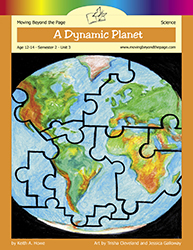
Unit 3: A Dynamic Planet
Lesson 1
The Dating Game
Students are given explicit domain vocabulary and definitions in the "Things to Know" section (e.g., "stratigraphy," "principle of superposition," "relative dating," "radiometric dating," "mya/bya"). Students apply those terms in activities: they create layered models in "The Sands of Time" to demonstrate superposition, sort fossils in the "Relative Dating" activity, and calculate ages and date ranges in the "Radiometric Dating" activity. Questions ask students to explain differences (e.g., between relative and radiometric dating) which requires use of the provided vocabulary.
Lesson 2
Plate Tectonics
Students are given explicit vocabulary entries (Lithosphere, Asthenosphere) and a "Things to Know" section that defines convergent, divergent, and transform boundaries and the term subduction. The reading directions tell students to read Chapter 2 and to "remember the following vocabulary," signaling use of those terms while answering content questions. Activities and prompts require students to describe the three types of plate boundaries, label diagrams, and place timeline cards that use domain-specific terms, so students must apply those vocabulary words in tasks.
Lesson 3
The First Four Billion Years
Students encounter and are given definitions for domain-specific terms in the Things to Know section (Hadean, Archean, Proterozoic, Precambrian). The Reading and Questions and answers explicitly explain vocabulary (for example, Q3 clarifies that 'blue-green algae' are cyanobacteria and describes oxygen production). The Student Activity Page and timeline cards label and illustrate terms such as 'prokaryotes,' 'cyanobacteria,' 'eukaryotic cells,' and 'multicellular life,' which students cut out and place on a timeline.
Lesson 4
The Age of Visible Life
Students are given explicit definitions in the "Things to Know" section (for example, Phanerozoic means "the age of visible life," Paleozoic means "the age of ancient life," and index fossil is defined). Students repeatedly use domain-specific terms by labeling and creating the Geologic Column timeline, adding Paleozoic/Mesozoic/Cenozoic cards, and answering direct questions that ask for the names or meanings of periods (e.g., "What does Phanerozoic mean?" and questions that require naming the Cambrian, Jurassic, Cretaceous, etc.). The "Order of Things" activity has students cut, shuffle, and place period/era/eon names in order, reinforcing vocabulary and its chronological usage.
Lesson 5
Digging for Clues
Students read informational text that includes domain-specific terms (e.g., evolution, principle of superposition, geologic column, Cenozoic/Mesozoic/Paleozoic, fossils) and are given an explicit definition of "Evolution" in the "Things to Know" section. Students label eras and fossil groups in the "Layers of Change" activity, using terms such as Cenozoic, Mesozoic, Paleozoic, and various fossil names. Students answer questions that require applying the principle of superposition (which layers are oldest) and describing how fossils change across layers, demonstrating use of those domain-specific phrases in context.
Lesson 6
Natural Selection
Students are presented with explicit definitions in the "Things to Know" and Wrapping Up sections (e.g., definitions of species, natural selection, and artificial selection). Students read pages 12–17 and answer direct questions that require them to state meanings (QUESTION #2 asks "What is a species?" and QUESTION #3 asks students to "Describe natural selection"). Discussion prompts at the end also ask students to define and contrast "natural selection" and "artificial selection," reinforcing vocabulary use.
Lesson 7
Survival of the Fittest
Students are given explicit definitions for domain vocabulary: the "Things to Know" section defines "mutation" and "genetic variation," and the reading questions include a definition of DNA as a set of instructions. The Parent Plan and wrap-up reiterate those definitions and ask discussion questions about what a mutation is and what genetic variation means. The colored-dots activity has students apply those vocabulary terms when recording and explaining changes in populations across environments.
Final Project
Fast Forward
Students are asked to "understand all of the terms and definitions on the 'Unit Review Sheet'" and to be able to define concepts such as evolution, convergent evolution, the four major eons, and the principle of superposition. Unit test questions require students to explain differences between relative and radiometric dating and to provide lines of evidence for evolution, which asks students to demonstrate meaning of domain-specific terms. In Option 2, students read and compare religious passages (e.g., Psalm 104:5) and document religious versus scientific evidence, requiring them to interpret texts to explain viewpoints.

Unit 3: The Book Thief
Lesson 1
The Author and Narrator
The Parent Plan Skills list explicitly states students will "determine the meaning of words and phrases as they are used in a text, including figurative and connotative meanings" and will "analyze the impact of specific word choices on meaning and tone." Activity 4 asks students to identify and use figurative language and color imagery and to write sentences that explain feelings using color words. Activity 1 (World War II Detective) requires students to read informational webpages and fill boxes that define historical terms and events (e.g., "Who was Hitler?", "What was the Holocaust?", "Sides involved"), which asks students to identify meaning of domain-specific history vocabulary.
Lesson 2
Similes and Metaphors
Students are prompted to read vocabulary words in context from The Book Thief and to look up and write definitions in their own words (Symbolizing Vocabulary directions and Student Activity Pages). Students create a mini picture dictionary pairing words (misogynistic, nefarious, rationing, ferocity, infamy, melancholic) with symbols, which requires them to determine meanings and connotations. Students analyze similes and metaphors in Part A–C of the Similes and Metaphors activity, explaining literal and figurative meanings and the effect of word choice on imagery and tone.
Lesson 3
Burning Books
Students complete the "Historical References" activity page that asks them to research and explain terms that appear in the book (e.g., Kommunist, Aryan, Mein Kampf goals, anti-Semitism, yellow stars) using the provided web links. The Student Activity Page and linked resources direct students to determine what these domain-specific words and phrases meant in Nazi Germany and how they apply to events in the text. In the propaganda activity, students analyze Nazi posters, identify target audiences and goals, and describe features that make the messages effective, reinforcing understanding of vocabulary like "propaganda," "swastika," and related historical terms.
Lesson 5
The Accordion Player
Students read excerpts from the Nuremberg Laws and the Hitler Youth law and answer specific questions that require them to interpret legal language and apply it to cases (e.g., eligibility for citizenship, rights denied to non-citizens, and how the Hitler Youth law influenced children in The Book Thief). Students complete the "Be Specific" activities that discuss denotation vs. connotation and compare words (e.g., stroll, trudge, stomp) and rewrite passages using more precise word choices. Students are asked to use a dictionary or thesaurus while changing underlined text, which supports analyzing word meaning and connotation.
Lesson 6
The Standover Man
Students are asked in the discussion prompts to consider how the meaning of someone being a "standover man" changes from the beginning to the end of Max's book, which asks them to determine the sense of that phrase in context. Students are directed to record examples of "propaganda" from the reading (with Mein Kampf noted as an example), showing they encounter domain-related vocabulary. A question asking why Max draws himself as a bird asks students to interpret a figurative phrase from the text.
Lesson 7
The Seven-Sided Die
The lesson provides explicit definitions of key terms (e.g., Slippery Slope, Bandwagon Appeal, Genetic Fallacy, Hasty Generalization, Post Hoc, Appeal to Improper Authority) in the "Things to Know" and Activity 1 sections. Students are asked to apply those terms by identifying which logical fallacy appears in a print ad and a television ad and by labeling fallacies in quoted Nazi propaganda in Activity 2. The student activity pages require students to name fallacies, explain which emotions arguments appeal to, and justify why the fallacies make the propaganda effective.
Lesson 8
The Thief Strikes Again
The Parent Plan lists the skill of determining the meaning of words and phrases, including figurative and connotative meanings, and prompts students to analyze the impact of specific word choices. The 'Ideas to Think About' and Activity 2 ask students to consider how figurative language and word choice create tone and to write original descriptive (figurative) descriptions as Death, which requires interpreting nonliteral language. The 'Things to Review' directs students to review the definition of propaganda, a domain-specific term related to history/social studies.
Lesson 9
Close Calls
The Parent Plan Skills section explicitly states students will "Determine the meaning of words and phrases as they are used in a text, including figurative and connotative meanings" and to "analyze the impact of specific word choices on meaning and tone." Activity 1 defines figurative devices (personification, simile, metaphor, onomatopoeia) and asks students to find and record multiple examples from the text. Activity 2 has students expand and refine sentences, practicing precise word choice and connotative detail.
Lesson 10
The Trilogy of Happiness
Students are asked to interpret the figurative phrase Max uses—what it might mean that the stars "burned" or "set fire to [his] eyes" (Question 4), which requires determining meaning of a phrase in context. Students are instructed to record examples of "propaganda" from the text (Part Seven/Propaganda page) and to analyze newsreel footage for informational versus propaganda aspects in the War Journalism activity, which requires understanding that domain-specific term. The Getting Started section defines and explains terms related to WWII (e.g., "concentration camp," "labor camp," and "death camps"), so students read contextual explanations of those history/social-studies vocabulary words.
Lesson 11
The Word Shaker
The lesson's Skills section explicitly requires students to "determine the meaning of words and phrases as they are used in a text, including figurative and connotative meanings" and to "analyze the impact of specific word choices on meaning and tone." Activity 2 (Descriptive Examples) asks students to find and explain effective adverbs, adjectives, and verbs and to interpret allegorical phrases (e.g., what Hitler is "planting" and the meaning of a "nation of farmed thoughts"). The reading and activities ask students to record examples of propaganda and to consider terms defined in the Things to Know/Parent Plan sections (e.g., "primary source," "ghetto," "allegory"), linking vocabulary to historical context.
Lesson 12
The Teddy Bear
Students are asked to jot down instances of figurative language (personification, simile, metaphor, onomatopoeia, allegory, and symbolism) as they read, which requires noticing word choice and interpreting phrase meaning in literary context. The lesson prompt asks students to consider how good writers use figurative language and word choice to create tone and engage the reader, prompting analysis of words and phrases. A short historical context paragraph defines Stalingrad and situates the battle, introducing domain-specific content related to history/social studies.
Final Project
Think-Tac-Toe
Students are asked to identify and illustrate examples of figurative language from the book and to create original examples (Teaching Figuratively and Figurative Illustration), which requires defining devices such as personification, simile, and metaphor. In the "Figuratively Writing" task students transform literal sentences into figurative ones, practicing interpretation of phrases in context. Students analyze propaganda posters by answering questions about how the poster functions and what emotions or logical fallacies it uses, requiring interpretation of persuasive language in historical artifacts. The unit review link and parent notes also direct students to review concepts and vocabulary needed for the final project.

Unit 4: Global Conflict and Civil Rights
Lesson 2
The Cold War and Communism
Students read short historical articles from the U.S. State Department and portions of Harry Truman's speech, exposing them to domain-specific terms like Truman Doctrine and Marshall Plan. The lesson's "Things to Know" section explicitly defines Cold War, communism, the Truman Doctrine, and the Marshall Plan for students. Students answer comprehension questions that ask them to summarize the Truman Doctrine and the Marshall Plan and view political cartoons that require interpreting symbolic language and meaning.
Lesson 3
The Cold War
The "Things to Know" section explicitly defines key domain-specific terms (Bay of Pigs Invasion, Cuban Missile Crisis, Red Scare, HUAC), so students read clear definitions of historical vocabulary. Students are directed to read primary and secondary texts (Office of the Historian pages and Kennedy's speech transcript) and to answer comprehension and analysis questions about those texts. The speech analysis prompts ask students to identify facts JFK provided and to explain how he used the past to justify decisions, which requires interpreting phrases in context.
Lesson 4
Civil Rights
Students read assigned texts (Claudette Colvin: The First to Keep Her Seat; Elizabeth Eckford: Facing a Mob; sections of Free at Last) that contain domain-specific civil rights vocabulary (e.g., segregation, Jim Crow, unconstitutional). The lesson includes a direct comprehension question asking "What were 'Jim Crow' laws?", which requires students to state the meaning of a historical/legal term as used in the text. Students also answer questions about Brown v. Board of Education and the role of the Arkansas National Guard, which require understanding of terms like "segregated" and "governor" in historical context.
Lesson 5
Sit-Ins and Freedom Rides
Students read multiple historical texts and primary sources (Carolyn McKinstry excerpt and Dr. King's speech) and are asked to highlight or underline powerful phrases in the speech. The materials include explicit definitions and domain terms in the "Things to Know" section (e.g., "Sit ins were non-violent protests of segregation," "SNCC was the Student Non-Violent Coordinating Committee") and a comprehension question that asks students to identify what CORE was. The compare-two-speeches organizer asks students to note key ideas, themes, audiences, and goals, which can prompt attention to language and phrase-level meaning.
Lesson 6
The Ballot
Students encounter domain-specific terms and short definitions in the "Things to Know" section (e.g., Freedom Summer and the Voting Rights Act of 1965 are described). Students read a historical text and answer comprehension questions that refer to domain vocabulary and practices (e.g., poll taxes, literacy tests, COFO, voter registration tactics).
Lesson 8
Korea
Students read a web-based text and answer comprehension questions that use domain-specific terms such as "civil war," "proxy war," and "armistice" (Question #2 and Question #4). The Things to Know and Reading sections include vocabulary tied to history/social studies (e.g., 38th parallel, communist, non-communist, armistice) that students must interpret to answer questions about causes, events, and outcomes. Activity prompts (e.g., writing a proposal or letter) require students to refer to and use historical terms and concepts from the reading.
Lesson 9
Vietnam
Students read U.S. Department of State webpages about the Gulf of Tonkin, the Tet Offensive, and ending the Vietnam War and then answer explicit comprehension questions (for example: "What is 'Tet'?" and "What did the Gulf of Tonkin Resolution authorize?"). The lesson also provides a "Things to Know" section that defines domain-specific terms such as the "Domino Effect," "Agent Orange," "Gulf of Tonkin Resolution," and the "Tet Offensive." These items require students to identify and explain the meaning of history-specific vocabulary and phrases as used in the texts they read.
Lesson 10
The Culture of the 1960s
Students view and read primary-source protest leaflets from the University of Washington as part of Activity 1, exposing them to words and phrases used in historical texts. Students listen to at least two protest songs and complete questions asking for each song's message and which lyrics struck them, requiring interpretation of phrases in context. The lesson explicitly defines the term "counter-culture" in the "Things to Know" section, providing at least one domain-specific vocabulary item.
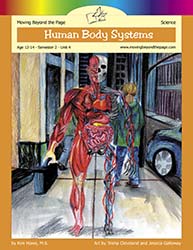
Unit 4: Human Body Systems
Lesson 1
Our Bodies
Students are instructed to "focus on the terms, definitions, and concepts" and to use the graphics and their labels to better understand the readings, which requires interpreting domain-specific vocabulary in context. In Activity 1 students read the "Body Systems" pages and either match cut-out descriptions to system labels or write their own short descriptions, practicing deriving meanings of system-related terms. Activity 2 asks students to read decision prompts and research effects on body systems, which requires them to determine the meanings and implications of health-related words and phrases from sources like KidsHealth.
Lesson 2
Cells, Tissues, and Organs
Students read labeled textbook pages and callouts that define and describe scientific terms (e.g., cell, tissue, organ, cell membrane, phloem, xylem, vascular cambium). Students answer explicit comprehension questions that require them to state meanings and functions of domain-specific vocabulary (e.g., "What is the function of the cell membrane?" and "What are the four primary tissue types and what is each used for?"). Students label diagrams and identify organ and tissue types during dissections and the carrot/earthworm activities, applying vocabulary to real structures.
Lesson 3
Musculoskeletal System
Students are assigned textbook readings and directed questions (Questions #1-4) that require identifying domain-specific terms (e.g., tendon vs. ligament, types of muscle tissue). The 'Things to Know' section explicitly defines vocabulary such as articulation, synovial joint, spongy bone, compact bone, and the three muscle types. Activities ask students to label and name bones and muscles on diagrams and to match body joints with mechanical joints, requiring use of technical terms in context.
Lesson 4
Cardiovascular System
Students are assigned specific pages to read and then answer questions that require defining and explaining domain-specific terms (e.g., plasma, red and white blood cells, platelets; arteries, veins, capillaries; systole and diastole). Students label and color diagrams of the cardiovascular system and heart, naming parts such as the heart, superior/inferior vena cava, aorta, carotid arteries, and jugular veins. Students build or explain a pump model and describe the function of valves, which requires using and applying relevant vocabulary in demonstrations and explanations.
Lesson 7
Urinary System
Students read assigned pages (pp. 240-247) and answer comprehension questions that require use of domain-specific terms (e.g., identifying ADH and aldosterone and saying what each controls, naming nephrons, and describing renal artery/vein flow). Students label and color a urinary-system diagram, identifying kidneys, ureters, bladder, and urethra. In the comic-strip activity, students must describe the water droplet's path and explain processes in a nephron and urine-collecting ducts, using urinary-system vocabulary in context.
Lesson 8
Endocrine System
Students read pages 130-137 and answer comprehension questions that require understanding vocabulary such as "hormones," "receptors," "hypothalamus," and "pituitary gland." Students complete a matching activity that pairs hormone names with their functions and the glands that produce them, using textbook and chart information. Students label, color, cut, and paste glands on an endocrine system diagram, and draw small structures (pituitary, hypothalamus, pineal) to reinforce anatomical and functional terms.
Lesson 9
Reproductive System
The text explicitly labels and defines several domain-specific terms (e.g., gametes, fertilization, embryo vs. fetus with week ranges, placenta functions) and presents answers to questions that state these meanings. Activities require students to read assigned pages, research organ functions, and then summarize the information in their own words or present orally, which engages them with the vocabulary in context. The pregnancy activity pages include labeled illustrations and descriptive text that use and reinforce specific terms (e.g., amniotic fluid, surfactant, gestation).
Lesson 10
Immune System
Students are given explicit definitions in the "Things to Know" section (e.g., antigen, macrophages, antibodies) and asked content questions that require understanding those terms (e.g., phagocytosis). Students read textbook pages and use the textbook diagram to label and color anatomical structures, which requires applying domain-specific vocabulary (e.g., incoming lymph vessel, germinal center). The optional interactive activity asks students to define a pathogen and an antigen, reinforcing vocabulary use.
Lesson 11
Nervous System
Students read specified pages and answer direct questions that define and explain vocabulary (e.g., Things to Know entries defining CNS, PNS, ANS; Q1–Q4 asking what dendrites, axons, and reflexes are). Students build or label neuron models and a brain diagram, naming parts such as nucleus, cell body, axon, dendrites, myelin sheath, synaptic terminal, and labeling functional regions of the brain. Students complete the Nerve Impulse activity where they place labels or sequence steps that show how impulses move through labeled parts of neurons.
Lesson 13
Human Growth and Development
Students are assigned to read pages 280-285 and to answer comprehension questions, including QUESTION #1 which asks them to define 'puberty' and state when it begins, requiring them to determine the meaning of that term as used in the text. The lesson lists domain terms in 'Things to Know' and the Skills section (e.g., genetics, embryo, cellular division, differentiation), which students encounter during reading and activities. In Activity 2 students must research and label environmental factors and describe their effects, which may require understanding domain-specific vocabulary from the readings and linked resources.

Unit 4: To Kill a Mockingbird
Lesson 2
Home and School
Students are asked to complete a Student Activity Page that presents five passages from the novel with highlighted words (assuaged, predilection, sojourn, disapprobation, asinine) and to write a "my definition" from context and a "dictionary definition" for each. The lesson repeatedly directs students to learn the meaning of listed vocabulary words and to review those vocabulary words and definitions. The Parent Plan also provides a list of appropriate definitions that students can compare to their own work.
Lesson 3
The Mystery of Boo
The lesson explicitly defines the word "hearsay" in the "Things to Know" section and asks students to "Review the meaning of hearsay." In Activity 1 students are instructed to list five things based on "Hearsay and Gossip" and five based on "Personal Experience and Reliable Sources," using chapters 1 and 5 as textual evidence to classify information. The student activity requires comparing the two columns and developing a hypothesis about Boo Radley based on those classifications.
Lesson 4
Snow and Fire
Students are asked to include at least one quotation from Chapters 8–9 and "explain the meaning and importance of the quotation," which requires them to interpret words and phrases in context. Discussion questions explicitly prompt students to consider Atticus's use of the word "common" and to discuss the meaning and historical associations of the racial slur, asking students to recognize it as derogatory and tied to historical treatment of African Americans. The Character Line-Up activity and literature response require students to analyze character descriptions and quotes, which involves attending to the language used to portray characters.
Lesson 5
Surprising Talent
Students read chapters 10–11 of To Kill a Mockingbird and answer comprehension questions, including QUESTION #2 which asks why Miss Maudie called it a "sin" to kill a mockingbird; the provided answer explains that mockingbirds "make music for people to enjoy, and they don't do any harm to anyone," requiring students to interpret that phrase in context. Students also label and analyze words and functions (simple subject, predicate, direct objects, predicate nouns/adjectives) through sentence-diagramming practice and Part II labeling exercises.
Lesson 6
Separate
The lesson explicitly addresses historical vocabulary and context by presenting segregation as a defining feature of the 1930s South and by asking students to examine images of segregation and connect them to To Kill a Mockingbird. Activity 2 directs students to select an image, write a caption about segregation, and write two or three sentences describing how the image relates to the story, which requires some engagement with domain-specific concepts. The lesson also provides explicit definitions for terms related to text use (quotation, paraphrase, summary), giving students practice with vocabulary about using text evidence.
Lesson 7
A Moral Dilemma
Students are presented with a list of vocabulary words (elucidate, amiably, mollified, volition, indicted, acquit, furtive, notoriety, irascible, connived) with definitions and example sentences from To Kill a Mockingbird. Students complete a Student Activity Page that asks them to write their own sentences using each vocabulary word. The Parent Plan explicitly lists the skill: determining the meaning of words and phrases as used in a text and analyzing the impact of specific word choices. The vocabulary set includes legal terms (e.g., indicted, acquit) that relate to social studies/civics domains.
Lesson 9
Order in the Court
Students read and use the student activity page "Order in the Court," which explicitly defines legal terms such as defendant, prosecution, jury, cross-examine, evidence, sentencing, and appeal. Students complete a fill-in-the-blank worksheet titled "The Trial" that requires them to supply the correct legal terms (using the bold words from the handout) in the context of Tom Robinson's case. The Parent Plan Skills section explicitly lists determining the meaning of words and phrases, including vocabulary specific to domains related to history/social studies, as a targeted skill.
Lesson 10
Equal Rights?
Students are given a direct definition of "Jim Crow" laws in the "Things to Know" section and read multiple historical excerpts of Jim Crow laws from Southern states, providing domain-specific vocabulary in context. The Parent Plan notes that students will see how the phrase "separate, but equal" was used to justify unequal treatment, and the Found Poetry activity asks students to select and arrange words and phrases taken from the Jim Crow law texts. These elements expose students to history/social-studies vocabulary and primary-source usage.
Lesson 12
Wise Words
Students are asked in the "Wise Words" activity to choose five quotes from To Kill a Mockingbird and "rewrite each, or explain it in your own words," which requires them to determine the meaning of words and phrases as used in the text. The student activity page provides an example of paraphrasing a quote, showing a model for interpreting figurative language and meaning. In the "Someone Else's Skin" activity students must adopt a character's perspective and explain thoughts and feelings in a diary entry or Venn diagram, which requires interpreting how words and phrases convey meaning for that character.
Final Project
Oral Book Presentation
Students study a labeled Historical Context section (Great Depression, Segregation, Jim Crow Laws, Racism) and are asked to explain how those terms affected events in To Kill a Mockingbird. The study guide and unit materials provide a vocabulary list with definitions (assuaged, predilection, sojourn, indicted, acquit, etc.) and a vocabulary matching activity on the unit test. The unit test asks students to paraphrase an underlined sentence and to summarize and analyze passages, requiring students to determine meanings of words and phrases in context.

Unit 5: Technology Explosion
Lesson 2
Demographics and Immigration
The lesson explicitly names and briefly defines domain-specific terms such as "Frost Belt," "Rust Belt," and "Sun Belt" in the "Things to Know" and the "Statistical Changes" explanatory paragraph (e.g., Frost Belt = the Northeast, Great Lakes region, and upper Midwest). The Immigration Act of 1965 is described in Activity 3 with an explanation that it "ended quotas that prioritized immigrants from specific places, emphasizing family connections and professional skills instead." Mapping Migration and the Statistical Changes activities require students to work with phrases like "percent of U.S. population" and to apply those terms when completing maps and charts.
Lesson 4
Leadership and Domestic Policy
The Presidential Speeches analysis table asks students to "Write down one particularly powerful sentence or idea from the speech" and to explain "What does that sentence or idea mean to you?", which requires students to interpret language in historical texts. The Leadership in Crisis activity directs students to read/watch presidential speeches and answer how each president "address[ed] those accusations," requiring students to interpret phrasing and tone in primary-source speeches. The Landmark Court Cases activity asks students to write a short summary and describe what the court decided, which requires comprehension of legal language in historical documents.
Lesson 6
Terrorism
Students are directed to read the "9/11 Attacks" webpage and answer specific comprehension questions, including QUESTION #4 which asks, "What was Operation Enduring Freedom?" Students also answer QUESTION #1 identifying the extremist group (Al-Qaeda). In the artifacts option, students are asked to "Explore the supporting documents that accompany each artifact," which requires reading domain-related texts tied to the historical event.
Lesson 7
Modern American Culture
Students read the assigned passage about Judi Warren and answer comprehension questions that require understanding Title IX and its effects (e.g., change in percent of female high school athletes). Students analyze an NCES data table titled "Men's Enrollment in Degree-Granting Postsecondary Institutions/Women's Enrollment in Degree-Granting Postsecondary Institutions," compute percentages for women in 1970, 1990, and 2010, and create graphs to represent those terms in context. The parent/teacher guidance explicitly defines Title IX in a discussion question, giving students a direct domain-specific definition to use.

Unit 5: Health and Nutrition
Lesson 3
Healthy Body
The lesson provides explicit vocabulary and definitions in the "Things to Know" section (definitions of communicable disease, pathogen, and chronic disease) and asks students to answer questions that require using those terms (Question #1 asks the difference between infectious and non-communicable disease). Activity 1 has students sort disease names into "chronic" and "communicable" categories, which requires applying domain-specific health vocabulary to classify items. Students are also directed to read linked articles and respond to comprehension questions, which can require interpreting word meanings in context.
Lesson 5
Alcohol, Tobacco, and Drugs
The lesson provides explicit definitions (e.g., "A drug is a medicine or substance that affects the body…" and distinctions between prescription and over‑the‑counter drugs) in the "Things to Know" and Activity 1 sections. Students are directed to read multiple informational texts and videos and to complete a Student Activity Page with a "What is it?" column for each drug, which requires them to identify and record the meaning/definition of domain‑specific terms. The answer key also lists concise definitions for terms like steroids, ecstasy, and inhalants that students could use to confirm meaning.
Lesson 6
Nutrition and Exercise
Students read explicit definitions and explanations of domain-specific terms such as serving size, calories, fats and sugars, nutrients, % Daily Value, and BMI in the "Food Label" and "Body Mass Index" sections. Students complete Activity 4 by interpreting a sample Nutrition Facts label and answering questions that require determining the meaning of values (e.g., calories per serving, grams of fat, % Daily Value). Students compute BMI using the given formula in Activity 5 and explain BMI meaning and interpretation in Activity 8 when they teach others.

Unit 5: Great American Poets
Lesson 1
Poetry Basics
Students are prompted to identify and look up unfamiliar words: Active Reader directs students to circle words they need to look up and to record definitions in a Definitions section. Students analyze word choice and figurative language in context: the Words of Poetry activity has students compare two descriptions of the same scene and discuss how specific words and a simile change meaning and effect. Students practice applying vocabulary for the poetry domain: the Poetry Vocabulary page has students mark line breaks, identify refrains, label rhyme schemes, find assonance, and underline stressed syllables, all of which require interpreting words and phrases as used in poetic texts.
Lesson 2
Early American Poetry
Students are instructed to look up synonyms for words in poems (for example, exploring synonyms for "acquainted" in Frost's "Acquainted with the Night" and listing synonyms for "noiseless" in Whitman's title) and judge which words fit best, explaining effects on tone, connotation, sound, and rhythm. Students mark phrases that strike them in poems and in Paul Revere's first-person account and use a Venn diagram to compare language and details between Longfellow's poem and Revere's account. The activities ask students to analyze how specific word choices influence meaning, tone, and mood.
Lesson 3
Figurative Language
The activities ask students to identify and analyze figurative language in specific poems (e.g., identifying metaphors, personification, imagery in provided stanzas) and instruct students to "use a dictionary to look up any words you don't understand." The lesson defines vocabulary items (metaphor, hyperbole, irony, idiom, personification, alliteration, assonance, onomatopoeia, simile) and has students locate and explain examples from poems and produce original lines using those devices.
Lesson 6
Meaning in Poetry
Students are asked to identify denotation and connotation and to look up unfamiliar words (Activities: Literal and Symbolic Meaning; Student Activity Page). Questions and activities require students to interpret figurative language and allusions (e.g., recognizing that the "Captain" in Whitman's poem refers to Abraham Lincoln and analyzing the allusion to Helen of Troy). The Parent Plan skills explicitly list "Determine the meaning of words and phrases as they are used in a text, including figurative and connotative meanings; analyze the impact of specific word choices...including allusions."
Lesson 7
Poetry Analysis
The Parent Plan Skills explicitly state that students will "determine the meaning of words and phrases as they are used in a text, including figurative and connotative meanings; analyze the impact of specific word choices on meaning and tone, including analogies or allusions to other texts." The Poem Analysis student page requires students to state a poem's literal meaning and any symbolic meaning and to identify figurative language, which asks students to determine meanings in context. The lesson includes a discussion question asking how understanding the allusion to the Colossus of Rhodes helps interpret "The New Colossus," and a vocabulary game that has students match terms and definitions and produce examples, encouraging word-meaning work.
Lesson 8
Robert Frost
Students are asked to analyze word choice and figurative language in poems (e.g., identifying images in "After Apple-Picking" and explaining symbolic meaning in "The Road Not Taken"). The lesson defines specific terms used in context, such as "psyche" (noted as the human mind or soul) and explains the art term "Cubism," giving students domain-specific vocabulary related to art. Students analyze punctuation in poetic context (Activity 3) by examining hyphens and dashes and their effects in poems, which involves interpreting how those marks affect meaning and phrasing.
Lesson 9
Memorizing Poetry
Students are explicitly instructed to "look up any word you're not familiar with or aren't sure how to pronounce" before memorizing a poem, which directs them to determine word meanings and pronunciations. The reading questions tell students to "be sure to look up 'Euclid' online if you don't recognize the reference," prompting research of a domain-specific proper noun. The discussion of the made-up word "Gubbinal" asks students to consider how assigning a meaning ("gubbin") changes interpretation, which engages students in determining a word's effect on meaning.
Lesson 10
Poems about Poetry
Students are asked to reread poems while "looking up key words you don't understand" and to underline phrases or images that strike them, prompting word-level investigation and close reading. The Parent Plan skills explicitly list that students "analyze idioms, analogies, metaphors, and similes to infer the literal and figurative meanings of phrases," which requires determining meanings in context. Student activity questions ask learners to interpret specific lines and phrases (e.g., last stanzas of "Poetry" and "Ars Poetica") and to explain why chosen images are effective, requiring analysis of word and phrase meaning.
Lesson 11
Editing Your Work
The reading questions instruct students to look up unknown words and reread in context (QUESTION #2 asks students to look up "deferred" and reinterpret the poem). QUESTION #1 directs students to analyze E.E. Cummings's capitalization choices and their effect on meaning, prompting interpretation of word/formatting choices. The Parent Plan Skills explicitly states students will "determine the meaning of words and phrases... including figurative and connotative meanings; analyze the impact of specific word choices on meaning and tone."
Final Project
Poetry Journal
Students define denotation and connotation directly (Part IV question 14) and answer questions that ask them to identify figurative language (multiple-choice items asking for metaphor, personification, alliteration, etc.). Students analyze the impact of specific word choices on meaning and tone when they answer questions about tone, mood, and punctuation use in poems and when they match figurative language to lines from poems. The Parent Plan skills list explicitly states that students will analyze idioms, analogies, metaphors, and similes and determine meanings of words and phrases, including figurative and connotative meanings.