


Sixth Grade - MATH
5: Math
Unit 2: Integers and Rational Numbers
Lesson 4
Negative Numbers and Integers
The Skills list explicitly includes the goal to "Extend number line diagrams and coordinate axes familiar from previous grades to represent points on the line and in the plane with negative number coordinates." Students practice placing and labeling positive and negative values on horizontal and vertical number lines (e.g., marking +4 and −4, plotting −200 and +200 on a scaled line) through foldables and activities. Students also classify and use negative numbers in real-world contexts, reinforcing their understanding of sign and location relative to zero.
Lesson 6
The Coordinate Plane
The lesson defines the four quadrants and states the sign rules for x- and y-coordinates in each quadrant, and students label quadrants and fill examples in the foldable (Activity 1). Students plot ordered pairs that include negative coordinates in all quadrants (Activity 2 and practice sheets) and use number-line opposites to connect sign to location (Activity 3). Students perform reflections by changing signs, complete guided reflection problems (Activity 5), and are given the general results ((a, b) -> (a, -b), (-a, b), (-a, -b)) in the answer key.
Lesson 7
Coordinate Problem Solving
Students plot and label points with positive and negative coordinates in multiple activities (e.g., plotting A (2,5) in quadrant I, C (−4,−1) in quadrant III, and creating drawings that use all four quadrants). In the garden/rectangle problem students find the two missing corner coordinates given (4,2) and (−4,−4) by producing (−4,2) and (4,−4), showing they change signs to locate corresponding points. An image and accompanying description explicitly show points whose coordinates change sign and states that the changes demonstrate flipping points across one or both axes (reflections).
Lesson 8
Unit 2 Test
Students are asked to identify the quadrant for given ordered pairs (e.g., (2, -2), (-4, 7), (-1, -6), (3, 8)) and record quadrant answers in the practice pages and answer key. Multiple activities require students to plot points and perform reflections over the x- and y-axes (e.g., reflect (3,4) over the y-axis to (-3,4); reflect (3,6) over the x-axis to (3,-6)), with grids provided for students to carry out the transformations. The parent plan and answer key explicitly list and show plotting, quadrant identification, and reflections as skills students should practice and demonstrate.
Final Project
Coordinate Game
The lesson's Skills list explicitly states students should "Understand signs of numbers in ordered pairs as indicating locations in quadrants of the coordinate plane." Students must choose one quadrant (I, II, III, or IV) to place all playing pieces and write that quadrant on their checklist. Students plot and call out x-y coordinates on a labeled grid that ranges from -12 to 12 on both axes, and the sample game images show points with negative and positive coordinates in different quadrants. Gameplay requires students to mark hits and misses by locating specific ordered pairs on their opponent's quadrant.
Unit 3: Ratios and Percentages
Lesson 3
Equivalent Ratios
Students are asked to plot ordered pairs on coordinate-plane graphs in multiple activities (e.g., plot points (1,6), (3,18), (5,30) and identify the point (4,24); and plot points such as (5,2), (15,6), (30,12) and (40,16)). Several activity pages contain coordinate planes with labeled axes for students to use when graphing and drawing lines through plotted points. The Basic Skills Review asks students to identify the quadrant for the point (-5, 3), prompting students to interpret a signed ordered pair.
Unit 5: Algebraic Equations
Lesson 2
Solving One-Step Equations, Part 1
The Basic Skills Review #9 includes a coordinate plane activity asking students to plot the point (3, -4) and identify its quadrant, and the review page provides a small coordinate grid with quadrants labeled I–IV. The answer key image shows a plotted point (-3, 4) and labels it as located in Quadrant II, demonstrating students practice locating points with positive and negative coordinates. The lesson also labels the four quadrants on the provided grid, giving students a visual reference for where signs of coordinates correspond to quadrant locations.
Lesson 7
Independent and Dependent Variables
Students work with a labeled coordinate grid that shows all four quadrants and plot points with positive and negative coordinates (examples include points like (2,4), (0,2), (−1,1), and (−2,0)). Activity tasks ask students to name solutions in specific quadrants (e.g., identify a solution from Quadrant II or Quadrant IV) and several student pages include tables and graphs that place ordered pairs into the correct quadrant. The lesson also shows examples of points with differing sign combinations on plotted lines and asks students to circle or cross out coordinate pairs that are solutions.
Lesson 8
Unit 5 Test
Students create tables of ordered pairs and graph solution sets on coordinate grids in multiple activities (for example, the x - y = 8 activity where students list (0, -8), (4, -4), (8, 0) and graph them, and the y + 5 - 2x = 6 activity rewritten as y = 2x + 1 with points like (-1, -1), (0, 1), (1, 3)). The unit goals and parent plan explicitly include using coordinate grids to graph two-variable linear equations and listing and graphing ordered pairs that show relationships between variables. Numbered practice pages require students to plot points on provided coordinate grids and identify points that are and are not solutions.
Unit 6: 2D Geometry
Lesson 3
Triangles
Students draw triangles on a laminated coordinate plane in Activity 3 using explicit ordered pairs and quadrant labels (e.g., build a right triangle starting at (1,1) in Quadrant I and a matching triangle starting at (-1,-1) in Quadrant III). The activity includes multiple tasks that require plotting points with negative and positive coordinates (examples: (-3,-5) to (-6,-5); (4,2) to (8,2); (-2,2) to (-7,2); (1,-2) to (7,-2)). The lesson reminds students that the coordinate grid has four quadrants and asks students to create and compare triangles placed in different quadrants.
Lesson 6
Scale Drawings
Students plot and label shapes on a coordinate grid (Activity 2) using ordered-pair-style descriptions (the image lists rectangle corners like (3, 4) and (7, 6)). The Basic Skills Review asks students to find coordinates of a point reflected across the x- and y-axes (Problem 5), and the answer key shows reflected coordinates with sign changes. The unit lists the skill "Draw polygons in the coordinate plane," indicating students practice placing figures using coordinate positions.
Unit 7: 3D Geometry
Lesson 2
Surface Area
The Basic Skills Review asks students to graph points at (3, 2), (-3, 2), (-5, -1), and (1, -1), giving practice placing ordered pairs with positive and negative coordinates on a coordinate plane. A coordinate-plane image is included in the review, and a task asks students to connect plotted points to form a polygon, so students physically locate points in different regions of the plane. These items provide direct student practice plotting points that differ in sign.
Lesson 5
Problem Solving With Solids
The Basic Skills Review includes a coordinate geometry problem that asks students to reflect point A(3, 2) over the y-axis and the answer key shows the reflected coordinates as (-3, 2). A Student Activity Page lists a coordinate-reflection question (Problem 8) and provides the specific example of reflecting a point over the y-axis. These items require students to perform a sign change in an ordered pair to produce a reflected point.
Unit 8: Statistics
Lesson 8
Making Inferences
Students work with a coordinate grid in the Basic Skills Review (Problem 10) where points are given with signed coordinates (A at (3, -2) and B at (-4, 2)). Students are asked to find horizontal and vertical distances between those points, which requires locating points with negative and positive coordinates on the plane. The answer key explicitly lists coordinates with negative signs, showing students encounter signed ordered pairs.
Unit 9: Skills Review
Lesson 2
Fractions, Ratios, and Coordinates
Students plot points with negative and positive coordinates (e.g., plot (-2, 4) and (3, 5) and (-3, -2)) and complete exercises that require reflection across axes. In Exercise 1 students reflect (-2, 4) over the y-axis and x-axis and write the resulting coordinates, with the answer key showing the sign changes to (2, 4) and (-2, -4). Students are directed to play an online game that explicitly uses all 4 quadrants, giving additional practice with points in different sign combinations.
3: Math
Unit 2: Proportions
Lesson 4
Graphing Proportions
Students repeatedly plot ordered pairs and label axes on coordinate grids in activities such as "Graphing Equations," "Graphing Scenarios," and various student activity pages. Several example and answer-key items include negative coordinates (for example, points listed as (-2, -4), (-1, -2), and (0, 0)) that students would place on the coordinate plane. Students also interpret specific points like (0, 0) and (1, k) and connect plotted points with lines.
Unit 3: Expressions
Lesson 4
Graphing Proportions
Students plot and analyze points that include negative coordinates (for example, Equation 3 yields y-values 2, -1, -4, -7 to be plotted, and Activity 4 includes a point (6, -18)). The Walk the Graph activity explicitly directs students to move down for negative y-values (e.g., y = -2x, y = -3x, y = -4x), so students practice placing points with negative signs. Several graphs and examples show lines with negative y-values or negative slopes, so students practice reading and creating ordered pairs with negative components.
Lesson 7
Rise Over Run
Students practice using signs when measuring rise and run: the lesson tells them that moving up or right is positive and moving down or left is negative. Students plot and work with ordered pairs that include negative coordinates (e.g., (-4, 1), (-5, -1), (-3, -4)) when calculating slope. Students place points on labeled x-y axes and count directionally to determine signed changes in x and y.
Lesson 8
y = mx + b
Students plot and graph points and lines on coordinate grids labeled from -10 to 10 in multiple activities (Activities 1–7), including specific ordered pairs with negative coordinates such as (−2, 5), (4, −1), (−3, 7), and (2, −3). Activity 8 explicitly refers to quadrants by explaining why some real-world graphs use only Quadrant I, and several student pages and answer keys show lines and points plotted in different quadrants. Activities require students to use axes and negative/positive values when computing slope, finding b, and extending lines, giving repeated practice placing points with various sign combinations on the plane.
Unit 5: Functions
Lesson 1
What Is a Function?
Students plot ordered pairs that include positive and negative coordinates (e.g., (−3,2), (0,−2), (2,−4)) and work with graphs whose axes are labeled with negative and positive values. Students record and plot symmetric coordinate pairs for quadratic examples (for instance (−2,2) and (2,2) in y = x^2 − 2) and a parent/answer note explicitly states that the parabola is symmetric around the y-axis. Students use coordinate grids ranging from negative to positive values and connect points across the axes when graphing linear and non-linear functions.
Unit 6: Geometry
Lesson 3
Reflections
Students apply coordinate rules for reflections such as (x,y) → (x,−y) and (x,y) → (−x,y) (Activity 6 chart and examples). Students complete numerous exercises that ask them to reflect points and shapes across the x- and y-axes and to identify when a reflection has occurred because only one coordinate's sign changes (Exercises 9 and 10; answer key commentary). The digital activity and answer keys reinforce that the x-coordinate can stay the same while the y-coordinate changes sign (and vice versa) when reflecting across a single axis.
Lesson 4
Rotations
Students practice plotting and rotating points and shapes using ordered pairs and quadrant language (e.g., counting quadrants for 90° increments). The lesson gives many algebraic rotation rules that change signs of coordinates (for example (x,y)→(−x,−y) for 180°) and has exercises where students compute and plot coordinates after rotations. Several activities ask students to identify rotations by comparing original and image coordinates, showing attention to how signs change under rotation.
Lesson 5
Sequences of Rigid Transformations
Students plot and transform points with explicit coordinates and perform reflections over the x- and y-axes (for example, the lesson shows triangle A(2,1), B(4,1), C(3,3) mapped to A'(-2,1), B'(-4,1), C'(-3,3) and notes that the x-coordinates changed sign indicating a reflection over the y-axis). Students perform and analyze reflections that change y-coordinates' signs (pentagon reflection over the x-axis) and carry out many problems that require reflecting given vertices with positive and negative coordinates. Students also work in labeled quadrants on activity pages (Upper Left, Upper Right, etc.) and apply translation rules that add or subtract from coordinates, reinforcing how signs change during moves.
Lesson 7
Sequences of Transformations
Students are explicitly asked to perform reflections across the x- and y-axes in multiple activities (e.g., ‘‘reflect across the y-axis'' and ‘‘reflect across the x-axis'' tasks). The Questions to Discuss states: "In a reflection, one coordinate changes sign. If the x-values change sign, it was a reflection over the y-axis. If the y-values change sign, it was a reflection over the x-axis." Answer keys and worked examples show coordinates with negated signs after reflections (for example, points changing from (x,y) to (−x,y) or (x,−y)). The rotation rule given (x,y) → (y,−x) also shows students applying sign changes to coordinates when computing transformations.
Lesson 8
Triangles and Transversals
Several quiz problems and answer keys require students to work with coordinates and reflections on the coordinate grid (e.g., reflecting (2,2) across the y-axis to get (-2,2); dilating and then reflecting a point to get (6,-2)). Images and answer keys show a triangle plotted in the first quadrant and its mirror image in the second quadrant, and other items ask students to find final coordinates after reflections and translations. The quiz answer key explicitly shows sign changes for reflections across the x- and y-axes.
Lesson 9
Using the Pythagorean Theorem
Students work with coordinate pairs when finding distances on grids in Activity 4, including examples A(0,0) to B(6,8) and A(−1,2) to B(2,−2) where they draw horizontal and vertical segments and count squares to get leg lengths. The Grid Problems activity pages require students to plot and compute distances for pairs that include negative coordinates (e.g., (−3,−4), (−6,8), (2,−3), (−8,−4)). Students use these plotted points to form right triangles and apply a² + b² = c² to find distances between points.
Lesson 11
Unit 6 Test
Students are asked to reflect triangles across the y-axis and x-axis and to plot the resulting vertices (e.g., original A(-2,1) → A'(2,1) in Problem 20 and multiple reflection problems). Several student pages and the image explicitly show triangles located in specific quadrants (top-right, bottom-left, etc.) and require plotting points with positive and negative coordinates. The answer keys and rotation/reflection rules list coordinate sign changes (e.g., rules like (−y, x), (y, −x), (−x, −y)) and give transformed coordinates that are sign-negated to indicate reflections across axes.
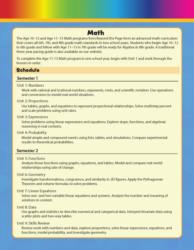
Unit 9: Semester Exams
Lesson 5
Semester Exam
Students are asked to plot and work with ordered pairs in several items (e.g., graph the line passing through (0,0) and (4,−8); Line A points: (1,2), (2,0), (3,−6); Line B points: (1,0), (2,3), (3,12)). The assessment includes a full coordinate grid image labeled from −10 to 10 on both axes and tasks to graph equations such as y = 4x and describe the line passing through the origin. Answer keys reference points with negative coordinates and note the line passes through (0,0), indicating students place points above/below the axes and left/right of the origin.
Lesson 7
Geometry Review
Students are given tasks that require plotting and reflecting points on the coordinate plane, for example reflecting A(-3, 4) across the y-axis and writing A'(3, 4) while describing how the x- and y-values changed. Several problems and images show reflections across the x- and y-axes and reflections across the line y = x (e.g., D(1, -2) → D'(−2, 1)), and a 180° rotation task maps (1, 2) to (−1, −2), making sign changes explicit. The directions prompt students to write coordinates after transformations and to explain the rules used, so students practice relating sign changes to specific axis reflections.
Lesson 10
Semester Exam
Students are asked to reflect a point explicitly in Problem 12: "Reflect the point A(5, 10) across the y-axis," and the answer key shows the mapping A(5, 10) → A'(−5, 10), which demonstrates a sign change in the x-coordinate. An image and problem set show pairs of shapes (squares and triangles) plotted on coordinate grids that are presented as reflections (one image shows a square in the top-right and a corresponding square in the bottom-left). Multiple problems require plotting points, graphing lines, and translating/rotating figures on coordinate grids (e.g., graphing triangles, translating with T_{-4,2}, rotating B(−3,4)), giving students practice working with ordered pairs on the plane.