


Seventh Grade - MATH
5: Math

Unit 1: Operations
Lesson 3
Division Review
Students practice dividing whole numbers and multi-digit decimals using the standard algorithm and learn to make equivalent division problems by multiplying both dividend and divisor by powers of ten (e.g., 1.75 ÷ 0.25 → 175 ÷ 25). Students solve numerous real-world division problems (dinosaurs, buttons, watermelons, vans, money, rope, chemicals) and explicitly interpret quotients and remainders in context (including using decimals to avoid remainders for money). Students create a foldable of division steps and complete practice pages that require finding and interpreting quotients of rational numbers.
Lesson 4
Exponents and Order of Operations
Students perform division within order-of-operations problems (e.g., 36 ÷ 9, 21 ÷ 7 × 3, 16 ÷ 4 in worked examples) and solve problems that require dividing in real-world contexts (e.g., finding how much Dwayne earns per car by computing 78 ÷ 5 = $15.60). The quiz and practice pages require students to compute quotients, use divisibility (circle numbers that 45,264 is divisible by), and apply division as part of multi-step evaluations.
Lesson 5
Factors and Prime Factorization
Students practice dividing integers when they use divisibility rules and list factor pairs (e.g., finding that 36 ÷ 2 = 18, 36 ÷ 3 = 12, etc.). Students apply division in real-world contexts by solving display/arrangement problems (Sally's 36 piggy banks and Grayson's 60 bulbs), interpreting how many items per shelf or per row. The lesson explicitly has students use divisibility to determine integer quotients and to decide factor pairs for various numbers.
Lesson 6
Greatest Common Factor
Students repeatedly divide whole-number quantities to find equal groups in real-world contexts (e.g., Luisa dividing 24 gumballs and 36 lollipops into 3 or 12 bags: 24 ÷ 3 = 8, 36 ÷ 3 = 12; 24 ÷ 12 = 2, 36 ÷ 12 = 3). Students solve many distribution word problems (snapdragons and daisies, snack bags, fruit baskets, coin distribution) by finding the number of groups or items per group using division. Students perform division with remainders in examples (36 ÷ 8 = 4 R4) and use division in the process of finding GCF and applying the distributive property in reverse (e.g., 15 + 21 → 3(5 + 7) so 15 ÷ 3 = 5 and 21 ÷ 3 = 7).
Lesson 8
Unit 1 Test
Students compute quotients with whole numbers and decimals throughout the review and test: problems include 172 ÷ 12 (Benji crackers), 42 ÷ 5 (scouts/cars), 850 ÷ 4 (weekly earnings = 212.50), and decimal divisions like 296.7 ÷ 4.3. Students are asked to interpret remainders in context (e.g., 172 ÷ 12 = 14 R4, 54 ÷ 5 = 10 R4) and to use division to solve real-world distribution and packing problems (shipping boxes, snack bags, serving cups). The materials also require students to produce decimal quotients from integer division (e.g., $850 ÷ 4 = $212.50).
Final Project
Planning a Party
Students compute a cost per goody bag by dividing the grand total recorded on the planning sheet by 12 guests (example: $42.84 ÷ 12 = $3.57). Students use division and multiplication with decimals to calculate package counts and total costs (e.g., determining 3 packages of 22 candy bars to cover 60 needed). The parent plan and activity pages explicitly instruct students to "divide whole numbers and decimal numbers, including decimal divisors" and to "solve real-world ... problems involving the four operations with rational numbers."
Unit 2: Integers and Rational Numbers
Lesson 1
Fraction Addition and Subtraction
Students perform integer division when converting improper fractions to mixed numbers (for example, 11/3 = 11 ÷ 3 = 3 R2) and complete many conversion problems that require dividing integers. Students solve real-world division contexts such as Carrie dividing $42 by 12 tickets to find the per-ticket cost and complete a long-division problem (5768 ÷ 7) on the Basic Skills Review. Students also convert mixed numbers to improper fractions by using multiplication and addition that are tied to division procedures.
Lesson 3
Fraction Division
Students convert whole numbers to fraction form (e.g., 4 -> 4/1) and use the Keep-Switch-Flip-Solve algorithm to divide whole numbers, fractions, and mixed numbers. Students draw and use visual models to find quotients (e.g., 1/2 ÷ 3 = 1/6, 3/4 ÷ 1/6 = 4 1/2) and then check answers by interpreting them in context. Multiple word problems ask students to interpret quotients of rational numbers in real-world contexts (e.g., how many 1/8-pound portions from 3/4 pound, how many 1/6-foot sections from 3/4 foot).
Lesson 4
Negative Numbers and Integers
Students read a definition that a rational number "can be expressed as the quotient of two integers," and they classify numbers (including fractions and decimals) as rational. Students work a real-world trivia problem that requires dividing an integer total score by 10 to find the number of correct answers (40 ÷ 10 = 4), demonstrating integer division in context. Students also encounter and place negative fractions (e.g., -8/13, -4/3) and decimals in classification and number-line activities, showing examples of quotients involving negative values.
Lesson 7
Coordinate Problem Solving
Students solve real-world division problems with rational numbers, for example dividing 68.4 ounces of popcorn among four people (68.4 ÷ 4 = 17.1) and dividing 3/4 of a cake into two equal portions (3/4 ÷ 2 = 3/8). Students compute quotients of fractions and decimals and write answers in context (ounces per person, portion of a cake).
Lesson 8
Unit 2 Test
Students solve many problems that involve dividing rational numbers (mixed numbers and fractions), including word problems that interpret quotients in real-world contexts (e.g., Zoe: 16 1/2 ÷ 1 1/2 servings; Mary Ellen: 14 2/3 ÷ 1 5/6; visual models for 6 ÷ 2/3 and 8 ÷ 4/5). The materials provide instruction on fraction-division procedures (keep–switch–flip) and model/algorithm methods for dividing fractions and mixed numbers. Several practice and test items ask students to compute and interpret quotients of rational quantities (servings, bags, lengths).
Unit 3: Ratios and Percentages
Lesson 1
Introduction to Ratios
Students write ratios as fractions (e.g., 3/1, 5/11) and convert between word form, colon form, and fraction form on multiple activity pages. Students scale ratios up and down by multiplying or dividing both quantities (for example, doubling 3:1 to 6:2 and dividing 9:6 by 3 to get 3:2) and solve real-world ratio problems (bread recipe, cleaning solution, piano vs. soccer hours). The parent plan and activities note the unit-rate form a/b with b ≠ 0 and ask students to use that form in context.
Lesson 3
Equivalent Ratios
Students set up and solve division situations to find unit amounts from ratios in real contexts (e.g., dividing a total of 72 stickers into a 3:5 ratio to find each girl's number, dividing $24 for 8 basil plants to find cost per plant, and using $1.50 for 3 apples to find cost per apple). Students complete problems that require dividing totals by number of equal parts (e.g., 1,216 jellybeans among 4 brothers) and use those quotients to answer contextual questions. Tables and graphs activities ask students to find unit rates (e.g., minutes per catalog or key chains per minute) by dividing paired values.
Lesson 4
Unit Rates
Students practice forming and interpreting quotients in real-world contexts by computing unit rates such as miles per hour (Elena: 216 miles ÷ 4 hours = 54 mph), calories per chip (156 calories ÷ 12 chips = 13 calories/chip), deliveries per hour, and unit prices (e.g., $5.25 ÷ 3 quarts = $1.75/quart). Multiple activity pages and problems require students to divide totals by counts to produce a "per 1" value and then apply that quotient to further computations (e.g., multiply unit rate by number of units). Quiz and practice items ask students to represent and use quotients from tables and word problems (pages per hour, deliveries per hour, calories burned over time).
Lesson 5
Percentages
Students are shown that a fraction represents a division problem (e.g., 1 ÷ 4 = 0.25) and are taught to convert fractions to decimals by dividing the numerator by the denominator. Students practice dividing by 100 to convert percentages to decimals (moving the decimal point two places) and use real-world percentage contexts (coupons, coins as a percent of a dollar, town residents paying taxes) to interpret those quotients. Students complete exercises converting fractions, decimals, and percents that involve performing these division operations.
Lesson 7
Unit Conversions
Students set up and use unit conversion ratios and equivalent ratios in real-world contexts (e.g., quarts to pints, centimeters to millimeters). The lesson explicitly tells students that "to convert from a small unit to a large unit, you divide" and gives the example 7000 meters ÷ 1000 = 7 kilometers. Activity 2 and the problem set ask students to compute conversions by forming and solving equivalent ratios (for example, converting kilograms to grams and ounces to grams).
Lesson 8
Unit 3 Test
Students perform division of whole-number quantities and interpret the results in real-world contexts (e.g., Braden: 19 miles ÷ 2 hours = 9.5 mph; unit price problems such as $32.40 ÷ 12 = $2.70). Students split totals by dividing to solve ratio problems (e.g., 91 total cars ÷ 7 = 13 to find 52 and 39 for a 4:3 ratio). Students convert between fractions, decimals, and percentages and solve percent-of problems by forming and evaluating quotients (e.g., 84% of 25 = 21).
Final Project
What's the Best Buy?
Students set up and compute unit prices by dividing a product's total price by its number of units (e.g., $3.38 ÷ 13 = $0.26 per ounce). Students use ratios and equivalent ratios to convert units (e.g., gallons → quarts → pints → cups → fl oz) so that division yields a comparable unit price. Students interpret quotients in real-world contexts such as price per ounce, distance/time (1 mile per 6 minutes) to find travel time, and currency conversions using dimensional analysis.
Unit 4: Algebraic Expressions
Lesson 3
Working With Expressions
Students translate real-world division situations into algebraic expressions (e.g., Piper: 24 ÷ n or 24/n; Tamika challenge: (n - 3)/2). Students evaluate division expressions with integer inputs that produce non-integer quotients (the table shows p ÷ 2 with 9 ÷ 2 = 4.5). Students also write integers in context (temperature examples use -17 and +82), showing familiarity with integer values used in problems.
Lesson 5
Equivalent Expressions
Students compute and interpret quotients in real-world contexts such as dividing total shipping weight by number of boxes (23.7 ÷ 15) and finding push-ups per minute (42 ÷ 3). Students see division represented with variables in models (the 8n ÷ 4 strip-model that groups eight n's into four sets) and use division in simplifying and generating equivalent expressions. Several practice problems and rate/word problems require students to form and evaluate quotients of numbers in context.
Unit 5: Algebraic Equations
Lesson 1
Algebraic Equations
Students translate and solve equations that use division in real-world contexts (for example, m ÷ 6 = 20 for marbles, p ÷ 2 = 85 for pills, and problems with blanks like ___ ÷ 4 = 25 and ___ ÷ 2 = 49). Students set up division equations from word problems (e.g., dividing marbles into bags, separating pills into doses, dividing sandwiches or muffins) and use substitution/guess-and-check to find the unknown. The materials include many practice items where students write a division equation from a scenario and verify a numeric solution.
Lesson 3
Solving One-Step Equations, Part 2
Students set up and solve equations that use division (e.g., n/2 = 5, n/3 = 11, n/5 = 7) using tape and hanger diagrams and the inverse-operation method. Students solve real-world division problems (Antonia's plant, Emma's plates, Levi's bird seed, Alex washing cars) that interpret quotients in context. The activities require students to multiply or divide both sides of an equation and to check solutions by substitution.
Lesson 4
Solving Two-Step Equations
Students solve equations that require dividing integers, decimals, and fractions (examples: 8n + 0.6 = 3 leading to n = 0.3; n/4 + 12 = 20 leading to n = 32; several fraction examples where students multiply by reciprocals). The lesson explains dividing fractions by flipping the divisor and treating whole numbers as fractions (e.g., "2 can be written as 2/1, and its reciprocal used to divide is 1/2"). Multiple word problems require writing and interpreting division in real-world contexts (flour divided into 8 containers, money split between two friends, boxes of granola bars), so students set up and interpret quotients in context.
Lesson 6
Solving Inequalities
Students solve and manipulate inequalities that include division and fractional coefficients (e.g., n/3 ≤ 1, (2/3)p ≥ 4, x/4, and problems solved by multiplying by reciprocals). Students write and solve word problems that use quotients in context (e.g., Gabriel's weekly earnings 5n ≤ 75, jelly beans divided among 3 jars n/3 ≥ 25, collars divided on 3 shelves) and interpret those quotients as amounts per unit. The activity pages require students to isolate variables by dividing or multiplying by reciprocals and then check and graph the resulting solution sets.
Lesson 7
Independent and Dependent Variables
Students rewrite equations by dividing both sides (for example dividing both sides by 45 to get t = d/45 and dividing by 2 to isolate x in 2x = 10). Students solve real-world problems by using division to interpret quotients (for example finding hours from earnings: 10x = y then x = y/10 to find hours worked for a given pay, and finding hours when Ron bikes 40 miles by dividing distance by speed). Students complete problems that require dividing to find one variable given the other (e.g., dividing 240 by 10 to get x = 24).
Lesson 8
Unit 5 Test
Students solve equations that require dividing by integers (for example 6m = 42 leading to m = 7, n/3 = 4 leading to n = 12, and a/7 − 5 = 9 which leads to a/7 = 14 and a = 98). Students set up and interpret quotient expressions in real-world contexts (for example Leah's photos problem uses n/4 ≥ 25 to represent photos per album and finds the smallest total). The practice problems include fractional and decimal coefficients (2(y + 1/2) = 13, x − 2.4 = 7.6) that require working with quotients of rational numbers.
Final Project
All About Me
Students are asked to create and solve problems that use division and fractions (requirements include "1 equation with a fraction," use of division in sample problems like y/5 < 3 and n/2 + 5 ≤ 9, and a checklist requiring one example of each operation including division). Students interpret quotients in real-world contexts by turning personal facts into equations (for example, 2x = y for piano vs. soccer practice and the prompt "How long is soccer practice if piano practice is 4 hours?" which requires dividing). Students also represent solutions on number lines and include diagrams that accompany fraction/division problems.
Unit 6: 2D Geometry
Lesson 6
Scale Drawings
Students compute and simplify ratios and quotients in multiple places (for example 8/2 = 4/1, 15/5 = 3/1, and simplifying 12/3 to 4/1) and use those results as scale factors. Students set up and solve proportions to interpret quotients in real-world contexts (for example 1 inch/5 feet = 6 inches/n to find n = 30 feet, and 1 cm/4 ft converted to 4 cm/100 cm when comparing units). Students convert scale-factor fractions to percentages (e.g., 1/4 → 25%, 3/1 → 300%) and apply those quotients to compute actual lengths, perimeters, and areas in applied problems about gardens, pyramids, and models.
Lesson 7
Unit 6 Test
Students compute and use ratios and scale factors in real contexts (e.g., finding the scale factor 4/12 = 1/3 for a photograph, 30/6 = 5 for an enlarged kite, and using a 1/3 scale to find scaled side lengths). Students find how many items are needed by comparing areas and coverage (e.g., determining number of sandbags by relating fountain area to 3.5 ft2 per bag). Students calculate perimeter and area scale-factor ratios (e.g., perimeter scale factor 3/1 and area scale factor 9/1), which requires forming and manipulating quotients of whole numbers.
Unit 7: 3D Geometry
Lesson 2
Surface Area
The Basic Skills Review includes a unit-price problem where students divide $3.12 by 24 oz to find $0.13 per ounce, explicitly interpreting a quotient of rational numbers in a real-world context. The lesson includes fraction computation (6/3 + 3/4 + 2/6) and directions to simplify fractions, which has students work with quotients of integers and fraction arithmetic. Several problems require decimal and fraction calculations (e.g., unit conversions and costs), so students practice computing with rational numbers.
Lesson 3
Volume
Students compute quotients when they simplify fraction results (for example 112/8 = 14 and 288/64 simplified to 4 1/2) and when they divide total volume by the volume of a unit cube to find total volume. Students interpret quotients in a real-world context when they determine how many 5-cubic-foot containers are needed to fill Kayne's aquarium (dividing aquarium volume by container volume). Several activity problems require converting mixed numbers to improper fractions and then multiplying and simplifying, which produces and uses fractional quotients in context.
Lesson 5
Problem Solving With Solids
Students perform division to interpret real-world quotients in multiple problems (e.g., 45,000 ÷ 600 = 75 boxes of salt; 27,000 ÷ 90 = 300 triangular prisms from a clay block; 528 ÷ 275 = 1.92 packages of paper, rounded to 2). Students use division to solve for missing dimensions in algebraic contexts (e.g., 54 = 9L → divide both sides by 9 to get L = 6; 864 = 6s^2 → divide by 6). The materials also include practice dividing with decimals (724 ÷ 1.6) and instruct students to interpret and round quotients in context.
Lesson 6
Unit 7 Test
Students solve real-world division problems with rational numbers, for example solving 182 = 6.5 × h by dividing both sides by 6.5 to find h = 28 for the flute case. Students determine how many cans of paint are needed by comparing surface area to coverage (implicitly dividing total area by 10 ft² per can). Students compute volumes using fractional dimensions (e.g., V = 3/4 × 1/2 × 4 4/5 = 1 4/5), which requires working with rational-number arithmetic and interpreting results in context.
Unit 8: Statistics
Lesson 6
Measures of Center
Students compute quotients of integer sums by dividing by an integer count to find means in multiple contexts (e.g., 219 ÷ 15 = 14.6 for swim team ages; 418 ÷ 20 = 20.9 for movies watched). Students find medians by averaging two middle integers (e.g., 41 ÷ 2 = 20.5) and then interpret those quotients in real-world contexts (rounding 14.6 to say the average age is 15; interpreting 20.9 as about 21 movies). The activities repeatedly require students to perform division of integers and to explain what the resulting quotient means for the situation.
Lesson 8
Making Inferences
Students compute quotients to find means and rates (for example, 600 ÷ 24 = 25 as the mean food-truck sale and 600 ÷ 8 = 75 miles per hour for the train problem). Students form and use part-to-whole ratios and convert them to percentages (for example, 3/10 → 30% for candy colors). Students interpret these quotients in real-world contexts (e.g., inferring about total sales from an average per customer and predicting miles per hour).
Lesson 9
Comparing Populations
Students compute means by dividing integer sums by 10 (e.g., 75 ÷ 10 = 7.5 and sums ÷ 10 = mean for pumpkin and zucchini data). Students compute mean absolute deviation by summing integer distances and dividing by 10 (e.g., 10 ÷ 10 = 1.0 and 12 ÷ 10 = 1.2). Students compute and interpret quotients in context when they divide the difference of means by the larger MAD (e.g., 1.5 ÷ 1.2 = 1.25 and 8 ÷ 1.6 = 5) to draw real-world inferences about overlap between populations.
Lesson 10
Unit 8 Test
Students compute means and mean absolute deviations in multiple activities (e.g., find the mean of Opal's and Randall's grades, find the mean of bagel sales, and find the mean for luggage weights). Students perform divisions in context when calculating averages and when dividing the difference in means by the larger mean absolute deviation (e.g., "divide the difference in their means by the larger mean absolute difference"). Students interpret these quotients in context when making inferences (e.g., inferring busiest day of the week, typical weeks on a best seller list).
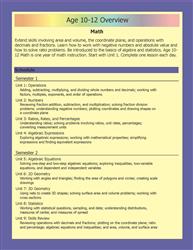
Unit 9: Skills Review
Lesson 1
Decimals, Factors, and Multiples
Students solve several division problems with whole numbers and decimals (for example, 2184 ÷ 56 and 994.08 ÷ 2.4) and compute non-integer quotients (118 ÷ 4 = 29.5). In the cupcake word problem, students interpret the quotient 29.5 by explaining the .5 as a partially filled box and determine a practical answer (round down to 29). Students also work on contextual word problems that require choosing division or LCM/GCF and performing division to find quantities.
Lesson 2
Fractions, Ratios, and Coordinates
Students solve division problems with rational numbers such as 5 1/4 ÷ 2 2/3 (converted and multiplied by reciprocal) and 1/2 ÷ 3 (=1/6). Students compute unit rates and quotients in real-world contexts (train speed 310 ÷ 5, unit price 6.12 ÷ 3, and time to make necklaces by scaling ratios). The student pages and answer key show procedures for dividing fractions and using division to interpret real-world situations.
Lesson 3
Expressions, Equations, and Percentages
Students solve equations that require forming and computing quotients (e.g., 9n = 63 leading to n = 7; m/4 = 5 leading to m = 20) and evaluate expressions that include division (x/2). Students also solve word problems that use division in context (Naomi: 5n + 3 = 18 solved by dividing to find hours; Pedro: n/3 = 9 representing equal grouping into bins). The answer keys show students carrying out division steps to find unknowns.
Lesson 4
Geometry
Students set up and evaluate quotients and ratios in scale/drawing problems (for example, they write 4/12 = 1/3 to find a scale factor and use a scale factor of 2/1 to enlarge a triangle). Students compute fractional products and areas (e.g., 3.5 × 2.8 and 9/2 × 9/2) that involve working with rational numbers. Students solve real-world proportional problems (e.g., increasing a 2 in. lighthouse by 800% to get 16 in.), which requires interpreting and applying ratios in context.
3: Math
Unit 1: Numbers
Lesson 1
Positive and Negative Rational Numbers
The Parent Plan explicitly states that integers can be divided (provided the divisor is not zero) and gives the identity (−)(p/q) = ((−)p)/q = p/((−)q). Day 3 activities and student pages present the rules for dividing signed numbers (positive ÷ positive = positive, positive ÷ negative = negative, etc.) and provide many practice problems dividing integers with real-world contexts (e.g., splitting debt, average daily loss, monthly deduction). The lesson includes explicit worked examples such as (−60) ÷ 5 = (−)12 and numerous word problems where students compute and interpret quotients in context.
Lesson 2
Fractions and Decimals
Students perform long division of integer numerators by integer denominators to convert fractions to decimals (examples: 3/4 → 0.75, 1/3 → 0.333…). Students use an algebraic procedure to convert repeating decimals into fractions (examples: 0.̅3 = 1/3, 0.̅17 = 17/99), showing that these quotients are rational. Students practice identifying that rational numbers have decimal expansions that terminate or eventually repeat and predict termination by examining prime factors of simplified denominators.
Lesson 5
Irrational Numbers
Students are given the formal definition that a rational number can be written as a fraction whose numerator and denominator are integers and the denominator is not zero. They convert decimals and repeating decimals to fractions (e.g., 0.625 → 5/8 and 0.3̅ → 1/3) and sort numbers into rational versus irrational categories, practicing identification of numbers that are expressible as integer quotients. The review quiz and activities require students to write numbers as fractions and simplify them, reinforcing the idea that many decimals and values are quotients of integers.
Lesson 6
Scientific Notation
Students perform division with numbers written in scientific notation (e.g., (6 × 10^8) ÷ (2 × 10^3) → 3 × 10^5) in multiple worked examples and student problems. Students use calculators in SN mode to compute quotients (examples show typing and solving division problems like (5 × 10^-8) ÷ (2 × 10^-3)). Students solve real-world division word problems that interpret quotients in context (e.g., dividing total cargo by number of trips, tank volume ÷ flow rate to find time).
Lesson 7
Arctic Marine Research
Students compute quotients of rational measurements in Phase 1 when they determine which organism has larger cells and calculate how many times larger the cod's cell is compared to the sponge (division of decimals/scientific notation). Students compare cell densities given in scientific notation (1.2×10^8 vs. 9.5×10^7), which requires forming and interpreting a ratio or difference between rational numbers. Students convert decimals to fractions (0.375 → 3/8 and 0.875 → 7/8) and classify numbers as rational or irrational in Phase 2, demonstrating understanding of numbers that can be expressed as quotients of integers.
Lesson 8
Unit 1 Test
The Parent Plan explicitly states: "Understand that integers can be divided, provided that the divisor is not zero, and every quotient of integers (with non-zero divisor) is a rational number. If p and q are integers, then (-)(p/q) = ((-)p)/q = p/((-)q)." Student-facing bullets repeat: "Divide integers (as long as you're not dividing by zero) and understand what the answer means in real-life situations." Practice problems ask students to compute integer quotients (e.g., -20 ÷ 4; -30 ÷ 5) and the answer key gives negative quotients, showing students practice dividing integers and explaining sign results.
Final Project
Mars Station Test Mission
The Skills list explicitly names the standard text about dividing integers and interpreting quotients of rational numbers. In Task 3 (Backup Fuel) students convert 7 × 10^2 kWh to 700 kWh and divide location energy shortfalls by 700 to compute how many fuel cells are needed, showing students produce and interpret quotients in a real-world context. The Task 2 supply-distance work and drop-zone calculations require students to compute quotients and unit-based divisions when finding costs and areas, providing additional real-world division practice.
Unit 2: Proportions
Lesson 1
Proportional Relationships
Students set up and solve proportions written as fractions for real-world contexts (e.g., miles per hour, eggs per cake, cost per item), and they use multiplication and division to isolate variables (for example, multiplying both sides by 12 then dividing by 2 to get x = 18, or dividing 72 by 2 to get n = 36). Several activities require students to interpret ratios as rates (e.g., 120 miles/3 hours → how far in 5 hours) and to compute the quotient to answer a practical question. The materials repeatedly have students write quotients (fractions) from contextual scenarios and use those quotients to find missing values.
Lesson 2
Unit Rates
Students repeatedly set up and compute quotients to find unit rates (e.g., $4.99 ÷ 6, 300 ÷ 5, 8 ÷ 20) and interpret the numerical results as rates like dollars per item or miles per hour. Students solve division of fractions and complex fractions using Keep-Change-Flip (e.g., 3/4 ÷ 1/2 → 3/2) and apply those quotients to real-world contexts (walking speed, recipe per batch, folding rate). Multiple activities require students to interpret the quotient as a unit rate and use it to make comparisons or predict outcomes in everyday situations.
Lesson 3
Constant Rate
Students repeatedly compute the constant k using the quotient k = y/x in tables, graphs, equations, and word problems (e.g., dog-walking pay, printing pages per minute, car speed, water per minute). Students divide integer and fractional measurements to find unit rates (examples show calculations like 60/1, 45/3 = 15, 21/3 = 7, and k = 1/12). Students also rewrite equations by dividing both sides (e.g., 4y = 8x → y = 2x) to identify k.
Lesson 4
Graphing Proportions
Students compute and interpret unit rates by dividing quantities in real-world contexts (e.g., money earned per hour, miles per hour, cost per item) and write equations y = kx with k found from table or graph. The activities ask students to check equivalent ratios (y/x) for proportionality and to compute rates from integer pairs (for example finding 50 mph from (3,150) and $8 per shirt from (1,8)). The lesson also includes examples with negative unit rates (e.g., change in temperature with points (1, -2), (2, -4)) and a skills item dividing rational amounts ((3/4) ÷ (2/3) = 9/8).
Lesson 5
Proportional Relationship Equations
Students compute quotients of rational numbers in contextual unit-rate problems (e.g., find speed when a car travels 3/4 mile in 1/2 hour and compute sugar per butter when a recipe uses 2/3 cup sugar per 1/4 cup butter). Several activity pages require students to divide fractions to find unit rates and to interpret those quotients in real-world contexts (distance/time, recipe ratios, calories per minute). The review quiz and answer key explicitly show fraction division procedures (3/4 ÷ 1/2 = 3/4 × 2/1) and ask students to explain what a unit-rate point like (1, y) represents.
Lesson 6
Taxes, Tips, and Commissions
Students set up and solve division equations to find original prices or values (e.g., p × 1.06 = 374.40 → p = 374.40 ÷ 1.06; 0.012 × V = 2400 → V = 2400 ÷ 0.012). Students compute incomes and rates by dividing amounts (e.g., 9000 ÷ 0.20 = 45,000; 225 ÷ 3000 = 0.075 = 7.5%). Students interpret those quotients in real-world contexts such as finding pre-tax price, property value, or income before tax.
Lesson 7
Markups and Discounts
Students compute and interpret quotients in real-world contexts using the percent-change formula (Percent Change = (New Value - Original Value) ÷ Original Value × 100) and apply it to examples like price increases and decreases. Students solve forward and backward problems that require division of rational numbers to find original prices (for example x × 0.85 = 255 → x = 255 ÷ 0.85) and calculate discounts and markups by dividing or multiplying decimals and percentages. The activities frame these quotients in shopping contexts (discounts, markups, percent change), so students interpret the meaning of those quotients as percentages or prices.
Lesson 8
Simple Interest and Percent Error
Students compute quotients in real contexts: the percent error example shows students find |30 − 25| = 5 and then perform 5 ÷ 30 = 0.1667, and multiple percent-error problems ask students to divide differences by actual values. In simple interest problems students solve for unknowns by dividing (for example r = 250/5000 = 0.05) and use division to convert integer ratios to decimal rates. Students also write rates as decimals and interpret those quotients in financial contexts (interest earned, rate, time).
Lesson 9
Unit 2 Test
Students compute unit rates that require dividing fractions (e.g., find the unit rate for 3/4 mile in 1/2 hour and 5/6 mile in 2/3 hour) and solve real-world quotient problems such as finding pre-tax prices by dividing total cost by 1.06. Students interpret quotients in context by explaining what points like (0,0) and (1,r) mean on proportional graphs and by deciding whether tables and graphs represent proportional (quotient) relationships. Students write and use proportional equations of the form y = kx, identifying the constant of proportionality as a quotient from tables and situations.
Final Project
Lemonade Stand
Students compute unit prices by dividing total cost by number of items (e.g., price per lemon, price per cup) and set up proportions to find amounts (e.g., pounds of sugar, lemons needed). Students create tables and graphs of cost vs. quantity and use equations in the form y = kx to represent unit rates, which are quotients in real-world contexts. Students use division to convert total cost for a gallon into cost per cup (total cost ÷ 16).
Unit 3: Expressions
Lesson 2
Rewriting Expressions
Students set up and solve equations by dividing to find original prices (e.g., 31.50 = P(1.05) then dividing both sides by 1.05 to get P = 30). The lesson includes multiple worked examples where students divide by decimal factors (54 = P × 0.9 → P = 54 ÷ 0.9) and practice problems that require dividing a known total by (1 + rate) or (1 − rate). Activity prompts ask students to interpret those quotients in shopping and business contexts (finding original price, tax rate, or markup).
Lesson 3
Algebraic Expressions
Students perform division of integers when solving equations (e.g., 54 = 2(l + 6) → 42 = 2l → l = 21; steps show "divide both sides by 2" and "divide each side by 3"). Students produce and work with non-integer rational quotients in solutions (examples include x = 7/2, x = 21/4, x = -1/3, x = 20/3) and are told answers may be left as simplified improper fractions. Students apply division in real-world contexts and interpret the quotient as a meaningful quantity (e.g., 12 ÷ 4 = 3 packs of markers; dividing total cost by cost per ride to find number of rides).
Lesson 4
Graphing Proportions
Students are instructed to find the unit rate by dividing the y-value by the x-value (e.g., 6 miles ÷ 3 hours = 2 mph; total cost ÷ pounds = $ per pound). Multiple real-world contexts appear (earnings $10/hour, miles per hour, price per pound, pencils and apples) where students compute and interpret quotients as unit rates. The lesson includes negative examples and division that yields negative or fractional quotients (e.g., k = (−18)/6 = (−3); unit rates shown as $0.63 and $0.67).
Lesson 5
More Graphing Proportions
Students compute unit rates by dividing integers in many places (e.g., 300 ÷ 5 = 60 mph; 95 ÷ 2 = 47.5 mph; 120 ÷ 2 = 60 mph; prices per candy from integer counts and costs). Students work with negative quotients and slopes in examples and problems (e.g., the equation y = -3x, graph points (1, -3), (2, -6), and slope answers like -2 and -3). Students interpret quotients as real-world rates in context (speeds in mph, price per candy, gallons per minute, cost per month).
Lesson 6
Intercepts
Students set one variable to zero and solve linear equations (for example, setting y = 0 in 2x + 4y = 8 gives 2x = 8 and x = 4), which requires dividing integers to find intercepts. The algebraic practice problems require students to solve for x or y by isolating the variable and performing division (e.g., 3x - 6y = 12, y = 5x + 10, x + 5y = 10). Students also work with negative numbers and decimal coefficients when finding intercepts, producing quotients as part of calculating intercept coordinates.
Lesson 7
Rise Over Run
Students draw right triangles between lattice points, count integer "rise" and "run," and compute slope by dividing rise by run, then simplify the resulting fraction (examples: +4/+4 = 1, (+5)/(+3) = 5/3, (−3)/+4 = −3/4). Students are instructed to mark direction with + or − signs when counting squares, and several activity problems and the answer key include slopes with negative numerators and positive denominators. Students also interpret slope values in real-world contexts (ramps, roads, skateboard/wheelchair ramp activity) connecting the quotient to steepness and motion.
Lesson 8
y = mx + b
Students compute slope using m = (change in y)/(change in x) with integer differences and form fractional slopes (e.g., m = -3/2 from 3x + 2y = 8). Students divide both sides of equations by integers (and by -1) to isolate y (examples: 3x + 2y = 8 → y = (-3/2)x + 4; 5x - y = 5 → y = 5x - 5). Students interpret slope as a rate in real-world contexts (e.g., $10 per hour, parking meter cents per time, cost per mile) and use those quotients to write and graph linear equations.
Lesson 9
Unit 3 Test
Students compute slopes using the quotient m = (change in y)/(change in x) in multiple problems (e.g., slope = ((-6) - 0)/(3 - 0) = -2 and other slope calculations). Students interpret unit rates and slopes in real-world contexts (earnings per hour, cost per day, GB per month) and solve word problems by dividing to find unit quantities (e.g., 30 + 10x = 80 → x = 5 GB; finding dollars per hour from tables). Several answer keys show fractional coefficients (e.g., y = 3/4 x - 2) and negative slopes, so students perform division with integers that produce rational results.
Final Project
Planes, Trains, and Automobiles
Students set up and solve equations of the form 500 = 60x, 500 = 80x, and 500 = 400x and compute x by dividing distance by rate (e.g., x = 500 ÷ 60 ≈ 8.33). Students interpret those quotients as travel times and compare the resulting rational numbers (times) across car, train, and plane to decide which is fastest. Students also compute cost per mile and write linear cost equations (y = mx + b), producing and interpreting quotients that arise in those comparisons.
Unit 4: Probability
Lesson 1
What Is Probability?
Students convert integer counts to fractions and decimals in multiple activities (e.g., turning 6 out of 10 coin flips into 6/10, 0.6, 60%). The spinner activity uses the formula Probability = number of favorable outcomes / total outcomes and has students compute fractions like 6/12, 2/12, and 4/12 and then express them as decimals and percents. The coin-toss and experimental probability activities have students divide counts by total trials to interpret the resulting quotient as a probability in real-world contexts.
Lesson 2
Observing Probability
Students compute experimental probability using the formula Experimental Probability = Number of times it happened / Total number of spins and convert those quotients to fractions, decimals, and percents (e.g., 59/100 = 0.59; 18 ÷ 100 = 0.18). Students use those quotients to make real-world predictions by multiplying the experimental probability by 600 (Prediction = Experimental Probability × 600) and interpret the quotient as a relative frequency in the spinner context.
Lesson 3
Probability Models
Students set up probabilities as quotients of whole-number counts (e.g., P = number in a group / total number of items such as 16/34 for the fine arts example, 1/6 for a die, 4/12 = 1/3 for marbles). They compute and simplify these fractions, convert them to decimals/percentages (e.g., 2/6 → 1/3 → 0.33 or 33%), and use those quotients to make real-world predictions (e.g., 1/6 × 120 = 20 expected occurrences). Students also build experimental probability models from observed integer tallies (e.g., 29/50 = 0.58) and compare those quotients to theoretical models.
Final Project
Happy Tails Dog Shelter
Students compute probabilities by dividing integer counts by the total (the lesson gives the formula Percentage = Number of dogs/60 × 100 and worked examples: (Small, Brown) 3/60 = 5% and (Medium, White) 9/60 = 15%). Students build a probability model that lists outcomes and their probabilities (size+color combinations with corresponding fractions/percentages) and then use those quotients to run simulations (using a 10-sided die) to predict real-world arrival patterns.
Unit 5: Functions
Lesson 1
What Is a Function?
Students write and use rules that include division (for example y = (x + 3)/2 and prompts like "the quotient of a number and five, increased by two" and "the difference of one fourth of a number and two"). Worked examples show students calculating with integer inputs that produce fractional or decimal outputs (e.g., (−2+3)/2 = 0.5 and −4 ÷ 4 = −1). Several student tasks require completing tables and computing outputs after division, so students practice dividing integers within function rules.
Lesson 4
Intercepts
Students set one variable to 0 and solve linear equations by dividing integer coefficients to find intercepts (examples show x = 4/3 and x = -3/2). Students solve a real-world intercept problem with $50 and $10 tickets, finding x-intercept (5, 0), which requires computing 50 ÷ 10. Student activity pages and worked examples show step-by-step division of integers when isolating variables (e.g., "3x = 4" then "x = 4/3").
Lesson 5
Slope
Students compute quotients of integers when they use the slope formula m = (y2 - y1)/(x2 - x1) in multiple examples (e.g., (16 - 2)/(-3 - 4) = 14/ -7 = -2, slopes of 1/2, 1/4, -1/2, etc.). The lesson explicitly warns that vertical lines have undefined slope because division by zero is not possible, so students see the restriction that the divisor cannot be zero. Students interpret slope values in context (e.g., "the line goes down 2 for every 1 step right," rollercoaster/stair/ramp examples, and a photo scavenger hunt to find real-world slopes).
Lesson 6
Slope-Intercept Form
Students compute slopes using the formula m = (y2 - y1)/(x2 - x1) in multiple activities, producing quotients such as 6/3 = 2 and 1/5 = 0.2. Students isolate y by dividing both sides of equations (e.g., −2y = −x + 4 leading to y = (1/2)x − 2 and 3y = −2x + 6 leading to y = (−2/3)x + 2). The lesson interprets slope as a rate in a real-world context (e.g., 1/5 miles per minute → 12 miles per hour).
Lesson 7
Creating Functions
Students use the slope formula m = (y2 - y1) / (x2 - x1) to find rates (division is used to compute slope) and they compute numeric quotients such as m = 3 and m = 0.25 from tables and graphs. Students interpret those quotients as real-world rates (e.g., 15 pages per hour, $3 per hour, 0.25 units per mile) and write function rules using those rates. The activities include negative rates (e.g., S = −3f + 30, P = −2s + 50, B = −5h + 100) which students interpret as decreases over time.
Lesson 8
Comparing Functions
Students compute rates by dividing differences (e.g., Alex: 1.5 ÷ 30 = 0.05 miles/min; Bella: (2 − 0)/(30 − 0) = 2/30 = 0.067). Students compute negative quotients to find rates of loss (e.g., Jordan's slope = −3 from y = −3x + 100; Taylor's slope = (261 − 275)/(4 − 0) = −14/4 = −3.5). Students interpret those quotients in real-world contexts (miles per minute, dollars per week) and use them to compare which situation changes faster or is losing money faster.
Lesson 9
Unit 5 Test
Students compute slopes as quotients of differences (e.g., Slope = (6−2)/(3−1) = 4/2 = 2) and find rates from tables (e.g., Rate of change = 60 miles per hour from distance/time data). Several real-world problems require interpreting a quotient as a unit rate (distance/time, dollars/hour) and students write functions for earnings (E = 12h, E = 15h). The review problems and answer keys show students producing and using fractional or decimal slopes (e.g., -1.5) obtained from division of numerical differences.
Unit 6: Geometry
Lesson 1
Congruence and Similarity
Students compute scale factors by dividing side lengths (e.g., 6 ÷ 3 = 2) and use division to find missing side lengths (e.g., x = 10 ÷ 2 = 5, x = 14 ÷ 2 = 7). They use fractional and decimal scale factors (examples include 1/2, 1/3, and 0.4) when solving proportional relationships. Students interpret scale factor as a real-world comparison of sizes in the Origami Zoo activity, describing how one folded figure is a scaled version of another.
Lesson 6
Dilations
Students calculate scale factors by dividing new lengths by original lengths (e.g., Scale factor = A′B′ ÷ AB; examples: 2 ÷ 4 = 0.5, 10 ÷ 6 = 5/3). Students use those quotients to determine whether a transformation is an enlargement or reduction and to compute new side lengths (new = original × scale factor). Students also encounter and work with rational scale factors (0.5, 0.25, 5/3, 0.33) in multiple practice problems and an applied example about flowers growing.
Unit 7: Linear Equations
Lesson 1
Linear Equations With One Variable
Students solve equations that require dividing both sides by integers (for example 4x = 32 → divide both sides by 4; 3x − 6 = 12 → divide by 3). Students work with fractional coefficients and explicitly use reciprocals to isolate the variable (examples: (3/4)x = 12, (2/5)x = 6 and the instruction "multiply by the reciprocal to isolate x"). Students also solve equations with decimal divisors and divide by decimal values (example: 0.4x + 2 = 6.8 → divide both sides by 0.4).
Lesson 2
Multi-Step Equations
Students solve many equations by dividing both sides to isolate a variable (for example, dividing by 3, 4, or 6 in worked solutions). Students work with equations that include explicit fractional coefficients (e.g., (1/2)(x+8)=6) and decimals and then divide to find non-integer solutions. Students set up and solve real-world word problems that require interpreting quotients (e.g., guests from total cost 50 + 8.75g = 312.50, days from total miles 1.5d = 36, tickets from total revenue 3t - 200 = 1600).
Lesson 3
How Many Solutions?
Students repeatedly divide both sides of equations by numerical coefficients to isolate variables (e.g., 3x+4=10 -> subtract 4 then divide both sides by 3 to get x=2; 5y+2=5y+2 -> subtract 2 then divide both sides by 5 to get y=y). Multiple activities prompt students to "divide both sides" as a procedural step and include practice problems requiring division in simplification. Worksheets and examples show students performing division with integer coefficients as part of solving or simplifying linear equations.
Lesson 4
Multi-Step Word Problems
Students solve equations by dividing both sides (e.g., 15x = 105 then divide by 15 to get x = 7) and work with fractional and decimal coefficients in context (problems include (3/4)x + 4 = 10, 0.5x - 3 = 7, and 40 + 0.30x = 94). Students interpret quotients in real-world settings such as splitting a bill among friends, finding boxes of cupcakes (dividing total cupcakes by 6), and determining months or miles from total cost and unit rates. Several word problems require students to compute and interpret quotients as meaningful quantities (months, boxes, miles, people).
Lesson 7
The Point of It All
Students solve arithmetic equations that involve division such as x/3 = 7 and x/2 - 7 = 3, and they find solutions that are integers. Students encounter and record rational solutions from solving systems (for example an answer of 4/3 appears in the answer key). Students also work word problems about rates (a delivery per-mile fee and a babysitting hourly rate) that require forming and solving equations that may involve quotients.
Lesson 9
Unit 7 Test
Students solve equations with fractional coefficients (e.g., 3/4 x = 12, 2/3 x = 3, 5/6 x = 15, 4/3 x = 8) using reciprocals and multiplication by the reciprocal to isolate x. Students solve real-world problems by forming linear equations and dividing totals by rates (e.g., 12h + 50 = 122 → 12h = 72 → h = 6), producing rational or decimal answers (e.g., ticket prices $9.00 and $3.50). Several graphing and algebra problems include negative coefficients and intercepts so students work with quotients and solutions involving negative numbers in context.
Final Project
Getting Ready for College
Students set linear expressions equal and solve by division to find real-world break-even quotients (e.g., Housing: 1200m = 1500 + 1050m → 150m = 1500 → m = 10). Students solve for miles and hours by isolating a variable and dividing (Transportation: 225 + 0.60x = 1.25x solved to x ≈ 346.15; Entertainment: 20 = 5 + 1.5h → h = 10). Students then interpret those quotients in context (months, miles, hours) to make decisions about costs and plans.
Unit 8: Data
Lesson 1
Statistics Review
Students compute means and other averages by dividing integer sums (for example, 30 ÷ 4 = 7.5 in the mean example and 171 ÷ 8 = 21.25 for turtle ages). Students compute MAD by summing absolute differences and dividing by the number of values to get a rational result (MAD ≈ 1.31). Students interpret those quotients in context (e.g., "the turtle ages are about 1.31 years away from the mean" and interpreting class average/test-score means).
Lesson 4
Linear Models
Students use the slope formula m = (y2 − y1) / (x2 − x1) to compute rates from scatterplots and perform divisions of integer differences (for example, 10 ÷ 4 = 2.5 in the bird migration sample). Students write and interpret linear equations like y = 2x + 50 to explain rates in context (e.g., 2 additional ice cream cones per 1°F) and interpret negative slopes in context (e.g., slope = −6 means 6 liters of fuel are used per hour). Several practice problems require students to calculate slopes, write quotients as decimal or fractional rates, and use those quotients to make predictions.
Lesson 5
Categorical Data
Students compute relative frequencies by dividing integer counts by integer totals (Relative Frequency = number of times of an event / number of events) and carry out examples such as 18/90 = 0.20. Students convert two-way frequency tables into relative frequency tables (row‑ or column‑based) and express results as decimals or percents across multiple activities. Students interpret those quotients in real‑world contexts (e.g., "20% of bikers caught a cold; 25% of drivers caught one") to compare groups.
Final Project
Collecting and Organizing Data
Students are instructed to total tally counts and "Calculate Percentages" for each cell of a two-way relative frequency table, with explicit guidance that each cell can represent the percentage of all 20 people who fit that combination. Activity pages direct students to convert tally marks into percentages and to use those percentages to identify which category combinations have the highest or lowest values. Reflection prompts ask students to interpret those percentages in real-world terms (e.g., which activity/time combinations are most popular).
Unit 9: Semester Exams
Lesson 1
Numbers Review
Students solve integer division problems such as -6 ÷ 2 in Mission 2 and complete context problems -45 ÷ 9 and -72 ÷ 6 on the activity page, with answers and interpretations provided. The lesson links a video titled "Dividing Positive and Negative Integers" and asks students to explain what their quotient means in real-world scenarios (gamer points, shared debt, temperature change). The Parent Plan text explicitly states the rule that integers can be divided (divisor not zero) and gives the identity (−)(p/q) = ((−)p)/q = p/((−)q).
Lesson 2
Proportions Review
Students compute quotients and unit rates in real-world contexts (e.g., 3 miles in 12 minutes → miles per hour; 2 cups for 5 batches → cups per batch; runner speeds; cost per ticket; map scale; simple interest), showing division of integers and fractions to produce decimal/rational results. Students represent proportional relationships with equations like y = kx and identify the constant of proportionality, linking the quotient (unit rate) to contextual meaning. Several tasks ask students to interpret what points such as (1, r) and (0,0) mean in situation-based graphs, reinforcing interpretation of quotients in context.
Lesson 3
Expressions Review
Students compute slopes as quotients of integer differences when they find slopes from two points (for example computing slope = -3 from (0,5) and (3,-4)). Students interpret unit rates as quotients in real contexts by finding pay per hour or cost per day (e.g., babysitting $14 per hour, car rental $75 per day, delivery service $18 per hour). Students write equations in form y = mx + b and explain what the slope (m) represents in context, connecting the numeric quotient to real-world meaning.
Lesson 4
Probability Review
Students compute probabilities by dividing integer counts, as shown by directions like "Probability = number of favorable outcomes ÷ total number of outcomes" and worked examples such as 3/10 for marbles, 4/20 = 0.20 for hamsters, 7/25 = 0.28 for spinner trials, and 21/26 for consonants. Students convert these quotients to fractions, decimals, and percents and interpret them in real contexts (e.g., interpreting 3/10 as "3 out of every 10 selections would be blue" and predicting expected counts like 20 × 1/4 = 5).
Lesson 5
Semester Exam
Students solve integer division problems such as -48 ÷ 6 (answer −8) and work with negative-number multiplication including reasoning about sign ((-6)(-4)). Students compute and interpret quotients of rational numbers in real-world contexts through unit-rate and proportional problems (e.g., 4/5 mile in 1/2 hour, 18 miles in 3 hours, and finding unit rate from a line through (0,0) and (2,10)). Students convert between fractions and decimals (7/16 → 0.4375, 0.375 → 3/8), showing practice expressing quotients as fractions or decimals.
Lesson 6
Functions Review
Students calculate slopes as quotients (for example, finding the slope from points (2,1) and (6,9) which requires computing (9−1)/(6−2)). Students interpret slopes as rates in real-world contexts (writing y = 18h for earnings and explaining the slope as dollars per hour, and answering questions about taxi starting fees and per-mile charges). Students also analyze negative slopes (e.g., y = −1.25x + 5) and explain that a negative slope means the output decreases as the input increases.
Lesson 7
Geometry Review
Students calculate scale factors in multiple dilation problems (e.g., Section 6 where they compute the scale factor 15 ÷ 6 = 2.5 and then find the other side lengths; Section 4 identifying a scale factor of 1/2; and the graphing task dilating Triangle LMN by a factor of 3). Students use those quotients to produce new side lengths and to decide whether a transformation is an enlargement or reduction. Several tasks require applying a numeric quotient as a scale factor to real geometric figures on coordinate grids.
Lesson 8
Linear Equations Review
Students solve linear equations that include fractional coefficients (e.g., (3/5)x = 18 and (2/3)x - 5 = 7) and are instructed to use reciprocals to isolate variables. The Parent Plan and Activity 1 explicitly state students will work with fractions and use reciprocals. Activity 4 has students translate real-world situations into equations and solve by dividing (for example 15m = 75 leading to m = 5), so students interpret quotients as answers to contextual questions like number of months or miles.
Lesson 9
Data Review
Students compute means and other averages by dividing integer sums by integer counts (e.g., Mean = 60 ÷ 7 ≈ 8.57; Mean = 44 ÷ 4 = 11). Students calculate mean absolute deviation using division (MAD = 8 ÷ 4 = 2) and compute relative frequencies and proportions such as 12/50 = 0.24 and 10/30 ≈ 0.33. Students interpret these quotients in context (e.g., 12/50 = 24% of evening students prefer gaming; median = 25 means half the days were at most 25 minutes).
Lesson 10
Semester Exam
Students solve equations that require dividing by rational numbers (e.g., problem 28: (3/5)x = 18 and problem 29: (2/3)x − 5 = 7), which requires finding quotients and using reciprocals. Students solve real-world rate problems that lead to quotients (problem 35: tutor charges $18/hour + $30 fee, and problem 8: $10 per hour earnings), which require interpreting a numerical result as hours or total earnings. Several problems produce non-integer solutions through division and ask for those numerical answers.