


Ninth Grade - ELA
• Literacy
1: Semester 1
Unit 1: Early Civilizations and Migration (600 BCE)
Lesson 3
Early Civilizations
Students create and annotate a flowchart (Option 1 and Option 2) that requires them to explain how stages (Farming -> Villages -> Towns -> Cities -> Civilizations) are linked and to describe relationships among behaviors, problems, and solutions. Students complete the "Elements of Civilization" chart by writing descriptive phrases or sentences that compare how community needs were met in small villages versus complex civilizations, which requires clarifying relationships between social elements. Reading questions and short-answer prompts (e.g., how irrigation required organization; how writing facilitated long‑distance communication) require students to explain causal and relational links in writing.
Lesson 8
Historical Essay
Students are explicitly asked to check and rewrite transitions during revision: the lesson tells students to read paragraph summaries in order and "consider re-ordering your paragraphs and/or rewriting your transitions for a more effective organization." The rubric includes an item assessing that "transitions between ideas are smooth," which requires students to produce and be evaluated on transitions. Students are also instructed to read their essays aloud to catch awkward phrasing, which supports improving sentence-level clarity and flow.
Final Project
Flow Chart
Students plan and assemble a multi-page flowchart that must show the progression of societies and use arrows/lines to indicate relationships among events and ideas. Each element on the chart must include a 2-3 sentence description of its significance, and the rubric explicitly checks that "the flowchart clearly shows the relationships between ideas and stages of development" and that descriptions are "informative, well written, and free of error." Students also must organize boxes for major sections (hunter-gatherers, pastoralism, agriculture, and three civilizations) and show how those sections relate.

Unit 1: Lord of the Flies
Lesson 2
Life on the Island
Students are taught what clauses are and how independent and dependent clauses function, including explicit instruction about subordinating conjunctions and coordinating conjunctions (FANBOYS). The materials explain punctuation rules for joining clauses (comma before coordinating conjunctions, semicolons) and provide guided practice identifying clauses in sentences. In Part II students are asked to write sentences that combine independent and dependent clauses, two independent clauses, and a sentence containing both a coordinating and a subordinating conjunction.
Lesson 3
Paths in the Jungle
Students are directed in the Parent Plan Skills to "Use various types of phrases... and clauses... to convey specific meanings and add variety and interest to writing or presentations," which explicitly addresses varied sentence structures. Students write a one-paragraph character journal entry and produce clear, coherent writing as part of activities, providing opportunities to use different sentence constructions. The student organizer and the requirement to produce a thesis and supporting points require students to organize ideas into connected sections.
Lesson 4
Images from Paradise
The lesson explicitly teaches that dependent clauses function as noun, adjective, and adverb clauses and gives examples for each type. Activity 2 asks students to identify italicized clauses in sentences and to write three sentences about a book, each containing a different type of clause. The Parent Plan skills section states that students will "use various types of phrases ... and clauses ... to convey specific meanings and add variety and interest to writing or presentations."
Lesson 5
Not Hunting, But Hunted
The lesson explicitly tells students that "writers may mix dialogue and action, long and short sentences" to control pacing and includes modeled examples (the Lord of the Flies excerpts and Example B) that break a moment into discrete actions and varied sentence rhythms. Students are directed to recreate an important moment "in the fashion of Example B," which requires them to practice using varied sentence structures and pacing (series of verbs, interruptions, long/short sentences) in their own writing.
Lesson 7
Bowed and Bowed Again
Students are asked to identify and produce varied sentence structures: they analyze noun, verb, adjective, adverb, absolute, and prepositional phrases and write journal sentences that combine these phrases (Activity 2). The Parent Plan skills explicitly state that students will "use various types of phrases ... and clauses ... to convey specific meanings and add variety and interest to writing or presentations." Students also mark prepositional phrases in authentic text excerpts from Lord of the Flies to see how phrase placement affects meaning.
Final Project
Now You Have the Conch
Students are prompted to identify and evaluate transitions during revision: the "You Are the Editor" pages ask students to locate transition words/phrases, evaluate their effectiveness, and mark transitions between main points and paragraphs. The outline and essay organizer explicitly require a "Transition to next paragraph" line for each body paragraph, so students plan transitions when outlining. Grammar and sentence-structure work appears in the unit: Part I of the Unit Test asks students to locate and label prepositional phrases and clauses, and editing checklists ask students to check sentence structure (run-ons, choppy sentences) and use clauses and phrases to vary sentence type.

Unit 2: World Religions (600 BCE - 600 CE)
Lesson 7
Christianity
Students are asked to write summaries of two sources in Activity 1 (Option 1) and to summarize key points from Matthew 5-7 across several categories in Activity 1 (Option 2), which require composing informative/explanatory text. Students fill in the Dimensions of World Religions booklet (Activity 2), producing distinct sections about Christianity's beliefs, origins, and spread. The reading questions and homework prompt students to answer explanatory questions about the life, teachings, and spread of Christianity in writing.
Lesson 8
Islam
Students are asked to write a timeline with one clear, well-organized paragraph for each date explaining the event and its significance, which requires organizing ideas and linking explanation to dates. Students complete a "Two Versions" comparison activity in which they summarize shared elements and note differences between Bible and Qur'an accounts, requiring them to relate and clarify connections across two texts. Students fill in sections of a "Dimensions of World Religions" booklet, which asks them to organize information across labeled dimensions and may require connecting ideas across those sections.
Unit 3: Grammar, Part I
Lesson 1
Parts of Speech
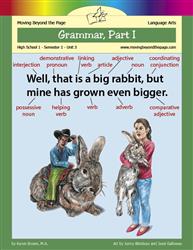
The lesson explicitly teaches conjunctions and conjunctive adverbs (definitions, examples, and the formula: independent clause + semicolon + conjunctive adverb + comma + independent clause) and has activities that ask students to identify subordinating, correlative, and coordinating conjunctions. Students practice identifying conjunctions and conjunctive adverbs on multiple activity pages (Prepositions and Conjunctions, Adjectives and Adverbs) and read explanatory sections describing how conjunctions begin dependent clauses and join clauses or sentences.
Lesson 6
Colons and Semicolons
Students are taught the formula independent clause + semicolon + conjunctive adverb + comma + independent clause and are given examples (e.g., "The restaurant's dress code forbids men to wear hats; nevertheless, Arnold walked in..."). Students must write opening statements that include one example joining two independent clauses and one example joining two independent clauses with a conjunctive adverb + comma. Students also present and defend their statements aloud, answering questions such as how a semicolon changes the relationship between two ideas.
Final Project
Wrapping Up
Students are asked in Part III question 14 to describe uses of a semicolon, and the answer key explicitly notes joining two independent clauses with a transitional word/phrase (conjunctive adverb). Option 2 requires students to write a short paragraph in which "all of your sentences work together as a paragraph" so students must produce cohesive sentences that tell a story or give advice. Part IV punctuation items require students to insert semicolons, commas, and transitional punctuation to link clauses, which practices marking relationships among ideas.
Unit 5: Nonfiction
Lesson 3
The Taliban
Students are explicitly told to "avoid writing a series of short, choppy sentences; instead, use transitional words and phrases to smoothly link your thoughts" when writing their informational paragraph. The lesson directs students to consult pp. 159–161 of The Only Grammar Book You'll Ever Need for a list of transitional words and phrases. The parent/teacher guidance instructs teachers to confirm the paragraph flows and to encourage use of transitional words and phrases if sentences seem choppy.
Lesson 12
Running from War
The lesson explicitly teaches three methods for transitioning into quotations: a complete introductory sentence followed by a colon, a short introductory phrase followed by a comma, and integrating a portion of the quotation into the student's sentence (Things to Know; Activity 1 examples). Activity 1 and the Student Activity Page ask students to practice those methods (Part II asks students to introduce a given quotation using one of the three methods). The Skills section also lists use of a colon to introduce a quotation, reinforcing punctuation choices for linking text and quoted material.
Lesson 15
A New Life
The lesson instructs students that their summaries should be in paragraph form and that "sentences flow together naturally," explicitly encouraging the use of transitional words and phrases. It directs students to "pp. 159-161 in The Only Grammar Book You'll Ever Need, Updated Edition" for a list of transitional words and phrases. The parent notes reiterate that students should use transitional words and phrases when composing summaries and the comparing-memoirs activity asks that sentences flow together well.
Final Project
Expository Essay
The Parent Plan Skills list explicitly requires use of "appropriate and varied transitions to link the major sections of the text, create cohesion, and clarify the relationships among complex ideas and concepts." The Organization criterion in the Expository Essay Rubric evaluates connection of thesis points "with transitional words and phrases." The homework/revision guidance tells students to "include clear transitional words and phrases" and points them to a list of transitions in The Only Grammar Book; proofreading notes also tell students to ensure "sentence length and type are varied."
2: Semester 2

Unit 1: Ender's Game
Lesson 7
Leaders Motivate
Students are asked to write a journal entry describing the links between the personalities behind the pen names Locke and Demosthenes, which requires them to explain relationships among ideas. Students match leadership quotes to characters and complete a three-column chart (Character, Quote, Reason), which requires them to organize claims and explain connections between quotations and character actions. Students discuss their journal entries and answer short-response questions about characters and leadership, practicing coherent explanation across multiple paragraphs or responses.
Final Project
Think-Tac-Toe
Students are asked in Box 4 to rewrite conversations and to add "any additional transitional phrases needed so that the quote makes sense," which explicitly names transitional language. Several final-project tasks require multi-paragraph writing (Box 5 asks for two to three paragraphs comparing and contrasting military and civilian leadership; Box 2 asks students to write a one- to three-paragraph flashback), which gives students opportunities to link ideas across sentences and paragraphs. Box 3 asks students to rewrite a passage in first-person, which requires revising sentence perspective and structure.
Unit 2: Grammar, Part II
Lesson 1
Review of Grammar, Part I
Students identify and match coordinating conjunctions (FANBOYS), subordinating conjunctions, and conjunctive adverbs in the Grammar Matching activity and answer key (e.g., I wanted to go; nevertheless, I stayed home). Students practice punctuation that links clauses, including inserting commas and semicolons and punctuating conjunctive adverbs in the "Punctuation and Grammar" activity and its answer key. Homework Option 2 asks students to create paragraphs that require commas and semicolons and to write an answer key explaining the rules that apply.
Lesson 3
Sentence Fragments and Run-on Sentences
The Parent Plan lists as a skill that students should "use various types of phrases ... and clauses ... to convey specific meanings and add variety and interest to writing or presentations," and activities require students to identify and use gerunds, participles, infinitives, participial phrases, and other verbal phrases (Activity 2). Activity 4 teaches students to correct run-on sentences by splitting clauses, using a semicolon, or using a comma plus a coordinating conjunction (FANBOYS), which practices combining and varying sentence structures. The Creative Writing Challenge asks students to write a 1–2 page narrative, giving them an opportunity to apply varied sentence structures in extended writing.
Lesson 8
Parallelism
Students identify and correct faulty parallelism in sentences (e.g., rewriting "Rashad enjoys going to the movies, skateboarding with his friends, and to read books" as "...and reading books"). Students read an online explanation and use an activity page to list coordinating conjunctions, correlative conjunctions, typical comparison words, and note examples/problems for items in lists, comparisons, and clauses. Students are asked to keep voice consistent across clauses and to order list items by chronology or importance, and they take notes and complete exercises that focus on parallel sentence structures.
Final Project
Wrapping Up
The lesson explicitly teaches sentence-level structure: the skills list includes "Use parallel structure," and the unit test and practice items require students to rewrite sentences from passive to active voice and correct fragments and parallelism. Mini-project options (Explanatory Guide, Slideshow, Song/Skit) require students to plan and organize explanations and provide their own descriptions and examples, and the project rubric requires clear explanations that demonstrate understanding. Several test items and editing exercises require students to revise sentences for correctness and clarity.

Unit 3: Informational Texts
Lesson 4
The 10,000 Hour Rule
The Looking Closely worksheet asks students to summarize Sections 1–3 and to analyze how Gladwell arranges information and develops his points, including a question that asks which words or phrases signal that Gladwell will treat Joy's story differently. The answer key explicitly points out the transition word "however," the hockey player example as a framing move, and the author's pause-and-return structure, directing students to analyze how sections are linked and developed.
Lesson 8
With Malice Toward None
Students learn explicit definitions and examples of parallelism and antithesis and are asked to identify those devices in Lincoln's Second Inaugural Address. Students complete an activity chart that requires them to quote lines, label the literary device, and explain its intended effect, focusing on sentence-level structures. Students also choose three sentences that represent the speech's background, main message, and forward-looking statement, which asks them to map sentences to major sections and consider the organization of ideas.
Lesson 11
Technical Writing
The Parent Plan Skills list explicitly includes "Use appropriate and varied transitions to link the major sections of the text, create cohesion, and clarify the relationships among complex ideas and concepts." Students are instructed to organize complex ideas, add headings/subheadings, write introductions and conclusions, and revise their guides for clarity and appropriate audience (Activities: How-to Guide planning, Organize and Revise, Guide Checklist). Students also practice creating cohesive products by assembling materials, steps, tips, and a final glossary and infographic that must be integrated into a single document.
Final Project
Argumentative Research Essay
Students are instructed to organize a five-paragraph classical argument with clear major sections (introduction/narration, confirmation, concession/refutation, conclusion) and to develop those sections (Part 7 and the Classical Argument activity). The Parent Plan Skills explicitly tell students to "Use words, phrases, and clauses to link the major sections of the text, create cohesion, and clarify the relationships" and to "Vary sentence patterns for meaning, reader/listener interest, and style." The Essay Rubric requires that key points be "strengthened with words and phrases connected with transitions" and that "Sentence structure varies" in the Style category.

Unit 4: Drama
Lesson 5
Act II
Students are asked to write a five-sentence reader-response paragraph using the APE (Answer, Prove, Extend) method, which requires them to organize a claim, provide evidence, and explain connections. Students must also write a six-sentence monologue (Option 1) and complete a multi-part character analysis that separates biographical, physical, and psychological sections. Several assignments require multi-sentence journal entries (song analyses, reader response) that ask students to support ideas with textual or media evidence.
Semester Exam
Semester Exam
Students complete multiple grammar and usage tasks that target sentence-level variety and clarity (e.g., rewriting verbose sentences for brevity, creating sentences with participial phrases, practicing active vs. passive voice, and correcting parallelism). The skills list and unit review sections explicitly ask students to know how to make writing parallel, understand verb voice and mood, and produce clear and coherent writing appropriate to purpose and audience. Discussion and short-answer tasks require students to write 1–3 paragraph responses that demand organized, coherent prose and revision of previous writing assignments.