


Sixth Grade - MATH
5: Math
Unit 3: Ratios and Percentages
Lesson 6
Percentage Problems
Students rewrite percentages as fractions and multiply to produce equivalent numeric expressions (e.g., 15% × 300 = 15/100 × 300 = 4500/100 = 45) and are shown cross-cancelling as a simplification strategy. Students create equivalent ratios using double number line diagrams to find missing values, effectively generating equivalent numeric relationships. Students also translate percent word sentences into number sentences and manipulate the equation form (e.g., 32 = 0.64x leading to x = 32/0.64) to find unknowns.
Unit 4: Algebraic Expressions
Lesson 4
Positive and Negative Numbers
Students are instructed to rewrite subtraction as addition of the opposite and then rearrange terms using the commutative and associative properties (example: 3 - 5 + 4 + 2 - 13 → 3 + (-5) + 4 + 2 + (-13) → (3+4+2)+((-5)+(-13)) → 9 + (-18) = -9). The lesson explicitly names and models the commutative and associative properties (18 + 27 + 2 + 3 rearranged and regrouped) and gives multiple activities where students change subtraction to add-the-opposite and then group and simplify. Activity prompts and a challenge problem ask students to generate equivalent numeric expressions by applying these properties.
Lesson 5
Equivalent Expressions
Students are asked to use the commutative and associative properties with variables (Activity 3) and to rewrite expressions using those properties (e.g., rewrite 9 + 6x as 6x + 9, rewrite (8x)y as 8(xy)). Students explicitly apply properties to generate equivalent expressions and simplify them (Activity 4 shows using the commutative property to reorder 5a + 6 + 2a + 3 into (5a + 2a) + (6 + 3) and then combining to 7a + 9). Students practice changing subtraction to adding the opposite so they can use addition properties to rearrange and combine like terms, and they complete matching and cut-and-paste activities to identify equivalent expressions (Activity 5 and student worksheets).
Lesson 6
The Distributive Property
Students learn and practice the distributive property a(b + c) = ab + ac with numeric and algebraic examples (e.g., converting 5(6+9) to 5·6 + 5·9 and 5(n+2) to 5n+10). Students match area models to two equivalent expressions, rewrite expressions using distributive/commutative/associative properties (examples such as 4(3a+5)-6a-10+2a simplified to 8a+10), and rewrite or factor expressions (e.g., 7m+14n = 7(m+2n)). Students also evaluate original and simplified expressions with the same variable value to prove equivalence (e.g., evaluating 5(x+3)+2x-12 and 7x+3 at x=5).
Lesson 7
Unit 4 Test
Students practice applying the distributive property to generate equivalent expressions (e.g., Problem 14: write 12(x + 6) as 12x + 72 and prove equivalence by evaluating with x = 10). Students write equivalent expressions using the commutative property (Problem 13 asks for an equivalent expression 5 + 12n) and match property names to example equations (distributive, commutative, associative). Students simplify expressions by combining like terms in several problems (e.g., 2(n + 9) + 7n - 13 → 9n + 5 and tasks to write expressions in simplest form).
Final Project
Algebra Think-Tac-Toe
Students simplify expressions in the "Prove It! Equivalencies" activity by applying the distributive property, changing subtraction to addition of opposites, using the commutative property, and combining like terms, then evaluate both forms to prove equivalence. In the "Math Properties Trading Cards" activity students create examples and explanations for the commutative, associative, and distributive properties, showing number examples that apply each property. The parent plan and skill list explicitly ask students to "Apply the properties of operations to generate equivalent expressions," and multiple projects (Prove It!, Make a Quiz, Create a GoFish!, Design a Book Cover) require students to rewrite or combine terms to produce equivalent simplified expressions.
Unit 5: Algebraic Equations
Lesson 2
Solving One-Step Equations, Part 1
The lesson explicitly names and uses the commutative property when it tells students that n + 3 is the same as 3 + n and uses that idea to explain how a variable is attached to a constant. The lesson also has students perform operations that preserve equality (adding or subtracting the same value from both sides) and describes these as properties (addition and subtraction properties of equality) that students use to manipulate expressions within equations. Several activities ask students to rewrite parts of equations (e.g., identify n + 3 = 8 or rewrite 2n + 5 = n + 3 as 2n + 5 = 3 + n) and then solve them.
Lesson 4
Solving Two-Step Equations
Students are shown explicit uses of the distributive property to rewrite expressions (e.g., 3(n - 4) = 15 rewritten as 3n - 12 = 15) and asked to simplify examples like 5(n + 2) = 25 to 5n + 10 = 25. The lesson has students combine like terms (e.g., 5 + 4n + 3 simplified to 4n + 8) before solving, and students create Interactive Notebook pages that require rewriting and simplifying expressions. Visual models and worked examples repeatedly show rewriting expressions into equivalent forms as a step in solving equations.
Lesson 7
Independent and Dependent Variables
Students are shown examples of rewriting equations using inverse operations (for example, d = 45t rewritten to t = d/45 and 2x - y = 4 rewritten to 2x - 4 = y), so they practice producing equivalent equations by performing the same operations to both sides. The lesson explicitly names the commutative property when listing solution pairs for x + y = 8 and notes that numbers can be switched. Visuals and steps demonstrate adding, subtracting, multiplying, and dividing both sides to isolate a variable, which produces algebraically equivalent expressions or equations.
Lesson 8
Unit 5 Test
Students expand expressions using the distributive property when solving equations such as 2(y + 1/2) = 13 (rewritten as 2y + 1 = 13) and 3(y − 4) = 6 (rewritten as 3y − 12 = 6). Students rewrite equations into equivalent forms (for example x − y = 8 rewritten as x − 8 = y and y + 5 − 2x = 6 rewritten as y = 2x + 1) and perform inverse operations (adding/subtracting, multiplying/dividing both sides) to produce equivalent equations. The Parent Plan explicitly lists applying properties of operations to add, subtract, factor, and expand linear expressions as a skill goal.
Unit 6: 2D Geometry
Lesson 2
Working With Angles
Students rewrite and simplify algebraic expressions when they combine like terms (for example, n + 2n = 90 simplified to 3n = 90 and 2n + 3n = 180 simplified to 5n = 180). Students rewrite equations by removing a variable from one side (for example, 5n = n + 92 is rewritten as 4n = 92 by subtracting n from both sides). Students also simplify an algebraic expression on the Basic Skills Review (12x + 6x + 4 - 5x + 4x - 10 simplified to 17x - 6).
Lesson 5
Circles
Students are guided to use inverse operations and the symmetric property to rewrite π = C/d into C = πd (Activity 2). Students use the relationship d = 2r and substitution to rewrite C = πd as C = 2πr when a radius is given (Activity 2). Students replace C with 2πr in the expression A = (1/2)·C·r and simplify 1/2·2 and r·r to generate the equivalent expression A = πr^2 (Activity 4).
Lesson 7
Unit 6 Test
Students write and solve linear equations for angle measures (e.g., n + 2n + (3n + 12) = 180 and 3n = 2n + 35) and the answer key shows these being simplified to 6n + 12 = 180 and solved by combining like terms and subtracting terms. Several problems require students to set up algebraic expressions for angle relationships (vertical, supplementary, complementary) and manipulate those expressions to find n (e.g., 3n + 35 = 4n leading to 35 = n).
Unit 7: 3D Geometry
Lesson 1
Three-Dimensional Solids
Students set up and solve equations using Euler's formula (e.g., F + 5 - 8 = 2) and then manipulate that equation by changing subtraction to adding the opposite, combining like terms (F + (-3) = 2), and adding the inverse to both sides to isolate the variable (F = 5). Students also solve similar problems on activity pages and in the answer key where they use the same algebraic steps to find unknown faces or vertices given edges and vertices.
Lesson 2
Surface Area
The Basic Skills Review includes a problem that asks students to simplify using the distributive property: 5(n + 7) =, and the answer key shows the expansion 5n + 35. In Activity 2 the lesson shows the sum of congruent face areas (60 + 60 + 50 + 50 + 30 + 30) and rewrites that sum in factored/formula form as SA = 2LW + 2LH + 2WH, demonstrating grouping and factoring of like products. The lesson also asks students to plug length, width, and height into the surface-area formula, reinforcing substitution into a factored expression.
Lesson 5
Problem Solving With Solids
Students set up and manipulate algebraic expressions when solving for missing dimensions (e.g., 54 = L × 4 1/2 × 2, then simplify to 54 = 9L and solve L = 6). Students solve equations that require isolating variables by dividing both sides (e.g., 864 = 6s2 leading to 144 = s2). Students simplify algebraic expressions in Basic Skills Review (e.g., 4x + 3x - 9 + x + 16 is combined to 8x + 7).
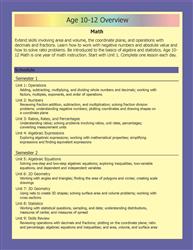
Unit 9: Skills Review
Lesson 1
Decimals, Factors, and Multiples
Activity 2 explicitly asks students to use the distributive property to factor 36 + 88 and to use the distributive property to multiply 15 × 32, and the answer key shows those rewrites as 4(9+22) and 15(30+2) leading to equivalent numerical expressions. Students also use prime factorization and greatest common factor work, which involves rewriting numbers in factor form and applying properties of multiplication. The tasks require students to generate equivalent numerical expressions as part of solving factor and multiple problems.
Lesson 3
Expressions, Equations, and Percentages
Students complete problems that require using the distributive property and combining like terms, for example simplifying 3(n + 6) + 4n - 10 to 7n + 8 and x + 2x + 3 + 3x - 7 to 2x - 4. The student activity asks them to write expressions from word phrases and evaluate expressions at given variable values, reinforcing manipulation of expression structure. The Parent Plan explicitly lists "Apply the properties of operations to generate equivalent expressions" and "Apply properties of operations as strategies to add, subtract, factor, and expand linear expressions with rational coefficients."
3: Math
Unit 1: Numbers
Lesson 1
Positive and Negative Rational Numbers
The lesson explicitly references the distributive property in the Parent Plan (noting that multiplication is extended to rational numbers by requiring properties of operations, particularly the distributive property) and asks students to explain (-3)×(-4) using the distributive property or a number line in Activity 2. Videos and teacher notes repeatedly connect sign rules to logical properties like the distributive property and the relation between multiplication and division. Several challenge prompts ask students to 'explain why' using the distributive property, indicating opportunities to use an operation property to justify equivalence in numeric cases.
Lesson 3
Properties of Exponents
Students fill in a "Properties of Exponents Notes" page that lists and requires them to complete rules such as x^0 = 1, x^{-n} = 1/x^n, x^m · x^n = x^{m+n}, x^m / x^n = x^{m-n}, (x^m)^n = x^{m·n}, (x·y)^m = x^m·y^m, and (x/y)^n = x^n/y^n. In Activities 1–5 students apply those rules to rewrite and simplify expressions (e.g., multiplying and dividing same-base powers, converting negative/zero exponents, applying power-of-a-power and power-of-a-product). The Mixed Review (Activity 6) explicitly asks students to produce answers in exponent form and then simplify numerically, requiring them to generate equivalent expressions using the taught properties.
Lesson 4
Square and Cube Roots
Students solve problems that require using laws of exponents to generate equivalent expressions: the Review Quiz and activity pages ask them to simplify (2^3)^2, compute 3^4 · 3^2, and simplify (4·5)^2. The answer key explicitly shows students applying exponent properties (e.g., (2^3)^2 = 2^6 = 64; 3^4 · 3^2 = 3^{4+2} = 3^6 = 729; (4·5)^2 = 4^2 · 5^2 = 16 · 25 = 400).
Lesson 6
Scientific Notation
Students rewrite numbers into equivalent forms in scientific notation (e.g., converting 56,000 to 5.6 × 10^4 and 3.1 × 10^3 to 3,100). Students generate equivalent numeric expressions by rewriting coefficients and exponents to add or subtract terms (e.g., rewriting 2 × 10^6 as 20 × 10^5 to combine with 4 × 10^5). Students apply exponent properties when multiplying and dividing (multiply coefficients and add exponents; divide coefficients and subtract exponents) and practice these steps in multiple activities and answer keys.
Lesson 7
Arctic Marine Research
Students are asked to rewrite decimal cell measurements in scientific notation (e.g., 0.0000042 → 4.2 × 10^-6) and to perform operations and find differences with numbers given in scientific notation (e.g., 1.2 × 10^8 and 9.5 × 10^7). Students compute and evaluate integer powers in exponential contexts (e.g., N = 2^t for bacteria growth: 2^6, 3^4, and 2^10). The Parent Plan explicitly states that students should "know and apply the properties of integer exponents to generate equivalent numerical expressions."
Lesson 8
Unit 1 Test
Students are asked to simplify and rewrite expressions using rules of exponents (e.g., 5^3 × 5^2, 4^5 ÷ 4^3, 4^−2, reciprocal of 3^−2) and to apply power and power-of-a-product rules. Multiple problems require combining factors and adding/subtracting exponents (e.g., (2 × 10^2) × (3 × 10^5), power-of-a-product item). The parent plan explicitly states students will "know and apply the properties of integer exponents to generate equivalent numerical expressions."
Final Project
Mars Station Test Mission
The Parent Plan explicitly states students will "know and apply the properties of integer exponents to generate equivalent numerical expressions," and Task 3 asks students to convert the fuel‑cell energy 7 × 10^2 kWh into a whole number (700 kWh), which requires applying exponent notation to produce an equivalent numeric expression. The materials also mention the distributive property in describing how multiplication is extended to rational numbers, linking a property of operations to numeric calculations in the activities.
Unit 2: Proportions
Lesson 1
Proportional Relationships
Students set up proportions as equivalent fractions and manipulate them by multiplying both sides (e.g., multiply both sides by 12 and rewrite 12 as 12/1) to isolate a variable. Student pages show cross-multiplication steps (e.g., 2n = 3 × 24 then divide both sides by 2) and examples of multiplying numerators and denominators to produce equivalent equations. Several activities require students to rewrite and simplify fractions to check equivalence (e.g., simplify 6/10 and 9/15 to 3/5).
Lesson 3
Constant Rate
Students rewrite equations into the form y = kx by dividing both sides (e.g., 4y = 8x → y = 2x) and simplify fractional coefficients (e.g., y = (6x)/12 → y = (1/2)x). Students are directed to isolate y (divide both sides by a coefficient) on multiple activity pages and to compute k = y/x from tables and graphs, producing equivalent algebraic expressions such as y = (1/8)x for 8y = x. Several problems require algebraic manipulation to produce an equivalent expression in y = kx form and to identify the constant of proportionality.
Lesson 6
Taxes, Tips, and Commissions
Students set up and manipulate expressions that combine an original amount and a percentage, for example writing the total price as 1.08 × x when reversing a sales tax ("1.08 × original price = total"). Several challenge problems require students to rewrite original + rate×original into a single multiplicative expression (e.g., p × 1.06 = 374.40) and then solve by dividing. Gratuity and commission sections use formulas (Gratuity = tip% × bill; Commission = sales × rate) and students use these to form and rearrange equivalent equations to find unknowns.
Lesson 7
Markups and Discounts
Students set up and solve algebraic backward problems that use percent factors, e.g., x × (1 - 0.40) = 18 → x × 0.60 = 18 and x * 1.20 = 72 → x = 72 ÷ 1.20. Students use and manipulate formulas written as expressions (Discount = Original Price × Discount Percentage; Final Price = Original Price − Discount; Selling Price = Cost Price + Markup). Answer keys show students simplifying expressions with numeric operations on percent factors (for example replacing (1 - 0.40) by 0.60 and using multiplication by 1.20 or 0.88).
Lesson 8
Simple Interest and Percent Error
Students are given the formula I = Prt and repeatedly rewrite and manipulate it to solve for missing quantities. Example steps shown include: I = Prt → 250 = 2500 × r × 2 → r = 250 / 5000 = 0.05 and I = Prt → 108 = 600 × 0.06 × t → t = 108 / 36 = 3. Practice problems require students to rearrange the formula and perform inverse operations (division/multiplication) to produce equivalent expressions for r or t.
Unit 3: Expressions
Lesson 1
Equivalent Expressions
Students are asked to rearrange terms using the Commutative Property (Activity 1) and to combine like terms on practice problems and an example (e.g., 3x + 5 + 2x → (3x+2x)+(5+4) → 5x+9). They regroup expressions with parentheses using the Associative Property and then simplify the regrouped expressions (Activity 2 and related student pages). They apply the Distributive Property to expand expressions and then use commutative/associative moves to combine like terms (Activity 5 examples and practice problems). Multiple activities require students to simplify, expand, and rewrite expressions into simpler equivalent forms (Activities 3, 4, and the Properties Quest).
Lesson 2
Rewriting Expressions
Students rewrite two-step calculations for sales tax and discounts into one-step equivalent expressions (e.g., 40 + 0.05×40 rewritten as 40(1.05) and Discounted Price = Price × (1 − Discount Rate) rewritten as Price × 0.75). The lesson explicitly presents and uses the distributive property in reverse (A + AB = A(1 + B)) when converting Selling Price = Wholesale Price + (Wholesale Price × Markup Rate) to Selling Price = Wholesale Price × (1 + Markup Rate). Students also expand and factor expressions while solving for unknowns (e.g., 48.75 = 65(1 − D) expanded to 48.75 = 65 − 65D) in Activity 3.
Lesson 3
Algebraic Expressions
Students are explicitly taught and shown the Distributive Property (e.g., 5(x + 3) → 5x + 15) and are given step-by-step factoring examples (6x + 12 → 6(x + 2); 15x - 10 → 5(3x - 2)). Activity 1 gives practice identifying a greatest common factor and rewriting expressions as a product, and the Review Quiz requires students to expand using the Distributive Property and factor 32a + 8. The lesson also asks students to rewrite and simplify expressions using the Commutative and Associative Properties (e.g., 3x + 7 + 2x + 5 → 5x + 12).
Lesson 8
y = mx + b
Students are shown step-by-step algebraic rearrangements such as 3x + 2y = 8 → subtract 3x from both sides → divide both sides by 2 to get y = (-3/2)x + 4, and 5x − y = 5 → y = 5x − 5. The lesson explicitly tells students to "isolate y" to convert equations into slope-intercept form and includes practice problems where students must "Convert These Equations" into y = mx + b before graphing. Activity 4 and its student pages require students to perform these operations on several equations (e.g., 3x − 2y = 6; 6y = 12x + 18).
Lesson 9
Unit 3 Test
The Introducing the Lesson section explicitly tells students to "Rewrite and simplify expressions using the Commutative, Associative, and Distributive Properties." The Skills list includes an explicit example, "a + 0.05a = 1.05a," illustrating rewriting an expression in a different form. The materials also ask students to "Convert equations into slope-intercept form (y=mx+b)," which requires some algebraic rewriting.
Final Project
Planes, Trains, and Automobiles
Students write and use linear expressions in context (e.g., y = mx for distance and y = mx + b for cost) and solve equations such as 500 = 60x to find time. The Parent Plan explicitly gives an example of rewriting an expression (a + 0.05a = 1.05a) and lists solving forms like px + q = r and p(x + q) = r as skills. Students set cost expressions equal to find break-even points (0.15x + 31.50 = 0.20x + 20.75), which requires rearranging and combining linear terms.
Unit 5: Functions
Lesson 4
Intercepts
Students substitute 0 for x or y in equations and then perform arithmetic and inverse operations to isolate a variable (e.g., 2y + 3(0) = 4 -> 2y = 4 -> y = 2; 0 = 2x + 3 -> -3 = 2x -> x = -3/2). Multiple activity pages ask students to set x = 0 or y = 0 and then simplify the resulting expressions or equations by subtracting and dividing. Worked examples show step-by-step algebraic manipulation (substitution, subtraction of 3, division by 2 or 3) to produce simpler equivalent equations or solutions.
Lesson 5
Slope
Students rewrite equations into slope-intercept form (e.g., 4x + 2y = -8 → 2y = -4x - 8 → y = -2x - 4), showing use of inverse operations and division. Students apply the distributive property in examples (e.g., y + 2 = -2(x - 3) → y + 2 = -2x + 6) and then isolate y by subtracting 2. Activity pages ask students to rewrite given equations into y = mx + b and identify slope and intercept, requiring algebraic manipulation of expressions.
Lesson 6
Slope-Intercept Form
Students rewrite equations into slope-intercept form by isolating y (Activity 3), for example transforming 2x + 3y = 6 into 3y = -2x + 6 and then y = (-2/3)x + 2 by subtracting 2x and dividing by 3. Students substitute known values and use inverse operations to solve for b (Activity 5), e.g., 4 = (-1)(2) + b leading to b = 6 by adding 2 to both sides. Multiple activities require algebraic manipulation (subtracting terms, dividing by coefficients, combining like terms) to produce equivalent expressions for y = mx + b from standard form or from point/slope information.
Lesson 7
Creating Functions
Students substitute and rename variables when they write function rules (for example converting y = mx + b into A = 6c + 12) and they simplify an expression that includes an additive zero (P = 15h + 0 is simplified to P = 15h). Multiple student activity pages ask learners to write equations by plugging in slope and intercept values, demonstrating generation of equivalent function expressions in context.
Unit 6: Geometry
Lesson 9
Using the Pythagorean Theorem
Students perform algebraic manipulations such as squaring known side lengths and adding to form c^2 (Example: 3^2 + 4^2 = c^2 → 25 = c^2 → c = 5). In examples where a leg is missing, students substitute numbers and isolate the variable by subtracting (e.g., a^2 + 25 = 169 → subtract 25 → a^2 = 144 → a = 12). Activities ask students to test whether triples satisfy a^2 + b^2 = c^2, which requires generating and comparing equivalent numerical expressions. Grid and 3D problems also require students to form right-triangle expressions and rearrange them to solve for unknowns.
Lesson 10
Volume
Students manipulate and simplify algebraic expressions when deriving the sphere formula: they substitute h = 2r into V = (2/3)·π·r^2·h and simplify (2/3·π·r^2·2r → 4/3·π·r^3). In cylinder and cone examples, students plug values into V = πr^2h and V = (1/3)πr^2h, square or cube r, multiply constants with variable terms, and isolate a variable by dividing both sides (e.g., 314 = 3.14·25·h → 314 = 78.5h → h = 4). Student activity pages and answer keys include many problems where students work backwards to solve for missing height or radius by algebraic rearrangement of the volume formulas.
Unit 7: Linear Equations
Lesson 2
Multi-Step Equations
Students are explicitly taught and shown the distributive property (a(b+c)=ab+ac) and see multiple worked examples expanding expressions such as 3(a+4)=3a+12 and 4(y+2)=4y+8. Student tasks require students to distribute factors, combine like terms, and rewrite expressions before solving (e.g., problems like 4x+3+2x = 5x−17 and worksheets titled "Reviewing the Distributive Property"). Instructions repeatedly prompt students to "Distribute, Combine, Isolate," and many activity problems require generating an equivalent expanded or simplified expression as a step toward solution. Answer keys and worked solutions show students rewriting expressions into equivalent forms and checking equivalence by substitution.
Lesson 3
How Many Solutions?
Students repeatedly apply the distributive property and combine like terms to rewrite expressions (e.g., the worked example 2(3x+4)+__ = 6x+8+10 where students are instructed to "Distribute the 2" and then combine like terms). In Activity 2 and multiple student pages they fill in missing coefficients or constants so that both sides simplify to identical expressions (e.g., 4x+7 = 4x+____ or ______x+5 = 2x+5), which requires generating equivalent expressions. Several examples show step-by-step algebraic rewriting (subtracting like terms and dividing) to produce forms x = a, a = a, or a = b, demonstrating use of properties of operations to create equivalent expressions.
Lesson 4
Multi-Step Word Problems
The Parent Plan explicitly states students will solve linear equations whose solutions require expanding expressions using the distributive property and collecting like terms. Several practice items require distribution and simplification (e.g., 5(2 - 3x) = 2x - 10 and examples showing 25 + 15x = 130 and 10x + 40 - 20 = 120). Review quiz and activity problems require students to expand parentheses, combine like terms, and transform equations step-by-step.
Lesson 5
Intersection and Graphing
Students are asked to rewrite equations into slope-intercept form in multiple activities (e.g., Activity 6/How Many Solutions? - Part 3 and the worked example converting 4x−2y=8 and 2x−y=4). The lesson shows step-by-step algebraic manipulations: subtracting 4x from both sides and dividing both sides by -2 to produce y=2x−4, and dividing 4x−2y=8 by 2 to obtain 2x−y=4 to show equivalence. Several student pages require converting standard-form or other equations into y=mx+b to compare slopes and intercepts. Answer keys and worked examples explicitly use inverse operations on both sides and division to generate equivalent equations.
Lesson 6
Substitution and Elimination
Students substitute an expression for a variable and then use the distributive property in Example 2: 2x + 3(x+2) = 16 is expanded to 2x + 3x + 6 = 16. Students combine like terms in multiple worked examples (e.g., 2x + x + 1 → 3x + 1 and 2x + 3x + 6 → 5x + 6). In the elimination with multiples example, students multiply an entire equation by a constant (−2(4x+2y)=−2(10)) to produce an equivalent equation before adding to eliminate a variable.
Lesson 8
Linear Algebra In the Wild
Students write and manipulate algebraic equations in multiple examples (e.g., substituting S = J + 5 into S + J = 65 to get J+5+J = 65 and then combining like terms to form 2J+5 = 65). In break-even examples students set y = 20x + 50 equal to y = 30x and rewrite the expressions as 30x = 20x + 50 before isolating x. Several solution steps explicitly show combining like terms, multiplying both sides by a constant (e.g., ×−2 in the candy shop example), and simplifying expressions (e.g., 2(4)+4y → 8+4y).
Lesson 9
Unit 7 Test
Students solve equations that require expanding with the distributive property (e.g., 4(2x − 3) = 20, 3[3x − 2] = 21) and combine like terms (e.g., 5x − 2x + 6 = 12) on multiple activity pages. The Parent Plan and skills list explicitly state that students should "apply the distributive property and combine like terms to simplify equations before solving" and "expand expressions using the distributive property and collecting like terms." Several problems require rewriting expressions into equivalent, simpler forms as steps toward solving.
Final Project
Getting Ready for College
Students are asked to write and simplify algebraic cost equations in multiple activities (e.g., Phone Plans: rewrite Plan B y=(10x+40)/2 to y=5x+20). In the Housing and Phone Plan tasks students combine like terms to produce equivalent expressions (apartment: C=1500+1050m from monthly components; Plan B simplification). Activity directions repeatedly prompt students to "write and simplify equations," and answer keys show steps that use distributive/combining operations to produce equivalent forms.
Unit 9: Semester Exams
Lesson 1
Numbers Review
Students solve exponent problems that require using properties of exponents to produce equivalent numerical expressions (e.g., 3^4 · 3^2, (2^1)^2, (4·5)^2) and answer a True/False prompt asking them to explain why 2^1 · 3^1 = 6^1 is false. The Parent Plan explicitly states that students "know and apply the properties of integer exponents to generate equivalent numerical expressions." These tasks require students to apply rules (product of powers, power of a product, power of a power) to rewrite and simplify expressions.
Lesson 3
Expressions Review
Students are asked to "simplify an expression using properties of operations," "use the distributive property to simplify an expression," and "factor an expression completely" (Activity 1 Student Activity Page). The Parent Plan and activity instructions explicitly prompt students to focus on recognizing when expressions are equivalent and to rewrite expressions to clarify meaning (for example, a + 0.05a = 1.05a). The provided answer key shows worked equivalent forms (e.g., 5x + 12, 8(4a + 1)), indicating students practice generating and recording equivalent expressions.
Lesson 5
Semester Exam
Students are asked to rewrite and simplify expressions (problem 26: 4x + 9 + 6x + 1), to distribute and simplify (problem 27: 3(y + 5) - y), and to factor expressions (problem 28: 24m + 12). Several tasks require using distribution in forward or reverse (problems 27 and 28) and combining like terms to produce simplified, equivalent expressions (problem 26). The answer key shows worked forms such as 12(2m + 1) for factoring and simplified combinations, indicating students practice generating equivalent expressions.
Lesson 6
Functions Review
Students convert verbal rules into algebraic expressions (e.g., writing y = 18h for earnings and y = 12x + 10 for a rental fee). Students write a rule from a description such as "Multiply by 2, then subtract 1" as y = 2x − 1 and fill a table from that rule. Students combine like terms and solve x + 3x = 28 → 4x = 28 in the write-and-solve activity.
Lesson 8
Linear Equations Review
Students are asked to "combine like terms, use the distributive property, and solve equations involving fractions" (Activity 1) and the student worksheet includes items such as 5(2x - 1) = 45 and 7x - 3x + 4 = 28 that require expanding and combining like terms. The Parent Plan explicitly states students will "expand expressions using the distributive property and collecting like terms" and to "transform the given equation into simpler forms" until an equivalent equation results. Several activities require showing step-by-step algebraic manipulations that produce equivalent equations during solving.
Lesson 10
Semester Exam
Students write algebraic expressions from verbal descriptions (Problem 10: "The difference between twice a number and 4 is 7") and solve equations that require using distributive or combining-like-terms steps (Problem 26: 5(2x − 1) = 45; Problem 27: 7x − 3x + 4 = 28). The answer key shows an equivalent symbolic form for the verbal rule (2x − 4 = 7). Several solving problems (e.g., 4x + 3x = 35, 5(2x − 1) = 45) require students to transform expressions while solving for x.