


Seventh Grade - MATH
5: Math

Unit 1: Operations
Lesson 2
Multiplication Review
Students are explicitly taught the commutative and associative properties (with definitions and examples) and are introduced to the distributive property with symbolic form a(b + c) = ab + ac. Students practice using the distributive property on problems (e.g., 4(2+5), 3(6+1)) and apply it to explain and compute multi-digit products such as 46 × 27 and 53 × 24. Students rewrite factors to include powers of ten and use the associative and commutative properties to regroup factors (e.g., 36 × 2.7 = (36 × 27) × 0.1) and then apply the "move the decimal" shortcut to find products.
Lesson 3
Division Review
The lesson instructs students to remove decimals from the divisor by multiplying both the dividend and divisor by the same power of ten, creating an equivalent division problem (e.g., 1.75 ÷ 0.25 → 175 ÷ 25). Students practice long division with whole-number divisors and with decimal divisors after converting them, applying this equivalence strategy in multiple examples and activities. The Basic Skills Review explicitly names the commutative property of multiplication, showing at least one property of operations is identified.
Lesson 4
Exponents and Order of Operations
Students are shown and told to use the associative property when evaluating exponential expressions (example: (3 × 3) × (3 × 3) = 9 × 9 = 81). Students complete a quiz item that asks them to match the commutative, associative, and distributive properties to concrete multiplication examples (e.g., 25 × 12 = 12 × 25; (6 × 4) × 5 = 6 × (4 × 5); 5(3 + 10) = (5 × 3) + (5 × 10)). Students practice multiplying whole-number factors in exponent and order-of-operations problems where these properties appear in worked examples and answer keys.
Lesson 6
Greatest Common Factor
Students factor numbers and list factor pairs to identify common factors and the greatest common factor (GCF) (e.g., finding GCF(24,36)=12 and GCF(24,32,56)=8). Students apply the distributive property in reverse to factor sums (for example, rewriting 28 + 36 as 4(7 + 9) and 15 + 21 as 3(5 + 7)). Students use prime factorization and match common prime factors to multiply them together as a strategy to compute the GCF for larger numbers (for example, GCF(528,840)=24). Students solve word problems by using the GCF to divide whole-number quantities evenly into groups (Luisa's gumballs and lollipops, Jacob's snack bags, Cameron's fruit baskets).
Lesson 8
Unit 1 Test
Students identify and match the distributive, associative, and commutative properties in vocabulary and matching exercises. Students model the distributive property and write undistributed/distributed forms (e.g., 6(4+3), 5(3+4)). Students use the distributive property to factor sums such as 84 + 120 and 48 + 64, and students solve many multiplication and division problems with whole numbers and decimals using standard algorithms.
Final Project
Planning a Party
Students are asked to "show the total number of goody bag items using the distributive property" with an explicit example 12(5 + 3) = (12 × 5) + (12 × 3). The Parent Plan and skills list explicitly include "Use the distributive property" and students multiply number-of-packages × price-per-package to compute total costs (multiplying decimals). Step 2 has students divide the grand total by 12 to compute cost per goody bag, so students practice division with decimal amounts.
Unit 2: Integers and Rational Numbers
Lesson 2
Fraction Multiplication
Students practice using the commutative property when the text states that order of factors does not matter and asks them to solve problems like 5 × 2/3 and 2/3 × 5. Students convert whole numbers to fractions (putting a whole number over 1) and group numerators and denominators when multiplying several fractions (e.g., 1/2 × 3/4 × 4/5), which models using associative/commutative rearrangement. Students are explicitly taught and asked to practice cross-cancelling (simplifying common factors between numerators and denominators) as a strategy before multiplying, with dedicated activity pages and examples.
Lesson 3
Fraction Division
The lesson explicitly defines and uses the reciprocal (multiplicative inverse) and explains that division is the inverse of multiplication. It teaches and has students apply the "Keep, Switch, Flip, Solve" algorithm to turn division problems into multiplication by the reciprocal, with worked examples for fractions, whole numbers (as n/1), and mixed numbers (converted to improper fractions). Visual models and word problems require students to interpret division as "how many groups fit" and then apply the reciprocal/multiplication strategy to compute quotients.
Lesson 8
Unit 2 Test
Students solve many problems that multiply and divide fractions and mixed numbers (e.g., 3/5 × 2/3 × 7/12, 2 3/8 ÷ 1 3/4) and practice converting mixed numbers to improper fractions before operating. Students are given and use the division algorithm ("Keep, Switch, Flip") and complete visual models for fraction division (e.g., 6 ÷ 2/3 = 9) to find how many groups of a fraction fit in a whole. Students also perform factor-level simplification and cancellation in worked examples (e.g., rewriting 5×2×3 / 8×3×10 and canceling common factors to get 1/8).
Unit 3: Ratios and Percentages
Lesson 1
Introduction to Ratios
Students are instructed to multiply both terms of a ratio by the same number to form equivalent ratios (Danny multiplies paint and water by 2 to get 8/2 from 4/1). Students are instructed to divide both terms by the same number to simplify ratios (Leslie divides 9 and 6 by 3 to get 3:2). Multiple student problems and word problems (bread recipe, cleaner, pies) require students to compute scaled quantities by multiplying or dividing the two parts of a ratio.
Lesson 2
Describing Ratios in Words and Pictures
Students scale and find equivalent ratios by multiplying and dividing whole-number parts (e.g., chef example: 10 lettuce and 6 tomatoes scaled to 30 and 18; Problem 5: 2:5 scaled to 6:15). Students simplify ratios by dividing both terms to find a smaller equivalent ratio (Problem 6: 12:21 reduced to 4:7). Students represent ratios as fractions (e.g., 9/14) and use fraction notation when describing part-to-whole relationships.
Lesson 3
Equivalent Ratios
Students are given many tasks that require multiplying and dividing numbers to make equivalent ratios: examples show calculations such as 5 × 12 = 60 and 7 × 12 = 84 for ratio parts, and dividing a total (e.g., 72 stickers) into ratio parts using tape diagrams. In double number line and ratio-scaling problems, students multiply both parts of a ratio by a factor (e.g., scaling 5:4 up to 250 hamburgers when chicken sandwiches = 50) and use division to find unit values. The tables/graphs section includes forming equivalent fractional relationships (e.g., (1/6) × (4/4) = 4/24) and decimal multiplication (e.g., $1.50 × 4 = $6.00).
Lesson 4
Unit Rates
Students compute unit rates by dividing totals by counts (e.g., 216 ÷ 4 = 54 miles per hour, $5.25 ÷ 3 = $1.75 per quart, 156 ÷ 12 = 13 calories per chip). Students also use multiplication of a unit rate to find totals (e.g., 13 calories × 25 chips = 325 calories; $2.09 × 10 = $20.90). The lesson has students form equivalent ratios by multiplying or dividing both terms of a ratio by the same number, and it compares two computational strategies (division of a fraction and multiplying a unit rate).
Lesson 5
Percentages
Students convert fractions to percentages by creating equivalent fractions with denominator 100 (examples: 4/10 → 40/100, 3/4 × 25/25 = 75/100, and the explicit worked example 9/20 × 5 = 45/100 = 45%). Students convert percentages to decimals by dividing by 100 and using the decimal-shift shortcut (e.g., 39% → 0.39, 240% → 2.4). The lesson shows division of a whole by a number to get a decimal (1 ÷ 4 = 0.25) and uses multiplication of numerator and denominator to form equivalent fractions.
Lesson 6
Percentage Problems
Students rewrite percentages as fractions and multiply by the amount (for example, 15% × 300 = 15/100 × 300 = 45) and are shown cross-canceling as a simplification strategy. Students set up and solve equations that require dividing by a decimal (example: 225 ÷ 0.8) and solve problems written as part = percent × whole (e.g., 32 = 0.64x, x = 32/0.64). The activity pages and answer key require students to carry out fraction multiplication and division across many percentage problems.
Lesson 7
Unit Conversions
Students set up and solve multiplication and division calculations to convert units (for example multiplying 3 quarts x 2 = 6 pints, multiplying 19 cm x 10 = 190 mm, and multiplying 5 ounces x 28.35 = 141.75 grams). Students use equivalent-ratio reasoning and double number line diagrams to scale both parts of a ratio by the same factor and to decide when to multiply or divide (e.g., multiply when converting to a smaller unit and divide when converting to a larger unit). The activity problems have students compute with whole numbers, decimals, and unit conversion factors (e.g., 8.5 kg to 8500 g, 5.2 ft to 62.4 in).
Lesson 8
Unit 3 Test
Students perform multiplication and division with rational numbers in multiple contexts: they compute unit prices by dividing total cost by quantity (e.g., $5.16 ÷ 4 = $1.29, $32.40 ÷ 12 = $2.70). Students convert units and use multiplication of decimals (e.g., 2.54 × 8 = 20.32 cm; 16 × 7 = 112 ounces) and solve percentage problems using multiplication and division (e.g., n = 28% × 200; 17 = 85% × n). The materials also show students creating equivalent ratios by scaling or dividing both parts (e.g., converting a cost/quantity ratio to a unit-price ratio).
Final Project
What's the Best Buy?
Students set up and solve division problems to find unit prices (e.g., dividing total cost by number of ounces to get price per ounce). Students multiply counts and unit sizes to find total quantity (e.g., 12 × 8 = 96 fl oz) and use chains of multiplication by conversion ratios to change gallons to fluid ounces via dimensional analysis. Students use equivalent ratios to scale recipes and compute currency conversions, which requires multiplying rational numbers and arranging factors to produce compatible units.
Unit 4: Algebraic Expressions
Lesson 2
Parts of an Expression
The lesson explicitly names multiplication ideas: it shows factors and products, uses examples like "factor times factor equals product," and includes a word bank with dividend, product, quotient, and divisor that students use in fill-in exercises. The Identity Property of Multiplication is stated and applied to variables (noting a variable written alone has coefficient 1 and 1 × y = y). The lesson also tells students that multiplication and division join parts of a term while addition and subtraction separate terms, which frames multiplication/division conceptually.
Lesson 5
Equivalent Expressions
Students are shown and practice the commutative and associative properties for multiplication (examples such as a·b = b·a, ab = ba and the 6 × 3 × 5 rearrangements) and are asked to rewrite multiplicative expressions using those properties (e.g., rewrite 8(xy) using the associative property). Students also use these properties with variables in exercises and create an Interactive Notebook page matching property names, definitions, and examples that include multiplication. Several practice items require students to reorder or regroup factors to simplify computations.
Lesson 6
The Distributive Property
Students use and practice the distributive property for multiplication in multiple numeric and algebraic contexts, for example comparing (5×4)+(5×8) with 5(4+8) and using the formula a(b + c) = ab + ac with examples like 5(6+9)=5·6+5·9 and 4(x+5)=4x+20. Students rewrite numeric and variable expressions using the distributive property (e.g., 5(n+2) → 5n+10, 10(y+2) → 10y+20) and match area models to expressions to compute totals. Students apply distributive and other properties to simplify expressions step-by-step and then evaluate expressions with substituted values to prove equivalence.
Lesson 7
Unit 4 Test
Students identify and apply the distributive property when they rewrite expressions such as 12(x + 6) as 12x + 72 and prove equivalence by evaluating with a given value. Students identify and use the commutative and associative properties in problems (e.g., rewriting 12n + 5 as 5 + 12n) and match property names to examples in a properties table. Students use area models to choose equivalent multiplicative expressions (e.g., 3(n + 5) and 3n + 15), showing multiplication distributed over addition.
Final Project
Algebra Think-Tac-Toe
Students create Math Properties Trading Cards that require them to state and illustrate the commutative, associative, and distributive properties, including multiplication examples (e.g., a × b = b × a and a(b + c) = ab + ac). Students use the distributive property and commutative property when they simplify expressions in the "Prove It! Equivalencies" tasks (examples show expanding 6(5 + n) and using distributive and commutative steps to combine like terms). Students complete an Exponent Matching activity that has them evaluate fractional and decimal bases raised to powers, which involves repeated multiplication of rational numbers.
Unit 5: Algebraic Equations
Lesson 1
Algebraic Equations
Students perform computations that involve multiplying and dividing rational numbers (e.g., 3/7 × 4/9, 7.2 × 0.4, and problems of the form ___/4 = 25 or p/2 = 85) on activity pages. The answer key shows students simplifying a product of fractions by cancelling common factors (12/63 → 4/21). The lesson also instructs students to apply the four operations with decimals, fractions, and exponents when solving equations.
Lesson 3
Solving One-Step Equations, Part 2
Students are instructed to use multiplication and division as inverse operations to isolate a variable (e.g., solving 4x = 12 by dividing both sides by 4 and solving n/3 = 5 by multiplying both sides by 3). The lesson has multiple activities where students draw tape and hanger diagrams to represent 2n = 8, n/2 = 5, 6n = 18, and similar equations and then multiply or divide both sides to find the unknown. Students practice the rule "multiply or divide both sides by the same value" and check solutions by substituting values back into the original equations.
Lesson 4
Solving Two-Step Equations
Students are shown and use the distributive property to rewrite expressions with parentheses (e.g., 3(n - 4) = 15 → 3n - 12 = 15). Students are taught to divide by a number by multiplying by its reciprocal and to 'flip' the second fraction when dividing fractions (examples: multiply both sides by 3/2 to undo 2/3, and divide by 2 is shown as multiplying by 1/2). Students practice strategies for multiplying fractions (numerators×numerators, denominators×denominators) and are explicitly shown cross-canceling as a simplification strategy, and they complete practice problems with decimals and fraction multiplication/division.
Lesson 6
Solving Inequalities
Students solve inequalities that require multiplying or dividing by rational numbers (for example, n/3 ≤ 1 is solved by multiplying both sides by 3; (2/3)p ≥ 4 is solved by multiplying both sides by the reciprocal 3/2). The activity set includes problems with fractions and decimals (e.g., ½y -<3/4 ≠ 1/4, 3n - 4.3 < 10.7) that require students to perform multiplication or division of rational numbers to isolate the variable. Several solution steps explicitly show multiplication or division of both sides as the chosen strategy to solve for the variable.
Lesson 8
Unit 5 Test
Students solve equations that require multiplying or dividing both sides by rational numbers (for example n/3 = 4 where students multiply both sides by 3; 6m = 42 where students divide both sides by 6; a/7 − 5 = 9 where students multiply to clear a denominator). Students apply the distributive property to expand expressions with rational coefficients (for example 2(y + 1/2) = 13 rewritten as 2y + 1 = 13 and 3(y − 4) = 6 rewritten as 3y − 12 = 6). Students use these operations and properties to isolate variables and write solutions in multiple practice problems and word problems.
Final Project
All About Me
Students are required to create and solve problems that include multiplication and division (e.g., 2x = y, y/5 < 3, 3x - 4 ≥ 56) and to include one equation with a fraction and one with a decimal. The checklist requires at least two problems that are two-step involving addition/subtraction and multiplication/division, and the project asks for one example of each operation (addition, subtraction, multiplication, division). Students also plug answers back into equations/inequalities to check accuracy.
Unit 6: 2D Geometry
Lesson 2
Working With Angles
Students write and solve equations such as n + 2n = 90 and 5n = n + 92, combine like terms (e.g., 2n + 3n = 5n), and use inverse operations to isolate a coefficient (e.g., subtract n to get 4n = 92 and then divide both sides to find n = 23). The materials show students dividing both sides by a numeric coefficient (3n = 90 => n = 30) and multiplying a numeric value by a coefficient to find an angle measure (2 × 30 = 60). The lesson explicitly instructs students to "use inverse operations to cancel multiplication or division."
Lesson 4
Area
Students multiply and divide numbers when they compute areas (A = b × h, A = 1/2 × b × h) for rectangles, parallelograms, and triangles, including examples with decimals (e.g., 1/2 × 4 × 2.5 = 5). Students solve equations by using inverses and reciprocals to find missing measures (Omar: 15 × n = 75, divide both sides by 15; text explicitly says "multiply both sides by the reciprocal of 1/2"). Students use multiplication and division in applied contexts (unit conversion and area division for pavers: convert feet to inches, compute 24n = 4320 and divide to get n = 180).
Lesson 5
Circles
Students compute the quotient C/d for three measured circles to find pi, so they perform division of measured (rational) values. Students follow an algebraic step to solve pi = C/d for C by multiplying both sides by d (inverse operations and symmetric property). Students follow the derivation of A = πr^2 which uses multiplying constants (1/2 × 2 = 1) and r × r = r^2 to simplify expressions.
Lesson 6
Scale Drawings
Students set up and solve proportions that involve multiplying and dividing rational numbers (for example, 1 in/5 ft = 6 in/n, multiply both parts by 6 to get n = 30 ft; 1/3 = x/18 solved to find x = 6). Students simplify ratios and fractions (examples: 8/2 → 4/1; 12/3 → 4/1) and convert fractions to percentages by multiplying by 100 (examples showing 3/1 → 300% and 1/4 → 25%). Students use equivalent-ratio reasoning by multiplying or dividing numerator and denominator by the same value to find unknown scale measurements.
Lesson 7
Unit 6 Test
Students perform multiplication and division of rational numbers when they compute areas (e.g., A = 1/2 × b × h and A = b × h), circumferences (C = π × d), and scale-factor problems (finding scaled perimeters and areas). Students also divide an area by the coverage per bag to determine how many bags are needed and compute area and perimeter scale factors by multiplying and squaring scale ratios. These tasks require students to carry out multiplication and division with fractions and decimals in context.
Unit 7: 3D Geometry
Lesson 2
Surface Area
Students compute with rational numbers when they apply formulas such as V = s^3 and A = 6s^2 with s = 1/2, which requires multiplying fractional values (e.g., (1/2)^3 and 6·(1/2)^2). The Basic Skills Review asks students to multiply decimals (2.5 × 1.58) and to divide to find a unit price ($3.12 ÷ 24), so students practice multiplying and dividing rational numbers in context. The lesson also includes a symbolic use of the distributive property (5(n + 7) = 5n + 35) and many area/surface-area problems where students multiply dimensions and add products (for example SA = 2LW + 2LH + 2WH).
Lesson 3
Volume
Students repeatedly multiply rational numbers (fractions, mixed numbers, and decimals) to find volumes: examples show converting mixed numbers to improper fractions and computing V = (3/2) × (3/4) × (4/1) and other fraction multiplications. Students use the cube-counting method with fractional unit cubes (e.g., counting 288 quarter-inch cubes and multiplying by 1/64) and then multiply the fractional measures directly with V = l × w × h to get the same result. Student activity pages and answer keys give multiple problems requiring multiplication of rational numbers (e.g., 1/2 × 1/4 × 3, 2.5 × 1.5 × 2).
Lesson 5
Problem Solving With Solids
Students set up and simplify equations that multiply and divide rational numbers, for example when solving 54 = L × 4 1/2 × 2: they convert 4 1/2 to 9/2, simplify 9/2 × 2 to 9, and divide both sides to find L = 6. Students multiply fractional factors to find volumes (e.g., V = (1/2 × 5 × 3) × 12 = 90 cm3) and then divide total volume by a prism volume to find how many pieces fit (27,000 ÷ 90 = 300). Students also perform division of decimals and integers in context (528 ÷ 275 = 1.92; 724 ÷ 1.6) and multiply dimensions to compute areas and surface areas using factors (SA = 2LW + 2LH + 2WH).
Lesson 6
Unit 7 Test
Students compute volumes and surface areas using formulas that require multiplying and dividing fractions and decimals (e.g., V = l × w × h with fractional edge lengths, Kareem's paint problem with mixed-number dimensions, and the volume problem V = 3/4 × 1/2 × 4 4/5). Students solve for an unknown by dividing with rational numbers (e.g., 182 = 6.5 × h to find height). Multiple answer keys show stepwise numeric multiplication and division of rational numbers for surface area and volume calculations.
Final Project
Building With Solids
Students are asked to calculate surface area and volume for selected nets using formulas such as V = l × w × h, V = B × h, A = 1/2 × b × h, and SA = 2lw + 2lh + 2wh. The answer key and activity pages show computations that multiply fractions and mixed numbers (for example, triangular prism area using 1/2 × 6 × 4 × 8 and a tetrahedron area using 4(1/2 × 11/2 × 9/2)). Students measure dimensions on graph paper, round fractional measurements to the nearest half unit, and then perform the multiplications to find area and volume. These tasks require students to multiply rational numbers in context.
Unit 8: Statistics
Lesson 2
Populations and Samples
Students complete a Basic Skills Review that requires multiplying whole numbers (e.g., 85 pieces/min × 12 minutes) and computing volume by multiplying dimensions (6 × 4 × 3). The Answer Key shows work on fraction operations and demonstrates dividing by a fraction using the Keep–Change–Flip (multiply by reciprocal) procedure. Students also perform integer arithmetic that involves adding and subtracting negative numbers.
Lesson 6
Measures of Center
Students use multiplication to combine a data value with its frequency (for example, 12 × 2, 13 × 2, etc.) to find the total sum more efficiently. Students divide the sum of data values by the number of values to compute the mean (for example, 219 ÷ 15 = 14.6 and 418 ÷ 20 = 20.9). Students perform multiplication and division that result in non-integer (decimal) quotients, showing work with rational-number results in context.
Lesson 8
Making Inferences
Students perform multiplication and division of rational numbers in several activities: they compute percentages from ratios (e.g., using a sample ratio 3:10 and multiplying fractions to get a percent), find means by dividing totals by counts (600 ÷ 24 = 25; 655 ÷ 183 ≈ 3.6), and multiply a mixed number by an integer in the Basic Skills Review (3 1/4 × 4 = 13). Students also compute equivalent ratios and use fraction calculations when converting sample counts to percentages and population percentages.
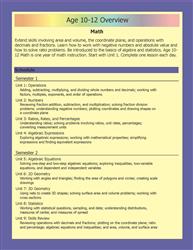
Unit 9: Skills Review
Lesson 1
Decimals, Factors, and Multiples
Students are asked to use the distributive property to factor 36 + 88 and to multiply 15 × 32 by rewriting 32 as (30 + 2), showing explicit use of a property of operations as a multiplication strategy. Students solve decimal multiplication and division problems (e.g., 6.2 × 0.96 and 994.08 ÷ 2.4), providing practice multiplying and dividing rational numbers. The factors and multiples activities also require prime factorization and use of factor/multiple reasoning, which connects to using properties for multiplication of whole numbers.
Lesson 2
Fractions, Ratios, and Coordinates
Students solve multiple multiplication and division problems with fractions and mixed numbers (e.g., 2 5/6 × 4 4/5; 5 1/4 ÷ 2 2/3; 1/2 × 3/5 × 5/8). The answer key and parent notes explicitly show and allow use of cross-cancelling and show the "Keep, Switch, Flip" reciprocal method for division. The multiplication examples show canceling common factors before multiplying numerators and denominators (e.g., 20/3 × 7/2 with cross-cancel).
Lesson 3
Expressions, Equations, and Percentages
Students simplify expressions such as 3(n + 6) + 4n - 10 (Problem 4a) which requires using the distributive property and combining like terms. Students solve equations like m/4 = 5 and n/3 = 9 (Activity 2) which require multiplying or dividing both sides by a number to isolate the variable. The Skills list explicitly states that students will "apply properties of operations as strategies" to factor and expand linear expressions with rational coefficients.
Lesson 4
Geometry
Students compute products of rational numbers in several problems: they multiply decimals to find the area of a rectangle (3.5 × 2.8 = 9.8) and use mixed-number multiplication for the square blanket (9/2 × 9/2 = 81/4). Students use multiplication with fractions in area formulas (1/2 × base × height for triangles) and multiply by 3.14 when applying circle formulas (πr and πr^2). Scale and percent problems require multiplying side lengths by scale factors (2/1) and by percent factors (800% of 2 inches = 16 inches).
3: Math
Unit 1: Numbers
Lesson 1
Positive and Negative Rational Numbers
Students are asked to explain why rules work using the distributive property or a number line (Activity 2 challenge asks students to explain (-3)×(-4) using the distributive property). The materials explicitly state that the sign rules are based on logical properties like the distributive property and prompt students to create a rules list and store it in an Interactive Notebook. The Parent Plan notes that multiplication of rational numbers is extended by requiring operations continue to satisfy properties of operations, particularly the distributive property, and gives ((-1)((-1)) = 1 as an example.
Lesson 2
Fractions and Decimals
Students use long division to divide numerators by denominators when converting fractions to decimals, practicing division of rational numbers (e.g., 3 ÷ 4 = 0.75 and 1 ÷ 3 = 0.333…). Students set repeating decimals equal to x and multiply both sides by powers of 10 (×10, ×100, ×1000) to move the repeating block before subtracting to solve for x, which requires applying multiplication and subtraction to manipulate rational-number expressions.
Lesson 3
Properties of Exponents
Students record and apply the Product of Powers and Quotient of Powers rules when completing problems such as 2^2 × 2^3 = 2^5 and 3^5 ÷ 3^2 = 3^3 (Activities 2 and 3). Students convert negative exponents to reciprocals and solve problems like 2^{-3} = 1/2^3 and (3·2)^{-2} = 1/36 (Activity 1 and Activity 5). Students use the Power of a Product and Power of a Quotient rules to distribute exponents across factors and numerators/denominators, then compute numerical results on mixed-review problems that combine these rules (Activities 5 and 6).
Lesson 4
Square and Cube Roots
Students practice and apply exponent rules that reflect properties of operations: problems ask them to simplify (2^3)^2, compute 3^4 · 3^2, and evaluate (4·5)^2. The calculator activity has students compute positive and negative exponents and interpret negative exponents as reciprocals (e.g., 2^(-3) = 0.125). The review quiz also has students perform multiplication and division with integers (for example, -4 × 6 and -24 ÷ 4).
Lesson 6
Scientific Notation
Students are taught explicit rules for multiplying and dividing numbers in scientific notation: they multiply coefficients and add exponents for multiplication and divide coefficients and subtract exponents for division. The lesson provides worked examples and many practice problems (e.g., (3×10^4)×(6×10^3), (6×10^8)÷(2×10^3)) where students perform these operations and rewrite results in proper scientific notation. Activities also require students to convert decimals to scientific notation before operating, and to use a calculator in scientific-notation mode to carry out division and multiplication.
Lesson 7
Arctic Marine Research
Students convert small decimal measurements to scientific notation (Phase 1: 0.0000042 and 0.0000065) and compute how many times larger one measurement is than another, which requires dividing numbers in scientific notation. Students compare and operate on cell densities given as 1.2 × 10^8 and 9.5 × 10^7, tasks that involve division and manipulation of powers of ten. The parent plan explicitly states students will "perform operations with numbers expressed in scientific notation" and "know and apply the properties of integer exponents."
Lesson 8
Unit 1 Test
Students solve and explain multiplication of signed numbers (e.g., -4 × -3, (-5) × (-2)) and are asked to justify whether products are positive or negative. Students simplify products and quotients using exponent properties (e.g., 5^3 × 5^2, 4^5 ÷ 4^3, 4^{-2}, reciprocal of 3^{-2}) and multiply numbers in scientific notation by multiplying bases and adding exponents. The Parent Plan and introduction explicitly state that students should understand why rules for multiplying signed numbers work and that multiplication of rational numbers is extended by requiring properties of operations (particularly distributive property).
Final Project
Mars Station Test Mission
The lesson's Skills section explicitly references properties of operations and rules for multiplying signed numbers, noting the distributive property and extension of multiplication from fractions to rational numbers. In Task 3 students convert a number in scientific notation (7 × 10^2) to a whole number and divide an energy shortfall by that value to find how many fuel cells are needed, which involves division of rational numbers. In Parts 1 and 2 students multiply rates by time and cost per kilogram by weight (e.g., heater kWh/hour × hours/day × days/year; cost per kg × monthly weight) to compute totals, so students perform real-world multiplications and divisions of rational numbers.
Unit 2: Proportions
Lesson 1
Proportional Relationships
Students set up and solve proportions by multiplying and dividing: examples show "multiply both sides by 12," rewriting 12 as 12/1, and isolating x (e.g., 3/2 = x/12 leads to 3×12 = x×2 then 36/2 = x). The materials explicitly state "multiplication is the inverse of division" and teach cross-multiplication (e.g., 2n = 3×24, then divide both sides by 2). Multiple worked examples and practice problems require students to scale numerators and denominators (e.g., 3/9 = x/27 and 3×3 = 9) and to simplify equivalent fractions to check proportionality.
Lesson 2
Unit Rates
Students are taught to rewrite a division of fractions as multiplication by the reciprocal using the Keep-Change-Flip (KCF) method (explicit KCF steps and worked examples such as 3/4 ÷ 1/2 → 3/4 × 2/1 = 3/2). Students practice multiplying fractions and simplifying results across several activity pages and answer keys that show fraction multiplication and simplification. Students also solve many complex-fraction word problems (with labeled units) that require converting division to multiplication and using reciprocal relationships to find unit rates.
Lesson 3
Constant Rate
Students compute constants of proportionality by dividing y by x in tables and graphs (Activity 2 and Activity 3), including examples with fractions and decimals (e.g., k = 6/12 = 1/2, k = 0.07). Students isolate y by dividing both sides of equations (e.g., 4y = 8x → y = 2x) to rewrite equations in the form y = kx (Activity 5). The review and real-world problem sets require students to divide to find unit rates and to simplify rational quotients when solving word problems (Activities 6 and Review Quiz).
Lesson 5
Proportional Relationship Equations
Students write and use equations of the form t = p × n and y = kx to multiply a unit rate by a quantity (e.g., t = 12n and filling tables by multiplying n by 12). Students solve multiplicative equations by dividing both sides (e.g., 156 = 10m then "Divide both sides by 10" to get m = 15.6). The Review Quiz answer key shows fraction division using multiplication by the reciprocal: (3/4) ÷ (1/2) = 3/4 × 2/1.
Lesson 6
Taxes, Tips, and Commissions
Students repeatedly convert percent rates to decimals and multiply prices by those decimals (e.g., 15 × 0.07 = 1.05, Commission = Sales Amount × Commission Rate, Sales Tax = Price × Tax Rate). The materials show students solving multiplicative equations by using inverse operations (e.g., 0.012 × V = 2400 → V = 2400 ÷ 0.012 and 1.08 × x = 212 → x = 212 ÷ 1.08). Many practice problems require multiplying and dividing rational numbers (decimals and percentages) to find taxes, tips, commissions, and pre-tax prices.
Lesson 7
Markups and Discounts
Students repeatedly multiply and divide decimals (rational numbers) when they compute Discount = Original Price × Discount Percentage and Markup = Cost Price × Markup Percentage (examples: 50 × 0.30 = 15; 20% of 100 = 20). Students apply sequential multiplication for stacked discounts (100 × 0.20 → 80, then 80 × 0.10 → 72) and use multiplication by 1.+markup or (1- discount) and division to work backward (e.g., x × 0.60 = 18 → x = 30; x × 1.60 = 208 → x = 130). Students also compute percent change using subtraction, division, and multiplication to convert to percentages ((new - original) ÷ original × 100).
Lesson 8
Simple Interest and Percent Error
Students use the simple interest formula I = Prt and perform multiplications with decimals and whole numbers in multiple worked examples (e.g., I = 600 × 0.04 × 5 = $120; I = 1200 × 0.05 × 3 = $180). Students solve for unknowns by isolating a variable and dividing (e.g., 250 = 2500 × r × 2 → r = 250 / 5000; 108 = 600 × 0.06 × t → t = 108 / 36). Students convert percent to decimal form before multiplying (r written as a decimal) and complete many practice problems that require multiplying and dividing rational numbers.
Lesson 9
Unit 2 Test
Students solve many problems that require multiplying and dividing rational numbers, including dividing fractions to find unit rates (e.g., 3/4 mile in 1/2 hour; 5/6 mile in 2/3 hour and recipe/rate problems like 2/3 cup per 1/4 cup). Students compute percent and interest problems that require multiplying decimals/fractions (e.g., simple interest on $500 at 4% for 3 years; finding pre-tax prices with 6% or 7% tax). Students write and evaluate proportional equations with fractional constants (e.g., y = (3/5)x, y = (2/7)x), which requires multiplying by fractional k-values.
Final Project
Lemonade Stand
Students calculate unit rates and unit prices by dividing total costs by counts (e.g., price per lemon, price per pound of sugar, price per cup). They set up and solve proportions and write equations in the form y = kx to scale recipes (e.g., tablespoons per cup and per gallon). Students multiply rational numbers to apply markups and percentages (e.g., selling price = unit price × 2, ×2.5, ×3; discounts and taxes computed by multiplying by 0.7, 0.07, 0.15).
Unit 3: Expressions
Lesson 1
Equivalent Expressions
Students multiply coefficients and variables in Activity 3 (e.g., 4ab × 2c → 8abc and combining products like 3x · 3a · 2c → 18a²bc). Activity 5 has students apply the Distributive Property to multiply a single factor across a sum (e.g., 3(x + 5) → 3x + 15) and then use commutative/associative rearrangements to combine like terms. Day 4 and other activities explicitly ask students to use the Commutative and Associative Properties with multiplication to reorder and regroup factors before simplifying.
Lesson 2
Rewriting Expressions
Students rewrite expressions like a + 0.05a as 1.05a and use one-step formulas (Total Price = Original Price × (1 + rate), Discounted Price = Original Price × (1 − rate), Selling Price = Wholesale Price × (1 + markup rate)). Students apply the distributive property in reverse (A + AB = A(1 + B)) when they factor expressions for markups and taxes. Students set up and solve equations such as 31.50 = P(1.05) and divide both sides by 1.05 to find an original price, and they complete many practice problems multiplying and dividing by decimal (rational) numbers (e.g., 1.08 × 120 = 129.60).
Lesson 3
Algebraic Expressions
Students practice and apply the Distributive Property both to expand (e.g., 2(l + w) -> 2l + 2w) and to factor expressions (Factoring activity: pull out the GCF and write expressions like 6x + 12 = 6(x + 2)). Students solve equations by dividing both sides by a coefficient (e.g., 54 = 2l + 12 → 2l = 42 → l = 21 and several examples that produce fractional solutions like x = 5/3), and they multiply by rational numbers in real contexts (sales tax: 60 × 1.07; area formulas with 1/2 × b × h). The review and activities explicitly name and use properties (Distributive, Commutative, Associative) as tools for simplifying and solving problems involving multiplication and division of rational numbers.
Lesson 5
More Graphing Proportions
Students calculate unit rates by dividing y by x in multiple contexts (e.g., 120 ÷ 2 = 60; 300 ÷ 5 = 60) and use equations of the form y = mx to multiply x by a rational slope (e.g., y = 2.5x, y = 0.6x). Students find slope using the Two-Point Formula m = (y2 - y1)/(x2 - x1), which requires subtracting and dividing rational numbers (examples with decimals and negatives are provided). Several activity pages ask students to compute and compare these products and quotients from tables, graphs, and equations.
Lesson 8
y = mx + b
Students calculate slopes using m = (change in y)/(change in x) and compute values that produce rational numbers (e.g., m = 8/4 = 2, m = -3/2, m = 1/2). Students isolate y by subtracting terms and dividing both sides (e.g., 3x + 2y = 8 → subtract 3x, divide by 2 to get y = (-3/2)x + 4; and dividing by -1 to solve -y = -5x + 5). Students use fractional slopes to plot lines (instructions for m = 1/2: up 1, right 2) and apply division and multiplication implicitly when using y = mx + b to compute and graph points.
Lesson 9
Unit 3 Test
Students are asked to "Rewrite and simplify expressions using the Commutative, Associative, and Distributive Properties," and the unit gives the explicit example a + 0.05a = 1.05a. Multiple problems require multiplying by decimals for percent calculations (discounts and sales tax) and the answer key shows computations such as $120 + 8.25% = $129.90 and $90 (-) 30% = $63. The answer key also shows solving one-step equations that require division (e.g., 30 + 10x = 80 → x = 5), indicating students perform division of rational numbers to isolate variables.
Final Project
Planes, Trains, and Automobiles
Students write and use equations in the form y = mx and solve 500 = 60x to find travel time, which requires dividing rational numbers to isolate x. Students construct and use linear cost equations such as y = 0.15x + 31.50 and set equations equal (0.15x + 31.50 = 0.20x + 20.75) to find break-even points, processes that require rearranging expressions and dividing by rational coefficients. The Parent Plan explicitly gives an example of rewriting expressions (a + 0.05a = 1.05a), showing how combining like terms can be used as a multiplication strategy.
Unit 4: Probability
Lesson 3
Probability Models
Students compute probabilities by multiplying fractions by whole-number totals in multiple places (e.g., P(2)=1/6 × 120 = 20; 1/2 × 500 = 250; 1/3 × 90 = 30). Students compute experimental probabilities and relative frequencies by dividing counts by totals (e.g., 29/50 = 0.58, relative frequency = count/total). Students simplify fractions and convert them to decimals/percentages in examples (e.g., 2/6 → 1/3 → 0.33 or 33%).
Lesson 4
Compound Events
Students multiply probabilities or proportions by total counts to make predictions (e.g., 16% × 120 = 20; 90 × 1/6 = 15). Students convert fractions to percents and decimals and then use those rational numbers in multiplication (e.g., 0.233 × 1143 ≈ 266.3). Students compute probabilities as fractions of a sample space and then scale those fractions to expected frequencies in repeated trials.
Unit 5: Functions
Lesson 1
What Is a Function?
Students write and use rules that include multiplication and division with rational numbers (for example, y = 2x + 6; y = (x + 3)/2; y = x/5 + 2; y = 1 + (1/2)x). Student activities require calculating outputs by multiplying by integers and fractions and dividing inputs (see exercises that compute x ÷ 4, x/5, and 1/2 · x). Students complete input/output tables and apply those multiplication/division steps to produce outputs and plot points on graphs.
Lesson 5
Slope
Students rewrite equations using the distributive property and division to isolate y (e.g., 4x + 2y = -8 → 2y = -4x - 8 → y = -2x - 4). Students expand expressions using the distributive property in examples such as y + 2 = -2(x - 3) → y + 2 = -2x + 6 and then subtract and divide to solve for y. Students also work with decimal multipliers (e.g., 0.5(x - 4)) when converting to slope-intercept form, demonstrating multiplication of a rational number with an expression.
Lesson 6
Slope-Intercept Form
Students compute slopes using the quotient m = (y2 - y1)/(x2 - x1), producing fractional slopes (examples include m = 1/5, m = -2/3, m = 3/4). Students isolate y by subtracting and then dividing both sides (e.g., 2x + 3y = 6 → 3y = -2x + 6 → y = (-2/3)x + 2), which requires dividing coefficients to produce rational-number coefficients. Students substitute slopes and coordinates into y = mx + b and perform arithmetic with rational numbers to solve for b (e.g., 4 = -1(2) + b → b = 6).
Lesson 7
Creating Functions
Students write function rules that use multiplication of a slope by an input (for example A = 6c + 12, T = 10n + 20, and examples with decimal or fractional slopes such as y = 0.25x and F = 0.5s). Students compute slopes using the slope formula m = (y2 − y1) / (x2 − x1), which requires subtraction and division of numbers. The pancake activity and several answer keys show students working with decimal and fractional multipliers (e.g., M = 0.33s, B = 0.5s).
Unit 6: Geometry
Lesson 1
Congruence and Similarity
Students compute and use scale factors by dividing and multiplying side lengths (for example, 6 ÷ 3 = 2 and 5 × 2 = 10, and x = 10 ÷ 2 = 5). The materials include examples with fractional and decimal scale factors (1/2, 1/3, 0.4) and tasks where students multiply or divide given side lengths to find missing measurements. Students write math sentences that use multiplication and division to relate corresponding sides (e.g., use of scale factor to find x).
Lesson 6
Dilations
Students repeatedly multiply and divide rational numbers when applying scale factors: examples show coordinates and side lengths multiplied by 2, 0.5, 2.5, 0.25, 0.33 and decimal calculations such as 3.6 × 3 = 10.8 and 8 × 0.5 = 4. The lesson directs students to compute scale factor as new ÷ original (e.g., Scale factor = A′B′ ÷ AB and examples like 2 ÷ 4 = 0.5). Activity pages require students to calculate new coordinates and new side lengths by multiplying or find scale factors by dividing, with answer keys showing decimal and fractional results.
Lesson 7
Sequences of Transformations
Students multiply coordinates by scale factors in multiple examples (Example 1 multiplies each coordinate by 2; Example 2 dilates by 2 then applies a rotation). Student activity pages require dilations by rational scale factors such as 1.5, 0.5, 0.25, and 2.5 and the answer key shows computed products and resulting coordinates (including decimals and negatives).
Lesson 10
Volume
Students repeatedly multiply and divide rational numbers when they compute volumes (e.g., V = 3.14×(3 in)2×4 in and V = (1/3)×3.14×(2 in)2×6 in) and when they solve for missing measurements by dividing both sides of equations (e.g., 314 = 78.5h then 314 ÷ 78.5 = h; 600 = (1/3)×3.14×36×h then 600 ÷ 37.68 = h). The lesson uses rational factors like 3.14, fractions such as 1/3 and 4/3, and operations on squared and cubed radii (r2, r3) in worked examples and student practice problems.
Final Project
Abstract Art Gallery
Students measure diameters and divide by 2 to find radii on the 3D Sculpture Volume Worksheet, use π = 3.14 and the volume formulas to calculate volumes (which requires multiplying decimals and squaring radii), and perform a dilation by a factor of 3 on a coordinate grid (which requires multiplying coordinates by 3). The answer key shows numerical volume computations for cylinder, sphere, and cone, indicating students will compute products and totals of rational numbers.
Unit 7: Linear Equations
Lesson 1
Linear Equations With One Variable
Students are instructed to use reciprocals to remove fractional coefficients (e.g., "If the variable is multiplied by a fraction, multiply by the reciprocal" and the example 3/4 x = 12 where students multiply by 4/3 to find x = 16). The fraction practice page contains many problems with fractional coefficients (e.g., (3/4)x + 3 = 7, (2/5)x = 6) that require multiplying by reciprocals, and the decimals activity has students divide by decimal coefficients (e.g., 0.4x + 2 = 6.8 where students divide by 0.4 to get x = 12). Examples and answer keys show students performing multiplication or division with rational coefficients as part of solving equations.
Lesson 2
Multi-Step Equations
Students repeatedly apply the distributive property to multiply a factor across parentheses (e.g., 3(a+4)=3a+12; 4(y+2)=16; 0.5(6y−4)+3y=12) and practice distributing with decimals and fractions in multiple examples and worksheets. Students also divide both sides of equations by numeric coefficients to isolate variables (e.g., dividing by 3 to get a = 3; dividing by 6 to solve 6y = 14) and are instructed to "clear fractions by multiplying by the denominator" in the review notes. Real-world and algebraic problems require students to multiply and divide rational coefficients as part of the solve process.
Lesson 3
How Many Solutions?
Students repeatedly divide both sides of equations to isolate variables (for example, 3x = 6 then divide both sides by 3 to get x = 2). Students use the distributive property to expand and simplify expressions (for example, 2(3x + 4) becomes 6x + 8) and work with equations that include fractional coefficients (examples include 3/2 a and 2a/3). Several activities ask students to simplify expressions and combine like terms before multiplying or dividing to solve.
Lesson 4
Multi-Step Word Problems
Students solve equations with rational coefficients and use multiplication and division to isolate variables (example: the gym example divides both sides by 15; the multiple-choice and quiz items include 0.5x - 3 = 7 and (3/4)x + 4 = 10). Students expand expressions using the distributive property in problems such as 5(2 - 3x) = 2x - 10 and collect like terms in several activity questions. The parent plan explicitly notes practice with equations whose solutions require expanding expressions using the distributive property and solving linear equations with rational number coefficients.
Lesson 6
Substitution and Elimination
Students apply the distributive property when they substitute y = x + 2 into 2x + 3y = 16 and carry out 3(x+2) → 3x+6. Students multiply entire equations by a constant when they perform elimination with multiples (for example multiplying an equation by −2 to create opposite coefficients). Students isolate variables by dividing (for example solving 3x = 6 to get x = 2) and work with problems that include fractions and decimals in substitution and elimination practice.
Lesson 8
Linear Algebra In the Wild
Students set up and solve systems using multiplication and division steps: for example, they multiply an entire equation by −2 in the candy-shop elimination method and divide both sides by integers to isolate variables (2J+5=65 → 2J=60 → J=30). Students perform decimal multiplication and division when solving price problems (e.g., 4y=15.40 → y=3.85) and multiply equations by scalars to create like coefficients for elimination. Students also combine like terms after multiplication and subtract terms from both sides as part of solving equations.
Lesson 9
Unit 7 Test
Students solve equations labeled "Solve using reciprocals" (e.g., (3/4)x = 12, (2/3)x = 3) and are told "If you need to remove a fraction, use a reciprocal," showing use of multiplicative inverses to divide by rational numbers. Multiple problems require expanding with the distributive property (e.g., 4(2x - 3) = 20) and the parent plan explicitly lists applying the distributive property and combining like terms. The answer key shows steps that multiply both sides by reciprocals and use distribution to isolate variables.
Final Project
Getting Ready for College
Students write and simplify expressions that require using operation properties: the Phone Plans activity asks students to simplify Plan B from y = (10x + 40)/2 to y = 5x + 20. Multiple answer keys show students dividing sums and coefficients (e.g., 225 + 0.60x = 1.25x leading to 0.65x and x = 225/0.65, and splitting apartment/furniture costs by 2 to get per-person rates). The Parent Plan skills explicitly list expanding expressions using the distributive property and solving equations with rational-number coefficients.
Unit 8: Data
Lesson 4
Linear Models
Students compute slope using the formula m = (y2 − y1) / (x2 − x1) when they pick two points on a line (example shown using (0,5) and (1,6)). Students evaluate linear models by substituting values into y = mx + b and performing multiplication (for example y = 2×10 + 50) and handle negative slopes in equations such as y = −5x + 50. Multiple activities require students to divide differences to find rates of change and multiply rates by input values to predict outputs.
Unit 9: Semester Exams
Lesson 1
Numbers Review
The Parent Plan explicitly states that students should "understand that multiplication is extended from fractions to rational numbers ... particularly the distributive property," and gives examples like (−1)(−1)=1 and sign rules for multiplying signed numbers. In Activity 1 students compute products and quotients of positive and negative integers (e.g., 4×(−6), (−3)(−5), −6÷2) and are asked to "explain why the sign of the answer makes sense." Mission 4 requires students to create and solve a real-world problem that uses multiplication or division with a fraction or decimal.
Lesson 3
Expressions Review
Students are asked to "Use the distributive property to simplify an expression" and to "Simplify an expression using properties of operations," which explicitly directs them to apply operational properties. The parent plan gives the example a + 0.05a = 1.05a, and Activity 1 includes sales tax and discount problems that require multiplying by decimals (rational numbers) and rewriting expressions (e.g., combining like terms or factoring). Activity 3 and other tasks have students write and interpret equations of the form y = mx + b and p(x + q) = r, which involve multiplying rational coefficients by variables.
Lesson 5
Semester Exam
Students are asked to multiply integers and justify the sign in problem 2 (Multiply (-6)(-4). Is the product positive or negative? Why?), and to divide integers in problem 3 (-48 ÷ 6). Students compute unit rates that require dividing fractions (e.g., 4/5 mile in 1/2 hour → compute (4/5) ÷ (1/2) in Unit 2). Problems 9 and 10 (5^1 x 5^2 and 8^4 ÷ 8^2) require students to use properties of exponents to simplify products and quotients of like bases.
Lesson 7
Geometry Review
Students calculate scale factors and use them to multiply side lengths in similarity and dilation problems (e.g., triangles with sides 5, 7, 9 and a corresponding side 10; shortest side 6 scaled to 15 gives scale factor 2.5). Students apply dilations to coordinates by multiplying coordinates by scale factors (e.g., dilating Triangle LMN by 3 to get L'(6,3), M'(12,3), N'(9,9)). Students perform multiplication and division when working with volume formulas and solving for dimensions (e.g., V = (1/3)πr^2h, computing volumes using 3.14, and solving 268.08 = 4/3·3.14·r^3 to find r).
Lesson 8
Linear Equations Review
Students solve equations with fractional coefficients such as (3/5)x = 18 and (2/3)x - 5 = 7, which requires multiplying both sides by a reciprocal to isolate x. Students are instructed to use the distributive property in problems like 5(2x - 1) = 45 and to expand expressions and collect like terms in multi-step equations. The materials include a referenced video on using reciprocals and explicit directions to 'use the distributive property' and 'work with fractions using reciprocals.'
Lesson 10
Semester Exam
Students solve equations with fractional coefficients such as (3/5)x = 18 and (2/3)x − 5 = 7, which requires dividing by a fraction or multiplying by a reciprocal. Students also solve 5(2x − 1) = 45, a problem that requires use of the distributive property to expand and isolate x. Several word problems (e.g., the tutor charging $18 per hour plus a $30 fee) require students to set up and solve equations that use multiplication and division of rational numbers.