


Ninth Grade - ELA
1: Semester 1

Unit 1: Lord of the Flies
Lesson 2
Life on the Island
Students are taught about coordinating conjunctions (FANBOYS) and subordinating conjunctions and how they join independent and dependent clauses, including comma and semicolon usage for joining clauses. The activity asks students to write sentences that contain an independent clause followed by a dependent clause, a dependent clause followed by an independent clause, two independent clauses, and a sentence containing both a coordinating and a subordinating conjunction. The parent plan provides example sentences that demonstrate combining clauses with coordinating and subordinating conjunctions (e.g., "Since Jack was the head... , but Roger thought...").
Final Project
Now You Have the Conch
The "You Are the Editor" pages include a dedicated Transitions section that asks students to identify transition words and phrases, evaluate their effectiveness, and mark transitions between main points and paragraphs. Both the Traditional Outline and Guided Outline templates prompt students to write a "Transition to next paragraph" in each body paragraph. The Brainstorming page and thesis word bank provide linking words (e.g., "therefore") that students can use when developing thesis and support.
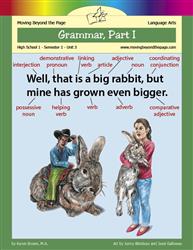
Unit 3: Grammar, Part I
Lesson 1
Parts of Speech
The lesson explicitly teaches that conjunctions join words, phrases, clauses, or sentences (coordinating, correlative, subordinating) and lists the FANBOYS as coordinating conjunctions. The lesson defines conjunctive adverbs as providing strong transitions between two independent clauses and gives the punctuation formula: independent clause + semicolon + conjunctive adverb + comma + independent clause. Students complete activities that require identifying correlative and subordinating conjunctions and circling/underlining conjunctions in sentences.
Lesson 4
Commas
Students practice joining independent clauses using a comma + FANBOYS (e.g., rewrite sentences like "I wanted to go to the game but I had too much homework" and insert the comma). The lesson explicitly identifies transitional words/phrases such as "however" and "on the other hand" as interrupters and asks students to set off interrupters with commas (example: "The stern choir director, however, was not amused"). Students also complete activities that require punctuating nonessential/interrupting phrases, reinforcing how transitional words are treated in sentences.
Lesson 6
Colons and Semicolons
The lesson explicitly teaches conjunctive adverbs as transitional words/phrases and gives the formula independent clause + semicolon + conjunctive adverb + comma + independent clause, with examples like however, indeed, furthermore, therefore. Students complete semicolon practice sentences (Option 1 and the answer key) that require them to join independent clauses and to use conjunctive adverbs (e.g., "however," "therefore") correctly. The Great Punctuation Trial requires students to write and present a semicolon's opening statement that must include one example joining two independent clauses with a conjunctive adverb + comma, so students practice using these transitions in their own paragraph writing and oral explanation.
Final Project
Wrapping Up
Students punctuate sentences that include conjunctive adverbs (for example, Part IV question 18 requires inserting a semicolon and comma around "nevertheless"). Students answer a short-response item (Question 14) that asks them to describe situations for using a semicolon, and the provided answer explicitly mentions joining independent clauses with a transitional word/phrase. Students practice punctuation choices that affect how clauses and ideas are linked (commas, semicolons, dashes, parentheses) in multiple Part IV items.
Unit 5: Nonfiction
Lesson 3
The Taliban
The paragraph-writing option explicitly tells students to "avoid writing a series of short, choppy sentences; instead, use transitional words and phrases to smoothly link your thoughts" and points them to pp. 159–161 of The Only Grammar Book for a list of transitions. The directions require students to begin with a strong introductory sentence and end with a concluding sentence, which supports practice in organizing and linking parts of their paragraph. The parent plan reiterates teacher encouragement to use transitional words and phrases when checking students' paragraphs.
Lesson 12
Running from War
Students are taught three specific methods for transitioning into quotations: writing a complete introductory sentence followed by a colon, using a short introductory phrase with the author's name and a comma, and integrating part of the quotation into their own sentence. Activity 1 and the Student Activity Page require students to practice those methods by selecting correctly punctuated introductory constructions and by writing their own introductions to a provided quotation. The parent plan and sample answers model and reinforce these methods for blending quotations into student writing.
Lesson 15
A New Life
Students are asked to write 1-2 paragraph summaries and told that their summaries should be in paragraph form so sentences "flow together naturally." Students are explicitly encouraged to use transitional words and phrases and are referred to a specific resource (pp. 159–161 in The Only Grammar Book You'll Ever Need) for a list of transitional words and phrases. Students are required to produce written summaries that require sentence-to-sentence cohesion.
Final Project
Expository Essay
The rubric's Organization criterion explicitly notes that thesis points should be "connected with transitional words and phrases," and the homework directions tell students to "include clear transitional words and phrases" and point them to pages 159–161 of a grammar reference for lists of transitions. The Parent Plan Skills list names using "appropriate and varied transitions to link the major sections of the text, create cohesion, and clarify the relationships among complex ideas and concepts" as a required skill. Revision and proofreading steps ask students to check that their essay contains clear transitions and to consult the rubric's "Excellent" column for organization.
2: Semester 2

Unit 1: Ender's Game
Final Project
Think-Tac-Toe
Students are explicitly asked in Box 4 (Leadership or Power?) to "rewrite the conversation, making the adjustment of adding the quote and any additional transitional phrases needed so that the quote makes sense," which requires them to insert transitions. Several writing tasks require multi-paragraph responses (Box 2 flashbacks, Box 3 narration rewrite, Box 5 compare/contrast) that provide opportunities for students to use transitions to connect ideas. The Think-Tac-Toe final project directs students to produce coherent written work (e.g., two- to three-paragraph comparisons, 1–3 paragraph flashbacks) where transitions would be necessary for clarity.
Unit 2: Grammar, Part II
Lesson 1
Review of Grammar, Part I
Students match grammar terms and examples that explicitly include coordinating conjunctions (FANBOYS), subordinating conjunctions, and conjunctive adverbs (e.g., nevertheless, however). The Mad-Libs option asks students to supply a coordinating conjunction, a subordinating conjunction, and a conjunctive adverb to complete clauses in a short story. The punctuation and grammar activity and answer key show learners inserting semicolons and commas with conjunctive adverbs (e.g., "I wanted to go; nevertheless, I stayed home") and correcting clause-level linking.
Lesson 3
Sentence Fragments and Run-on Sentences
Students are taught ways to correct run-on sentences, including that run-ons can be fixed by splitting clauses, using a semicolon, or using a comma plus a coordinating conjunction (FANBOYS). The lesson text and activities use sequencing/connective words in examples and directions (e.g., "First," "Next") and include a multi‑paragraph Creative Writing Challenge in which students write a 1–2 page narrative. Students are given clause‑level practice (identifying and correcting fused sentences and comma splices) that requires choosing conjunctions to join clauses correctly.

Unit 3: Informational Texts
Lesson 2
Outliers
The Parent Plan lists as a skill that students will "analyze how the author unfolds an analysis or series of ideas or events, including the order in which the points are made, how they are introduced and developed, and the connections that are drawn between them," which asks students to examine organizational links between ideas. Activity 1 asks students to explore how Gladwell uses analogy and "other strategies" to help readers understand the term "outlier," prompting students to identify how the author connects concepts. Homework questions require students to explain causal relationships (e.g., why the birthday cutoff affects success), which has students practice articulating relationships among ideas.
Lesson 4
The 10,000 Hour Rule
The "Looking Closely" student activity asks students to summarize Sections 1–3 and answer analysis questions about how Gladwell develops his points, including a question that asks what words, phrases, or sentences Gladwell uses to signal a different approach to Bill Joy's story. The answer key explicitly points out the transition word "however," the hockey-player example as a signaling device, and Gladwell's rhetorical question as signals that shift focus between sections. Students are also asked to analyze the structure of the three sections and explain why Gladwell organized them as he did.
Lesson 8
With Malice Toward None
Students are asked to analyze how Lincoln organizes his Second Inaugural Address, including a homework task that has them select three sentences that correspond to background, main message, and a forward-looking statement. The Parent Plan skills list includes analyzing the order in which points are made and the connections drawn between them, which students practice when they map parts of the speech to its broad persuasive structure. Activities require students to chart rhetorical devices and consider how choices of organization and tone advance the speech's purpose.
Lesson 11
Technical Writing
The Parent Plan Skills list explicitly includes the learning target: "Use appropriate and varied transitions to link the major sections of the text, create cohesion, and clarify the relationships among complex ideas and concepts." Students are directed to organize their guides with introductions, headings/subheadings, steps in order, and conclusions, and to revise so information is appropriate to the audience and navigation aids are added. The Guide Checklist and revision tasks require students to ensure introductions, steps, and conclusions are present and clearly organized, which gives students opportunities to create cohesion between sections.
Final Project
Argumentative Research Essay
The Skills section explicitly instructs students to "Use words, phrases, and clauses to link the major sections of the text, create cohesion, and clarify the relationships between claim(s) and reasons, between reasons and evidence, and between claim(s) and counterclaims," and also to "Use varied transitions and sentence structures to link the major sections of the text, create cohesion, and clarify the relationships among ideas and concepts." The Essay Rubric's Content Development criterion requires that key points be "strengthened with words and phrases connected with transitions." The assignment requires students to organize a five-paragraph classical argument (introduction, confirmation, concession/refutation, conclusion), which requires linking major sections of the text in their writing and revision activities.