


Sixth Grade - MATH
5: Math
Unit 2: Integers and Rational Numbers
Lesson 3
Fraction Division
Students draw and use visual fraction models in Activities 1 and 2 to represent division situations (e.g., 1/2 ÷ 3 illustrated with a garden, 3/4 ÷ 1/8 and 1/4 ÷ 1/3 shown on the 'Dividing a Fraction by a Fraction' notes page). Students compute quotients using the invert-and-multiply algorithm (Keep, Switch, Flip, Solve) with worked examples including whole ÷ fraction, fraction ÷ fraction, and mixed-number division (e.g., 3/4 ÷ 1/6, 7/2 ÷ 7/3). Students solve multiple word problems that require dividing fractions by fractions or mixed numbers (cheese 3/4 ÷ 1/8, yogurt servings 3 ÷ 2/3, fishing line 3/4 ÷ 3/8) and are prompted to check answers by using multiplication to verify quotients.
Lesson 7
Coordinate Problem Solving
The Basic Skills Review includes a problem in which Petra has 3/4 of a cake and divides it into two equal portions, showing 3/4 ÷ 2 = 3/8 and the computation 3/4 × 1/2 = 3/8. The review also contains other fraction work (adding mixed numbers, comparing fractions) and instructs students to simplify fractions and include units. These items show students compute and reason about some fraction operations, including dividing a fraction by a whole number.
Lesson 8
Unit 2 Test
Students solve many computation and word problems that require dividing fractions and mixed numbers (e.g., 2 3/8 ÷ 1 3/4, 14 2/3 ÷ 1 5/6, Mary Ellen and Zoe word problems about dividing quantities into fractional servings). Students complete model-based tasks for division of a whole by a fraction (e.g., 6 ÷ 2/3 with shading and an image showing 6 ÷ 2/3 = 9, and an image for 8 ÷ 4/5 = 10). The answer key and activities show students converting to improper fractions and using the 'keep–switch–flip' algorithm to compute quotients, and the Parent Plan explicitly instructs students to "use visual models and equations to represent and solve fraction division word problems" and references an IN page with a model method for dividing a fraction by a fraction.
Unit 3: Ratios and Percentages
Final Project
What's the Best Buy?
Students set up and compute unit prices by dividing total price by number of units, for example dividing $3.38 by 13 ounces to get $0.26 per ounce. Students convert between measurement units using chains of equivalent ratios (e.g., 1 gallon → 4 quarts → 8 pints → 16 cups → 128 fl oz) so they practice multiplicative reasoning with fractional unit conversions. Students extend ratio work to real contexts (doubling/tripling recipes, speed as miles per minutes, currency conversions) that require forming and manipulating ratios and quotients.
Unit 4: Algebraic Expressions
Lesson 1
Introduction to Algebra
Students are asked to evaluate numerical expressions using PEMDAS that include fraction operations (for example, a practice item includes (2/3) ÷ (1/3) within a longer expression). The lesson also includes work with fractions in other contexts (e.g., evaluating (3/5)^2 and (1/3)^2 + (1/2)^3) so students compute with fractions in arithmetic expressions. The Word Clues and Division Phrases sections prompt students to identify language that corresponds to division, which connects words to the division operation.
Lesson 3
Working With Expressions
Students practice dividing fractions by whole numbers in the Basic Skills Review #7 item and answer key which shows 4/5 ÷ 3 = 4/15 and uses the keep-switch-flip method. Students set up and evaluate division expressions in several places (e.g., the Tamika challenge ((n − 3)/2), the Piper problem 24/n, and the table showing p ÷ 2 evaluated for specific values). Students also perform fraction arithmetic in context (adding mixed numbers) and apply division in order-of-operations problems.
Unit 5: Algebraic Equations
Lesson 4
Solving Two-Step Equations
Students solve and check equations that involve fractions (e.g., 2n + 1/4 = 3/8 leading to n = 1/16 and (2/3)n - 2/5 = 1/10 leading to n = 3/4). The lesson explains fraction computation rules (add/subtract with common denominators, multiply numerators/denominators, and divide by flipping the second fraction) and shows students multiplying both sides by a reciprocal to isolate a variable. Activity pages give multiple practice problems with fractional coefficients and constants (e.g., 1/2 n = 7, 2/5 x + 4 = 5, n/3 + 1 = 7). Visual models (tape diagrams and hanger diagrams) are used for modeling and solving equations in several examples.
Unit 7: 3D Geometry
Lesson 3
Volume
Students are asked to determine how many fractional unit cubes fit along edges (e.g., "How many 1/4-inch cubes are in 1 1/2 inches?" and how many 1/3-ft cubes fit in 3 ft), and they count cubes per row/layer (sugar-cube and lawn-dice examples) to find counts. Students use those counts times the volume of a single fractional cube (e.g., 1/8 in3 for 1/2-inch cube, 1/64 in3 for 1/4-inch cube) to compute total volume. Several activity problems require students to convert mixed numbers to improper fractions and compute with fractional dimensions when using V = l × w × h.
Lesson 6
Unit 7 Test
Students compute volumes and areas using fractional and mixed-number dimensions (e.g., V = 3/4 × 1/2 × 4 4/5 = 1 4/5 and SA calculations using 3 1/2 and 1 1/2). Students set up and solve for a missing dimension by dividing a volume by a base area (e.g., 182 = 6.5 × h; h = 28). Students practice multiplying fractions and working with mixed numbers in context (surface area and volume problems, paint coverage using mixed-number dimensions).
Unit 8: Statistics
Lesson 2
Populations and Samples
The Basic Skills Review (#15) includes a problem that requires students to compute 8/15 ÷ 4/9. The Answer Key shows the step-by-step division procedure (keep–switch–flip), cross-canceling, and the simplified result 6/5 (1 1/5). The review instructions also remind students to simplify fractions when needed.
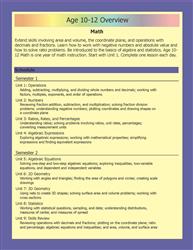
Unit 9: Skills Review
Lesson 2
Fractions, Ratios, and Coordinates
Students compute division of mixed-number fractions in Activity 1 problem 4 (5 1/4 ÷ 2 2/3), where they convert to improper fractions (21/4 ÷ 8/3) and apply the reciprocal method (21/4 × 3/8) to find 63/32 = 1 31/32. The Answer Key also shows students solving a fraction ÷ whole-number word problem (1/2 ÷ 3 = 1/6) for the trail-mix/baggie task. The Parent Plan explicitly states that students will "apply and extend... to divide fractions by fractions" and "solve word problems involving division of fractions by fractions."
3: Math
Unit 2: Proportions
Lesson 2
Unit Rates
Students compute quotients of fractions using the Keep-Change-Flip (KCF) method and solve many fraction ÷ fraction problems (e.g., 3/4 ÷ 1/2 is rewritten as 3/4 × 2/1 and simplified to 3/2). Student activity pages include practice problems that require simplifying complex fractions such as (2/3) ÷ (5/6) and word problems that ask for unit rates when both numerator and denominator are fractional quantities (e.g., 3/4 cup per 2/3 batch, 5/8 mile in 1/3 hour). Problems require students to set up division equations with labeled units and compute resulting rates (miles/hour, cups/batch), and answer keys show the multiplication-of-reciprocals steps.
Lesson 4
Graphing Proportions
The Skills Review answer key explicitly shows a fraction division: it states the unit rate is (3/4) ÷ (2/3) = 9/8, indicating students are expected to compute a quotient of two fractions. The lesson also includes scenarios with fractional unit rates (e.g., ribbon kits using 1/4 meter per kit, a ribbon problem answered as y = 1/2 x in an answer key) and several exercises asking students to find unit rates and write y = kx, which sometimes involve fractional or decimal rates.
Lesson 5
Proportional Relationship Equations
Students are asked to compute unit rates that require dividing fractions on the Review Quiz (e.g., "Compute the unit rate if a car travels 3/4 miles in 1/2 hour" and "2/3 cup of sugar for every 1/4 cup of butter"), and the answer key shows these are solved by (3/4) ÷ (1/2) = 3/4 × 2/1 = 1.5 and (2/3) ÷ (1/4) = 8/3. Several problems require setting up and solving proportion equations with fractional values (e.g., 5/8 = 15/x). The materials instruct students to simplify fractions and report unit rates, and the answer key gives explicit fractional-division computations for the quiz items.
Lesson 9
Unit 2 Test
Students are asked to compute unit rates that require dividing fractions in multiple problems (e.g., Problem 1: 5/6 mile in 2/3 hour; Problem 22: 3/4 cup sugar per 1/3 cup flour; other items: 2/3 cup per 1/4 cup, 4/5 mile in 1/2 hour). Several test problems and review items require students to calculate speeds or unit rates by dividing a fractional distance by a fractional time, and the answer key provides numerical quotients for these items. The student practice and test questions place fraction ÷ fraction computation in real-world contexts (unit rates, recipes, and speeds).
Unit 6: Geometry
Lesson 6
Dilations
Students calculate and apply scale factors to coordinates and side lengths (e.g., multiply x and y by 2, 0.5, 0.25, 2.5, 1/3). Students solve for scale factor by dividing new length by original length (examples show A′B′ ÷ AB = 2 ÷ 4 = 0.5 and 10 ÷ 6 = 5/3). Students set up and solve equations using new length = original length × scale factor to find unknown lengths or scale factors in multiple practice problems.
Unit 7: Linear Equations
Lesson 1
Linear Equations With One Variable
Students are taught to multiply by the reciprocal when the variable is multiplied by a fraction (Things to Know and Activity 3). Example problems and worked examples include fractional coefficients such as (3/4)x = 12 and practice problems like (2/5)x = 6, (3/2)x = 4, and (5/6)x + 2/3 = 4 where students isolate x by multiplying both sides by a reciprocal. The student activity page "Reviewing Equations with Fractions" provides ten problems that require solving equations with fractional coefficients, and the worked examples show substituting and checking solutions.
Lesson 9
Unit 7 Test
The lesson repeatedly instructs students to "use a reciprocal" to remove fractions and includes sections titled "Solve using reciprocals" with problems such as (3/4)x = 12, (2/3)x = 3, (5/6)x = 15, and (4/3)x = 8. The Getting Started text explicitly tells students they have "worked with fractions using reciprocals," and the activity pages require students to isolate x by multiplying by reciprocals (effectively performing division by a fraction).
Unit 9: Semester Exams
Lesson 2
Proportions Review
The Parent Plan explicitly states that students will "compute unit rates associated with ratios of fractions, including ratios of lengths, areas and other quantities measured in like or different units." Multiple activities require students to find unit rates and interpret proportional relationships (e.g., speed: 3 miles in 12 minutes; recipe: 2 cups for 5 batches; comparing runners' mph). Activities 2 and 3 ask students to write and interpret equations of the form y = kx and explain what points like (1, r) mean, which practices identifying and using unit rates.
Lesson 5
Semester Exam
Students are asked to compute a quotient of fractions in Unit 2 problem 14: "Find the unit rate: 4/5 mile in 1/2 hour," which requires evaluating (4/5) ÷ (1/2) and interpreting the result as miles per hour. The answer key gives 1.6 miles per hour, indicating students compute and interpret a fraction ÷ fraction in a real-world context. Additional proportional problems (e.g., writing y = (3/5)x and finding unit rates from graphs or tables) give more practice forming equations that relate quantities involving fractions.
Lesson 8
Linear Equations Review
Students solve linear equations that include fractional coefficients, for example (3/5)x = 18 and (2/3)x - 5 = 7 in Activity 1. Directions explicitly tell students to "solve equations involving fractions" and the answer key shows x = 30 and x = 18, which result from computing 18 ÷ (3/5) and 12 ÷ (2/3). The student activity pages and parent notes emphasize using reciprocals and working with fractions when isolating the variable.
Lesson 10
Semester Exam
Students solve linear equations that require dividing by a fraction to isolate the variable (e.g., problems 28: (3/5)x = 18 and 29: (2/3)x − 5 = 7). The answer key shows solutions x = 30 and x = 18, indicating students compute 18 ÷ (3/5) and 12 ÷ (2/3). These items require students to perform division by a fraction in an algebraic context.