


Ninth Grade - ELA
1: Semester 1

Unit 1: Lord of the Flies
Lesson 3
Paths in the Jungle
The Character Journal Entry asks students to write a one-paragraph journal in a chosen character's first-person voice, prompting them to reflect on significant events, the character's emotional response, and what the character is learning or how he is adapting to survive. The Parent Plan and Wrapping Up sections state that entries should be reflective and thoughtful and encourage students to think about what they learned about a character by looking at the story through his eyes.
Lesson 6
Symbolism, Part 1
Students are asked to write a one-page journal entry from a character's point of view that records actions and quotes and considers that character's priorities, fears, and trust—activities that require recounting experienced events and observations. The journal prompt directs students to note the effects the boys have on one another and the island, which asks for reflective consideration of events. The activity pages also require students to write brief text-supported explanations for symbol interpretations, practicing concise reflective writing grounded in narrative details.
Lesson 10
Which Is Better?
Students are asked to write a one-page journal entry from a chosen character's point of view that analyzes Jack's leadership and contrasts it with Ralph's leadership and the boys' prior civilized lives, including the option to write as a deceased narrator who reflects on events after death. The wrapping-up prompts ask students to consider Golding's failures of civilization and to draw parallels between the boys and what they represented, encouraging reflective thinking about the narrative's outcomes. The Developing Civilization activity asks students to compare similarities and differences between the boys' experience and early civilizations, which requires synthesizing observations across the text.
Lesson 11
The Film
Students watch the 1963 film and complete a "Movie vs. Book" chart that asks them to compare similarities and differences in characters, setting, theme, and plot. Students answer journal questions that ask whether omitted scenes were critical to the novel's major theme and to describe visuals that differed from their imagined images. Discussion prompts and the wrapping-up note ask students to reflect on important scenes and speculate about what will happen to the boys after rescue, encouraging reflection on narrative outcomes.
Final Project
Now You Have the Conch
Students are instructed to include a conclusion in their essay outlines: the Traditional Outline and Essay Organizer explicitly ask students to "Restate the thesis (in a different way)," "Summarize key points or ideas," and "Provide an important take-away." The "You Are the Editor" pages prompt students to evaluate whether the conclusion "offer[s] a significant 'take-away' or merely repeat[s] the introduction," guiding students to revise conclusions for meaning. The revision and finalizing steps require students to compare their draft to the rubric and prompt, which includes assessing whether the conclusion ties up the essay and provides a final reflection.
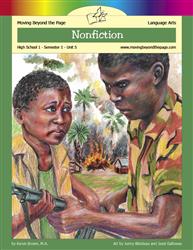
Unit 5: Nonfiction
Lesson 1
Types of Nonfiction
Students are prompted to "add notes" about how characters, setting, and plot events contribute to the theme and to answer "What can you conclude so far? How does this book relate to your life and decisions you are making today?" in the "All About a Person" activity. The activity also asks students to "Compare themes, view points, thoughts about character identity, and evidence about the book's accuracy" and to "Support your comparison with specific examples," which requires students to draw conclusions from observed events. Activity 2 asks students to "write a short response in your journal" about cultural approaches to fiction/nonfiction, giving students practice in reflective writing based on texts they read.
Lesson 10
Learning from the Past
Students are asked to create a written record of a sad or traumatic experience as a journal entry or poem (Homework), which requires them to recount events in writing. Students are prompted to explain to a parent or grandparent why creating a written record is important, and the Parent Plan notes they should suggest how the record might help others. Other activities ask students to reflect in writing (e.g., drafting a paragraph linking a universal truth in Wiesel to MLK or Malala, and writing formal explanations for the museum wall).
Lesson 14
Rehabilitation
Students are asked in Activity 1 (Option 2) to write a journal response that chooses or formulates a conclusion about whether the government army committed war crimes and to support that conclusion with examples and quotations from the narrative. Students complete the "Wiesel's Words" page, selecting a quotation and explaining how it applies to Beah's memoir, which requires them to draw a reflective connection between events and a stated claim. In Homework Option 2, students record a specific nightmare from the book and analyze whether that nightmare functions as a form of memory, writing a concluding judgment based on events described in the narrative.
Lesson 15
A New Life
Students are asked to consider and discuss the ending of A Long Way Gone, with prompts such as "Why do you think the memoir ends where it does?" and "How does the hunter and monkey story at the end of the book relate to the author's experience?" Students compare aspects of the two memoirs and evaluate whether the details each book included were appropriate for the author's purpose and audience, which requires reflecting on how the narrative concludes.
2: Semester 2

Unit 1: Ender's Game
Lesson 9
Conflict Within and Without
Students are asked to use a chart to identify internal and external conflicts in Ender's Game and then write a paragraph describing the development of the conflict over the course of the text. The Student Activity Page requires students to write a paragraph addressing how the conflict impacts relationships, plot development, and character change, which asks students to reflect on events and their consequences. In the Veni, vidi, vici activity students write 1–2 journal paragraphs speculating on the title's meaning and whether Ender has "conquered" something larger, which prompts reflective conclusions about the narrative.
Lesson 12
Campbell's Comparisons
Students watch a video summarizing the 12 steps of the hero's journey and record those steps in their journals. Students choose six steps and use the activity page to describe parallels between those steps (including Return, New Life, and Resolution) and events in Ender's Game. Students retake an issues survey and explain whether and how their views changed, citing examples from the novel.

Unit 3: Informational Texts
Lesson 5
Harlan, Kentucky
Students are asked to write an informal journal reflection in which they note stereotypes about their area, research who originally settled the area, and reflect on what influence those settlers may have had. The homework directs students to take notes on observations and share findings with their family, which requires them to draw conclusions from their research and personal observations. The Parent Plan also lists a skill to "produce clear and coherent writing," signaling an expectation that students will organize and express their reflective ideas in writing.
Lesson 8
With Malice Toward None
Students are asked to identify a "forward-looking statement" as the typical ending of persuasive speeches and to choose a sentence from Lincoln's address that fits that role as part of the homework. Students analyze Lincoln's closing phrase (for example, "With malice toward none, with charity for all...") in the activity key, noting how it functions as a closing/forward-looking appeal. The lesson asks students to map parts of the speech into Background, Main Message, and Forward-Looking Statement, which requires recognizing how the ending relates to the rest of the text.

Unit 4: Drama
Lesson 1
What Is Drama?
Students are asked in the homework to "Write a paragraph in your journal recalling a play, musical, or other live stage production you have seen," which requires recounting an experience. The homework prompts include reflective questions such as "How was the experience of watching a live play different from watching a movie or television show?" and "How did the play make you feel? What brought the feelings?", which ask students to reflect on their experience.
Lesson 5
Act II
Students are asked to write a six-sentence monologue in Option 1, answering "How would you describe a perfect day?" in the voice of a chosen character, which asks them to adopt a narrative perspective and produce an ending statement. The Reader Response Paragraph requires students to write a 5+ sentence paragraph using APE (Answer, Prove, Extend), where the Extend step asks students to give an opinion, explanation, or connection that functions like a brief reflection. The Character Analysis and other writing tasks require students to synthesize character experience and perspective, which can inform narrative conclusions.
Lesson 7
Fences
Students are asked to write a paragraph in their journal answering "what did you learn from reading this play and watching the movie?" and to finish a short paragraph describing at least three insights gained from the interview with Denzel Washington and Viola Davis. The comparison activity also requires students to write at least two sentences about how the works are alike and two about how they are different, which asks for synthesis of observed events and themes.
Lesson 9
Romeo and Juliet
Students are repeatedly asked to "summarize what you think is the most important event that occurred in the scene" in their journals after reading each scene of Act I. Students are prompted to reflect on performances by noting observations while watching Act 1 (e.g., costume colors, use of balcony) and to answer reflective journal questions about Renaissance marriage (pros/cons of being the bride or groom). Students also discuss challenges of performing at the Globe Theatre, which requires them to reflect on observed theatrical experience.
Final Project
Drama
Students are asked to create narrative-style products such as a podcast that tells a scene from a first-person point of view or interviews a character, a song that can tell the story of a scene or the whole play, and a 6–8 panel comic strip/storyboard that summarizes scenes and labels act/scene. Students must write scripts, lyrics, or panel summaries (e.g., podcast scripts, song lyrics, and brief summaries under each storyboard panel) that recount events. The unit also includes a final reflection prompt asking students to reflect on what they have learned and whether they want to read or watch more plays.