


Ninth Grade - ELA
1: Semester 1

Unit 1: Lord of the Flies
Lesson 1
The Call
The Parent Plan explicitly lists the writing skill: "Develop and strengthen writing as needed by planning, revising, editing, rewriting, or trying a new approach, focusing on addressing what is most significant for a specific purpose and audience." Students are asked to record titles and respond to structured questions on the Option 1 Dystopias activity page and to create two columns and write bulleted characteristics in their journals in Option 2. Students also write answers to comprehension questions after reading Chapter 1 and are prompted to take notes and compare lists with a partner.
Lesson 2
Life on the Island
Students are asked to write their own sentences in Part II of the "Independent and Dependent Clauses" activity (e.g., write a sentence with an independent clause followed by a dependent clause; write a sentence with two independent clauses). Students create and continually add to STEAL character pages for Ralph, Piggy, Jack, Simon, Roger, and Sam 'n Eric, recording speech, thoughts, actions, looks, and page-numbered notes as they read. The activity pages require students to produce written responses grounded in textual evidence (e.g., underlining/boxing clauses, writing sentences about the novel, and recording examples from specific pages).
Lesson 3
Paths in the Jungle
Students are asked to use a top-hat graphic organizer to organize their responses and form their own opinions, which provides an explicit planning step before writing. In Activity 2, students are instructed to write a one-paragraph character journal from a first-person viewpoint, explicitly asking them to adopt a new narrative approach and to answer structured preparatory questions (Who am I? What do I want? What will happen if I don't get it?). The Student Activity Pages prompt students to annotate, gather supporting points, and record reactions, which supports preparatory organization of ideas prior to composing.
Lesson 4
Images from Paradise
Activity 1 instructs students to take a sentence from the book that lacks imagery and "embellish it yourself," including the original and the embellished version. The Student Activity Page for "Types of Clauses" asks students to write three sentences about a book, each containing a different type of clause, which directs students to produce written sentences applying specific sentence-level techniques. The Parent Plan notes that practicing the use of clause types can help students vary their writing and improve description.
Lesson 5
Not Hunting, But Hunted
Students are asked in Activity 1 to recreate an important moment from their life using slow-motion narrative pacing and are given Example A/B and a 5-minute video to model the approach. The activity prompts students to write an extended descriptive piece that emphasizes slowing time with specific sensory and action details. Activity 2 asks students to draft four to five laws or to write a one-page journal describing a system for adopting laws, requiring students to produce organized written work for discussion.
Lesson 10
Which Is Better?
Activity 2 asks students to write a one-page journal entry from the point of view of a chosen character that analyzes Jack's leadership and contrasts it with Ralph's and the boys' prior civilized lives. The Parent Plan repeats that students may write from a deceased narrator, explicitly presenting an alternative narrative approach. The Skills section lists producing clear and coherent writing appropriate to task, purpose, and audience, linking the activity to audience/purpose concerns.
Lesson 11
The Film
Students are asked to complete a "Movie vs. Book" chart to record similarities and differences in characters, setting, theme, and plot, which collects material they can use in writing. Students must answer two journal questions about omitted scenes and visual differences, producing written responses that focus on what is most significant to theme. The lesson states that after reflecting on the novel and film students will be "better prepared to write a final essay on the book," linking the activities to preparation for a formal writing task.
Final Project
Now You Have the Conch
Students engage in planning through brainstorming pages, prewriting links to Purdue OWL, and two explicit outline options (traditional or graphic organizer). Students draft essays (Part 5) and then revise using structured peer-editing activities ("You Are the Editor") that direct them to review thesis clarity, organization, support, and audience alignment. Students edit and proofread using an Essay Checklist and rubric that call out grammar, mechanics, and the need to focus on purpose and audience when revising and finalizing work.
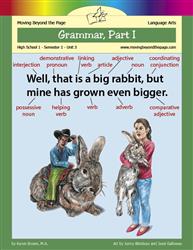
Unit 3: Grammar, Part I
Lesson 3
Pronoun Problems
Students identify and correct pronoun errors on activity worksheets (Pronoun Agreement, Indefinite Pronouns, and Pronoun Cases), practicing revision at the sentence level by rewriting incorrect pronouns. Students are instructed to produce corrected versions of example sentences and to use strategies (e.g., rewording, specifying antecedents) to fix vague references. In Activity 2 students create a poster or slideshow to teach someone else about vague references or point-of-view shifts, explaining the error and showing corrected versions in their own words.
Lesson 4
Commas
Students rewrite sentences to insert correct commas, parentheses, and dashes on multiple activity pages (Commas, Part I; Comma Homework; Essential vs. Nonessential; Commas, Parentheses, and Dashes). Students create a personal "comma guide" (poster, booklet, or slideshow) that records rules, explanations, and examples, and they check answers against an answer key and review rules when they miss items. For three sentences on the punctuation activity page, students must explain why they chose one form of punctuation over the others, and students write a journal entry evaluating the Oxford (serial) comma.
Lesson 5
Review
Students practice editing and correcting others' writing by crossing out incorrect commonly confused words and writing the correct words above them in Part I. Students find and correct subject-verb agreement and pronoun errors in Part II and insert missing commas in Part III. Students review notes, use index cards to record rules and examples, and take a grammar quiz to test their application of corrections and then review areas of weakness.
Lesson 6
Colons and Semicolons
Students are required to plan and write formal opening statements for both the semicolon and the colon (Great Punctuation Trial Part 1), which asks them to review evidence and include specified examples. Students present those statements aloud to a judge and answer questions in the courtroom hearing (Part 2), and the guide instructs the judge to ask for clarification or additional examples when explanations are unclear. Activity pages and answer keys ask students to check their answers and review rules for any missed items, prompting correction of errors.
Final Project
Wrapping Up
Students are asked to choose and plan a mini-project (either a visual aid explaining a grammar rule or a short quiz) and to use unit resources to create that product. The options explicitly invite students to make work that will 'help a friend or sibling' and to be 'thorough, accurate, neat, and appealing,' which orients students to a specific audience and purpose. For the quiz option, students must create an answer key, have someone take the quiz, assess the responses, and explain missed words to the quiz-taker.

Unit 4: Poetry
Lesson 1
Introduction to Poetry
Students complete a timed freewrite listing words and then write an initial definition of poetry (Activity 1) and are explicitly asked to "add to or revise your original definition of poetry" after reading poets' quotations. In Activity 2 and the Dickinson worksheet, students identify specific words, record denotations and connotations, and consider similar words and whether the original is more effective, which has them evaluate and choose language. The homework Poem Response asks students to mark a poem for important/noticeable words and to explain why selected words with strong connotations are effective.
Lesson 3
Figurative Language
Students are asked to write their own poem (Option 2 homework), which requires them to choose a subject, gather sensory details, and include specific figurative devices. The instructions tell students to consider going outside and taking notes on what they see, smell, hear, and feel, which guides planning and idea-gathering. The assignment states the goal is to have the reader experience a familiar subject in a new way, which orients student writing toward a purpose and audience.
Lesson 4
Voice and Tone
Students are asked to produce original writing in two options: (1) write a short letter in a character's voice that refers to parts of the poem and addresses a specific recipient, and (2) write a new stanza or at least four lines in a different voice, matching style, rhythm, and rhyme where applicable. The directions require students to analyze the speaker and to make the new voice believable and consistent with the poem's events, which asks them to adopt a new approach to composition. The Activity pages and Parent Plan emphasize that the produced lines or letters should show understanding of the speaker and content.
Lesson 8
Types of Poems
Students are instructed to write their own Shakespearean sonnet or a free-verse poem and are given structured activity pages: a sonnet template (quatrains/couplet, rhyme-scheme, aim for iambic pentameter) and a free-verse planning page with brainstorming prompts, sensory detail lists, and strong-verb practice. The lesson asks students to mark rhyme and meter in exemplar sonnets and to use brainstorming and 'final thoughts' guidance (e.g., tighten language, play with words) when composing their poems. Students are asked to plan (choose option, list places, describe sensory details) and to try different poetic forms (fixed-form sonnet versus free verse), which requires adopting different approaches to writing.
Lesson 9
The Crossover
Students are asked in Option 2 to write a poem defining a word "in a manner similar to the way it's done in the book," using people and events from their own lives to create the three "As in:" sentences, which requires composing in a new form. Homework options and journal prompts ask students to write 3–4 sentence responses about the book's themes and the shifting meaning of "crossover," giving students opportunities to produce written work tied to purpose. The vocabulary activity (Option 1) asks students to compare and explain definitions and to use one word as an example, which requires explanatory writing about word choice.
Final Project
Poetry
Students are asked to "re-read each [project choice] carefully and take notes on how you will approach each choice" and to begin "writing initial ideas," which shows explicit planning. Students create written products such as an ekphrastic poem, a one-page argumentative response about Bob Dylan, and a poetry explication presentation that requires drafting text and organizing content. Students are instructed to "put the finishing touches on your poetry projects," "polish your poetry recitation," and present/display their work to an audience, indicating some attention to refining and preparing final versions.
Unit 5: Nonfiction
Lesson 3
The Taliban
Students are instructed to "jot down the answers" to targeted questions before composing an informational paragraph, which shows planning prior to writing. The paragraph task requires a strong introductory sentence, coherent body sentences with transitional words, and a concluding sentence, guiding organization for a specific purpose and audience. Option 2 asks students to create slides using text and visuals and to put information in their own words and cite sources, which orients writing to an audience. The lesson also notes that students will "practice paraphrasing," indicating practice in rewriting source material in their own words.
Lesson 5
Displacement
Students choose images from a global schools gallery and plan a photo report by recording school name, location, grade level, and three assumptions based on the picture. Students conduct brief research (suggested search terms and use of library resources/interviews) to gather information about school conditions and challenges. Students create a mini-book about modes of transportation by selecting four types, collecting or drawing images, writing advantages and disadvantages, and assembling and sharing the finished product with family.
Lesson 7
Life in England
Students are asked to write a short informal journal response identifying a world issue they care about and imagining how they would make a difference, which serves as initial idea-generation and planning. The unit states that students' final project will be a paper about an important issue and that the journal assignment will help them begin thinking along those lines, linking the journal to future formal writing.
Lesson 8
Civil Rights
Students write answers in journals after watching Freedom Riders clips and after reading portions of King's "Letter from Birmingham Jail," recording the four steps to a nonviolent campaign and identifying persuasive arguments. Students complete Part II of the "African-American Authors" page by writing sentences about each author's contribution and how the works speak to the African-American experience. Students create a "Students in Action" pros/cons graphic organizer and produce a creative homework response (graphic or poetic), including an option to compose a found poem by selecting and rearranging phrases from source texts.
Lesson 10
Learning from the Past
Students are asked to draft a paragraph in Activity 3 that compares a universal truth in Wiesel's speech to other thinkers and to use quotes to support their argument. Activity 4 requires students to create a museum wall with one- to two-sentence formal explanations and a clear, formal description of the point, which asks them to consider audience and tone. The homework asks students to record a sad event as a journal entry or poem, and Activity 1 suggests annotating the speech, which can serve as prewriting or planning support. The Parent Plan lists skills including developing a topic with relevant facts and establishing a formal style and objective tone.
Lesson 12
Running from War
Students are taught three explicit methods for integrating quotations into their writing (use a complete sentence + colon, use a short introductory phrase + comma, or integrate a small section into their sentence). Students practice these methods on the Student Activity Page (Part II asks them to introduce a provided quotation using one of the methods) and are given practice questions (Part I) that require correct punctuation for quoted material. The homework requires students to use the APE strategy and to "Prove" their answer by using a quotation and one of the taught integration methods.
Lesson 14
Rehabilitation
Students are asked to write extended responses in multiple activities: Option 2 (a written journal response) requires students to choose a conclusion about war crimes and provide examples/quotations from the text to support it. The "Wiesel's Words" activity directs students to circle a quotation and explain how it relates to A Long Way Gone, including specific examples from the book or video. The homework options ask students to record and analyze a dream or Beah's nightmare in their journals, composing an analysis with textual references.
Lesson 15
A New Life
The lesson gives step-by-step guidance for writing summaries: students read, annotate or take notes, determine the main point, choose which points to include, and then write the summary in their own words, with advice to close the text before writing and to use transitional words for paragraph flow. In the marketing activity, students must create a flyer or webpage and are told to consider what information to include (background, how the organization helps, accomplishments), which requires planning for a specific purpose and audience. The homework and activity directions require producing written products (journal summary, flyer or webpage) and note audience considerations for memoir comparisons.
Final Project
Expository Essay
Students plan their writing by choosing a topic, developing a focused research question, and completing K-N-S and "What's My Question" activity pages. Students draft their essays across multiple days by developing a thesis, writing three body paragraphs using the APE (Answer, Prove, Extend) method, and composing introductions, conclusions, and a Works Cited page. Students revise and strengthen writing through explicit revision and proofreading steps (Part 7 Revising, Part 8 Proofreading), use the rubric and peer/parent feedback, read aloud strategies, spell-check, and checklist items (transitions, thesis clarity) to edit and improve drafts. Students attend to audience and purpose by being instructed to assume readers are peers from the unit and by being required to choose and focus on the three most pertinent facts for that audience.
Semester Exam
Semester Exam
Students are invited to revise previous writing projects (for example the Lord of the Flies paper or short story) during the five-day exam/review period. Students are told to write paragraph responses for Part IV and explicitly encouraged to "read back over the paragraphs and revise them as needed." Students complete grammar- and proofreading-focused tasks (correcting a paragraph, rewriting sentences) and a Quoting and Paraphrasing activity that requires integrating and reworking source material.
2: Semester 2

Unit 1: Ender's Game
Lesson 7
Leaders Motivate
Students are asked to read about John Locke and Demosthenes and then write a journal entry describing the links between the two sets of personalities, which asks them to produce written work based on source material. The lesson notes that Peter and Valentine intentionally adopt opposite personas and that both children contribute to each other's writing, which models adopting a new writing approach or voice (writing in a persona). The quote-matching and character-application activities require students to select appropriate quotations and explain why a quote fits a character, which engages students in choosing language suited to a rhetorical purpose.
Final Project
Think-Tac-Toe
Students are asked to rewrite passages (Box 3) by converting selected paragraphs into first-person narration and to rewrite conversations to incorporate historical quotes (Box 4). They compose a one- to three-paragraph flashback (Box 2) and write two to three paragraphs comparing military and civilian leadership (Box 5). The Think-Tac-Toe project also asks students to create storyboards or other creative products (Box 6, Box 1, Box 7) that require composing and reorganizing narrative elements.
Unit 2: Grammar, Part II
Lesson 1
Review of Grammar, Part I
Students are asked to identify and correct punctuation, subject-verb agreement, and pronoun errors in Option 1 homework, where they insert commas and semicolons and correct agreement/pronoun mistakes. Students create their own short paragraphs containing deliberate punctuation and grammar errors in Option 2 homework and produce an answer key that explains the applicable rules. Students complete matching activities and a Mad-Libs style exercise that require them to apply grammar knowledge to produce or choose correct word forms and sentence elements.
Lesson 2
Capitalization and Numbers
Students practice editing and proofreading conventions by placing check marks beside correctly capitalized sentences and writing the rule that explains each pair. Students complete activity pages, check their answers against the provided Answer Key, and are instructed to review any exercises they missed. Students record rules and preferred styles for writing numbers on a "Writing Numbers" page to use as a reference and to be consistent in future writing.
Lesson 3
Sentence Fragments and Run-on Sentences
Students write a 1–2 page narrative in the Creative Writing Challenge and are instructed to "review your draft carefully" and revise word choices as needed, with parent feedback. Students complete multiple editing activities: identifying and correcting sentence fragments and run-on sentences on activity pages and a paragraph-editing task where they mark and correct errors. Students also take online quizzes (with immediate feedback) for fragments and run-ons, supporting iterative correction of their writing.
Lesson 4
Modifier Errors
Students are directed to rewrite sentences with misplaced and dangling modifiers in Activity 2 (Part 1 and Part 2), explicitly instructing them to "rewrite each sentence so the modifier clearly describes the correct word" and to "rewrite each sentence so the modifier clearly refers to the correct subject." Option 1 requires students to record an "Original Sentence" and a "Corrected Sentence" and to illustrate how the correction changes meaning. Option 2 asks students to create a modifier-error quiz with an answer key and to have a peer take the quiz, and the activities instruct students to check their work using the provided answer key and to review rules for missed items.
Lesson 5
Hyphens and Apostrophes
Students are asked to edit and rewrite sentences for correct punctuation: the Hyphens activity asks them to explain meaning changes and rewrite sentences with correct hyphenation, to rewrite number-based modifiers (e.g., "a ten-year-old exhibit"), and to rewrite sentences using en dashes and em dashes. The Apostrophes activity requires students to mark up a travel-post text "like an editor" (circle, insert, or cross out apostrophes) and complete a Challenge Section with sentences to correct, demonstrating sentence-level editing and correction. Activity instructions also direct students to check answers in an Answer Key and to retake online quizzes, which supports iterative correction.
Lesson 6
Word Choice
Students practice revising and editing in multiple activities: they rewrite sentences on the "Avoiding Wordiness" page, cross out redundancies on the "Avoiding Redundancy" page, and complete word-choice exercises that require translating clichés and wordy phrases into clearer language. In the optional "College Essay Editor" activity, students read a draft, identify vague/clichéd/wordy language, and rewrite the paragraph to make it clearer and more specific for the admissions-audience. The lesson also directs students to choose language appropriate to purpose and audience (formal vs. informal), and to apply punctuation to set off nonrestrictive elements, reinforcing audience-appropriate revision choices.
Lesson 7
Verb Voice and Mood
Students complete an online exercise that asks them to identify passive constructions and, where appropriate, change them into active voice, giving practice in revising sentence-level choices. Students plan and produce a creative explanatory product (poster, slideshow, comic strip, or card game) that must explain the subjunctive mood to a younger audience, which requires them to select an approach and tailor content for purpose and audience. Students are given a rubric that requires the project to be free of grammar and punctuation errors and to include clear definitions and examples, which directs attention to correctness and clarity (editing) and to conveying the main idea.
Lesson 8
Parallelism
Students are shown a faulty-parallelism sentence and a corrected rewrite, and they are instructed to read an online explanation and use the Parallelism activity page to record descriptions and examples of parallelism problems. Students complete activity pages that require choosing correct commonly confused words and decoding a message, and they edit a passage in "Commonly Confused Words, Set XV" by writing the correct words above mistakes and using the answer key to check work. The Parent Plan directs students to take notes, complete exercises, and, if they miss items, review the applicable rules.
Final Project
Wrapping Up
Students are asked to plan mini-projects before beginning work ("plan the content of your guide/presentation before you begin creating it" and "read over the information about the topic in the lesson and book, take notes on what you want to include"). Several project choices require targeting a specific audience (create a poster suitable for an older elementary age group; create an explanatory guide for foreign students or peers) and to present information in a different approach from the book. Students practice editing and correcting writing in the unit test tasks (correct capitalization, fragments, run-ons, commonly confused words, hyphens/apostrophes) and the project rubric requires products be free from grammar and punctuation errors.

Unit 3: Informational Texts
Lesson 3
The Matthew Effect
Students are asked in Activity 1, Option 1 to take the birth-month data from the chapter chart and create a new chart (bar, pie, pictograph) that accurately represents and labels the key information, requiring them to choose which data to include and how to present it. In Activity 1, Option 2, students must read a paragraph (the TIMSS findings) and sketch a graphic that would replace or supplement the written information, planning a visual approach to communicate the study findings. The activities require students to ensure accuracy, clear labeling, and an effective title, which involves deciding what information is most significant for the intended reader.
Lesson 4
The 10,000 Hour Rule
Students are asked to write brief summaries and answer analysis questions for Sections 1–3, which requires planning and composing focused responses. Students are prompted to mark key opportunities while reading Sections 4–6 and then use those notes to create a visual communication (flowchart, infographic, diagram, slide) that conveys the most important points and ties the example to the chapter's bigger ideas. The Parent Plan and Skills list explicitly call for translating information into visual form and drawing evidence from texts to support analysis and reflection.
Lesson 7
Rice Paddies and Math Tests
Students are asked to plan and produce a diagram or infographic over two days, beginning the project on Day 1 and finishing it on Day 2. The assignment directs students to create a graphic "to help others quickly understand the information," use digital media to enhance audience understanding, and to produce a product that is "neat, attractive, and free from grammar and punctuation errors." Day 2 explicitly tells students they may add anything from the later reading to their graphic, implying an opportunity to revise or expand their work.
Lesson 9
Writing about History
Students are asked to compose an editorial (Option 2) that must persuade readers and use facts from primary and secondary sources to support points, which requires planning content for a particular audience. Students complete a graphic organizer that connects secondary-source claims to supporting primary-source evidence, demonstrating selection and organization of material before writing. Students also choose quotations for a double-entry diary/screenwriter task and design a split-perspective magazine cover, activities that require deciding which details are most important for a chosen purpose and audience.
Lesson 11
Technical Writing
Students plan their how-to guide using the "Guide Planning" sheet and complete a "Guide Checklist" that enumerates required elements (introduction, materials, steps, glossary, works cited). They produce a first draft (Day 2 homework), create a glossary, and are instructed to type and insert infographics before performing a revision pass in Activity 6 where they are told to revise steps, ensure audience-appropriate information, add navigation aids, and proofread. On Day 3 homework students have another person follow their guide while they observe and take notes, then conduct a follow-up interview to identify unclear or missing information and are encouraged to implement improvements.
Final Project
Argumentative Research Essay
Students plan their writing by choosing a topic and research question (Part 1) and locating at least five high-quality sources (Part 3). They draft a five-paragraph argument following the Classical Argument structure and use the "Present the Evidence" activity to organize notes and create a working thesis (Parts 2, 6, 7). Students revise and edit their drafts: Day 6 instructs them to reread focusing on content, organization, and support and to revise as needed; homework directs proofreading, formatting, and MLA Works Cited preparation (Part 9, Part 10). Students also adapt their written essay for a specific audience by drafting and revising an oral presentation and slideshow, shortening sentences and creating visual aids to suit listeners (Day 7–8).

Unit 4: Drama
Lesson 5
Act II
Students are asked to write a 5-sentence reader-response paragraph using the APE (Answer, Prove, Extend) method, which requires them to plan an answer and provide textual evidence. For a longer writing task, students must use their character analysis to write a six-sentence monologue that "reflects the character," connecting prior planning work to a composed product. In the vocabulary activity, students write initial definitions from context and then look up and revise those definitions, which explicitly requires revising their written responses.
Lesson 8
Shakespeare
The student activity sheet explicitly asks students to "Summarize: Rewrite the passage in your own words," and the Parent Plan includes an example answer that directs students to put the passage in their own words. Students are also asked to create a Shakespeare timeline using book, video, and web resources, which requires organizing information into a written product.
Lesson 11
Nuanced Meaning
Students are asked to rewrite a 6-line exchange from Act 3 as modern text messages using modern language and emojis, which requires them to produce a rewritten version of existing dialogue. Students write journal summaries of the most important event in each scene, practicing composing focused prose about significance. The parent notes ask students to show the original scene and compare it to their modern version and to demonstrate understanding of character relationships, plot, and emotions, which directs attention to purpose and audience.
Lesson 14
Modern Retelling
Students are directed to choose three specific areas to discuss and craft a parallel thesis statement, which requires planning the content and organization of their analysis. They are taught to use the APE method (Answer, Prove, Extend) to structure each paragraph, giving an explicit planning/organization strategy. The checklist asks students to include a thesis, begin each paragraph with a topic sentence, use specific examples from both productions, end paragraphs with an explanation of significance, and to read their paragraphs aloud and "Revise or edit as needed." The Parent Plan also states students will write routinely over extended and shorter time frames and produce clear, coherent writing appropriate to task, purpose, and audience.
Final Project
Drama
Students are asked to write scripts or text before recording or filming (e.g., "write out what you... will say" for podcasts and "Write the script for your commercial before you proceed"). The lesson directs students to produce draft and final versions (e.g., "use 'Set Design Template' pages or use your own stage design (one for a draft and one for your final design)", "finish the rough version" on successive days, and "polish/finalize all three mini-projects"). Students must consider purpose and audience (e.g., "Keep your audience in mind," present projects to a parent/family audience, and the commercial must answer why people should buy it). The rubric explicitly evaluates mechanics (spelling, punctuation, grammar) and content, which requires students to edit and revise to meet criteria.
Semester Exam
Semester Exam
The lesson explicitly invites students to "revise writing assignments or projects from previous units, such as the essay from Informational Texts," and the Skills list includes "time for research, reflection, and revision." Students complete multiple grammar and usage tasks that require editing and rewriting (e.g., rewriting a wordy sentence for brevity, correcting misplaced modifiers, fixing apostrophe and hyphen errors, and rewriting for parallelism). The Part IV discussion and short-answer items require students to produce 1–3 paragraph responses, which provide opportunities for drafting written responses.