


Seventh Grade - MATH
5: Math

Unit 1: Operations
Lesson 3
Division Review
Students compute quotients in real-world contexts that produce unit rates, for example dividing $82 by 8 to find $10.25 per hour, dividing $77.40 by 12 to find $6.45 per bag, and dividing 645.4 inches by 7 to find 92.2 inches per piece. The lesson shows how to divide decimals and convert decimal divisors to whole numbers (example 1.75 ÷ 0.25), and students solve problems like 79.2 ÷ 2.2 and 54 ÷ 4.5 that involve measures in different units. Multiple activity pages require students to set up and compute these quotients using long division with decimals.
Lesson 8
Unit 1 Test
Students complete multiple division and quotients problems that produce per-unit values (for example, $850 ÷ 4 = $212.50 for weekly earnings, $650 ÷ 4 = $162.50, 296.7 ÷ 4.3 = 69, and 135 ÷ 2 = 67 serving cups). Several word problems ask students to divide totals by counts to determine an amount per unit (e.g., snacks per bag, weekly pay, boxes needed), and many problems require decimal division and interpretation of remainders. The test problems and review items repeatedly have students compute quotients that correspond to unit-like rates (amount per week, items per box, cups per ounce).
Final Project
Planning a Party
Students are asked to compute a unit cost by dividing the grand total cost by the number of guests (e.g., $42.84 ÷ 12 = $3.57 per goody bag). The activity repeatedly has students compute totals, divide by 12 to find cost per bag, and convert percentages to decimals and multiply to find tax amounts. Students also work with package sizes and prices (e.g., 3 packages × $4.80 = $14.40) which involves computing cost per collection of items.
Unit 2: Integers and Rational Numbers
Lesson 3
Fraction Division
Students practice dividing fractions and mixed numbers using visual models and the invert-and-multiply algorithm (Keep, Switch, Flip, Solve). Students solve contextual division problems that use fractions, such as dividing 3/4 pound of cheese into 1/8-pound portions, finding how many servings are in 3 cups when a serving is 2/3 cup, and determining how many frames can be painted with fractional pints of paint. Students convert mixed numbers to improper fractions and compute quotients in multiple word-problem contexts involving lengths and quantities.
Lesson 8
Unit 2 Test
Students solve several division problems that involve fractions, including word problems that divide a total amount by a fractional serving size (e.g., Zoe: 16 1/2 ÷ 1 1/2 = 11 servings; Mary Ellen: 14 2/3 ÷ 1 5/6 = 8 bags). The materials include visual models and worked examples of dividing by fractions (images showing 6 ÷ 2/3 = 9 and 8 ÷ 4/5 = 10) and explicit parent-plan skills stating students should "divide fractions by fractions." Students also complete practice items computing quotients of mixed numbers and fractions on the review and test pages.
Unit 3: Ratios and Percentages
Lesson 1
Introduction to Ratios
The Parent Plan Skills section explicitly lists understanding the concept of a unit rate a/b associated with a ratio a:b and using rate language. Students practice writing ratios in fraction form (e.g., 5/11, 3/4) and create equivalent ratios by multiplying or dividing both terms, as shown in the Equivalent Ratios activities. Word problems involve quantities with different units (e.g., 50 ml cleaner with 5 liters of water) and scaling those ratios to new quantities.
Lesson 3
Equivalent Ratios
Students solve proportional problems that require finding per-one or scaled rates: e.g., using double number lines to find how long it takes to make 12 and 40 sandwiches given 2 sandwiches every 3 minutes, using a 100-meter/20-second speed to find time for 20 meters, and using cost problems (8 plants for $24; 2 sodas for $5; 3 apples for $1.50) to find unit costs and scaled costs. Tables and graphs tasks ask students to determine how long to print one catalog (finding time per catalog) and to plot and read points like (4,24) from proportional data. Many activities require students to compute missing values by scaling ratios across different units (minutes vs. items, meters vs. seconds, dollars vs. items).
Lesson 4
Unit Rates
Students set up rates as ratios and write them in fraction form, then divide the numerator by the denominator to compute a unit rate (e.g., Elena: 216 miles / 4 hours -> 54 miles per hour). Students also form equivalent ratios using diagrams or double number lines to make one quantity equal to 1 (e.g., Jalen: 156 calories / 12 chips -> 13 calories per chip). Students practice many contextual unit-rate and unit-price problems (speeds, calories, ounces, quarts, dollars) and use multiplication of a unit rate to find totals for other quantities.
Lesson 5
Percentages
The lesson presents ratios and unit situations: it explains percent as a part-to-whole ratio (parts out of 100) and has students convert among fractions, decimals, and percents. A Basic Skills Review problem asks students to find a unit price: given a 14-ounce box costing $3.92, students divide the cost by the weight to find a unit rate of $0.28 per ounce. The lesson includes other ratio problems (games won to lost) that have students write and manipulate ratios.
Lesson 8
Unit 3 Test
Students calculate unit rates in multiple problems: they compute speed (19 miles in 2 hours → miles per hour), unit price problems (peaches $5.16 for 4 lb → $/lb; dozen roses → $/rose), production rates (1,200 pieces in 40 minutes → pieces per minute), and pages per minute for a printer. Students set up and solve ratio tables, double number lines, and division to find values per one unit in these contexts. Several problems require converting between units and comparing unit prices, so students practice forming rates with different units.
Final Project
What's the Best Buy?
Students collect product data and compute unit prices by setting up ratios and dividing total price by number of units (Activity 3 shows $3.38 ÷ 13 = $0.26 per ounce). Students convert between measurement units using equivalent ratios (the gallon → quarts → pints → cups → fl oz chain) so that unit prices use the same units. Students also apply ratio reasoning in extension tasks (constant speed 1 mile per 6 minutes, currency conversion, and recipe scaling) that require computing and interpreting unit rates.
Unit 4: Algebraic Expressions
Lesson 5
Equivalent Expressions
The Basic Skills Review includes a rate problem where students compute Elias's push-ups per minute from 42 push-ups in 3 minutes and then scale that rate to other time intervals. Another task asks students to divide a total shipping weight (23.7 pounds) by 15 boxes to find pounds per box, and the review directions explicitly tell students to include unit labels in answers. These items require students to compute unit rates by dividing quantities and to express answers with appropriate units.
Unit 5: Algebraic Equations
Lesson 7
Independent and Dependent Variables
Students encounter and use unit-rate language and number-per-1 reasoning in multiple places: the introduction reminds them they learned unit rates and gives d = 45t with 45 described as 45 miles per hour. Real-world examples show rates per unit such as Grandma's recipe (15 cookies per 1 egg), Kevin earning $10 per hour, and Ron biking 5 miles per hour. Several activities have students write equations of the form dependent = (rate) * independent and use tables/graphs to find outputs from those whole-number rates.
Unit 6: 2D Geometry
Lesson 4
Area
Students compute areas and perform unit conversions (e.g., converting 10 ft to 120 in and 3 ft to 36 in) and then divide total area by area-per-item to find counts (the paver problem: 4,320 in^2 ÷ 24 in^2 = 180 pavers). Students also convert yards to feet and divide area by coverage-per-package in the seed problem (54 ft^2 ÷ 3 ft^2 = 18 packages). Several area computations produce fractional or decimal results (e.g., 1/2 × 9 × 5 = 22 1/2 mm^2), showing work with non-integer quantities.
Lesson 5
Circles
Students measure the circumference and diameter of three die-cut circles (X, Y, Z), then use a calculator to divide circumference by diameter and record c/d rounded to two decimal places, showing values near 3.14. Students set up the ratio π = C/d and use inverse operations to solve for C, rewriting it as C = πd and C = 2πr, and then practice computing circumference given radius or diameter. Students also compute half-circumference and radius when rearranging parts to relate circumference and area in the hands-on wedge-to-rectangle activity.
Lesson 6
Scale Drawings
Students set up and simplify ratios that compare scale drawings to originals (for example, 8 cm / 2 m simplified to 4 cm / 1 m for Mia's garden). Students use scale factors expressed as fractions (1/3, 1/2, 1/4, 3/1) to compute corresponding linear measures (e.g., 18 by 12 reduced by 1/3 becomes 6 by 4). Students work with ratios that use different units (1 cm / 4 ft, 1 in / 5 ft) and use equivalent ratios to compute actual lengths (architect and fort examples) and convert scale-factor ratios to percents.
Lesson 7
Unit 6 Test
Students compute scale factors from length comparisons in several problems (e.g., Heath's photograph: actual diameter 12 in vs. photo diameter 4 in yields a scale factor of 4/12 = 1/3). Students use fractional scale factors to create scaled drawings (use a scale factor of 1/3 to draw a scaled rectangle and find the new base and height). Students compute unit ratios for perimeter and area when scaling (example: perimeter scale factor 3/1 and area scale factor 9/1 for a 3× enlargement) and compute enlargement scale factors from paired dimensions (Jeremy's kite: 30/6 and 20/4 = 5:1).
Unit 7: 3D Geometry
Lesson 2
Surface Area
The Basic Skills Review includes Problem 7 (Evie bought a 24-ounce bottle of orange juice for $3.12) and the answer key shows students compute the unit price per ounce by dividing $3.12 by 24 to get $0.13 per ounce. The lesson also contains other arithmetic practice with decimals and mixed numbers (e.g., grapes costing $1.58 per pound and 2.5 pounds) that involves working with ratios and unit-price style computations.
Lesson 3
Volume
Students compute how many smaller fractional cubes fit along a length (e.g., asking "How many 1/4-inch cubes are in 1 1/2 inches?" and finding 6) and use division of mixed numbers and fractions to determine counts (Activity 2 examples and student pages). Several problems require dividing lengths by fractional unit sizes (e.g., 3 ÷ 1/3 = 9, 1 1/2 ÷ 1/4 = 6) and then use those quotients to build totals for volume. The lesson also requires converting mixed numbers to improper fractions and performing fraction division/multiplication to produce those numerical results.
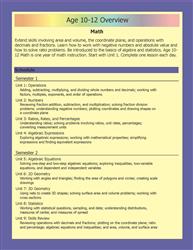
Unit 9: Skills Review
Lesson 2
Fractions, Ratios, and Coordinates
Students compute unit rates in concrete problems: the train problem has students divide 310 miles by 5 hours to find 62 mph, and the apples problem has students divide $6.12 by 3 pounds to find $2.04 per pound. Students also divide a fractional quantity by a whole number in the trail-mix problem (1/2 ÷ 3 = 1/6 pound per bag), giving practice with unit-rate interpretation when a numerator is fractional. Students practice fraction division procedures in Activity 1 (e.g., 5 1/4 ÷ 2 2/3), which provides the arithmetic skill needed to form complex fractional rates.
Lesson 3
Expressions, Equations, and Percentages
The Parent Plan skills explicitly list "Use ratio reasoning to convert measurement units; manipulate and transform units appropriately when multiplying or dividing quantities," and the lesson states it "wraps up the review of ratio-related topics with a brief quiz about percentages and unit conversions." The wrapping up directs students to an external web quiz titled "Percentages and Unit Conversions," indicating some planned practice with unit conversions and ratio-related ideas.
3: Math
Unit 1: Numbers
Lesson 1
Positive and Negative Rational Numbers
Students solve real-world "per" problems that require computing rates by division (e.g., a company loses $60 over 5 days → −60 ÷ 5; a submarine descends 150 meters over 5 minutes → −150 ÷ 5; a temperature drop of −48°F over 6 hours → −48 ÷ 6). Activities ask students to interpret quotients as average rates per unit (per day, per hour, per minute) and include practice dividing signed numbers in contextual problems. Several tasks explicitly ask students to write equations and compute a quantity per unit in authentic contexts.
Lesson 6
Scientific Notation
Students divide and manipulate quantities in scientific notation to find per-item or per-time values (e.g., Activity 6 Problem #2: 4 × 10^5 liters ÷ 2 × 10^3 trucks to find liters per truck). Students convert and scale rates across time units (e.g., Activity 5 fire hose: 1.2 × 10^3 liters per minute × 60 to find liters per hour). Students also convert between units (e.g., km to m, kg to g) and work with rates expressed in scientific notation in calculator activities, which provides practice with numeric division and multiplication needed for unit-rate reasoning.
Lesson 7
Arctic Marine Research
Students divide measured cell lengths (0.0000065 m and 0.0000042 m) to determine how many times larger one organism's cells are than another (Phase 1, part d). Students are given and compare cell densities expressed as cells per ounce (1.2 × 10^8 and 9.5 × 10^7) when comparing equal tissue samples (Phase 1, part 2). These tasks require students to work with ratios of measured quantities expressed as decimals and in scientific notation.
Final Project
Mars Station Test Mission
Students calculate energy use per hour, per day, and per year for each location (Task 1 and its answer key show kWh per hour, per day, per year). Students compute energy production per day and per year from solar panels and wind turbines and combine totals (Task 2 and answer key show daily and yearly outputs). Students compute area of a drop zone using A = πr^2 and then compute total cost by applying a cost per area or cost per unit (cost per kg is used for supply cost calculations).
Unit 2: Proportions
Lesson 2
Unit Rates
Students work with explicit complex-fraction unit-rate examples such as 3/4 miles ÷ 1/2 hours, using Keep-Change-Flip and simplifying to get 1.5 miles per hour. Student activity pages include multiple fraction-over-fraction problems and word problems (e.g., 3/4 cup per 2/3 batch; 5/8 mile in 1/3 hour; 7/9 gallons in 1/4 hour; 3/5 mile every 1/10 hour) that require computing unit rates from ratios of fractions. Activities also require students to compute and compare unit rates for lengths and areas (cost per square foot, area per inch) and include a conversion example (9 yards → 27 feet) and a hands-on area-per-length challenge.
Lesson 3
Constant Rate
Students are taught and repeatedly asked to compute the constant of proportionality using k = y/x in tables, graphs, equations, and word problems (explicit formula k = y/x appears in "Things to Know" and multiple activities). Students compute k in real contexts that produce fractional unit rates (e.g., baker: 3 cups for 4 cakes → k = 3/4 cups per cake; runner: 5 miles per 60 minutes → k = 5/60 = 1/12 miles per minute). Activities ask students to find unit rates from tables and graphs and to write y = kx equations and solve for y, including rates given in different units (liters per minute, miles per hour, dollars per pound). The Parent Plan and Skills lists explicitly state students should "understand the concept of a unit rate a/b associated with a ratio a:b" and identify unit rates in various representations.
Lesson 4
Graphing Proportions
Students compute unit rates in multiple places: the Skills Review explicitly gives (3/4) ÷ (2/3) = 9/8 cups of sugar per cup of flour as a unit-rate computation. Activities and answer keys ask students to find unit rates from tables and equations (e.g., ribbon problem with 1/4 meter per kit, fuel efficiency 5 gallons per 100 miles → 1 gallon/20 miles, and Graph 5 unit rate 0.2). The lesson repeatedly has students write y = kx, identify k as the unit rate (point (1,k)), and compute k from fractional or decimal values in tables and graphs.
Lesson 5
Proportional Relationship Equations
Students compute unit rates with fractional quantities on the Review Quiz (Question 1: 3/4 miles in 1/2 hour → (3/4) ÷ (1/2) = 1.5 mph; Question 2: 2/3 cup sugar per 1/4 cup butter → (2/3) ÷ (1/4) = 8/3). Multiple activities require finding unit rates or constants of proportionality (e.g., d = 4.5t asks for the unit rate, painting area rates like 20 sq ft per hour and 15 sq ft per hour). Students are directed to practice finding unit rates in the Quiz Review and Activity pages that include lengths, areas, and mixed-unit situations (cups vs. cups, calories per minute, miles per hour).
Lesson 6
Taxes, Tips, and Commissions
Students set up and solve division equations that compute a quantity per unit by dividing an amount by a rate (for example: 0.012 × V = $2,400 → V = $2,400 ÷ 0.012; 0.20 × I = $9,000 → I = $9,000 ÷ 0.20). Students find pre-tax prices by dividing a total by 1 + tax rate (for example: 1.08x = $212 → x = $212 ÷ 1.08). The Parent Plan and activity descriptions explicitly state students use proportional reasoning to solve multistep ratio and percent problems.
Lesson 8
Simple Interest and Percent Error
Students set up and compute rates using the simple interest formula I = Prt and solve for the annual interest rate in multiple problems (e.g., 250 = 2500 × r × 2 → r = 0.05; 540 = 3000 × r × 3 → r = 0.06). Students solve problems that involve dividing by time to produce a per-year rate (for example, finding r when interest and multi-year times like 2.5 years are given). Students also solve for time and compute interest per year and total balances, practicing the arithmetic of rates and unit-rate reasoning in a financial context.
Lesson 9
Unit 2 Test
Students are asked to compute unit rates from fractional ratios in multiple problems (e.g., find the unit rate for 3/4 mile in 1/2 hour; 5/6 mile in 2/3 hour; 4/5 mile in 1/2 hour). Several tasks require dividing one fractional quantity by another in different contexts (recipes: 2/3 cup sugar per 1/4 cup flour; cyclist distances per hour; map scales inches-to-miles). The parent plan and review lists explicitly state the skill: "Find unit rates, even when working with fractions or different types of measurements."
Final Project
Lemonade Stand
Students are instructed to "use unit rate formula to calculate the price per lemon" for individual and bulk purchases and to record $ per lemon for each store. Students divide total cost by quantity to find unit prices for sugar (divide price of a 2 lb bag by 2 to get $ per lb) and for cups (divide package price by number of cups). Students set up proportions and compute fractional results (e.g., converting tablespoons to lemons and pounds, rounding to the nearest hundredth), write equations in the form y = kx for recipe scaling, and graph the relationships, interpreting slope/steepness as the unit rate.
Unit 3: Expressions
Lesson 4
Graphing Proportions
Students are repeatedly instructed to find the unit rate by dividing the y-value by the x-value, and they practice this procedure in multiple activities (e.g., Finding the Unit Rate and Turning Graphs into Equations). Students work with fractional coefficients in equations such as y = 1/2 x and with real-world ratio problems that produce fractional unit rates (e.g., 8 pencils for $5 → $5/8, 3 apples for $2 → $2/3). Classroom tasks require students to compute k = y/x from plotted points including non-integer y-values (for example (3, 7.5) → k = 2.5).
Lesson 5
More Graphing Proportions
The lesson repeatedly has students compute unit rates by dividing y by x across tables, graphs, and equations (e.g., "Unit Rate = y/x" shown in the table method and many worksheet problems asking for miles per hour, dollars per month, or price per candy). Students find unit rates from equations in the form y = mx (e.g., y = 4x, y = 1/2 x) and identify the unit rate as the y-value when x = 1. Multiple answer keys and activities require students to compute and interpret fractional slopes such as 3/4, 1/2, and 9/7, and students work with different units (miles/hour, gallons/minute, cm per book, ml per liter).
Lesson 8
y = mx + b
Students are taught that slope (m) represents a rate of change and are instructed to compute slope using m = (change in y)/(change in x). Students compute slopes from two points (e.g., m = (6−2)/(3−1) = 2 and m = (−1−5)/(4−(−2)) = −1) and work with fractional slopes such as 1/2 and −3/2 in examples and graphing tasks. Real-world scenarios present rates in unit-rate form (e.g., $10 per hour, $1.50 per mile, $0.25 per 10 minutes) so students write and graph linear equations that use rates as slope values.
Lesson 9
Unit 3 Test
Students are asked to interpret unit rates and slopes from tables and graphs (listed in the Introducing the Lesson and Parent Plan sections). Multiple activity problems require students to compute slopes and unit rates from tables of whole-number data (e.g., babysitting earnings: hours vs. dollars; car rental and dog walker/lawn care tables) and to write equations like y = 10x or y = 50x. Several problems explicitly ask students to find slope from two points, identify if a relationship is proportional, and write unit-rate equations (slope = rate in context).
Final Project
Planes, Trains, and Automobiles
Students write and use equations in the form y = mx where m is speed (miles per hour) for car, train, and plane (e.g., y = 60x, y = 80x, y = 400x). They interpret the slope/unit rate on distance-time graphs and compute unit-rate coefficients in cost equations (e.g., y = 0.15x + 31.50, y = 0.20x + 20.75, y = 0.50x + 63.25). Students compute travel time by dividing distance by rate (500 = 60x → x = 500/60) and calculate fractional numbers of stops and fractional hours when converting minutes to hours (500 ÷ 200 = 2.5 stops; 15 minutes = 0.25 hours).
Unit 5: Functions
Lesson 2
Linear and Nonlinear
Students compute rate of change using the formula (y2 - y1) / (x2 - x1) in multiple examples and tables (explicitly shown in the text and worked tables for y = 2x + 4 and y = x^2). Students complete activity pages where they fill in x and y values, calculate the rate of change, and decide whether the relationship is linear or nonlinear. Students also plug x-values into given equations to produce y-values and then compute differences between y-values to find the rate.
Lesson 5
Slope
Students compute slope using the formula m = (y2 − y1) / (x2 − x1) and practice finding slopes that are fractions (for example, slope = 1/2 and slope = 1/4 are shown). Students find slope from tables, graphs, and equations and are asked to simplify the ratio of change in y to change in x. Students also interpret slope as a rate (e.g., "goes up 2 for every 1 right"), reinforcing the idea of a quantity per one unit.
Lesson 6
Slope-Intercept Form
Students calculate slopes as rates in several places. In the "Table to Equation" example they compute slope m = 1/5 (0.2) miles per minute from table data and explicitly convert that unit rate to 12 miles per hour. Multiple activities have students compute slopes that are fractions (e.g., m = -2/3, m = 1/2) from two points, tables, or by isolating y.
Lesson 7
Creating Functions
Students identify and compute rate of change (slope) from stories, tables, and graphs using the slope formula m = (y2 − y1)/(x2 − x1). Students find unit-rate style slopes in multiple activities (e.g., pages per hour from a table, bike rental cost $3 per hour from a graph). The lesson includes fractional rates in tasks and answer keys (e.g., Graph 2 with slope = 0.25, cooking functions with ingredient rates like 0.33 or 0.5 per serving).
Lesson 8
Comparing Functions
Students are taught to compute rates using the formula Rate of change = Δdistance/Δtime and shown worked examples (Alex: 1.5 miles ÷ 30 minutes = 0.05 miles/min; Bella: slope computed from (0,0) and (30,2) to get 0.067 miles/min). Students practice finding slope from graphs, tables, and equations (e.g., Jordan's y = −3x + 100, Taylor's table with weekly balances) and are asked in multiple activity problems to compute and compare rates (Rider A 4 miles/20 minutes, Person A 12 gallons/6 minutes, etc.). The parent plan and activities explicitly direct students to find rate of change and starting points across representations.
Unit 6: Geometry
Lesson 1
Congruence and Similarity
Students compute scale factors by dividing side lengths (for example, finding scale factor 6 ÷ 3 = 2) and use those factors to find missing side lengths (for example x = 10 ÷ 2 = 5). Students work with fractional and decimal scale factors (answers and examples list scale factors like 1/2, 1/3, and 0.4) and write proportional relationships between corresponding sides (e.g., AB → DE and AB:DE = 1:2). Students practice setting up and evaluating numerical division of lengths to determine how one length compares to another.
Lesson 6
Dilations
Students compute scale factors by dividing new coordinates or lengths by original ones (e.g., x':x and y':y quotients are shown to equal the scale factor). Students apply fractional scale factors (0.5, 0.25, 0.33) and multiply original side lengths by the scale factor to get new lengths (new length = original × scale factor). Students set up and solve equations for unknowns using the ratio new/original = scale factor in several problems and examples.
Unit 7: Linear Equations
Lesson 1
Linear Equations With One Variable
Students solve many equations where the variable is multiplied or divided by a fraction (e.g., problems such as (3/4)x + 3 = 7, (2/5)x = 6, x/5 = 7, and the activity page Reviewing Equations with Fractions). The lesson explicitly teaches multiplying by the reciprocal to isolate a variable and includes worked examples that multiply both sides by a reciprocal to solve for x. Students practice these procedures across multiple problems and check solutions by substitution.
Lesson 2
Multi-Step Equations
Students set up and solve equations that involve rates and per-unit quantities (for example, Jason runs 1.5 miles every morning and students solve 1.5d = 36 to find days; the catering, phone plan, car rental, and water tank problems use expressions like $8.75 per guest, $0.15 per text, $0.25 per mile, and 7.5 gallons per day). Several problems require translating word problems with 'per' language into linear equations and solving for an unknown quantity (e.g., 50 + 8.75g = 312.50, 450 - 7.5d = 210).
Lesson 8
Linear Algebra In the Wild
Students define variables for unit quantities (e.g., Let x = price per pound of peach rings, Let a = price of one apple) and write systems that directly represent total cost = (unit price × quantity) in the Candy Shop and apple/banana problems. Students solve those systems to produce unit rates such as $4 per pound and $2.00 per apple, and they set up and solve rate-based equations in Break-Even Analysis (y = 20x + 50, y = 30x) to compare per-hour costs. The activity pages repeatedly prompt students to find per-item or per-hour prices by solving for a single-unit variable after forming two equations.
Final Project
Getting Ready for College
Students set up and compute unit costs in multiple activities: they write and use per-mile rates in the Transportation activity (C = 225 + 0.60x and C = 1.25x) and compute per-hour and flat rates in the Entertainment activity (C = 20 and C = 5 + 1.5h). Students determine per-week slopes from graphs in the Meal Plans vs. Groceries activity (e.g., $80/week and $50/week) and compute per-person splits for apartment costs (e.g., 1050/2 = 525, 1500/2 = 750). In the Phone Plans activity students simplify and interpret unit-rate expressions (y = 5x + 20).
Unit 8: Data
Lesson 4
Linear Models
Students practice finding slope using m = (y2 - y1) / (x2 - x1) and writing linear equations from scatterplots. Students interpret slope as a rate in context (for example, y = 2x + 50 is explained as 2 additional cones sold per 1°F increase; parent notes and problems give slopes like 1.5 cm/hr, −6 liters per hour, and a sample bird-count slope of 2.5 birds per day). Several activities ask students to identify variables, compute slopes from two points, write y = mx + b, and use the slope as a unit rate to make predictions.
Lesson 5
Categorical Data
Students compute relative frequencies by dividing cell counts by row or column totals (for example, computing 18/90 = 0.20) and fill two‑way relative frequency tables. Activities ask students to convert frequencies to decimals or percentages and to compare proportions across groups. Multiple tasks require students to divide table entries by totals and interpret the resulting proportions to describe associations.
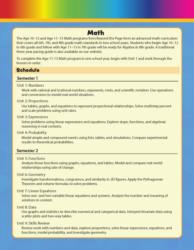
Unit 9: Semester Exams
Lesson 1
Numbers Review
Students compute and interpret unit-rate style quotients such as "-45 ÷ 9 = -5" and describe this as the gamer losing 5 points per round. Students compute "-72 ÷ 6 = -12" and interpret this as each friend owing $12. Students are asked in Mission 4 to create, solve, and explain a real-world problem that must include multiplication or division and a fraction or decimal, providing an opportunity to work with rates involving non-integer values.
Lesson 2
Proportions Review
The Parent Plan explicitly lists the skill "Compute unit rates associated with ratios of fractions, including ratios of lengths, areas and other quantities measured in like or different units." Activity 1 asks students to convert 3 miles in 12 minutes to miles per hour and to find flour per batch (2 cups for 5 batches), and students compute and compare unit rates for two runners (miles per hour). Activity 4 includes a map-scale problem (1 inch = 6 miles; find miles for 9 inches) and Activities 2–3 focus on identifying constants of proportionality and writing y = kx, which supports finding unit rates.
Lesson 3
Expressions Review
Students are asked to identify unit rates by finding slopes from tables and graphs (e.g., babysitting pay: hours vs. earnings with answers y = 14x and slope = 14; car rental: days vs. cost with answers y = 75x and slope = 75). Several activities instruct students to "graph proportional relationships, interpreting the unit rate as the slope of the graph," and to write equations in the form y = kx (e.g., "y = 40x" and "y = 18x"). Problems require students to interpret the meaning of the origin and the slope in context (e.g., "What does the slope represent? $18 per hour").
Lesson 5
Semester Exam
Students are asked explicitly to find a unit rate when given a ratio of fractions in problem 14: "Find the unit rate: 4/5 mile in 1/2 hour," and the answer key gives 1.6 miles per hour (showing conversion of the complex fraction). Students compute unit rates from whole-number and decimal ratios in problems 15 (18 miles in 3 hours) and 34 (6 miles in 1.5 hours). Students also find a unit rate from a graph in problem 19 (line through (0,0) and (2,10)), reinforcing multiple representations of unit rate.
Lesson 6
Functions Review
Students calculate slopes from pairs of points (e.g., find slope from (2, 1) and (6, 9)) and find slopes from equations (e.g., y = -1.25x + 5). Students write and interpret linear functions in context (e.g., y = 18h for earnings, a bike rental: y = 12x + 10, and a taxi scenario asking which intercept represents starting cost). Students compare rates of change (e.g., compare slope = 6 to slope = 5) and explain the meaning of slope as a rate of change in real-world contexts.
Lesson 7
Geometry Review
Students compute scale factors and use them to find missing lengths in similarity problems (e.g., a triangle with side 5 corresponding to 10 gives scale factor = 2 and other sides 14 and 18). Students identify and reason about fractional scale factors (a dilation with scale factor 1/2 labeled as a reduction). A problem requires computing a scale factor from 6 to 15 (scale factor = 15 ÷ 6 = 2.5), and students apply integer scale factors to coordinates (dilate Triangle LMN by factor 3 to get L'(6,3), etc.). These tasks require forming and using ratios of lengths to calculate multiplicative relationships.