


Ninth Grade - ELA
1: Semester 1

Unit 1: Lord of the Flies
Lesson 3
Paths in the Jungle
Students read and annotate an article to identify the author's thesis and supporting points and then record the "Author's main argument/thesis" and "Key points that support the thesis" on a student organizer. Students complete a column labeled "Your reaction to the thesis" and evaluate the writer's view, then decide and record their own opinion. Students may consult an additional article to gather more supporting reasons for the topic.
Lesson 6
Symbolism, Part 1
Students are asked in Activity 1 to choose an interpretation for each symbol (e.g., Piggy's glasses: science and technology, intelligence, civilization) and to circle the interpretation they agree with. Students must write a brief explanation and back up their choice with support from the text, as described on the Student Activity Page and in the Parent Plan. The activities prompt students to reflect on alternative interpretations by presenting multiple options for each symbol.
Lesson 8
Defects of Human Nature
Students are asked to choose themes that support Golding's major theme and to "support those choices by referring to details from the novel" (Option 1 and Parent Plan). The Student Activity Pages provide space for notes and instruct students to write 3–4 sentence explanations describing how a chosen theme supports the major theme. Option 2 explicitly asks students to "choose the theme they feel best supports the major theme" and to "write 3-4 sentences explaining how the chosen theme supports Golding's major theme."
Lesson 10
Which Is Better?
Students are asked to write a one-page journal entry that analyzes Jack's leadership and contrasts it with Ralph's leadership and the boys' pre-island civilized lives, which requires them to state positions about leadership and support them with textual details. Students complete a "Developing Civilization" comparison chart that has them list similarities and differences between the boys and early peoples, which involves organizing claims about likenesses and differences with supporting points. The skills section requires students to "produce clear and coherent writing in which the development, organization, and style are appropriate to task, purpose, and audience," implying an expectation of organized analytical writing.
Final Project
Now You Have the Conch
Students are instructed that "the thesis is your claim" and that a thesis should be specific, arguable, and supportable. The Essay Organizer and Traditional Outline require students to write a thesis with three supporting reasons and to provide specific examples/quotes and explanations for each body paragraph. The sample prompt models locating passages, paraphrasing the question, forming a thesis (e.g., "mob mentality compels characters..."), and supporting it with textual evidence. Editor checklists and the rubric ask students to evaluate whether the thesis is specific, arguable, and supportable and whether details follow a logical order.
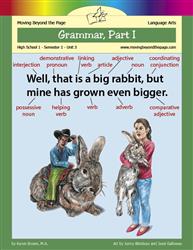
Unit 3: Grammar, Part I
Lesson 6
Colons and Semicolons
Students prepare formal opening statements in the Great Punctuation Trial, writing persuasive paragraphs that must utilize listed claims about semicolons and colons and include specific examples (e.g., joining independent clauses, conjunctive adverb use, complex lists, introducing a list or quotation). Students must defend their claims aloud before a judge, answer probing questions about rules, and provide example sentences as evidence when asked. The activity asks students to describe why each punctuation mark deserves use and to address common mistakes, which requires providing reasons and supporting examples.

Unit 4: Poetry
Final Project
Poetry
The "Provide Your Opinion" final-project choice asks students to consider both sides of the Bob Dylan Nobel Prize debate and then "write a response ... in which you argue whether Dylan did or did not deserve the prize," citing reasons. The assignment directs students to read supporting and critical articles (links provided) and to use other writers' arguments or quotations, with credit, in their response. The parent plan reiterates that students should provide specific reasons to support their argument and consider both sides of the debate.
Unit 5: Nonfiction
Lesson 1
Types of Nonfiction
Students are asked to classify I Am Malala as a biography, autobiography, or memoir and to "Give specific examples" from the catalog record, front matter, and back matter to support that conclusion. The Student Activity Page directs students to compare books and "Support your comparison with specific examples," requiring them to cite evidence for claims about themes, viewpoints, and accuracy. The Web link activity asks students to read an interview and answer whether the interviewer's role changes how they would classify the book and to explain why or why not, prompting consideration of an alternate classification.
Lesson 6
A Day Like Any Other
The lesson requires students to use the APE strategy where "Answer" directs students to answer the question in their own words and include part of the question, which prompts them to state a claim. The "Prove" step requires students to provide evidence using specific examples and quotations (with page numbers) to support their answer. The "Extend" step asks students to give an opinion, explanation, or connection, prompting them to explain how evidence supports their claim.
Lesson 8
Civil Rights
Students complete a 'Students in Action' graphic organizer that asks them to record arguments for and against children participating in the 1963 march and then state their overall opinion, requiring them to list reasons on both sides. Students read and annotate excerpts of King's Letter from Birmingham Jail, identify the most persuasive argument he made, and explain why it was effective, which asks them to analyze reasoning and supporting evidence. Students complete a 'Just and Unjust Laws' double-entry diary in which they underlined portions of the text, noted agreement or disagreement, and articulated their own views, practicing comparison of viewpoints and reasons.
Lesson 9
Civil Disobedience
The Opposing Quotes activity asks students to "Decide which of the two men you agree with more, and explain the ways that your views and his align," requiring students to take a position and provide explanation. The comparison activities (MLK and 'Civil Disobedience' and the Passages sets) ask students to analyze paired excerpts and explain overlapping ideas, prompting use of textual evidence to support interpretations. The Parent Plan lists related skills such as "Draw evidence from literary or informational texts to support analysis" and "Develop the topic with well-chosen, relevant, and sufficient facts," which frame argument-related work.
Lesson 10
Learning from the Past
Students are asked in Activity 3 to skim Wiesel's speech, identify a statement that is a universal truth, and draft a paragraph arguing how that statement aligns with one or two other advocates, using a quote from each person to support their argument. The Parent Plan and activity sheets require students to quote Wiesel and other thinkers (Malala, MLK, Thoreau) and to rewrite or paraphrase key sentences in their own words. Activity 4 requires students to write a clear and formal description of the point they want to make on a museum wall, which asks for a concise, claim-like statement supported by images and one- or two-sentence explanations.
Lesson 12
Running from War
Students are asked to use the APE strategy for a journal response: Answer (state the answer, including wording of the question), Prove (use a quotation from the text), and Extend (explain how the quotation supports the answer). Activity 1 and the Student Activity Page require students to practice integrating quotations into their own writing and to introduce a specific quotation using one of three methods, which asks students to provide textual evidence and explanation.
Lesson 13
Child Soldier
Students are asked in Activity 1 to consider two explicit viewpoints (supporters and detractors of Beah's accuracy) and to "write a response in your journal" about whether the accuracy matters, which prompts them to adopt and justify a position. In Activity 2 (Different Accounts) students fill parallel "Book" and "Video" columns comparing accounts on specific questions, requiring them to record evidence from both sources. The "Child Soldiers" activity asks students to list advantages and disadvantages from different perspectives, prompting them to assemble reasons that could support or counter an argument about using child soldiers.
Lesson 14
Rehabilitation
Students are asked in Activity 1 Option 2 to re-read the lieutenant's speech and the RUF child's conversation, choose a conclusion about whether the government committed war crimes, and "state one of these conclusions (or one of your own) and provide examples or quotations from the text". The "RUF vs. Government Soldiers" student activity page directs students to mark which listed war crimes each side committed and to provide supporting examples or quotations. The Wiesel's Words activity requires students to choose a quotation and explain how it relates to Beah's memoir using specific examples from the book or video.
Final Project
Expository Essay
Students are asked to develop a research question and then write a clear thesis that answers that question; the homework and examples show students composing a precise expository thesis and listing three supporting points. The rubric explicitly evaluates 'Thesis' clarity, 'Organization' (use of transitions and logical order), and 'Support' (three key facts backed by sources), and activities guide students to draft body paragraphs using APE (Answer, Prove, Extend) with citations. Students also plan audience/purpose and use graphic organizers to link thesis, reasons, and evidence.
2: Semester 2

Unit 1: Ender's Game
Lesson 7
Leaders Motivate
Students are asked to write a journal entry explaining why Peter chose the pen names Locke and Demosthenes and to 'describe the links between the two sets of personalities,' which requires making a claim and supporting it with reasons from readings on Locke and Demosthenes. In the "Complete the Thought" and character-quote activities, students must match quotes to characters and "explain why you chose each quote," which asks them to provide reasons and textual or contextual evidence for their selections. The Parent Plan skill asks students to analyze how an author draws on and transforms source material, which asks for evidence-based analytical writing about authorial choices.

Unit 3: Informational Texts
Lesson 4
The 10,000 Hour Rule
Students analyze how Gladwell arranges and develops points in Sections 1–3 through the "Looking Closely" activity, answering questions about how the author introduces Bill Joy, pauses to present scientific studies, and then returns to the story. Classroom discussion prompts ask students to evaluate whether Gladwell believes talent/intelligence or opportunities/practice matter more, which requires comparing competing explanations. The Parent Plan lists skills that students practice, including determining an author's point of view, analyzing how an author's claims are developed, and citing textual evidence to support analysis.
Lesson 6
The Ethnic Theory of Plane Crashes
Students read a critical blog (Activity 4) and identify the blog author's primary objections to Gladwell's claims about plane crashes. In Activity 5 Option 1, students prepare an oral explanation summarizing the article's main objections and answer questions comparing the strengths and credibility of those objections. In Activity 5 Option 2, students complete a chart that lists each criticism, Gladwell's response, and an evaluation of the response's effectiveness, directly engaging with claims and counterclaims and the supporting evidence.
Lesson 7
Rice Paddies and Math Tests
The Parent Plan lists skills that require students to draw and cite textual evidence, determine a central idea, and analyze how an author's ideas are developed, which asks students to use reasons and evidence from the text. The homework and discussion prompts ask students to form and explain their views (e.g., comparing Gladwell's view of success to their prior understanding and discussing talent vs. preparation), which requires students to state positions and support them in discussion. The infographic mini-project requires students to translate a concept into a clear visual that condenses and explains information from the book and may include embedding audio or images as supporting evidence.
Lesson 9
Writing about History
Students read multiple secondary summaries and primary eyewitness testimonies and complete a 'Firsthand Accounts' graphic organizer that asks them to match secondary-source claims to supporting primary-source evidence. Students are asked to read pro-Chivington editorials and either create a split-perspective magazine cover or write an editorial that defends the Indians' side using facts from the accounts. The parent-plan Skills list explicitly states that students will 'write arguments focused on discipline-specific content' and 'Introduce precise claim(s), distinguish the claim(s) from alternate or opposing claims, and create an organization that establishes clear relationships among the claim(s), counterclaims, reasons, and evidence.'
Lesson 10
Science Writing
Students are asked to complete an "Investigating Claims in Science Writing" activity that requires them to explain how the author supports two explicit claims ("Noncontact forces are invisible" and "Centripetal force is often called a fictitious force"). The parent plan lists skills students will practice, including citing specific textual evidence and assessing the extent to which an author's reasoning and evidence support a scientific claim. The activity prompts students to identify methods the author uses (e.g., explanation, example, illustration, highlighting) and to judge audience appropriateness, which requires analysis of claims and supporting details.
Lesson 11
Technical Writing
Students are asked to write a brief introduction that explains the skill and its potential advantages and to back up this claim with information from an outside source (Homework/Day 1). The Guide Checklist explicitly requires that the benefit be supported by an outside source and that a Works Cited section be included (Guide Checklist; Activity 6). A sample introduction models introducing a claim about the value of a skill and quoting an expert with a citation, showing how to introduce a claim and provide supporting evidence.
Lesson 12
Logical Fallacies
Students analyze texts and speeches (e.g., Gehrig's speech, Andrew Jackson's message) to identify a main point or thesis and to locate the specific examples and reasons the speaker uses to support that thesis. Students learn about logos and are asked to state how speakers support claims with facts, examples, and statistics, and to write their own persuasive speech or essay that uses appeals to ethos, pathos, and logos. Students practice evaluating reasoning by identifying fallacies and determining whether evidence is relevant or misleading in political statements and short speeches.
Final Project
Argumentative Research Essay
The lesson requires students to create a working thesis and explicitly write a counterargument (Present the Evidence Part B asks students to state their thesis and the opposing viewpoint). The Classical Argument activity and its student page guide students to introduce a clear position, provide background (narration), present confirmation (reasons and evidence), and include concession/refutation and conclusion. Part 7 maps the five-paragraph essay to those parts (Paragraph 1: Introduction/Narration; Paragraphs 2–3: Confirmation; Paragraph 4: Concession and Refutation; Paragraph 5: Conclusion). The essay rubric and instruction on using transitions and in-text citations reinforce organizing relationships among claims, counterclaims, reasons, and evidence.

Unit 4: Drama
Lesson 4
A Raisin in the Sun
Students are asked to take a position and give reasons in short-answer prompts such as "Do you think Walter should have given Travis the money? Why or why not?" and reflections after the videos asking whether college will be necessary and why. Students write a paragraph summarizing Act I and make a prediction in journal homework, which requires them to state a viewpoint and support it with plot details. Several discussion prompts ask students to explain character motives and solve interpretive questions, prompting brief justificatory responses.
Lesson 5
Act II
Students are asked in Activity 3 to write a five-sentence reader-response paragraph that uses evidence from the play to support their points. The APE graphic and directions require students to Answer (make a claim), Prove (provide specific examples and quotations from the text), and Extend (explain or connect the evidence). Several prompts explicitly instruct students to use evidence from the play to support their answers.
Lesson 13
Tragic Hero
Students are asked in Activity 1 to decide whether Romeo and Juliet are tragic heroes and to "explain how Romeo does or does not meet each criterion," which requires making a claim and supporting it with reasons from the play and video. In Activity 2 students complete a timeline and then "decide if the character is static or dynamic, supporting your conclusion" and state whether the character is round or flat with rationale, requiring use of evidence from scenes. In Activity 3 students compare Pyramus and Thisbe with Romeo and Juliet, collecting parallel details that can serve as supporting evidence for character/genre claims.
Lesson 14
Modern Retelling
The lesson directs students to write a thesis statement that names three areas of difference and to place that thesis above three supporting paragraphs. It instructs students to begin each paragraph with a topic sentence that answers a focused question, to provide specific examples from both productions as proof, and to end each paragraph with an explanation of the significance or effect of those differences. The lesson also recommends using the APE method (Answer, Prove, Extend) to structure paragraphs, which organizes claims, reasons, and evidence.
Final Project
Drama
The Skills list explicitly includes the parent standard "Write arguments to support claims..." and related research/citation skills. In the Commercial project, students must write a script that answers "What is it? What is it used for? Why should people buy it? Why is it a good product?" which requires stating a persuasive claim and giving reasons. Several projects (Playlist, Set Design, Costumes) require students to provide explanations and cite sources or include sample lyrics as evidence to justify their choices.
Semester Exam
Semester Exam
Students are asked to define and explain a counterargument (Part III asks "Explain what a counterargument is and why it's usually a good idea to include one"). The Part IV discussion tasks require students to take a position (e.g., argue whether Shakespeare should be taught, or whether Outliers is informational or persuasive) and support it with specific details in 1–3 paragraph responses. Several short-answer and essay-style prompts (e.g., comparing types of writing, defending adaptations, evaluating sources) ask students to provide reasons and examples to support their positions.