


Sixth Grade - MATH
5: Math
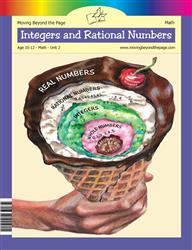
Unit 2: Integers and Rational Numbers
Lesson 4
Negative Numbers and Integers
Students use number lines and are told that each number has an opposite that is an equal distance from zero, and they plot and compare points such as +3 and -3 on horizontal and vertical number lines. Students complete activities that require marking opposites (e.g., marking -4 and +4 on a foldable number line) and explain which negative balance is farther from zero when comparing debts (Jasper -$50 vs Patrice -$75). Real-world contexts involving magnitude appear in finance and temperature problems (Marcus is $218.72 in debt; temperatures below/above zero), which students represent with negative and positive numbers.
Lesson 5
Absolute Value and Inequalities
Students are asked to define absolute value as a number's distance from zero and to label number lines and vectors showing that distance (Activity 2 "Absolute Value Notes" and accompanying parent notes). Students calculate absolute values for integers, fractions, and decimals (examples and answer key showing |−2.75| = 2.75, |3 1/2| = 3 1/2) and complete practice problems finding and ordering absolute values (Activity 3 Practicing Absolute Value). Students apply absolute value as a magnitude in real-world contexts by finding distances between locations, comparing temperatures, comparing depths (diving platform and pool bottom), and comparing absolute distances of a balloon and a submersible (Activity 1 and Activity 4).
Lesson 6
The Coordinate Plane
In Activity 3 students plot pairs of opposites (for example, 6 and -6) on horizontal number lines, draw colored segments from zero to each number, and fold the number line at zero to observe that the two segments match. The lesson text explicitly states that "the length of the red line is the same as the length of the green line" and that "opposite numbers are the same distance away from zero." The lesson connects this observation to reflections and extends the idea to coordinate planes when reflecting points across axes.
Lesson 7
Coordinate Problem Solving
Students plot points with negative and positive coordinates and calculate horizontal and vertical distances between them (e.g., problems with points like (7, −3) and (2, −3); (−3, 5) and (−3, −4)). The Parent Plan and activities explicitly state use of absolute value to find distances between points with the same first or second coordinate. A Basic Skills Review item asks for the distance from −3 to 5 and uses absolute value notation in the provided answer.
Lesson 8
Unit 2 Test
Students are asked to "Find the absolute value of a number and use a number line to find distances" in the unit learning targets. Several student items require evaluating absolute value notation (for example, problems/answer key with |4| = |(-)4| and comparisons like (-)2 < |(-)7|). Multiple activities ask students to plot numbers on a number line and identify which is closest to zero, and temperature/distance problems require finding how far values are apart (e.g., temperature rising from -11 to -2).
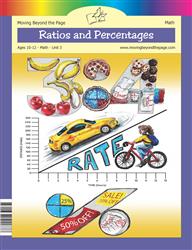
Unit 3: Ratios and Percentages
Lesson 3
Equivalent Ratios
The Basic Skills Review includes a comparison task (Question 7) that requires students to work with absolute value notation; the answer key shows items such as |(-)3| = |+3| and 4 < |(-)9|. The answer key explicitly lists these absolute-value comparisons, indicating students will practice evaluating and comparing expressions that use absolute value notation.
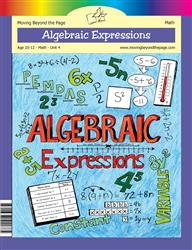
Unit 4: Algebraic Expressions
Lesson 4
Positive and Negative Numbers
The lesson defines absolute value as "the distance of a number from zero" and shows examples such as |−6| = 6 and |6| = 6 with number-line diagrams. It teaches that opposites have the same distance from zero (additive inverses) and shows students using absolute value to decide which number is farther from zero when adding a positive and negative. The lesson includes real-world contexts (bank balances, depths, temperatures, owing money) where students write and solve expressions that use negative values.
Lesson 7
Unit 4 Test
The Parent Plan Skills section explicitly states that students will "show that the distance between two rational numbers on the number line is the absolute value of their difference, and apply this principle in real-world contexts." The materials include integer practice (problems like -14 - (-9), games such as Orbit Integers and Fruit Splat) and instruction on subtraction as "add the opposite," which engages students with positive and negative quantities and distances between numbers.
Unit 8: Statistics
Lesson 9
Comparing Populations
Students compute mean absolute deviation by listing each data value's "distance from the mean" and summing those distances, as shown in the tables for pumpkins and zucchinis where positive distances (e.g., 1.5, 0.5, 2.5) are recorded. Student activity pages ask them to calculate the mean and then fill in a column of distances from the mean and compute the average of those distances (MAD = sum of distances ÷ 10).
Lesson 10
Unit 8 Test
Multiple student activity pages require students to compute mean absolute deviation (e.g., "Find the mean absolute deviation to the nearest tenth" for the bagel sales problem, MAD values for Opal and Randall, and MAD for best-seller weeks). Answer keys and problems provide MAD values and ask students to compute or use those values in comparisons and inferences. These tasks implicitly require students to take absolute values of deviations from a mean when computing MAD.
Final Project
Statistical Study
Students are asked in Step 4 to calculate the mean absolute deviation and record it as part of their measures of variability. The project requires students to compute measures of center and variability (mean, median, mode, range, interquartile range, and mean absolute deviation) and to display these results on their presentation. The repeated mention of mean absolute deviation indicates that students will perform calculations that involve absolute values of deviations from a center.
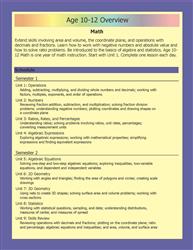
Unit 9: Skills Review
Lesson 1
Decimals, Factors, and Multiples
The Parent Plan explicitly lists "Understand ordering and absolute value of rational numbers" as a skill students will review. In Wrapping Up, students are instructed to play a game that practices ordering positive and negative numbers and to complete an online exercise titled "Ordering and Absolute Value," indicating students will practice ordering and some absolute value items. These items provide direct student practice with ordering and some exercises labeled for absolute value.
3: Math
Unit 1: Numbers
Lesson 1
Positive and Negative Rational Numbers
Students work with a number line and draw movements to and from zero (Activity 1), identify zero pairs (e.g., 3 + (−3) = 0), and solve scenarios that locate values relative to zero (depth, temperature, money). Students represent debts and balances as negative numbers and compute remaining amounts (e.g., a student owes −$12, 20 + (−12) = 8), and they draw visual representations or circle zero pairs to show cancellations. Several real-world problems ask students to find how much was lost, descended, or remains, which requires thinking about the size or distance of a quantity from zero in context.
Lesson 7
Arctic Marine Research
Phase 5 asks students to find the temperature range between -15°C and 5°C and to compute the average daily temperature, which requires finding the difference between a negative and a positive value. The submarine depth task has students compute a final depth after diving to -450 m and rising 175 m, requiring students to add and interpret negative and positive quantities. The lesson groups these under a "Positive/Negative Numbers" heading, so students practice computations that involve magnitudes of signed numbers.
Final Project
Mars Station Test Mission
Students calculate temperature differences using negative temperatures (e.g., Arctic average -10°C leading to a reported temperature difference of 30°C) to determine heater energy needs. Students compute energy shortfalls as the difference between energy needed and energy produced and then determine how many fuel cells are required to make up that shortfall (e.g., energy shortfall values and fuel cell counts are given). These tasks require treating negative temperature values and differences as magnitudes in real-world contexts (heating and stored energy).
Unit 2: Proportions
Lesson 8
Simple Interest and Percent Error
The percent error section presents and uses the absolute value notation in the formula Percent Error = (|Actual Value - Estimated Value| / Actual Value) × 100. An explicit worked example computes |30 − 25| = 5 and then completes the percent error calculation to get 16.67%. The student activity pages and answer key include several practice problems and worked answers that use absolute value (for example, |3 − 2.5|, |208 − 212|, |6.10 − 5.50|) to find percent error.
Unit 6: Geometry
Lesson 3
Reflections
Students repeatedly measure how far a point is from a line of reflection (e.g., Point A at (3, 0) is described as 3 units from the y-axis and A' is placed the same distance on the opposite side). The Perpendicular Distance Method instructs students to measure perpendicular distances (counting graph-paper boxes) from points to a reflection line and place image points the same distance away. Many exercises ask students to record coordinates before and after reflection and note that only the sign of a coordinate changes while the magnitude (number of units) stays the same.
Unit 8: Data
Lesson 1
Statistics Review
The lesson's MAD section explicitly instructs students to "Take the absolute value (ignore negative signs)" when finding distances from the mean and gives worked examples using expressions like |22 − 21.25|. Steps for MAD include "Find the distance of each value from the mean" and then "Find the average of all of these distances," which has students compute absolute values of differences in multiple practice problems. Several sample MAD calculations show students computing and averaging absolute distances.
Unit 9: Semester Exams
Lesson 1
Numbers Review
Students compute and interpret negative quantities in real-world contexts (e.g., submarine: −12 + 7 = −5 with final position described as 5 meters below sea level; temperature: −2.5 × 6 = −15 with meaning "dropped 15°"); students solve contextual division of negatives (e.g., −45 ÷ 9 = −5 meaning lost 5 points per round; −72 ÷ 6 = −12 meaning each friend owes $12). Students identify zero pairs that sum to 0 (e.g., 9 + (−9) = 0 and 15 + (−15) = 0), reinforcing the idea of canceling opposites. Several tasks ask students to explain what negative answers mean in context, requiring them to state the magnitude of a loss or debt.
Lesson 9
Data Review
Activity 2 asks students to compute mean absolute deviation and the Answer Key shows distances written with absolute value notation (e.g., |12 − 15| = 3) and averages those distances to find MAD. The lesson also states that "The MAD shows the average distance each data value is from the mean," which asks students to interpret absolute-value expressions as distances from a reference value.
Lesson 10
Semester Exam
Students are asked to calculate the mean absolute deviation (MAD) for given data sets (Problems 40–42) and the answer key states that "MAD is the average distance of the data values from the mean," which requires taking absolute deviations. The materials include MAD calculations (e.g., MAD ≈ 5.31) and explicit language describing absolute deviations as distances from the mean.