


Seventh Grade - MATH
5: Math
Unit 3: Ratios and Percentages
Lesson 3
Equivalent Ratios
Students set up and solve linear equations that come from tape diagrams and tape-division problems (for example, the answer key shows 4x + 3x = 91 to find how many bottles each person collected). Multiple student problems require writing and solving equations of the form kx = total (e.g., 3x+7x=500, 7x=63) as students use tape diagrams or combine ratio parts to find x. Students also create tables and graphs to find equivalent ratios and use proportional reasoning to compute unknown quantities.
Lesson 6
Percentage Problems
Students translate percentage word problems into number sentences using a variable (n) and write equations such as 32 = 0.64x and 560 = 0.8n. Students solve these equations by isolating the variable (e.g., x = 32/0.64) and compute answers using multiplication or division. Students also set up and solve many percent problems as equivalent ratios or with the fraction-times-number method (e.g., n = 15/100 × 20).
Final Project
What's the Best Buy?
Students set up and solve proportional equations to find unit prices (divide total price by number of units) and use equivalent-ratio equations for conversions (e.g., gallons → fl oz via a chain of multiplicative ratios). The answer key and Activity 5 show students writing and solving a percent equation (n = 10/100 × $200) and manipulating that proportion to find the part. Students also solve rate and scaling problems (doubling/tripling recipes, distance × time rate) using arithmetic equations and ratios.
Unit 4: Algebraic Expressions
Lesson 1
Introduction to Algebra
Students translate word problems into algebraic expressions (for example, Carlee has 12 board games -> 12 + n) and match word phrases to expressions (e.g., 3n + 4, 4x - 9). Students write and solve simple equations such as 20 + n = 35 and a + 3 = 8, choosing values that make the sentence true. Students work with multiplicative expressions (5n, 36n, 20n) and evaluate those expressions for given values of the variable.
Lesson 6
The Distributive Property
Students translate real-world situations into algebraic expressions (e.g., Tessa: 2n + 3n → 5n; Raoul: 15p - 18) and write factored and expanded forms such as 5(n + 2) and 5n + 10. Students use visual area models and matching activities to connect a(b + c) with (a·b) + (a·c) and practice expanding and simplifying expressions. Students evaluate expressions by substituting given values (several problems require evaluating expressions for specified variable values) and use evaluation to prove equivalence between original and simplified expressions.
Lesson 7
Unit 4 Test
Students write algebraic expressions to represent real-world situations such as Zane's pay (12n + 5), Jeremiah's earnings (5x + 3), Tasha's shells (n + 7), and Kelsey's cookies (n - 12). Students also work with expressions in the form p(x + q), for example Alana's beads 12(x + 6), and use properties (distributive and commutative) and numerical substitution to produce equivalent expressions and evaluate them (e.g., evaluating 12(x + 6) and 12x + 72 at x = 10).
Final Project
Algebra Think-Tac-Toe
Students are asked to identify and label variables, coefficients, constants, exponents, and terms in the "Show and Tell Vocabulary Poster," which builds use of variables to represent quantities. Students practice the distributive property and simplifying expressions in the "Math Properties Trading Cards" and "Prove It! Equivalencies" tasks (examples include 6(5 + n) – 24 – 2n and 10(4 + y) – 3y – 25). The "Make a Quiz" activity includes writing and solving algebraic-style problems (example given: 4m + 6 = 2m + 8), asking students to create and answer equation problems and to evaluate expressions by substitution to check equivalence.
Unit 5: Algebraic Equations
Lesson 1
Algebraic Equations
Students translate word problems into one-variable linear equations such as 32 + p = 48, 36 - 4n = 12, 3x = 24, and m ÷ 6 = 20, and they set up equations from scenarios on multiple activity pages. Students practice finding values that make those equations true by substituting candidate numbers (guess-and-check) and by selecting correct options on multiple-choice items. Students solve many examples that are of the form px + q = r (including instances with subtraction and division interpreted as multiplication by a rational) through these activities.
Lesson 2
Solving One-Step Equations, Part 1
Students represent unknowns with variables and set up and solve equations that attach a variable to constants using addition or subtraction (examples: n + 60 = 100, 48 = 21 + x, 16 + n = 72). Students use tape and hanger diagrams to model equations such as 2x + 4 = x + 6 and 2n - 7 = 3 + n and perform inverse operations (subtracting or adding the same value to both sides) to isolate the variable. Students practice writing equations from word problems (e.g., n + 5 = 11) and check solutions by substituting values back into the original equations.
Lesson 4
Solving Two-Step Equations
Students write and solve two-step equations from word problems such as 3n + 4 = 19 (Abby's snowfall), 5n + 12 = 92 (Marissa's pickets), n/2 + 10 = 35 (Tanya and lemonade), and 2n - 9 = 51 (Marcos and baseball cards). Students also work with equations in the form p(x + q) = r, e.g. 3(n - 4) = 15 and 5(n + 2) = 25, using the distributive property then inverse operations. Students solve equations with integers, decimals, and fractions and practice checking solutions by substituting back into the original equation.
Lesson 7
Independent and Dependent Variables
Students translate word problems into two-variable equations (e.g., Kevin: 10x = y; Ron: 5x = y; cube/pyramid: y = 2x; Kelsey/Michelle: x + 4 = y). Students isolate variables and solve equations using inverse operations and substitution (e.g., solving 10x = 240 to find x = 24, rewriting y - 5x = 8 as y = 5x + 8). Students generate solution pairs with input/output tables and graphs (examples: tables for 2x - 4 = y, 2x + 4 = y, and graphing y = x + 2) to find multiple solutions.
Lesson 8
Unit 5 Test
Students write and solve word problems that produce equations of the forms px + q = r and p(x + q) = r: examples include Heather (3n + 2 = 23), Dominic (3n − 5 = 115), Jenna (n + 4 = 7), Titus (n − 5 = 12), and 2(y + 1/2) = 13 on the practice page. Students solve a variety of one- and two-step equations with rational coefficients (e.g., x − 2.4 = 7.6, 6m = 42, n/3 = 4), showing procedures such as using inverse operations and the distributive property. Multiple student activity pages require writing the equation from a real-world context and solving for the unknown, with answer key steps shown for each problem.
Final Project
All About Me
Students are asked to create at least 5–7 equations and sample problems include x + p = q (e.g., n + 3 = 15), px + q = r (e.g., 3x - 4 = 56 and n/2 + 5 ≤ 9), and simple proportional forms (e.g., 2x = y). The project checklist requires at least two problems that are two-step (involving addition/subtraction and multiplication/division) and at least one equation with two variables. Students must write an answer key and check solutions by plugging answers into the original equations, and they are expected to share and have others solve the problems.
Unit 6: 2D Geometry
Lesson 2
Working With Angles
Students write and solve equations that represent angle relationships such as 126 + n = 180 and n + 2n = 90, and they solve multi-step equations like 5n = n + 92 by subtracting n and dividing to get n = 23. Day 2 shows step-by-step algebraic solutions using inverse operations (subtracting and dividing) and substitution to find actual angle measures (e.g., 5(23) = 115). Student activity pages require students to write equations from diagrams (including expressions with parentheses like n + 2(n - 40) = 130) and to solve sets of equations such as 2n + 3n = 180.
Lesson 3
Triangles
Students are asked to write and solve simple equations for unknown angles as shown in the Unit 6 quiz prompt that asks for an equation and solution for the angle supplementary to 104° (expecting 104 + n = 180). The Parent Plan skills list explicitly states that students will "use facts about supplementary, complementary, vertical, and adjacent angles in a multi-step problem to write and solve simple equations for an unknown angle in a figure." Several activities require students to set up and solve for an unknown angle using the triangle-angle-sum (e.g., finding the third angle by computing 180° minus the sum of two given angles).
Lesson 4
Area
Students set up and solve algebraic equations from area word problems such as 24n = 4320 for the paver problem and 15·n = 75 for Omar's parallelogram height problem. In the triangle-area problem students write and manipulate the equation 1/2 · b · 5 = 20 to solve for the missing base. The materials show students dividing both sides by a coefficient to isolate the unknown.
Lesson 6
Scale Drawings
Students set up and solve equations with variables in several activities: they solve 8 + 3n = 44 on the Basic Skills Review and solve proportions written with variables such as 1 inch/5 feet = 6 inches/n feet to find actual measures. Students write and solve multiplicative equations like 28n = 56 and 48n = 192 when comparing perimeters and areas of scaled figures. Students also solve proportional equations in the form 1/3 = x/18 and 1/2 = y/4 to compute scaled lengths and heights.
Lesson 7
Unit 6 Test
Students are asked to write and solve equations for unknown angle measures, for example forming n + 2n + (3n + 12) = 180 and solving to get 6n + 12 = 180, and solving 3n = 2n + 35 or 3n + 35 = 4n to find n. The answer key shows students combine like terms, add or subtract terms on both sides, and divide to isolate the variable, demonstrating fluent solutions to linear equations of the form px + q = r. Multiple practice and test items require students to set up these linear equations from diagrams and solve for the unknowns.
Unit 7: 3D Geometry
Lesson 1
Three-Dimensional Solids
In Activity 3 students set up and solve equations from Euler's formula, for example writing F + 5 (-) 8 = 2 and then manipulating it to F + (-)3 = 2 and finally F = 5, with step‑by‑step algebraic work shown. The Problem Solving: Polyhedrons activity includes word problems that lead to equations (e.g., F + 8 (-) 12 = 2 giving F = 6 and 5 + V (-) 8 = 2 giving V = 5) that students solve. Several student activity pages require students to write the variable equation from given data about faces, edges, and vertices and solve for the unknown.
Lesson 2
Surface Area
Students are asked to solve the equation 4x + 12 = 24 in the Basic Skills Review and provided an answer (x = 3). Students also practice simplifying expressions that use parentheses, e.g., rewriting 5(n + 7) as 5n + 35, which relates to handling distributive forms like p(x + q). Several tasks require evaluating expressions at given variable values (e.g., n = 3) and using arithmetic operations in sequence.
Lesson 5
Problem Solving With Solids
Students set up and solve equations with a variable for missing dimensions (e.g., 54 = L × 4 1/2 × 2 → 54 = 9L → L = 6). Multiple problems require writing and solving linear equations such as V = B × h (1792 = 64 × h → h = 28) and the Basic Skills Review asks students to write and solve 5n + 10 = 130 (n = 24). The materials repeatedly ask students to plug known quantities into geometric formulas, represent unknowns with variables, and solve by isolating the variable using multiplication/division.
Lesson 6
Unit 7 Test
Students set up and solve linear equations in multiple problems: Bella's flute case uses 182 = 6.5 × h to solve for h, and the soap factory problem uses 6300 = 42 × h to find the prism length. The Euler's Formula problem rearranges 5 + V − 8 = 2 to solve for V, showing manipulation of an equation of the form px + q = r (with p = 1). Answer keys show students performing division and addition steps to isolate the variable.
Unit 8: Statistics
Lesson 2
Populations and Samples
Students set up and solve a one-step linear equation in the Rico word problem by writing n + 26 = 102 and solving n = 76. Students also solve a one-step inequality n + 3 < 5 and use inverse operations to isolate the variable. Basic skills items require working with expressions involving variables (e.g., evaluating 4n + 12 when n = 5) which gives practice manipulating linear expressions.
Lesson 8
Making Inferences
Students are asked to solve the equation 4n - 3 = 17 on the Basic Skills Review and the answer key shows the algebraic steps (add 3, divide by 4) to find n = 5. A word problem (Josie had 4 fish...) leads students to write the inequality 4 + n ≤ 9, showing students translate a context into an algebraic expression. The Basic Skills Review contains several contextual problems that require arithmetic work (e.g., rate, area) alongside the algebra problem.
Unit 9: Skills Review
Lesson 3
Expressions, Equations, and Percentages
Students write and solve linear equations in standard forms: Activity 2 asks students to solve equations such as 9n = 63, x - 1.3 = 5.8, and 2(n + 3) = 16, and the Naomi word problem is modeled by 5n + 3 = 18. The answer key shows students using inverse operations (subtracting 3 then dividing by 5 for 5n + 3 = 18; distributing/isolating for 2(n + 3) = 16) to find solutions. Activity 1 and Activity 2 include writing expressions from words and solving for variable values, so students practice forming and solving px + q = r and p(x + q) = r type equations with rational coefficients.
Lesson 4
Geometry
Students write and solve the equation 3n = 2n + 16 for the vertical angles problem and substitute the value of n to find angle measures. Several problems require setting up and computing area formulas (including fractional side lengths) and working with scale factors, giving practice manipulating numeric expressions and solving for numeric results.
3: Math
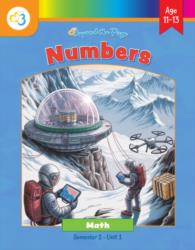
Unit 1: Numbers
Lesson 2
Fractions and Decimals
Students set repeating decimals equal to x, multiply by 10 or 100 to shift the repeating block, subtract the original equation, and solve the resulting linear equations (examples shown: 10x - x = 3.3 - 0.3 => 9x = 3 and 100x - x = 17.17 - 0.17 => 99x = 17). The activity pages and worked examples require students to carry out the algebraic steps to isolate x and write the repeating decimal as a fraction. Practice problems ask students to show work converting repeating decimals into fractions using these algebraic equation steps.
Final Project
Mars Station Test Mission
Students convert the fuel cell energy given as 7 × 10^2 kWh to 700 kWh and then compute how many fuel cells are needed by dividing the computed energy shortfall by 700 (Task 3), with the answer key listing values such as 119 fuel cells for the Arctic Tundra. Students calculate energy shortfall as the difference between energy needed and energy produced and then use that quotient to determine fuel cells and storage area. The project also has multiple arithmetic word problems where students compute totals and unit-based costs (e.g., supply cost per kg and total supply cost) that result in linear computations.
Unit 2: Proportions
Lesson 2
Unit Rates
Students set up and solve proportions that produce linear equations (for example, the recipe proportion 2/4 = n/10 rewritten as 2 × 10 = 4 × n leading to 4n = 20). The Word Problems and Answer Keys include solving equations such as 2n = 750 and 6n = 30, showing students practice isolating the variable and dividing to find solutions. The lesson also asks students to solve word problems using both the unit-rate (arithmetic) method and the proportion (algebraic) method and shows both solution paths for the same problem.
Lesson 3
Constant Rate
Students set up and solve word problems by identifying variables, finding a constant k, writing equations in the form y = kx, and solving for the unknown (Activities 6, 7, and multiple real-world problems). Students rewrite and manipulate linear equations to isolate y in proportional forms (Activity 5 examples such as 4y = 8x ➜ y = 2x). Students classify equations as direct variation or not (e.g., identifying that y = 2x + 3 is not proportional) and practice converting equations to the y = kx form.
Lesson 6
Taxes, Tips, and Commissions
Students set up and solve linear equations representing tax and income problems (e.g., 0.012 × V = 2400 to find a home's value; 0.20 × I = 9,000 to find income). Students write and solve equations for pre-tax price problems (e.g., let p = price before tax; 1.06p = 374.40 → p = 374.40 ÷ 1.06). The activities include forward and backward problem types (calculate tax/commission/tip and work backwards from totals), with answer keys showing algebraic solution steps.
Lesson 7
Markups and Discounts
Students solve backward percent problems and are shown algebraic setups in the answer keys (for example: x × 0.60 = 18 → x = 30; x × 1.60 = 208 → x = 208 ÷ 1.60 = 130; x × 0.85 = 255 → x = 300). Several review and backward problems prompt students to 'Let x be the original price' and solve for x, and the lesson includes worked examples that convert percent-word problems into equations and solve them. The Lesson Review and answer keys explicitly demonstrate solving word problems by forming and solving equations like p·x = r.
Lesson 8
Simple Interest and Percent Error
Students set up and solve equations using the simple interest formula I = Prt to find missing quantities (for example, 250 = 2500 × r × 2 to solve for r and 108 = 600 × 0.06 × t to solve for t). Students compute balances using Balance = Principal + Interest and perform algebraic isolation of a single variable by dividing both sides in multiple practice problems. Students complete word problems that require translating a real-world situation (principal, rate, time, interest) into an equation and solving for the unknown.
Lesson 9
Unit 2 Test
Students solve word problems that are set up as multiplicative equations, for example letting the pre-tax price be p and solving 1.06p = 212 and 1.07p = 265.50, and solving property-value problems like 0.012p = 1728. The Student Activity and Unit Test problems repeatedly ask students to form and solve equations of the form coefficient × unknown = total (e.g., tax, markups, and simple interest calculations). The answer key explicitly shows algebraic setups and solutions for these problems.
Final Project
Lemonade Stand
Students write and use equations of the form y = kx to model proportional relationships (e.g., y = 2x for tablespoons of lemon juice and y = 1.5x for tablespoons of sugar) and fill tables and graphs from those equations. Students set up and solve proportions to find unknown quantities (e.g., 1 lemon/3 tbsp = x lemons/36 tbsp and 1 lb sugar/36 tbsp = x lb/___ tbsp) and compute numeric solutions for amounts needed. Students also write arithmetic expressions that model cost, for example (Number of lemons × Unit price) + (Amount of sugar × Price per pound) = Total cost for 1 gallon, and use division to find cost per cup.
Unit 3: Expressions
Lesson 2
Rewriting Expressions
Students set up and solve equations of the form Total Price = Original Price × (1 + Sales Tax Rate) and Discounted Price = Original Price × (1 − Discount Rate), using examples like 40(1.05)=42 and 120(1.08)=129.60. Students write and solve linear equations of the form px + q = r, for example 25 + 3r = 58 leading to r = 11, and they solve for unknowns inside parentheses by distributing and isolating the variable (e.g., 48.75 = 65(1 − D) → 48.75 = 65 − 65D → D = 0.25). Students practice solving for original price by algebraic manipulation (dividing both sides by 1.05 or 0.9) and also perform the two-step arithmetic methods (find tax/discount then add/subtract) alongside the one-step algebraic method.
Lesson 3
Algebraic Expressions
Students set up and solve the rectangle perimeter word problem 54 = 2(l + 6) and also the expanded form 54 = 2l + 12, carrying out subtraction and division steps to find l = 21. Students solve many paired equations of the forms px + q = r and p(x + q) = r in Activity 3 and the Review Quiz, producing integer and fractional solutions (e.g., 3x + 2 = 11 and 3(x + 2) = 11; solutions shown as x = 3 and x = 5/3). Students solve real-world word problems both arithmetically and algebraically (markers, packs of markers, rides, shopping examples) and are prompted to show the arithmetic steps and the algebraic equation-and-solution steps for comparison.
Lesson 6
Intercepts
Students set one variable to zero and solve resulting linear equations to find intercepts (for example, setting y = 0 in 3x - 6y = 12 gives 3x = 12 and x = 4). The activities include multiple problems where students solve equations such as 2x + 4y = 8, y = 5x + 10, x + 5y = 10, and y = -0.5x + 1 to compute x- and y-intercepts. Students practice solving for a single variable after substitution and then plot the resulting ordered-pair intercepts on coordinate grids.
Lesson 9
Unit 3 Test
Students set up and solve linear word problems in the form px + q = r: for example, they write and solve 30 + 10x = 80 to find GB usage and 24 + 3x = 66 to find number of rides. Multiple items ask students to write equations of the form y = mx + b (e.g., y = 12x + 20, y = 15x + 10) and solve for unknowns, and the answer key shows solutions for these equations. The unit overview explicitly states that students should "Solve word problems leading to equations of the form px + q = r and p(x + q) = r," linking the practice items to the target equation forms.
Final Project
Planes, Trains, and Automobiles
Students write and use equations in the form y = mx and solve examples like 500 = 60x, 500 = 80x, and 500 = 400x to find travel times. Students write and graph linear cost equations in the form y = mx + b (for example y = 0.15x + 31.50, y = 0.20x + 20.75, y = 0.50x + 63.25) and solve an equation where two linear expressions are set equal (0.15x + 31.50 = 0.20x + 20.75) to find the break-even distance x = 215. Answer keys and activity pages show students computing numerical solutions for times, total costs, and the intersection point, demonstrating practice solving these linear equations.
Unit 5: Functions
Lesson 1
What Is a Function?
Students write equations from verbal rules and represent function rules in algebraic form (for example y = 2x + 6, y = (x + 3)/2, y = 2(x - 5)) and complete input/output tables using those equations. Activity 2 and its answer key require students to translate word descriptions into equations (e.g., "The sum of twice a number and three" → y = 2x + 3) and compute outputs for given inputs. Multiple exercises ask students to fill tables and plot points from these equations, showing practice with the forms px + q and p(x + q) as function rules.
Lesson 4
Intercepts
Students set one variable to 0 and solve linear equations to find intercepts in Activity 3 (examples: 2y + 3x = 4 solved to get y = 2 and x = 4/3; y = 2x + 3 solved to get y = 3 and x = -3/2). Students practice solving equations for x or y from both standard form and slope-intercept form on the "Intercepts from an Equation" activity page with eight equations to solve. A real-world mixed-review problem (a $50 prepaid card buying $10 movie tickets) asks students to model the situation, identify intercepts, and interpret their meaning in context.
Lesson 5
Slope
Students rewrite and solve linear equations for y: Activity 6 shows steps converting 4x + 2y = -8 into y = -2x - 4 and expanding and isolating y in y + 2 = -2(x - 3) to get y = -2x + 4. Student activity pages require students to rewrite equations into slope-intercept form and identify the slope and y-intercept, including dividing both sides to isolate y. The lesson has practice problems where students apply the distributive property, move terms, and divide to solve for a variable in linear equations.
Lesson 6
Slope-Intercept Form
Students isolate y from standard form (example: 2x + 3y = 6 is manipulated to y = -2/3 x + 2), and students solve for an unknown intercept by substitution (example: 4 = -1(2) + b leading to b = 6). Students convert tables of real-world data (minutes and miles) into equations y = mx + b (example computing m = 1/5 and writing y = (1/5)x). The cumulative quiz asks for solving for x in a simple linear equation (example: find x when y = 2x and y = 10 giving x = 5).
Lesson 7
Creating Functions
Students define variables and write linear equations in the slope-intercept structure (output = slope × input + starting value), with explicit examples such as A = 6c + 12 and T = 10n + 20. Students identify rate of change and starting value from word problems, tables, and graphs (e.g., finding slope = 3 and y-intercept = 5 to write C = 3h + 5). Multiple activities and answer keys require students to produce function rules from stories and data, including scenarios producing equations like S = −3f + 30 and P = −2s + 50.
Lesson 9
Unit 5 Test
Students are asked to translate verbal descriptions into equations (for example, "The difference between twice a number and 3 is 5" is written as 2x - 3 = 5; answers also show E = 12h and y = 2x + 17 for earnings scenarios and Liam's money). Students write linear equations from context (gym membership y = 15x + 25, y = 4x - 3, and rule-based tables producing y = 4x - 1). Students find intercepts and solve for values that require solving simple linear equalities (for example finding the x-intercept of 3x + 2y = 12 by setting y = 0 and solving 3x = 12).
Lesson 10
Final Project
Students are asked to create Blue Cards that include types such as "Solve for x or y (one-step)" and "Plug in a value and solve," directly engaging them in solving simple algebraic equations. The Blue Card example about starting with $20 and earning $15 per hour and the Yellow Card example where Emma earns $10 per hour ask students to write an equation from a real-world description and compute values, which leads to equations of the form px + q = r. Students are instructed to write answer keys and "show work where needed," requiring them to produce and check algebraic solutions.
Unit 6: Geometry
Lesson 1
Congruence and Similarity
Students find scale factors and use them to calculate missing side lengths by setting up and computing proportions (for example, finding scale factor 6 ÷ 3 = 2 and then x = 14 ÷ 2 = 7). Several activity problems require students to compute x by multiplying or dividing by the scale factor (examples: x = 10 ÷ 0.4, x = 5 cm from 10 ÷ 2). Students also practice writing numeric relationships (e.g., 5 × scale factor = 10) and filling in blank steps that show the arithmetic used to find unknown measurements.
Lesson 6
Dilations
Students set up and solve equations based on the dilation relationship new length = original length × scale factor (e.g., x = 8 × 2.5 and finding scale factor via A'B' ÷ AB). Activity pages ask students to compute new side lengths, solve for unknown lengths, and compute scale factors from given before/after lengths (for example, a segment of length 7 dilated to 21). Multiple worked examples and practice problems require students to write simple equations and solve them to find unknowns related to real-world geometric dilation contexts.
Lesson 10
Volume
Students set up and solve equations for missing dimensions from volume formulas (e.g., 314 = 3.14 × 25 × h → 314 = 78.5h → h = 4 in the cylinder example). Students rearrange formulas and divide to isolate a variable in cone and cylinder problems (e.g., 600 = (1/3)×3.14×36×h → 600 = 37.68h → h ≈ 15.92). Activity pages include many word problems where students are given volume and must solve for height or radius, and answer keys show the algebraic steps (plug in values, multiply constants, divide to solve).
Lesson 11
Unit 6 Test
Students solve for unknown side lengths using scale factors and dilations (e.g., determine x for a larger square given a 5×5 square and scale factor 3, and compute A'B' when triangle side AB = 5 is dilated by factor 2). Students compute unknown measurements by reversing volume formulas or direct multiplication/division (e.g., find a cylinder height given volume and radius, and find radii from given sphere or cone volumes). Several problems require students to set up and solve simple equations in one variable to find missing geometric measures (answers in the key show numerical solving steps).
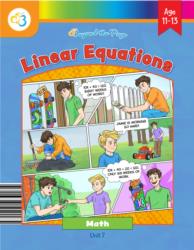
Unit 7: Linear Equations
Lesson 1
Linear Equations With One Variable
Students solve many equations of the form p x + q = r during examples and activities (e.g., 3x − 6 = 12; 5x − 2 = 18; 3x + 5 = 14) and work with rational coefficients including fractions and decimals (fraction and decimal practice pages and examples). Contextual scenarios (conveyor belt, robotic arm, space station) present equations in real-world settings, and timed practice and multiple problem sets give repeated practice to build fluency. The lesson also shows procedures for isolating variables, undoing addition/subtraction first, then multiplication/division, and using reciprocals for fractional coefficients.
Lesson 2
Multi-Step Equations
Students write and solve equations that match both forms: the lesson explicitly models p(x + q) = r with 4(y+2)=16 (Activity 2) and uses px + q = r in real-world problems such as Mr. Patel's groceries (12 + 15 + 3c = 45) and the catering problem (50 + 8.75g = 312.50). Multiple student activity pages ask learners to define a variable, translate a word problem into an equation, and solve step-by-step, providing repeated practice solving these equation forms (Activities 1–4). Students also practice fluency by solving many similar equations, including distributive, fraction, and decimal cases, and checking solutions by substitution.
Lesson 4
Multi-Step Word Problems
Students write and solve linear equations in forms like 25 + 15x = 130 and 18x + 20 = 146, and they work perimeter/rectangle problems that lead to equations such as 2(3w + w) = 64. The lesson includes practice with rational coefficients and decimals (e.g., 3/4 x + 4 = 10, 0.5x - 3 = 7) and problems that require using the distributive property (e.g., 5(2 - 3x) = 2x - 10, 6(b + 2) - 3b = 15). Students solve these problems step-by-step, check their answers by substitution, and complete quizzes and activity pages that require fluent solution of such equations.
Lesson 7
The Point of It All
Students solve one- and two-step equations in the Review Quiz Part 3 word problems (e.g., a delivery fee + per-mile charge and a babysitting flat fee + hourly rate) that lead to linear equations of the form px + q = r. The activity pages include explicit equations such as x/3 = 7 and x/2 - 7 = 3 and provide answer keys (e.g., 40 miles, x = 16, 4 hours) showing students find numerical solutions. The lesson directions also tell students to practice solving one- and two-step equations, especially in word problems.
Lesson 8
Linear Algebra In the Wild
Students define variables and write linear equations from word problems (e.g., S+J=65 and S=J+5; 2x+4y=23.40 and 3x+2y=19.70). Students solve single-variable linear equations that fit the form p x + q = r in multiple places (e.g., 2J+5=65 leading to 2J=60 and J=30; 10x=50 leading to x=5). Students set up and solve break-even problems using y = mx + b and then algebraically solve for x (e.g., y = 20x+50 and y = 30x leading to 30x = 20x+50 and x = 5).
Lesson 9
Unit 7 Test
Students solve multiple word problems that translate directly to linear equations of the form px + q = r (e.g., Jamie: 12h + 50 = 122; gym: 25 + 5c = 60; multiple answer keys show setups like 15h + 40 = 160). Students also solve classroom and test problems that require handling parentheses and distributive structure (e.g., 4(2x - 3) = 20, 3[3x - 2] = 21), which practice the p(x + q) style of equations. The Student Activity Pages and answer keys require students to set up, manipulate, and solve these equations fluently, including fractional-coefficient problems using reciprocals.
Final Project
Getting Ready for College
Students write and solve linear equations from real-world scenarios such as Housing (C = 1200m and C = 1500 + 1050m, then solve 1200m = 1500 + 1050m for the break-even), Transportation (225 + 0.60x = 1.25x solved by substitution and elimination), Entertainment (20 = 5 + 1.5h solved to h = 10), and Meal Plans (students derive equations from graphs and solve 80w = 100 + 50w). Students also create tables of values and graphs (Phone Plans table and graph) and simplify algebraic expressions (Plan B simplifies to y = 5x + 20). These activities require forming px + q = r style equations and solving them algebraically, numerically, and graphically.
Unit 8: Data
Lesson 4
Linear Models
Students write linear equations in slope-intercept form (y = mx + b) from scatterplots, choosing matching equations in multiple-choice items and writing equations for given trend lines. Students identify slope and y-intercept from graphs and interpret their meanings in context (for example, interpreting m = 2 and b = 50 in y = 2x + 50). Students substitute numeric values for x and perform arithmetic to make predictions (for example, substituting x = 10 into y = 2x + 50 to get y = 70).
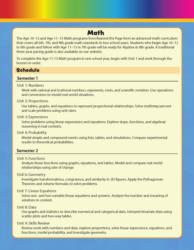
Unit 9: Semester Exams
Lesson 2
Proportions Review
Students write and use equations of the form y = kx to represent proportional relationships (Activity 2 and Activity 3 ask students to write equations like y = 6x and y = 5x and to match tables to equations). Students solve real-world percent and proportional word problems (Activity 1 and Activity 4 ask for unit rates, speeds, recipe rates, taxes, tips, markups, discounts, and simple interest) and are asked to work backward to find original values when given a total (e.g., finding a home value from property tax or finding original price from total).
Lesson 3
Expressions Review
Students write and solve linear equations in context, for example finding the width of a rectangle from perimeter (answer: w = 12 cm) and solving cost problems written as linear equations (e.g., C = 9t + 6, y = 18x + 12, and 40 + 5x = 80). Multiple activities ask students to write equations from real-world descriptions (gym classes, delivery fee, movie tickets, job pay) and to solve for unknowns. Answer keys show students obtain numerical solutions from px + q = r style equations.
Lesson 5
Semester Exam
Students solve and write equations in the required forms: they solve 5(x + 4) = 45 (problem 29) and 4x + 6 = 30 (problem 30). Students set up and solve a word problem that leads to p(x + q) = r: a rectangle perimeter 54 = 2(12 + w) to find the width (problem 32). Students also write a px + q equation from a real context (movie tickets: C = 11t + 4) and compute a numeric answer (problem 33).
Lesson 6
Functions Review
Students write equations from real-world descriptions (e.g., y = 18h for earnings, y = 12x + 10 for a bike rental) and translate a verbal problem into an equation ("The sum of a number and three times the number is 28") and solve it step-by-step (x + 3x = 28 → 4x = 28 → x = 7). Students find intercepts by setting x = 0 (e.g., finding the y-intercept of 2x + 3y = 12) and solve for unknowns in linear contexts. Students construct function rules from verbal descriptions (e.g., "Multiply by 2, then subtract 1" → y = 2x − 1) and complete tables, reinforcing equation writing and basic solving.
Lesson 7
Geometry Review
Students write and solve an equation in Activity 3 Problem 8 where Angle A is twice Angle B and A and B are complementary, leading to 2x + x = 90 and solving for x. In Activity 1 students compute scale factors and use multiplication to find missing side lengths (for example, finding x and y by multiplying by the scale factor 2). In Activity 1 and 4 students apply dilation and scale-factor reasoning to coordinates and side lengths (e.g., dilating Triangle LMN by a factor of 3 to get L'(6,3), etc.), which requires setting up multiplicative relationships.
Lesson 8
Linear Equations Review
Students translate real-world situations into linear equations such as 25 + 15m = 100 (gym membership), 12 + 3m = 39 (streaming service), and 6 + 2m = 34 (taxi fare), and solve them for the unknown. Students solve one-step and multi-step algebraic equations in Activity 1, including equations like 9x = 63, (3/5)x = 18, and 5(2x - 1) = 45, showing use of distributive property and operations with fractions. Students are instructed to define variables, write equations or systems of equations, show all steps, and interpret solutions in context in Activity 4.
Lesson 10
Semester Exam
Students set up and solve linear equations in Unit 7 (problems 23–27) such as x + 7 = 19, 9x = 63, and 5(2x − 1) = 45. A word problem (problem 35) has students write and solve 18h + 30 = 138 to find hours worked. Problem 10 asks students to write an equation from a verbal rule: "The difference between twice a number and 4 is 7," leading to 2x − 4 = 7.