


Seventh Grade - MATH
5: Math

Unit 1: Operations
Lesson 2
Multiplication Review
Students practice multiplying multi-digit whole numbers and decimals using the standard algorithm (Activity 1, Day 3, Activity 5) and complete real-world multiplication problems such as uniform costs, area, magazine pages, earnings, and babysitting hours. Students apply properties of operations (commutative, associative, distributive) to restructure and compute products (Activity 2 and Activity 4) and explicitly use the distributive property to connect partial products to the standard algorithm. Students are taught and practice mental strategies for multiplying by powers of ten and are encouraged to use mental math shortcuts in solving problems (Day 2 and Activity 3).
Lesson 3
Division Review
The lesson has students practice the standard algorithm for long division with whole numbers and with decimals (Day 2 and Day 3 activities) and explicitly teaches how to convert a decimal divisor into a whole number by multiplying both dividend and divisor (moving decimal points). Students learn and use divisibility rules to check whether divisions will have remainders and complete many real-world division word problems (e.g., money, watermelons, buttons, vans). The lesson also teaches interpreting remainders in context (include, discard, round up, or extend with decimals) and gives many practice problems and answer keys.
Lesson 4
Exponents and Order of Operations
Students write and evaluate exponential expressions and convert between exponential and expanded form (e.g., activities asking for expanded form and final value of 10^6, 5^4, etc.). Students apply order of operations including exponents (PEMDAS) to solve multi-step numerical and word problems, and they solve real-life decimal problems (pumpkin weights, sprint time reduction, pay per car). Students match and use properties of operations (commutative, associative, distributive) when identifying examples and simplifying expressions.
Lesson 6
Greatest Common Factor
Students factor whole numbers to list all factors and identify common factors and the greatest common factor (GCF) (Activity 1, practice problems and answer keys). Students use the distributive property in reverse to factor sums (Activity 2) and apply GCF/distributive factoring to solve real-world distribution problems (e.g., gumballs/lollipops, snack bags, beads, fruit baskets). Students use prime factorization and factor trees to find GCFs for larger numbers and then multiply shared prime factors to compute the GCF (Activity 3).
Lesson 8
Unit 1 Test
Students practice computing with whole numbers and decimals in many problems (addition, subtraction, multiplication, division, and decimal arithmetic problems such as 703.89 + 26.152, 98.6 × 2.4, and division with remainders). Students apply properties of operations (distributive, associative, commutative) in matching and factoring tasks and use order of operations and exponents in multi-step expression evaluation. Students solve multi-step real-world word problems that require sequences of operations (e.g., Michael's score: subtract then add; packaging and LCM/GCF problems for treat bags and purchases).
Final Project
Planning a Party
Students calculate total items and package counts and multiply by price to find costs (e.g., determine 60 candy bars, buy 3 packages, and compute 3 × $4.80 = $14.40). Students divide a grand total by 12 to find cost per goody bag and convert a percent tax to decimal form and multiply to find tax (e.g., 6% → 0.06, then total × 0.06). Students use the distributive property to show totals (example: 12(5 + 3) = (12×5) + (12×3)) and apply standard algorithms for adding, subtracting, multiplying, and dividing decimals in multi-step budgeting tasks.
Unit 2: Integers and Rational Numbers
Lesson 1
Fraction Addition and Subtraction
Students practice adding and subtracting fractions and mixed numbers through many real-world word problems (e.g., Kelly adding two bags of dog food then subtracting what was used, perimeter problems, running and recipe problems). The lesson includes converting between mixed numbers and improper fractions, making equivalent fractions, and using both ECD and LCD methods for common denominators. Students are directed to use tools such as an online fractions calculator, number-line tutorials/games, measuring tools (ruler, measuring cup), and are shown the commutative property when rearranging whole and fractional parts for mixed-number addition.
Lesson 2
Fraction Multiplication
Students practice multiplying fractions, mixed numbers, and whole numbers using the fraction×fraction algorithm and by converting whole numbers to fractions (e.g., 8 = 8/1) and converting mixed numbers to improper fractions (e.g., 1 4/8 = 12/8). Students use cross-cancelling and the commutative property to simplify and compute products and are given multi-step real-life word problems that require combining operations (e.g., the Challenge punch problem and the bike-trail/area problems). Students set up and solve area, perimeter, and multi-step contextual problems that require multiplying fractional and mixed-number measures (e.g., 13 1/2 × 6 2/3 for area).
Lesson 3
Fraction Division
Students practice dividing fractions and mixed numbers using visual models and the invert-and-multiply algorithm (Keep, Switch, Flip, Solve). Students convert mixed numbers to improper fractions and simplify or convert improper results back to mixed numbers in worked examples and activity pages. Students solve real-life word problems that require dividing fractional quantities (e.g., cheese portions, servings, lengths) and check division answers by converting to multiplication.
Lesson 4
Negative Numbers and Integers
Students represent positive and negative rational numbers in real contexts (temperatures, elevator floors, debt, game scores, depths) and write those values in integer or decimal form on activity pages. Students classify numbers as natural, whole, integer, and rational and place fractions and decimals (for example -8/13 and 38.5) in the rational-number category. Students use number lines and create a foldable to plot opposites and identify additive inverses, and they compute simple results such as temperature change and bank-balance differences.
Lesson 5
Absolute Value and Inequalities
Students plot integers, fractions, and decimals on number lines and compute distances/absolute values (examples include pairs like -3 and 2, 2 1/2 and 6, -23 and 6). Students solve real-world calculation problems with positive and negative rational numbers (temperature difference 47 and -14.5 → 61.5; delivery locations 58 and 73 → 15; diving platform 32.8 and -16 → 48.8) and practice comparing and ordering numbers and absolute values using inequality notation. One activity and answer key show comparing fractions by converting to a common form (4/5 and 3/4 converted to twentieths) to write an inequality.
Lesson 6
The Coordinate Plane
Students plot and label ordered pairs that include positive and negative integers, decimals, and fractions (examples include 3.5, 4.5, and points like (-6, 4.5)). Students reflect points across the x- and y-axes and write the coordinates of reflected points (e.g., A(4,3) -> A'(4,-3); rules for (a,b) -> (a,-b), (-a,b), (-a,-b) are given). Students also move points by specified offsets (move A left 5 and down 3) and trace routes on a city map (Deon's map) using coordinate movements, connecting plotting to a real-world navigation context.
Lesson 7
Coordinate Problem Solving
Students plot points with positive and negative coordinates in all four quadrants and calculate horizontal and vertical distances by comparing x- or y-values (e.g., problems with points like (7, −3) and (2, −3), and using absolute value to get positive distances). Students solve map-style real-world problems by finding horizontal and vertical miles between bus stops and adding those distances to get total travel. Students find missing rectangle corners by computing horizontal and vertical shifts between given diagonal points and then determining the other two corner coordinates.
Lesson 8
Unit 2 Test
Students solve numerous real-world word problems that use positive and negative rational numbers in fraction and mixed-number form (e.g., Violet combining 2 1/4 and 3 3/5 then subtracting 2 2/3; Timothy adding pet food amounts then subtracting consumption; Mary Ellen dividing 14 2/3 by 1 5/6). Students perform all four operations with fractions and mixed numbers and are shown algorithmic steps (keep, switch, flip) and visual models for dividing fractions. Students work with negative integers and decimals in context (temperature and money problems), plot and compute distances on number lines and coordinate planes, and convert between improper fractions and mixed numbers in several problems.
Unit 3: Ratios and Percentages
Lesson 1
Introduction to Ratios
Students practice writing ratios in three forms (in words, with a colon, and as a fraction) on multiple activity pages and in examples (e.g., 5 to 11, 5:11, 5/11). Students practice forming equivalent ratios by multiplying or dividing both parts of a ratio (examples: 4/1 → 8/2; 9:6 → 3:2) and complete problems that require finding scale factors and computing new amounts. Students solve real-world scaling problems that require multiple steps, such as Eduardo's bread recipe (determine multiplier, compute flour and milk for 9 loaves), the floor cleaner mixing problem (scale 50 ml with 5 L to 200 ml → find water), and the piano/soccer hours problem.
Lesson 3
Equivalent Ratios
Students solve a variety of real-world ratio and proportion problems using tape diagrams, double number lines, and tables/graphs (e.g., finding how many stickers each person has from a total and ratio, using number lines to find hamburgers sold given chicken sandwiches, and plotting pitcher's lemonade data to find lemons for 4 pitchers). Students use decimal money values in proportional problems (e.g., 3 apples cost $1.50 and students use a double number line to find the cost of 12 apples). Students use multiplication and division to scale ratios and fill missing table values and graph points, practicing procedural calculations with whole numbers and some decimals.
Lesson 4
Unit Rates
Students find unit rates by making equivalent ratios and by dividing the numerator by the denominator (e.g., 216 miles ÷ 4 hours = 54 mph; $5.25 ÷ 3 = $1.75 per quart). Students apply a found unit rate to solve follow-up multi-step problems (e.g., find unit price then multiply to get cost for 5 quarts or 10 pounds). Students use visual tools (double number line, tape diagrams, tables, and graphs) and perform multiplication and division with decimals and whole numbers to compute rates and prices.
Lesson 5
Percentages
The lesson explicitly teaches converting among percents, fractions, and decimals (multiple explanations, step-by-step images, and student activity pages). Students practice real-world percent situations such as Annie's 10% coupon, Gilly's $0.83 as a percent of a dollar, and orchestra members (word problems provided). The lesson teaches a mental shortcut for converting percents and decimals by moving the decimal point and includes practice problems and answer keys for these conversions.
Lesson 8
Unit 3 Test
Students solve many real-world problems with positive rational numbers: they compute unit rates and unit prices (peaches, roses, chocolate milk), calculate speeds (miles per hour), and convert between fractions, decimals, and percentages (multiple table exercises). Students use visual/tools strategically such as tape diagrams, double number lines, tables, and graphs to find unknowns (Marco/Stanley cars, Farmer Ned cows, apples/pies). Students perform unit conversions between measurement systems (inches to centimeters, pounds to ounces, miles to kilometers) and complete multi-step computations like finding unit price then total cost.
Final Project
What's the Best Buy?
Students set up and solve unit-rate ratio problems by dividing price by quantity to find unit prices (Activity 3 shows dividing $3.38 by 13 ounces to get $0.26/oz). Students convert units with chains of equivalent ratios (the gallon → quarts → pints → cups → fl oz conversion is shown and practiced). Students apply percent computations in real contexts (the 10% off coupon problem and savings-over-time table) and use dimensional analysis to convert currencies in the "Challenge!" activity.
Unit 4: Algebraic Expressions
Lesson 1
Introduction to Algebra
Students practice evaluating exponential expressions that use decimals and fractions (for example, (1.5)^3 and (2/5)^2) and compute combined expressions such as (1/3)^2 + (1/2)^3. Students solve multi-step numerical expressions using order of operations (PEMDAS) with decimals, fractions, exponents, multiplication/division and addition/subtraction in the provided practice problems. Students translate word problems into algebraic expressions and apply formulas in real contexts (A = s^2 and V = s^3) and check a real-world area constraint in the poster challenge.
Lesson 3
Working With Expressions
Students translate word problems into algebraic expressions (e.g., Milo, Jade, Yuji, and the Student Activity Page problems such as 6 + n, n − 8, 2n + 10). Students evaluate expressions by substituting numbers for variables (Activity 3 examples: n + 6 with n = 4, 5 + 4y with y = 6, and (n − 3)^2 + 4 evaluated for several n). The Basic Skills Review and answer key include work with fractions, decimals, percentages, integers (including a negative temperature), and order of operations problems.
Lesson 4
Positive and Negative Numbers
Students practice rewriting subtraction as adding the opposite and use number lines and arithmetic rules to evaluate positive and negative sums and differences. Students apply the commutative and associative properties to reorganize multi-term expressions after changing subtraction to addition (e.g., 3 + (-5) + 4 + 2 + (-13) rearranged and grouped). Students solve real-world integer problems (money, temperature, depths, game scores) that require combining positive and negative whole numbers.
Lesson 5
Equivalent Expressions
Students practice and apply properties of operations (commutative and associative) to rewrite and simplify expressions with variables (e.g., rearranging 5a + 6 + 2a + 3 to 7a + 9). Students combine like terms and change subtraction to adding the opposite when simplifying expressions with positive and negative terms (examples and guided problems with 6x - 3 + 2x + 7). The Basic Skills Review includes real-life numerical problems using decimals, division, and percents (e.g., dividing 23.7 by 15, computing 25% off $24) and a table converting fractions, decimals, and percentages.
Lesson 6
The Distributive Property
Students use area models and numerical examples to apply the distributive property (for example, showing (5×4)+(5×8)=5(4+8)=60 and 5(n+2)=5n+10). Students generate equivalent expressions and simplify them by applying distributive, commutative, and associative properties (e.g., 4(3a+5) → 12a+20, then combine like terms to 8a+10). Students evaluate expressions by substituting real-number values to prove equivalence and solve contextual word problems (for example, translating Tessa's purchases to 5n and evaluating n=4, or Raoul earning 15p−18 and evaluating p=8).
Lesson 7
Unit 4 Test
Students translate real-world situations into algebraic expressions (Zane's wages, Jeremiah's dog-walking pay, Alana's beads, Tasha's shells, Kelsey's cookies) and evaluate those expressions with given values. Students apply properties of operations (distributive, commutative, associative) to generate equivalent expressions and simplify by combining like terms (e.g., 2(n+9)+7n-13 → 9n+5). Students evaluate expressions involving decimals and fractions as exponents and perform operations with negative numbers, including rewriting subtraction as adding the additive inverse.
Final Project
Algebra Think-Tac-Toe
Students simplify and verify equivalence of multi-step algebraic expressions using distributive, commutative, and inverse operations in the "Prove It! Equivalencies" activity, including substituting numerical values to check results. Students create quizzes, GoFish games, and book-cover problems that require adding and subtracting positive and negative integers and combining like terms, showing practice with signed numbers. The Exponent Matching activity has students evaluate fractional and decimal bases raised to powers, and the skills list explicitly includes understanding subtraction of rational numbers as adding the additive inverse and using positive and negative numbers in real-world contexts.
Unit 5: Algebraic Equations
Lesson 1
Algebraic Equations
Students practice writing and solving equations that use fractions and decimals (e.g., 5 1/2 + 3 5/6, 98.6 - 39.75, 7.2 × 0.4) and evaluate variable substitution to make equations true (Activity 1 and Activity 2). Students translate real-world word problems into equations (e.g., 32 + p = 48, m/6 = 20, 70 = n + 29) and use substitution/guess-and-check to find solutions. Students are shown and asked to use diagrams (bar model/double number line) and to consider extraneous information, and they are introduced to the symmetric property of equality and order of operations when evaluating expressions.
Lesson 2
Solving One-Step Equations, Part 1
The lesson has students use tape diagrams and hanger diagrams as tools to represent and solve equations such as n + 60 = 100, 48 = 21 + x, and 16 + n = 72, and includes word-problem practice where students write an equation and solve it. Students practice the inverse-operation method (subtracting or adding the same value to both sides) to isolate variables and check solutions by substitution. Activity pages and answer keys show students solving equations with variables on both sides (for example 2n + 4 = n + 6) and a variety of one-step addition/subtraction problems.
Lesson 3
Solving One-Step Equations, Part 2
Students solve one-step equations of the form px = q and x/p = q using tape diagrams and hanger diagrams (examples: 2n = 8, n/2 = 5, 5n = 40, 4x = 24). Students set up and solve real-world one-step problems (Antonia's plant, Alex washing cars, Levi's bird seed) and check solutions by substituting values back into the original equations. The materials direct students to use visual tools (tape and hanger diagrams, number and symbol cards) to isolate the variable and perform the inverse operation on both sides.
Lesson 4
Solving Two-Step Equations
Students solve two-step equations that include integers, decimals, and fractions (activities and practice problems such as 2n+4=8, 8n+0.6=3, and (2/3)n−2/5=1/10). Students use properties of operations (distributive property) to rewrite and simplify expressions with parentheses and then apply inverse operations to isolate the variable. Students represent and solve real-life word problems by defining a variable, writing a two-step equation, and solving it (several word-problem activity pages). Students use tape diagrams and hanger diagrams as strategic tools and check solutions by substituting the found value back into the original equation.
Lesson 6
Solving Inequalities
Students set up and solve one- and two-step inequalities that include whole numbers, fractions, and decimals (examples: n/3 ≤ 1, x<- 2.6 < 2.4, 2/3 p ≥ 4, 6a + 14 ≥ 20). Students write inequalities from word problems (e.g., Mateo, Farmer Joe, Gabriel) and solve them using inverse operations, then graph solution sets on number lines and check answers by substituting values from the solution set. Students reason about which solutions are reasonable for real-world contexts (e.g., eliminating fractional or negative counts for shirts or chickens).
Lesson 7
Independent and Dependent Variables
Students set up two-variable equations from word problems (e.g., 10x = y for hourly pay, 5x = y for biking) and use substitution and inverse operations to solve for one variable when the other is given. Students construct and use input/output tables to compute solution pairs (including examples with decimals and fractions) and plot those pairs on coordinate grids to represent infinite solution sets as lines. Activities require students to rewrite equations so the dependent variable is isolated and to find multiple solution pairs by guess-and-check, tables, and substitution. Graphing and table work are used as tools for finding and interpreting solutions in real contexts (hours vs. earnings, temperature differences, recipes).
Lesson 8
Unit 5 Test
Students solve one- and two-step equations that include decimals and fractions (for example x - 2.4 = 7.6, 2(y + 1/2) = 13, and a/7 - 5 = 9) and use properties of operations (distributive property shown in solutions). Students set up and solve real-world word problems and write corresponding equations (Heather's $23 rides/games problem, Dominic's weight problem, Naomi's charity inequality) and practice graphing solution sets on number lines including negative values (e.g., n - 7 > -12). Students use visual tools strategically such as tape diagrams, hanger diagrams, tables, and coordinate grids to represent and solve equations and inequalities.
Final Project
All About Me
Students are asked to brainstorm real-life numerical facts and create at least 10 problems (5–7 equations and 4–6 inequalities) that represent those facts, so they write and solve equations and inequalities tied to personal contexts. The Project Checklist requires at least two two-step problems (involving both addition/subtraction and multiplication/division) and at least one equation with a fraction and one with a decimal, and students must produce an answer key and check solutions by plugging answers back into the originals. Students are also required to represent an inequality solution on a number line and to show one equation with a tape/hanger diagram and a two-variable equation with a table describing the relationship.
Unit 6: 2D Geometry
Lesson 1
Lines and Angles
Students compute angle measures by adding and subtracting whole-number degree measures to find complementary, supplementary, and reflex angles (examples shown: 90 - 40 = 50, 180 - 110 = 70, 360 - 70 = 290, 360 - 45 = 315). Students estimate angle measures and then measure them with a protractor on activity pages, and they draw angles of specified degree measures (e.g., 90°, 55°, 170°, 340°). Students use the protractor strategically as a tool to measure and draw angles and record estimates before measuring.
Lesson 2
Working With Angles
Students write and solve algebraic equations representing angle relationships (examples: n + 2n = 90, 5n = n + 92) and use inverse operations and combining like terms to find variable values. Students substitute variable values into expressions to find actual angle measures and check answers for reasonableness (e.g., confirming acute/obtuse angles sum correctly). The Basic Skills Review includes computation with fractions, decimals, a percent discount problem, and a negative-temperature problem, giving students practice with rational numbers in different forms.
Lesson 4
Area
Students solve multi-step real-world area problems that require working with fractions and decimals and converting between units (for example, converting 10 ft and 3 ft to 120 in and 36 in, finding areas, and dividing to get 180 pavers). Students set up and solve algebraic equations for unknown measures (24n = 4320) and compute areas using formulas that involve fractions (1/2 × b × h) and decimal measurements (e.g., 10.5 in). The lesson includes multiple word problems that require sequential steps: compute area(s), perform unit conversion, and divide or subtract to find final answers.
Lesson 5
Circles
Students measure physical circles, record circumference and diameter, and compute the quotient C/d to discover pi, using tape measures and calculators. They apply formulas C = πd, C = 2πr, and A = πr^2 to compute circumference and area for given radii and diameters (examples: pool diameter, rubber seal radius, tablecloth). Students perform a multi-step semicircle/circumference task where they compute a full circumference, divide by two, and add straight-edge length to get the semicircle perimeter. The lesson also shows algebraic steps (inverse operations and substitution) to derive C = πd and A = πr^2, and students convert a given diameter to radius by dividing by 2.
Lesson 6
Scale Drawings
Students set up and solve proportions and equivalent ratios to find scale factors and actual measurements in real-life problems (e.g., Mia's garden, Luca's fort, the architect's blueprint, Mrs. Yee's fenced area). They convert scale-factor ratios to percentages and use unit conversions (centimeters ↔ meters, inches ↔ feet) and decimal arithmetic in context (money and cm conversions in Basic Skills Review). Students compute perimeters and areas of originals and scale drawings and apply the squared scale factor to area, and they use physical tools such as rulers and grid drawings to produce and measure scale drawings.
Lesson 7
Unit 6 Test
Students compute perimeters and areas in multi-step real-world contexts (e.g., Aunt Hazel's parallelogram: perimeter 34 cm and area 48 cm2; Kari's kite decomposed into two triangles with areas 81 and 162 to get 243 cm2). Students compute circumference and area of a circle and then use those results in follow-up calculations (e.g., fire ring: circumference 12.56 ft and area 12.56 ft2, then divide by 3.5 to determine 4 sandbags). Students work with scale factors and fractional/decimal scale conversions (e.g., photograph nest scale factor 1/3 or 33 1/3%, rectangle scaling by 1/3 and deriving perimeter and area scale factors).
Unit 7: 3D Geometry
Lesson 1
Three-Dimensional Solids
The lesson uses Euler's formula in algebraic form and guides students through solving for an unknown: students write F + 5 (-) 8 = 2, rewrite subtraction as adding the opposite (F + 5 + (-)8 = 2), combine like terms (F + (-)3 = 2), and add the inverse to both sides to find F = 5. The explanation explicitly shows manipulating negative values and applying properties of operations to isolate a variable. These steps demonstrate multi-step symbolic manipulation involving negative integers.
Lesson 2
Surface Area
Students solve real-world arithmetic problems that use decimals and fractions, such as finding the cost of grapes (2.5 lb × $1.58 = $3.95), determining wrapping-paper needed for a box (finding 190 in²), and computing the area of triangular faces using A = 1/2 bh. Students calculate areas and surface areas by measuring nets, labeling dimensions, and adding face areas (examples: cube, rectangular prism, triangular prism, square pyramid). Student activity pages and answer keys include computations with mixed numbers, fractions, and decimals in context (area totals, sums of face areas, and surface-area formulas).
Lesson 3
Volume
Students solve multi-step real-world volume problems that use fractions and decimals (e.g., calculating volume of boxes filled with 1/2- and 1/4-inch cubes, Kayne's aquarium and number-of-containers problem). Students convert mixed numbers to improper fractions and multiply fractions and decimals to compute volumes using V = lwh and V = B·h. Students use both counting fractional unit cubes and formula substitution to show equivalence of methods and complete activity pages with several multi-step word problems.
Lesson 5
Problem Solving With Solids
Students calculate volumes and surface areas in real-world contexts (Archie's mugs: V = 80 in^3, total V = 640 in^3; compare to Box A/B/C volumes and choose Box C). Students perform arithmetic with fractions and mixed numbers when solving for missing dimensions (e.g., 54 = L × 4 1/2 × 2, converting 4 1/2 to 9/2 and isolating L = 6) and with decimals (dividing 528 by 275 to get 1.92 and rounding to 2 packages). Student pages also require work with percentages, division by decimals, and integer sums (Basic Skills Review), showing practice with numbers in whole, fractional, and decimal form.
Lesson 6
Unit 7 Test
Students solve multi-step real-world problems using fractions and decimals when they compute surface area and volume (e.g., Kareem's paint problem uses mixed numbers and division to find 4 cans; the decorative paper/cube problem uses decimal and whole-number multiplication and division to find 20 boxes). Students compute volumes with fractional edge lengths (example: V = 3/4 × 1/2 × 4 4/5 = 1 4/5) and use decimal dimensions (e.g., 5.1 cm in a composite solid). Students set up and carry out arithmetic operations to find heights from volume and base area (e.g., 182 ÷ 6.5 = 28).
Final Project
Building With Solids
Students measure pre-printed nets on graph paper, round dimensions to the nearest whole or half unit, and use provided formulas to calculate surface area and volume for selected solids (cube, rectangular prism, triangular prism, square pyramid). Students complete multi-step calculations for surface area (summing face areas) and volume (using V = l×w×h, s³, and V = B×h) and record work on Surface Area and Volume activity pages. The answer key includes fractional arithmetic (e.g., 1/2 × 11/2 × 9/2 and results like 49 1/2), showing students work with positive rational numbers and fractions in computations.
Unit 8: Statistics
Lesson 2
Populations and Samples
Students complete Basic Skills Review problems that require computing with fractions (8/15 + 4/9 and multiplying fractions yielding 6/5 = 1 1/5), working with decimals and π to find circumference and area, and performing arithmetic with negative numbers (4 + 7 - 13 + 1 - (-2)). Students evaluate expressions by substituting values (4n + 12 when n = 5), solve a simple inequality <n + 3 < 5), and solve unit-rate multiplication word problems (85 pieces/min × 12 min = 1,020).
Lesson 6
Measures of Center
Students practice computing means by adding data values and dividing by the number of values (e.g., 219 ÷ 15 = 14.6 and 418 ÷ 20 = 20.9). Students work with dot plots, frequency tables, and stem-and-leaf plots to list data, use multiplication by frequencies to find totals, and round decimal results to specified place values. Students reason about reasonableness by rounding mean results and by choosing median over mean when an outlier skews the data.
Lesson 8
Making Inferences
Students convert ratios to percentages and compute percentages in the candy-sample activity (e.g., converting 3:10 to 30%). Students compute means for samples and a population (e.g., food truck mean 600 ÷ 24 = 25; word-count mean 655 ÷ 183 ≈ 3.6) and round to the nearest tenth when directed. Students solve multi-step numeric tasks in the Basic Skills Review (for example, find a cube root from volume then compute surface area, and multiply mixed numbers to find total flour), showing work with fractions and whole-number arithmetic.
Lesson 9
Comparing Populations
Students compute means by summing data values and dividing by the sample size (e.g., finding means of pumpkin and zucchini data sets). Students compute mean absolute deviation by finding distances from the mean, summing those distances, and dividing by the sample size. Students perform a multi-step computation that takes the difference of the two means and divides by the larger mean absolute deviation to compare populations quantitatively.
Final Project
Statistical Study
Students design and carry out a multi-step real-life investigation by posing a numerical statistical question, collecting data (e.g., ages, heights, prices), and organizing it into lists, frequency tables, dot plots or histograms. Students compute numerical summaries including mean, median, mode, range, first and third quartiles, interquartile range, and mean absolute deviation and draw a box plot with a five-number summary. Students use graphs and calculations to analyze results and present their findings, which involves multiple calculation steps and use of graphing tools or calculators as appropriate.
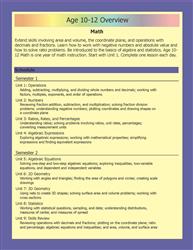
Unit 9: Skills Review
Lesson 1
Decimals, Factors, and Multiples
Students solve many arithmetic problems that involve adding, subtracting, multiplying, and dividing whole numbers and decimals (e.g., 632.3 + 87.59; 994.08 ÷ 2.4) and complete multi-step money problems that require addition and subtraction (e.g., adding March and April earnings then subtracting the scooter cost). Students apply properties of operations by using the distributive property to factor and multiply (e.g., factor 36 + 88; compute 15 × 32 via 15(30+2)), find prime factorizations, and compute GCF and LCM. Students practice order of operations and work with absolute value and ordering of positive and negative numbers through linked online activities.
Lesson 2
Fractions, Ratios, and Coordinates
Students practice adding, subtracting, multiplying, and dividing fractions and mixed numbers through multiple computation problems and word problems (e.g., operations pages and problems finding area, hours worked, and money earned). Students solve multi-step fraction word problems (Mario: add hours then multiply by $16) and work with decimals and rates in real-world contexts (unit price $6.12 ÷ 3, train 310 miles ÷ 5 hours). Students work with negative coordinates by plotting points, reflecting over axes, and computing distances on the coordinate plane.
Lesson 3
Expressions, Equations, and Percentages
Students solve single-step and simple two-step equations that include decimals and division (e.g., x - 1.3 = 5.8; m/4 = 5; 2(n + 3) = 16). Students write and evaluate expressions for real-world contexts involving money (Marie makes 9n + 3; Naomi's babysitting 5n + 3 = 18) and simplify linear expressions using properties of operations (e.g., 3(n+6)+4n-10). The lesson also directs students to an online quiz for practice with percentages and unit conversions.
Lesson 4
Geometry
Students compute with decimals when finding the area of a rectangle (3.5 × 2.8 = 9.8) and with fractions when squaring 4 1/2 to find area (81/4 = 20 1/4). Students use percent-to-multiplier conversion in the scale problem (800% of 2 in. = 16 in.) and work with scale factors and corresponding ratios (e.g., 1/3). Students perform multi-step geometric area calculations by decomposing a trapezoid into simpler shapes and summing their areas.
3: Math
Unit 1: Numbers
Lesson 1
Positive and Negative Rational Numbers
Students solve signed multiplication and division problems with integers, fractions, and decimals on activity pages and word problems (e.g., -0.2×6.5, 1/5×8/3, 5.5×6.7, and division scenarios like -60÷5). Students write equations for real-world contexts (temperature drops, debt, descent rates), draw visual representations or number-line models, and circle zero pairs to represent addition/subtraction of opposites. Students are asked to explain why rules hold using properties of operations (challenge problem using the distributive property) and to use number lines and diagrams to justify answers.
Lesson 2
Fractions and Decimals
Students practice converting between fractions and decimals in multiple ways: they use long division to change fractions to terminating or repeating decimals, use place value to turn terminating decimals into fractions, and apply an algebraic multiply-and-subtract method to convert repeating decimals into fractions. Students also learn to predict whether a fraction's decimal will terminate or repeat by examining the prime factorization of the simplified denominator. A short review quiz includes problems with positive and negative numbers (e.g., 5 + (-5), a diver descending then ascending, and a temperature drop rate), so students perform basic computations with signed rational numbers.
Lesson 3
Properties of Exponents
Students learn and practice the rules a^0 = 1 and a^{-n} = 1/a^n (Activity 1) and complete problems that convert negative exponents to fractional form (e.g., 2^{-3} = 1/2^3). Students apply properties of operations for exponents throughout: am × an = a^{m+n} (Activity 2), a^m ÷ a^n = a^{m-n} (Activity 3), (a^m)^n = a^{m·n} (Activity 4), and (a·b)^m = a^m·b^m (Activity 5). Students complete mixed-review tasks that require simplifying expressions to exponent form and then producing numerical answers, including examples that produce fractional or decimal results in the answer keys.
Lesson 4
Square and Cube Roots
Students solve contextual exponent and root problems in Activity 3 (a 10-question Real-World Problems page that asks for area, volume, and population calculations using exponents and roots). Students use a calculator strategically in Activity 2 to compute squares, cubes, roots, and negative exponents (examples show 2^-3 = 0.125 and directions for using TI-30 functions). The Review Quiz and practice pages require students to apply properties of exponents (e.g., (2^3)^2, 3^4 * 3^2), and to convert between fractions and decimals (questions on converting 7/8 to a decimal and writing decimals as fractions).
Lesson 5
Irrational Numbers
Students practice estimation and approximation by identifying nearest perfect squares, testing decimal guesses, and narrowing square-root values to two decimal places (Activities 3, 4, 6). They place approximated square roots on a number line to judge closeness to whole numbers (Activity 5). The review quiz and activities include operations and conversions with rational numbers (e.g., multiplying negative fractions, converting repeating decimals to fractions, converting decimals to fractions) and allow use of a calculator as a tool.
Lesson 6
Scientific Notation
Students convert numbers between standard form and scientific notation (e.g., 45,000 → 4.5 × 10^4 and 2.3 × 10^-2 → 0.023) and rewrite decimals in scientific notation (e.g., 0.0003 → 3 × 10^-4). Students perform operations with numbers in scientific notation—adding/subtracting by aligning exponents, multiplying by multiplying coefficients and adding exponents, and dividing by dividing coefficients and subtracting exponents—and they solve word problems that mix decimals and scientific notation. Students also use calculators in scientific (SCI) mode and interpret calculator output (the "E" notation), and they compare orders of magnitude to judge relative size of quantities.
Lesson 7
Arctic Marine Research
Students convert very small decimal measurements into scientific notation and compare sizes and ratios in Phase 1 (e.g., 0.0000042 and 0.0000065, then compute how many times larger). Students model exponential growth using properties of exponents in Phase 3 (N = 2^t and comparison with 3^t, and doubling DNA strands over cycles). Students convert decimals to fractions in Phase 4 (0.375 → 3/8, 0.875 → 7/8) and perform operations with positive and negative rational numbers in Phase 5 (temperature range and average from -15°C to 5°C; submarine depth from -450 m then rising 175 m).
Lesson 8
Unit 1 Test
Students practice operations with positive and negative rational numbers in context (e.g., problems asking for sums like -6+6, products of negatives, division of negatives, submarine/diver depth changes, and a company profit/loss). Students convert between forms and compute with fractions and decimals (e.g., convert 3/8 to decimal, 0.75 to fraction, 4.75 to fraction) and work with scientific notation (convert 450,000 to scientific notation and vice versa). Students apply properties of operations and exponents (e.g., simplifying 5^3×5^2, 4^5÷4^3, negative exponents, reciprocal of 3^{-2}) and approximate irrational values (e.g., estimate square roots to specified decimal places).
Final Project
Mars Station Test Mission
Students solve multi-step real-world problems about energy and logistics (Tasks 1–3) that require calculating temperature differences, hourly/daily/yearly energy use, solar and wind production for 10 panels/turbines, and total supply costs. The lesson requires converting forms and using exponents and scientific notation (Task 3 asks students to convert 7 × 10^2 kWh to a whole number) and to evaluate distances given as square roots without a calculator (Logistics Task 2). The Parent Plan explicitly lists skills such as converting rational numbers to decimals, operating with scientific notation, and applying properties of operations, which students are expected to practice through the calculations and tables.
Unit 2: Proportions
Lesson 1
Proportional Relationships
Students set up and solve proportions in labeled, real-world contexts (recipes, travel, shopping, paint coverage) and practice methods including the Eyeball Method, multiplication/division, and cross-multiplication. Students multiply both sides and divide to isolate variables (e.g., multiply both sides by 12 then divide by 2 to get x = 18), demonstrating use of properties of operations. Students solve problems that produce fractional and decimal answers (e.g., 7.5 cups) and complete practice problems with space to show work.
Lesson 2
Unit Rates
Students set up and solve multi-step real-world problems using unit rates and proportions (e.g., recipe scaling, travel/gas problems, and multi-step word problems in Activity 6). Students calculate with fractions and decimals (e.g., $4.99 ÷ 6 = 0.83 per apple; complex fraction examples like (3/4) ÷ (1/2) using KCF) and compare unit rates for lengths and areas (tile, rugs, converting 9 yards = 27 feet in an example). Students practice using division, multiplication of fractions, and the Keep-Change-Flip method as tools to compute unit rates and simplify complex fractions.
Lesson 3
Constant Rate
Students identify and compute the constant of proportionality k = y/x from tables, graphs, and equations (Activities 2–5) by dividing y by x and checking for consistent k values. Students rewrite equations into the form y = kx (Activity 5) by using properties of operations (e.g., dividing both sides) and simplify fractions (6/12 → 1/2) and decimals (examples include 0.07 and $1.50). Students solve real-world rate problems (Activity 6) by identifying variables, finding k, writing y = kx, and substituting values for multi-step word-problem procedures (printer, car, faucet, baker).
Lesson 4
Graphing Proportions
Students create tables, plot points, and write equations in the form y = kx (e.g., Jim's dog-walking table and multiple activity pages where students graph (0,0),(1,k),(2,2k), etc.). Students compute unit rates from tables and graphs (examples show unit rates like $12/hr, $8 per t-shirt, 0.2 in/hr) and work with decimals, fractions, and a negative-rate example (temperature change with negative y-values). The Skills Review includes tasks converting fractions to decimals and simplifying fractions, and several activities ask students to identify independent/dependent variables and check constant rates by computing y/x for each row.
Lesson 5
Proportional Relationship Equations
Students write and use equations of the form y = kx and t = p×n to model real situations (movie tickets, apples, theme park tickets). Students solve for unknowns using multiplication and division with whole numbers and decimals (e.g., 156 = 10m → m = 15.6 in the cookie/calories example) and work with fractions in rate problems on the review quiz (3/4 miles in 1/2 hour → 1.5 mph; 2/3 ÷ 1/4 = 8/3). Students convert percents to decimals and apply them in multi-step cost problems (e.g., group ticket pricing t = 50 × n × 0.9) and complete multi-step cumulative problems (factory overtime totals).
Lesson 6
Taxes, Tips, and Commissions
Students convert percent rates to decimals and compute sales tax, income tax, property tax, tips, and commissions by multiplying rates by amounts and then adding results to find totals (examples show 7% → 0.07 and 15% tip calculations). Students set up and solve reverse (work‑backward) problems using equations (e.g., 1.08x = 212, 0.20·I = 9000) and divide to find original prices or incomes. Students solve multi-step problems that combine operations (for example, compute commission then add base salary; compute tax then tip; multi-step gratuity + tax examples) and practice quick mental estimation strategies for tips (10%, 15%, 20%).
Lesson 7
Markups and Discounts
Students solve multi-step, real-world percent problems such as stacked discounts (e.g., 20% off then 10% off a $100 pair of sneakers) and multi-step markup/markdown problems (e.g., a 75% markup followed by a 30% markdown on jeans). Students work backward to find original prices from final prices (e.g., x * 1.20 = $72) and calculate percent increase/decrease using the percent change formula with several applied problems. Students practice estimation and mental strategies through a "Quick Estimate Discount Problems" page and a tip sheet (10% rule, doubling/tripling the 10% amount, dividing by 2 for 50%).
Lesson 8
Simple Interest and Percent Error
Students use the simple interest formula I = Prt to compute interest and total balance (examples show I = 600 × 0.04 × 5 = $120 and balance = 600 + 120 = $720). Students solve for missing variables by rearranging the formula (problems asking for rate and time such as r = I/(Pt) and t = I/(Pr)). Students apply the percent error formula (|actual − estimated| / actual × 100) across multiple real-world examples and convert between percent and decimal forms when computing rates (e.g., 4% → 0.04, 5.6% → 0.056).
Lesson 9
Unit 2 Test
Students solve many multi-step real-world problems involving fractions, decimals, and percents (e.g., unit-rate problems with fractions, pre-tax price given total with 6–7% sales tax, tip/markup/discount problems, and simple interest calculations). Students convert between percent and decimal forms to compute and reverse computations (e.g., p = 212 ÷ 1.06 and p = 265.50 ÷ 1.07 in answer keys). Students also represent proportional relationships with equations (y = kx), identify constants of proportionality from tables, and interpret graphs through problems that ask whether a relationship is proportional and what points like (0,0) and (1,r) mean.
Final Project
Lemonade Stand
Students find and compute unit prices for lemons, sugar, and cups by dividing totals to get unit rates and filling tables for multiple quantities. Students set up and solve proportions and write equations in the form y = kx to scale the lemonade recipe (e.g., tablespoons per cup to gallons) and convert those proportions into ingredient counts. Students calculate total cost per gallon and cost per cup by combining unit prices and quantities, then apply percent operations to compute markups, discounts, sales tax, and gratuities. Students graph cost data, compare slopes to judge unit rates, and are instructed to use calculators and round to specified decimal places.
Unit 3: Expressions
Lesson 1
Equivalent Expressions
Students practice applying the Commutative, Associative, and Distributive Properties to rearrange, regroup, expand, and combine like terms across multiple activities and worksheets. Students perform multi-step symbolic manipulations (for example, distributing then combining like terms in 2(n + 4) + 3n - 6 and other problems) and simplify expressions on activity pages and in the Properties Quest. Students also translate a simple real-life scenario (the bake-sale/cookie example and the sandwich/drink/cookie money example) into an expression and evaluate it using the Distributive Property.
Lesson 2
Rewriting Expressions
Students rewrite real-world price expressions into one-step formulas (e.g., Total Price = Original Price × (1 + Sales Tax Rate) and Discounted Price = Original Price × (1 − Discount Rate)) and apply them to compute totals for items and combined purchases. Students convert percents to decimals (move decimal two places) and perform decimal multiplication and division to find totals or original prices (examples show 40 × 1.05 = 42 and solving 31.50 = P(1.05) to get P = 30). Students use the distributive property in reverse (A + AB = A(1 + B)) to rewrite selling-price/markup expressions and set up equations to solve for unknowns (selling price, wholesale price, number of rides). Multiple student activity pages require setting up and solving equations for multi-item totals, markups, discounts, and fixed-plus-variable cost situations.
Lesson 3
Algebraic Expressions
Students set up and solve multi-step real-world equations (e.g., 15 = 4p + 3 for packs of markers, s = 2(6 + t) for rides, and perimeter problems using P = 2(l + w)). Students apply properties of operations repeatedly: they use the Distributive Property and factoring (pulling out the GCF) and practice rewriting expressions (commutative/associative). Students work with whole numbers, decimals, and fractions: percent-to-decimal conversions are shown (60 × 1.07), and many equation solutions are left or produced as fractions (for example x = 7/2, 20/3, or -1/3).
Lesson 4
Graphing Proportions
Students calculate unit rates by picking points on graphs and dividing y by x (examples: walking 6 miles in 3 hours → 2 mph; apples 3 for $2 → $0.67). Students translate among tables, equations, and graphs (e.g., make tables from y = 3x, plot points, and write equations from graphs by computing k = y/x). Students work with positive and negative coefficients and with fractional and decimal rates in equations and graphs (examples include y = 1/2 x, y = 1.5x, y = -3x, and k = 2.5).
Lesson 5
More Graphing Proportions
Students compute unit rates from equations (e.g., identifying m in y = mx and reading y at x = 1) and from tables (dividing y by x) and find slope using the two-point formula m = (y2 - y1)/(x2 - x1). The materials include practice with decimals (y = 2.5x, y = 0.6x), fractions (1/2, 3/4), whole numbers, and a negative slope example (y = -3x with plotted points). Several activities require multi-step work such as calculating speeds or prices from tables or equations and then ranking or comparing those rates.
Lesson 6
Intercepts
Students set y = 0 and solve for x and set x = 0 and solve for y to find x- and y-intercepts (Activity 2). Students work through many algebraic problems (e.g., 3x - 6y = 12, y = 5x + 10, x + 5y = 10, y = -0.5x + 1) to compute intercepts, plot the resulting ordered pairs, and draw lines. Students also identify intercepts from graphs and record intercepts as ordered pairs, including negative values and a decimal coefficient.
Lesson 8
y = mx + b
Students practice converting equations into slope-intercept form (e.g., 3x + 2y = 8 → y = -3/2 x + 4) and use algebraic steps to isolate y. They calculate slope from two points using m = (change in y)/(change in x) and solve for b by substituting a point into y = mx + b. Students write equations from tables of values and graph real-world scenarios (hourly pay + bonus, subscription fees) that use positive, negative, fractional, and decimal slopes.
Lesson 9
Unit 3 Test
Students write and solve real-world equations such as 30 + 10x = 80 to find usage and 24 + 3x = 66 to find number of rides, showing they set up and solve linear equations from contexts. Students calculate percent problems and money amounts (e.g., 25% off a jacket, 6.5% sales tax, final prices like $63 or $129.90) using decimals/percent representations. Students plot points, find slopes (including negative slopes), identify y-intercepts, and write equations in slope-intercept form for real contexts (e.g., y = 12x, y = 40x + 35).
Final Project
Planes, Trains, and Automobiles
Students set up and solve rate equations such as y = mx and 500 = 60x to find travel time for car, train, and plane, and they convert those solutions to hours (decimals). Students write and graph linear cost equations in the form y = mx + b (for example y = 0.15x + 31.50) and solve a break-even equation by setting two cost equations equal to find the mile threshold. Students compute multi-step totals by adding percent-based taxes, discounts, fees, and extra time (e.g., adding 5% tax, a 10% discount, 15% tip, and converting minutes of stops into fractional hours).
Unit 4: Probability
Lesson 1
What Is Probability?
Students compute theoretical probability using the formula "number of favorable outcomes / total outcomes" (spinners and dice) and list sample spaces for events. Students convert results between fraction, decimal, and percent (e.g., 6/10 → 0.6 → 60%) in the coin-toss example and complete a table of fraction/decimal/percent for spinner sections. Students run experiments (coin tosses) and compare experimental probability to theoretical probability, recording results for 5, 10, 50, and 100 tosses to evaluate how results approach expected values.
Lesson 2
Observing Probability
Students collect counts from spinner trials and compute experimental probability using the formula Number of times it happened / Total number of spins, then express results as a fraction, decimal, and percent. Students multiply their experimental probability by 600 (Prediction = Experimental Probability × 600) and round to the nearest whole number to predict outcomes for larger sample sizes. Students record tallies, calculate relative frequencies, and compare results across 10, 50, and 100 trials to observe patterns.
Lesson 3
Probability Models
Students set up probability models using fractions, decimals, and percentages (e.g., sample spaces, 1/6 for a die, 1/2 × 500 = 250 for coin flips). Students convert between forms and calculate expected counts by multiplying probabilities by numbers of trials (examples: 1/6 × 120 = 20; 1/3 × 90 = 30). Students compare experimental relative frequencies to theoretical probabilities and use the Law of Large Numbers to judge how close results are and to assess reasonableness.
Lesson 4
Compound Events
Students build sample spaces and compute compound probabilities as fractions, convert those fractions to decimals and percents (e.g., 1/6 = 16.7%, 1/8 = 12.5%, 1/12 = 8.3%), and multiply probabilities/percentages by a number of trials to predict expected counts (e.g., 0.233 × 1143 ≈ 266). They use organized lists, tables, and tree diagrams as tools to model multi-step events and account for unequal likelihoods by repeating outcomes. Several activities require students to set up the sample space, identify favorable outcomes, compute probabilities, convert between fraction/decimal/percent, and scale results to larger populations or repeated trials.
Lesson 5
Simulations
Students convert percentages to digit assignments in the Music Playlist activity (e.g., 40% → digits 0–3) and set up simulations based on those conversions. Students compute averages by adding trial outcomes and dividing by the number of trials (Music Playlist and other activities) and convert a fraction of successful trials into a percent in The Library Hunt. Students also compare their numerical results to an initial hypothesis and use that comparison as a reasonableness check.
Unit 5: Functions
Lesson 1
What Is a Function?
Students translate verbal rules into algebraic equations (e.g., write y = 2x + 3 for "the sum of twice a number and three") and complete input/output tables from those equations. Students compute outputs for given inputs using multi-step operations that include negatives, fractions, and decimals (for example y = (x+3)/2 with x = -2, 0, 1 produces decimal and negative results; Exercise 9 uses one-fourth of a number and subtraction with negative inputs). Students organize calculations in tables and plot (x,y) points on coordinate grids and use the Vertical Line Test to interpret graphs.
Lesson 4
Intercepts
Students set x = 0 and y = 0 and solve equations like 2y + 3x = 4 and y = 2x + 3 to find intercepts, producing fractional answers (4/3, -3/2) and negative values. Students find intercepts from tables by locating rows with x = 0 or y = 0 and from graphs by identifying where lines cross the axes. Students interpret intercepts in real-world contexts (prepaid card/movie tickets, walking and water, basketball) and record coordinate answers for mixed review problems.
Lesson 5
Slope
Students calculate slope from graphs, from two given points, and from tables by selecting rows and applying the formula m = (y2 − y1)/(x2 − x1). Students rearrange equations into y = mx + b using the distributive property and division to identify slope and y-intercept, and they work with slopes expressed as fractions and decimals (examples include 1/2 and 0.5). Students practice classifying slopes as positive, negative, zero, or undefined and complete guided problems that require subtracting and dividing rational numbers to find slope.
Lesson 6
Slope-Intercept Form
Students rewrite linear equations from standard form to slope-intercept form by isolating y, showing use of inverse operations and division to solve for y. Students compute slopes from two points, from tables, and from equations, including fractional slopes (e.g., −2/3, 1/2) and decimals (example converting 1/5 to 0.2). Students translate among representations (graph, table, points, equation) and then write y = mx + b, demonstrating algebraic manipulation and conversion between equation forms.
Lesson 7
Creating Functions
Students define variables and write linear functions from real-world descriptions, tables, and graphs using the structure output = slope × input + starting value (e.g., A = 6c + 12, M = 7h + 5). They compute slope from data and graphs using differences and the slope formula, including positive, negative, and decimal slopes (examples: S = −3f + 30, B = −5h + 100, y = 0.25x). Students identify and interpret starting values (y-intercepts) from stories and graphs (e.g., Liam's $12, bike rental $5).
Lesson 8
Comparing Functions
Students compute and compare rates of change by calculating slopes from graphs (e.g., Bella: use points (0,0) and (30,2) to get 0.067) and by dividing changes in tables or verbal descriptions (e.g., Alex: 1.5 miles/30 min = 0.05). Students work with negative slopes and intercepts in real contexts (Jordan: y = -3x + 100 and Taylor: table giving slope -3.5) and convert dates to numeric week values to find slope from a table. Multiple activity problems require students to read and compare functions presented as graphs, tables, equations, and verbal descriptions and to identify starting values (y-intercepts).
Lesson 9
Unit 5 Test
Students write linear functions for real situations (E = 12h; E = 15h + 25; y = 2x + 17) and translate verbal scenarios into equations. Students interpret and match multi-step distance-time stories (car: 40 mph for 2 hours, stop 1 hour, 60 mph for 3 hours) to graphs and compute rates from tables (train: 60, 120, 180, 240). Students work with negative and decimal coefficients in equations (examples: y = -1.5x + 2; y = -2x - 2) and solve for intercepts and x- or y-values from linear equations (3x + 2y = 12, find intercepts).
Lesson 10
Final Project
The lesson asks students to write equations from real-world descriptions (Yellow Cards) and to compute values from those equations (examples: Emma earning $10/hour, temperature dropping 3° per hour), which has students translate stories into linear rules and perform calculations. Blue Cards require students to identify slope and y-intercept, substitute values, and solve for x or y (one-step), so students practice solving algebraic equations and using equations to find outputs. Green and Red Cards ask students to read tables and graphs, determine slopes, complete missing values, and match representations, so students practice moving between representations and computing rates from data.
Unit 6: Geometry
Lesson 6
Dilations
Students multiply and divide coordinates and side lengths by scale factors to perform and identify dilations (e.g., "New side length = original length × scale factor", examples with scale factors 2, 0.5, 3). The lesson has students solve for unknowns by computing scale factor = new ÷ original and then applying it (Activity 4 examples and answer key). Students work with decimal scale factors (2.5, 0.33, 0.25, 0.5) and with negative coordinates in several graphing tasks, so they calculate with positive/negative rational numbers and decimals.
Lesson 7
Sequences of Transformations
Students perform multi-step coordinate computations for transformations that require arithmetic with positive and negative numbers and decimals (examples: dilations by 2, 1.5, 0.25, 2.5 and translations like T3,1). The lesson shows explicit step-by-step coordinate calculations (multiply coordinates for dilation, add for translation, and apply the rotation rule (x,y) → (y, −x)). The answer key includes resulting negative and decimal coordinates (e.g., N'' = (−1.5, 1.5); R'' = (−0.5, 0.75)), indicating students produce and work with rational numbers in various forms.
Lesson 9
Using the Pythagorean Theorem
Students solve multi-step real-world and mathematical problems using the Pythagorean Theorem (Activity 5 real-world ladder/city map problems and Activity 7 3D cube/pyramid problems that require two-step Pythagorean reasoning). Students work with negative coordinates in grid distance problems (example A(–1,2) and B(2,–2)) and with decimal approximations for answers (cube diagonal ≈15.59, billboard diagonal ≈26.83). Students also rearrange and manipulate the equation a^2 + b^2 = c^2 to solve for a missing leg or hypotenuse, and are allowed to use calculators and videos as tools.
Lesson 10
Volume
Students calculate volumes of cylinders, cones, and spheres in real-world contexts (pencil cup, paint can, traffic cone, tennis ball) and work backward to find missing dimensions by algebraically solving the volume formulas. Students convert a given diameter to a radius (divide by 2), use fractional factors in formulas (1/3, 4/3), and perform calculations with decimals using π ≈ 3.14 with directions to round answers. Students complete multi-step tasks (Flavor Frenzy design challenge, Ice Cream Party) that require computing volumes, using division to determine quantities, and labeling cubic units.
Lesson 11
Unit 6 Test
Students solve multi-step numerical geometry problems such as finding hypotenuses (e.g., using √(a^2+b^2)) and solving for heights or radii from volume formulas for cylinders, cones, and spheres using decimal approximations for π. Students perform calculations that produce and use decimal results (answers given like 10, 4.47, 3.79) and manipulate coordinates that include negative values when reflecting, rotating, and translating figures on the plane. Several problems require algebraic rearrangement of formulas (e.g., solving V = πr^2h for h or solving cone volume for r).
Final Project
Abstract Art Gallery
Students measure diameters and divide by 2 to find radii and then compute volumes for a cylinder, sphere, and cone using formulas and pi = 3.14, recording each calculated volume and a total volume (3D Sculpture Volume Worksheet and answer key). Students perform multi-step calculations when they compute each solid's volume (measure → find radius/height → apply formula → round to nearest inch) and add the parts to find total volume. Students create shapes on a coordinate grid, apply dilations by a factor of 3, and use translations, rotations, and reflections that require multiplying and adding coordinate values.
Unit 7: Linear Equations
Lesson 1
Linear Equations With One Variable
Students practice solving one-step and two-step equations with whole numbers, fractions, and decimals through worked examples and timed practice pages. Students apply inverses of operations (subtracting/adding, dividing/multiplying) and multiply by reciprocals to isolate variables in fraction equations. Students check solutions by substituting values back into the original equations. Activity pages include multiple problems with fractional and decimal coefficients and constants for repeated student practice.
Lesson 2
Multi-Step Equations
Students solve a wide variety of multi-step equations that include fractions (e.g., 1/2(x+8)=6), decimals (e.g., 0.5(6y−4)+3y=12, 1.2 and 0.4 examples), and negative coefficients in many practice problems. Students apply properties of operations such as the distributive property, combining like terms, and inverse operations to move variables and constants to opposite sides and isolate the variable. Students set up and solve real-world problems (grocery, catering, contractor/painting invoice, phone plan, rent sharing) and check solutions by substituting answers back into equations; a calculator is explicitly permitted as a strategic tool.
Lesson 3
How Many Solutions?
Students simplify and solve linear equations step-by-step using subtraction, division, distribution, and combining like terms (e.g., 3x+4=10 → x=2; distribution examples like 2(3x+4)). Students create and modify equations to force infinite- or no-solution cases by matching coefficients and changing constants (fill-in problems and building 4x+__=4x+6 or similar). Students also work with fractional coefficients and terms in many problems (examples include 3/4 z, 3/2 a, 2a/3) and encounter negative and decimal answers in the answer keys.
Lesson 4
Multi-Step Word Problems
Students translate real-world situations into multi-step equations (e.g., membership, subscriptions, van rental, phone plans) and solve them step-by-step. Problems and answer keys include fractions (3/4 x), decimals (0.30 per mile), distributive cases (5(2−3x)=2x−10), and a negative solution (x = −6), and students check solutions by substitution and contextual reasonableness (e.g., "Does this answer make sense?"). The review quiz and activity pages require students to set up, manipulate, and solve multi-step equations from word problems.
Lesson 5
Intersection and Graphing
Students convert linear equations into slope-intercept form (for example 4x - 2y = 8 → y = 2x - 4) and use algebraic operations (subtracting and dividing) to isolate variables. Students substitute coordinate pairs into equations to verify solutions (for example substituting (1,3) into both equations to check). Students graph pairs of linear equations to find intersection points and categorize systems as one solution, no solution, or infinite solutions.
Lesson 6
Substitution and Elimination
Students solve systems algebraically using substitution and elimination, including multi-step procedures (isolate a variable, substitute, back-substitute; align equations, add/subtract, multiply to create opposites). Students work with negative numbers, fractions, and decimals in the practice problems and apply the distributive property when substituting expressions. Students also rewrite equations between standard and slope-intercept form and use graphing (by hand and with Desmos) to estimate solutions and check algebraic answers.
Lesson 7
The Point of It All
Students practice solving systems of linear equations both graphically and algebraically: they graph lines from two points to estimate intersection points and they solve systems using substitution and elimination (multiple worked examples and practice pages). The review quiz includes real-world word problems (e.g., delivery service and babysitting) and single-variable equations involving fractions (x/3 = 7, x/2 - 7 = 3). The answer key shows a fractional solution with its decimal approximation (4/3 ≈ 1.33), and students are asked to estimate intersections on graphs as a check on exact computation.
Lesson 8
Linear Algebra In the Wild
Students define variables, write systems of two linear equations from real-world contexts (earnings, prices, hours), and solve those systems using substitution or elimination as shown in multiple worked examples and activity pages. Students work with decimals and whole numbers in multi-step problems (e.g., candy shop with $23.40 and $19.70, streaming and cleaning break-even examples) and are prompted to check solutions by substituting values back into original equations. Students are asked to choose solution methods using a flowchart and to graph lines to visualize break-even points, supporting strategic use of tools.
Lesson 9
Unit 7 Test
Students solve a variety of real-world word problems (wages, gym fees, lemonade sales, ticket prices) by writing and solving linear equations and systems. Students work with fraction coefficients and use reciprocals to isolate variables in problems such as (3/4)x = 12 and (5/6)x = 15. Students apply properties of operations (distributive property, combining like terms) in equations like 4(2x - 3) = 20 and 3[3x - 2] = 21 and use strategic tools—graphing, substitution, and elimination—to solve systems, including ones with negative slopes and intercepts.
Final Project
Getting Ready for College
Students set up linear cost equations for multiple real-life scenarios (housing, transportation, streaming, meals, phone plans) and solve them algebraically (e.g., 1200m = 1500 + 1050m for housing; 225 + 0.60x = 1.25x for transportation). Students use substitution and elimination to find break-even points and graph the equations to confirm intersections (transportation break-even ≈ 346.15 miles; streaming break-even = 10 hours). Students convert and manipulate numeric forms (dividing annual fixed costs by 12 to get monthly costs; simplifying (10x+40)/2 to 5x+20) and express solutions as fractions and decimals (4500/13 and ≈346.15).
Unit 8: Data
Lesson 4
Linear Models
Students identify independent and dependent variables, find slope and y-intercept from scatterplots, and write linear models in y = mx + b form (multiple activities ask students to match or write equations from graphs). Students substitute values into those equations to make predictions and solve contextual problems (e.g., ice cream shop: y = 2x + 50 with x = 10 → y = 70). Students work with negative slopes and negative coefficients in context (answer key includes y = −5x + 50, y = −8x + 40) and they compute a fractional slope and convert it to a decimal when predicting (bird migration sample computes slope 10 ÷ 4 = 2.5 and predicts about 24–25 birds).
Unit 9: Semester Exams
Lesson 1
Numbers Review
Students solve problems with positive and negative integers and decimals (e.g., Mission 3: −2.5 × 6 = −15 and interpretation; Student problems −45 ÷ 9 = −5 and −72 ÷ 6 = −12). Students are asked to create and solve a real-world problem that uses multiplication or division and includes a fraction or decimal (Final Boss Challenge). Students practice converting between fractions and decimals and identifying terminating vs. repeating decimals in the Fractions and Decimals matching activity.
Lesson 2
Proportions Review
Students solve multi-step real-world problems with rational numbers in Activities 1 and 4 — e.g., converting 3 miles in 12 minutes to miles per hour and computing tax/tip/markup/markdown/simple interest and percent error. Students compute unit rates and convert units (recipe cups per batch, map scale inches to miles) and represent proportional relationships with equations and graphs (Activities 2 and 3 ask for y = kx, graphing y = 6x, and identifying constants of proportionality). Students also practice determining proportionality from tables and comparing ratios (Activity 1 asks whether 8:12 and 14:21 are proportional).
Lesson 3
Expressions Review
Students practice using properties of operations (simplifying expressions, distributive property, factoring) and rewrite expressions (example: a + 0.05a = 1.05a) when working problems about sales tax, discounts, and fees. Students set up and solve linear equations in real-world contexts (e.g., px + q = r and p(x + q) = r forms, finding width from perimeter, movie ticket cost C = 9t + 6) and compute with decimals and fractions (answers include decimals like $64.20 and fractional slopes like 3/5). Students use graphs, tables, and slope as unit rate to model and compare proportional relationships and apply these tools to interpret rates and initial values in contexts such as babysitting pay, car rental, and delivery fees.
Lesson 4
Probability Review
Students calculate probabilities as fractions, decimals, and percents (e.g., 7/25 = 0.28; converting 4/10 to 40%). Students create probability models using fractions (e.g., spinner with 1/6, 2/6, 3/6) and compute expected counts by multiplying probability by trials (e.g., expected wins = 20 × 1/4 = 5). Students reason about experimental versus theoretical probability and predict long-run relative frequency (e.g., rolling a cube 600 times to expect roughly 200 occurrences).
Lesson 5
Semester Exam
Students perform operations with positive and negative rational numbers (e.g., add -18 and 27; multiply (-6)(-4); divide -48 ÷ 6; submarine depth rise problem). Students convert between fraction and decimal forms (convert 7/16 to a decimal; convert 0.375 into a simplified fraction) and work with decimals in context (tax, tip, markups). Students apply properties of operations and algebraic procedures (simplify expressions, distribute, factor, exponent rules) and solve real-world calculation problems that use rational numbers (movie tickets cost 11t + 4 and compute cost for 3 tickets; jacket cost with 6% tax; 20% tip; 25% markup; simple interest on $600 at 4% for 5 years; scale drawing conversions).
Lesson 7
Geometry Review
Students perform multi-step calculations when finding missing side lengths from scale factors (e.g., scale factor = 15 ÷ 6 = 2.5 and computing sides 22.5 and 30). Students compute volumes of cylinders, cones, and spheres using π = 3.14 and solve for a radius from a given volume (algebraic manipulation and taking cube roots). Students work with positive and negative rational coordinates when reflecting, translating, and rotating points and triangles (e.g., reflecting A(-3,4), translating with rules, and rotating P(1,-9)).
Lesson 8
Linear Equations Review
Students solve one- and multi-step linear equations including problems that require the distributive property and solving equations with fractional coefficients (e.g., 3/5 x = 18 and (2/3)x − 5 = 7). Students work with negative numbers and slopes when finding slope from points that include negative coordinates and when graphing lines with negative slopes. Students translate real-life situations into linear equations and systems (gym membership, streaming fees, ticket sales, taxi fares) and solve those equations, and they practice solving systems by graphing, substitution, and elimination.
Lesson 10
Semester Exam
Students solve multi-step equations with fractional coefficients (e.g., problem 29: (2/3)x − 5 = 7) and one-step-plus operations in real-world contexts (problem 35: 18h + 30 = 138 to find hours). Students compute with decimals in applied contexts when finding volumes using π ≈ 3.14 (problems 18 and 19). Students also work with intercepts, slopes, and negative coordinates on graphs, which requires manipulating positive and negative rational numbers.