


Ninth Grade - ELA
1: Semester 1

Unit 1: Lord of the Flies
Lesson 2
Life on the Island
Students are asked to create and continually add to STEAL character pages, recording speech, thoughts, actions, looks, and page-numbered notes from the text. The Parent Plan and activity examples model using direct quotations and specific page references (e.g., Ralph's line about 'Hands up' and Jack's speech about hunting) as evidence for characterization. In the clauses activity, students write their own sentences about what they have read, which prompts use of content from the novel in constructed responses.
Lesson 4
Images from Paradise
Students are asked to fill a "Five Senses" chart with quotations from the book (or to embellish original sentences) and to include the original quotation, note whether the description is positive or negative, and explain how the description serves as a good example of imagery. The activity specifically requires students to cite textual quotations and to explain how those quotations create tone and sensory effect, linking concrete details to interpretation. In the "Types of Clauses" writing exercise, students must write three sentences about the book (one with a noun clause, one with an adjective clause, one with an adverb clause), practicing using varied sentence structures to convey meaning.
Lesson 5
Not Hunting, But Hunted
The lesson explicitly teaches use of concrete, minute details and interruptions in dialogue to slow narrative pace (e.g., directions to note mindset, voice inflections, posture, facial expressions, and physical motions). It models the technique with two extended excerpts from Lord of the Flies and contrasts a brief summary (Example A) with a developed, detail-rich retelling (Example B). The student activity asks learners to "use slow motion narrative pacing to recreate an important moment from your life," prompting them to write expanded, sensory-rich descriptions and provides a video resource to reinforce the technique.
Lesson 6
Symbolism, Part 1
Students are asked to circle an interpretation for each symbol and "write an explanation supported by the text," which requires them to use textual evidence, facts, or quotations to justify their claims. The journal-entry activity requires students to write a one-page entry that "record[s] actions and quotes from the other main characters," prompting them to incorporate concrete details and quotations as evidence. The lesson repeatedly directs students to analyze symbols and "back up" their explanations with support from the novel, preparing them to gather examples and details from the text.
Lesson 8
Defects of Human Nature
Students are asked to choose the three themes that best support Golding's stated major theme and to "support those choices by referring to details from the novel." Option 1 directs students to record details from the book in boxes and to write a 3-4 sentence explanation of how the main theme supports their choice. Option 2 similarly requires students to choose themes and "write 3-4 sentences explaining how the chosen theme supports Golding's major theme," and teacher notes model specific examples (e.g., Jack's hunt, Piggy's intelligence vs. appearance) that students can use as supporting details.
Lesson 10
Which Is Better?
Students compare the boys' situation to ancient civilizations on the "Developing Civilization" activity page, listing concrete similarities and differences (food scarcity, shelters, infrastructure, lack of medicine/laws). The lesson provides specific factual examples and extended definitions (Roman aqueducts, Colosseum, definitions of civilization and savagery) and directs students to review a Crash Course video for additional informational content. Students also write a one-page journal entry analyzing Jack's leadership in contrast with Ralph's and the boys' prior civilized lives, drawing on details from the text.
Lesson 11
The Film
Students are asked to watch the 1963 film and complete a "Movie vs. Book" chart that requires them to list similarities and differences in characters, setting, theme, and plot. Students must answer journal questions that ask them to identify omitted scenes they consider critical to the novel's theme and to describe specific visuals that differed from their mental images. The provided answer key models use of concrete details (e.g., specific character actions, scenes added or omitted) that students can use as examples when comparing the book and film.
Final Project
Now You Have the Conch
Students are instructed to locate and record passages with page numbers in the Brainstorming activity and to "provide specific examples from the text to support the point, including quotes" in the Essay Organizer and guided outline. The sample prompt walkthrough explicitly directs students to return to Chapter 7, note passages where Ralph and Jack contend and where the group is "caught up," and to use those passages as support (e.g., the boys injuring Robert). The Essay Rubric and "You Are the Editor" pages require students to include and evaluate supporting details and quotations and rate the essay's Support category.
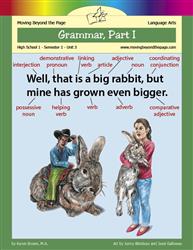
Unit 3: Grammar, Part I
Lesson 3
Pronoun Problems
Students are asked to research and explain either vague pronoun references or shifts in point of view by creating a poster or a short slideshow that explains the topic in their own words. The assignment explicitly requires students to provide two example sentences that contain the error and to show corrected versions and strategies for fixing them. The lesson text and reading pages supply definitions, examples, and explanations of pronoun reference problems and point-of-view shifts that students can use as source material for their explanations.
Lesson 4
Commas
Students are asked to create a comma guide that includes the name of each rule, a short description, an explanation, and at least one example. Activities require students to record explanations and examples (in the guide, journal entries, and activity pages) and to correct and justify punctuation choices on practice items. Homework asks students to write in their journal about the Oxford (serial) comma, explaining their position with reasons.
Lesson 6
Colons and Semicolons
Students are asked to write two well-developed opening statements (one for the semicolon, one for the colon) that must utilize listed claims and include specific examples (e.g., an example joining two independent clauses, an example joining with a conjunctive adverb + comma, an example introducing a list, and an example before a quotation). The Great Punctuation Trial requires students to review claims (definitions and rules), gather evidence, and defend their reasoning aloud to a judge, supplying example sentences as proof. The activities also require students to include concrete usage examples on activity pages and to check or explain answers using answer keys and web quizzes.
Final Project
Wrapping Up
Students are asked to create a visual aid that "graphically explains the tips or tricks" for specific grammar rules using information from the book, lessons, or other resources, which requires selecting and organizing explanatory material. In Option 2, students must write a short paragraph that uses as many commonly confused words as possible, produce an answer key, and then have a peer take the quiz and explain any missed words. The Skills section explicitly asks students to "produce clear and coherent writing in which the development, organization, and style are appropriate to task, purpose, and audience," and to use technology to produce and publish writing products.

Unit 4: Poetry
Lesson 1
Introduction to Poetry
Students write an initial definition of poetry and then read and compare poets' quotations on the "What Is Poetry" page, using those quotations to add to or revise their definition. Students examine specific word choices in poems (e.g., "Richard Cory") and use the Denotation and Connotation pages to record denotations, list connotations, propose similar words, and explain why the original words are more effective. For homework, students print and mark a poem and answer Poem Response questions that ask them to cite marked words with strong connotations and explain why the poet chose them.
Lesson 2
Sound and Rhythm
Students identify and mark instances of alliteration, assonance, and consonance in poems (Activities 1, homework on "The Tyger") and then write short journal responses explaining why a chosen repetition is effective. Students annotate poems with colored pencils and determine rhyme schemes, and they answer guided questions about rhyme, internal rhyme, and sound devices on the Rhyme activity page. Students practice scansion using an interactive tool and write brief reflections about what the poem's rhythm sounds like and the effect it has (Day 2 activities and homework).
Lesson 3
Figurative Language
Students are asked to read poems and identify examples of figurative language, including recording stanza and line numbers and providing explanations (Figurative Language I activity). Multiple activities instruct students to "identify the figurative language device, provide the phrase or line that illustrates it, and explain how the poem uses that device" and to "record the examples in their journal," which requires quoting and explaining textual evidence. The lesson also provides explicit definitions of devices (imagery, metaphor, simile, personification, symbolism, irony, paradox, understatement, overstatement) that students can use in their explanations.
Lesson 5
What Does It Mean?
Students are asked to write brief summaries of poems and to look up unfamiliar words, which requires them to use definitions when explaining meaning. Students use background facts about authors and historical context (e.g., Whitman and Lincoln) to interpret and explain a poem's meaning. Students research and record the meanings of allusions and identify images, symbols, and themes with supporting details on activity pages.
Lesson 6
Fooling with Words
Students are asked to research a poet online for homework and record information on a provided "Poet Profile" page. The profile prompts students to list the poet's name, favorite poem, additional poems, biographical facts (where the poet is from, age, current work), and publications or awards. Students are also asked to provide a personal reflection explaining why they chose the poet and what was interesting or appealing about the poet's work or delivery.
Lesson 7
Analyzing Poetry
Students annotate poems by writing thoughts, questions, and conclusions in the margins and are shown a sample annotation of Shelley's "Ozymandias" that highlights quotations, rhyme scheme, vocabulary, and thematic notes. The Poetry Map organizer asks students to record word choice, imagery, symbols/allusions, tone, sound devices, figurative language, speaker, a summary, and theme, and students are directed to paraphrase and cite phrases (for example, noting Heaney's "glutting our cache" and "rat-grey fungus"). The Poetry Puzzle has students mark nouns, verbs, and sensory words from a word list and then read Blake's poem to locate and reflect on the words they marked.
Lesson 8
Types of Poems
Students are prompted to use precise words, sensory language, and telling details when composing free-verse poems (student activity page: Describing, Strong Verbs, Final Thoughts). Students complete an Ekphrasis Analysis chart that asks them to identify what the poem says about the artwork, what emotions it evokes, and how the poem changes the meaning of the artwork, requiring use of specific evidence and examples. The parent-plan Skills section explicitly lists "Draw evidence from literary or informational texts to support analysis, reflection, and research," connecting lesson tasks to use of textual evidence.
Lesson 9
The Crossover
Students compare the book's vocabulary definitions with dictionary definitions in Activity 1 (Option 1), including discussing differences and using one word as an example. Students may write a vocabulary poem that defines a chosen word using three concrete "As in:" sentences drawn from their own life (Option 2). For homework, students analyze how the meaning of "crossover" changes by looking at specific poems/pages and explain whether the multiple uses are effective.
Lesson 10
Poems and Poets
Students are asked to research a poet and record important information in the Poet Biography Boxes, including 'Known For,' 'Influences,' 'Biographical Details,' and 'Interesting Facts.' Students must prepare a one-page biographical sketch that includes the poet's name, country, language, dates, and at least three interesting facts or cultural factors. Students also write a journal response that summarizes a poem and explains how cultural references enrich the poem, drawing on biographical and contextual research.
Final Project
Poetry
The Poetry Explication choice (Choice 5) directs students to create a digital presentation in which they copy/paste or type poem sections and "demonstrate the aspects" they discuss (e.g., highlighting words for tone, color-coding sound devices). The explication checklist explicitly asks students to address items such as poem type, rhyme and meter, sound devices, speaker and tone, imagery, word choice, figurative language, symbols/allusions, literal meaning, and theme—requiring use of quotations and concrete textual examples. The Director's Notebook choice requires students to analyze the poem and write paragraphs explaining set, costume, and lighting choices using details from the poem to justify their decisions.
Unit 5: Nonfiction
Lesson 1
Types of Nonfiction
Students are asked to look up and rewrite definitions for biography, autobiography, and memoir in their own words, which practices creating extended definitions. The "All About a Person" activity requires students to cite specific examples from a book's catalog, front matter, and back matter to justify whether it is a biography, autobiography, or memoir. Students are also asked to write a comparison of books and to support that comparison with specific examples, and to write a short journal response after reading the Guardian article.
Lesson 2
Pakistan
Students read Chapters 2–4 of I Am Malala and answer targeted questions that require locating and reporting factual details about life in the Swat Valley and Taliban rule. Students use the book's timeline, a Wikipedia page, and a languages webpage to find and record specific facts (e.g., Pakistan's creation date, capital, official languages, geographic features) on the Student Activity Page. The provided answer key lists concrete facts students are expected to gather and report in response to the activity questions.
Lesson 3
The Taliban
Students are asked to research the Taliban using a provided PBS article (and other sources) and then write an informational paragraph that answers four explicit content questions about location, membership, beliefs/goals, and late-1990s actions and criticisms. Students are directed to organize that paragraph with a strong introductory sentence, body sentences that provide the required information, transitional words/phrases for flow, and a concluding sentence. As an alternative, students may create slideshow slides that combine visual aids (maps, images) and text to communicate the same factual points and must note image sources. The Wrapping Up section and Parent Plan instruct students to practice paraphrasing, conduct short research, and produce clear, coherent writing appropriate to task and audience.
Lesson 4
Dear Diary
Students receive direct instruction on quoting, summarizing, and paraphrasing (definitions and examples are given). Students analyze sample paraphrases and practice paraphrasing sentences from Malala's text on the Student Activity Page, including guided tips (use synonyms, change order, check context) and example paraphrases. Students write a one-page diary entry for homework, providing an opportunity to incorporate paraphrased or quoted material and supporting details.
Lesson 5
Displacement
The Option 1 activity directs students to choose classroom photos, record school name/location/grade, write three assumptions based on the picture, and do brief research about school conditions and notable statistics for that city/country. The Option 2 activity requires students to choose four transportation types, print or draw pictures, and write advantages and disadvantages for each, then assemble a mini-book. The Parent Plan also states students will "conduct short as well as more sustained research projects based on focused questions," connecting the activities to gathering information and examples.
Lesson 6
A Day Like Any Other
The lesson requires students to use the APE strategy which explicitly directs them to 'Answer,' 'Prove: Provide evidence... Use specific examples and quotations from the text,' and 'Extend: Give your own opinion, explanation, or connection.' The example APE response models quoting the text with a page number and then explaining how that quotation supports the answer. The Parent Plan further instructs that the 'prove' section should include a quotation or one or two specific examples and that the 'extend' section should explain how the example/quotation supports the answer.
Lesson 7
Life in England
Students are asked to take notes and compare the book and an 11-minute documentary, with specific prompts that point them to pages in the book and to a quoted filmmaker comment (e.g., references to p.75, p.106, and a filmmaker quote around 3:10). Students are assigned a journal informal response asking them to identify a world issue, imagine how they would make a difference, and describe what education or experience they might need. The lesson also states that students will write a final paper about an issue important to them as the unit project, linking the journal entry to future writing.
Lesson 8
Civil Rights
Students read and analyze primary and secondary sources (Martin Luther King Jr.'s "Letter from Birmingham Jail," a Frederick Douglass excerpt, poems by Langston Hughes and Maya Angelou) and are asked to identify persuasive arguments and list the four steps of a nonviolent campaign. Students gather and organize factual details by cutting out and arranging timeline excerpts chronologically to show steps forward and backward in civil rights history. Students record answers to targeted comprehension questions about Freedom Riders videos, complete a double-entry diary on just and unjust laws, and match historical figures King referenced while writing brief descriptions of them.
Lesson 9
Civil Disobedience
Students are given multiple activity pages that require them to analyze excerpts from Thoreau and King, highlight similar phrases, and explain overlapping ideas (Activity 1). In the 'Opposing Quotes' activity students must read quotes on America, government, and voting, decide which author they agree with, and write explanations in the provided 'Your Views' space. The Parent Plan Skills list explicitly names as a skill: 'Develop the topic with well-chosen, relevant, and sufficient facts, extended definitions, concrete details, quotations, or other information and examples appropriate to the audience.'
Lesson 10
Learning from the Past
The Parent Plan skills list explicitly includes developing a topic with well-chosen, relevant, and sufficient facts, extended definitions, concrete details, quotations, or other information and examples. Activity 3 asks students to draft a paragraph that cites a universal-truth statement from Wiesel and uses quotes from Wiesel and one or two other advocates to support comparison. Activity 1 and the associated activity pages require students to look up vocabulary/extended definitions, find and quote textual evidence, paraphrase passages in their own words, and annotate the speech for important ideas.
Lesson 12
Running from War
Students are taught specific methods for integrating quotations into their writing (introduce with a complete sentence + colon; short introductory phrase + comma; or integrate part of the quote) and given examples showing square brackets and ellipses. Students complete an activity page with Part I practice on correct punctuation for quotations and Part II requiring them to introduce a quoted line from the text using one of the taught methods. The homework APE task requires students to 'Prove' their answer by using a quotation from the text and to 'Extend' by explaining how the quotation supports their answer.
Lesson 13
Child Soldier
Students are prompted to use and record specific evidence when they complete the "Different Accounts" activity; the directions explicitly ask students to "Give examples or quotes from the book to back up your answer." The Parent Plan lists the skill "Cite strong and thorough textual evidence" as an expected skill. Several activities (the Role of Rap page, the Child Soldiers chart, and the book/video comparison) require students to gather concrete details from the text and video and to record advantages/disadvantages or answer specific, evidence-based questions.
Lesson 14
Rehabilitation
Students are asked to support conclusions with examples or quotations from the text (Activity 1 Option 2: "state one of these conclusions … and provide examples or quotations from the text"). Activity 2 directs students to choose a Wiesel quotation and "include specific examples from the book or video" that helped form their opinion. Homework Option 2 requires students to record page numbers for nightmares and "analyze" them using evidence from the book.
Lesson 15
A New Life
Students will research nonprofit websites and write a flyer or webpage that includes background information, how the organization helps others, and what it has accomplished (Activity 2, Options 1 and 2). The instructions tell students to use information and images from the organizations' sites as needed and to write much of the text themselves, which requires selecting and presenting factual details. The summarizing activity allows students to include brief quotations and emphasizes putting information in their own words, which supports using quoted or paraphrased evidence in writing.
Final Project
Expository Essay
Students are directed to choose three most relevant supporting facts and record the sources for each (Homework/Day 1 example and rubric Support criteria). The rubric explicitly requires "Three key facts support the thesis and are backed by carefully researched sources" and describes presenting facts as quotes, paraphrases, or summaries with credit. Activities require students to plan audience-appropriate research (Audience, Purpose, and Sources), use quoting/paraphrasing/summarizing for supporting facts (Part 3), and turn each key fact into a developed body paragraph using the APE (Answer, Prove, Extend) method with in-text citations (Part 4).
Semester Exam
Semester Exam
Students practice integrating and paraphrasing source material in Part V, where they must introduce and correctly quote a Wordsworth excerpt and paraphrase selected passages. Students write extended paragraph responses in Part IV (Discussion), answering prompts that require explanation, comparison, and use of examples from texts. Short-answer and essay-style questions (Parts III and VI) ask students to describe significance, identify examples, and explain differences, which requires supplying concrete details and textual evidence.
2: Semester 2

Unit 1: Ender's Game
Lesson 1
Born to Genius
Students are asked to read the book's introduction and use Internet research to answer specific "About the Author" questions, requiring them to locate historical facts, author influences, and genres. Students complete guided questions that ask for concrete details (e.g., three historical facts from 1957–1963; how Asimov inspired Card; sources of Card's ideas about war). Students rate and discuss issue statements and are expected to explain their reasoning in class discussions, which asks them to use relevant information to support opinions.
Lesson 2
We're People, Not Thirds
The lesson asks students in Activity 2 (Option 2) to research eugenics and record ten facts they learned, which requires students to locate and note factual information. The "Planned Procreation" activity asks students to brainstorm reasons for family planning across four explicit categories (religious, environmental/ethical, personal/financial, governmental/legal), which requires selecting and organizing relevant details. The "Things to Know" section provides a concise definition of eugenics that students can use as a reference when collecting information.
Lesson 5
Movement and Time
Students are asked to define a flashback and name functions (extended definition and purposes) on the Student Activity Page. They must locate and record a flashback passage from Ender's Game (including a quoted example from Chapter 5) and explain what insights that flashback gives about Ender and how it increases tension. Activity 1 asks students to narrate movements using "strong descriptive phrases," which practices producing concrete descriptive details.
Lesson 6
Performance Is Personal
The Text Structure activity asks students to identify examples of foreshadowing and to "Provide an example from the text," requiring students to locate and cite concrete details. The Text Structure questions also ask students to explain how conversations create tension and to discuss the job roles of two authority figures, prompting analytic explanations grounded in textual evidence. The Competing Commanders activity asks students to determine three evaluation criteria, score each commander on those criteria, and organize their point of view in a scored leaderboard, which requires selecting and applying relevant aspects of the text to support judgments.
Lesson 7
Leaders Motivate
Students read background material on John Locke and Demosthenes and write a journal entry describing links between those historical figures and the novel characters (Activity 1), which requires them to gather and use factual information from provided web sources. Students complete a "Complete the Thought" worksheet by matching and then applying quotations about leadership to three novel characters, and they record reasons in a Character–Quote–Reason chart (Activity 2). The lesson also supplies explicit definitions and distinctions (power, authority, leadership) in the "Things to Know" section that students can use as concrete details in their writing.
Lesson 8
Flies and Self-Loathing
Students complete a compare-and-contrast graphic organizer that asks them to identify specific elements (setting, leadership, theme, power, responsibilities, fears, consequences) in both Lord of the Flies and Ender's Game. Students are prompted to evaluate Ender's actions and perceptions and to answer focused reading questions about Chapter 11, which requires citing textual events (e.g., why Ender calls Bean, what other commanders do). The Activities ask students to research animal symbolism for army logos, which would require locating relevant facts about animals and cultures.
Lesson 9
Conflict Within and Without
Students identify and categorize examples of internal and external conflict by cutting and pasting provided text boxes into a chart that lists character vs. self, character vs. character, character vs. society, and character vs. nature. Students write a paragraph responding to three questions about each conflict's impact on relationships, plot development, and character change, and they circle and justify which conflict is most central to the novel's theme. Students also write one- to two-paragraph journal responses speculating why the author chose the chapter title and how that allusion foreshadows plot events. The parent plan explicitly lists the skill of citing specific textual evidence when writing or speaking to support conclusions.
Lesson 11
Thud, Whump, Huut
Students are asked to reread a scene from Ender's Game and re-watch the corresponding movie scene, taking notes on differences, omissions, and changes in dialogue, which prompts them to identify relevant details and quotations. The Comic Adaptation activity requires students to list narration or dialogue that was omitted or changed and to evaluate whether the comic communicated the omitted content through pictures, using quoted passages as evidence. Sample answers and an answer key show students where to locate concrete details and quotations from the novel and adaptation for comparison.
Lesson 12
Campbell's Comparisons
Students record the 12 steps of Campbell's Hero's Journey from a summary video and then choose six steps to which they draw parallels in Ender's Game. Students complete a 'Hero's Journey' activity page in which they describe specific examples from the novel that fit each chosen step (e.g., Call to Adventure = Colonel Graff recruits Ender; Trials = Ender tested in Battle School). Students retake an issues survey and are prompted to discuss any changes in their views, potentially providing examples from the novel to explain those changes.
Lesson 13
The Enemy's Gate Is Down
Students write one- to two-sentence summaries of four leadership lessons on the "Leadership Lessons: Forbes Four" activity page and describe how to apply one lesson to their own lives, showing brief practice in developing a topic. Students complete the "Discovering Subplots" page by listing mysteries and unanswered questions for Graff/I.F., Ender, and Peter/Valentine and by comparing how the subplots function, which requires organizing ideas and citing narrative details. The Parent Plan lists a skill to "summarize the key supporting details and ideas," which indicates students practice summarizing evidence from the text.
Final Project
Think-Tac-Toe
Students are asked to research NATO and the Warsaw Pact, color and sort member countries, and list two key similarities and two key differences while explaining why the author used the historical reference, which requires use of factual information and explanatory reasoning. Students must choose two historical quotes and rewrite moments in Ender's Game to incorporate those quotations with appropriate transitional phrases, explicitly practicing integration of quotations into writing. Students are directed to write two to three paragraphs comparing and contrasting military and civilian leadership, including examples (such as Peter and Valentine), and to produce one- to three-paragraph flashbacks or three- to four-paragraph POV rewrites that require use of concrete story details and background information.
Unit 2: Grammar, Part II
Lesson 6
Word Choice
Students are asked to act as a College Essay Editor where they identify vague language, clichés, weak verbs, and wordiness and then rewrite a draft paragraph to be "clearer, more specific, and less wordy." The Life Application text explicitly tells students that "Strong writing... uses clear, precise language and concrete details so the reader can understand what actually happened and why it mattered." Activity instructions for Revision (Part 3) direct students to "choose words and details with strong, vivid descriptions" and to use active voice and simplify sentences.
Lesson 7
Verb Voice and Mood
Students are asked to create a creative product (poster, slideshow, comic strip, or card game) that explains the subjunctive mood to a younger audience, which requires them to provide definitions and examples appropriate to that audience. The rubric explicitly requires that students "clearly show what the subjunctive mood is using definitions, examples, and/or context" and that the project be free of grammar and punctuation errors. The activity prompts students to include basics and instances of usage and to consult linked resources for explanations and examples. Students also practice with multiple examples in the text (indicative, imperative, subjunctive, conditional) and convert passive constructions to active ones in Activity 1, demonstrating use of concrete examples.
Final Project
Wrapping Up
Students are asked to create mini-projects (slideshow, poster, explanatory guide, or song/skit) that require them to clearly define terms and provide examples (e.g., slideshow: "Be sure to clearly define any terms and provide examples"). The explanatory guide option explicitly directs students to explain a grammar concept to a specific audience and to use their own descriptions and examples. The project rubric requires that each mini-project "clearly explains the topic," that information is "appropriate for the target audience," and that the work "demonstrates that the student understands the topic," which directs students to develop topic content.

Unit 3: Informational Texts
Lesson 3
The Matthew Effect
Students extract quantitative birth-month data from a table and create an alternate visual (bar chart, pie chart, or pictograph) using Excel or by hand. Students sketch a graphic to translate the TIMSS study findings into a visual representation that conveys percentile differences. Students brainstorm, list, and prioritize (star the top three) factors that may contribute to athletic success in a journal and answer targeted comprehension questions explaining the 10,000-hour rule and how it relates to the sports examples.
Lesson 4
The 10,000 Hour Rule
Students are asked to mark and record the key opportunities that The Beatles or Bill Gates had and then take those notes and "communicate the information presented in visual form," which requires selecting relevant facts and examples from the text. The "Looking Closely" activity asks students to summarize each section, identify specific words/phrases that signal Gladwell's intent, and explain how sections develop ideas, prompting use of textual details and quotations. The Parent Plan skills explicitly instruct students to "cite strong and thorough textual evidence" and to "translate quantitative or technical information ... into visual form," both of which direct students to develop a topic using concrete details and evidence.
Lesson 5
Harlan, Kentucky
Students are assigned a homework journal reflection that asks them to research who originally settled their area, take notes about stereotypes and influences, and share findings with family. Students read Chapter 6 and its footnotes, underline unfamiliar words, and answer comprehension questions about cultural legacies and the Michigan experiment, drawing on informational text. The Parent Plan skills list directs students to 'Draw evidence from literary or informational texts' and to 'Produce clear and coherent writing,' which aligns with researching and writing about a topic.
Lesson 6
The Ethnic Theory of Plane Crashes
Students read multiple informational texts (Gladwell chapter and an online blog) and answer targeted reading questions that ask for details and reasons (e.g., identifying clues about causes of crashes, noting PDI examples, and explaining mitigated speech). Students prepare a short oral summary of the blog's main objections or complete a written chart analyzing each criticism, Gladwell's response, and the effectiveness of that response, which requires identifying specific criticisms and responses. Students also write journal responses predicting the chapter's focus and reflecting on cultural scores, which asks them to use evidence from the readings to support their ideas.
Lesson 7
Rice Paddies and Math Tests
Students are asked to create an infographic or diagram that explains a concept from the chapter and may use book information or additional sources, which requires selecting and organizing facts and details. Students must take notes on how the Chinese counting system works and present findings to a parent, providing examples and explanations. The Parent Plan skills list explicitly directs students to draw evidence from texts, cite textual evidence, and translate quantitative or technical information into visual form.
Lesson 9
Writing about History
Students identify and match secondary-source claims to supporting primary-source quotes in the 'Firsthand Accounts' graphic organizer, including using specific testimony lines (e.g., Smith and Brent) as evidence. Students are instructed to "use facts from the accounts" when composing an editorial supporting the Indians' side, which requires selecting relevant facts and quotations to back up points. Multiple activities (Primary Falsehoods, the double-entry diary, and the homework reading questions) require students to extract concrete details, dates, and quotations from primary and secondary texts for analysis.
Lesson 10
Science Writing
Students read science-text excerpts and answer comprehension questions that require precise definitions and examples (e.g., defining equilibrium with a 2 lb. book example and distinguishing centrifugal vs. centripetal force). The lesson lists and teaches explicit methods for developing and explaining terms (Example, Explanation, Highlighting, Synonym, Antonym, Analogy, Illustration) and asks students to identify which methods the author uses on the Investigating Claims activity page. The Parent Plan directs students to cite specific textual evidence and to determine how the author explains or clarifies scientific phenomena and incorporates supporting details.
Lesson 11
Technical Writing
Students are required to write an introduction that is supported by an outside source or quotation and to include a Works Cited entry (Day 1 homework; Activity 6). They must list required materials, provide background information, and record step-by-step procedures and tips using the How-to Guide template (Activity 3), producing concrete details and examples appropriate for a novice audience. Students create and revise a glossary of specialized terms (Activity 4) and are instructed to make information appropriate to readers who "know little or nothing" about the topic and to test their guide with a reader, then revise based on feedback.
Lesson 12
Logical Fallacies
Students are taught about logos and told that logos involves using facts, statistics, examples, and clear ideas to support claims (homework section). Students analyze Lou Gehrig's speech to identify the thesis and how he supports it with numerous specific examples, and they complete a sample speech that includes a numeric example of accidents as supporting evidence. Students are asked to write their own short speech and to note where they appealed to ethos, logos, and pathos, which asks them to produce supporting information for a claim.
Final Project
Argumentative Research Essay
Students are instructed to locate at least five high-quality sources (Day 2) and to collect facts, statistics, and specific examples from those sources (Part 4: Focusing Your Topic). The "Present the Evidence" activity page directs students to record quotes/ideas from sources and reflect on how each piece of evidence influences their thinking, guiding thesis formation. Paragraphs 2 and 3 are explicitly designated as Confirmation where students present evidence that backs up the thesis, and the rubric requires a Works Cited with three or more authoritative sources and correct in-text citations (Day 4 and Part 10).

Unit 4: Drama
Lesson 1
What Is Drama?
Students read explicit definitions and examples of drama genres (tragedy, comedy, tragicomedy, farce, melodrama, spectacle, musical) and see a genre table with sample works. Students watch video clips in Activity 1 and record genre identifications, practicing matching examples to definitions. Students learn and label drama-specific vocabulary and stage types in Activity 2 and are asked in homework to write a paragraph describing a play, noting its type, setting, characters, and how the live experience differed from film.
Lesson 4
A Raisin in the Sun
Students are asked to write a one-paragraph summary of Act I that includes setting, main characters, and plot, which requires them to identify and report key facts. Students determine vocabulary meanings from context and consult dictionary definitions, and they match words to definitions, demonstrating use of extended definitions and precise word choice. Students analyze dialect using quoted lines from the play and listen to audio samples, using concrete textual quotations and examples to describe language differences.
Lesson 5
Act II
Students are asked to write a reader-response paragraph using the APE method (Answer, Prove, Extend) and to "Provide evidence to support your answer. Use specific examples and quotations from the text," which directly requires use of quotations and concrete examples. In the Hansberry Quotes activity students read excerpts and answer analytical questions that require them to explain which characters or themes the quotations describe and to compare passages, prompting use of textual details. Homework tasks (song analysis and the Character Analysis/monologue assignments) require students to record specific facts (song title and year), explain what the song says about the American Dream, and create developed biographical and psychological details for a character, all of which ask for relevant supporting information and examples.
Lesson 6
Act III
Students read Act III and read Langston Hughes's poem "Harlem," then answer focused questions that ask them to define the term "defer," identify five similes in the poem, and analyze the final image "Or does it explode?." Students are prompted to relate specific poem comparisons to a chosen character from the play and to explain which comparison best describes that character's "dream deferred." Students complete short-answer tasks that require citing poem images and explaining their meanings in relation to character experience.
Lesson 7
Fences
Students are asked in Activity 2 to compare and contrast Fences and A Raisin in the Sun by filling out charts on theme, characters (including goals, attitudes, obstacles), plot, and setting and to "Write at least 2 sentences" about similarities and differences. Activity 3 requires students to watch an interview and "Write at least three insights in a paragraph in your journal," which asks them to summarize character insights gained from primary-source commentary. Homework asks students to write a paragraph reflecting on what they learned from reading the play and watching the movie, encouraging use of specific observations from both texts.
Lesson 8
Shakespeare
Students are asked to use the book, a video, and web resources to create a Shakespeare timeline, selecting and ordering specific facts (birth, marriage, children's dates, theater dates, death). The activity sheet directs students to read a passage, identify speaker, meaning, actions, and desires, visualize the scene, and "Summarize: Rewrite the passage in your own words," which requires them to restate content with relevant details. The reading questions prompt students to locate factual information (e.g., name of the Globe Theater, reasons theaters closed, historical influences) and to interpret contextual notes that clarify challenging words and scene summaries.
Lesson 10
Figurative Language
Students read Act II scenes and are asked to summarize the most important event in their journals and answer specific comprehension questions, which requires writing organized explanations. Students identify and explain oxymorons and paradoxes using quoted lines from Romeo and Juliet and complete analysis questions asking why Shakespeare uses these devices. Students unscramble and reconstruct the Prologue sonnet and then write an explanation of the major conflict Shakespeare summarizes. Students complete a spouse-survey comparison and discuss similarities and surprises in writing.
Lesson 12
Time and Tension
Students are directed to read Act IV and answer focused comprehension and analysis questions, and to write a journal summary identifying the most important event in the scene. The Time and Tension activity instructs students to locate and count time-related words in the play, list ways Friar Lawrence mentions time, and analyze the Nurse's and Capulet's language for foreshadowing and suspense. The answer key and activity prompts require students to cite specific lines and textual details (e.g., lists of time references, counts of words, and quoted phrases) when explaining how time creates tension.
Lesson 13
Tragic Hero
Students answer journal questions asking them to explain how Romeo meets tragic-hero criteria and to state the three types of heroes from the video, which requires explanation and use of examples. Students complete a timeline and character-development worksheet that asks them to record specific actions/events from named scenes and to use that chart to determine and justify whether a character is static or dynamic and whether they are round or flat. Students read excerpts of Pyramus and Thisbe and fill a comparison page noting similarities with Romeo and Juliet, requiring them to cite parallel plot details.
Lesson 14
Modern Retelling
Students are asked to choose three specific areas of difference and write a thesis that names those areas, guiding focused development of the topic. The instructions require students to use the APE method: answer a question, prove with specific examples from both productions, and extend by explaining the significance or effect. The writing checklist explicitly requires each paragraph to contain specific information or examples from both productions and to end with an explanation of the significance or effect of those differences.
Final Project
Drama
Students are asked to write detailed paragraphs for costume and set designs that include specific details (color, material, accessories, act/scene) and explanations of choices. Playlist and news projects require students to include sample lyrics or the first four to five sentences that answer who, what, when, and where, which are concrete facts and quotations. Multiple projects require students to write scripts, provide summaries for comic panels, and cite outside sources with a Works Cited page; the rubric explicitly evaluates Content and Sources.
Semester Exam
Semester Exam
Students are prompted to write 1-3 paragraph responses to discussion questions that require explanations, examples, and textual support (e.g., Discussion C asks students to identify a social message and explain how the work conveys it; Discussion F asks for specific reasons and examples and to consider features like footnotes/endnotes). Short-answer items explicitly require definitions and examples (e.g., define idiom, flashback, euphemism, subplot) and ask students to "provide an example from the book" or to "be sure to mention" specific factual explanations (e.g., why Roseto residents were outliers). The Parent Plan skills list also includes drawing evidence from texts and producing clear, coherent writing, which frames expectations for using facts and examples in responses.