


Sixth Grade - MATH
5: Math
Unit 3: Ratios and Percentages
Lesson 1
Introduction to Ratios
Students are asked to simplify ratios by dividing both quantities (for example, reducing 9:6 to 3:2) and to generate equivalent ratios by multiplying both quantities (for example, 4/1 to 8/2). Activity pages and answer keys include problems that require students to divide or multiply both parts of a ratio (e.g., 12 to 4 shown as 6 to 2 and 3 to 1). Word problems ask students to scale ingredient amounts and hours by a common factor to keep ratios equivalent, requiring use of common divisors or multipliers.
Lesson 3
Equivalent Ratios
Students are explicitly asked to find the greatest common factor of 18 and 42 on the "Basic Skills Review #5" page, and the answer key gives the GCF (6). Students also set up and solve ratio-total equations such as 4x + 3x = 91 (Sam and Lindy) when using tape diagrams to divide a total into ratio parts, showing work with repeated groups and multiplication by a common factor.
Unit 4: Algebraic Expressions
Lesson 3
Working With Expressions
Students are asked to find the greatest common factor in the Basic Skills Review (#10 asks for the greatest common factor of 126 and 189) and the answer key shows use of prime factorization to compute the GCF (63). The Basic Skills Review description also lists factoring as one of the included topics, and the answer key explicitly lists the prime factorizations used to determine the common factors.
Lesson 5
Equivalent Expressions
Students are shown and asked to work with examples of the distributive relationship such as 3x + 6 = 3(x + 2) and 2(x + 3) = 2x + 6, so they practice generating equivalent expressions by distributing or factoring a common factor with variables. The Basic Skills Review includes a problem asking students to find the least common multiple (LCM) of 18 and 54 using prime factorization, so students practice computing an LCM. Multiple activities require combining like terms and applying properties to generate equivalent expressions, reinforcing the use of properties that underlie factoring and LCM reasoning.
Lesson 6
The Distributive Property
Students compute and compare numeric examples of the distributive property such as (5×4)+(5×8)=5(4+8). They translate numeric and algebraic sums into factored and expanded forms (e.g., 5(n+2) ↔ 5n+10, 6 + 2n ↔ 2(3 + n), and 7m + 14n ↔ 7(m + 2n)). Practice problems ask students to rewrite expressions using distribution (e.g., rewrite 10(y+2) and (7+x)3) and to match area models with expressions that show distribution.
Lesson 7
Unit 4 Test
Students practice the distributive property by writing and expanding expressions (Problem 14 asks them to write 12(x + 6) and expand it to 12x + 72 and to prove equivalence by evaluating at x = 10). Students identify and match distributive-property representations in area-model items (e.g., choosing 3(n + 5), (3·n)+(3·5), and 3n+15) and complete problems that require using and recognizing commutative and associative properties.
Final Project
Algebra Think-Tac-Toe
The materials require students to create Math Properties Trading Cards that explicitly include the distributive property and number examples, including the example 15 + 5n = 5(3 + n). The "Prove It! Equivalencies" tasks ask students to use the distributive property to expand and simplify expressions (e.g., 6(5 + n) -> 30 + 6n) and to show step-by-step use of properties. Several activities (trading cards, proofs, and examples) ask students to generate and explain numeric and algebraic examples using the distributive property.
Unit 5: Algebraic Equations
Lesson 2
Solving One-Step Equations, Part 1
The Basic Skills Review (#9) includes a problem requiring students to use prime factorization to find the GCF and LCM of 14 and 21, and the answer key explicitly shows GCF = 7 and LCM = 42. The review item asks students to compute both GCF and LCM, demonstrating direct practice with those concepts and prime-factor methods.
Unit 6: 2D Geometry
Lesson 2
Working With Angles
Students are asked to find the greatest common factor of 75 and 105 on the Basic Skills Review and to use prime factorization to do so. Students also simplify algebraic expressions (for example, 12x + 6x + 4 - 5x + 4x - 10) and write and solve equations, showing practice with algebraic manipulation related to factors and combining terms.
Unit 7: 3D Geometry
Lesson 5
Problem Solving With Solids
Students are explicitly asked to find the greatest common factor of 64 and 96 in the Basic Skills Review #14 (Question 2) and the answer key shows the GCF found by prime factorization. The lesson's answer key and problems provide step-by-step prime factorization for 64 and 96 and identify the GCF as 32.
Unit 8: Statistics
Lesson 2
Populations and Samples
The Basic Skills Review #15 includes Problem 6 asking, "What is the greatest common factor of 36 and 54?" The answer key shows students use prime factorization (36 = 2^2 × 3^2; 54 = 2 × 3^3) to compute the GCF = 18. This gives explicit practice finding a greatest common factor for two whole numbers less than 100.
Lesson 8
Making Inferences
The Basic Skills Review #16 asks students to "Use prime factorization to find the least common multiple (LCM) of 15 and 18," and the answer key shows the prime factorization method and resulting LCM of 90. The review also includes other arithmetic and algebra practice (e.g., evaluating 6p + 12 when p = 4) that gives students opportunity to work with numeric expressions. The materials instruct students to simplify and use arithmetic methods, which supports practicing number-factor procedures.
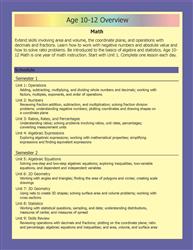
Unit 9: Skills Review
Lesson 1
Decimals, Factors, and Multiples
Students find the greatest common factor using prime factorization in problem 1 (GCF of 56 and 70). Students find least common multiples in both a direct problem (LCM of 18 and 30) and a word problem that uses numbers ≤12 (batches of 6 and 10, LCM = 30). Students use the distributive property to factor sums in problem 2 (36 + 88 factored as 4(9 + 22)) and to rewrite a product using a sum (15 × 32 as 15(30 + 2)).
Lesson 3
Expressions, Equations, and Percentages
Students practice the distributive property and combining like terms when they simplify expressions such as 3(n + 6) + 4n - 10 to 7n + 8 and x + 2x + 3 + 3x - 7 to 2x - 4 (Activity 1, Problem 4). The Parent Plan lists skills that include applying properties of operations to factor and expand linear expressions and identifying parts of an expression (sum, term, factor, coefficient), which supports practice with factoring and recognizing factors. Students also write and evaluate algebraic expressions (Activity 1, Problems 2, 3, 5), reinforcing manipulation of expressions.
3: Math
Unit 1: Numbers
Lesson 2
Fractions and Decimals
Students practice simplifying fractions by dividing numerator and denominator by their greatest common factor when converting terminating decimals to fractions (examples and answer key show simplification like 625/1000 = 5/8). Students also use prime factorization of denominators to predict whether a fraction's decimal will terminate or repeat (several activity pages ask students to factor denominators such as 40, 9, 18 to decide terminate vs. repeat).
Unit 3: Expressions
Lesson 3
Algebraic Expressions
Students practice identifying and pulling out a greatest common factor (GCF) when factoring linear expressions (Activity 1 shows 6x + 12 → 6(x + 2) and 15x − 10 → 5(3x − 2)). Students also use the Distributive Property in numeric contexts by factoring common numeric factors from sums (Activity 2 rewrites 2×7 + 2×5 as 2(7 + 5) and the review shows 32a + 8 → 8(4a + 1)). Multiple activity pages and answer keys require students to divide terms by a common factor and rewrite expressions as a product of a GCF and a parenthetical sum.
Lesson 9
Unit 3 Test
The lesson explicitly instructs students to "Rewrite and simplify expressions using the Commutative, Associative, and Distributive Properties" and gives an example of rewriting (a + 0.05a = 1.05a) in the Skills/Introducing sections. Parent-facing notes also repeat that students should rewrite expressions and simplify using the distributive property. These statements indicate students are expected to practice using the distributive property to rewrite expressions.
Unit 9: Semester Exams
Lesson 3
Expressions Review
Students are asked to use the distributive property and to factor expressions (Activity 1 lists: "Use the distributive property to simplify an expression" and "Factor an expression completely"). The Student Activity Page and answer key include an explicit factored algebraic result (e.g., 8(4a + 1)), showing students practice rewriting expressions as a product. The Parent Plan repeatedly emphasizes rewriting expressions in different forms and using properties of operations, which supports practice with distributive/factoring skills.
Lesson 5
Semester Exam
Students are asked to "Distribute and simplify: 3(y + 5) - y" and to "Factor completely: 24m + 12," and the answer key shows factoring 24m + 12 = 12(2m + 1). These items require students to apply the distributive property and to factor out a common factor from expressions with coefficients.