


Sixth Grade - MATH
5: Math
Unit 2: Integers and Rational Numbers
Lesson 7
Coordinate Problem Solving
Students plot points and calculate horizontal and vertical distances in multiple activities (e.g., Distances on a Coordinate Plane problems with pairs like (7, −3) and (2, −3), and pairs with same x such as (−3, 5) and (−3, −4)). Students apply distance techniques in real-world contexts such as the bus-stop map and the Map of Centerville questions where they compute block/mile distances along grid lines. Students find missing vertices and draw rectangles from diagonal corners in the garden and quilt problems (e.g., given (4, 2) and (−4, −4) they locate the other two corners), and they create coordinate pictures by plotting and connecting points across all four quadrants.
Lesson 8
Unit 2 Test
Students plot points in all four quadrants and perform translations and reflections (Exercises 18, 19, 21 and several coordinate-grid tasks). Students are asked to state horizontal and vertical distances between pairs of points (e.g., between (-5, 2) and (4, -3); between (4, -6) and (-2, 1)), which requires using coordinate differences to find side lengths. Students draw rectangular figures by following coordinate moves or by connecting given vertices (e.g., points (1,7), (1,0), (-3,0), (-3,7) forming a rectangle and sequences that form rectangular paths).
Final Project
Coordinate Game
Students plot ordered pairs on a labeled coordinate grid ranging from -12 to 12 and call out x-y coordinates to mark hits and misses. Students are instructed to position targets that cover a specific number of coordinate points (one of 5 points, one of 4 points, two of 3 points, one of 2 points) and to sketch those targets in a chosen quadrant. The activity requires students to record opponent and own coordinates, mark points on an opponent sheet, and track hits/misses using Xs and Os on the coordinate plane.
Unit 6: 2D Geometry
Lesson 3
Triangles
Activity 3 and its student pages ask students to draw triangles on a laminated coordinate plane using specific coordinates and line segments (e.g., draw a bottom side extending right from (1,1) of length 5; draw a line segment from (-2,2) to (-7,2); draw segments from (3,1) to (16,1) and from (-3,-5) to (-6,-5)). Several tasks require placing vertices by given coordinates in different quadrants and connecting them to form triangles. The student activity prompts comparing triangles drawn from coordinate instructions to decide if they are the same, congruent, or similar.
Lesson 4
Area
Students work with a kite drawn on a coordinate grid (vertices shown at (4,3), (6,5), (8,3), and (6,1)) and are asked to divide it using a vertical or horizontal line and count grid units to find bases and heights for triangle area calculations. Student activity pages include plotted polygons on coordinate planes and ask students to find the area by decomposing the figure and counting grid squares or using grid-measured lengths. The lesson directs students to choose a vertical or horizontal division and to use the number of grid units covered by each line to compute areas of the resulting shapes.
Lesson 6
Scale Drawings
Students work with a coordinate grid in Activity 2 where they are told to draw an "original" rectangle (4 by 2) and corresponding reduction and enlargement on the coordinate plane. The lesson image lists vertex coordinates for those rectangles (for example, original bottom-left (3,4) and top-right (7,6)), and students are asked to plot and color the three rectangles on the grid. Students also draw figures on a laminated grid (e.g., a right triangle 18 by 12 blocks) and use block counts to create scaled copies.
Lesson 7
Unit 6 Test
Students are asked to use a labeled grid to draw polygons in multiple problems (e.g., "Use the grid to draw an obtuse scalene triangle" on a grid labeled 0–18 on both axes and "Use the grid to draw a right isosceles triangle" on a grid labeled 0–19 by 0–13). Trapezoids ABCD and KLMN are presented on a grid and students answer which sides correspond and compare side measures (e.g., asking what side corresponds to BC and asking for MN when CD is given). Several tasks require students to draw scaled versions of figures on grids (scale-drawing triangle/rectangle problems) and to reason about side lengths and similarity from grid-based diagrams.
Unit 7: 3D Geometry
Lesson 2
Surface Area
The Basic Skills Review asks students to graph points at (3, 2), (−3, 2), (−5, −1), and (1, −1) on a coordinate plane and then connect the points in order to determine the name of the resulting polygon. A coordinate-plane diagram of a parallelogram with labeled vertices appears in the review materials, giving students an example for plotting and recognizing shapes from coordinates.
Unit 8: Statistics
Lesson 8
Making Inferences
The Basic Skills Review #16 includes a coordinate-grid problem that asks students to find the horizontal and vertical distance between points A and B. The answer key gives coordinates A(3, -2) and B(-4, 2) and shows horizontal distance 7 and vertical distance 4, indicating students compute distances by subtracting x- and y-coordinates.
Unit 9: Skills Review
Lesson 2
Fractions, Ratios, and Coordinates
Students plot and transform individual points (e.g., plot (-2, 4) and reflect it; plot (3,5) and (-3,-2)). Students compute horizontal and vertical distances between plotted points (questions ask for the vertical distance and the halfway/midpoint). Students produce a rectangle by following vertical and horizontal moves from a starting coordinate and label the rectangle's vertices (points at (-3,5), (-3,-2), (-6,-2), and (-6,5)).
3: Math
Unit 3: Expressions
Lesson 7
Rise Over Run
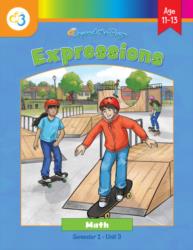
Students choose pairs of lattice points or are given point pairs (e.g., (-4, 1) and (2, 4); (-5, -1) and (3, 5)) and draw vertical and horizontal segments between them to form right triangles. They count squares to find the rise (vertical change) and run (horizontal change), fill in signed values, and use those counts to compute lengths of vertical/horizontal legs and the slope (rise/run). The lesson includes real-world framing (ramps, skate park) and an optional ramp-building activity that asks students to vary rise and run and observe effects.
Unit 6: Geometry
Lesson 2
Translations
Students are asked to plot points and draw polygons from given coordinates (for example, draw triangle XYZ with X(0,0), Y(2,0), Z(1,2) and a rectangle with listed vertices). Multiple activities require students to plot line segments and triangles from explicit coordinate pairs and to record the coordinates after applying translation rules (P(x,y) → P'(x+a,y+b)). The lesson includes an application activity (checkers) where students record start and end coordinates and describe moves with translation rules.
Lesson 3
Reflections
Students are given lists of vertex coordinates and are asked to place, plot, and connect those vertices to form polygons (e.g., the Reflecting Shapes activity lists vertices for shapes A, B, C, and D and directs students to place each polygon so its vertices match the ordered pairs). Multiple activities require students to plot polygon vertices on coordinate grids, trace originals and images, and fill tables of original and reflected vertex coordinates. Students also label vertices and their images (A → A') and use axes ranging from -8 to 8 to draw the polygons on the coordinate plane.
Lesson 4
Rotations
Students are given explicit vertex coordinates for points, line segments, and polygons (for example G(1,-3) and H(4,-3); triangles KLM, NOP, etc.) and are asked to apply algebraic rotation rules to compute and write the images' coordinates. Activity pages provide coordinate grids for students to plot original and rotated points and to connect those plotted points to form rotated line segments and polygons. The lesson's examples and rules ((x,y)→(−y,x), (y,−x), (−x,−y)) require students to calculate new ordered pairs and place the rotated vertices precisely on the coordinate plane.
Lesson 5
Sequences of Rigid Transformations
Students are given multiple starting figures with explicit vertex coordinates (for example, A(1,1), B(1,4), C(4,4), D(4,1) and several triangles, rectangles, and a pentagon) and asked to draw those polygons on coordinate grids and label vertices with primes. Students perform sequences of rigid transformations (translations, reflections, rotations) on plotted figures and track coordinate changes (e.g., translation rules T_{1,-1}, T_{-2,1}, rotations about the origin, and reflections over axes). Students are asked to verify congruence after moves and are encouraged to check that side lengths and angles remain the same after each transformation.
Lesson 6
Dilations
Students are asked to graph polygons from given coordinates (e.g., graph triangle NOP with N(1,2), O(1,7), P(4,2); graph rectangle ABCD with A(2,3), B(8,3), C(8,5), D(2,5); graph polygon ABCDEF with listed coordinates). Problems explicitly prompt students to find side lengths (e.g., "What is the length of NO?" and "What is the length of AB?") and use dilations to compute new lengths. Multiple activities require plotting vertices, connecting them to form polygons, and using coordinate-based operations (multiplying coordinates for dilations and multiplying side lengths by the scale factor) to find resulting segment lengths.
Lesson 7
Sequences of Transformations
Students are given explicit vertex coordinates for many polygons (triangles, rectangles, parallelograms) and are instructed to graph the original figures on coordinate grids (e.g., A(1,2), B(2,2), C(1,4); many Student Activity Page problems list coordinates). Students apply coordinate rules to produce images after transformations by calculating new coordinates (examples show multiplying coordinates for dilations and using rotation rules such as (x,y)→(y,−x)). Students examine coordinates to identify reflections and rotations (the Questions to Discuss prompt asks students to recognize sign changes for reflections and the Activity 2 ‘‘What Happened?'' requires using coordinates to determine sequences).
Lesson 8
Triangles and Transversals
Students work with coordinate-based transformation problems on the quiz (e.g., reflect (2,2) across the y-axis then translate up 2 → (-2,4); dilate a point D(3,1) by factor 2 to (6,2) then reflect across the x-axis → (6, -2)). The lesson includes plotted triangles and coordinate grids (Problems 12 and 13) where students read and produce coordinates after dilations, reflections, and translations. Several answer keys show computed coordinate results, indicating students practice computing new vertex coordinates.
Lesson 9
Using the Pythagorean Theorem
Students plot pairs of points on coordinate grids and compute distances by forming right triangles (examples: A(0,0) to B(6,8) and A(−1,2) to B(2,−2)). The Grid Problems activities give multiple coordinate pairs and ask students to count squares for horizontal and vertical legs and then apply a²+b²=c² to find the distance. The lesson explicitly directs students to create a right triangle from two points on a grid and use the legs as a and b to find the hypotenuse (distance).
Lesson 11
Unit 6 Test
Students are given multiple problems that require them to plot polygons from coordinates (for example, triangles and squares with vertices like (0,0),(4,0),(4,4),(0,4) and triangles A(-2,1), B(-4,1), C(-3,3)) and to draw images after transformations (reflections, rotations, translations). Exercises ask students to perform rotations (e.g., rotate X(0,1), Y(2,1), Z(1,3) 90° CCW), reflections across axes and y = x, and to translate vertices using rules like T_{5,-3}, which require computing and plotting new vertex coordinates. Problems that ask whether two squares are related by a dilation and to find the scale factor (comparing the 4×4 square to a 2×2 square) require students to compare coordinate-based side lengths to determine scale.
Final Project
Abstract Art Gallery
Students are asked to draw an x-axis and y-axis on graph paper and to place shapes on that coordinate grid. Students reflect a polygon across the x- or y-axis, rotate a polygon 90° clockwise about the origin (0,0), translate a polygon using a rule like "move right 4 units and up 2 units," and dilate a figure about the origin by a factor of 3. These tasks require students to plot and transfer figures on the coordinate plane and to apply coordinate-based transformation rules.
Unit 7: Linear Equations
Lesson 7
The Point of It All
Students repeatedly plot points and draw lines on a Cartesian grid using two given coordinates and write the equations of those lines (e.g., tasks with points like (0,2) and (2,6) or (0,0) and (2,2)). Several practice items include vertical or horizontal lines given by point pairs (for example points (6,6) and (6,0) produce a vertical line, and points (0,1) and (4,1) produce a horizontal line). Students estimate intersection points from graphs and compute exact intersections algebraically after finding line equations.
Unit 9: Semester Exams
Lesson 7
Geometry Review
Students are asked to plot polygons from given vertex coordinates, for example drawing Triangle LMN with vertices L(2,1), M(4,1), and N(3,3) and then dilating it (Activity 1). Multiple tasks in Activity 2 require students to plot and transform triangles given coordinates (e.g., reflecting D(1,-2), E(4,-2), F(3,-5); translating A(1,-3), B(2,5), C(4,1); rotating XYZ with X(1,2), Y(3,2), Z(2,4)). Activity 4 asks students to find the distance between A(0,0) and B(6,8) using the Pythagorean Theorem and references a video on finding distance between two points.
Lesson 10
Semester Exam
Students are asked to perform and plot transformations of polygons given coordinates, for example translating a square using the rule T_{1,-3} and translating triangle ABC with given vertices A(6,1), B(10,3), C(8,6), which requires drawing the polygon in the coordinate plane. Students also work with plotted shapes and labeled points (e.g., squares and triangles shown on coordinate grids) and carry out point rotations and reflections with given coordinates (e.g., B(-3,4) → B'(4,3), A(5,10) → A'(-5,10)). Several problems require plotting and identifying points on coordinate grids (graphing lines and systems) that involve placing and reading vertex coordinates.