


Ninth Grade - ELA
1: Semester 1

Unit 1: Lord of the Flies
Lesson 2
Life on the Island
Students identify and mark independent and dependent clauses by underlining and bracketing clauses in provided sentences and by using examples such as "After they had eaten" and "Ralph and the biguns set out along the beach." Students practice joining independent clauses with coordinating conjunctions (FANBOYS) and semicolons and apply comma rules for dependent clauses placed before independent clauses. Students write their own sentences in Part II that require an independent+dependent clause, dependent+independent clause, two independent clauses, and a sentence containing both a coordinating and a subordinating conjunction.
Lesson 4
Images from Paradise
The Parent Plan and Activity 2 explicitly instruct students about dependent clauses and their functions: students read definitions and examples of noun clauses, adjective (relative) clauses, and adverb clauses. The Types of Clauses activity asks students to identify italicized clauses as noun/adjective/adverb clauses, underline or bracket clauses in sentences, and write three sentences containing one noun clause, one adjective clause, and one adverb clause. The answer key provides model sentences labeled with clause types that students can emulate.
Lesson 7
Bowed and Bowed Again
Students are given explicit definitions and examples of noun phrases, verb phrases, adjective/adverb phrases, absolute phrases, and prepositional phrases and are asked to write sentences in their journals that contain noun+verb phrases, adjective+adverb phrases, and an absolute phrase. Students complete a Prepositional Phrases activity in which they bracket prepositional phrases in sentences from the text and draw arrows to indicate whether each phrase functions as an adjective or an adverb. The Parent Plan and activities prompt students to notice how phrases add detail and to practice creating and identifying these phrase types.
Final Project
Now You Have the Conch
Students are asked in the Unit Test (Part I: Grammar) to find four prepositional phrases and label each as an adjective or adverb phrase. Students must bracket clauses in sentences and label them as independent or dependent (with examples and an answer key showing labeled clauses). The editor checklist asks students to mark whether clauses are used effectively to vary sentence type and to check phrase placement near the words they modify.
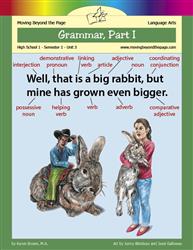
Unit 3: Grammar, Part I
Lesson 1
Parts of Speech
Students identify and label prepositional phrases ("A preposition is always followed by its object, which is a noun or pronoun. Together they form a prepositional phrase") and verb phrases (discussion of helping/auxiliary verbs and a "verb phrase"). The lesson asks students to supply and recognize participle forms (present/past/past participle) in the "Verb Adventure" activity and to recognize that phrases can act as adverbs (example: "in the corner" functions as an adverb). Students also identify relative pronouns and subordinating conjunctions and complete exercises that circle or label conjunctions and relative pronouns (e.g., "The student who answered...").
Lesson 2
Subject-Verb Agreement
Students are taught to recognize and ignore prepositional phrases when matching subjects and verbs, with explicit instructions to cross out intervening prepositional phrases and a Part I exercise focused on that skill. The lesson explains adjective (relative) clauses beginning with who/that/which and models covering them to isolate the subject, including a worked example (A babysitter who is patient ... deserves). Students practice subject-verb agreement across exercises that target indefinite pronouns and compound subjects, reinforcing how certain clause and phrase types affect agreement.
Lesson 4
Commas
Students are taught to set off introductory participial and prepositional phrases with commas (e.g., "Sensing that she was going to win, Jan began clapping her hands") and practice inserting commas after introductory dependent clauses ("When we arrived at the mall, my brother realized..."). Students practice joining independent clauses using a comma + FANBOYS in the "Separating a Compound Sentence" section and complete exercises that require rewriting sentences with correct punctuation. Students identify and punctuate nonessential relative clauses and appositives (e.g., distinguishing "The player who scored..." vs. "Liz, who scored...") and are asked to write pairs of sentences showing a clause used both essentially and nonessentially.
Lesson 6
Colons and Semicolons
The lesson explicitly teaches that semicolons join two closely related independent clauses and gives the formula independent clause + semicolon + conjunctive adverb + comma + independent clause; students practice this in semicolon exercises and must produce example sentences. The lesson also teaches that a colon must follow a complete sentence and is used to introduce lists or quotations; students complete colon activity pages and write examples. The Great Punctuation Trial requires students to write opening statements that include an example joining two independent clauses, an example with a conjunctive adverb + comma, and an example using complex lists.
Final Project
Wrapping Up
Students take a unit test that asks them to identify parts of speech (e.g., which is not an adverb) and to choose correct punctuation for nonessential information, which reflects awareness of clauses set off in sentences. Students answer a short-answer item asking them to describe uses of semicolons to join independent clauses. Part IV requires students to insert punctuation into complex sentences (including a participial opener and items that create clause boundaries), so students practice working with clause and phrase boundaries in context.

Unit 5: Nonfiction
Semester Exam
Semester Exam
Students are asked to write a sentence that contains an adjective phrase and an adverb phrase and to identify each, giving explicit practice with adjectival and adverbial phrases. Students are asked to write a sentence containing a nonessential appositive, which gives practice with a noun phrase functioning as an appositive. Grammar correction items ask students to fix pronoun case and subject-verb agreement and to correct comma placement, providing practice with basic phrase-level and clause-level mechanics.
2: Semester 2
Unit 2: Grammar, Part II
Lesson 1
Review of Grammar, Part I
Students identify and match grammatical items such as appositives, coordinate adjectives, indefinite pronouns, transitive and intransitive verbs, subordinating and coordinating conjunctions, and conjunctive adverbs in the Grammar Matching activity. In the Mad-Libs activity students supply parts of speech (adverb, coordinating adjectives, intensifier, noun, preposition, subordinating conjunction, conjunctive adverb, etc.) and then place those words into a written paragraph. In the Punctuation and Grammar tasks students edit and create paragraphs that involve sentence-level structures and clause-marking devices (commas, semicolons, subordinating conjunction examples are provided).
Lesson 3
Sentence Fragments and Run-on Sentences
Students receive explicit instruction and practice on verbals and verbal phrases: gerunds, participles, and infinitives (including gerund phrases, participial phrases, and infinitive phrases) with examples and activity pages that ask them to underline and identify these phrases and their functions. The Parent Plan and lesson text explicitly list the use of various types of phrases and clauses as a targeted skill, and activities require students to identify independent and dependent clauses in the context of sentence fragments and run-on errors. Students complete exercises that ask them to identify participles and draw arrows to the nouns they modify, underline gerund and infinitive phrases, and label infinitive phrase functions as noun/adjective/adverb.
Lesson 4
Modifier Errors
The lesson defines a modifier as a word, phrase, or clause and explicitly teaches participial phrases, noting that participial phrases must come right before or right after the noun they modify. In Activity 2, students rewrite sentences to correct misplaced and dangling modifiers and check answers against an answer key. Homework and Option 2 require students to attend to misplaced adverbs (limiting modifiers) and create a quiz that includes at least one misplaced adverb error.
Lesson 5
Hyphens and Apostrophes
Students read explicit instruction about compound adjectives and when to hyphenate them (e.g., rules for hyphen use before nouns, suspended hyphens, and examples like "two-hundred-year-old artifacts"). Students complete activity pages that require them to identify meaning changes with hyphenated vs. non-hyphenated modifiers and to rewrite sentences with correct hyphenation (Part 1 and Part 2 of the Hyphens activity). Students also practice applying punctuation to modify meaning (en dashes for ranges, em dashes for emphasis) which involves recognizing how modifier punctuation affects sentence clarity.
Lesson 6
Word Choice
Students study restrictive vs. nonrestrictive (essential vs. nonessential) clauses in Activity 2, compare example sentences (The player who scores... vs. Maria, who scored...), and practice when to use that vs. which and who/whom; they are directed to take a quiz to check understanding. Students practice punctuation for setting off nonrestrictive/parenthetical elements and complete exercises that require recognizing and correcting redundant adverbs/adjectives (Activity 3) and rewriting wordy sentences to use stronger, more concise wording (Activity 4). Students also act as editors in the College Essay Editor task, where they identify vague language, clichéd phrases, weak verbs, and revise sentences to be more specific and direct.
Lesson 7
Verb Voice and Mood
Students are shown that passive constructions often include a prepositional "by" phrase (e.g., "The ball was caught by the girl") and are given practice converting passive sentences to active ones via an online revising-passive exercise. Students encounter and create examples of different clause types in mood instruction (e.g., the adverbial/conditional clause "If I were rich" and the noun/subjunctive clause "I suggest that he cook extra spaghetti"). Students are asked to produce examples and explanations of the subjunctive mood for a younger audience, which requires them to use clauses showing mood distinctions.
Lesson 8
Parallelism
The lesson explicitly teaches parallelism using the example sentence that contrasts gerunds (going, skateboarding) with an infinitive (to read), and it asks students to rewrite for parallel form. Student activity pages require students to take notes on how "words, phrases, and clauses joined by coordinating conjunctions should be parallel," list coordinating and correlative conjunctions, and address consistency of voice in sentences with more than one clause. The Parallelism activity directs students to an online module and provides guided prompts for describing parallelism problems in lists, comparisons, and elements joined by linking verbs.
Final Project
Wrapping Up
Students answer assessment items that identify and distinguish participial phrases and gerunds (e.g., the multiple-choice item asking whether "Running down the hill" is a participial phrase and the question about how gerunds function). Students revise sentences for passive/active voice and correct misplaced or dangling modifiers, as indicated by test rewriting items and the skills list that names placing phrases and clauses within a sentence. Mini-project and explanatory-guide choices ask students to explain grammar topics such as when to use "that" vs. "which," which requires understanding relative clauses and clause choice.

Unit 3: Informational Texts
Final Project
Argumentative Research Essay
The skills section directs students to "Vary sentence patterns for meaning, reader/listener interest, and style" and to "Use varied transitions and sentence structures to link the major sections of the text." The rubric and homework repeatedly ask students to attend to sentence structure and to proofread for grammar/mechanics (subject-verb agreement, fragments/run-ons, modifier errors). The presentation guidance also instructs students to shorten long sentences and adapt complex sentences for an oral audience.

Unit 4: Drama
Semester Exam
Semester Exam
Students are asked to write a sentence containing a participle or participial phrase and to underline it in Part V: Grammar and Usage. The Studying section explicitly tells students to review "what the various types of verbals and verbal phrases are" and to skim lessons explaining verbals, modifier errors, and related grammar topics. Other tasks require students to correct a relative/ restrictive clause use ("The car which is parked...") and to compare active and passive voice, which involve clause- and phrase-level sentence changes.