


Ninth Grade - ELA
1: Semester 1

Unit 1: Lord of the Flies
Lesson 3
Paths in the Jungle
Students read and annotate a linked article ('Why Is Dystopia So Appealing to Young Adults?'), identify the author's thesis and supporting points, and record their reactions on a graphic organizer. The lesson offers an optional second web source ('The Rising Popularity of Dystopian Literature') for students to consult for additional input. Students are prompted to use their annotations and the completed organizer to form and explain their own opinion about why dystopian books are appealing.
Lesson 10
Which Is Better?
Students are asked to "consider what you have learned about early civilizations in history classes" and to complete a "Developing Civilization" chart comparing the boys to early peoples, which prompts them to gather and apply background knowledge. The lesson provides an external source (a Crash Course World History video link) for students who need more information on what makes a civilization. Students are directed to write a one-page journal entry analyzing leadership and contrasts between Jack, Ralph, and pre-island civilized life, which asks them to integrate textual evidence with contextual knowledge.
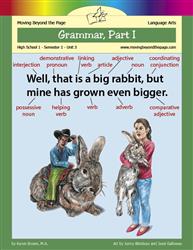
Unit 3: Grammar, Part I
Lesson 3
Pronoun Problems
Activity 2 asks students to read the lesson and specified pages in The Only Grammar Book and (optionally) online sources, then teach the chosen topic (vague pronoun references or shifts in point of view) using a poster or short slideshow. Students must explain the topic in their own words, provide two example sentences with errors, and show strategies and corrected versions. The lesson provides web links and asks students to use the book, lesson, or online sources as reference material.
Final Project
Wrapping Up
Students are asked in Option 1 to "use the information in the book, the lessons of this unit, or other resources to find the tips you want to include," which requires them to consult multiple resources. The Parent Plan and project directions point students to online resources and tools for creating a visual aid, and Option 2 directs students to refer to their "Commonly Confused Words" pages as they create a quiz. The unit also instructs students to produce a finished product (visual aid or quiz) and to publish or present it, implying use of external sources and technology.

Unit 4: Poetry
Lesson 1
Introduction to Poetry
Students generate a self-originated definition of poetry through a timed freewrite and then read a collection of poets' quotations on the "What Is Poetry" page to compare and revise their definition. Students are directed to look up the word "poetry" in a dictionary or online encyclopedia and to record denotations on the Denotation and Connotation activity page. Students retrieve and print a poem from an external source (Poetry Foundation), annotate the text for important words/phrases, and answer guided questions that require drawing on the poem and poets' quotations.
Lesson 5
What Does It Mean?
Students are asked to research and identify allusions in the poem "Old Christmas Morning," using the provided background paragraph about Appalachian Old Christmas and a web link to the poem. Students are instructed to look up unfamiliar words and use online links for poems (e.g., Whitman, Blake, Bishop) as part of homework and in-class activities. The activity pages prompt students to record answers from their investigation (e.g., what Old Christmas is, what elder bushes refer to), indicating students use sources to answer comprehension questions.
Lesson 6
Fooling with Words
Students choose a poet from the video and are assigned to "research your poet online" for homework. Students complete a structured Poet Profile worksheet that prompts them to record biographical details (where the poet is from, age, current work), publications/awards, favorite and additional poems, and a personal reflection about why they chose the poet. Students are given starter web links (Poetry Foundation, Poets.org) and timestamps to revisit specific poets in the video.
Lesson 8
Types of Poems
Students are asked to locate and study images of artworks (e.g., find a reliable image of Brueghel's The Kermesse or a Grecian urn) and then synthesize those visual sources with the poems by completing an ekphrasis analysis chart. Students read and view multiple sources (poems, audio recordings, and videos such as Billy Collins's reading and animated interpretations of Whitman) and answer comparative questions about interpretations and devices. Students are directed to combine information from the poem and the artwork and to "synthesize your findings with your understanding of the poem," which requires integrating at least two different source types.
Lesson 10
Poems and Poets
Students are assigned homework to research the poet they chose using the Poet Biography Boxes and provided web links (Poetry Foundation, Poets.org) and to record biographical details, influences, and interesting facts. Students must prepare a one-page biographical presentation about a world poet that includes country, language, dates, and cultural factors, demonstrating more sustained research. Students are asked in Activity 4 to research references in a poem, use biographical information, and write a journal response summarizing the poem and explaining how cultural references enrich it.
Lesson 11
Reciting Poetry
Students read at least 10 poems from the Poetry Out Loud site to select a poem, and they are instructed to print copies and choose one they relate to. Students watch multiple recitation videos and read a "Tips on Reciting" page, and they take journal notes on what makes each performance effective. Students look up unfamiliar words and pronunciations and analyze speaker, tone, and imagery as they prepare and mark the poem for recitation.
Final Project
Poetry
Students are asked to read multiple sources and form an evidence-based argument in Choice 7: they read Dylan lyrics plus two linked opinion articles and then write a one-page response considering both sides and citing sources. In Choice 3 (ekphrastic poem) and Choice 5 (poetry explication) students are directed to consult external examples and a how-to resource, take notes, and use those materials to create a final product. Several choices require students to gather and incorporate digital or print materials (artwork, recordings, animator interpretations) into their projects and presentations.
Unit 5: Nonfiction
Lesson 1
Types of Nonfiction
Students complete the "All About a Person" activity in which they examine a book's catalog record, front matter, and back matter to decide whether it is a biography, autobiography, or memoir and must "support your comparison with specific examples." Students read an interview with Patricia McCormick and are asked to consider and write about McCormick's role in writing I Am Malala, linking the interview with the book. In Activity 2 students read a Guardian article about genre categories and write a short response, engaging with multiple texts and perspectives.
Lesson 2
Pakistan
Students are directed to use I Am Malala, the book's timeline, and two web links (Wikipedia and a languages page) to answer a set of guided questions on the Student Activity Page about Pakistan. The activity asks students to gather facts (e.g., ancient civilization, date of creation, capital, languages, geography, wars) from multiple sources and the wrap-up asks students to report what they learned in their research. The Parent Plan answer key and directions explicitly link specific questions to sections of the timeline and web pages, prompting students to consult and combine those sources.
Lesson 3
The Taliban
The Parent Plan skills explicitly include "Conduct short as well as more sustained research projects based on focused questions, demonstrating understanding of the subject under investigation." Option 1 directs students to consult the provided PBS webpage (and any other sites) to gather answers and then write an informational paragraph in their own words, which requires collecting and summarizing information. Option 2 asks students to create slides using images and text from the suggested webpage and other internet sources, noting image sources, which requires students to gather and combine information from multiple media into a single product.
Lesson 5
Displacement
The activity directs students to choose pictures of schools and "do some brief research about school conditions and educational opportunities in that city or country," even suggesting search terms like "education + [country name]." The student activity page and parent notes explicitly instruct students to "Research a school in another part of the world. Use library resources and conduct interviews if possible," and Option 2 asks students to use an article and other online sources to assemble a mini-book. The Parent Plan Skills section lists conducting short as well as more sustained research projects based on focused questions as a targeted skill.
Lesson 7
Life in England
Students watch an 11-minute documentary and are instructed to take notes and compare the filmmaker's account with Malala's memoir, answering specific comparison questions about portrayals and focus. The lesson prompts students to analyze which details each medium emphasizes and to evaluate how the film and book differ in portraying Malala and her family. The Parent Plan explicitly lists skills to "analyze various accounts" and to "integrate and evaluate content presented in diverse media," which students practice by comparing the two sources and discussing their observations.
Lesson 8
Civil Rights
Students use multiple external sources (PBS Freedom Riders videos, texts of Douglass, Hughes, Angelou, and King's "Letter from Birmingham Jail") to gather information. The "Civil Rights Overview" timeline activity and the African-American Authors activity require students to read sources and organize or summarize information (cutting/pasting timeline excerpts; matching authors and writing sentences). The "People of the Past" activity explicitly offers an Option 2 in which students must supply their own information through brief research.
Lesson 9
Civil Disobedience
Students read and analyze primary-source excerpts from Thoreau and Martin Luther King Jr. in the "MLK and 'Civil Disobedience'" and "Passages" activities, marking similar phrases and filling an "Overlapping Ideas" column to synthesize ideas across texts. In the "Opposing Quotes" activity, students compare sets of assertions on America, the role of government, and voting, decide which author they agree with, and explain how their views align. Homework requires students to read additional "Civil Disobedience" excerpts and answer questions that draw on those texts.
Lesson 10
Learning from the Past
Students are asked to read Elie Wiesel's speech and to "skim Wiesel's speech and look for a statement that is a universal truth," then "draft a paragraph" comparing that statement with one or two other human-rights advocates (Malala, MLK, or Thoreau) and to "use a quote from each person you mention." Activity 4 asks students to create a model museum wall that draws on the work and progress of multiple activists (Wiesel, Malala, MLK, Thoreau), requiring students to select images and write formal descriptions linking the figures. The lesson provides primary sources and multimedia links (Wiesel lecture, Wiesel Foundation, MLK video) for students to consult while completing these comparative and synthesis tasks.
Lesson 13
Child Soldier
Students complete the "Different Accounts" activity by filling in book and video columns after watching a six-minute interview, explicitly comparing and synthesizing what the book says with what Beah says in the video. The "Child Soldiers" homework asks students to use what they have read in the book, what Beah said in the video, and their own thoughts to record advantages and disadvantages from a commander's point of view, prompting students to combine multiple sources. The journal prompt about the memoir controversy asks students to weigh two viewpoints and write a response, requiring them to integrate information and reason about accuracy and perspective.
Lesson 14
Rehabilitation
Students analyze and cite specific passages from A Long Way Gone to decide whether the government army committed war crimes (Activity 1, Options 1 and 2), and they are asked to provide examples or quotations from the text to support conclusions. Students re-watch a short author video and choose an Elie Wiesel quotation, then explain how that quotation relates to Beah's memoir using evidence from both the book and the video (Wiesel's Words activity).
Lesson 15
A New Life
Students are asked to review linked organization websites (Malala Fund and Human Rights Watch) and use information and images from those sites to create a flyer or a webpage, which requires gathering and using online source material. The Comparing Memoirs activity directs students to analyze and answer questions about both I Am Malala and A Long Way Gone, requiring students to draw evidence from and synthesize information across the two texts. The Parent Plan also lists using technology to produce and publish writing products, indicating students will compile information into a published product.
Final Project
Expository Essay
The lesson requires students to choose or generate a research question and use a "What's My Question?" activity and K-N-S chart to narrow a broad topic into a specific question. Students are directed to gather information from multiple credible sources (at least three key facts backed by researched sources), evaluate source credibility (.edu, .gov, reputable news), and use quoting, paraphrasing, and summarizing to incorporate evidence. Students must synthesize those facts into a thesis and three body paragraphs, provide in-text citations, and produce a Works Cited page in proper format.
Semester Exam
Semester Exam
Students are asked in Part IV, prompt E to "use essays, speeches, and other texts from the Nonfiction unit" to discuss the importance of writing about the horrors of war, which requires combining information from multiple unit sources. The Parent Plan skills list explicitly states students should "draw evidence from literary or informational texts to support analysis, reflection, and research" and to "write routinely over extended time frames (time for research, reflection, and revision)." The exam prompts (e.g., comparing authors, explaining relationships among nonfiction authors, and the informative essay referenced) require students to refer to and synthesize information from multiple texts they studied this semester.
2: Semester 2

Unit 1: Ender's Game
Lesson 1
Born to Genius
Students are asked to read pp. xi-xiii of the author's introduction and use Internet search tools to fill out the "About the Author" activity page. The activity directs students to find three historical facts from 1957–1963, describe author influences (e.g., Isaac Asimov), and identify sources of Card's ideas about war and genres he worked in. The parent notes reiterate that students will use the introduction plus online research to answer these five focused questions.
Lesson 2
We're People, Not Thirds
The lesson explicitly tells students in Activity 2, Option 2 to "research eugenics and record ten facts you learned." The Planned Procreation activity instructs students they can "browse the Internet" using suggested search terms (e.g., "procreation" or "childbearing") to gather ideas for the four-category worksheet. The Parent Plan also states students will "briefly researching historic reasons" for child‑limiting policies and record facts on the activity sheet.
Lesson 3
Science Fiction
Students read the introductory text and an external article (the provided web link) and were instructed to use both sources to fill out a graphic organizer about the science fiction genre. Students completed activity pages that ask them to define science fiction, list common themes, name historical eras and authors, and classify examples as hard or soft science fiction, which requires integrating information from the introduction and the article. The Parent Plan notes students "read an article to learn about the genre of science fiction and then filled out an organizer," indicating they synthesize at least two informational inputs to demonstrate understanding.
Lesson 7
Leaders Motivate
Students are directed to "Read about John Locke and Demosthenes (using the following resources or other reference material) and watch the short presentation on Demosthenes," with four explicit web resources provided. Students are then asked to "Reflect on the reasons Peter feels that he needs Valentine to help him write under the name 'Locke'... Write a journal entry describing the links between the two sets of personalities," which requires using and combining information from those sources. The activity asks students to apply quotations to novel characters and complete a chart explaining why they matched a quote to a character, requiring synthesis of text-based evidence with external source material.
Lesson 8
Flies and Self-Loathing
The logo design activity tells students they "could research the symbolism or significance of the animals in cultures around the world," which prompts targeted background research to inform a creative product. The Lord of the Flies vs. Ender's Game activity asks students to compare and contrast settings, leadership, themes, fears, responsibilities, and consequences across the two novels, requiring students to synthesize information from both texts. The graphic organizer and discussion prompts require students to bring together material from multiple literary sources to demonstrate understanding of themes and leadership.
Lesson 12
Campbell's Comparisons
Students watch a video that summarizes Joseph Campbell's 12-step "hero's journey" and record the steps in their journals. Students choose six steps and use a graphic organizer to describe parallels between those steps and events in Ender's Game, explicitly comparing the framework (video/summarized theory) with the novel. Students are assigned a Forbes article to read for a later activity, providing an additional text students will use in forthcoming work.
Final Project
Think-Tac-Toe
Students are explicitly asked in Box 8 (Historical References) to "look up NATO and the Warsaw Pact," to color and sort countries based on that research, and to write in their journal two key similarities and two key differences between the historical Warsaw Pact and the fictional Second Warsaw Pact. The prompt also asks students to explain "Why might the author have used this historical reference?", which requires drawing connections between historical sources and the novel.
Unit 2: Grammar, Part II
Lesson 7
Verb Voice and Mood
The lesson asks students to create a sustained subjunctive-mood project (poster, slideshow, comic, or card game) and to finish it for homework, which requires producing an extended product. The student-facing text provides web links (Carson-Newman, Grammarly) and explicitly says students may refer to them for explanations and examples. The project rubric requires that students "clearly show what the subjunctive mood is using definitions, examples, and/or context" and provide "useful strategies/techniques," which implies gathering information to support the presentation.
Final Project
Wrapping Up
Students are asked to create multi-part mini-projects (slideshow, poster, explanatory guide, song/rap/skit) that require planning content, defining terms, and providing examples. The Explanatory Guide option explicitly allows students to "consult outside sources as needed" and instructs them to give credit when quoting those sources. The Parent Plan and skills list also direct students to use technology and the Internet to produce and publish work, and the rubric requires that work "demonstrates that the student understands the topic."

Unit 3: Informational Texts
Lesson 3
The Matthew Effect
Students are asked in Activity 2 to brainstorm factors affecting athletic success and are told they 'may want to look online at the biographies of a few of your favorite players,' which directs them to consult external sources. Option 2 asks students to read a paragraph about the TIMSS study and create a graphic that communicates study findings, requiring them to interpret and represent informational content. The Parent Plan also notes writing over extended time frames 'time for research, reflection, and revision,' implying opportunities for research-related work.
Lesson 5
Harlan, Kentucky
Students are asked to do brief research about who first lived in or settled their area (suggested search: "[city] settlers"), take notes on what they find, and share findings with their family. The homework directs students to compare stereotypes about their area with their research and personal observations and to write an informal journal reflection. The skills list explicitly includes "Draw evidence from literary or informational texts to support analysis, reflection, and research" and "Consult general and specialized reference materials."
Lesson 6
The Ethnic Theory of Plane Crashes
Students read Chapter 7 of Outliers, an assigned critical blog post, and (optionally) Gladwell's response, and they are asked to identify the blog author's main objections and evaluate Gladwell's replies. Activity 5 Option 2 asks students to complete a chart that records each criticism, how Gladwell responds, and whether the response is effective, requiring students to compare and synthesize information across those sources. The lesson's skills list also asks students to come to discussions prepared and to refer to evidence from texts and other research when discussing the topic.
Lesson 7
Rice Paddies and Math Tests
Students are asked to complete a two-day mini-project (start Day 1, finish Day 2) creating a diagram or infographic that explains a concept from the reading, which requires gathering and organizing information. The homework explicitly allows students to use other sources in addition to the book and instructs them to give credit to any outside sources they use. The lesson also asks students to watch and take notes from videos (Counting to 100 in Chinese and Learn Numbers 1-10) as source material for activities.
Lesson 9
Writing about History
Students read multiple secondary-source summaries and three linked web articles and answered guided questions that required them to identify facts all sources agreed on. Students analyzed primary-source testimonies (Smith, Brent, Chivington) and completed a graphic organizer matching secondary-source claims to supporting primary-source excerpts. Students read a research article ("The Search for the Site of the Sand Creek Massacre") and answered questions about organization and types of primary evidence, and they wrote an editorial or produced a split-perspective magazine cover using facts from the sources.
Lesson 11
Technical Writing
Students select a self-generated topic and spend three days producing, revising, and testing a how-to guide, indicating a sustained project. Students are instructed to find information online to back up the introduction, to record the source, to include a quotation or statistic, and to add a "Works Cited" section; the Guide Checklist explicitly requires that the benefit be supported by an outside source and that a Works Cited section is included. Students also perform a real-world test of their product by having another person follow the guide and then revise based on feedback, which involves using research/evidence to improve the product.
Lesson 12
Logical Fallacies
Students are asked to look up two fallacies online (hasty generalization and false dilemma) and record their meanings on the "Focus on the Foundation" activity page, which requires short research. Students read and analyze multiple source types: four short videos (Critical Thinking Parts 1–4) and a primary-source speech by Andrew Jackson via a provided link, highlighting and identifying fallacies. The lesson asks students to complete activity pages that require extracting information from these sources (fill-in-the-blank, matching Fallacy Bank examples, and identifying appeals in Lou Gehrig's speech).
Final Project
Argumentative Research Essay
Students generate a self-selected research question and narrow it into a thesis and counterargument (Part 1 and Part 6). They locate at least five high-quality sources, beginning with library research databases, and collect facts, statistics, and examples from those sources (Part 3 and Part 4). Students evaluate online sources for credibility and content, take notes linking evidence to sources, and use the "Present the Evidence" activity to form a working thesis from multiple sources (Part 5 and Part 6). They produce a Works Cited page in MLA format and are required to use in-text citations as they integrate source material into their essay (Part 10 and Part 7).

Unit 4: Drama
Lesson 5
Act II
Students are asked to look up vocabulary in a dictionary and revise their context-based definitions, which requires consulting reference materials. For homework, students must listen to Johnny Cash's recording and choose three additional songs from provided links, record each song's title and year, and explain what each song says about the American Dream. Students also read excerpts from Hansberry's To Be Young, Gifted and Black and answer analytical questions about those excerpts.
Lesson 7
Fences
Students watch the movie Fences, read/recall A Raisin in the Sun, and view an interview with Denzel Washington and Viola Davis, giving them at least three distinct source types to consider. Students complete a comparison chart requiring them to analyze and compare theme, characters (including specific pairings like Walter and Troy), plot, and setting across the two works. Students write short reflective paragraphs (e.g., three insights from the interview and a paragraph about what they learned) that require integrating observations from the film, play, and interview.
Lesson 8
Shakespeare
Students are assigned homework to use their book, a video, and other web resources to create a timeline of Shakespeare's life, and the lesson provides specific web links and a Timeline activity page. Students are instructed to look up and include particular biographical dates and events, cut out boxes, and glue them in order on the timeline. The task requires students to gather information from multiple sources (book, video, websites) and place events in chronological order, which asks them to combine information from those sources.
Lesson 9
Romeo and Juliet
Students read Act I of Romeo and Juliet and answer scene-by-scene comprehension questions and journal summaries, which requires using the play as a primary source. Students watch a video of the Globe Theatre and take a virtual tour, then answer guided discussion questions about challenges of performing there, showing use of multimedia sources. Students read an external article on Renaissance weddings and dowries and respond to specific journal prompts about historical practices, connecting that source to the play's marriage context.
Lesson 14
Modern Retelling
Students watch two distinct productions (Luhrmann's 1996 film and a Globe Theatre performance) and take structured notes on a "Two Versions" comparison chart that asks them to record character portrayals, major changes, use of setting, and use of color. Students choose three specific areas to investigate, create a thesis comparing the two productions, and write an informal three-paragraph analysis using the APE method (answer, prove with specific examples from both productions, and extend). The assignment requires students to synthesize examples from both productions to explain the significance or effect of differences.
Final Project
Drama
Students are instructed to "research costumes from the Renaissance era" and to "use information from your research" to create costume designs, with web links provided for sources. Several project choices (costumes, set design, news, playlist) require students to gather information or images from outside sources and to include parenthetical references and a Works Cited page. The Set Design task asks students to read scenes and answer focused questions (Where is the scene? What mood? What time period?), guiding students to use textual evidence to inform design choices. The project rubric includes a "Sources" category evaluating use of resources, citing, and research.
Semester Exam
Semester Exam
Students answer items that ask them to evaluate source credibility (Discussion prompt B) and to distinguish primary and secondary sources (a short-answer question and the provided answer key). Students also analyze the rhetorical and evidentiary features of Gladwell's Outliers (Discussion prompt F) and are asked to draw evidence from texts for analysis and research in the Parent Plan skills list.