


Sixth Grade - MATH
5: Math
Unit 3: Ratios and Percentages
Lesson 3
Equivalent Ratios
Students evaluate a whole-number exponent in the Basic Skills Review (Question 2 asks to compute 6^4 with the answer key showing 1,296). Students set up and solve expressions with a variable when using tape diagrams (answer key shows 4x + 3x = 91 and solves for x). Students use tables and graphs to find corresponding values for proportional relationships (e.g., fill table entries and determine how long to print 16 key chains or how many lemons for 4 pitchers), which requires computing outputs for given inputs.
Lesson 6
Percentage Problems
Students translate percentage word sentences into number sentences using a variable (n) and the formula part = percent × whole. Students set up and compute expressions such as 32 = 0.64x leading to x = 50, n = 6/100 × 150 = 9 (sales tax), and other percent-of problems. Students solve real-world percent problems (discounts, tax, test scores, attendance) by evaluating the numeric expressions that arise from those formulas.
Lesson 8
Unit 3 Test
Students translate word sentences into number sentences and evaluate expressions such as n = 28% × 200 (finding 56), 17 = 85% × n (solving for n), and 37 = n% × 50 (finding the percent). Students compute unit rates and unit prices by substituting numbers into expressions and carrying out arithmetic (for example, 5.16 ÷ 4 = 1.29 and 19 ÷ 2 = 9.5). The practice problems require forming and evaluating simple algebraic expressions that arise from real-world contexts like percentages, rates, and unit conversions.
Final Project
What's the Best Buy?
Students set up and evaluate numeric expressions when finding unit price by dividing total price by number of units (e.g., $3.38 ÷ 13 = $0.26/oz). Students evaluate percent expressions in the coupon activity by computing 10/100 × (weekly cost) to find savings (example: 10/100 × $200 = $20). Students also substitute numeric values to scale recipes and distances (doubling/tripling ingredient ratios; 1 mile/6 minutes scaled to 6 miles/36 minutes) and compute products when converting units (e.g., 12 × 8 = 96 fl oz).
Unit 4: Algebraic Expressions
Lesson 1
Introduction to Algebra
Students evaluate expressions with specific variable values in multiple places: Cassandra uses A = s^2 with s = 3 and s = 4 to find areas, and the Using Exponents activity asks for the volume V = s^3 when s = 5. Students compute numerical exponential expressions (e.g., 10^2 × 2^3, (1/3)^2 + (1/2)^3, (2.1)^2 − (0.4)^2) and solve order-of-operations problems that include exponents (e.g., 8 × 3^2 + 6 ÷ (4 − 2)). Real-world/formula contexts appear in problems about a square patio, cube volume, poster areas, and Jackson's batting time (20n) with specific n values.
Lesson 3
Working With Expressions
Students practice evaluating expressions by substituting specific values for variables in Activity 3 (e.g., n + 6 with n = 4; 5 + 4y with y = 6 and y = 8). They apply the order of operations explicitly (PEMDAS) when evaluating expressions and work with whole-number exponents in examples such as (n - 3)^2 + 4 and a^2 - 2. The student activity pages include real-world formula-style expressions (Matt's pay 5 + 4y, Josie's earnings 3n) that students evaluate for given variable values.
Lesson 5
Equivalent Expressions
Students evaluate an expression with a given variable value in the Basic Skills Review (evaluate n - 14 when n = 25). Students practice order-of-operations problems with mixed operations and parentheses (e.g., 5 + 8 × 4 − (9 × 7 − 3) − 24). Students simplify and combine like terms, including terms that use whole-number exponents as part of variable expressions (e.g., 5m^2 + 8m^2).
Lesson 6
The Distributive Property
Students substitute given values for variables and evaluate expressions in multiple places (for example, evaluating 4n - 3 when n = 5 and evaluating x^2 + 3x + 12 when x = 2). Students use evaluation to prove equivalence of expressions by substituting the same number into both the original and simplified forms (e.g., 5(x+3)+2x-12 and 7x+3 evaluated at x=5). Students also form expressions from real-world contexts (Tessa's cost, Raoul's earnings, playground area 5(n+2)) and evaluate those expressions for specified variable values.
Lesson 7
Unit 4 Test
Students repeatedly evaluate expressions at given variable values (e.g., Section 4 asks students to evaluate expressions if x = 5; Problem 11 evaluates expressions if x = 2; other items evaluate with x = 3 and n = 5). Students evaluate exponential expressions (e.g., (3)^2, (0.2)^1, 4^3, 0^4, and other exponent problems) and evaluate combined expressions that require applying exponents and arithmetic (e.g., c·4^2 + 2^2, 8(x+5)-20-4x). Students also evaluate expressions that arise from real-world contexts and formulas by substituting numbers (e.g., Tasha's shells, Kelsey's cookies, Jeremiah's earnings, Alana's bead problem is evaluated at x = 10).
Final Project
Algebra Think-Tac-Toe
Students simplify and then evaluate expressions by substituting specific values in the "Prove It! Equivalencies" task (example: evaluating 6 + 4n at n = 2). Students create and evaluate exponential expressions in the "Exponent Matching" activity (e.g., (1/5)^3 = 1/125 and (1.2)^2 = 1.44). Students design a PEMDAS flyer, which requires them to apply and demonstrate the conventional order of operations when evaluating expressions. The parent/skills list and several activities (Make a Quiz, Create a GoFish! game) explicitly ask students to work with exponents, combine like terms, and evaluate numerical expressions at given values.
Unit 5: Algebraic Equations
Lesson 1
Algebraic Equations
Students repeatedly substitute given numeric values for variables and evaluate to see if equations are true (e.g., evaluate 2x + 12 = 18 for x = 2 and x = 3; substitute n = 8 and n = 6 into 36 - 4n = 12). Multiple student activity pages ask students to choose or write the value that makes an equation true and to evaluate expressions after substitution. The lesson explicitly tells students to apply the order of operations (PEMDAS) and includes problems with whole-number exponents and mixed operations (e.g., 3^2, 2^x * 3^2, and 3(4+9)-10+2*5).
Lesson 2
Solving One-Step Equations, Part 1
Students practice substituting numeric values for variables and evaluating the resulting expressions to check solutions (for example, evaluating n + 2 = 5 by substituting n = 3 and verifying 3 + 2 = 5, and checking 2x + 4 = x + 6 with x = 2 to get 8 = 8). Student activity pages explicitly ask students to evaluate expressions after solving equations (e.g., "Evaluate p + 3 = 8 if p = 5") and to check solutions for word-problem equations such as 16 + n = 72. Several practice problems require simplifying and evaluating linear expressions (for example, problems that involve combining terms and substituting numeric answers on the activity pages).
Lesson 3
Solving One-Step Equations, Part 2
Students substitute numeric values for variables to evaluate and check expressions (examples: Evaluate 2n = 8 if n = 4; 10/2 = 5; 6(3) = 18). Students write equations from real-world contexts (plant growth 5n = 40, Emma's plates, birdseed, canoeing, car washing) and then solve and evaluate the resulting expressions. Multiple activity pages require students to compute variable values and check their answers by substitution, reinforcing evaluation at specific variable values.
Lesson 4
Solving Two-Step Equations
Students practice substituting a found value into an expression to check solutions (e.g., substituting n = 3 into 2n + 5 = 11 and checking 6 + 5 = 11). Students evaluate expressions that arise from real-world word problems by writing equations from scenarios (snowfall, granola bars, pens, flour, cookies) and solving for the variable. Students work with numeric evaluations that include integers, decimals, and fractions when they check solutions (examples: 8n + 0.6 = 3 leading to n = 0.3; fraction examples showing arithmetic to verify results).
Lesson 5
Inequalities
Students substitute specific numbers for variables and evaluate the resulting expressions (for example, substituting x = 4 into 2x + 6 > 10 and simplifying to 14 > 10). Students practice checking candidate values for inequalities on worksheets (e.g., circling which of given numbers make p + 1 ≥ 5 or 2n ≥ 8 true). Students use guess-and-check to produce values that satisfy algebraic expressions (e.g., find valu<s for 2y + 4 < 20).
Lesson 6
Solving Inequalities
Students are instructed to use substitution to check solutions by selecting a value from the solution set and substituting it into the original inequality (multiple places in the activity instructions and Parent Plan). The student activity pages explicitly tell students to check their answer by choosing a value from the solution set and substituting it into the original inequality to show it is true. The Parent Plan skills list includes 'Use substitution to determine whether a given number in a specified set makes an inequality true.'
Lesson 7
Independent and Dependent Variables
Students repeatedly substitute numerical values into two-variable equations to find the other variable (e.g., 10x = y with x = 20 to get y = 200; 2x - 4 = y with y = 6 to find x = 5). Students translate real-world situations into linear formulas and evaluate them (Kevin earns $10/hour → 10x = y; Ron bikes 5 mph → 5x = y; recipe cookies → y = 15x) and use tables and graphs from those formulas. The Basic Skills Review asks students to evaluate an expression with a whole-number exponent (evaluate x^2 + 5x - 6 when x = 3), requiring exponent computation during evaluation.
Lesson 8
Unit 5 Test
Students create tables and compute values for linear expressions (for example, rewriting y + 5 - 2x = 6 to y = 2x + 1 and filling a table of x and y values). Students write equations from word problems and substitute specific numbers to find variable values (for example, daffodil/tulip problem, Jenna swimming, Dominic's weight). Students solve numeric equations that require evaluating expressions at given values (for example n/3 = 4, x + 3.8 = 9.2, 2(y + 1/2) = 13).
Final Project
All About Me
Students create and solve equations and inequalities that represent real-world personal facts (age, money, time, distance) and are asked to produce at least 5–7 equations and 4–6 inequalities. Students create and use a two-variable equation (example: 2x = y) and solve for one variable given a value of the other (e.g., find x when y = 4). Students are explicitly instructed to check solutions by plugging answers into the original equations or inequalities to verify accuracy.
Unit 6: 2D Geometry
Lesson 2
Working With Angles
Students write equations that represent angle relationships (e.g., n + 2n = 90 and 5n = n + 92) and solve those equations to find variable values. Students substitute the found values into expressions (for example, 5(23) = 115 and 2(30) = 60) to determine actual angle measures. Student activity pages require forming and evaluating linear expressions such as 2n - 10, n - 25, and 3n when n is solved.
Lesson 4
Area
Students apply area formulas (A = l × w, A = b × h, A = 1/2 × b × h) by substituting numeric measurements to compute areas in multiple real-world problems (e.g., pool: 52×40 − 6×6; sails: 1/2×18×8 and 1/2×15×6; paver problem using 24n = 4320). Students also set up and solve simple algebraic equations that arise from formulas (Omar's parallelogram 15×n = 75 and solve for n). The lesson repeatedly has students evaluate these formula-based expressions with given numeric values and perform the arithmetic to find areas and counts.
Lesson 5
Circles
Students substitute numeric values into the circle formulas C = πd, C = 2πr, and A = πr^2 and compute results in multiple activities (e.g., Activity 2 example: diameter 6 in → 3.14 × 6 = 18.84; Activity 4 example: radius 9 in → 9^2 = 81 then 3.14 × 81 = 254.34). Several real-world problems require evaluating formulas at given variable values (pool diameter 25 ft, rubber seal radius 2.5 in, tablecloth diameter 8 ft, rug radius 3 ft). Students perform arithmetic with decimals and a whole-number exponent (square the radius) and are instructed to include units in their answers.
Lesson 6
Scale Drawings
Students solve proportions to find actual measurements from scale drawings (for example, using 1 in : 5 ft to find a 6 in drawing corresponds to 30 ft and 4 in to 20 ft). Students compute perimeters and areas numerically (for example, A = 8 × 6 = 48 ft² and A = 16 × 12 = 192 ft²) and solve simple equations such as 28n = 56 to compare scale changes. Students calculate scale factors as ratios and convert them to percentages (examples show 3/1 → 300% and 1/4 → 25%) and use the square of the scale factor to determine how area changes.
Lesson 7
Unit 6 Test
Students compute numeric values from formulas in real-world contexts: they evaluate circle area A = πr^2 for a fire ring (diameter 4 ft → r = 2) and use circumference C = πd to find distances around rims. Students substitute given measurements into area formulas (triangle 1/2·b·h, parallelogram b·h, trapezoid decomposition) and compute numeric results for quilting, patio, and kite problems. Students calculate scale-factor effects on perimeter and area, explicitly squaring the scale factor to find area ratios and computing numeric scaled dimensions.
Final Project
Geometry Stations
Students are asked to 'apply area formulas in the context of solving real-world and mathematical problems' and to 'find the area of right triangles, other triangles, special quadrilaterals, and polygons' by decomposing shapes. The 'Real-Life Area Problem' activity has students create and solve area problems using models and drawings, which can involve using formulas and variables. The 'Ideas to Think About' prompt explicitly asks, 'What could a variable represent in a geometry problem?' and planning sheets prompt students to write problem text that could include formula-based tasks.
Unit 7: 3D Geometry
Lesson 1
Three-Dimensional Solids
Students write Euler's formula F + V - E = 2 and use a letter to represent an unknown (F) when given V and E. They substitute numeric values into the formula (F + 5 - 8 = 2), combine like terms (F - 3 = 2), and perform inverse operations to solve for F = 5. The activity asks students to record faces, vertices, and edges and to apply the formula to verify F + V - E = 2 for various solids.
Lesson 2
Surface Area
Students substitute numerical values into formulas such as SA = 6s^2 and compute results (examples show 6(3^2) = 54 and SA = 6(5^2) = 150). Students plug length, width, and height into the rectangular prism formula SA = 2LW + 2LH + 2WH and carry out the arithmetic (e.g., 2(10×6)+2(10×5)+2(6×5)=280). Students solve real-world tasks that require evaluating expressions from formulas, such as finding wrapping paper needed for a box (190 in.^2), painting a pyramid roof, and deciding if Carlotta has enough tape (150 in.^2).
Lesson 3
Volume
Students substitute numeric values (including fractions and decimals) into volume formulas and compute the result: Activity 2 has students convert mixed numbers to improper fractions and evaluate V = l × w × h for examples like 1 1/2 × 3/4 × 4 and the sugar-cube box (result 4 1/2 in^3). Activity 3 has students evaluate whole-number exponents by computing V = s^3 for s = 1 1/3 and other cube examples (e.g., 5^3 = 125). Multiple real-world word problems (Kayne's aquarium, mailing boxes, craft-cube boxes) require students to plug given dimensions into formulas and perform the arithmetic to find volumes.
Lesson 5
Problem Solving With Solids
Students substitute numeric values into geometric formulas and compute results in real-world contexts (e.g., Archie: V = 5 × 4 × 4 = 80 in^3, then 80 × 8 = 640 in^3). They evaluate cube volumes by repeated multiplication (Box A: V = 8 × 8 × 8 = 512; Bentley: V = 15 × 15 × 15 = 3,375) and use the surface-area formula with an exponent (SA = 6s2) to solve 864 = 6s2 and find s = 12. Students also set up and simplify expressions with variables in context (54 = L × 4 1/2 × 2 simplified to 54 = 9L and L = 6).
Lesson 6
Unit 7 Test
Students plug numeric values into geometric formulas such as V = s3 and SA = 6s2 (e.g., SA and volume calculations for cubes with s = 6 and s = 12). Students evaluate volumes using fractional edge lengths (e.g., V = 3/4 × 1/2 × 4 4/5 = 1 4/5) and compute surface area and paint requirements for a rectangular prism with fractional dimensions (Kareem problem). Real-world formula use appears in multiple tasks: determining cans of paint from surface area, finding prism length from base area and volume, and computing boxes covered by decorative paper (SA = 6s2 with s = 5).
Final Project
Building With Solids
Students choose three preprinted nets, measure side lengths (rounding to the nearest 1/2 unit), and use the provided formulas (for example V = s^3, V = l × w × h, V = B × h and SA = 2lw + 2lh + 2wh, 6s^2, area formulas for rectangles/triangles) to calculate surface area and volume. The activity pages and answer key show students evaluating those formulas with specific numeric values (e.g., 6(4^2) = 96, s^3 = 4^3 = 64, and calculations for triangular prism volume and surface area). Students apply these calculations in the context of a model-building project, using the formulas that arise from that real-world task.
Unit 8: Statistics
Lesson 2
Populations and Samples
Students evaluate algebraic expressions by substituting numeric values for variables (Basic Skills Review Problem 1 asks: What is the value of 4n + 12 if n = 5?). Students compute whole-number exponents (Problem 8: evaluate 2^4) and evaluate formulas from real-world contexts by substituting given measurements (Problem 5: circumference and area of a circle using r = 10; Problem 10: volume of a rectangular prism using given side lengths). Students perform arithmetic operations with negatives and multiplication in context (Problem 4 and the bubble-gum production Problem 9), requiring conventional order-of-operations to obtain correct results.
Lesson 8
Making Inferences
Students are asked to evaluate the expression 6p + 12 when p = 4 in the Basic Skills Review; the answer key shows the calculation 6(4) + 12 = 36. Students are also given a real-world formula context with a cube: 27 = s^3 is solved to find s = 3 and then SA = 6s^2 is evaluated as 6(3)^2 = 54 ft^2. The answer key explicitly shows substitution, use of whole-number exponents, and arithmetic carried out in the conventional order.
Lesson 9
Comparing Populations
Students compute means by adding data values and dividing by the sample size (e.g., 75 ÷ 10 = 7.5 and 96 ÷ 10 = 9). Students calculate mean absolute deviation by finding distances from the mean, summing them, and dividing by 10 (e.g., MAD = 10 ÷ 10 = 1.0). Students evaluate the expression (larger mean − smaller mean) ÷ (higher MAD) in context (e.g., (9.0 − 7.5) ÷ 1.2 = 1.25) to compare populations.
Unit 9: Skills Review
Lesson 2
Fractions, Ratios, and Coordinates
Students compute numeric results from real-world contexts that require evaluating arithmetic expressions: they multiply hours worked by an hourly rate to find Mario's earnings (10 1/8 × 16) and compute the area of a rug by multiplying length and width given as fractions (6 2/3 × 3 1/2). Students also divide to find unit amounts (1/2 ÷ 3 for trail mix, 310 ÷ 5 for train speed) and perform fraction arithmetic across several problems on the operations page. These activities require students to carry out arithmetic operations on given numeric values that arise in context.
Lesson 3
Expressions, Equations, and Percentages
Students evaluate numeric expressions at given variable values in Activity 1 Problem 3 (e.g., evaluate 32 - 3x, x/2 when x = 6, and 4(y - 3) + 3 when y = 3). Students write and evaluate a real-world expression in Activity 1 Problem 5 (write 9n + 3 for Marie's earnings and compute it for n = 7). The skills list explicitly includes "Evaluate expressions at specific values of their variables," indicating students are expected to practice this skill.
Lesson 4
Geometry
Students write and solve an equation with algebraic expressions (3n = 2n + 16) and then substitute n = 16 into the expressions 3n and 2n + 16 to find angle measures. Students evaluate area formulas at given numeric values, e.g., A = s^2 with s = 4 1/2 to compute the area of a square and A = πr^2 with r = 5 to compute circle area. Students also compute circumference C = 2πr for a given diameter/radius and complete practice on surface area and volume via the linked quiz to apply formulas to numeric values.
3: Math
Unit 1: Numbers
Lesson 4
Square and Cube Roots
Students compute squares, cubes, and roots of specific numbers (e.g., √9 = 3, ∛27 = 3) on the Student Activity Pages and in the calculator practice. Students evaluate numeric expressions that include exponents in real-world contexts (e.g., 5 × 4^4, 4 × (1.5^3), bacteria growth 3 × 2^4) and solve word problems that require taking square roots or cube roots to find dimensions. Students use a calculator to enter specific values for exponents and roots, and the Review Quiz asks them to simplify exponent expressions like 5^3 and (2^3)^2.
Lesson 5
Irrational Numbers
Students square numbers and decimals repeatedly in Activities 3, 6 and the approximating tasks (e.g., squaring guesses like 5.4^2 and 5.5^2 to narrow √30). The Review Quiz asks students to evaluate expressions with whole-number exponents and formulas (e.g., compute 5 × 2^n for n = 6, simplify (2)^4, simplify expressions involving powers, and find area using s^2 where s is given as an expression). Students also perform arithmetic with exponents combined with other operations (e.g., evaluating s = 3 × 2^2 then computing s^2), which requires applying the conventional order of operations.
Lesson 6
Scientific Notation
Students practice arithmetic with whole-number exponents in the context of scientific notation: they multiply and divide coefficients and add or subtract exponents (e.g., (3 × 10^4) × (6 × 10^3) and (6 × 10^8) ÷ (2 × 10^3)). Students solve many real-world word problems that use powers of ten (e.g., flow rates, grains of rice, distances) and perform the necessary arithmetic to produce numeric answers. Students also convert between standard form and scientific notation and use calculator scientific-notation mode to evaluate expressions involving powers of 10.
Lesson 7
Arctic Marine Research
Students evaluate exponential expressions in real-world contexts: they use N = 2^t to compute a bacterium population after 6 intervals and compare growth using 3^t after 4 intervals. Students compute 2^10 to find DNA strands after 10 replication cycles. These tasks require substituting specific values for variables and calculating whole-number exponents in applied scenarios.
Lesson 8
Unit 1 Test
Students simplify and evaluate many expressions with whole-number exponents (e.g., problems asking for 5^3 × 5^2, 4^5 ÷ 4^3, 4^-2, and 3^4 × 3^2). Students compute and interpret exponent-based growth in real contexts (e.g., a bacteria culture starting at 2^4 and doubling for additional hours results in evaluating 2^(4+3) = 128). Students perform arithmetic with powers of ten and scientific notation (e.g., convert 3.2 × 10^4 to standard form, multiply (2 × 10^2) × (3 × 10^5)).
Final Project
Mars Station Test Mission
Students convert the scientific notation expression 7 × 10^2 kWh to the decimal 700 kWh and use that value to compute how many fuel cells are needed. Students compute geometric expressions by evaluating whole-number exponents, e.g., calculating the area of a fuel cell from side length 4 ft as 4^2 = 16 ft^2 and multiplying by the number of cells to find total floor area (119 × 16 = 1,904 ft^2). Students evaluate distances given in square-root form to a numeric value (to the nearest hundredth) and then use those numeric distances in delivery cost calculations. Students substitute given numeric data into real-world formulas such as A = πr^2 for drop-zone area and provided energy/output formulas to calculate daily and yearly solar and wind energy outputs.
Unit 2: Proportions
Lesson 2
Unit Rates
Students substitute numeric measurements into area formulas (Rectangle: Area = Length × Width; Triangle: Area = 1/2 × Base × Height) in the Activity 4 bonus task and compute areas from measured values. Students compute unit rates arising from real-world formulas and measures (e.g., cost per square foot, miles per hour, folding rate) by carrying out numeric division and multiplication with given quantities. Students set up and evaluate numerical expressions when they divide area by a length to find area per inch and when they compute rates from recipe, speed, and wage formulas.
Lesson 3
Constant Rate
Students set up and evaluate linear expressions by substituting numeric values for variables in real-world formulas such as y = 60x (car distance) and y = 15x (printer), solving for y when x is given (e.g., y = 60 × 4 = 240). Students find constants of proportionality by computing k = y/x from tables and graphs and rewrite or isolate equations into the form y = kx (e.g., 4y = 8x → y = 2x) before substituting values. Multiple activities (Activity 5 and Activity 6) guide students through writing equations from word problems and evaluating them for specific inputs to produce numerical answers.
Lesson 4
Graphing Proportions
Students repeatedly substitute numeric x-values into equations of the form y = kx and compute resulting y-values (e.g., Jim's dog-walking table with y = 12x; Activity 3 example y = 4x where x = 1,2,3,4 and y is computed). Multiple activities ask students to build tables from given equations, evaluate the expressions for several x values, and plot the points (e.g., Graphing Equations, Graphing Scenarios, Day 2 and Day 3 problems). The Skills Review and later questions include tasks involving exponents and scientific notation (e.g., questions about scientific notation, exponent simplification, cube roots), showing some exposure to exponent notation and arithmetic with powers.
Lesson 5
Proportional Relationship Equations
Students substitute numbers into linear formulas and compute results in multiple places: e.g., they set t = 12n for movie tickets and fill tables, substitute 156 and 10 into 156 = 10m to solve for m, and use a = 20h with 100 = 20h to find h = 5. The Review Quiz and activity pages ask students to evaluate expressions such as y = 2.5x at x = 8, compute unit rates ((3/4) ÷ (1/2), (2/3) ÷ (1/4)), and calculate totals using formulas like d = 4.5t and t = 50 × n × 0.9. Students also practice substituting into real-world formulas for cost, distance, calories, and area and performing the resulting arithmetic with fractions and decimals.
Lesson 6
Taxes, Tips, and Commissions
Students repeatedly substitute numbers into real-world formulas and evaluate them: they compute sales tax by calculating Price × Tax Rate and then add that result to the original price (e.g., $15 × 0.07 = $1.05 → $15 + $1.05 = $16.05). They evaluate gratuity and commission expressions (Gratuity = Tip Percentage × Original Bill; Commission = Sales Amount × Commission Rate) with given numeric values and compute total earnings or totals. Students also set up and solve simple equations from those formulas to work backward (e.g., 1.08 × original price = $212.00 to find the pre-tax price).
Lesson 7
Markups and Discounts
Students compute discount and markup amounts by substituting numeric prices and percent-rate values into formulas such as Discount = Original Price × Discount Percentage and Markup = Cost Price × Markup Percentage. Students evaluate real-world formulas for final price (Final Price = Original Price − Discount) and percent change ((New − Original) ÷ Original × 100) with given numeric values in examples and practice problems. Students solve multi-step and backward problems that require evaluating numeric expressions (for example, x × 0.60 = 18 → x = 30 and x × 1.60 = 208 → x = 130).
Lesson 8
Simple Interest and Percent Error
Students substitute numeric values into the simple interest formula I = Prt to compute interest (e.g., I = 600 × 0.04 × 5 = $120) and then compute balances by adding principal and interest. Students solve for missing variables (r, t, P) by rearranging and evaluating expressions using division and multiplication (e.g., r = 250/5000). Students also evaluate the percent error expression by computing absolute differences, dividing by the actual value, and multiplying by 100 (e.g., (|30 − 25|/30) × 100 = 16.67%).
Lesson 9
Unit 2 Test
Students are asked to compute values from linear expressions and proportional equations (e.g., problems asking to graph y = 5x or y = 4x, identify constants of proportionality in y = 9x or y = 3.2x, and interpret points like (1,6)). Students evaluate numerical formulas in real-world contexts such as finding simple interest (e.g., $500 at 4% for 3 years) and solving for pre-tax price (e.g., 1.06p = 212). Multiple problems require students to calculate unit rates from given quantities and to compute percent increases, discounts, and final prices, which involve substituting numeric values and performing arithmetic operations.
Final Project
Lemonade Stand
Students write and use linear formulas (y = kx) to model recipe scaling and then evaluate those expressions for specific x-values (e.g., finding tablespoons for 16 cups). Students calculate unit prices and substitute numeric values into cost formulas (e.g., total cost = number of lemons × unit price + amount of sugar × price per pound) and compute cost per cup by evaluating the quotient (total cost ÷ 16). Students also evaluate selling-price expressions by substituting their computed unit price into markup formulas (selling price = unit price × 2, × 2.5, × 3) and apply percent multipliers for discounts, tax, and gratuity (e.g., price × 0.7 for a 30% discount).
Unit 3: Expressions
Lesson 2
Rewriting Expressions
Students repeatedly substitute numeric values into real-world formulas and compute results. For example, students evaluate Total Price = Original Price × (1 + Sales Tax Rate) with P = 40 and tax = 0.05 to get 40(1.05) = 42, and they use Discounted Price = Original Price × (1 − Discount Rate) with 80(1 − 0.25) = 60. Students also evaluate Selling Price = Wholesale Price × (1 + Markup Rate) and Total Cost = Fixed Cost + (Variable Cost × # of items) with given numbers (e.g., 25 + 3(5) = 40). Practice problems ask students to compute final prices, original prices, and totals by plugging numbers into these formulas.
Lesson 3
Algebraic Expressions
Students substitute numeric values into real-world formulas and compute results (e.g., P = 2(l + w) with l or w given; A = l × w; A = 1/2 × b × h). Students translate word problems into equations and evaluate them (e.g., 15 = 4p + 3 → 3 = p; s = 2(6 + 12) → s = 36). Students carry out arithmetic operations (addition, subtraction, multiplication, division) and use distribution when parentheses appear to evaluate expressions.
Lesson 4
Graphing Proportions
Students substitute specific x-values into equations such as y = 3x, y = 2x, and y = 1/2 x to fill tables and plot points (Activity 3). Students calculate unit rates from real-world examples (earnings $10 per hour, 120 miles in 3 hours, cost per pound) by dividing y by x and use those values to evaluate and graph linear expressions (Activities 1 and 2). Several student pages require computing y-values for given x-values and writing equations in the form y = kx (Activity 4).
Lesson 5
More Graphing Proportions
Students repeatedly evaluate linear expressions at specific x-values by creating tables from equations like y = 3x, y = 5x, y = 0.6x, y = 2x, and y = 60x and plotting the resulting (x,y) pairs (e.g., tables showing (1,3),(2,6),(3,9)). Activities ask students to find unit rates by dividing y by x (e.g., 300 ÷ 5 = 60) and to identify the slope m in equations written as y = mx, which requires computing y for given x-values. Several student pages explicitly direct students to fill in tables of values and graph points generated by substituting specific x values into given equations.
Lesson 6
Intercepts
Students set y = 0 and solve for x and set x = 0 and solve for y in multiple equations (for example 3x - 6y = 12, y = 5x + 10, x + 5y = 10), explicitly evaluating expressions at specific variable values to find intercepts. Students evaluate linear expressions such as y = 5x + 10 at x = 0 to find the y-intercept and substitute y = 0 into equations to solve for x-intercepts. Students also plot the computed ordered pairs and connect them to form lines, reinforcing the connection between evaluated values and graphs.
Lesson 7
Rise Over Run
Students use the slope formula m = (y2 - y1)/(x2 - x1) by selecting two lattice points, counting rise and run, and substituting the coordinate values to compute a numerical slope. Student activity pages require filling in RISE and RUN from given point pairs (for example, (2,3) and (6,7)) and simplifying the resulting fraction (e.g., +4/+4 = 1). The answer key and practice problems show students performing the arithmetic operations needed to evaluate the slope expression for specific variable values.
Lesson 8
y = mx + b
Students substitute numerical values into linear expressions (y = mx + b) to solve for unknowns (e.g., plug x, y, and m into y = mx + b to find b in Activity 6). Students create and use real-world linear formulas (e.g., y = 10x + 50) and plot points, which requires computing y for given x values when graphing scenarios in Activity 8. Students use tables of values to determine slope and then write and graph the corresponding equation, which involves evaluating the expression for specific x entries.
Lesson 9
Unit 3 Test
Students set up and work with linear expressions from real-world contexts (e.g., writing equations like y = 12x, y = 60x, y = 15x + 10, and 30 + 10x = 80) and compute numerical results for money problems (discounts and taxes such as $90 - 30% = $63 and $150 + 6.5% = $159.75). Students identify slope and y-intercept from equations and graphs and graph linear relationships from tables of values (e.g., hours vs. earnings, days vs. cost). Multiple problems require evaluating numeric expressions that arise from those real-world formulas to find prices, totals, or unknown quantities.
Final Project
Planes, Trains, and Automobiles
Students write and use linear formulas such as y = mx to model distance and solve equations like 500 = 60x to find travel time, and they write and evaluate cost formulas in the form y = mx + b (for example y = 0.15x + 31.50) and compute total costs for a 500-mile trip. Students substitute specific values (e.g., x = 500) into those formulas and carry out arithmetic (multiplication, division, addition, percentages) to produce numeric answers (times and dollar amounts). Students also set two cost equations equal to each other and solve for x to find a break-even distance (x = 215).
Unit 4: Probability
Lesson 3
Probability Models
Students compute expected counts by multiplying a probability by a number of trials in multiple places (e.g., P(2) = 1/6 × 120 = 20; 1/6 × 30 = 5; 1/3 × 90 = 30; 1/8 × 64 = 8). Students also form probability models as fractions or decimals (e.g., Choir = 16/34 ≈ 0.47) and use those numerical probabilities to answer real-world questions (e.g., expected number called or expected counts over many trials).
Final Project
Happy Tails Dog Shelter
Students are given and use the percentage formula Percentage = (Number of dogs in the group / 60) × 100 and compute concrete examples such as (Small, Brown): 3/60 × 100 = 5% and (Medium, White): 9/60 × 100 = 15%. Students fill out a Probability Model table by writing each size+color combination and calculating the percentage for each one, substituting the actual counts from the shelter data. Students also map probabilities to simulation rules (e.g., assigning die faces based on the computed percentage) and perform the corresponding arithmetic to run the simulations.
Unit 5: Functions
Lesson 1
What Is a Function?
Students substitute specific input values into function rules and compute outputs in multiple places (e.g., Activity 2: y = 2x + 6 with x = 1, 0, -2, 5; y = (x+3)/2 with various inputs). Students evaluate expressions that include whole-number exponents (e.g., y = x^2 - 2, tables and graphing activities where students compute x^2 then subtract) and complete input/output tables by performing the arithmetic operations in sequence. Several activities require students to fill tables, carry out the operations, and plot the resulting coordinate pairs.
Lesson 2
Linear and Nonlinear
Students are given equations (e.g., y = 2x + 4, y = x^2, y = x^3 - x, y = x^2 + 6) and prompted to plug in specified x-values and fill tables with the resulting y-values. Tables and activity pages require students to compute y-values for powers (squares and cubes) and use those computed values to decide whether a relationship is linear or nonlinear. Parent-facing text explicitly cites A = s^2 as an example, showing an instance of a real-world formula (area) included in the material.
Lesson 4
Intercepts
Students set a variable to a specific value and evaluate the resulting expression when finding intercepts from equations (for example, setting x = 0 to find the y-intercept and y = 0 to find the x-intercept in 2y + 3x = 4 and y = 2x + 3). Students perform arithmetic operations (substitution, multiplication, addition/subtraction, and division) to solve for the remaining variable and record coordinate answers. Students also evaluate numeric outputs from tables and from real-world linear situations (prepaid card, water/walking, basketball) to produce intercept coordinates.
Lesson 5
Slope
Students repeatedly substitute numeric values into algebraic expressions and compute results, for example using the slope formula m = (y2 - y1) / (x2 - x1) and computing m = (16 - 2) / (-3 - 4) = -2. Students rearrange and evaluate linear equations (e.g., 4x + 2y = -8 rewritten and simplified to y = -2x - 4) and simplify expressions after distributing (e.g., y + 2 = -2(x - 3) → y = -2x + 4). Students also pick values from tables and plug them into the slope formula to calculate numerical slopes.
Lesson 6
Slope-Intercept Form
Students repeatedly substitute specific x and y values into linear expressions (y = mx + b). For example, Activity 1 and multiple Graph-to-Equation and Table-to-Equation tasks have students compute slope from two points, plug m and b into y = mx + b, and evaluate y for given x; Activity 5 has students substitute x, y, and m to solve for b. The Cumulative Unit Quiz asks students to fill a table for y = 3x + 1 and to find y when x = 4 for y = x + 2, requiring direct evaluation of expressions at specific variable values.
Lesson 8
Comparing Functions
Students compute numeric rates by substituting values and performing arithmetic (for example, Alex's rate 1.5 ÷ 30 = 0.05 and Bella's slope m = (2 − 0)/(30 − 0) = 2/30 = 0.067). Students read and use linear equations in context (y = −3x + 100) to identify the value at x = 0 and determine starting amounts. Activity problems ask students to calculate rates from tables, graphs, verbal descriptions, and equations in real-world contexts (money, distance, growth).
Lesson 9
Unit 5 Test
Students evaluate expressions that include whole-number exponents when they complete Problem 17, filling a table for the rule y = x^2 - 2 with x = 0, 1, 2, 3 and produce y-values [−2, −1, 2, 7]. Students also identify nonlinear expressions involving exponents in multiple-choice items (e.g., selecting y = x^2 + 2 as nonlinear). The parent-facing skills list and examples reference A = s^2 as an example of a nonlinear function, providing additional explicit mention of squaring as an operation to use.
Lesson 10
Final Project
Students are asked to "plug in a value and solve" on the Blue Cards and to "complete a missing value" on the Green Cards, requiring substitution of specific numbers into expressions. The Yellow Cards give real-world scenarios (e.g., Emma earns $10 per hour; determine earnings for 5 hours; temperature drops 3° per hour; determine temperature after 4 hours) that ask students to write equations from stories and calculate outputs for given inputs. The game play requires students to solve card problems and check answers, so students repeatedly evaluate expressions and formulas arising from context.
Unit 6: Geometry
Lesson 1
Congruence and Similarity
Students compute scale factors by evaluating numeric expressions (for example, 6 ÷ 3 = 2) and then use those factors to find unknown lengths (for example, x = 10 ÷ 2 = 5). The activities ask students to substitute numeric values for unknowns labeled x and perform arithmetic (multiplication or division) to solve for missing side lengths and angles. Several problems and answer keys show students writing and evaluating expressions like x = 14 ÷ 2 and x = 5 cm.
Lesson 2
Translations
Students repeatedly apply algebraic translation rules of the form (x, y) → (x + a, y + b) to specific coordinate values (e.g., M(6, -2) with T_{-5,3} producing M' = (6+(-5), -2+3) = (1,1)). Student activities ask them to compute new coordinates for points, line segments, and triangles using given numeric a and b values and to identify the translation rule from original and image coordinates. Interactive notebook notes and examples show students filling in blanks like P(x,y) → P'(x + a, y + b) and computing numeric sums to produce translated coordinates.
Lesson 3
Reflections
Students apply coordinate "formulas" by substituting given numeric coordinates into rules such as (x,y)→(x,−y) and (x,y)→(y,x); for example, they reflect (2,6) to (2,−6) and (−4,3) to (4,3). Activity pages and Answer Keys require students to compute and record reflected coordinates for many points, segments, and shapes (multiple problems and a 12-problem "Reflecting with Formulas Practice" worksheet). The digital activity also asks students to predict and test numeric coordinate outcomes when points are moved and reflected.
Lesson 4
Rotations
Students are given a Rotation Rules chart ((x,y)→(−y,x), (y,−x), (−x,−y), etc.) and asked to apply those algebraic rules to specific coordinate values (e.g., M(6,−2) → M′(2,6); A(1,2)→A′(−1,−2)). Multiple examples and activity problems require students to substitute numeric x and y into the coordinate-rule expressions and write the resulting ordered pairs (Problems asking for D′, E′, F′, G′H′, K′L′M′, etc.). Student pages instruct students to write new coordinates and plot the images after performing the algebraic substitutions.
Lesson 6
Dilations
Students repeatedly compute numerical values by substituting given numbers into multiplication and division expressions: e.g., C′B′ = 3.6 × 3 = 10.8, x = 8 × 2.5 = 20, and scale factor = A′B′ ÷ AB = 2 ÷ 4 = 0.5. Students multiply coordinates by a given scale factor to find new points (e.g., A(1,2) → A'(2,4); A(3,4) → A'(6,8)) and fill activity pages requiring calculation of new side lengths and new coordinates. Several problems ask students to set up and solve equations of the form new length = original length × scale factor and to compute numeric scale factors from given lengths.
Lesson 9
Using the Pythagorean Theorem
Students repeatedly plug numeric values into the formula a^2 + b^2 = c^2 (for example, a=3, b=4) and compute 3^2 + 4^2 = 25 then take the square root to find c. Real-world problems (ladder against a wall, flagpole shadow, city blocks, distance between grid points, and 3D pyramid/cube problems) require students to substitute measured values into the Pythagorean formula and evaluate the resulting expressions. Activity directions and worked examples show students squaring whole-number side lengths, adding the results, and then taking square roots, demonstrating arithmetic with whole-number exponents and the conventional sequence of operations.
Lesson 10
Volume
Students substitute numeric values into volume formulas in multiple worked examples (e.g., V = 3.14×(3 in)^2×4 in for a pencil cup and V = 3.14×(4 in)^2×10 in for a paint can). They evaluate expressions with whole-number exponents (r^2 and r^3) in cone and sphere examples (e.g., V = (1/3)×3.14×(2 in)^2×6 in and V = (4/3)×3.14×3^3). Activity pages and answer keys require students to compute volumes for real-world objects (cans, snow cones, tennis balls) and to work backward algebraically to find missing heights or radii from given volumes.
Lesson 11
Unit 6 Test
Students are given multiple problems that require substituting numeric values into geometric formulas and computing results (e.g., find the height of a cylinder with V = 314 in³ and r = 5 in; find the radius of a cone with V = 150 in³ and h = 10 in; find the radius of a sphere with V = 113.04 cm³ using π = 3.14). The Parent Plan and answer key explicitly list use of volume formulas for cylinders, cones, and spheres and show numeric computations involving r² and r³. Other tasks also ask students to compute volumes (e.g., a cylindrical water bottle r = 3 in, h = 10 in), so students practice arithmetic with whole-number exponents in formula contexts.
Final Project
Abstract Art Gallery
Students are asked to measure radii and heights and "calculate the volume of your sculpture" using formulas for a cylinder, sphere, and cone on the "3D Sculpture Volume Worksheet." The worksheet provides a table for recording radius, height, and calculated volume, and instructs students to use π = 3.14 and to find radius by dividing diameter by 2. An answer key gives fully evaluated numeric volumes for the cylinder, sphere, and cone, showing the expected substitutions and calculations.
Unit 7: Linear Equations
Lesson 1
Linear Equations With One Variable
Students substitute numerical values into algebraic expressions to check solutions (for example, substituting x = 8 into x + 6 = 14 and x = 12 into 0.4x + 2 = 6.8). Students solve and evaluate linear expressions with whole numbers, fractions, and decimals across one-step, two-step, fraction, and decimal activities and answer pages. Practice problems require students to perform arithmetic operations (addition, subtraction, multiplication, division) when isolating variables and when checking solutions.
Lesson 2
Multi-Step Equations
Students set up and solve real-world formulas (e.g., Mr. Patel: 12+15+3c=45; painter: 3(x+10)+50=410) and substitute their found values back into the original expressions to check (e.g., 12+15+3×6=45, 3(110+10)+50=410). Several real-world activity problems require writing an equation that includes variable expressions (cost per guest, miles per day, percent discounts) and then computing numeric totals after solving for the variable. Worked examples also show arithmetic order when checking solutions (multiplying before adding in the checks).
Lesson 4
Multi-Step Word Problems
Students substitute numeric solutions back into expressions to check answers (e.g., substituting x = 7 into 25 + 15x and 18x + 20 to verify 130 and 146). Students compute real-world totals by forming expressions from contexts such as ticket sales, phone plans, bookshelf costs, and delivery fees (e.g., 100×12 + 50×8 = c). Several word problems require evaluating arithmetic expressions with decimals and fractions when computing costs or totals (e.g., 0.30x in the van rental problem and fractional-coefficient equations in the quiz).
Lesson 5
Intersection and Graphing
Students substitute specific values for variables to evaluate equations and verify solutions (for example, substituting (1, 3) into y = 2x + 1 and y = −x + 4 to show 3 = 2(1) + 1 and 3 = −1 + 4). Students also substitute (1, −2) into 2x − y = 4 and 4x − 2y = 8 and carry out the arithmetic to confirm 4 = 4 and 8 = 8. Several activities ask students to write coordinate pair solutions and convert equations to slope-intercept form, performing subtraction and division steps to isolate y.
Lesson 6
Substitution and Elimination
Students repeatedly substitute numerical values into algebraic expressions when they back-substitute and check solutions (e.g., substituting x=2 and y=3 into y = x+1 and 2x+y=7). Activities ask students to evaluate expressions with whole numbers, fractions, and decimals (Advanced Substitution and Elimination Practice) and to simplify results after substitution, including using the distributive property. Several student pages require evaluating expressions to confirm ordered-pair solutions from graphing and algebraic methods.
Lesson 7
The Point of It All
Students set expressions equal and substitute variable values in several worked examples and problems (for example, the substitution example sets 2x = -2x + 8 and then substitutes x = 2 into y = 2x to get y = 4). The lesson text explicitly tells students that plugging x = 1 into both line equations yields y = 4 and asks students to substitute found x-values back into linear equations to compute y in multiple activity problems. Student activity pages and answer keys show students writing equations like y = 2x and then evaluating y for a specific x to produce ordered-pair solutions.
Lesson 8
Linear Algebra In the Wild
Students write linear formulas from real-world contexts (e.g., Total Cost = Rate × Quantity + Fixed Amount and y = mx + b) and substitute numeric values to compute results (for example, substituting x = 5 into y = 30x to get y = 150). Students substitute solutions back into equations to check answers (e.g., J = 30 substituted into S = J + 5 to find S = 35). Multiple activity pages require defining variables, writing systems, and evaluating expressions for specific variable values to reach numerical conclusions (break-even and cost comparisons).
Lesson 9
Unit 7 Test
Students evaluate linear expressions when they graph lines such as y = 2x − 1 and produce sample points (for example, the answer key lists points (0, −1), (1, 1), (2, 3)). Students compute numeric slopes from pairs of points (for example, slope calculations like m = (7 − 3)/(4 − 2) = 2 appear in problems and the answer key). Students substitute numbers into linear equations in word problems (for example, forming and solving 12h + 50 = 122 to find h = 6).
Final Project
Getting Ready for College
Students write and use real-world formulas (e.g., C = 1200m and C = 1500 + 1050m) and solve those equations for specific variable values (finding the break-even m = 10). Students compute and fill tables of values (e.g., dormitory and apartment costs for 9, 10, 12 months; phone plan costs for x = 0,1,2,3,4) which requires evaluating expressions at given variable values. Students set expressions equal (e.g., 20 = 5 + 1.5h, 225 + 0.60x = 1.25x) and solve for the variable, then compute corresponding costs to interpret results.
Unit 8: Data
Lesson 4
Linear Models
Students substitute specific x-values into linear expressions and compute numerical results (for example, substituting x = 10 into y = 2x + 50 to get y = 70). Students solve real‑world problems by evaluating linear models (e.g., y = 3×5 + 10 = 25 for plant growth, y = −6×5 + 180 = 150 for fuel left, y = 8×4 + 50 = 82 for tickets sold). Students write equations from scatterplots and then use those equations to make predictions by calculating y for given x values across multiple activity pages.
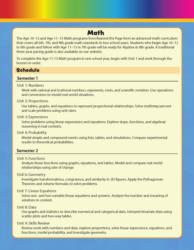
Unit 9: Semester Exams
Lesson 1
Numbers Review
Students evaluate numerical expressions that include whole-number exponents and follow order of operations (Activity 3: problems such as 2^3, (2^1)^2, (4·5)^2, and (3^3)^2 + 3^3). Students also compute arithmetic in real-world numeric contexts (Activity 1: −2.5 × 6 for temperature drop, −45 ÷ 9 for points per round, −72 ÷ 6 for debt per friend). The Final Boss task asks students to create and solve a real-world problem that uses multiplication or division and includes a fraction or decimal.
Lesson 2
Proportions Review
Students compute values of expressions in real-world contexts, such as finding speed (3 miles in 12 minutes → 15 mph), unit rates for recipes (2 ÷ 5 = 0.4 cups per batch), and comparing rates for runners (6 ÷ 1.5 and 10 ÷ 2). Students use and evaluate linear formulas of proportionality (e.g., y = kx, y = 6x, y = 4x) to generate points like (1,6) and to find totals from simple-interest contexts (compute interest on $750 at 5% for 4 years and total amount after 4 years). Students write equations from proportional situations and substitute specific values to find outputs for given inputs when graphing or creating tables.
Lesson 3
Expressions Review
Students write linear expressions from real-world contexts (e.g., y = 14x for babysitting, y = 75x for car rental, y = 18x + 12 and y = 12x + 20 for job/cost scenarios) and evaluate them at specific input values (answer keys compute earnings after 1–3 hours, costs after 3 hours, and plan costs after 4 months). Student tasks ask them to graph those equations and compute numeric outputs (e.g., Plan A = $80, Plan B = $90 at x = 4; Job A = $54, Job B = $56 at x = 3). Several problems require forming an equation from a contextual formula and then using that formula to find a numerical result.
Lesson 5
Semester Exam
Students write and evaluate real-world formulas such as C = 11t + 4 and then compute C(3) = $37 for three movie tickets. Students compute unit-rate formulas (e.g., y = 4x from 6 miles in 1.5 hours) and evaluate scale/measurement conversions (1 inch = 4 miles → 7 inches = 28 miles). Students work with whole-number exponents in numeric expressions such as 6.9 × 10^2, 5^1 × 5^2, and 8^4 ÷ 8^2, practicing exponent arithmetic and simplification.
Lesson 6
Functions Review
Students are asked to find y-intercepts (for example, find the y-intercept of y = 3x + 4 and identify y = -2 for y = 3x - 2), which requires evaluating the expression at x = 0. Students identify an x-intercept from a table (the table with x=4, y=0), and students write functions from real-world situations (e.g., y = 18h for earnings and y = 12x + 10 for bike rental). Students also identify a nonlinear expression y = x^2 + 3, recognizing the presence of a squared term.
Lesson 7
Geometry Review
In Activity 4 students are asked to write volume formulas (V = πr²h, V = 1/3 πr²h, V = 4/3 πr³) and substitute given numeric values to compute volumes (e.g., r = 4, h = 10 for a cylinder and r = 3, h = 14 for a cone). The answer key shows explicit computations such as V = 3.14 × 4² × 10 = 502.4 and solving 268.08 = 4/3 × 3.14 × r³ to find r = 4, demonstrating use of whole-number exponents and arithmetic. The Pythagorean and distance problems also require students to evaluate expressions with squares and square roots (a² + b² and √(...)).
Lesson 10
Semester Exam
Students are asked to compute volumes for real-world objects (a pencil cup and a snow cone) using given dimensions and π=3.14, which requires substituting numeric values into volume formulas and performing arithmetic (Problems 18 and 19). Students compute distances and hypotenuses by squaring leg lengths and taking square roots (Problems 16 and 17), which requires evaluating expressions with whole-number exponents. These tasks require carrying out multiplication, exponentiation (squaring), and other arithmetic in the conventional order to get correct numerical answers.