


Eighth Grade - MATH
3: Math
Unit 3: Expressions
Final Project
Planes, Trains, and Automobiles
Students write linear cost equations in the form y = mx + b for car, train, and plane and graph all three equations on the same axes. They set two cost equations equal (0.15x + 31.50 = 0.20x + 20.75) and solve algebraically to find the break-even distance x = 215. Students also plot distance vs. time lines (y = mx) for car, train, and plane and use the graphs to compare rates and relative positions of lines.
Unit 5: Functions
Lesson 8
Comparing Functions
Students read and compare two lines presented on the same coordinate plane in multiple activities (e.g., Gym Memberships, Bike Race, Lemonade Stand, Growth Rate of Plants) and answer questions such as "When do both gym memberships cost the same?" and "When are both riders at the same location?". Students estimate intersection points by interpreting graphs and compute slopes and y-intercepts from equations and tables (for example, finding slope and y-intercept for y = -3x + 100 and H = 4x + 10). Activities ask students to determine which function changes faster and which started higher, requiring them to compare rates and initial values across representations.
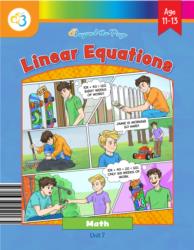
Unit 7: Linear Equations
Lesson 4
Multi-Step Word Problems
Students set two linear expressions equal and solve for one variable in problems that ask when two costs or earnings are the same (e.g., Lena and Mia phone plans: 25 + 7x = 10 + 8x; mowing vs weeding comparison). Students solve these equalities algebraically by isolating the variable and checking solutions in the given context. Students also identify and classify special cases (one solution, no solution, infinite solutions) in true/false items and review quiz items.
Lesson 5
Intersection and Graphing
Students repeatedly graph pairs of lines and identify whether they have one solution, no solution, or infinitely many solutions (multiple activity pages ask them to plot lines and label the number of solutions). Several activities require students to convert equations into slope-intercept form and compare slopes and intercepts to determine solution type (How Many Solutions? – Part 3 includes step-by-step algebraic simplification to y = mx + b). The materials also show students substituting a given point into both equations to verify that a coordinate pair is a solution.
Lesson 6
Substitution and Elimination
Students estimate solutions by graphing in multiple activities (for example, the graphing task for 3x - 2y = 7 and x + y = 4 with the intersection labeled (3,1)). Students learn and practice algebraic solution methods: substitution is taught with step-by-step examples, guided practice problems, and an Advanced Substitution worksheet. Students learn elimination, including elimination with multiples, with worked examples, practice problems, and a worksheet for mixed forms. The lesson also includes a "Which Method Should I Use?" checklist that has students decide when to use substitution or elimination.
Lesson 7
The Point of It All
Students practice estimating intersections by graphing in multiple activities (e.g., "Do These Lines Intersect?" problems and the Review Quiz graphing problem y=2x and y=3x). Students find equations from two given points and then solve systems algebraically using substitution and elimination in guided examples and in the "Intersection Challenge" problems. Students determine the number of solutions (one, none, or infinite) from both graphs and equations (examples include parallel lines y=-x+2 and y=-x-5 for no solution and proportional equations 3x-y=6 and 6x-2y=12 for infinite solutions). Worked examples explicitly show solving by substitution and elimination and instruct students to choose the most efficient method.
Lesson 8
Linear Algebra In the Wild
Students define variables and write two linear equations for real-world scenarios (e.g., Dog Walkers: S + J = 65, S = J + 5) and then use substitution to solve for each variable. Students set up and solve systems by elimination with rational coefficients in examples like the Candy Shop (2x + 4y = 23.40 and 3x + 2y = 19.70) and in multiple activity problems. Students also solve break-even systems by equating two y-expressions (e.g., y = 20x + 50 and y = 30x leading to x = 5, y = 150) and complete many worksheet problems that require substitution or elimination.
Lesson 9
Unit 7 Test
Students solve systems by substitution and elimination in Problems 14–19 where they set up and solve pairs of linear equations algebraically. Students graph systems in Problems 10–13, 24–25 and read intersection points to estimate or determine solutions (including labeled intersection points in the images). Students identify special cases (infinitely many or no solutions) in both equation-only problems (e.g., 2x+4=2x+4 and 3x+11=3x+5) and graphing problems showing parallel lines (e.g., y=3x+1 and y=3x−5). Word problems (e.g., ticket-price problems) require forming and solving two linear equations from context.
Final Project
Getting Ready for College
Students set up and solve systems algebraically in multiple activities: the Transportation activity requires students to write equations and solve the system using substitution and elimination to find the break-even miles. In Housing and Entertainment activities students set two linear cost equations equal and solve for the break-even month/hours. Students also graph both equations in Housing, Transportation, Entertainment, Meal Plans, and Phone Plans to estimate and confirm intersection points.
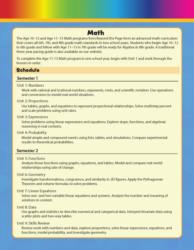
Unit 9: Semester Exams
Lesson 8
Linear Equations Review
Students solve systems by graphing, substitution, and elimination in Activity 3, where problems 1–2 ask them to find intersections from graphs and problems 4–7 require substitution or elimination with space to show algebraic steps. Students estimate solutions by graphing in Activity 3's graph problems and in Activity 2 where they graph lines (y = x - 3 and y = -2x + 1) and compute slopes from points. Students identify one solution, no solution, or infinitely many solutions in Activity 2 Part A (e.g., 4x - 3 = 4x + 9) and the parent-plan example about 3x + 2y = 5 vs 3x + 2y = 6, practicing inspection reasoning for special cases.
Lesson 10
Semester Exam
Students are asked to solve systems by graphing in problem 32 (y = x + 2 and y = -x + 6) with a provided graph grid and the intersection labeled (2,4). Students are asked to solve systems algebraically using substitution in problem 33 (y = x + 3; 2x + y = 15) and using elimination in problem 34 (3x + y = 14; -3x + y = 2). Students are asked to determine the number of solutions in problems 28–31, including explicit cases 30 (6x + 4 = 6x + 4) and 31 (8x - 2 = 8x + 6) which model infinite and no-solution cases by inspection.