


Eighth Grade - MATH
3: Math
Unit 6: Geometry
Lesson 9
Using the Pythagorean Theorem
Students solve for hypotenuses and missing legs in Activity 1 and Activity 2 using step-by-step substitution into a^2 + b^2 = c^2. They test whether triples form right triangles in Activity 3, compute distances between points on coordinate grids in Day 2 (Grid Problems), and work through multiple real-world word problems (ladders, shadows, city blocks) in Activity 5. Activity 7 explicitly has students apply the theorem in three dimensions (pyramids, cube diagonals, cones, zip lines) by stacking Pythagorean steps.
Lesson 11
Unit 6 Test
Students are asked to compute hypotenuses (e.g., find the hypotenuse given legs 6 and 8; given legs 9 and 12 produce √(81+144)=15) and to determine whether side lengths form a right triangle (e.g., check 9, 12, 15 or 10, 24, 26 using a²+b²=c²). The unit skills list explicitly states that students should "Understand and apply the Pythagorean Theorem" and "Apply the Pythagorean Theorem to determine unknown side lengths..." and the answer key shows Pythagorean calculations used in student responses.
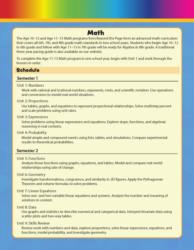
Unit 9: Semester Exams
Lesson 7
Geometry Review
The Pythagorean Theorem is directly practiced in Activity 4: students write the theorem and compute the hypotenuse of a right triangle with legs 9 and 12. Students determine whether the triple 8, 15, 17 is a right triangle by checking a^2 + b^2 = c^2. Students also find the distance between A(0,0) and B(6,8) using the Pythagorean Theorem on the coordinate plane.
Lesson 10
Semester Exam
Students are asked to find the distance between A(0,0) and B(6,8) (Problem 16) and to find the hypotenuse of a right triangle with legs 9 and 12 (Problem 17). The answer key gives the distance as 10 units and the hypotenuse as 15 units, showing use of the Pythagorean relationship in coordinate and triangle contexts. These items require computing unknown side lengths in right triangles in a two-dimensional setting.