


Sixth Grade - MATH
5: Math

Unit 1: Operations
Final Project
Planning a Party
Students are asked to convert sales tax percentages to decimal form (example: 8% → 0.08) and to multiply the grand total by the decimal tax rate to find the amount of tax (Spending Your Money, Questions 2 and 3). The Answer Key explicitly demonstrates finding a percent of a quantity: 6% → 0.06 and $42.84 × 0.06 = $2.57. The activity requires students to compute totals before and after tax and compare the final amount to the $50 budget (Spending Your Money Questions and Answer Key).
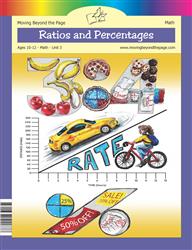
Unit 3: Ratios and Percentages
Lesson 5
Percentages
Students are taught that a percentage is a part-to-whole ratio with the whole equal to 100 and practice converting between percents, fractions, and decimals (multiple activities and answer keys show conversions such as 93/100 = 93% and 0.83 = 83%). Student problems ask them to convert a part and whole to a percent (e.g., Gilly has $0.83 of a dollar → 83%) and to use percent complements in context (Annie's 10% coupon → pay 90% = 9/10). The lesson also gives procedures and shortcuts for interpreting percents as hundredths (moving the decimal two places) that students practice on activity pages.
Lesson 6
Percentage Problems
Students are taught that a percentage is a part-to-whole ratio and are repeatedly shown to rewrite a percent as a fraction over 100 (e.g., 15% × 300 = 15/100 × 300 = 45). Activity 1 and the answer key require students to create double number line diagrams and equivalent ratios to solve "What is __% of __?" problems and to set up equations of the form part = percent × whole. Multiple activities and answer keys give problems where students solve for the whole given a part and a percent (e.g., 75 = 15/100 × n; n = 500; 45 is 30% of what number? Answer: 150). The lesson also has students translate word problems into number sentences using the percentage formula and practice solving a range of percent-of, percent-of-what, and what-percent problems.
Lesson 8
Unit 3 Test
The lesson's skill list explicitly includes "Find a percent of a quantity as a rate per 100" and "Find a whole amount when given a part and the percent of the whole the part represents." Student problems ask for percent-of calculations (e.g., "What number is twenty-eight percent of two hundred?" and "What number is ninety-two percent of twenty-five?") and for finding the whole given a part and percent (e.g., "Seventeen is eighty-five percent of what number?" with worked solutions). The matching and conversion activities define percentage as a part-to-whole ratio with the whole equal to 100 and provide practice converting between fractions, decimals, and percents.
Final Project
What's the Best Buy?
Students set up and compute percent-of-amount problems in Activity 5 Question 4, where they calculate savings from a 10% off coupon by writing n = 10/100 × $200 and solving n = $20. The Answer Key shows the percent expressed as a rate per 100 (10/100) and uses that to find the part (amount saved) from a given whole (weekly grocery cost). The Skills list explicitly includes "Find a part when given the whole amount and the percent of the whole the part represents."
Unit 4: Algebraic Expressions
Lesson 3
Working With Expressions
The Basic Skills Review #7 asks "What is 45% of 80?" and the Answer Key shows the computation written as 45/100 × 80 = 36, explicitly treating percent as a rate per 100. The review section lists "percentages" among topics and the answer key demonstrates converting a percent to a fraction of 100 and multiplying by the quantity. These items provide direct student practice computing a percent of a quantity.
Lesson 5
Equivalent Expressions
Students practice percent skills in the Basic Skills Review #8 where a conversion chart links fractions, decimals, and percentages (e.g., 4/5 = 80%) and a percent word problem asks for the sale price after a 25% discount on a $24 book. The worked solution shows percent-as-rate-per-100 set up as 25/100 = n/24 to find the part (n = 6) and then subtracts that part from the whole to get $18. The review also includes a table of fraction/decimal/percentage conversions reinforcing the idea of percent as a rate per 100.
Unit 5: Algebraic Equations
Lesson 2
Solving One-Step Equations, Part 1
Students solve a Basic Skills Review problem asking "What is 12% of 600?" and compute the result. The answer key shows the method n = 12/100 × 600 and the final value 72, so students practice finding a percent of a quantity as a rate per 100.
Lesson 7
Independent and Dependent Variables
Students complete a Basic Skills Review problem asking "What is 70% of 40?" and the answer key shows the work n = 70/100 × 40 = 28. The answer key explicitly uses the percent-as-rate-per-100 representation (70/100) to compute a percent of a quantity. This is the only explicit percent task and explanation present in the lesson materials.
Unit 6: 2D Geometry
Lesson 2
Working With Angles
The Basic Skills Review #11 includes a percent word problem: students compare Brand A (usually $60 with 15% off) to Brand B ($50) and must compute the discounted price. The answer key shows a ratio/percent calculation (15/100 = n/60) and computes the discount ($9) and final price ($51). This is the only explicit use of percent in the lesson materials.
Lesson 6
Scale Drawings
Students are shown how to convert ratios and fractions to percentages (e.g., 1/4 = 25%, 3/1 = 300%) and asked to record scale factors as percents on worksheet problems. Students compute a percent of a quantity in worked examples (for instance, finding 200% of 8 by using n = 200/100 × 8) and apply percent multiplication to find enlarged dimensions in Mrs. Yee's fence example. Student activity pages ask learners to write ratios and their equivalent percents for paired shapes (problems 6–10 and similar tasks).
Unit 7: 3D Geometry
Lesson 5
Problem Solving With Solids
The Basic Skills Review includes the percent problem "Eighteen is what percent of 50?" and shows the algebraic setup 18 = (n/100) × 50 with the solution n = 36. The answer key explicitly solves the equation 18/50 = n/100, demonstrating percent as a rate per 100. This provides at least one clear example of students using the percent-as-rate-per-100 representation to find a percent from a given part and whole.
Unit 8: Statistics
Lesson 7
Measures of Variability
Students are asked to identify percentages of a data set in box-plot sections (e.g., Box Plot #1 question d asks "What percent of the total data is represented by the whisker from 50 to 200?" and the Parent Plan question asks "What percent of the total data points lie in the interquartile range? (50% or one-half)"). Activity prompts (Box Plot #2 d) also ask students to state percent of data values between two values (e.g., percent between 30 and 40). These items require students to relate quartile/section counts to percents of the whole data set.
Lesson 8
Making Inferences
Students write part-to-whole ratios for candy colors and use equivalent ratios to calculate the percentage of each color in a sample (Activity 1). An example shows converting a sample fraction to a percent (e.g., 9/60 = 0.15 × 100 = 15%) when finding percent of a population in Step Six. The Basic Skills Review includes a direct percent problem: "64 is what percent of 200?" which requires finding percent as a rate per 100.
Unit 9: Skills Review
Lesson 3
Expressions, Equations, and Percentages
The lesson's Skills list explicitly states that students will "Find a percent of a quantity as a rate per 100," "Solve real-world and mathematical problems involving percents," and "Solve problems involving finding the whole, given a part and the percent." The Wrapping Up section directs students to an online quiz titled "Percentages and Unit Conversions," indicating students will practice percent problems via that external activity.
Lesson 4
Geometry
Students convert a scale factor to a percentage (the answer key states "The scale factor can also be expressed as a percentage: 1/3 = 33 1/3%"), and students solve a percent-size problem where Christie wants an image "800% larger" and the answer key shows solving with a proportion 100/800 = 2/n to get n = 16. The lighthouse problem has students compute a new measurement by treating a percent as a multiplier of a quantity (800% × 2 = 16 as shown).
3: Math
Unit 2: Proportions
Lesson 5
Proportional Relationship Equations
The Review Quiz includes a task (Question 15) where students compute sale prices after a 25% discount and the Answer Key shows Final Price = 0.75 × Original Price with worked examples. The student pages ask learners to complete tables of Original and Sale Price and determine whether the sale price is proportional to the original price. The lesson also uses percent multipliers in examples (e.g., using 0.9 for a 10% discount in the ticket challenge), so students practice multiplying quantities by a percent factor.
Lesson 6
Taxes, Tips, and Commissions
Students convert percent to a decimal and multiply to find a percent of a quantity (e.g., 15 × 0.07 = 1.05 for sales tax and Gratuity = Tip Percentage × Original Bill). Students set up and solve equations that work backward from a part to the whole (e.g., 0.012 × V = 2400 → V = 2400 ÷ 0.012; 1.08x = 212 → x = 212 ÷ 1.08). Student activity pages include many practice problems requiring both forward percent-of-quantity calculations and reverse problems where students find the original price, property value, or income given a part and a percent.
Lesson 7
Markups and Discounts
Students are instructed to compute a percent of a quantity using the formula Discount = Original Price × Discount Percentage and shown examples converting percents to decimals (e.g., 30% = 0.30 and 50 × 0.30 = 15). Multiple practice problems require multiplying a price by a percent (simple and stacked discounts) and mental‑math tips show percent-of calculations (10%, 20%, etc.). Work-backward problems explicitly ask students to find the original price given a final price and a percent (e.g., x × 0.60 = 18 → x = 30; x × 1.20 = 72 → x = 60) and answer keys show the algebraic division used to find the whole.
Lesson 8
Simple Interest and Percent Error
Students convert percent symbols to fractions or decimals and use them in computations (e.g., I = 600 × (4/100) × 5 and r written as 0.04). Students compute a percent-of quantity when finding interest earned (interest = principal × rate × time) and compute balances by adding the part (interest) to the whole (principal). Students also practice percent calculations in the percent error activity by dividing a difference by the actual value and multiplying by 100.
Lesson 9
Unit 2 Test
Students are asked to compute percents in multiple real-world problems (e.g., find the final price after a 25% markup on $40; calculate a 15% tip on a $20 meal; find a 15% discount on a $90 item). Students are asked to find the whole given a part and a percent in explicit items (e.g., find the price before tax when $212 includes 6% sales tax; find the property value when $1,728 is 1.2% tax). The Unit Test and review pages repeatedly require students to set up and solve percent equations (tax, tip, discounts, percent error, simple interest).
Final Project
Lemonade Stand
Students calculate percents applied to prices in Part 5: they compute a 30% discount on a per-cup price and calculate sales tax and a 15% gratuity using multiplication (examples show $1.28 × 0.7 for a 30% discount, $1.28 × 0.07 for tax, $1.28 × 0.15 for tip). In Part 4 students use percent-based markups (100%, 150%, 200%) to find selling prices by multiplying the unit cost by 2, 2.5, or 3. These activities ask students to find parts of quantities (discount amount, tax amount, tip, and increased price) by applying a percent to a given amount.
Unit 3: Expressions
Lesson 2
Rewriting Expressions
Students convert percent to decimals and compute a percent of a quantity in multiple examples (e.g., 0.05 × 40 = 2 for 5% sales tax; 0.08 × 120 = 9.60 for 8% tax; 0.25 × 80 = 20 for 25% discount). Students use one-step formulas Total Price = Original Price × (1 + rate) and Discounted Price = Original Price × (1 − rate) to calculate final amounts by multiplying the original quantity by (1 ± percent-as-decimal). Students also solve for the original whole given a part and a percent by rearranging and dividing (e.g., 54 = P × 0.9 → P = 60; 31.50 = P × 1.05 → P = 30), and several activity problems explicitly ask for original price given sale/final price.
Lesson 3
Algebraic Expressions
Students compute percents in applied contexts: the Review Quiz includes a sales tax problem (60 × (1 + 0.07) = 64.20) showing 7% as 0.07 and multiplying a whole by (1 + rate). The lesson includes Discount and Markup problems (25% off $100; 30% markup on $500) and answer keys that use percent-rate multiplication to find final prices. Students also apply percent reasoning in real-world word problems that use the one-step percent formula for tax, discounts, and markups.
Lesson 9
Unit 3 Test
Students solve multiple percent-of-quantity problems such as finding sale prices and totals: e.g., a $80 jacket with 25% off, a $120 item taxed at 8.25%, a $90 sweater with 30% off, and several other discount and sales-tax questions. The answer key shows students compute final prices by applying the percent to the given amount (for example, $120 + 8.25% = $129.90 and $90 − 30% = $63). These items require students to calculate a percent of a quantity (discounts and taxes) and write the resulting totals.
Final Project
Planes, Trains, and Automobiles
Students calculate percentage amounts in cost contexts: the answer key shows a 5% tax added to food ($30 + 5% = $31.50), a 10% discount applied to a plane ticket (from $250 to $225), and a 15% tip calculation ($16 × 1.15 = $18.40). The Parent Plan skills list explicitly shows percent-as-decimal reasoning (a + 0.05a = 1.05a) connecting percent change to multiplication by a decimal. Students use these percent computations when finding total costs for trips and when adjusting prices for discounts and taxes.
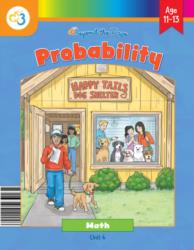
Unit 4: Probability
Lesson 1
What Is Probability?
Students convert probability fractions and decimals to percents in multiple activities: the coin-toss example shows 6/10 → 0.6 → 60%, and the spinner activity asks students to fill a table giving fraction, decimal, and percent for each color (e.g., 6/12 → 0.5 → 50%). The coin recording table and questions prompt students to turn their tallies into probabilities and percentages after sets of flips. The parent/answer keys explicitly list percent values for outcomes (e.g., 50%, 17%, 33%).
Lesson 2
Observing Probability
Students record frequencies out of 100 and convert them to fraction, decimal, and percent (for example, 59/100 → 0.59 → 59%). Students use the experimental probability (expressed as a decimal or percent) to calculate a predicted count out of 600 using Prediction = Experimental Probability × 600 (example: 0.59 × 600 = 354). The student activity page explicitly asks students to fill in experimental probability in decimal and percent form and to predict the number of spins out of 600 for each color.
Lesson 3
Probability Models
Students convert probabilities given as fractions to decimals and percents (e.g., 7/12 ≈ 0.583 = 58%, 29/50 = 0.58 or 58%). Students use a probability rate (fraction or decimal) times a given total to find expected counts (e.g., 1/2 × 500 = 250 heads, 1/6 × 120 = 20 expected rolls of a given number, 75 × 1/2 = 37.5). Several activities ask students to compute relative frequency and then express it as a percent (experimental probability = count/total → percent). The tasks repeatedly require finding "how many times" an outcome would occur by multiplying a percent/decimal rate by the number of trials.
Lesson 4
Compound Events
Students convert fractions from probability models to percents in multiple places (e.g., 1/6 = 16.7%, 1/8 = 12.5%, 2/6 = 33.3%). In the Making Inferences activity students compute a sample percent (14/60 = 23.3%) and then apply that percent to a larger population by multiplying 0.233 × 1143 ≈ 266 to estimate counts. Several student pages and answer keys ask students to calculate a probability as a fraction and then convert it to a percent and predict how many times an outcome would occur when repeated (e.g., multiply percent × number of trials).
Lesson 5
Simulations
Students map percentages to number assignments (e.g., Pop = 40% represented by digits 0–3) in the Music Playlist and other activities. Students convert experimental results to percents by writing a fraction of trials (e.g., #/20) and using the procedure "divide numerator by denominator, multiply by 100" in The Library Hunt. Students reflect on how changing a percentage (for example, going from 10% to 20% instrumentals) would affect outcomes and averages.
Lesson 6
Unit 4 Test
Students are asked to model percents by assigning spinner sections (e.g., "assign 2 of the 10 spinner sections to represent red marbles since 20% of 10 is 2"), which requires computing a percent of a given total. Several simulation prompts use percent values (e.g., "If 40% of marbles are red," "If 30% of coins are copper") that students must interpret when designing and running trials. The answer key and problems regularly convert probabilities to percent form (e.g., .25 = 25%, .167 = 16.7%, 0.4 = 40%), so students practice expressing fractional probabilities as percents.
Final Project
Happy Tails Dog Shelter
Students are asked to build a probability model by writing each size/color combination and calculating the percentage using the formula Percentage = (Number of dogs in the group / 60) × 100. The lesson gives worked examples showing (Small, Brown): 3/60 × 100 = 5% and (Medium, White): 9/60 × 100 = 15%, and asks students to finish the full list of 15 combinations and percentages. Reflection questions ask students to add percentages for categories (e.g., total probability of meeting a medium-sized dog or total chance of meeting a white dog).
Unit 7: Linear Equations
Lesson 2
Multi-Step Equations
Students solve two real-world discount problems that require working with percents: the sofa problem (20% off plus a $50 delivery fee, final cost $610) and the website problem (15% discount plus $5 shipping, total $42.50). In the answer keys and sample setups, students write and solve equations that use percent as decimal multipliers (p - 0.2p + 50 = 610 and 0.85x + 5 = 42.50) and then solve for the original price. Students are asked to define variables, set up the equations, and solve for the whole given the part and percent.
Unit 8: Data
Lesson 5
Categorical Data
Students are taught to compute relative frequencies using the formula Relative Frequency = Frequency of an event / Total number of events and to fill two‑way relative frequency tables. The lesson explicitly computes 18/90 = 0.20 and states 0.20 = 20%, and it instructs students to express relative frequencies as decimals or percentages. Several activities require converting frequency tables to relative frequency tables and answering questions using those proportions (including directions to round decimals or give percentages).
Final Project
Collecting and Organizing Data
Students are asked to convert tally counts into percentages and fill a two-way relative frequency table (e.g., "Step 2: Calculate Percentages" and "Each cell represents the percentage of all 20 people"). Activity pages and models show students computing percent totals for rows and columns and circling key percentages to interpret which groups are most or least common. Reflection prompts ask students to identify which category combination had the highest percentage and to use percentages to describe patterns.
Unit 9: Semester Exams
Lesson 2
Proportions Review
Students solve multiple percent-of-a-quantity problems in Activity 4 (e.g., calculate 7.5% sales tax on $64, a 15% tip on $52, 30% markup on $48, 25% off $80). Activity 4 also includes a reverse-percent problem (#8) where students find the home value given $2,100 in property tax at a 1.5% rate, and the answer key shows the correct whole ($140,000). The Parent Plan explicitly says students "work backward to find original values when given a total," and the activity set includes videos and prompts for percent increase/decrease and simple interest that require interpreting percent as an operator on quantities.
Lesson 3
Expressions Review
Students are asked to calculate the total cost of a video game with sales tax and determine the final price of a jacket after a discount (Activity 1), and the answer key shows numeric results ($64.20 and $75.00) indicating practice computing percent of a quantity. The Parent Plan gives an explicit algebraic example a + 0.05a = 1.05a to show "increase by 5%" as multiplying by 1.05, so students are exposed to rewriting percent as a decimal multiplier. Activity descriptions and problem prompts repeatedly present contexts (sales tax, discounts, fees) where students compute parts of totals using percentages.
Lesson 4
Probability Review
Students convert probability fractions to decimals and percents (e.g., 4/20 = 0.20 = 20% for the hamster problem) and are asked to write probabilities as percents. Students explain percent representation with spinners (e.g., showing that 4 out of 10 sections models a 40% probability). The activity prompts reasoning using fractions and percents when creating probability models and when expressing experimental probabilities as decimals and percents.
Lesson 5
Semester Exam
Students solve percent-of-quantity problems: questions 21–23 ask for sales tax (6% of $48), a 20% tip on $42, and a 25% markup on an $80 item, with the answer key showing totals ($50.88, $50.40, $100). Question 49 asks students to explain how a 10-section spinner could model a 40% probability, which connects percent reasoning to parts of a whole. The answer key and problems require students to compute percent amounts and add them to prices, so students practice finding a percent of a given quantity.
Lesson 9
Data Review
Students compute relative frequencies and express them as decimals and percents in the two-way table (for example, the answer key shows 12/50 = 0.24 (or 24%) of evening students prefer gaming). The activity asks students to calculate and compare relative frequencies across categories and time-of-day columns, requiring them to form part/whole ratios and convert those ratios into decimal and percent forms. Several table entries are shown as fractions and decimals (e.g., 10/30 = 0.33, 16/40 = 0.40), indicating students practice finding the portion of a whole and expressing it in different representations.