


Sixth Grade - MATH
5: Math

Unit 1: Operations
Lesson 2
Multiplication Review
Students are told that "the numbers being multiplied are called factors, and the answer to a multiplication problem is the product." Students are given the distributive property a(b + c) = (a · b) + (a · c) with worked examples (for example, 46 × (20 + 7) = (46 × 20) + (46 × 7)) that show (20 + 7) can be treated both as a single entity and as a sum. Students see letter-based formulas for the commutative and associative properties (a × b = b × a; (a × b) × c = a × (b × c)) and are asked to represent multiplication in multiple forms (e.g., 4 × n, 4 · n, 4(n), 4n).
Lesson 3
Division Review
Students read and interpret division expressions in multiple forms (e.g., 12 ÷ 3, 12/3, long division) and label the parts as dividend, divisor, and quotient. Students perform long-division procedures and produce quotients in many practice problems and word problems. Students apply division and relate it to multiplication (e.g., 3 × 2 = 6 and 6 ÷ 2 = 3), reinforcing the meaning of quotient as the result of division.
Lesson 4
Exponents and Order of Operations
Students label and read exponential expressions (e.g., identify the base and exponent for 3^4 and 4^5), describe the base as a factor and write exponential expressions in expanded (factor) form. Students identify factors and products when comparing 3 × 4 to 3^4, and students practice treating grouped expressions as single entities when working with parentheses and nested grouping symbols (examples showing (5−3)^4 and stepwise simplification). Students also use terms like product, factor, and sum in worked examples and practice problems involving addition, subtraction, multiplication, division, and exponents.
Lesson 5
Factors and Prime Factorization
The lesson explicitly defines factors and products (e.g., "Factors (noun) are numbers multiplied together to get other numbers" and statements like 4 (x) 5 = 20) and has students list factor pairs for numbers 1–20 and larger numbers. Students practice identifying factor pairs using factor rainbows, divisibility rules, and factor trees, and they write multiplicative factorizations and prime factorizations (including exponential notation). The activities require students to select a factor pair as an entity and to factor composite factors further using factor trees.
Lesson 6
Greatest Common Factor
Students factor numeric expressions and use the distributive property in reverse, for example rewriting (4 · 7) + (4 · 9) as 4(7 + 9) and factoring 24 + 54 into 6(4 + 9). Students identify and name factors, common factors, and the greatest common factor (GCF) for pairs and sets of numbers and use prime factorization and factor trees to find shared prime factors. Students view parenthesized sums as single entities when they "undistribute" (e.g., 4(7 + 9) is treated as a product of a factor and a single sum).
Lesson 7
Least Common Multiple
Students are shown a concrete factoring example that rewrites the sum 24 + 56 + 32 as a product 8 × (3 + 7 + 4), explicitly labeling this as a factorization and demonstrating the parentheses as a single entity. The materials define a factor as a number multiplied by another to get a product and repeatedly use the words "product," "factor," and "sum" in explanations and examples (e.g., simplifying fractions and factor expressions). Students complete an interactive foldable and fill-in-the-blank definitions that require them to write and explain "Factor," "Multiple," "Greatest Common Factor," and "Least Common Multiple."
Lesson 8
Unit 1 Test
Students match expressions to terms that include "Factors" and "Multiples," and vocabulary/answer-key entries define "factor," "multiple," "product," and the distributive property. Students convert between distributed and undistributed forms (e.g., write 6(4 + 3) and 5(3 + 4) and factor numerical sums like 84 + 120 = 12(7 + 10)), which has them view a parenthesized sum as a single entity and express a product of factors. Students factor numbers, circle common factors, and find GCFs using prime factorization, practicing identification of factors and products.
Final Project
Planning a Party
Students are asked to show the total number of goody bag items using the distributive property with the explicit example 12(5 + 3) = (12 × 5) + (12 × 3) = 60 + 36, which requires forming, expanding, and evaluating an expression and viewing (5 + 3) as a single entity. Planning activities require students to write numerical expressions for totals (for example, number of packages × price per package such as 3 × $4.80 = $14.40) and to evaluate those products. The Parent Plan and activity instructions explicitly reference using the distributive property and writing/evaluating numerical expressions involving whole-number exponents, so students practice constructing and evaluating expressions in real contexts.
Unit 2: Integers and Rational Numbers
Lesson 2
Fraction Multiplication
The lesson uses the term "factors" when discussing the commutative property of multiplication, showing students that the order of factors does not matter. A chart of operation clue words explicitly lists "product" and "factors," and students solve and write multiplication expressions such as 2/3 × 6 and 8/1 × 3/4. Activities require students to multiply expressions and convert whole numbers to fractions, giving repeated exposure to multiplication expressions and related vocabulary.
Unit 3: Ratios and Percentages
Lesson 3
Equivalent Ratios
Students set up and compute numerical and algebraic expressions in several problems (for example, the answer key shows 4x + 3x = 91 for the Sam and Lindy bottles problem and shows calculations like 5 × 12 = 60 and 7 × 12 = 84). Students also write ratios in fraction form (e.g., 2/7) and use multiplication and division to find missing values from tables and diagrams. Tables and graphs require students to work with ordered pairs and proportional relationships represented as numeric expressions.
Unit 4: Algebraic Expressions
Lesson 1
Introduction to Algebra
Students are asked to identify constants and variables (e.g., circle variables in red and underline constants in green) and to translate word phrases into algebraic expressions via matching activities. Word-clue boxes and matching exercises expose students to addition/product/division language and phrases (e.g., product, quotient, addition phrases) and ask them to connect those phrases to symbolic expressions. The materials explain that a numeral or variable outside parentheses multiplies the grouped expression (example 8(z − 2)) and show that parentheses act as a single grouping (also shown when applying exponents to a parenthesized fraction).
Lesson 2
Parts of an Expression
Students are asked to name parts of expressions using precise vocabulary: the lesson defines coefficient, term, constant, variable, factor, product, quotient, addend, sum, minuend, and subtrahend and places many of these words in the activity word bank. In the opening example students are shown 2n + 8 and instructed to identify n and 2 as factors, 2n as a product, and 2n and 8 as addends; Activities 1–3 ask students to label coefficients, variables, constants, factors, and the operations that join parts. The lesson also instructs students that multiplication and division join parts into a single term and explicitly guides them to count terms and to treat parenthesized expressions next to a coefficient as a single term (for example, the 8(2+5) discussion).
Lesson 3
Working With Expressions
Students are asked to identify constants, coefficients, terms, and the operation joining terms (Activity 1 asks: What number doesn't change? Does the expression have a coefficient? How many terms?). The Parent Plan and activities require students to write expressions with addition, subtraction, multiplication, and division (examples: 2n, 24/n, 50 - n) and to evaluate expressions with parentheses such as 3(n + 1) and (n - 3)^2 + 4. Student tasks and answer keys repeatedly have students name terms and coefficients and translate word problems into expressions containing products and quotients.
Lesson 4
Positive and Negative Numbers
Students rewrite subtraction as addition and then rearrange and group addends using the commutative and associative properties (for example: 3 + (-)5 + 4 + 2 + (-)13 → 3 + 4 + 2 + (-)5 + (-)13 → (3+4+2)+((-5)+(-13))). Students use parentheses to create and view grouped subexpressions as single entities and treat signed numbers like (-5) as single addends. Activities ask students to change expressions and simplify grouped sums, and several problems require grouping positives and negatives before simplifying.
Lesson 5
Equivalent Expressions
Students identify and combine like terms in multiple activities (e.g., grouping [4x + 9x - 3x] + [12 + 3] and simplifying to 10x + 15). Students work with coefficients and terms in many examples and problems (e.g., 5x - 2x + 7 - 2 + 4 simplified to 3x + 9, and practice problems asking to combine terms like 8n + 9n + 14 - 10). Students practice treating grouped parts as single entities using parentheses and properties (e.g., rewriting (5a + 6 + 2a + 3) as (5a + 2a) + (6 + 3) and rewriting expressions with commutative/associative properties). The lesson also shows multiplication as repeated addition and uses examples of multiplication and division with variables (4n = n + n + n + n, 2(2n), and 8n/4) which helps students view products and quotients in context.
Lesson 6
The Distributive Property
The lesson repeatedly presents expressions in both factored and expanded form (e.g., 5(n + 2), (5·n) + (5·2), and 5n + 10) and explicitly states that a factor written next to parentheses signifies multiplication and that a constant multiplied by a variable is a coefficient. Multiple examples show a(b + c) = ab + ac and specific instances such as 4(x + 5) = 4x + 20 and 12(x + y) = 12x + 12y. Student tasks ask learners to match area models with expressions and to rewrite and simplify expressions, which requires viewing parenthetical sums as single entities and recognizing factors, products, and coefficients.
Lesson 7
Unit 4 Test
Students identify parts of expressions by answering vocabulary questions that ask for the number of terms, the variable, the constant, and the coefficient for expressions such as 7x^2 + 5x - 14 and 15 + 9n. Students translate word phrases into algebraic expressions and write expressions from clues, practicing recognition of sums and terms. Students use area-model problems and distributive-property tasks (e.g., select 3(n + 5), (3·n)+(3·5), and 3n+15) that require viewing (n+5) as a single entity and as a sum while also representing the product form.
Final Project
Algebra Think-Tac-Toe
Students are asked to create a vocabulary poster that must include and label constant, variable, coefficient, exponent, and term. The Math Properties Trading Cards require students to write sentences and number examples for the distributive, associative, and commutative properties, including wording such as "multiplying the sum of two numbers...by a factor" and examples a(b + c) = ab + ac. In the Prove It! activity, students simplify expressions like 6(5 + n) using the distributive property and then evaluate both forms to show equivalence, which treats the parenthesized sum as a single entity.
Unit 5: Algebraic Equations
Lesson 1
Algebraic Equations
Students are told that an algebraic expression is made up of variables, constants, and operations and are shown examples with sums (for example, 4 + 6 = 10). In Activity 2 the text explicitly identifies parts of 2x + 12 = 18: it states the expression has two terms, that the first term is a variable multiplied by a coefficient (2), and that the second term is a constant (12). Student pages include expressions with multiplication, division, and parentheses (e.g., 3(4 + 9), fractions, and 2^x) so students work with a variety of expression forms.
Lesson 2
Solving One-Step Equations, Part 1
Students represent expressions such as n + 60 = 100 and 2x + 4 = x + 6 using tape and hanger diagrams, treating grouped parts (a tape segment or a grouped set of shapes) as single entities. The lesson explicitly explains that if no coefficient is shown in front of a variable it is understood to be 1, and it uses the word "term" when discussing commutativity (e.g., n + 3 is the same as 3 + n). Students practice identifying the unknown and the constants in additive expressions and substitute found values back into expressions to check that both sides are equal.
Lesson 3
Solving One-Step Equations, Part 2
Students interpret expressions like 2n as two equal groups using tape and hanger diagrams and solve for n by dividing, which shows they work with the multiplicative structure of expressions. The lesson explicitly names and uses the term "coefficient" (e.g., "The coefficient (4) is attached to the x") and shows how to use inverse operations to remove a coefficient. The lesson also explains division notation by identifying the dividend and divisor (numerator and denominator) when reading n/2.
Lesson 4
Solving Two-Step Equations
Students identify parts of expressions when they are asked which constants are attached to the variable and which operations attach those constants (e.g., 2n + 5 = 11). Students label and use tape diagrams and hanger diagrams to represent 2n, 4n, and grouped constants, and the lesson explicitly uses the term "coefficient" when describing equations in the expected form. Students also rewrite expressions using the distributive property (e.g., 3(n - 4) → 3n - 12) and treat the parenthetical expression as a single entity to be multiplied.
Lesson 6
Solving Inequalities
Students work with expressions such as n + 6, 3n - 5, n/3, and (2/3)p when solving inequalities and are asked to use inverse operations to isolate the variable. The lesson text explicitly refers to the "coefficient attached to the variable" and tells students to add or subtract whole parts (e.g., "the number of shirts with stripes and the number of shirts without stripes are added together"). Students also perform operations on products and quotients (multiplying by reciprocals to remove coefficients or dividing to isolate n) in several problems and answer keys.
Lesson 8
Unit 5 Test
Students rewrite and expand expressions using the distributive property (e.g., 2(y + 1/2) is rewritten as 2y + 1) and solve equations that include coefficients (e.g., 6m = 42, 3n + 4 = 2n + 7). Several problems require working with quotients and multiplication (e.g., n/3 = 4, a/7 − 5 = 9) so students manipulate factors, quotients, and coefficients in context. The parent/skills list explicitly states students will "apply properties of operations as strategies to add, subtract, factor, and expand linear expressions with rational coefficients."
Final Project
All About Me
Students are asked to write and solve a variety of expressions and equations that include addition, subtraction, multiplication, and division (examples given: n + 3 = 15, 2x = y, 3x - 4 ≥ 56, n/2 + 5 ≤ 9, 2n - 6 > 4). The project requires inclusion of a tape or hanger diagram and a number-line graph for an inequality, and asks for a two-variable equation with a corresponding table and description of the relationship. The checklist requires students to produce problems that use coefficients and operations, and to check solutions by plugging answers back into the original expressions.
Unit 6: 2D Geometry
Lesson 2
Working With Angles
Students write and interpret algebraic expressions for angle relationships such as 126 + n = 180, n + 2n = 90, and 5n = n + 92. Students manipulate expressions with coefficients and like terms when they solve and simplify problems (for example, combining 12x + 6x + 4 - 5x + 4x - 10 to 17x - 6). Students substitute numerical values for variables to evaluate expressions (e.g., 5(23) = 115 and n + 92 = 23 + 92 = 115).
Lesson 4
Area
Students write and evaluate multiplicative expressions such as A = l × w, A = b × h, and A = 1/2 × b × h when finding areas. Students set up and solve simple algebraic equations derived from area contexts (for example, 24n = 4,320 to find the number of pavers and 15 × n = 75 to find a missing height). The lesson has students substitute numeric values into formulas and compute products and quotients to find areas.
Lesson 5
Circles
Students compute the ratio C/d in the hands-on activity (they measure circumference and diameter and record the c/d column), explicitly recognizing that the quotient of circumference to diameter equals pi. Students use algebraic manipulation to solve for C from π = C/d (inverse operations and symmetric property) and see the formulas C = πd and C = 2πr. Students also use d = 2r and are shown that 2r can be treated as the same single entity as d when rewriting formulas, and they replace C with 2πr when deriving A = πr^2.
Lesson 7
Unit 6 Test
Students write and solve equations that contain algebraic expressions such as 2n, 3n + 12, 3n + 35, and 4n in several problems. The answer key and problems show students forming equations like n + 2n + (3n + 12) = 180 and then combining to 6n + 12, and substituting a found value for n into expressions (e.g., substitute 35 into 3n + 35 and 4n). Parent/answer explanations refer to combining like terms and treating parentheses as a grouped entity when forming and simplifying equations.
Unit 7: 3D Geometry
Lesson 1
Three-Dimensional Solids
Students work with Euler's formula written as an algebraic expression (F + V - E = 2) and are asked to write an equation using a letter to represent an unknown. Students change a subtraction into adding the opposite (F + 5 + (-)8 = 2), combine like terms (F + (-)3 = 2), and isolate the variable by adding the inverse to both sides to solve for F. These steps show students reading and evaluating simple algebraic expressions with letters as numbers.
Lesson 2
Surface Area
Students encounter and use algebraic expressions and formulas such as SA = 2LW + 2LH + 2WH, SA = 6s^2, A = 1/2 bh, and examples written as 2(10 × 6) and 6(3^2). Students evaluate expressions in problems (for example, finding the value of n^2 - (-5) when n = 3 and expanding 5(n + 7) = 5n + 35). Activity pages and worked examples require students to compute products, sums, and use coefficients when calculating areas and surface areas.
Lesson 3
Volume
Students work with multiplicative expressions such as V = l (x) w (x) h and V = lwh and are told that variables written next to each other are being multiplied. Students rewrite repeated multiplication as an exponential expression (V = s3) and are told the number being multiplied is the base and the number of times is the exponent. Students also use grouped subexpressions when finding the volume of prisms (for example V = (1/2 x 6 x 4) x 8 and using B to stand for the area of the base), which shows viewing a multi-term area as a single entity in an expression.
Lesson 5
Problem Solving With Solids
Students set up and solve algebraic expressions using a variable to represent a missing dimension (e.g., 54 = L × 4 1/2 × 2, then simplify to 54 = 9L and solve L = 6). Students expand and interpret exponents in expressions (SA = 6s2 is expanded to s × s) and simplify algebraic sums (combine 4x + 3x + x to 8x in the Basic Skills Review). Students also write and solve linear equations from word problems (e.g., 5n + 10 = 130 for Lucas).
Lesson 6
Unit 7 Test
Students work with algebraic formulas that use letters for numbers (for example, V = l × w × h, V = B × h, and SA = 2LW + 2LH + 2WH) and substitute numeric values to compute volume and surface area. Students solve for a variable in an equation (for example, 182 = 6.5 × h then dividing both sides to find h = 28). Students compute with expressions that include coefficients and products (for example, terms like 2LW and 6s^2) when finding surface area and volume.
Final Project
Building With Solids
Students use and evaluate numerical formulas and expressions such as A = l × w, SA = 2lw + 2lh + 2wh, V = l × w × h, and s^3 when calculating surface area and volume. The answer key and sample calculations present combined expressions like 2(2 × 7) + 2(4 × 7) + 2(2 × 4) and the triangular-prism volume 1/2(6 × 4) × 8, which expose students to coefficients, products, and sums in context.
Unit 9: Skills Review
Lesson 1
Decimals, Factors, and Multiples
Students factor numeric sums and rewrite products using the distributive property, for example factoring 36 + 88 as 4(9 + 22) and rewriting 15 × 32 as 15(30 + 2) before multiplying. Students use prime factorization to find greatest common factors and compute least common multiples, showing understanding of factors and multiples. Students evaluate expressions with parentheses and order of operations, such as 5 + 3² × (6 − 2) + 18 ÷ 3.
Lesson 3
Expressions, Equations, and Percentages
Students identify number of terms, coefficients, and constants in x^2 + 3x + 9 (Problem 1). Students translate word phrases into expressions such as 4n + 5 and 6 - n, representing products and sums/differences (Problem 2). Students work with quotients and division in expressions (x/2, m/4) and solve equations involving division. Students simplify and evaluate expressions with parentheses (3(n + 6) + 4n - 10 and 4(y - 3) + 3), treating grouped parts as single entities when distributing or evaluating.
Lesson 4
Geometry
Students write and solve an equation from vertical-angle expressions 3n and 2n + 16 (3n = 2n + 16), solve for n, and substitute to evaluate 3(16) and 2(16) + 16. Area and circle tasks use expressions such as A = 1/2 · b · h, C = 2πr, and A = πr^2, and scale problems require multiplying side lengths by a scale factor. Students perform operations on multi-term expressions and evaluate products that include numeric coefficients.
3: Math
Unit 1: Numbers
Lesson 1
Positive and Negative Rational Numbers
Students write equations for scenarios (e.g., 10 + (−8) = 2) and draw number-line or symbolic representations, showing sums and paired terms. Students practice multiplication and division with signed numbers and use vocabulary such as "product" and "quotient" in activities and answer keys. Students are asked to explain (−3)×(−4) using the distributive property or a number line, and to create rule lists matching multiplication/division examples to rules, which engages with factors and products in context.
Lesson 3
Properties of Exponents
Students learn and use the vocabulary and rules for product and quotient situations: activities and notes label and practice the Product of Powers, Quotient of Powers, Power of a Product, and Power of a Quotient and use words like "product," "factor," and "quotient." Students work with examples that treat parentheses as grouped entities (e.g., (2⋅3)^3 is expanded and then seen as 2^3 ⋅ 3^3) and complete exercises that require selecting fraction expressions that match the quotient rule. Students fill the "Properties of Exponents Notes" page with formulas that explicitly show (a⋅b)^m = a^m⋅b^m and (a/b)^n = a^n/b^n.
Lesson 6
Scientific Notation
Students repeatedly identify and work with coefficients by name (e.g., "Multiply the coefficients," "Add the coefficients") when multiplying and adding numbers in scientific notation. They rewrite one term to share a common exponent (e.g., rewriting 2 × 10^6 as 20 × 10^5) and then add the coefficients, treating each product (coefficient × 10^n) as a single entity to combine like terms. Students also divide and multiply by separating the numeric coefficient from the power of ten (divide the coefficients; subtract the exponents; multiply the coefficients; add the exponents).
Unit 2: Proportions
Lesson 3
Constant Rate
Students practice rewriting equations into the form y = kx (e.g., 4y = 8x → y = 2x) and identify k by computing k = y/x, which requires treating y/x as a quotient. Students classify equations as direct variation or not (sorting y = 17x, y = 3x^2, 8y = x, y = 1/4 x), and they are asked to note when an "extra +3" makes an expression nonproportional (identifying an extra term). Several activities have students pick points on graphs and compute k = y/x, reinforcing viewing y = kx as a product of k and x.
Lesson 5
Proportional Relationship Equations
Students write and use multiplicative equations such as t = pn, t = 12n, t = 15n, t = cm, and a = rh, and they substitute numbers into these expressions to solve for unknowns. Students complete tables, test proportionality, and are asked to write equations in the form y = kx and identify the unit rate or constant of proportionality (k). The review and activities require forming and interpreting expressions that multiply a unit rate by a quantity (for example, c = 8m or d = 4.5t).
Lesson 6
Taxes, Tips, and Commissions
Students set up and manipulate expressions such as Sales Tax = Price × Tax Rate and Total Amount = Original Bill + Gratuity, and they solve equations like 1.08 × x = 212.00 and 0.012 × V = 2400 by treating the multiplicative expression as a single entity. The activities require students to write equations in the form Commission = Sales Amount × Commission Rate and Total Earnings = Commission + Base Salary and then compute or isolate the unknown. Several problems ask students to work backward (e.g., let p = price before tax; p × 1.06 = $374.40 → p = $374.40 ÷ 1.06), which has students view combined expressions as single units to solve.
Lesson 7
Markups and Discounts
Students work with algebraic-style expressions such as Discount = Original Price × Discount Percentage and Markup = Cost Price × Markup Percentage, performing multiplication and addition/subtraction to compute amounts. Students apply sequential operations (stacked discounts) by calculating a new price and then using that new price as the quantity for the next multiplication, effectively treating the grouped new price as a single entity. Answer keys and backward problems use equations like x × (1 − 0.40) = 18 and x * 1.20 = 72, which require students to manipulate multiplicative factors and solve for unknowns.
Final Project
Lemonade Stand
Students write and use equations in the form y = kx and t = pn to model proportional relationships and costs. They set up and compute expressions such as (Number of lemons × Unit price) + (Amount of sugar × Price per pound) = Total cost for one gallon, and they calculate unit rates and the constant of proportionality (unit rate). Activity pages ask students to create tables, graphs, and equations from given relationships and to use proportions to solve for unknowns.
Unit 3: Expressions
Lesson 1
Equivalent Expressions
Students are taught and practice identifying and combining like terms and coefficients (e.g., explanations that like terms have the same variable/exponent and directions to "multiply the numbers (called coefficients)"). Students regroup and treat parts of expressions as single entities when using the Associative Property (e.g., rewrite (x+4)+9 as x+(4+9)) and when using the Distributive Property (e.g., interpret 3(x+5) as multiplying 3 by the parenthesized quantity and distribute 3 to each term). Students also reorder and group terms using the Commutative and Associative Properties to make combining terms easier (multiple activities ask students to rearrange and then simplify expressions).
Lesson 2
Rewriting Expressions
Students rewrite sum-plus-product forms into a single product using the distributive property in reverse (e.g., A + AB = A(1 + B)) and apply this to concrete examples like Total Price = Original Price × (1 + Sales Tax Rate) and Selling Price = Wholesale Price × (1 + Markup Rate). Students set up and compute expressions such as 40(1.05) and 60(1.50), and solve equations for unknowns (e.g., 31.50 = P(1.05) and 25 + 3r = Total Cost), which requires treating parentheses like (1 + rate) as a single multiplicative entity. Multiple student activity pages ask students to fill in and manipulate these rewritten expressions and to use them in word-problem contexts.
Lesson 3
Algebraic Expressions
Students identify and work with terms and factors when they are asked to "Look at both terms: 6x and 12" and to find the GCF and rewrite 6x + 12 as 6(x + 2). Students expand and distribute expressions (e.g., 5(x + 3) → 5x + 15) and rewrite perimeter expressions from 2 × 7 + 2 × 5 to 2(7 + 5), showing they treat parentheses as a single grouped entity and as part of a product. Students compare forms like 3x + 2 and 3(x + 2) and practice both distributing and factoring, reinforcing viewing parts of an expression as single entities and as sums or products.
Lesson 4
Graphing Proportions
Students identify the constant of proportionality k in equations written as y = kx and describe it as the number that multiplies x (e.g., y = 3x, y = 2x). Students make tables of x and y values, plug x into expressions like y = 3x and y = (1/2)x to compute y, and calculate k by dividing y by x for chosen points. Students also turn graphs into equations by selecting a nonzero point and computing k = y/x to write y = kx.
Lesson 8
y = mx + b
Students repeatedly identify and use parts of the form y = mx + b: they find and name the slope (m) and the y-intercept (b), plot the y-intercept, and use the slope to find points. Students convert equations like 3x + 2y = 8 into y = (-3/2)x + 4 by isolating y, subtracting 3x, and dividing by 2, and then use those parts (slope and intercept) to graph. Students substitute a point into y = mx + b to solve for b, showing they treat m·x and b as distinct components when writing equations from points or tables.
Lesson 9
Unit 3 Test
The Parent Plan lists "Rewrite and simplify expressions using the Commutative, Associative, and Distributive Properties," and it mentions solving equations of the form p(x + q) = r, which uses parentheses as a grouped subexpression. Many student problems ask students to write linear equations in forms like y = mx + b or 25 + 15x = 100 and to identify slope and y-intercept (e.g., y = -4x + 2, y = 12x + 20), which requires recognizing the coefficient of x. Several word problems require students to set up and solve equations that include grouped terms or constant additions (e.g., 30 + 10x = 80; 24 + 3x = 66).
Final Project
Planes, Trains, and Automobiles
Students write and use linear expressions such as y = mx (y = 60x, y = 80x, y = 400x) and y = mx + b (y = 0.15x + 31.50, y = 0.20x + 20.75, y = 0.50x + 63.25). Students interpret m as the unit rate/slope and b as a fixed starting cost (questions ask which method has the steepest slope and which has the highest fixed starting cost b). The Parent Plan includes the explicit example a + 0.05a = 1.05a, showing rewriting a sum as a product and linking additive and multiplicative views of an expression.
Unit 5: Functions
Lesson 1
What Is a Function?
Students translate verbal phrases into algebraic expressions and write equations (e.g., tasks ask for y = 2x + 3, y = 10 − 4x, y = x/5 + 2, y = x^2 + 5). The lesson includes word forms using 'sum', 'product', and 'quotient' and shows grouped expressions with parentheses (e.g., y = (x+3)/2 and y = 2(x−5)), and students compute outputs by treating the grouped part as a single step. Students also work with expressions that include multiplicative coefficients (e.g., 2x, 3x) when completing input/output tables and graphing.
Lesson 6
Slope-Intercept Form
Students repeatedly identify m and b in the expression y = mx + b and write equations by plugging in values for m, x, and b. Students isolate y by subtracting terms and dividing by coefficients (e.g., 3y = -2x + 6 -> y = -2/3 x + 2), and they compute slope as a quotient using the slope formula (rise/run). Activity directions ask students to identify the slope (m) and y-intercept (b) and to write the expression in slope-intercept form.
Lesson 7
Creating Functions
Students repeatedly write and interpret expressions in the form output = slope × input + starting value (for example A = 6c + 12 and T = 10n + 20). Students identify the slope as "the number multiplying the chore variable" and identify the starting value by evaluating the function at 0 (y-intercept). From tables and graphs students calculate a rate of change and a y-intercept, substitute those values into the expression, and simplify (e.g., P = 15h + 0 → P = 15h).
Lesson 9
Unit 5 Test
Students write and interpret linear expressions and equations (e.g., tasks that produce y=4x-3, y=2x+17, E=12h) and identify slope and y-intercept in multiple problems (e.g., find the y-intercept of y=2x+3; determine the slope of a given line or equation). Several items ask students to translate verbal rules into algebraic equations (e.g., "The difference between twice a number and 3 is 5") and to complete function tables using given rules, which requires working with the parts of linear expressions.
Lesson 10
Final Project
Students are asked to create and answer Blue Cards that include tasks to identify slope and y-intercept (for example, "What is the slope and y-intercept of y = -2x + 5?"). Green and Yellow card tasks require students to write equations from tables and real-world descriptions, which has students work with algebraic expressions and the coefficient that represents rate of change. Several card types require matching equations to graphs or stories and substituting values into equations, so students manipulate parts of expressions when solving for variables.
Unit 6: Geometry
Lesson 10
Volume
Students write and use formulas such as V = πr^2h, V = (1/3)πr^2h, and V = (4/3)πr^3 and plug numeric values into these expressions (e.g., 3.14 × (3 in)^2 × 4 in). Students compute with grouped parts like r^2 and r^3 as single quantities when squaring or cubing the radius, and they treat factors such as 1/3 or 4/3 as multipliers (cone and sphere formulas). Students also manipulate products and coefficients algebraically (for example 314 = 78.5·h and then dividing both sides by 78.5 to solve for h).
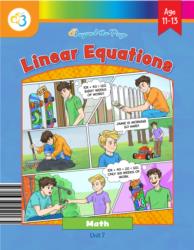
Unit 7: Linear Equations
Lesson 2
Multi-Step Equations
Students repeatedly work with parentheses and the distributive property (e.g., a(b+c)=ab+ac and the 3(a+4) → 3a+12 example) and see a visual showing the factor outside parentheses distributing to each term inside. Students set up and interpret product-style expressions in context (e.g., 4(y+2)=16) and the activity explicitly labels parts of that equation (y = cupcakes each person baked; +2 = Grandma's gift; 4 = number of bakers; 16 = total). Students also practice "combine like terms" and are asked to recognize and group terms with the same variable on student pages and in teacher/parent notes.
Lesson 3
How Many Solutions?
The lesson explicitly defines "coefficient" and shows students identifying coefficients in expressions (e.g., "3 is the coefficient of 3x" and that x alone has coefficient 1). Students perform distribution and combine like terms (e.g., 2(3x+4) → 6x+8) and complete activities that ask them to fill in missing coefficients, numbers, or terms so both sides of an equation match. Several tasks require simplifying whole subexpressions and comparing entire sides of equations to determine whether they are identical.
Lesson 4
Multi-Step Word Problems
Students set up and manipulate algebraic expressions such as 25 + 15x = 130 and 18x + 20 = 146, solve equations that require dividing by coefficients (e.g., dividing both sides by 15), and work with parentheses and the distributive property in problems like 5(2 - 3x) = 2x - 10 and 6(b + 2) - 3b = 15. Several activity problems and answer keys show terms written as coefficients times variables (e.g., 15x, 18x) and students perform operations on grouped expressions (e.g., substituting values into 25 + 15(7) and adjusting 10x + 40 - 20 = 120 in the comic strip).
Lesson 6
Substitution and Elimination
Students substitute expressions like (x + 2) for a variable and are instructed to "put it in parentheses and distribute," which has them treat a sum inside parentheses as a single entity to be multiplied (e.g., 3(x+2) → 3x+6). The lesson repeatedly uses and has students work with the term "coefficient" and asks them to compare coefficients when using elimination (e.g., "If the variable terms have the same coefficient, subtract; if the variable terms are opposites, add"). Worked examples and practice problems require students to align variable terms and manipulate coefficients to eliminate variables and to perform distributive multiplication of a coefficient across a grouped expression.
Lesson 8
Linear Algebra In the Wild
Students write and manipulate expressions such as S = J + 5 and then substitute J + 5 for S, producing J + 5 + J and then combining like terms to get 2J + 5. In break-even examples students treat 30x and 20x + 50 as whole expressions (substituting 30x for y to form 30x = 20x + 50) and solve by isolating and dividing coefficients. The activity pages repeatedly prompt students to define variables, write equations in forms like y = mx + b, and perform substitution or elimination on those expressions.
Final Project
Getting Ready for College
Students write and use linear expressions such as C = 1200m and C = 1500 + 1050m in the housing activity and set them equal to find a break-even point. Students simplify and rewrite expressions in the Phone Plans activity (e.g., y = (10x + 40)/2 simplified to y = 5x + 20) and set up linear equations like C = 225 + 0.60x and C = 1.25x in the transportation activity. Students analyze graphs to identify starting values and rates (y-intercepts and slopes) in the Meal Plans activity, finding initial costs and cost-per-week from given lines.
Unit 8: Data
Lesson 4
Linear Models
Students write and interpret linear equations in slope-intercept form y = mx + b (e.g., y = 2x + 50, y = x + 5) and identify m as the slope and b as the y-intercept. Students compute slope using the formula m = (y2 − y1) / (x2 − x1), which has them perform a quotient to find the rate of change. Students substitute values into equations (for example x = 10 into y = 2x + 50) to evaluate parts of the expression and produce numeric results.
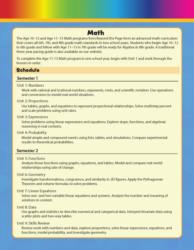
Unit 9: Semester Exams
Lesson 2
Proportions Review
Students write and match linear equations of the form y = kx (e.g., y = 6x, y = 4x, y = 7x) and identify the constant of proportionality (k) from tables and graphs in Activities 2 and 3. Students label points such as (0,0) and (1,k) and explain what those points represent in context, and they solve for unit rates and compare coefficients as unit rates in Activity 1 and Answer Keys. Several tasks ask students to write equations from tables and to select or confirm the equation that fits a proportional table or graph.
Lesson 3
Expressions Review
Students are asked to use the distributive property and to "factor an expression completely" (Activity 1) and answer keys show factored forms such as 8(4a + 1), which treats a parenthesized sum as a single factor. The Parent Plan explicitly references solving equations of the form p(x + q) = r and px + q = r, showing students work with expressions written as a product of a factor and a parenthesized expression. In Activity 3 and other places students identify the slope in equations of the form y = mx + b (e.g., "What is the slope?") which aligns with recognizing the coefficient of x in linear expressions.
Lesson 5
Semester Exam
Students rewrite and simplify expressions such as 4x + 9 + 6x + 1, which requires combining like terms and working with coefficients. Students distribute in problems like 3(y + 5) - y and solve equations like 5(x + 4) = 45, treating expressions in parentheses as single entities while applying a factor. Students factor expressions such as 24m + 12 into 12(2m + 1), explicitly creating a product of a factor and a parenthetical expression.
Lesson 8
Linear Equations Review
Students work with expressions that include parentheses, coefficients, and products such as 5(2x − 1) and equations with like terms (e.g., 7x − 3x + 4 = 28) in Activity 1. Students solve problems with fractional coefficients (e.g., (3/5)x = 18, (2/3)x − 5 = 7) and use the distributive property and combining like terms when simplifying and solving. Activity 4 has students write and solve equations from contexts (e.g., 25 + 15m = 100, 12 + 3m = 39), which requires recognizing constant terms and coefficients in linear expressions.
Lesson 10
Semester Exam
Students translate verbal expressions into algebra (e.g., problem 10: "The difference between twice a number and 4 is 7"), and write functions from real-world rates (e.g., "You earn $10 per hour. Write a function..."). Students work with expressions that include coefficients and grouped terms such as y = 3x + 4, y = 10x, and equations with parentheses like 5(2x − 1) = 45, which require recognizing multiplicative structure and coefficients when solving.