


Seventh Grade - MATH
5: Math
Unit 2: Integers and Rational Numbers
Lesson 4
Negative Numbers and Integers
Students are introduced to and practice the additive inverse: the lesson defines additive inverse/opposite, asks students to find additive inverses (e.g., "What is the additive inverse of -32?"), and has activities where opposites are plotted on horizontal and vertical number lines. Students solve real-world problems that use differences on the number line (for example, finding how many degrees temperature rose from -4 to +8 and comparing negative bank balances) and complete foldable and activity tasks that show opposites adding to zero.
Lesson 5
Absolute Value and Inequalities
Students use number lines to find distances between rational numbers (examples include -3 and 2 with 3+2=5 and 1 and 4 with 4-1=3). The materials explicitly define absolute value as a number's distance from zero and include exercises finding |x| for integers, fractions, and decimals. Multiple real-world problems (temperature differences, depths, distances between drivers) require students to compute distances between rational numbers and report positive answers, showing application of absolute value as distance.
Lesson 6
The Coordinate Plane
Students plot opposite numbers on number lines and fold the paper to see that a number and its opposite are the same distance from zero (Activity 3). Students change signs of coordinates and plot reflected points (Activity 5), and they use examples and rules showing (a,b) reflected across the x- or y-axis becomes (a, -b) or (-a, b). Students also plot and move points by specified left/right and up/down shifts, reinforcing how sign changes affect location on the number line and plane.
Lesson 7
Coordinate Problem Solving
Students plot integer and negative coordinates and compute horizontal and vertical distances between pairs of points (for example, finding that the horizontal distance between (7, −3) and (2, −3) is 5 and the vertical distance between (−3, 5) and (−3, −4) is 9). Multiple activities ask students to add horizontal and vertical distances to find total travel along grid lines in real-world contexts (bus stops, town maps, and a rectangular garden). The parent/skills notes and discussion questions explicitly state that distances are always positive because distance is the absolute value of a point from another point, and several problems use absolute value to find distances when coordinates share the same x or y value.
Lesson 8
Unit 2 Test
Students practice finding additive inverses (problems asking for the additive inverse of numbers and answer key showing opposites sum to 0). Students plot and compare integers on number lines and solve distance problems using absolute value (e.g., Cassie and Tim distance, temperature increase, and questions asking which number is closest to zero). The unit explicitly lists skills to "find the absolute value of a number and use a number line to find distances" and includes problems asking for horizontal and vertical distances between coordinate points.
Unit 3: Ratios and Percentages
Lesson 5
Percentages
Students solve a real-world subtraction problem when they find how much longer Alisha took to run a mile than Mirabelle (14.2 − 11.95 = 2.25). Students work with negative numbers and absolute value when they order the list including -4, |-9|, 2.5, 0, and -1 1/2, which requires evaluating |-9|. Students perform arithmetic with rational numbers (decimals and fractions) in multiple practice problems that include subtraction of decimals.
Unit 4: Algebraic Expressions
Lesson 3
Working With Expressions
Students translate real-world situations into subtraction expressions (e.g., Jade: n - 8; Benjamin: 50 - n; Lindy: n - 15; Tamika: (n - 3)/2) and complete practice problems requiring those expressions. Students evaluate expressions that include subtraction by substituting numbers for variables (e.g., evaluating n + 7 when n = 13, and other substitution practice). Students work with negative integers in context (writing temperatures as -17) which exposes them to signed rational numbers in problems.
Lesson 4
Positive and Negative Numbers
Students are taught explicitly that subtraction is adding the additive inverse (e.g., "Subtraction is the same as adding the opposite" and repeated rewriting of p - q as p + (-q)) and practice rewriting and evaluating many problems (Activity 2, Activity 4 and practice pages). Students are taught absolute value as the distance of a number from zero (several definitions and number-line diagrams showing |6| = 6 and |−6| = 6). Students use horizontal number lines to visualize addition and subtraction and solve real-world contexts involving temperatures, depths, money, and scores using these ideas (Activities 2, 4, 5).
Lesson 5
Equivalent Expressions
Activity 4 explicitly states that "subtraction is the same thing as add the opposite" and shows students rewriting expressions such as 6x - 3 + 2x + 7 as 6x + 2x + (-3) + 7 to combine like terms. The Basic Skills Review includes problems that use absolute value notation (for example, comparisons like |−16| > −16 and |−8 1/2| = |8 1/2|), indicating students practice with absolute value.
Lesson 6
The Distributive Property
Students are shown and practice changing subtraction into addition of the opposite (for example, the step that rewrites 5x + 15 + 2x - 9 as 5x + 15 + 2x + (-9)). Several worked examples and simplification steps explicitly convert subtraction to adding the negative when simplifying expressions (e.g., in the sequence that simplifies 5(x+3)+2x-9 and other examples). Student activity pages require evaluating and simplifying expressions that include subtraction so students practice using negatives when substituting values.
Lesson 7
Unit 4 Test
The lesson explicitly lists "the rule for changing subtraction to addition of the additive inverse of a number" and includes directions to "change subtraction to 'add the opposite.'" Multiple student problems require rewriting and solving expressions like 18 - 5, 20 - 36, -14 - (-9), 16 - 35 + 2, and 35 - (-7), and the answer key shows each being converted to p + (-q). The Parent Plan Skills section explicitly names the goal to "show that the distance between two rational numbers on the number line is the absolute value of their difference," indicating intended coverage.
Final Project
Algebra Think-Tac-Toe
The Parent Plan Skills list explicitly states "Understand subtraction of rational numbers as adding the additive inverse, p - q = p + (-q)." The Prove It! Equivalencies tasks repeatedly model and ask students to "Change subtract to add the opposite" and show worked examples converting subtraction into addition of negatives. Several student activities (Make a Quiz, Design a Book Cover, and other tasks) require students to solve real-world integer word problems and to apply rules for adding and subtracting positive and negative numbers.
Unit 5: Algebraic Equations
Lesson 2
Solving One-Step Equations, Part 1
Students are taught that addition and subtraction are inverse operations and that you use the opposite operation on both sides to isolate a variable (e.g., x + 9 = 21 solved by subtracting 9 from both sides). The materials state that "Additive inverses can be used to solve equations containing addition and subtraction" and the Basic Skills Review answer explicitly converts subtractions to adding opposites (e.g., change subtraction to add the opposite: 8 + (-2) + 7 + 5 + (-1)). Students practice using inverse/additive-opposite reasoning when solving equations and checking solutions in multiple activities.
Lesson 7
Independent and Dependent Variables
Students encounter subtraction of negatives in practice problems and answer keys (for example, the Basic Skills Review problem -8 - (-5) + 11) where the solution shows changing a subtraction to adding the opposite. The answer key explicitly states "Change subtract to add the opposite: (-)8 + 5 + 11 = ...", which demonstrates p - q = p + (-q) in a worked example. Students also work with number lines and coordinate grids (equation/inequality number-line comparisons and many graphing activities) that develop familiarity with positions of rational numbers on number lines.
Lesson 8
Unit 5 Test
Students solve equations that include subtraction of rational numbers (for example, x − 2.4 = 7.6 and a/7 − 5 = 9), and they are instructed to add the same quantity to both sides to isolate the variable. Students also solve and graph inequalities on number lines (several problems include number lines from −8 to 8 with open/closed dots and arrows) and rewrite subtraction equations in equivalent forms (e.g., x − 8 = y).
Unit 6: 2D Geometry
Lesson 2
Working With Angles
Students work with a real-world temperature context where the answer key explicitly rewrites subtraction as addition of a negative: (−14) − 7 = (−14) + (−7) = (−21). The Basic Skills Review also asks students to solve and graph an inequality on a number line and to use inverse operations to cancel addition or subtraction when solving equations, showing practice with subtraction and additive inverses in algebraic manipulations.
Unit 7: 3D Geometry
Lesson 1
Three-Dimensional Solids
Students rewrite a subtraction expression as adding the opposite when solving for an unknown in Euler's Formula (the text shows changing F + 5 − 8 = 2 to F + 5 + (−8) = 2 and then combining like terms to get F + (−3) = 2). The solution steps also show adding the inverse to both sides to isolate the variable (F + (−3) + 3 = 2 + 3).
Lesson 2
Surface Area
Students evaluate an expression that explicitly uses the idea of additive inverses in the Basic Skills Review: when finding n^2 − (−5) with n = 3, the solution shows rewriting the subtraction as an addition (9 + 5) and computes the result. The Basic Skills Review also has a number-line tas< (graphing y < 2), providing limited exposure to number-line representations.
Unit 8: Statistics
Lesson 2
Populations and Samples
Students perform arithmetic that converts subtraction to adding the opposite (Problem 4: 4 + 7 - 13 + 1 - (-2) with the answer key noting "Change subtraction to add the opposite"). Students also work with a number line when solving and graphing the inequality n + 3 < 5 (Problem 7), showing practice using a horizontal number line diagram for numerical relationships.
Lesson 7
Measures of Variability
Students repeatedly compute differences as measures of spread: they find range by subtracting the minimum from the maximum and complete "Distance from the Mean" tables to find the mean absolute deviation. The student pages ask students to list the distance of each data value from the mean and then average those distances, and several activities place these calculations in real-world contexts (orchards, cars parked, water usage, hours worked). Students construct and read box plots on horizontal number lines, marking minimum, quartiles, median, and maximum, and interpret the lengths of whiskers and boxes as distances on the number line.
Lesson 9
Comparing Populations
Students compute differences between means (for example, 9.0 - 7.5 = 1.5) and then divide that difference by a measure of variability. Students also compute mean absolute deviation by listing distances from the mean as positive values, summing those distances, and dividing to find the average distance. These computations are applied to real-world contexts such as pumpkin and zucchini weights to draw inferences about populations.
Final Project
Statistical Study
Students are instructed to display numerical data on number lines using dot plots and box plots, and the Parent Plan explicitly lists "Display numerical data in plots on a number line." Students are directed to compute the range (maximum minus minimum) and to draw box plots that place minimum and maximum values on a number line. Students also calculate mean absolute deviation, which requires computing absolute differences from a central value.
Unit 9: Skills Review
Lesson 2
Fractions, Ratios, and Coordinates
Students solve subtraction problems with rational numbers in the Operations with Fractions activity (e.g., 18 1/4 − 10 2/3 and word problems like Bart's fabric: 6 1/2 − 3 2/3). Students apply subtraction in real-world contexts such as calculating hours worked and fabric remaining. Students compute distances on a coordinate grid (Exercise 2 asks for the vertical distance between two plotted points and the midpoint/what is halfway between them).
3: Math
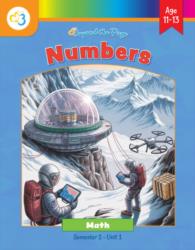
Unit 1: Numbers
Lesson 1
Positive and Negative Rational Numbers
Students are shown and asked to use the equivalence of subtraction and adding a negative (for example, 3 - 3 = 0 and 3 + (-3) = 0) and complete activity pages that require writing equations like 10 + (−8) to represent real situations. Multiple tasks ask students to draw movements on a number line, circle zero pairs, and write equations using one positive and one negative number (e.g., scuba diver scenarios, jellybeans, earning/spending money). Activities require students to represent real-world changes with signed rational numbers and to solve for resulting amounts using those representations.
Lesson 4
Square and Cube Roots
Students work with subtraction involving negative numbers in the Review Quiz (e.g., 7 - (-3) appears in Part 1). The answer key explicitly rewrites that problem as 7 - ((-)3) = 7 + 3 = 10, demonstrating subtraction of a negative as addition of its additive inverse. Several word problems and quiz items involve negative changes (e.g., temperature drop) requiring students to compute with negatives.
Lesson 7
Arctic Marine Research
Students calculate temperature range between -15°C and 5°C and compute an average daily temperature (answers show range = 20°C and average = -5°C). Students compute submarine depth changes starting at -450 m and rising 175 m to find a final depth of -275 m. The unit also repeatedly asks students to perform calculations with positive and negative numbers in real-world contexts.
Lesson 8
Unit 1 Test
Students solve real-world subtraction problems with signed numbers such as a submarine 300 feet below sea level ascending 125 feet (answer: -175) and a diver 400 feet below ascending 150 feet (answer: -250). Students compute net profit/loss problems (e.g., $2,000 minus $1,500 = $500) and answer arithmetic problems that involve subtracting or adding negative numbers (sums like -12 + 12 and division of negatives). Several items ask for explanations of reasoning, so students practice performing and justifying computations with positive and negative rational numbers in context.
Final Project
Mars Station Test Mission
Students compute energy shortfalls by subtracting energy produced from energy needed for each location (Task 3), producing numeric differences in kWh and then converting those differences into counts of fuel cells. Students compute distances to supply depots by simplifying given square-root distances to decimals to the nearest hundredth (Logistics Task 2), using those distances to calculate delivery costs. Students calculate drop zone radii and areas (Task 1) and use those spatial measures and costs in real-world supply logistics calculations.
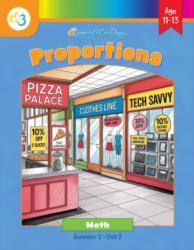
Unit 2: Proportions
Lesson 7
Markups and Discounts
Students calculate differences using subtraction in multiple places: they use the formula Final Price = Original Price − Discount and complete examples such as 50 − 15 = 35 and 100 − 20 = 80 then 80 − 8 = 72. Students also compute percent change with New − Original in the formula Percent Change = ((New Value − Original Value) ÷ Original Value) × 100 and solve problems like 117 − 90 = 27 to find percent increase. Students work backward on problems that require solving equations involving subtraction (for example, x × 0.85 = 255 → x = 300).
Lesson 8
Simple Interest and Percent Error
Students compute the absolute value of the difference between actual and estimated values in the percent error examples (e.g., |30 − 25| = 5) and then use that absolute difference in the percent error formula. The student activity pages include multiple real-world problems (weights, temperatures, prices, shots made) that require finding |actual − estimated| and applying it to compute percent error.
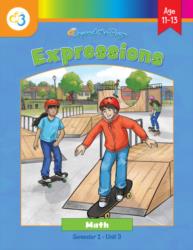
Unit 3: Expressions
Lesson 7
Rise Over Run
Students draw right triangles between points and count vertical and horizontal changes (rise and run), recording a '+' when moving up/right and a '−' when moving down/left. The activity materials require students to compute rise as y2 − y1 and run as x2 − x1 by counting squares and to record signed values (examples in the answer key show negative rises). The lesson places slope and these signed differences in real-world contexts (ramps, roads, skateboard ramps).
Lesson 8
y = mx + b
Students compute differences using subtraction when finding slope with m = (change in y)/(change in x), e.g., m = (6 - 2)/(3 - 1) and m = (−1 − 5)/(4 − (−2)). Students use subtraction to solve for b by substituting a point into y = mx + b and isolating b (for example 5 = 4 + b then subtract 4 to get b = 1). Students also compare steepness by considering the magnitude of slopes (noting "ignoring the sign" when judging steepness).
Lesson 9
Unit 3 Test
Students compute differences of rational numbers when finding slope and when working with coordinates that include negative values (e.g., plotting (0,0) and (3, -6) and using slope = (y2 - y1)/(x2 - x1); the answer key shows slope computed as ((-6 - 0)/(3 - 0) = -2)). Multiple problems require subtracting y- and x-coordinates and working with negative results. Students also work in real-world contexts (earnings, costs) that involve linear relationships and use subtraction in solving those equations.
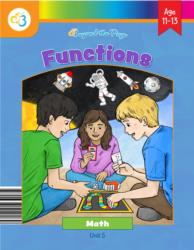
Unit 5: Functions
Lesson 5
Slope
Students repeatedly compute differences using the formula m = (y2 - y1) / (x2 - x1), filling in and simplifying expressions such as 16 - 2 and -3 - 4 to get positive and negative results. The lesson records changes in coordinates as signed 'rise' and 'run' (for example, "y changes by -1, x changes by +1") and has students calculate slopes using negative numerators and denominators. The materials also emphasize subtraction order (y2 - y1 over x2 - x1) and provide multiple practice problems where students subtract rational numbers from one another.
Lesson 7
Creating Functions
Students model situations that involve decreasing quantities and use negative coefficients (for example S = −3f + 30, P = −2s + 50, B = −5h + 100) so they identify and work with negative rates of change. Students write and interpret linear equations from stories, tables, and graphs that include both positive and negative slopes and place points on a number-line-style graph to find intercepts and slope (e.g., using points like (0,5), (1,8)).
Unit 6: Geometry
Lesson 2
Translations
Students apply algebraic translation rules written as (x + a, y + b) and compute coordinates using additions with negative numbers (for example, M(6, -2) with T_{-5,3} gives x: 6 + (−5) = 1 and y: (−2) + 3 = 1). Example 2 explicitly shows using x + (−4) and y + 1 when translating triangle vertices X(0,0), Y(2,0), Z(1,2) by T_{-4,1}. The notes and practice problems include many translation rules with negative a or b, requiring students to add negative rational numbers to find new coordinates.
Unit 8: Data
Lesson 1
Statistics Review
Students calculate range by subtracting the smallest value from the largest (example: 52 − 38 = 14) and use number-line-based box plots that mark minimum and maximum values. Students compute mean absolute deviation by taking absolute values of differences from the mean (examples show |value − mean| and averaging those distances). Students place values and five-number summaries on a number line when constructing and interpreting box plots.
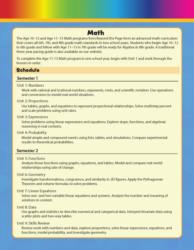
Unit 9: Semester Exams
Lesson 1
Numbers Review
Students write and evaluate expressions that add negatives in real contexts (e.g., 9 + (−9) = 0 for the hiking zero-pair and 15 + (−15) = 0 for the banking example). Students compute with negative numbers in arithmetic problems (e.g., −12 + 7 = −5 for the submarine, sign-rule multiplication and division items, and −45 ÷ 9 = −5 and −72 ÷ 6 = −12 in real-world contexts). Students are asked to create and solve their own real-world problems involving positive and negative rational numbers, including fractions and decimals.
Lesson 9
Data Review
Students calculate distances using absolute value when finding mean absolute deviation (e.g., |12 - 15| = 3 and MAD = (3+1+1+3)/4 = 2). Students compute ranges by subtraction (e.g., Range = 13 - 4 = 9) and draw box plots on a horizontal number line showing minimum, Q1, median, Q3, and maximum. Students apply these computations to real-data contexts (books read, class scores) to interpret spread and consistency.
Lesson 10
Semester Exam
Students are asked to compute mean absolute deviation (MAD) for data sets (Problems 36–45) and the answer key states that MAD is "the average distance of the data values from the mean," which invokes distance as an absolute difference. Students also compute distances in coordinate geometry (Problem 16: find the distance between A(0,0) and B(6,8) = 10 units), practicing distance calculations between points.