


Ninth Grade - ELA
1: Semester 1

Unit 1: Lord of the Flies
Lesson 1
The Call
The Parent Plan lists a skill to "determine the meaning of words and phrases...; analyze the cumulative impact of specific word choices on meaning and tone," which directs students to examine diction. Activity 2 (Vocabulary) has students match words, definitions, images, and passage quotations, requiring students to use context to interpret precise word meanings. The lesson text explicitly states "Word choice is a tool authors use to create the tension and excitement in their stories," framing vocabulary study as a means to understand how language evokes place and tone.
Lesson 2
Life on the Island
Students are prompted to collect telling details on STEAL character pages, recording Speech, Thoughts, Actions, Effect on Others, and Looks for each boy, and to add page-numbered examples as they read. The Getting Started section and example passages (e.g., the power outage and 1940s Britain descriptions) provide concrete sensory and telling details that students are asked to notice. The Parent Plan lists a skill to "use various types of phrases and clauses to convey specific meanings and add variety and interest to writing or presentations," and Part II of the clauses activity asks students to write original sentences about the novel.
Lesson 3
Paths in the Jungle
Students write a one-paragraph journal entry from a chosen Lord of the Flies character's first-person point of view, answering prompts about who they are, where they are, what they want, and what they must overcome. Students are instructed to imagine the character's perceptions, emotional responses, and reflections on significant events, which asks them to describe thoughts and feelings and include descriptive details. The skills list asks students to 'use various types of phrases and clauses to convey specific meanings and add variety,' which supports attention to word- and phrase-level craft.
Lesson 4
Images from Paradise
The lesson defines literary imagery as using words to invoke sensory memories from all five senses and gives model quotations from Golding that use vivid sensory detail. Activity 1 asks students to find or write sentences that evoke each of the five senses, include the original and an embellished version, and explain how the description serves as imagery and whether it suggests paradise or dystopia. The parent-plan notes explicitly that students will practice finding and/or writing examples of imagery to evoke awareness of all five senses and that this practice reinforces how imagery creates tone.
Lesson 5
Not Hunting, But Hunted
Students are shown explicit examples from Lord of the Flies that interrupt dialogue with details of mindset, voice inflections, posture, facial expressions, and physical motions to slow the pace. The lesson highlights sensory details (sunlight, brightness) and a series of verbs (looked, spilt, leapt, laughed) that break a moment into discrete, vivid components. Students compare a sparse Example A with a detailed, sensory-rich Example B (crunch of boots, silhouette, heart pounded) and are instructed to recreate their own moment in the style of Example B.
Lesson 6
Symbolism, Part 1
Students are asked to write a one-page journal entry from a character's point of view, recording actions and quotes and addressing the character's priorities, fears, and relationships, which requires composing narrative text with character-specific detail. Students complete a Student Activity Page where they pick interpretations for symbols and write 2–3 sentence explanations supported by textual evidence, practicing selecting language to convey meaning. Students are assigned to add to STEAL character pages as homework, prompting them to collect speech, thoughts, effects, actions, and looks—elements that can include descriptive and sensory details about characters.
Lesson 7
Bowed and Bowed Again
The lesson explicitly shows how phrases create vivid images by citing Golding's examples ("ill-balanced twister," "darkish figure against the shimmer of the lagoon," "a kind of dentist's chair unreality"). Activity 2 directs students to "notice how phrases can be used to add detail to your writing" and asks students to write journal sentences that contain noun, verb, adjective, adverb, and absolute phrases. The prepositional-phrase activity has students add descriptive prepositional phrases to sentences and identify how phrases modify nouns or verbs in context.
Lesson 8
Defects of Human Nature
Students complete vocabulary exercises (matching definitions to words in context and filling blanks) that require attention to precise word meanings (e.g., incredulity, luxuriance, ululation, dun). Students are asked to support theme choices by referring to specific details from the novel and to write 3-4 sentence explanations defending their selections, which requires choosing words and details to convey ideas. The activities prompt students to record details and to cite scenes (e.g., Ralph's appearance, the fire, Piggy's glasses) when explaining themes.
Lesson 10
Which Is Better?
Students are asked to write a one-page journal entry from a chosen character's point of view, a narrative task that asks them to describe events, settings, and characters (Activity 2). The lesson includes descriptive teacher text about the Colosseum and Roman aqueducts that uses telling details and concrete imagery which students read and can reference as a model. The Developing Civilization activity asks students to compare similarities and differences between the boys and early peoples, prompting them to record specific details about experiences and settings on the student activity page.
Lesson 11
The Film
Students are prompted to reflect on description with the journal question: "Description in writing allows us to create our own mental images. What is an example of a visual from the movie that was different from how you imagined it when you read the book?" The activities ask students to compare setting, characters, and visuals between book and film on the "Movie vs. Book" chart. The lesson also asks students to look for subtext and mentions imagery and other literary devices to review before the unit test.
Final Project
Now You Have the Conch
The lesson's skills list tells students to use various types of phrases and clauses to convey specific meanings and add variety and interest to writing, and the revision materials ask students to check sentence structure, placement of phrases, and use of clauses to vary sentence type. The brainstorming and outline pages require students to find passages, note key phrases or quotes, and provide specific examples and explanations to support their points. The editor and revision activities prompt students to attend to style and to make changes that improve clarity and organization.
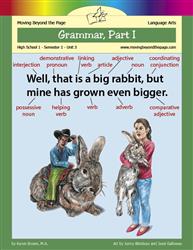
Unit 3: Grammar, Part I
Lesson 2
Subject-Verb Agreement
Students review many commonly confused word pairs (e.g., affect/effect, advice/advise, a/an) and record notes, tips, and examples on activity pages, then choose the correct word in multiple-choice sentences. Students create or complete exercises and quizzes that require selecting precise lexical items and explaining choices (Option 2 asks students to write questions and explanations). The Parent Plan repeatedly instructs students to add their own notes and examples, reinforcing attention to correct word choice.
Lesson 7
Spelling
Students practice choosing the correct word form in multiple exercises (Commonly Confused Words, Sets VI and VII and the SPELLING activity) by circling the correct word in sentences. The lesson provides explicit definitions and usage notes for pairs/groups (e.g., council vs. counsel; cite/sight/site; compliment vs. complement) so students learn to select the precise word for a given context. In Activity 3 students create detective cards with mnemonics and clues, say and spell words aloud, and write sentences using the target words.

Unit 4: Poetry
Lesson 1
Introduction to Poetry
Students analyze poets' word choices in multiple activities: in Activity 2 they mark words in "Richard Cory" and discuss lines like "sole to crown" and "imperially slim" to see how diction creates appeal. They use a Dickinson poem on a worksheet to list words, write denotations and connotations, select similar words, and explain why the original word is more effective. Homework asks students to mark Billy Collins's poem and choose words with strong positive/negative connotations, explaining why those words are effective.
Lesson 2
Sound and Rhythm
Students identify and label sound-based word choices (alliteration, consonance, assonance, and onomatopoeia) in multiple poems (e.g., marking examples in "Nothing Gold Can Stay," "The Tyger," and the provided phrase list including onomatopoeia like "meow," "slurp," "hiccup"). Students write short journal responses explaining why a chosen repetition or sound device is effective and reflect on how rhyme and rhythm affect the reader. Students also practice producing language patterns (creating words or phrases to match metrical feet) which requires deliberate word selection for sound.
Lesson 3
Figurative Language
Students are instructed to identify imagery in "I Wandered Lonely as a Cloud," citing stanza and line numbers and explaining how the imagery appeals to the senses. The homework options ask students to note which senses a poet appeals to ("To a Skylark") and to take sensory notes outside, then write an original poem that must include imagery appealing to two or more senses. The Parent Plan and activities direct students to analyze specific word choices and the cumulative impact of language on meaning and tone.
Lesson 4
Voice and Tone
Students explicitly identify sight and sound images in Robert Frost's "The Fear," recording sensory details and noting why those images create an eerie, mysterious tone. Students use a student activity page that asks them to analyze a poem through the senses and to count repeated sensory words (see, look, light, lantern) and explain the effect of repetition. In the Tone activity, students list words or phrases that convey tone and cite specific language from poems that transmits emotion. Students also complete creative tasks (letters or new stanzas) that ask them to refer to parts of the poem and write in another voice or style.
Lesson 7
Analyzing Poetry
The lesson directs students to identify and comment on words or phrases that create strong images (e.g., "Comment on a word or phrase that conveys a strong image or feeling" and annotation prompts asking "What do you imagine/see as you read the word/line/poem?"). The Poetry Map activity explicitly asks students to find images that appeal to each of the five senses and includes a Word Choice box and an Imagery box for students to record sensory language. The Parent Plan skills state students will "determine the meaning of words and phrases" and "analyze the cumulative impact of specific word choices on meaning and tone," which guides students to analyze precise diction and its effect.
Lesson 8
Types of Poems
The lesson's Skills list explicitly names using precise words and sensory language to convey vivid pictures. The Free Verse activity and its student activity page direct students to brainstorm sensory details (sight, sound, touch, smell), choose strong verbs, and craft a 5–10 line poem that uses at least two devices (simile/metaphor, personification, apostrophe). The Writing-a-Sonnet and Write-a-Poem pages provide templates and prompts that require students to select specific words and try to achieve evocative meter and imagery, and the Describing/Strong Verbs sections give concrete practice in replacing bland verbs with more vivid ones.
Lesson 9
The Crossover
The Skills section asks students to "determine the meaning of words and phrases...; analyze the cumulative impact of specific word choices on meaning and tone," and the introduction tells students to "note how the poet uses words and patterns to bring the world of the boys to life." The vocabulary Option 1 asks students to compare the book's word definitions to dictionary definitions and explain how the author's method aids understanding. Option 2 asks students to write a poem defining a word "in a manner similar to the way it's done in the book" using people and events from their own lives to create three "As in:" sentences.
Lesson 10
Poems and Poets
Students complete a "Poetry Map" that explicitly asks them to record "Word Choice," "Imagery," and "Other Figurative Language," and to "Summarize in your own words" and identify the poem's "Theme." Students are asked to read poems aloud and annotate or take notes, which directs them to attend to sensory details and specific word choices. Activity 4 asks students to analyze cultural references in a poem and then write a journal response summarizing the poem and describing how those references enrich meaning.
Lesson 11
Reciting Poetry
Students are directed to mark unfamiliar words and look up their meanings and pronunciations, which requires attention to word choice and precise language. Students are asked to consider what images the poem's words put in their minds and to use imaginative focus to picture settings and events for an audience. The lesson gives a concrete example (Housman's "chaired" vs. "picked up") and includes a parent-plan skill that tells students to determine the meaning of words and phrases and analyze the cumulative impact of specific word choices on meaning and tone.
Final Project
Poetry
The unit's Skills list explicitly names "Use precise words and phrases, telling details, and sensory language to convey a vivid picture" as a targeted skill. In Choice 5 (Poetry Explication) students are asked to identify memorable imagery, note what senses the poem appeals to, and analyze notable word choice and figurative language. In Choice 4 (Artwork Based on a Poem) and Choice 1 (Director's Notebook) students take notes on imagery, sketch or design scenes, and write explanatory paragraphs that rely on poem details to convey setting and characters. Choice 3 (Ekphrastic Poem) requires students to compose an original poem inspired by artwork, an activity that calls for deliberate use of sensory and telling details.
Unit 5: Nonfiction
Lesson 4
Dear Diary
The lesson's Skills section explicitly lists writing narratives using "well-chosen details" and producing "style" appropriate to task. The paraphrasing activity gives students explicit guidance on word choice ("use different terms," "use a thesaurus") and asks students to analyze paraphrases for copied phrasing or inaccurate wording. The homework asks students to write a one-page diary entry about a significant event, providing an opportunity to practice narrative word choice and detail selection.
Lesson 5
Displacement
Students are asked to examine photographs of schools and record three assumptions about the school or its students, prompting them to choose descriptive details from images. Students must write 3–4 sentences from the point of view of a pictured student about what he or she likes and dislikes, a task that requires depicting experiences, setting, and character perspective. The photo-report/illustration objective asks students to "position [the photo] in the world" and to use words and objects around the photo to communicate something about the students, which encourages selecting informative details.
Lesson 6
A Day Like Any Other
The lesson asks students to use the APE strategy, where the "Prove" step requires students to provide evidence with specific examples and quotations from the text, and the "Extend" step asks for an explanation or personal connection. The student activity and discussion prompts ask students to imagine and explain what it would be like to quit school or be forced into marriage, which invites descriptive responses about experiences. The parent plan reiterates that students should provide quotations and examples and explains expectations for the "prove" and "extend" sections.
Lesson 8
Civil Rights
Students read vivid primary and literary texts (excerpts from Frederick Douglass, poems by Langston Hughes and Maya Angelou, and Martin Luther King Jr.'s "Letter from Birmingham Jail") that model telling details and rhetorical imagery. Students watch video clips about the Freedom Riders and the Birmingham Children's March to get a sense of atmosphere and sensory context. Students are asked to create a poetic description (Option 2) or a creative graphic response (Option 1), including an option to compose a found poem by selecting and arranging evocative phrases from source texts.
Lesson 10
Learning from the Past
Students are asked to annotate and analyze Elie Wiesel's speech, with explicit prompts to "notice the style and tone" and to identify examples of metaphor and figurative language. Students complete writing tasks that require composing paragraphs (finding and comparing universal-truth quotations), creating a museum wall with one- or two-sentence formal descriptions, and producing a written record (journal entry or poem) of a sad event. Students also paraphrase and rewrite quotations in their own words, practicing selection of wording when explaining meaning.
Lesson 11
A Boy's Story
Students are asked to interpret words and phrases and analyze how specific word choices shape meaning or tone, as stated in the lesson skills. Students look up vocabulary, record definitions in their own words, and fill sentences from the book using those words, practicing selection and understanding of precise terms. Students are prompted to compare the memoir's writing style to I Am Malala and discuss impressions from the author's interview, which requires attention to word choice and descriptive effect.
Lesson 12
Running from War
Students are asked in Option 1 to take journal notes about an important event including who was there, what they wore, and what sounds or smells they remember, which prompts use of sensory details. In Option 2 students must draw or paint a remembered scene including colors, items, and people to convey layout and detail. The homework APE task requires students to 'Prove' their answer using a quotation and then 'Extend' by explaining how the quotation supports their answer, which invites relating sensory or telling details from the text.
Lesson 14
Rehabilitation
Students are asked to write journal responses (Option 2) that require them to state conclusions and provide examples or quotations from the text. The "Wiesel's Words" activity directs students to explain how a quotation relates to the memoir and to include specific examples from the book or video. The homework options ask students to record the details of a recent dream or one of Beah's nightmares and then analyze its meaning, which requires describing events and details.
Lesson 15
A New Life
The lesson explicitly asks students to analyze authors' rhetoric and writing style and to choose adjectives (e.g., descriptive, literary, conversational) to describe each memoir's style. Students are asked to look at specific scenes (for example Malala's shooting and Beah's rebel attack) to compare how details are presented, which directs attention to authors' use of telling details and sensory description. The parent notes list specific sensory/details from Chapter 20 (cold, snow, lights, food, Times Square) that students might include in their summaries, and the flyer/webpage activity asks students to write persuasive, descriptive text about nonprofit organizations.
Final Project
Expository Essay
The lesson's skills list explicitly tells students to "use precise language and domain-specific vocabulary to manage the complexity of the topic." The rubric and activity pages include a "Style" category that assesses word choice and sentence variety, and the guidance asks students to read aloud to spot awkward wording and to revise for clearer wording. The lesson also requires students to develop the topic with "well-chosen, relevant, and sufficient facts, extended definitions, concrete details, quotations, or other information."
Semester Exam
Semester Exam
The lesson asks students to analyze poems for imagery, tone, and figurative language (Part VI: Poem Analysis), requiring identification of examples of personification, simile/metaphor, and imagery. The skills list and activities encourage students to revise previous writing (short stories, papers) and to produce clear, coherent writing appropriate to audience and purpose. Discussion prompts (Part IV, especially E) ask students to reflect on authors' transparency and specificity about war, which invites attention to precise and specific language in analysis.
2: Semester 2

Unit 1: Ender's Game
Lesson 2
We're People, Not Thirds
The Parent Plan lists a skills goal that asks students to determine meanings of words and analyze the cumulative impact of specific word choices on meaning and tone, which directs students to attend to precise words and their effects. The vocabulary activity requires students to match advanced words (e.g., puerile, invective, impassively, albedo) with definitions, giving students practice identifying precise words and their connotations. The collage option asks students to select words, quotes, and images related to the theme of "three," which requires choosing language and details to represent a concept.
Lesson 5
Movement and Time
Students perform a close reading of action sequences in Activity 1 ("Words in Motion") to "pay close attention to the way [Card] communicates motion sequences." Students build pipe-cleaner figures and recreate movements, then (optionally) narrate those movements "using strong descriptive phrases." The lesson explicitly asks students to practice narrating motion and to analyze how authorial word choices create visual images of action.
Lesson 9
Conflict Within and Without
Students are asked to write paragraphs in their journals about the development and impact of conflicts (Activity 1) and to write 1–2 paragraphs speculating on the chapter title (Activity 2), which requires descriptive explanation. The lesson includes sensory and vivid phrases in its examples (e.g., "the boys are sweaty and tired at the end of battle," "freezing cold temperatures," "blood rain," "poisonous fog") that model telling details about events and settings. The student activity page prompts students to consider how conflicts fit into theme and plot and to describe conflict development, which can invite use of precise language and details.
Lesson 11
Thud, Whump, Huut
The lesson explicitly defines onomatopoeia in "Things to Know" and repeats the concept in Activity 1, noting that comics sometimes shorten descriptions to onomatopoeias. Student activity pages include panels and sound words (e.g., THUD WHUMP, ~HUUUT!) that students are asked to analyze. The Comic Adaptation activity asks students to note what narration or dialogue was omitted or changed and to decide whether Marvel communicated the omitted words through pictures.
Final Project
Think-Tac-Toe
Students are asked to write a one- to three-paragraph flashback to insert into a scene (Box 2), which requires composing narrative prose and conveying a character's thoughts and memories. Students must rewrite a three- to four-paragraph passage from third person into first person (Box 3), practicing narrative voice and perspective. Students create narrative/storyboard/artistic pieces (Boxes 1, 6, and 7) that involve selecting details and presenting scenes visually or in sequence.
Unit 2: Grammar, Part II
Lesson 1
Review of Grammar, Part I
Students are asked to identify and match descriptive grammatical forms such as coordinate adjectives and appositives (e.g., "a delicious banana split," "the thirsty, complaining visitor") in the Grammar Matching activity. The Mad-Libs "Parts of Speech Zombie Apocalypse" requires students to produce adverbs, coordinate adjectives, intensifiers, nouns, and interjections and then insert them into a short narrative. Several activities prompt students to choose specific adjectives and adverbs and to notice how those word types function in sentences.
Lesson 2
Capitalization and Numbers
Students complete a "Commonly Confused Words" activity in which they choose the correct word from a word bank to fill blanks in a letter, applying distinctions among pairs like envelop/envelope, fewer/less, and forego/forgone. Students record notes, tips, and examples on activity pages for each word pair to reinforce precise word choice. Students also record rules and examples for writing numbers and write rules that explain correct capitalization in paired-sentence exercises.
Lesson 3
Sentence Fragments and Run-on Sentences
Students are asked to write a 1–2 page narrative (Creative Writing Challenge) that must use nine target words correctly and naturally and to show differences between word pairs (for example, good vs. well and imply vs. infer). Students complete exercises identifying and using participial, gerund, and infinitive phrases (e.g., underlining participles and drawing arrows to the nouns they modify), with example sentences like "Perched on a fence, the bird sang happily." The Parent Plan also lists as a skill that students should "use various types of phrases... to convey specific meanings and add variety and interest to writing or presentations."
Lesson 4
Modifier Errors
Students practice precise word choice in Activity 1 by selecting the correct words from commonly confused sets (e.g., peak/peek/pique, passed/past) and by checking answers against an answer key. Students learn how participial phrases function as adjectives and must be placed next to the nouns they modify, which affects how descriptions attach to characters, objects, or settings. In Option 1 students redraw or rewrite sentences to show how modifier placement changes meaning, requiring them to attend to how wording shapes the image conveyed.
Lesson 6
Word Choice
Students practice choosing precise, specific words and strong verbs when they rewrite sentences in the Avoiding Wordiness and Avoiding Redundancy activities and when they translate clichéd or wordy phrases on the Word Choice worksheet. In the College Essay Editor activity, students read a draft paragraph, identify vague or clichéd language, and rewrite the paragraph using clearer, more specific wording and vivid descriptions. The lesson text explicitly tells students that "strong writing uses clear, precise language and concrete details" and directs them to "choose words and details with strong, vivid descriptions."

Unit 3: Informational Texts
Lesson 2
Outliers
The vocabulary activities require students to look up words in a thesaurus, choose synonyms that match both denotation and connotation, and try inserting those synonyms into sentences from Chapter One. The parent-plan notes and activities ask students to determine meanings of words and analyze the cumulative impact of specific word choices on meaning and tone. Students also re-read and analyze Gladwell's Introduction to examine how analogy and word choice help convey meanings.
Lesson 5
Harlan, Kentucky
Students complete a Chapter 6 Vocabulary activity in which they underline unfamiliar words in the text, guess meanings from context, and then look up and record dictionary definitions and pronunciations. The Parent Plan asks students to add challenging words to a spelling journal and to consult the provided dictionary link to hear pronunciations, reinforcing accurate word choice and precise vocabulary. Students also complete an informal journal reflection homework about the settlers of their area and local stereotypes, requiring them to write about experiences and influences in prose.
Lesson 8
With Malice Toward None
The lesson explicitly instructs students to "analyze Lincoln's rhetorical strategies including the choices he made regarding tone, organization of ideas, and word choice," and asks students to read the speech and identify quotes and the literary devices used (parallelism, antithesis, allusion). Students complete a chart identifying specific lines from the address, label the literary device, and explain the intended effect on the audience (for example, analyzing how "With malice toward none, with charity for all..." functions as parallelism and shapes tone). The parent plan asks students to analyze particular sentences and cite textual evidence, which requires attention to specific words and phrasing.
Lesson 9
Writing about History
Students are asked to "write a paragraph" about what they expect to see and feel at the Sand Creek Massacre National Historic Site (Homework), which prompts sensory and descriptive responses. The Getting Started vignette models sensory description ("a giant crash sound," "you run in to see," "look around the room") that students could emulate. Option 1 (Picture This) asks students to produce a split-perspective magazine cover, which invites creating vivid depictions of events and characters. Primary-source activities require students to select and cite telling details from testimonies (e.g., descriptions of flags, mutilation, women and children killed) as supporting evidence.
Lesson 11
Technical Writing
The Parent Plan lists "Use precise language and domain-specific vocabulary to manage the complexity of the topic," and students are asked to identify and highlight subject-specific terms, create a glossary, and explain jargon for a general audience. Students must list required materials, write ordered steps, and include background information and tips in paragraph form, which requires providing telling details so another person can complete the task. The Guide Checklist and revision instructions ask students to make instructions clear, appropriate to audience, and to highlight glossary terms the first time they appear.
Lesson 12
Logical Fallacies
Students read explicit explanations of pathos that state "vivid images and personal stories are often used to tug at an audience's emotions." Students analyze Lou Gehrig's speech for emotionally resonant words and phrases (honor, wonderful, blessing, tower of strength) and identify how those details appeal to readers. Students write their own short speech (Option 2) and are asked to note where they appealed to ethos, logos, and pathos, with a provided sample that uses an imagined scene ("Imagine how sad and tragic it would be if a child were injured") to evoke emotion.

Unit 4: Drama
Lesson 2
How to Read Drama
Students complete a Diction/Language student activity page that asks them to identify figurative language, dialect, and how the playwright uses language to evoke feelings. Students answer journal questions about specific sensory and spectacle details (e.g., set description, sound effects, lighting) and cite examples from the Trifles script and performance. The Applying Aristotle activity asks students to describe diction and how language distinguishes characters and triggers audience emotion.
Lesson 4
A Raisin in the Sun
Students identify and record strong adjectives and character descriptions on the "Characters and Their Dreams" organizer, noting Hansberry's descriptive choices. Students analyze dialect and vernacular (including AAVE) and identify how speech patterns and stage directions reveal character, and they match vocabulary in context to precise definitions. Students create a detailed stage drawing or direct and rehearse scenes, which asks them to add authentic, time-specific details to convey setting and character.
Lesson 5
Act II
Students complete a character analysis that asks them to record physical characteristics, mannerisms, type of speech, and psychological profile, requiring descriptive detail. Students write a six-sentence monologue based on that character analysis that must "reflect the character," prompting use of telling details. The vocabulary activity has students infer word meanings from context and then look up precise definitions in a dictionary, which supports more exact word choice.
Lesson 6
Act III
Students identify five similes in Langston Hughes's poem and analyze the imagery of the final line ("Or does it explode?"), explaining how those images differ in motion and effect. Students answer prompts that ask them to relate specific poem comparisons to a play character's deferred dream, explaining which image best describes that character's experience. Students also complete vocabulary matching tasks that require attention to precise word meanings.
Lesson 8
Shakespeare
Students are instructed to clarify unclear words using contextual clues or a dictionary (Student Activity Page Step 2), which makes them attend to precise meanings. Students are asked to visualize the scene as a movie (Step 4) and to summarize and rewrite the passage in their own words (Step 5), practicing translation of language into their own phrasing. The Parent Plan skills also ask students to "apply knowledge of language ... to make effective choices for meaning or style," which implies attention to word choice.
Lesson 9
Romeo and Juliet
Students are asked to imagine Juliet's marriage and answer journal questions about what they would wear and who would attend, which prompts them to think descriptively about setting and characters. Students are instructed to note sensory details while watching the Globe performance (e.g., the colors of each family's costumes, the lack of props and sets, quick movement, use of the on-stage balcony). Students summarize the most important events of scenes in their journals, an activity that can require selecting telling details to convey events clearly.
Lesson 11
Nuanced Meaning
Students analyze denotation and connotation in the "Nuances in Meaning" activities, identifying how word meanings and feelings differ. In Part III students select two synonyms (one with positive connotation, one with negative) and write sentences using each, practicing deliberate word choice. The Text Messaging activity asks students to rewrite a six-line exchange in modern language to demonstrate character relationships, plot, and emotions, requiring choice of words and tone.
Lesson 12
Time and Tension
Students are directed to search the play for specific time-related words (minute, hour, day, week, year, Wednesday, Thursday, to-night, to-morrow) and record how many times each word is mentioned. Students analyze Scene 1 (Friar Lawrence's monologue) and Scene 5 (the Nurse's monologue) by listing ways time is mentioned and explaining how repetition of time words and foreshadowing create tension. Students answer questions about how Capulet's repetition of "tomorrow/3 times" and Juliet's waiting in Scene 3 build suspense through word choice and pacing.
Lesson 14
Modern Retelling
Students watch two productions and complete a "Two Versions" comparison chart that asks them to note use of setting, use of color, and how characters are portrayed. Students are instructed to select three specific areas (for example, use of color, portrayal of Mercutio, portrayal of Friar Lawrence) and to provide specific examples from both productions in three supporting paragraphs using the APE method. The writing checklist requires each paragraph to contain specific information or examples from both productions and to explain the significance or effect of those differences.
Final Project
Drama
Students are asked to write descriptive paragraphs for costume designs that specify color, material, how the costume is worn, accessories, and the act/scene when it is used. Students must write detailed set-design paragraphs explaining colors, mood, time period, and reasons for design choices. Students also write scripts for podcasts and lyrics for songs, provide playlist descriptions with sample lyrics, and compose news lead paragraphs that require concise, engaging detail.
Semester Exam
Semester Exam
Students complete Grammar, Part II review tasks that tell them to avoid clichés and wordiness/repetition and to rewrite verbose sentences for clarity. Part V grammar items ask students to write a sentence containing a participle or participial phrase and to correct misplaced modifiers, which practices more precise sentence-level wording. The Part IV discussion prompt asking students to adapt A Raisin in the Sun to a modern setting asks for specific changes to set, costume, and plot, which requires students to produce concrete descriptive details.