


Ninth Grade - ELA
1: Semester 1

Unit 1: Lord of the Flies
Lesson 3
Paths in the Jungle
The lesson tells students to "Mark words you don't understand and then look them up." It instructs students to re-read the text "replacing the unknown words with the definitions." The annotation suggestions also tell students to "circle key terms or words you need to define to understand the text," which directs students to identify and clarify unknown vocabulary.
Unit 3: Grammar, Part I
Lesson 1
Parts of Speech
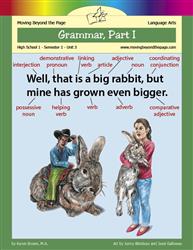
The lesson directs students to use external reference websites for clarification (Guide to Grammar and Writing; Grammar Bytes; Towson University Online Writing Support) and tells students to consult a chart in the book for irregular verb forms. The homework Option 1 explicitly tells students to "Use a dictionary if you need to confirm a word's part of speech." These instructions require students to consult both digital (web links) and print (book/chart/dictionary) resources to clarify meaning and determine part of speech.
Lesson 3
Pronoun Problems
Students are directed to read specific pages in The Only Grammar Book You'll Ever Need (pp. 90–100) and to visit two provided web links (Pronoun-Antecedent Agreement; Usage -- Pronoun Reference) for more detailed explanations. Students complete activities that require identifying pronoun types, cases, and antecedents (Pronoun Agreement, Pronoun Cases, Who/Whom exercises) and check answers with an Answer Key in the Parent Section. The activities and readings guide students to use those print and digital resources to clarify pronoun function and usage.
Lesson 5
Review
Students are asked to read about the next five groups of commonly confused words on p. 18 of the book and to read the additional tips and information that follow, which requires consulting the textbook. Students are told to use the Answer Key in the Parent Section to check their work after completing homework activities. The lesson provides explicit explanations of meanings and parts of speech for word pairs (e.g., bad/badly, bear/bare) that students read and record as part of their practice.
Lesson 7
Spelling
Students are explicitly told to "look up the others in a dictionary" when encountering homophones (carat/karat/caret/carrot). The Questions to Discuss section lists "looking up the word in the dictionary" and using spell-check or a search engine as ways to figure out correct spelling. The lesson provides web links to Merriam-Webster word games and an online spelling program, which are digital reference or practice resources students can consult.

Unit 4: Poetry
Lesson 1
Introduction to Poetry
Students are instructed to record the denotation of selected words and are told to use a dictionary if needed when completing the denotation and connotation activity. The Parent Plan explicitly asks students to "Look up the word 'poetry' in a dictionary or online encyclopedia" and to look up words or references they do not understand. Homework guidance and activity directions prompt students to mark unfamiliar words and consult reference sources as needed.
Lesson 3
Figurative Language
The lesson includes a specific hint telling students to "look up" the word "suffice" if they do not know its meaning. Multiple activities require students to identify figurative language in poems and to provide explanations or analyses of word meanings in journal or activity-page responses.
Lesson 4
Voice and Tone
The lesson explicitly tells students, in Activity 2, "If you come across any unfamiliar words, look them up." The Tone activity also directs students to use the provided Tone List link to find words that describe tone. The Parent Plan includes an explicit denotation explanation for the optional challenge (e.g., the denotation of "sexual" is given as "relating to reproduction").
Lesson 5
What Does It Mean?
Students are explicitly instructed to "Look up any unfamiliar words" as one of the steps for analyzing a poem, and the student activity pages repeat this direction. The materials provide web links and note that "the ease of research on the internet helps in finding the meaning of allusions," and activity pages direct students to read linked background information about references and battle locations. The student pages include space for written responses after students research words and references.
Lesson 6
Fooling with Words
Students are directed to research a chosen poet online using specialized digital reference sites (Poetry Foundation and Poets.org) and to find samples of the poet's work. The lesson invites students to listen to audio recordings of poems in addition to reading them, which could help students determine pronunciation. The skills list includes demonstrating understanding of nuances in word meanings, suggesting attention to word-level interpretation while engaging with poems.
Lesson 7
Analyzing Poetry
Students are explicitly asked to "be sure to look up the reference to Bluebeard" for the Symbols or Allusions box, which requires consulting an external source to clarify a reference. The lesson provides a web link to the Poetry Foundation text of "Blackberry-Picking," so students access digital material to read and analyze poems. The annotation activity asks students to mark words they don't understand (suggesting use of resources) and to note "Strange word - Greek?" in the sample annotation, indicating attention to word origins or unfamiliar vocabulary.
Lesson 9
The Crossover
Students are asked to "Compare the words and definitions as shown in the book with how they appear in a dictionary," which requires looking up dictionary entries. The lesson provides a Resource List link that includes online dictionaries for student use. The Parent Plan and activity notes indicate students will note syllable breaks and that pronunciation and part of speech are provided in the book and should be compared to dictionary entries.
Lesson 11
Reciting Poetry
The homework asks students to mark unfamiliar words and "look up their meanings and pronunciations," which directs students to seek clarifications for word meaning and pronunciation. The Parent Plan also includes determining the meaning of words and phrases as they are used in the text. Students are directed to read multiple poems online and to note unfamiliar vocabulary as part of preparation for recitation.
Final Project
Poetry
Students are directed to "Study for Your Unit Test" by reviewing the terms and concepts using the provided Review Sheet web link, which the lesson describes as containing all definitions and concepts from the unit. The unit test and its answer key require students to define terms (e.g., denotation vs. connotation, meter, onomatopoeia) and identify poetic types, so students practice using definitional reference material. Parent-plan notes repeatedly instruct students to review the unit's terms and concepts to prepare for assessment.
Unit 5: Nonfiction
Lesson 1
Types of Nonfiction
The homework directs students: "As you read, if there are any terms you don't understand, consult the Glossary on p. 213," which explicitly tells students to use a reference resource to clarify word meaning. The Parent Plan/Answer Key states that "Students should have looked up the terms 'biography,' 'autobiography,' and 'memoir' in a dictionary or other reference source" and then write definitions in their own words, indicating students are expected to consult general reference materials.
Lesson 4
Dear Diary
The lesson explicitly tells students to "use a thesaurus if needed" when choosing different terms for paraphrasing and advises students to "be sure to look up any words you don't know." The Student Activity Page has students analyze paraphrases and produce their own paraphrases, which the instructions link to looking up unfamiliar words as part of the activity.
Lesson 10
Learning from the Past
Students are instructed in the vocabulary section to "look up unfamiliar terms and then complete" entries, writing each term and describing/defining the word in complete sentences. The lesson tells students to annotate the speech and "note the definitions of words you need to look up," and footnotes in the speech define terms such as Torah, Judas Maccabeus, and Talmud. An answer key with definitions (e.g., xenophobia, abstraction, nationalism) is provided for students to compare or use.
Lesson 11
A Boy's Story
Students are explicitly directed to "look up each word in the dictionary and record its definition in your own words" (Activity step C). The Vocabulary activity has students write initial definitions, fill sentence blanks from the book, and then correct those definitions after consulting a dictionary. The Parent Plan also supplies dictionary-style definitions for the listed vocabulary words, indicating students are expected to consult reference material to clarify meanings.
Semester Exam
Semester Exam
The paraphrasing task in Part V explicitly tells students they may "consult a thesaurus as needed" when paraphrasing Wordsworth's lines. The Grammar and review sections require students to "know the definitions of the various parts of speech" and to review Unit Review Sheets and lessons to "read the explanations and examples of the concepts covered." The exam tasks ask students to identify denotation vs. connotation, indefinite pronouns, and parts of speech, which requires understanding word meanings and grammatical categories.
2: Semester 2
Unit 2: Grammar, Part II
Lesson 2
Capitalization and Numbers
The lesson explicitly directs students to use online reference pages for capitalization (OWL Purdue and Grammarbook.com) and instructs them to consult those sites while completing the capitalization activity. The commonly confused-words section includes a pronunciation note for envelop/envelope that models consulting pronunciation information. Students are instructed to record notes, tips, and examples on activity pages, which encourages using external resources to clarify word usage.
Lesson 3
Sentence Fragments and Run-on Sentences
Students are directed to revisit specific book pages (pp. 21–22) for guidance on commonly confused words and to use the book's list of common irregular verbs (pp. 77–81) as a reference. The lesson explicitly mentions looking up a meaning in the dictionary when discussing the word "hopefully" ("If you look up the word in the dictionary, though, the meaning 'I hope' ... has been added."). The lesson provides digital resources (web links to Khan Academy and Guide to Grammar) that students use for practice and feedback.
Lesson 5
Hyphens and Apostrophes
Students are explicitly prompted to "consult the dictionary" when in doubt (Wrapping Up) and asked how writers can use outside resources, such as dictionaries, to prevent errors (Getting Started). Activity directions point students to an online GrammarBook quiz (a digital resource) and instruct them to check the Answer Key and the book's pages for rules (Activity 1 and Hyphens). The lesson also gives explicit information about parts of speech for specific words (e.g., "principle" is always a noun) that students read and use in exercises.
Lesson 7
Verb Voice and Mood
Students are directed to read specific web pages for more explanations and examples (OWL Purdue on active vs. passive voice and Carson-Newman/Grammarly pages on the subjunctive mood). Students complete an online exercise (Capital Community College passive-voice quiz) and are told they may refer to the listed web links as needed for more explanations or examples. The student rubric and activities prompt students to use these digital resources to understand and explain grammatical terms such as voice and mood.

Unit 3: Informational Texts
Lesson 1
What Are Informational Texts?
Students are explicitly directed to use reference resources: Activity 1 points out glossaries as a feature of informational texts, and the student activity instructs students to find a glossary in Outliers. The Student Activity Page tells students, "If you're not sure what 'social science' is, look it up in a dictionary or online." Homework Question #5 asks students to guess the meaning of "egalitarian ethos" from context and then "look up both words in the dictionary to see if you were correct."
Lesson 2
Outliers
Students are instructed in Activity 2 to use a thesaurus to find synonyms for vocabulary words and to look up any unfamiliar synonyms in a dictionary. The lesson provides a web link labeled "Dictionaries and Thesauruses" and the Parent Plan repeatedly tells students to use a dictionary and thesaurus (physical or online) for the vocabulary activity. The answer key notes that on p. 3 the author provides dictionary definitions along with pronunciation and parts of speech, showing an example of reference-material use.
Lesson 5
Harlan, Kentucky
Students are instructed to lightly underline unfamiliar words as they read and then complete the "Chapter 6 Vocabulary" activity, where they must guess meanings from context and "use a dictionary if needed." The activity provides a digital Collins Dictionary link and explicit directions for finding pronunciations (including an audio icon) and the Parent Plan asks students to say the words aloud and check pronunciations. The answer key supplies pronunciations and definitions for the target vocabulary, and Section 2 requires students to look up definitions for any additional words they underlined.
Lesson 6
The Ethnic Theory of Plane Crashes
Students are instructed in Activity 1 to use a dictionary, either a physical one or online, to discover the meanings of vocabulary words and to write synonyms or antonyms and use the words in context. The Parent Plan skills list explicitly includes "Consult general and specialized reference materials (e.g., dictionaries, glossaries, thesauruses), both print and digital" and also notes that students should "Verify the preliminary determination of the meaning of a word or phrase (e.g., by checking the inferred meaning in context or in a dictionary)."
Lesson 7
Rice Paddies and Math Tests
Students are given a vocabulary list that labels word meanings and parts of speech (e.g., autonomous (p.236) adjective; efficacy (p.237) noun). The lesson's skill list explicitly names consulting general and specialized reference materials (dictionaries, glossaries, thesauruses), both print and digital, as a targeted skill. Students are directed to digital pronunciation resources (Counting to 100 in Chinese video, Learn Numbers 1-10 video, and a Tones in Chinese audio file) and asked to practice pronunciation by listening and imitating.
Lesson 11
Technical Writing
Students are directed to identify specialized vocabulary and create glossary entries using the "Glossary" activity sheet, including drafting entries and copying final glossary entries in alphabetical order. The Guide Checklist requires a glossary with terms and definitions, and the revision steps instruct students to highlight the first use of glossary terms in their guide. The lesson provides sample glossary entries (e.g., boric acid, knead, slime) and asks students to assume readers know little or nothing about the topic, prompting them to define necessary terms.
Lesson 12
Logical Fallacies
The lesson explicitly directs students in Option 1 to "look these two fallacies up online and record their meaning" (hasty generalization and false dilemma), requiring them to consult digital sources to determine definitions. Multiple activities ask students to supply or match definitions (e.g., fill-in-the-blank for 'premise,' 'non-sequitur,' and identifying examples of 'ad hominem,' 'slippery slope,' and 'bandwagon'), reinforcing students' use of informational sources to clarify term meanings.
Final Project
Argumentative Research Essay
The lesson explicitly directs students to use library research databases and reference resources such as encyclopedias (e.g., Encyclopaedia Britannica, World Book, Credo Complete Core, Gale, SIRS, CQ Researcher) as primary research tools. Students are instructed to consult these general and specialized reference materials to gather background information and trustworthy facts for their argumentative essays and to record citation information for a Works Cited page. The curriculum also asks students to locate and evaluate sources online and in print, and to use reference materials to find authoritative pro and con viewpoints.

Unit 4: Drama
Lesson 4
A Raisin in the Sun
The vocabulary activity directs students to determine word meanings from context and to consult a dictionary if the meaning is unclear, and the Parent Plan explicitly lists consulting general and specialized reference materials (dictionaries, glossaries, thesauruses), print and digital, as a skill. The lesson introduces the International Phonetic Alphabet and provides links to the Speech Accent Archive audio samples with IPA transcriptions, asking students to listen and note the IPA forms and pronunciation differences. The Student Activity Page and Parent Plan note that students may use a dictionary as needed when matching vocabulary to definitions.
Lesson 5
Act II
The Act II and III Vocabulary activity instructs students to read each word in context, write what they think the definition is, and then "look up each word in the dictionary and revise your definition as needed," which requires consulting a reference. The Parent Plan Skills list explicitly names "Consult general and specialized reference materials (e.g., dictionaries, glossaries, thesauruses), both print and digital" as a targeted skill, linking student vocabulary tasks to that practice.
Lesson 8
Shakespeare
The Student Activity Page explicitly tells students: 'If a word or phrase is unclear, use contextual clues or check a dictionary.' The Reading and Questions section directs students to use the Folger edition's left-hand notes to help interpret challenging words and phrases. The Parent Plan Skills list also states that students should 'Consult general and specialized reference materials (e.g., dictionaries, glossaries, thesauruses), both print and digital.'
Lesson 11
Nuanced Meaning
Students are directed in Part III to find synonyms with different connotations and the parent plan explicitly notes that "They can use a thesaurus." The activities ask students to determine meanings of bolded words from Romeo and Juliet using provided word boxes and to explore how word meanings have changed, and the lesson defines etymology and mentions etymologists.