


First Grade - ELA
1: Environment

Unit 1: Habitats and Homes
Lesson 1
My Environment
Students are asked to label rooms, number rooms in exploration order, and write or copy room names (Activity 2), which requires producing written labels and sequencing information. In Activity 3 students complete a structured paragraph ("The most important room…", uses, and reason), dictate ideas to an adult or write them, and read the paragraph aloud, supporting guided composition and organization. Handwriting practice and copying words (Activity 4) gives students practice producing written text with letter- and word-level control.
Lesson 7
Tools in My Environment
Students are asked to write the names of three tools on the "Measuring Tools" activity page and to record the number of inches for each tool, providing direct practice producing written labels and numerical records. Students are prompted to copy letters and words (beginning letters, sound out words, and copy words) and to use a handwriting sheet to practice the letter I and the words it and inch. The activities require students to write numbers 5-12 and to practice writing those numbers over several days.
Final Project
Animal Research / My Environment
Students create a small book (Option 1 or Option 2) by completing titled pages and stapling them in sequence, which requires them to produce written labels and short responses (e.g., "Draw a picture of the animal and write its name," "Where in the World?" lines, "Interesting Facts" page). The directions ask students to "complete the descriptions at the top of each page" and to "help your child label his pictures," prompting students to write information matched to each page purpose. The project organizes content into specific pages (name, habitat, diet, facts), giving students a clear task and structure for their writing product.
Unit 2: Weather
Lesson 1
Reading the Skies
Students practice writing by dictating and/or writing sentences using vocabulary words in the Weather Words activities (Options 1 and 2) and by recording a sentence in the space labeled "Sentence." Students produce a short story by dictating and/or illustrating their favorite weather activity in Activity 3, and an adult records dictated text for them to read together. Students record daily weather observations and temperatures on the Weather Calendar over several weeks, which requires ongoing written entries and labeling of days and conditions.
Lesson 3
Measuring and Charting Weather
Students are asked to record measured temperatures on a "Measuring Temperature" sheet and color the degrees the thermometer reads, which requires writing numeric values and marking. Students are asked to write an acrostic by writing "RAIN" vertically and supplying a word or phrase for each letter, which requires generating and writing words/phrases. The activities ask students to measure rain in a jar and practice measuring depth with a ruler, which involves producing numeric measurements (though the lesson does not explicitly require written recording of those measurements).
Lesson 5
Fall
Students are prompted to write three sentences about the fall picture, to use circled words in sentences, and to copy dictated sentences about fall. Students practice handwriting the letter F and write or copy words such as "fall" and "fun." These activities require students to produce short written responses with adult support.
Lesson 8
Summer
Students complete multiple written exercises: they fill in blanks in the "A Summer Story" passage using picture-word prompts or a provided word box, write beginning letters or copy words into blanks, and (in Option 2) are asked to illustrate and are encouraged to write their own summer story if advanced. In "Changes in Weather" students write season names or beginning letters beneath the temperature continuum and complete four written sentences identifying warmest/coldest seasons. The activities require students to produce written responses and to read their completed text aloud.
Final Project
Weather Games
Students write season names above pictures and label clothing items in Activity 1, demonstrating writing to match a task. Students record answers on the Weather Forecast graphic organizer and record current temperatures, showing they produce written responses to specific prompts. Students prepare a three-day weather forecast using guiding questions and an example forecast, composing sentences to report weather observations and recommendations.
Unit 3: Community
Lesson 1
On the Town
Students are asked to write or dictate a sentence or two about a new page they draw for Charlie (Activity 3), which requires producing written content with adult support. Activity 2 has students fill in blanks and copy community vocabulary words into sentences, and Option 1 explicitly asks students to copy or paste words to complete sentences. Activity 4 provides handwriting practice and tracing of words (People, Park), supporting the mechanics of producing written text.
Lesson 2
My Community Environment
Students label places on a poster and write or dictate a brief description of how each place serves the community (Activity 2). Students copy book titles and draw simple illustrations, producing written labels and brief text about different communities (Activity 3). Students prepare interview questions and take notes or record responses during a community visit, using writing to gather and record information for a purpose (Activity 4).
Lesson 5
Resources
Students are asked in Activity 3 to gather three natural and three manmade resources and then "explain how each resource is used, explain where it is found, and/or write a sentence about the resources," which provides an explicit writing task. In Activity 2 students write the number of items in each box and mark each item with an "N" or "M," producing written labels and numeric responses tied to a task. Activity 1 asks students to sort and draw one natural and one manmade resource, which includes producing a drawn representation and a possible caption or label.
Lesson 6
A Good Community Citizen
Students are asked to draw and label pictures in Option 2 of "Good Citizenship at Home," producing three labeled examples for good and not-good home environments. In Activity 3 students write the names of family members and describe observed examples of good citizenship (either by dictating while an adult records or by attempting to record independently). In Option 1 students sort and paste pictures into categories and then draw one additional example of a good citizen and one of a not-good citizen, which involves producing brief written or drawn responses.
Final Project
I Can Make A Difference
Students write a plan using the provided activity page with sentence starters such as "I am planning to...", "The first thing I will do is...", "Next I will...", and "Finally I will...". Students sequence steps for a community project, check off steps as they complete them, and paste a photo into the plan sheet. Students write a reflection using guided sentence starters (e.g., "I helped __ with __..." and "I made my community a better place because __.").
2: Similarities and Differences
Unit 1: Amazing Attributes
Lesson 2
Animal Attributes
Students are asked to write names of living and nonliving objects in Activity 1 (Option 2), including listing two additional examples. In Activity 2 (Option 2) students write the name of the body part that helps each animal move. In Activity 3 (Option 2) students write animal names into category columns (feathers, scales, fur, other) and add another example to each column. Activity 4 provides handwriting practice where students trace and copy the letter A and the words "animal" and "ant," and may use the words in a sentence.
Lesson 4
How Does It Feel?
The handwriting activity has students write or copy a sentence about an object's texture: "______ feels ________," so students produce a written sentence using descriptive vocabulary. The skills list explicitly includes "Use new vocabulary in conversation and writing" and "Use words that describe in speech and writing," indicating students will apply adjectives in written form. The activity pages require students to copy or paste texture words beneath pictures, which has students practice writing descriptive words and matching them to objects.
Lesson 5
How Old?
Students are asked to record names for illustrated people and to write questions for each person (Option 1 and Option 2), with explicit prompts to start sentences with a capital letter and end with a question mark. Students are guided to draw and label animals and write each animal's average life span (Activity 3). The lesson includes a handwriting activity where students practice writing the letter Oo and copy/write sentences containing the words "old" and "order."
Lesson 7
More Attributes
Students practice handwriting by tracing and writing the uppercase and lowercase letter V and the word "Venn" on the Student Activity Page. Students are prompted to write the word "Venn" and are given the option to use the word in a sentence, providing an opportunity for producing a short written response.
Lesson 9
Solids and Liquids
Students are asked to write down definitions for "Solid" and "Liquid" on the activity page and to label sheets of construction paper "Solids" and "Liquids." Students brainstorm and record examples by cutting out and pasting pictures into the appropriate columns of a graphic organizer. Students also sort pictured items and paste them on the correct sheet, which requires them to organize information by category.
Lesson 10
Earth Materials: Rocks, Soil, and Water
Students are asked to produce an "Earth Materials" book (Activity 7) in which they label and organize three two-page spreads (Dirt, Rocks, Water), add a cover and author name, and write properties and descriptions on designated pages. Students complete sentence tasks (preposition worksheets) and record brainstormed lists of places water is found, which require them to write or fill in text for a clear purpose. Several activity pages prompt students to write short descriptive words or phrases (Properties of Dirt, Properties of Rocks, Properties of Water).
Lesson 11
Using Earth Materials
Students are asked to keep a Water Log where they record or dictate all the times they and family members use water during the day, and they may take photos to document uses. During the rock scavenger hunt students are asked to keep a list of what they find or take photos of their discoveries. The activities require students to record observations and produce simple written artifacts (logs, lists, and possibly captions for a collage).
Final Project
Presenting Attributes
Students plan and produce a poster or a demonstration that requires them to write words and sentences explaining at least five attributes and how those attributes show similarities and differences. Students organize the poster layout before writing, label pictures, and may dictate ideas to an adult who records their words, which practices developing and organizing content for a purpose. Students practice presenting their written descriptions to family or younger children and receive adult feedback and help with wording and organization.
Unit 2: Senses
Lesson 1
My Five Senses
Students are asked to dictate four sentences describing a sensing experience and have those sentences recorded (Activity 3, Option 2). Students are guided to write or copy a sentence about a sense on handwriting paper (Activity 4) and to fill in short written labels (favorite sense, sense organ) and simple sentence lines on activity pages. Students are taught and prompted to use complete sentences and to identify elements of a sentence (person/place/thing and an action) when describing their experiences.
Lesson 2
Senses and Body Parts
Students are asked in Option 2 to make up a story about Jackie that has a beginning, middle, and end and to think about where the story will take place and what will happen, pausing to glue sense organs as events occur. Students are asked in Activity 4 to practice the letter S and to use the words "sense" and "see" in a sentence on the provided page, producing written sentences.
Lesson 4
Hearing and Seeing
Students are asked to describe their blindfolded experience and have those thoughts recorded (Activity 4). Students generate and record sound-based place descriptions and are encouraged to attempt to read their descriptions aloud to others (Activity 5). Students practice writing by composing sentences that include the words eyes and ears and by tracing/writing the letter E (Activity 8).
Lesson 7
Using All of Our Senses
Students are asked in Activity 4 to write or copy a sentence on handwriting paper about something they observed on their nature walk. Activity 2 invites students to "attempt to write their ideas," to draw, or to dictate findings, and the Nature Walk student page provides spaces labeled "I hear...","I see...","I smell...","I feel..." for students to record observations. The materials explicitly prompt students to record and communicate observations in writing (or via dictation) after guided sensory exploration.
Final Project
A Sensible Party
Students plan and record ideas on the Party Planner sheets by filling in 'Ideas' and 'Supplies' for each of the five senses. Students make and check off a supply list, count guests, and write a guest list. Students create invitations that include place, date, and time, and write descriptions of games for guests to play.
Unit 3: We're the Same, We're Different
Lesson 5
Shapesville
Students are asked to dictate a short description of their chosen shape and to record their ideas using a provided sample as a guide (Activity 2). They fill in a structured worksheet with lines for name, shape, color, physical characteristic, personality trait, hobby, and interest, and they are encouraged to attempt to read their description aloud. Students also write or copy a sentence on handwriting paper that describes an interest or personality trait (Activity 4).
Lesson 6
Different Families
Students are asked to complete sentences and respond in writing as indicated in the Skills section which lists "Complete sentences," "Dictate ideas and responses," and "Attempt to write words and sentences using inventive spelling." In Activity 2 students fill sentence prompts comparing their family to a family from another country or use a Venn diagram to organize similarities and differences, providing explicit opportunities to plan and record ideas. In Activity 3 students practice handwriting and trace the word "different," supporting letter- and word-level written production.
Lesson 9
Different Modes of Transportation
Students draw a picture of a trip and tell a story about it, with the story recorded for them (Activity 3), which requires them to produce narrative content tied to a task. Students write or copy a sentence about a mode of transportation on handwriting paper (Activity 4), practicing producing a written sentence. In Option 2 of 'Getting from Point A to Point B' students write the mode of transportation for each scenario, producing short written responses to match task prompts.
Final Project
Differences Make the World Go 'Round
Students create a short book comparing themselves to a child from another country by filling labeled pages (Location, Food, Hobbies, Homes, Clothing, Transportation, Holidays, Similarities) with sentences and illustrations. Students are encouraged to locate and read about the chosen country to supply facts, to write the sentences themselves using provided sentence starters, to assemble a cover and an "The End" page, and to share the finished book with family or a person from the chosen country (audience).
3: Patterns
Unit 1: Identifying and Creating Visual Patterns
Lesson 4
Extending a Pattern
Students are asked to copy or write a sentence on handwriting paper about a pattern they made (Activity 4). Students recreate and extend given patterns and complete sentence prompts about those patterns in the "Writing About a Pattern" activities (Activity 2). Option 2 explicitly asks students to write the names of the objects they used for patterns and to complete sentences about the given patterns.
Lesson 5
Making Color Patterns
Students are asked to use color words or the first letter of color words to show patterns on a separate sheet (writing letters/words to represent patterns). Activity 3 directs students to write or copy a sentence on handwriting paper that describes something they created today. The lesson includes modeling for the pattern activities (doing the first one with the child) which may support the writing-about-creation task.
Unit 2: Patterns in Sounds, Words, and Actions
Lesson 6
Sound Patterns
Students are asked to write about a sound pattern on handwriting paper in Activity 4 with a prompt example ("I heard a pattern that went..."). The Student Activity Page "Listen Carefully" provides a space labeled Pattern and Repeat for students to record and create their own sound patterns. Several activities instruct students to record how many times each sound repeats, which requires short written responses or notations.
Lesson 7
Making Sound and Action Patterns
Students are asked in Activity 4 to write or copy a sentence on handwriting paper that describes a pattern they made today. Multiple prompts throughout the activities ask the child to describe and demonstrate patterns (sounds and actions), providing guided opportunities to translate observed patterns into written language. The activities instruct a parent to prompt and check that the child made a repeating pattern, implying adult support during the writing task.
Final Project
Patterns Video
Students write or dictate scripts on four Video Script pages, recording the type of pattern, where they found or made it, the parts of the pattern, and how the parts create the pattern. Student Activity Pages prompt students to sequence events with prompts such as "First comes..." and several "Then..." slots for action, sound, rhyming, and story patterns. Students practice presenting the scripts by rehearsing, pretending to be videotaped, recording the video, and watching it to reflect on what they did well and what to improve.
Unit 3: Patterns in Your World
Lesson 2
Patterns of Growth
Students draw the plant every few days and write a sentence to record its growth on the "A Plant's Pattern of Growth" activity page (Activity 1). Students label parts of a plant using a word box or record initial letters on the "Plant Parts" sheet (Activity 2). Students cut and glue pictures to put life-cycle stages in order and organize personal photos from youngest to oldest (Activities 4 and 5). Activity 6 has students copy target words multiple times, modeling and practicing writing.
Final Project
Patterns All Around Lapbook
Students are instructed to write titles and labels on their mini-books (for example, writing "Symmetrical Pattern," "Pattern in Nature," labeling stages on the 3-flap book, and writing the days of the week on the fan book). The Skills list explicitly includes "Record or dictate knowledge on a topic," and activity instructions ask students to draw, paste, or write pattern examples inside the matchbook and other mini-books. Students also arrange and sequence content (putting the four seasons in order on the wheel book and stacking days of the week in order), which requires organizing information for a clear purpose.
4: Change
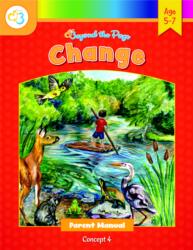
Unit 1: Changes on Planet Earth
Lesson 1
What Causes Change?
Students are asked to draw a before-and-after picture and complete structured sentences on the "Write About a Change" page (e.g., "Once I saw ______ change," "______ changed because ______," "The change happened over a ______ amount of time"). The Skills list explicitly includes "Read or attempt to read own dictated story," "Use naming words and action words," and "Express ideas through writing and conversation," and the activity asks students to attempt to read their completed paragraph aloud. In Activity 1 and 2 students observe, describe changes, and record responses (gluing picture pairs, marking fast/slow), which requires composing brief written responses or labels.
Lesson 2
What Changed?
Students are asked to mark changes on the Student Activity Page by circling applicable attributes, which requires written/marking responses. Activity 2 asks students to give examples of changes and record a sentence to describe each example, directly prompting written production. The activities also prompt students to explain and describe changes, which may produce brief written or oral responses.
Lesson 5
Changes in Location
Students practice writing prepositions and prepositional phrases by completing the "Where Did He Go?" activity, either by choosing words from a word box or by writing the words/phrases themselves. Students in the "Mouse in the House" Option 2 are asked to read sentences and then write simple sentences describing the mouse's location, and Activity 3 asks students to record three or four sentences describing relationships of objects. Students are also asked to write directions for another person to read and follow as a wrap-up extension.
Lesson 6
Changes in the Sky
Students are asked to list adjectives and phrases to describe the Sun and the Moon and may write their ideas or dictate them while an adult writes (Activity 1). The student activity pages provide space for the child to add written content about the Sun and Moon. The wrapping up prompt asks the child to describe how objects in the sky change positions, which can be recorded as student-produced language.
Lesson 7
Living Things Change
Activity 4 directs the child to write or copy a sentence on handwriting paper that describes how something changes in size, providing a concrete opportunity to produce written text. Several student pages include labeled spaces and prompts (for example, checkboxes and places to circle words or note whether a change is 'fast' or 'slow') that require students to record short written responses or labels.
Lesson 9
Heat Causes Change
Students are asked to write or copy a sentence about an observation in Activity 4 (Handwriting). Students label the three states of matter on the "Ice, Water, Steam" activity page and fill word boxes, demonstrating short written labeling. Students record measurements and observations on the "A Burning Candle" data sheet, entering numbers and brief responses over time.
Final Project
Mobile of Change
Students are asked to write the word "CHANGES" on a hanger and to draw or paste "before" and "after" pictures in labeled boxes for categories like Animal Change, Plant Change, Physical Change, and Chemical Change. Student activity pages provide spaces for students to write or draw observations in a grid with explicit "before" and "after" columns and prompts such as "Change in the Environment" and "Changes in Position." The skills list explicitly includes "Use new vocabulary in speech and writing" and "Express ideas through writing and conversation."
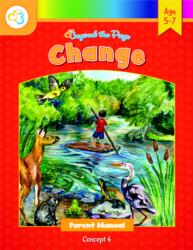
Unit 2: Characters Change
Lesson 1
What's in a Name
Students are asked to rewrite and correct sentences in Activity 1 (e.g., correcting "chrysanthemum loved her name.") and to complete short sentence prompts such as "My name is" and "I wish my name were." Activity 5 directs students to list three characteristics of Chrysanthemum at the start and end of the story and to "write a few short sentences about how the character changed." Activity 3 and the vocabulary activities ask students to interpret phrases and record word meanings, which require short written responses linking text to meaning.
Lesson 2
Why Worry?
Students are asked to combine pairs of sentences orally and on the "Using 'And'" activity page, practicing how to join ideas with conjunctions. Students complete the "Characters Change" page by writing how Wemberly was at the beginning and at the end, using bullet points and sentence prompts such as "Before Wemberly was ____, but now she is ____." Adults are directed to prompt, model, and review student responses (e.g., asking the child to use conjunctions in sentences and to discuss story changes).
Lesson 4
Comparing Characters
Students are asked to dictate two story summaries of three or four sentences (one sentence for beginning, middle, and end) and either have an adult record them or write them themselves. The "I Change" page explicitly directs students to "Think Write 3 complete sentences" describing themselves before and after solving a problem. Several activity pages include lines and boxes for students to write short responses and answers to questions about the stories.
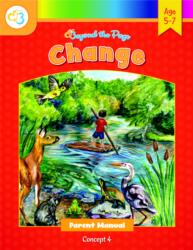
Unit 3: A First Look at History - Change Over Time
Lesson 2
Understanding Time
Students are asked to record the date (month, day, year) and to complete the three-box activity labeled "Yesterday I," "Today I," and "Tomorrow I will," writing or drawing responses for each. The lesson asks students to respond to prompts about past, present, and future events (e.g., naming something that happened in the past, something happening now, and a future hope) and to write numbers/dates on ordering activity pages. These tasks require students to produce short written responses tied to a clear task (reflecting on time) and to record information in writing.
Lesson 3
Communities Change
Students are asked in Activity 7 to write a sentence about The House on Maple Street (or to dictate a sentence for copying), which shows students produce a written statement with adult support. Students also complete tasks that require brief written responses or number events (numbering timeline events, filling # blanks in graphic organizers), demonstrating guided, simple writing and labeling tied to the story.
Lesson 4
Past and Present
Students are asked to tell a story about living in a past time period and to have an adult record the story as she dictates it (Activity 2), with an explicit reminder that a story should have a beginning, middle, and end. Students are asked to draw and dictate comparisons between a historical child and themselves (Activity 4) and to write a sentence describing how life in the past differs from today (Activity 8). The activities include guided adult support (adult records dictation and discusses ideas) and a handwriting/writing task.
Lesson 7
People of the Past
Students are asked in Activity 4 to write a sentence on handwriting paper about a historical person they learned about today, providing direct practice with composing a written sentence. In Activity 3 students are prompted to "write down her ideas" for making a positive change, which engages them in recording thoughts. Activity 1 and the wrap-up include questions that prompt students to describe people and their actions, which can supply content for student writing.
6: Reading

Unit 1: Semester 1
Lesson 10
Blends with r
Students write individual words by sounding them out (Activity 2.2 "Writing Words") and copy/tracing sight words (Activity 5.1 "Writing Sight Words"). Students practice writing full sentences from dictation and are reminded to consider how sentences begin and end (Activity 5.3 "Sentence Dictation"). Students create a mini-book and sort/write words under blend headings, organizing words by beginning blend (Activity 4.1 "Blends Review").
Lesson 11
Ending Blends
Students copy and write sight words (copying "words" and writing dictated sight words "but" and "not"). Students spell and write word lists using letter cards and word-building cards into labeled pages for nd, mp, lf, and nt words and read them back. Students write full sentences from dictation on handwriting paper (four sentences provided) and participate in word-chain spelling and writing activities that change one letter to form new words.

Unit 2: Semester 2
Lesson 6
Long e Spellings ee, ey, ea
Students write words from pictures on the "Writing 'ea' Words" pages and write additional dictated words (eat, weak, team, teach), showing guided word-level and spelling-focused writing practice. Students complete the "Alphabet Soup" task by creating and writing at least 12 words on handwriting paper, practicing producing written words from given letter sets. Students form and read sentences using word cards in the Making Sentences activity and write two dictated sentences during Sentence Dictation ("We eat a lot." and "The cake is sweet.").
Lesson 11
Long Vowel Sounds Review
Students are asked to write each word from a Word Bank in a sentence so the sentence makes sense (Activity 3.1). Students fill in blanks to complete a short story using words from a word bank (Activity 5.3). Students write long-vowel words they find in readers on a laminated writing sheet and read them aloud (Activities 2.1, 4.1, 5.1).
Lesson 12
Other Vowel Sounds oi, oy
Students create sentences using Making Sentences cards (Activity 4.1) and are given sentence starters to help compose sentences. Students write dictated sentences on handwriting paper (Activity 5.2) and are reminded to attend to sentence beginnings and endings (capitalization and punctuation). Students also generate silly sentences using learned rhyming words in the Life Application and are asked to read sentences aloud after composing them.
Lesson 14
Other Vowel Sounds aw, au
Students write words and sentences throughout the week: they generate lists of rhyming words in Activity 1.2, write practiced words on handwriting lines (town, round), complete Alphabet Soup by writing words they create (Activities 3.2 and 4.2), take a spelling test by writing target words (Activity 4.3), and write dictated sentences while attending to how sentences begin and end (Day 5 Sentence Dictation). Students are also asked to recognize distinguishing features of a sentence and to read back what they have written.
Lesson 17
Year-End Review
Students complete a Sentence Writing activity (Activity 2.2) in which they look at pictures and write one or two sentences about each, with lined pages and dotted guidelines provided. They are reminded to use words they've learned and to think about how sentences begin and end, and then they read their sentences aloud. The activities provide guided support (prompting, examples) while students compose and read their sentences.