


Sixth Grade - MATH
5: Math

Unit 1: Operations
Lesson 1
Addition and Subtraction Review
Students are taught and practice the standard addition algorithm with decimals by lining up decimal points, adding placeholder zeros, adding columns right-to-left, regrouping (carrying), and bringing the decimal point down (Activities 2 and 3, foldable and practice pages). Students are also taught and practice the standard subtraction algorithm with decimals by lining up decimal points, adding zeros, borrowing (exchange), subtracting columns right-to-left, and bringing the decimal point down (Activities 5 and 6, foldable and practice pages). The materials include worked examples, multiple practice problems (including word problems), and modeling videos that require students to perform the algorithms step-by-step.
Lesson 2
Multiplication Review
Students are shown the standard algorithm for multi-digit multiplication with a step-by-step stacked example (46 × 27) and complete practice problems using that algorithm. Students are taught how to apply the same standard algorithm to decimal multiplication (Activity 5), including the specific step to count decimal places and move the decimal in the product. Multiple student activity pages and an algorithm foldable give students practice multiplying multi-digit decimals (Activity 6) with worked answer keys for feedback.
Lesson 3
Division Review
Students explicitly practice the standard long-division algorithm with decimal divisors: Activity 3 explains moving the decimal in divisor and dividend and has a foldable task for the division algorithm. Activity 4 provides multiple long-division-with-decimals problems (e.g., 81.27 ÷ 9, 256 ÷ 0.8, 42.8 ÷ 0.04) and worked examples (54 ÷ 4.5 → 540 ÷ 45). Day 2 and Day 3 materials include step-by-step division algorithm images, videos, and practice sheets that require students to perform long division with multi-digit decimals and place decimal points correctly.
Lesson 4
Exponents and Order of Operations
Students solve several multi-digit decimal problems on the Unit 1 Quiz, including addition (762.4 + 29.63), subtraction (189.2 - 98.46; 26.2 - 4.05), multiplication of decimals (7.3 × 0.15), and a division scenario that produces a decimal result (78 ÷ 5 = 15.60). The quiz word problems require students to add decimal weights (17.8 + 23.15) and compute time reductions with decimals. These items require students to perform the four operations with decimal numbers.
Lesson 6
Greatest Common Factor
Students are asked to compute multi-digit decimal problems on the Basic Skills Review sheet, including 16.87 + 481.9 (addition), 8.72 × 0.16 (multiplication), and a division problem that yields a decimal result (459 ÷ 36 = 12.75). The answer key supplies the decimal results (498.77, 1.3952, 12.75), indicating students are expected to produce decimal sums, products, and quotients.
Lesson 8
Unit 1 Test
Multiple student activity pages instruct students to "Use the standard algorithm to solve each problem," and include decimal addition (e.g., 703.89 + 26.152; 889.46 + 17.035), decimal subtraction (e.g., 537.2 - 228.637; 390.7 - 284.56), decimal multiplication (e.g., 7.05 × 4.2; 98.6 × 2.4), and decimal division including decimal divisors (e.g., 296.7 ÷ 4.3; 74.1 ÷ 3.9). The Parent Plan explicitly lists as skills that students should "Fluently add and subtract multi-digit decimals using the standard algorithm" and "Fluently multiply and divide multi-digit decimals using the standard algorithm." The answer key provides correct results for these multi-digit decimal problems, showing expected fluent outcomes.
Final Project
Planning a Party
Students multiply package counts by decimal prices to find item costs (example: 3 × $4.80 = $14.40) and multiply a decimal tax rate by a decimal total to find tax (example: $42.84 × 0.06 = $2.57). Students add and subtract decimal totals to check against the $50 budget (example: $50.00 − $42.84 = $7.16). Students divide a decimal grand total by 12 to find cost per goody bag (example: $42.84 ÷ 12 = $3.57), and instructions repeatedly direct students to use the algorithms for adding, subtracting, multiplying, and dividing decimals.
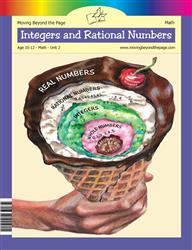
Unit 2: Integers and Rational Numbers
Lesson 1
Fraction Addition and Subtraction
Students solve decimal addition and multiplication problems in the Basic Skills Review (e.g., add 48.2 + 12.3 + 3.81 and compute 7.3 × 1.6). Students perform division problems that produce decimal results (e.g., $42 ÷ 12 = $3.50) and compute whole-number division (5768 ÷ 7) which practices long-division skills. The Basic Skills Review description explicitly lists operations with decimals among the review items students complete.
Lesson 7
Coordinate Problem Solving
Students compute monetary change using decimal operations (calculating 12.50 × 2, 5.75 × 3, adding those results to get 42.25, and subtracting from 50.00 to get 7.75) on the Basic Skills Review. Students also divide a decimal amount (68.4 ounces) by 4 to find 17.1 ounces, which requires performing decimal division. These item answers are presented in the lesson answer key and require students to carry out decimal addition, subtraction, multiplication by whole numbers, and division with decimals.
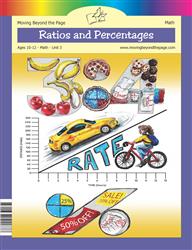
Unit 3: Ratios and Percentages
Lesson 3
Equivalent Ratios
The Basic Skills Review #5 includes explicit decimal computations: students compute an area using 9.7 × 4.2 (answer shown 40.74) and find a weight difference 13.7 − 11.94 (answer shown 1.76). The answer keys and problems show decimal multiplication and subtraction worked out, and a money problem (12 apples costing $6.00 from $1.50 for 3 apples) requires multiplying a decimal by an integer. The Parent Plan frames these reviews as practice for previously learned skills, indicating students are expected to complete decimal calculations on the review sheet.
Lesson 4
Unit Rates
Students set up and compute decimal division problems to find unit price (e.g., $5.25 ÷ 3 = $1.75 and $6.27 ÷ 3 = $2.09) with a long-division display. Students multiply unit rates by whole-number quantities to find totals (e.g., $1.75 × 5 = $8.75, $2.09 × 10 = $20.90). Students also perform a decimal subtraction to compare prices (e.g., $1.75 - $1.45 = $0.30).
Lesson 5
Percentages
Students are asked to compute decimal arithmetic in the Basic Skills Review (e.g., multiply 14.6 x 2.5, subtract 14.2 - 11.95, and find unit price by dividing $3.92 by 14). The review also requires students to compare and order decimal numbers and to convert between decimals and percents, which has students perform decimal manipulations. Several activity pages include decimal examples such as 1.32 = 132/100 (132%) and conversions like 0.26 = 26/100 = 26% that reinforce decimal place-value operations.
Final Project
What's the Best Buy?
Students set up and compute unit prices by dividing a decimal price by a quantity (example: $3.38 ÷ 13 = $0.26) and an image shows the long-division steps for that computation. The materials instruct students to divide prices by unit counts and to round decimals to the hundredths place when necessary. Students also perform percent and currency calculations (e.g., 10% of a weekly grocery total, converting $3.25 into euros/yen/Canadian dollars/pesos) and compute differences and cumulative savings (subtracting and multiplying decimal amounts) in the answer-key examples.
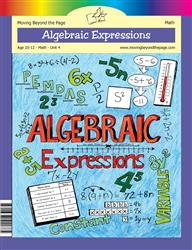
Unit 4: Algebraic Expressions
Lesson 1
Introduction to Algebra
Students evaluate exponential expressions that use decimals (for example, (1.5)^3 = 3.375, (1.8)^2 = 3.24, and (0.2)^3 = 0.008) and perform decimal arithmetic in order-of-operations problems (for example, 8.5 + 2 × 1.4 − 6 ÷ 1 1/2 and 2.1^2 − 0.4^2 = 4.41 − 0.16 = 4.25). Activity pages require students to multiply and subtract decimal values and to use decimals within PEMDAS evaluations. Several answer keys show students carrying out decimal multiplication and subtraction to find final numeric results.
Lesson 3
Working With Expressions
Students compute with decimals in the Basic Skills Review (e.g., problem 8 asks for 5.5 × 2.7 = 14.85 and problem 9 involves decimal subtraction using 2.72 and 10.9). In Activity 3's evaluation table students perform division that produces decimals (e.g., 9 ÷ 2 = 4.5) and complete substitution problems that yield decimal results. Several student tasks require students to evaluate and simplify expressions that include decimal arithmetic.
Unit 5: Algebraic Equations
Lesson 1
Algebraic Equations
The lesson includes decimal computation problems students must solve, for example 98.6 - 39.75 and 7.2 × 0.4 in the "Equations: Statements of Equality" activity, and it tells students to "review using the four operations with decimals, fractions, and exponents." Students are also asked to apply order of operations (PEMDAS) while solving those equations, and to substitute decimal values when checking equations.
Lesson 4
Solving Two-Step Equations
Students are given a "Working with Decimals" reference page that tells them to line up decimals, add zeros, and "add or subtract using the standard algorithm" and shows multiplication steps (use the standard algorithm; count decimal places) and division steps (use the standard algorithm; move the decimal in the divisor). The lesson includes worked examples with multi-digit decimals (156.9 + 36.24, 1.27 × 1.5, 1.75 ÷ 2.5) and shows step-by-step solutions (e.g., 8n + 0.6 = 3 leading to n = 0.3). Students are asked to complete the decimal reference page, solve example decimal computation problems, and apply decimal computations in two-step equation practice problems and answer keys that give numerical results for the decimal examples.
Lesson 6
Solving Inequalities
Students solve inequalities that require adding or subtracting decimals (for example, x - 2.6 < 2.4 and 3n - 4.3 < 10.7, where students add 2.6 or 4.3 to both sides). Students work with decimal constants in multi-step manipulations (for example, (n/3) - 1.4 ≠ 1.6 where students add 1.4 then multiply by 3). Students also perform multiplication/division steps with rational numbers (for example multiplying both sides by 3 or by 3/2 in 2/3 p ≥ 4).
Lesson 8
Unit 5 Test
Students solve equations that require adding and subtracting decimals (e.g., x − 2.4 = 7.6 solved by adding 2.4 to both sides; x + 3.8 = 9.2 solved by subtracting 3.8 to get x = 5.4). The practice and test pages include decimal arithmetic in equation solving (answers show adding/subtracting decimals) and include division or multiplication by whole numbers (e.g., 6m = 42 solved by dividing by 6; n/3 = 4 solved by multiplying both sides by 3).
Unit 6: 2D Geometry
Lesson 4
Area
Students compute areas using decimal factors in several examples (for instance, a triangle with base 4 and height 2.5 yields area 5 in^2; a triangle area shown as 22 1/2 mm^2 = 22.5 mm^2). Students multiply decimal measurements in word problems (e.g., 14 × 10.5 = 147 for the tray) and then divide to find counts (147 ÷ 3 = 49 pavers). Unit conversion examples require multiplication by whole numbers (10 ft → 120 in) and subsequent division to solve for quantities.
Lesson 5
Circles
Students compute circumferences and areas by multiplying with the decimal approximation of pi (3.14) in many practice problems (e.g., 3.14 × 6 = 18.84; 3.14 × 9^2 = 254.34). Students divide measures when finding half the circumference or when computing c/d for pi (they are instructed to use a calculator to divide circumference by diameter and to divide circumference or area by 2 for semicircles). The Parent Plan explicitly notes that students may use the standard algorithm for multiplying decimal numbers as an option, and problems require multiplication and some division of multi-digit decimals.
Lesson 6
Scale Drawings
Students complete the "Basic Skills Review #12" problems that require decimal arithmetic: they subtract money (172.00 − 147.63 = 24.37), multiply to convert units (3 × 2.54 = 7.62), and divide to find a decimal quotient (396 ÷ 15 = 26.4). Classroom examples and problem solutions also show students multiplying by percent values (e.g., 200% × 8 = 16) and using scale-factor computations that involve decimal results.
Lesson 7
Unit 6 Test
Students compute decimal results when working with circles and material coverage (e.g., circumference and area calculations use π ≈ 3.14 to get 12.56 and 28.26). Students use decimal multiplication to find circumferences (3.14 × 6 = 18.84) and decimal division to determine quantities of materials (e.g., 12.56 ÷ 3.5 to decide on 4 bags of sand). Decimal arithmetic appears in answer keys and applied word problems involving perimeters, areas, and material coverage.
Unit 7: 3D Geometry
Lesson 2
Surface Area
Students are asked to compute decimal multiplication in Basic Skills Review #13, Problem 1 (Michael buys 2.5 pounds of grapes at $1.58 per pound, answer $3.95). Students are also asked to compute a unit price involving decimal division in a later problem (find unit price per ounce: $3.12 ÷ 24 = $0.13). These tasks require students to perform multi-digit decimal multiplication and division as part of the review problems.
Lesson 5
Problem Solving With Solids
Students perform decimal division in applied problems: the lesson shows 528 ÷ 275 = 1.92 and instructs students to "add a decimal and zeros to the dividend" when dividing. The Basic Skills Review includes 724 ÷ 1.6 = 452.5 and explicitly tells students to move the decimal to create 7240 ÷ 16. These items demonstrate use of the standard long-division procedure with decimals in context.
Lesson 6
Unit 7 Test
Students are asked to compute surface area and volume for figures that include decimal dimensions (for example a composite solid with a 5.1 cm measurement, a rectangular prism with a 4.5 cm side, and a problem using a base area of 6.5 in² and volume 182 in³ to find height). Problems require multiplication and division involving decimals (e.g., V = B × h leading to 182 ÷ 6.5 = 28). Other tasks include real-world calculations that combine mixed numbers/decimals (Kareem's paint problem with 3.5 and 1.5 feet).
Unit 8: Statistics
Lesson 2
Populations and Samples
The Basic Skills Review asks students to compute circle measurements using π ≈ 3.14, producing decimal results (circumference = 62.8 and area = 314), which requires multiplying a multi-digit decimal by whole numbers. The review also includes a multiplication word problem (85 pieces per minute × 12 minutes = 1,020) that practices multi-digit multiplication, and the answer key shows decimal arithmetic when working with 3.14. These items indicate students perform decimal multiplication in context.
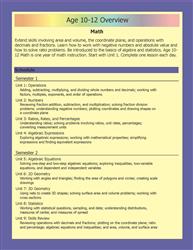
Unit 9: Skills Review
Lesson 1
Decimals, Factors, and Multiples
Students solve explicit practice problems that add, subtract, multiply, and divide decimals (e.g., 632.3 + 87.59; 847.2 − 37.89; 6.2 × 0.96; 994.08 ÷ 2.4) and complete word problems that require decimal computations (e.g., 2.1 × 72; 150 + 265 − 368.72). The Parent Plan section explicitly lists as a skill that students will "fluently add, subtract, multiply, and divide multi-digit decimals using the standard algorithm for each operation." An answer key is provided showing correct decimal results for these operations, indicating students practice full decimal computations.
Lesson 3
Expressions, Equations, and Percentages
Students solve an equation with decimals (x - 1.3 = 5.8) and compute x = 7.1, which requires adding a decimal to both sides. Students also work with numeric equations (e.g., m/4 = 5) that involve basic division and solving for a variable.
Lesson 4
Geometry
Students calculate decimal multiplications in several problems: they find the area of a rectangle using 3.5 x 2.8 = 9.8, compute circle measures using 3.14 x 25 = 78.5 and 2 x 3.14 x 5 = 31.4, and square the side 4 1/2 x 4 1/2 = 20 1/4. The answer keys show these decimal multiplication computations and results, indicating students perform multi-digit decimal multiplication in context.
3: Math
Unit 1: Numbers
Lesson 1
Positive and Negative Rational Numbers
Students solve multiple problems that require multiplying decimals and fractions (e.g., 5.5 × 6.7, -1.2 × 4.3, 2.3 × (-0.6), -4 × -0.25) in Activity 3 and apply a two-step procedure: "multiply as usual, ignoring the sign" and then "apply the sign rule" with worked examples (0.2 × 6.5 = 1.3; -0.2 × 6.5 = -1.3). Activity 4 offers additional real-world decimal multiplication practice (e.g., -3.5 × 4 = -14, -2.5 × 5 = -12.5) and word problems involve multiplying decimals and fractions in context.
Lesson 5
Irrational Numbers
Students compute and test decimal squares (e.g., 5.4^2 = 29.16, 5.5^2 = 30.25, 5.45^2, 5.48^2) to refine approximations to two decimal places. The activities instruct students to use a calculator to square decimals and to approximate values like √30 and √2 by squaring decimal guesses. The review quiz includes a decimal multiplication context (e.g., (-2.5) × 6) and tasks converting decimals to fractions (0.625 → 5/8, repeating 0.3 → 1/3).
Lesson 7
Arctic Marine Research
Students convert small decimal measurements (0.0000042 and 0.0000065) to scientific notation and compare which is larger. Students compute how many times larger one cell measurement is than another, producing a decimal ratio (answer key shows ~1.55). Students convert decimals to fractions (0.375 → 3/8 and 0.875 → 7/8) and perform basic numeric calculations for temperature range, average, and submarine depth.
Unit 2: Proportions
Lesson 2
Unit Rates
Students set up and compute unit rates by dividing totals by quantities, including examples with multi-digit decimals (e.g., $4.99 ÷ 6 = $0.83 and $12.99 ÷ 20 = $0.65). The student activity pages and answer keys require students to perform decimal division for prices and rates across many problems (e.g., $9.60 ÷ 12 = $0.80, $8.99 ÷ 10 = $0.90). The lesson also has students divide fractions (complex fractions) using Keep-Change-Flip, producing decimal or simplified fraction results (e.g., 3/4 ÷ 1/2 = 1.5 miles/hour).
Lesson 6
Taxes, Tips, and Commissions
Students convert percent rates to decimals and multiply multi-digit dollar amounts by those decimals to find tax, tip, and commission amounts (e.g., $15 × 0.07 = $1.05; $30,000 × 0.05 = $1,500; $50 × 0.20 = $10). Students add decimal amounts to original prices to find totals (e.g., $15 + $1.05 = $16.05; $50 + $10 = $60). Students solve backward problems by dividing totals by decimal factors to find pre-tax prices or original values (e.g., $212 ÷ 1.08 = $196.30; $374.40 ÷ 1.06 = $353.21).
Lesson 7
Markups and Discounts
Students calculate discounts and markups by multiplying prices by decimal percents (e.g., 50 × 0.30 = 15; 70 × 0.15 = 10.50; 75 × 0.35 = 26.25). Students subtract decimal amounts to find final prices (e.g., 50 − 15 = 35; 70 − 10.50 = 59.50). Students also solve backward problems that require division by decimals (e.g., x × 1.20 = 72 → x = 72 ÷ 1.20; 208 ÷ 1.60 = 130; 255 ÷ 0.85 = 300).
Lesson 8
Simple Interest and Percent Error
Students set up and compute decimal multiplications and divisions when using I = Prt (e.g., I = 800 × 0.042 × 5 = 168) and when converting percents to decimals for interest problems. Students solve for unknowns by dividing with decimals (e.g., r = 250 / 5000 = 0.05 and r = 540 / 9000 = 0.06). Students compute percent error by taking absolute differences, dividing by the actual value, and multiplying by 100 (e.g., 5 ÷ 30 = 0.1667 → 16.67%).
Final Project
Lemonade Stand
Students calculate unit prices by dividing total cost by number of items (per-lemon, per-pound of sugar, per-cup), set up proportions and divide to find amounts needed for a gallon, and divide the total cost for a gallon by 16 to find cost per cup. Students multiply unit costs by markup factors (×2, ×2.5, ×3) and compute discounts, taxes, and gratuities by multiplying by percentages, and they add ingredient and cup costs to find total per-cup cost. The activity asks students to round to the nearest hundredth, showing work spaces for these decimal calculations.
Unit 3: Expressions
Lesson 2
Rewriting Expressions
Students set up and compute one-step formulas that require multiplying decimals (e.g., Total Price = 40 × 1.05 → $42; 120 × 1.08 = 129.60) and use decimal multiplication for discounts and markups (e.g., 0.40 × 120 = 48). Students solve for original prices by dividing by decimal factors (e.g., 31.50 = P(1.05) leading to P = 31.50 ÷ 1.05; 54 = P × 0.9 → P = 60). Students add and subtract decimal amounts in context (e.g., 40 + 2 = 42; fixed cost + variable cost examples) and complete numerous practice problems that require decimal arithmetic.
Lesson 3
Algebraic Expressions
Students multiply by decimal factors in real-world percentage problems (e.g., Total Price = 60 × (1 + 0.07) → 60 × 1.07 = 64.20) and use decimal multipliers in markup/discount examples (e.g., Selling Price = (1 + 0.30) × 500 = 650; Discounted Price = 0.75 × 100 = 75). Word problems about money and sales tax require translating percentages to decimals and performing multiplication with decimals. Several problems require division of whole-number totals by unit costs (money context) that can result in non-integer answers.
Lesson 9
Unit 3 Test
Students solve multiple real-world price problems that require working with decimals, including calculating discounts and sales tax (e.g., $120 + 8.25% = $129.90; $40 + 6.5% = $42.60; $90 - 30% = $63). Several word problems ask students to compute final prices, totals, and fees (examples: computing sale price, total cost with tax, and adding startup or joining fees to per-unit charges). The answer keys show numeric decimal results, indicating students perform decimal multiplication and addition/subtraction in context.
Final Project
Planes, Trains, and Automobiles
Students solve time problems by dividing 500 by given speeds to produce decimal quotients (e.g., 500 = 60x → 8.33 hours; 500 = 80x → 6.25 hours; 500 = 400x → 1.25 hours). Students compute costs using decimal unit rates and percentages (e.g., y = 0.15x + 31.50, 0.20x + 20.75, 0.50x + 63.25; 5% tax calculations producing values like $12.50). Students add and subtract decimal amounts and multiply by decimal factors in context (e.g., summing ticket + tax + fees, calculating a 10% discount to get $225, computing a 15% tip: $16 × 1.15 = $18.40).
Unit 4: Probability
Lesson 2
Observing Probability
Students compute experimental probability by dividing counts by the total number of spins and express results as decimals and percents (e.g., 59/100 = 0.59). Students use those decimal probabilities to make predictions by multiplying the decimal by 600 (e.g., 0.59 × 600 = 354). The activity pages require students to record totals, convert fractions to decimal form, and perform decimal multiplication to predict counts for each color.
Lesson 4
Compound Events
Students convert fractions and percentages to decimal form and use decimal multiplication to make predictions (e.g., 14/60 -> 0.233 and 0.233 × 1143 ≈ 266.3; 35% -> 0.35 and 0.35 × 500 = 175). Students compute percent chances like 16.7% and use those decimals to multiply by a number of trials to find expected counts (examples showing 1/6 ≈ 16.7% and multiplying by 120 or 90). Several activity answers show students carrying out decimal-by-integer multiplications to produce non-integer results (e.g., 0.233 × 1143 and 0.375 × 480).
Unit 6: Geometry
Lesson 6
Dilations
Students multiply and divide decimals when finding new side lengths and scale factors (e.g., C′B′ = 3.6 × 3 = 10.8 and X′Y′ = 8 × 0.5 = 4). Students compute scale factors by dividing lengths (examples show calculations like 2.5 ÷ 5 = 0.5 and 6 ÷ 4 = 1.5). Activity answer keys and performing-dilation pages require students to compute and record decimal coordinates and lengths (e.g., P′(5, 2.5), scale factors 0.33, 0.25).
Final Project
Abstract Art Gallery
Students measure dimensions and calculate volumes using formulas that involve decimal multiplication (e.g., V_cylinder = πr^2h with π = 3.14) and then record decimal answers (example answers: 75.36 in³, 113.04 in³, 16.75 in³). The 3D Sculpture Volume Worksheet asks students to find radius by dividing diameter by 2 and to compute a total volume by adding the component volumes. The answer key and worksheet require students to perform multi-step arithmetic with decimals in a practical context.
Unit 7: Linear Equations
Lesson 1
Linear Equations With One Variable
Students solve two-step equations that require decimal arithmetic (for example, 0.4x + 2 = 6.8 where they subtract 2 to get 0.4x = 4.8 then divide by 0.4 to find x = 12). The student activity page includes ten decimal problems (e.g., x/2.5 + 1 = 5.4, x/4.2 + 3 = 8.1, x/3.3 = 6.5, x/1.5 = 3.42) and instructions to round answers to two decimal places. Example solutions and answer keys show students performing decimal subtraction, multiplication/division by decimal values, and working with multi-digit decimal results.
Lesson 8
Linear Algebra In the Wild
Students perform decimal arithmetic in context: in the Candy Shop example they multiply 19.70 by -2 to get -39.40 and add/subtract decimal amounts to form −4x = −16. Students divide decimals by whole numbers to find prices (15.40 ÷ 4 = 3.85) and check solutions by substituting decimal values (3×4 + 2×3.85 = 19.70). Several activity problems use decimal totals (e.g., 10.40 and 5.60) requiring students to add, subtract, multiply by integers, and divide to solve systems.
Lesson 9
Unit 7 Test
Students are asked to "Solve one-step and two-step linear equations with whole numbers, fractions, and decimals" in the Parent Plan and practice solving equations on student pages where decimals appear in solutions (e.g., coordinate solutions like (3.5, 1.5) and (1.5, 4)). The test directions explicitly allow use of a calculator, and many activities require solving equations and systems by graphing, substitution, and elimination where decimal answers may result.
Final Project
Getting Ready for College
Students set up and solve equations that involve decimal coefficients (e.g., Transportation: 225 + 0.60x = 1.25x, requiring subtracting 0.60x and dividing by 0.65 to find x). In Entertainment and Phone Plans activities students work with decimals (C = 5 + 1.5h and simplifying (10x + 40)/2 to 5x + 20), requiring division and multiplication of decimals. The Meal Plans and other comparisons use decimal rates and intercepts when interpreting slopes and computing break-even points, so students perform decimal arithmetic in context.
Unit 9: Semester Exams
Lesson 1
Numbers Review
Students multiply a decimal by a whole number in Mission 3 (−2.5 × 6 = −15) and solve integer division problems (e.g., −45 ÷ 9, −72 ÷ 6) on the activity pages. Students are asked in Mission 4 to create a real-world problem that uses multiplication or division and must include a fraction or decimal, which requires them to set up and solve at least one decimal operation. Students practice identifying, converting, and matching fractions and decimals in Activity 2, reinforcing decimal representations.
Lesson 2
Proportions Review
Students solve percent problems that require multiplying and adding decimals (e.g., sales tax 7.5% on $64 → $68.80; 15% tip on $52 → $59.80) and compute simple interest using decimal rates. Students find unit rates and speeds that require division producing decimal results (e.g., 3 miles in 12 minutes → 15 mph; 6 ÷ 1.5 = 4 mph). Several activities require multiplying quantities by decimal unit rates (e.g., interest and percent change problems).
Lesson 5
Semester Exam
Students compute sales tax, tip, markup, and simple interest (problems 21, 22, 23, 24) producing decimal-dollar answers such as $50.88 and $50.40, which requires multiplying with decimals. Students convert between fractions and decimals (problems 5 and 6) and simplify decimal expressions like 6.9 × 10^2 (problem 8). The exam notes that calculators are not allowed for Unit 1 problems, indicating students must perform some computations by hand.
Lesson 7
Geometry Review
Students compute volumes using π ≈ 3.14, which requires multiplying decimals by whole numbers (e.g., V = 3.14 × 4² × 10 = 502.4 for a cylinder and V = ⅓ × 3.14 × 9 × 14 ≈ 131.88 for a cone). The sphere problem gives a decimal volume (268.08 cm³) and asks students to solve for the radius, which requires dividing by a product involving 3.14 and 4/3 (a decimal division step) to isolate r³.