


Seventh Grade - MATH
5: Math

Unit 1: Operations
Lesson 3
Division Review
Students practice converting division problems with decimal divisors into equivalent whole-divisor problems by moving decimals in both dividend and divisor (Activity 3 example: 1.75 ÷ 0.25 → 175 ÷ 25). Students perform long division with decimal dividends by adding decimal points and zeros to continue the algorithm until there is no remainder (Activity 4 and Activity 5 example: $127 → 127.0 giving 63.5). Multiple student activity pages require computing decimal quotients (e.g., 81.27 ÷ 9 = 9.03, 6288.8 ÷ 2.8 = 2246), so students practice producing decimal results via long division.
Unit 3: Ratios and Percentages
Lesson 4
Unit Rates
Students are shown and asked to perform division with decimals to find unit prices and unit rates, including a worked long-division demonstration of $5.25 ÷ 3 = $1.75 with the long division steps displayed. Multiple problems require students to divide totals by unit counts (e.g., $6.27 ÷ 3 = $2.09, $2.90 ÷ 2 = $1.45, 156 ÷ 12 = 13), and the lesson explicitly presents a "Division" method that asks students to write a ratio as a fraction and divide the numerator by the denominator. The student activity pages and answer keys repeatedly show students converting fractional ratios into decimal unit rates by performing division.
Lesson 5
Percentages
The materials explicitly state that converting a fraction to a decimal is done by dividing the numerator by the denominator and show a long-division work-up converting 1/4 to 0.25 (including the step-by-step division layout). Student activities and answer keys require students to convert fractions, decimals, and percents into decimal form (e.g., examples like 0.6 = 6/10 → 60/100 = 0.60 and problems converting percentages to decimals). The text also explains dividing by powers of 10 and the decimal-point shortcut for dividing by 100, linking division ideas to decimal conversion.
Lesson 8
Unit 3 Test
Students complete multiple tasks that convert between fractions, decimals, and percentages (for example, tables showing 13/100 = 0.13, 3/4 = 0.75, 2/25 = 0.08, and 1 1/2 = 1.5). The unit lists as a learning goal: "Convert percentages to fractions and decimals, and convert fractions and decimals to percentages." Several practice problems ask students to fill in charts and translate word problems that require converting rational numbers to decimal form.
Final Project
What's the Best Buy?
Students are instructed to find unit prices by dividing the total price by the number of units, and an explicit long-division example is shown dividing $3.38 by 13 to obtain $0.26 with step-by-step long division work. The materials tell students to set up a ratio problem and divide price by units to find a price per unit and note that quotients may not be exact. The Parent Plan allows use of a calculator but the student-facing pages show manual division steps for at least one conversion to a decimal.
Unit 7: 3D Geometry
Lesson 5
Problem Solving With Solids
Students perform long-division style computations with decimals in real problems (e.g., dividing 528 by 275 and noting "add a decimal and zeros to the dividend as you divide" to get 1.92). The Basic Skills Review directs students to divide 724 by 1.6 by moving the decimal and performing division (7240 ÷ 16) and adding zeros to avoid a remainder. Several word-problem solutions show students dividing volumes or areas (e.g., 45,000 ÷ 600 = 75; 27,000 ÷ 90 = 300), reinforcing the use of division to produce exact quotients.
Unit 8: Statistics
Lesson 9
Comparing Populations
Students compute means and mean absolute deviations by performing divisions that produce decimal results (e.g., 75 ÷ 10 = 7.5; 96 ÷ 10 = 9; MAD 10 ÷ 10 = 1.0 and 12 ÷ 10 = 1.2). The lesson shows students carrying out a further division to compare means (1.5 ÷ 1.2 = 1.25). A fraction (1/2) is used when asking about proportions in a graph, showing some engagement with rational numbers.
3: Math
Unit 1: Numbers
Lesson 2
Fractions and Decimals
Students convert fractions to decimals by performing long division in multiple activities (Activity 1 and the "Changing Fractions to Decimals" practice page) with worked examples such as 3/4 -> 0.75 and 1/3 -> 0.333.... The materials include explicit directions to use long division for the first practice problems and show step-by-step division set-ups on student pages. Students learn to classify decimals as terminating or repeating (definitions, examples, and practice items) and use a prime-factor rule of the simplified denominator to predict termination. The Parent Plan and Day 3 activities also have students convert repeating decimals back into fractions using the algebraic x, 10x, subtract method, reinforcing that repeating decimals represent rational numbers.
Lesson 4
Square and Cube Roots
Students are asked to convert fractions to decimals (e.g., "Convert 7/8 into a decimal" in the Review Quiz) and to identify whether a decimal is terminating or repeating (e.g., "Identify whether 0.8333... is a terminating or repeating decimal"). The answer key shows fractional-to-decimal conversions (3/4 = 0.75, 0.45 = 9/20) and labels 0.8333... as a repeating decimal. Calculator examples produce decimal results for negative exponents (0.125 and 0.1111...), reinforcing decimal representations of rational values.
Lesson 5
Irrational Numbers
Students are asked to convert fractions to decimals on the Review Quiz (e.g., Problem 5: convert 2/9 to a decimal and determine if it is terminating or repeating) and the answer key shows several fraction–decimal conversions (e.g., 3/4 = 0.75, 0.625 = 5/8) and discussion of repeating decimals (0.333... shown as an example). The lesson repeatedly states that rational-number decimal expansions terminate or eventually repeat (Things to Know, Parent Plan) and provides examples of repeating and terminating decimals (0.333..., 0.75). Students also work with converting repeating decimals to fractions in the quiz answer key (the x = 0.3 method), showing engagement with the relationship between fractions and repeating decimals.
Lesson 7
Arctic Marine Research
Phase 4 asks students to convert terminating decimals (0.375 and 0.875) into fractions, with an answer key showing 0.375 = 3/8 and 0.875 = 7/8. Phase 2 requires students to classify numbers as rational or irrational (e.g., √2 vs. 1.75) and justify their answers. The Parent Plan/Skills section explicitly states that students should understand that every number has a decimal expansion and that for rational numbers the decimal expansion repeats eventually, and it mentions converting a repeating decimal expansion into a rational number.
Lesson 8
Unit 1 Test
Students are asked to convert fractions to decimals (e.g., Problem 5: convert 3/8 into a decimal with the answer key noting "divide 3 by 8" and other items showing 5/8 → 0.625). The parent/planner text and the review checklist explicitly instruct students to "turn a fraction into a decimal using long division" and state that a rational number's decimal either terminates or repeats. Multiple questions require students to identify whether decimals are terminating or repeating (e.g., 0.3, 0.6) and to explain their reasoning.
Unit 2: Proportions
Lesson 2
Unit Rates
Students compute decimal unit rates by dividing quantities (e.g., $4.99 ÷ 6 = 0.83 per apple; $9.99 ÷ 14 = $0.71 per ounce; 300 ÷ 5 = 60 miles per hour). Students convert some fraction results to decimals in worked examples and answer keys (e.g., 3/2 = 1.5 miles per hour; 6/4 simplified to 3/2 then presented as 1.5). Many activity problems and answer keys require students to perform division that yields decimal answers for unit rates across prices, speeds, and areas.
Lesson 4
Graphing Proportions
The Skills Review and Activity pages ask students to convert fractions to decimals using long division (e.g., "Convert 13/16 into a decimal using long division") and include problems that require identifying whether the decimal terminates or repeats. The answer key gives explicit converted examples and labels them as terminating or repeating (e.g., 13/16 = 0.8125 terminating; 7/9 = 0.777... repeating). Additional items ask students to work with repeating decimals (e.g., convert 0.444... into a fraction), so students practice both conversion and recognizing repeating versus terminating decimals.
Lesson 7
Markups and Discounts
Students convert percentages to decimals (for example, the lesson shows 30% = 0.30) and then use those decimal forms to compute discounts and markups (e.g., 50 × 0.30 = 15 and many practice problems multiply prices by decimal percents). Activity pages require students to show work when multiplying by decimal equivalents of percents and to compute percent change by dividing and multiplying to get a decimal result (e.g., (New − Original) ÷ Original = 0.25 → 25%). Students repeatedly practice working with decimals in context when finding discounts, markups, and percent increases/decreases.
Lesson 8
Simple Interest and Percent Error
Students are asked to write the interest rate r "as a decimal," and example calculations convert percents to decimal form (e.g., 4% → 0.04, 4.2% → 0.042, 5% → 0.05). The percent error example performs division to get a decimal (5 ÷ 30 = 0.1667) and the activity answer keys show several decimal results from fraction or percent inputs. Worksheets and answer keys require students to use decimal representations when computing interest and percent error.
Lesson 9
Unit 2 Test
Students are asked to compute unit rates and prices that require dividing rational numbers, and the answer key shows fraction results converted to decimals (for example, 15/12 = 1.25 miles per hour and several prices given as decimal amounts like $248.13 and $41.30). Multiple problems ask for unit rates or unit prices where students must perform division of fractions or whole numbers (e.g., 5/6 mile in 2/3 hour, recipe and speed problems). Several activity pages and the test require students to produce decimal answers for rational-number computations.
Unit 3: Expressions
Final Project
Planes, Trains, and Automobiles
Students set up and solve division problems that produce decimal answers (for example 500 = 60x giving x = 8.33 hours, 500 = 80x giving x = 6.25 hours, and 500 = 400x giving x = 1.25 hours). The activity asks students to compute times and costs using formulas like y = mx and shows decimal unit rates (for example cost per mile 0.15, 0.20, 0.50) and allows use of a calculator. Students record and interpret decimal results in tables and graphs when comparing travel times and costs.
Unit 4: Probability
Lesson 4
Compound Events
Students convert probabilities written as fractions into decimal and percent forms in multiple places (for example, 1/8 = 0.125 = 12.5% and 1/6 ≈ 16.7%). Activity instructions explicitly ask students to "convert it to a percent" and allow use of a calculator, and answer keys show decimal/percent equivalents for several probability fractions.
Unit 5: Functions
Lesson 6
Slope-Intercept Form
The lesson converts a rational slope to a decimal in the Table to Equation example where m = 1/5 is written as 0.2 ("The subway travels: 1/5 or 0.2 miles per minute"). Several activity answer keys and examples list slopes as fractions and sometimes as decimal values (e.g., slopes shown as 1.0 or 0.2). Students also perform arithmetic with fractional slopes when rewriting equations (examples include slopes like -2/3, 1/2, 3/4).
Unit 7: Linear Equations
Lesson 1
Linear Equations With One Variable
Students solve many equations that contain decimals (Activity 4) and are instructed to produce decimal answers (with a direction to round to two decimal places). Students solve equations with fractional coefficients by multiplying by reciprocals (Activity 3), which exposes them to relationships between fractions and decimal computations. The answer key includes a decimal with a repeating bar (x = 4.67̅), indicating awareness that some rational-number results can repeat.
Unit 8: Data
Lesson 5
Categorical Data
Students convert ratios to decimals when creating relative frequency tables (for example, Activity 4 computes 18/90 = 0.20). Multiple examples and answer keys show students writing cell values as decimals (e.g., 0.75, 0.25) and expressing proportions as percentages. Activity 5 explicitly asks students to label values as decimals or percentages and to round decimal answers to the nearest hundredth.
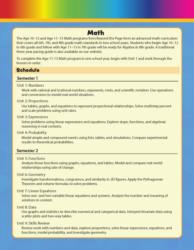
Unit 9: Semester Exams
Lesson 1
Numbers Review
The Parent Plan explicitly lists as a skill: "Convert a rational number to a decimal using long division; know that the decimal form of a rational number terminates in 0s or eventually repeats." Activity 2 has students match fractions and decimals (e.g., 3/4 ↔ 0.75, 0.375 ↔ 3/8) and includes items labeled "A decimal that stops after a certain number of digits" and "A decimal with a pattern that repeats forever." The materials also provide refresher videos titled "Changing Fractions to Decimals" and "Repeating Decimals to Fractions," indicating conversion and identification of terminating vs. repeating decimals are addressed.
Lesson 2
Proportions Review
Students compute quotients that produce decimal forms of rational numbers in multiple activities (for example, Activity 1 shows 2 ÷ 5 = 0.4 and compares unit rates such as 6 ÷ 1.5 and 10 ÷ 2). Percent and rate problems in Activities 3 and 4 require students to perform division to find decimal or percent values (e.g., simple interest, percent error, and unit-rate calculations).
Lesson 4
Probability Review
Students are asked to write probabilities as fractions and decimals (for example, the spinner experiment: 7/25 is written as 0.28). Several answer keys show fraction-to-decimal conversions (e.g., 4/20 = 0.20 = 20%), and the student directions explicitly allow use of a calculator. Tasks repeatedly require expressing probabilities in fractional, decimal, and percent form.
Lesson 5
Semester Exam
Students are asked to convert the fraction 7/16 into a decimal (Question 5) and the answer key gives 7/16 = 0.4375. Students are also asked to determine whether the decimal 0.42 is terminating or repeating and to explain (Question 7), with the key labeling it as terminating. Additionally, students convert a decimal to a fraction (0.375 → 3/8 in Question 6), showing practice with reciprocal conversions between fractions and decimals.