


Eighth Grade - MATH
3: Math
Unit 6: Geometry
Lesson 1
Congruence and Similarity
Students practice identifying corresponding sides and angles (writing statements like AB → DE and △ABC ≅ △DEF) and use hash marks and angle arcs to show matching segments and angles. Several activities present shapes that are rotated or flipped on purpose and instruct students to match parts despite those rotations or flips. The Parent Plan and wrap-up note that congruent shapes "line up perfectly" when placed on top of each other and mention using physical models, transparencies, or geometry software to understand congruence.
Lesson 2
Translations
Students draw and translate line segments (e.g., draw segment AB with A(1,4) and B(4,2) and translate it 2 left, 4 down, then plot A'B'). Multiple student tasks ask for translating line segments (DE, FG, A and B in various exercises) and recording the new coordinates and labels such as Line A'B'. Explanatory text and examples state that translated shapes remain the same size and orientation (e.g., "Both triangles are the same size and shape" and "The shape stays exactly the same size and orientation").
Lesson 3
Reflections
Students reflect individual points, endpoints, and entire line segments across the x-axis, y-axis, and diagonal lines in multiple activities (e.g., tasks reflecting E(1,1)-F(4,1), G(-2,0)-H(-2,-3), J(-4,2)-K(1,2), and many others). The materials state and have students use the rule "To reflect any line segment, just reflect its endpoints; the line between them follows naturally," and ask students to connect reflected vertices to form image segments and shapes. Students use the Perpendicular Distance Method (draw a perpendicular, measure distance, place the reflected point the same distance on the opposite side) and apply coordinate rules/formulas that produce corresponding image coordinates, with notes explicitly saying reflected shapes and segments are congruent.
Lesson 4
Rotations
Students rotate line segments and plot the images in multiple places: Example 2 shows a line segment with endpoints P(4, -1) and Q(2, -3) moved to P'(-4, 1) and Q'(-2, 3). Algebraic Rotations Example 2 rotates line AB (A(1,2), B(3,2)) 180° and instructs students to connect the new points to draw the rotated image of the line segment. Student activity pages require rotating line segments (e.g., GH, IJ) on coordinate grids and the answer key lists the resulting endpoints and the image lines (G'H', I'J').
Lesson 5
Sequences of Rigid Transformations
Students perform translations, reflections, and rotations on coordinate grids (e.g., translate by T1,-1, reflect over the x- or y-axis, rotate 90° or 180°) and graph original and image figures. Students label vertices with primes and follow coordinate rules to produce images, and several answer-key diagrams show corresponding original and transformed shapes with vertex coordinates. The parent notes and wrap-up explicitly ask students to check that side lengths and angles stay the same after each move and to verify congruence between original and image.
Lesson 6
Dilations
Students are told that rigid transformations (translations, rotations, reflections) "keep the shape exactly the same size," and the Skills section asks students to describe the effect of dilations, translations, rotations, and reflections using coordinates. Students practice coordinate methods for verifying transformations (e.g., multiplying coordinates by a factor for dilations) and complete many activities that compare original and transformed points and compute scale factors. Some examples and answer keys mention translations and show transformed coordinates alongside originals.
Lesson 7
Sequences of Transformations
Students plot original polygons and compute new vertex coordinates when performing translations, rotations, and reflections (see Example 1 and Example 2 and the multi-step activity problems that require rotating by 90°, reflecting across axes, and translating by specified units). Student work includes applying transformation rules such as (x,y) → (y, -x) and translating coordinates by adding or subtracting values, producing transformed endpoints for triangles, rectangles, and parallelograms. The activity pages and answer key list original and transformed coordinates for line segments, showing students generate images of lines and segments after rigid transformations.
Lesson 8
Triangles and Transversals
Students answer quiz questions that identify rigid transformations and which are not rigid (e.g., selecting that dilation is not a rigid transformation). Students work with coordinate-plane tasks that ask them to reflect and translate figures (e.g., reflect (2,2) across the y-axis then translate up 2) and to describe sequences of rigid transformations that map one triangle to another. Several problems ask what stays the same under reflections/translations (angle measures and side lengths) and students decide whether pairs of triangles are congruent or similar.
Lesson 11
Unit 6 Test
Students perform many coordinate-plane transformations: they reflect triangles across the y-axis and y = x, rotate triangles 90° (both directions) and 180°, and apply translations (e.g., T5,-3) as shown in multiple exercises and answer keys. Students are asked to decide whether pairs of figures are congruent or similar and to match corresponding sides and angles (squares and triangles problems). The materials also include a multiple-choice question identifying which transformation is not rigid and an explicit skills list stating students should "verify experimentally the properties of rotations, reflections, and translations."
Final Project
Abstract Art Gallery
The Skills section explicitly lists verifying experimentally that rotations, reflections, and translations take lines to lines and line segments to line segments of the same length. In Part 2 (Transformative Art) students create shapes on a coordinate grid, then reflect a polygon across an axis, rotate a polygon 90° about the origin, and translate a polygon, drawing both pre- and post-images. The Student Activity Page asks students to choose two congruent shapes, which requires producing or identifying shapes that are identical in size and shape after transformations.
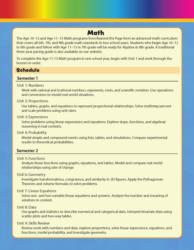
Unit 9: Semester Exams
Lesson 7
Geometry Review
Students perform reflections, translations, and rotations on points and triangles on coordinate grids (Activity 2), writing the coordinates of images and describing how x- and y-values change. Students plot and dilate triangles by given scale factors (Activity 1), producing corresponding vertices (e.g., L′(6,3), M′(12,3), N′(9,9)). Students are asked to identify which transformations are rigid (Rigid or Not? question) and to explain that dilations change size while reflections/translations/rotations do not.
Lesson 10
Semester Exam
Students are asked to perform rigid transformations: translate a square using T_{1,-3} (problem 11), translate triangle ABC using T-4,2 (problem 14), rotate point B(-3,4) 90° clockwise about the origin (problem 13), and reflect point A(5,10) across the y-axis (problem 12). Students compute and plot images of points and shapes (several items require new coordinates and graphs). Problem 15 explicitly asks whether a dilation is rigid or non-rigid, prompting students to consider preservation of size under transformations.