


Ninth Grade - ELA
1: Semester 1

Unit 1: Lord of the Flies
Lesson 1
The Call
Students match vocabulary words to definitions and to quotations from Lord of the Flies using a cut-and-paste/matching activity that pairs words (incredulous, errant, furtive, susurration, sepals, decorum, discursive, leviathan) with contextual sentences and images. The Parent Plan states students will "determine the meaning of words and phrases as they are used in the text, including figurative and connotative meanings," and the vocabulary answer key links each word to a specific passage. Students are asked to review vocabulary terms and definitions to prepare for encountering the words in the text. The activities require students to use context to select the correct meaning for each target word.
Lesson 4
Images from Paradise
The Parent Plan skills section explicitly requires students to "determine the meaning of words and phrases as they are used in the text, including figurative and connotative meanings" and to "analyze the cumulative impact of specific word choices on meaning and tone." Activity 1 asks students to fill a chart with quotations, label each description as positive or negative, explain how it serves as imagery, and indicate whether the description suggests paradox or contrast. The lesson repeatedly directs students to attend to word choice and tone (e.g., "word choice that communicates a writer's attitude" and "create an experience for the reader through word choice").
Lesson 6
Symbolism, Part 1
Students are asked to choose among related interpretive labels for symbols (e.g., Piggy's glasses: science and technology / intelligence / civilization; the conch: social order / democracy / communication; the beast: savagery / fear / ignorance). Students must circle the interpretation they agree with and write a brief, text-supported explanation for that choice. The Activity and Student Activity Page direct students to defend their selections using evidence from the novel.
Lesson 8
Defects of Human Nature
Students are asked to learn meanings and practice recognizing vocabulary in context through two explicit activities: Option 1 asks students to match bolded words from Lord of the Flies to definitions in a definition bank, and Option 2 asks students to fill blanks in sentences using a provided word bank and contextual clues. The lesson explicitly directs students to "learn the meanings of the words and practice recognizing them in context," and provides answer keys for the matching and fill-in exercises.
Lesson 10
Which Is Better?
Students are asked to define and contrast the concepts of "civilization" and "savagery," including a provided definition of savagery and guided discussion questions that ask "What does it mean to be civilized?" and whether civility is about cleanliness or nonviolence. The Student Activity Page requires students to compare and contrast the boys' lives with early peoples (Similar to Early Peoples / Different from Early Peoples), and the Piggy quote is used to prompt direct comparisons between rules/agreement and hunting/killing.
Final Project
Now You Have the Conch
Students are asked in the Unit Test (Part II: Vocabulary) to match vocabulary words (reluctant, furtive, susurration, discursive, errant) with their definitions. The answer key supplies precise definitions for those words, and the test requires students to demonstrate knowledge of each word's meaning. The lesson repeatedly references reviewing vocabulary in the "Things to Know" sections and studying vocabulary as part of test preparation.
Unit 3: Grammar, Part I
Lesson 1
Parts of Speech
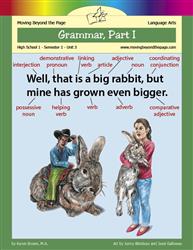
Students practice forming and choosing comparative and superlative adjective/adverb forms in the "Comparisons" activity and an online adjective/adverb exercise, which requires selecting between forms (e.g., "more" vs "-er"). The lesson explicitly gives a usage tip distinguishing farther/farthest (physical) from further/furthest (abstract), and it defines intensifiers that alter degree (very, too, more). Activities ask students to choose correct adjective/adverb forms and to decide usage based on context (Option 2 adjective/adverb exercise and comparisons worksheet).
Lesson 2
Subject-Verb Agreement
Students read explicit explanations and lists of commonly confused word pairs (e.g., a/an; a lot/alot/allot; accept/except; adapt/adopt; advice/advise; affect/effect; aggravate/annoy) and are instructed to record notes, tips, and examples in the "Commonly Confused Words" activity pages. Students complete multiple-choice and sentence-completion exercises that require them to choose the correct word form in context (e.g., sets I–VII and Commonly Confused Words, Set I and II). The lesson gives some guidance about differences in part of speech or usage (for example, "Affect is a Verb; Effect is a Noun") and asks students to write examples and check answers against an answer key.
Lesson 4
Commas
Students read explicit explanations for word pairs/groups (all together/altogether, allusion/illusion, altar/alter, alumni/alumnae/alumnus/alumna) and record notes and examples for Set III of the "Commonly Confused Words" activity. Students complete a worksheet that requires them to choose the correct word in context (circle the correct answer) and then check their answers against an answer key. The parent plan directs students to add their own notes or examples and copy helpful tips, reinforcing recognition of different meanings and forms.
Lesson 5
Review
Students review and correct commonly confused words in Part I of the Grammar Quiz by crossing out incorrect words and writing the correct form above them, practicing word-choice in context. The homework and activity pages require students to circle the correct word from pairs (e.g., among/between, bad/badly, bear/bare, besides/beside), reinforcing selection based on usage. Explanatory notes for bad/badly and bear/bare describe differences in part of speech and meanings (e.g., 'badly' as an adverb; 'bear' versus 'bare' meanings and irregular forms). Students are prompted to define words and describe when they should be used (suggested index-card study and oral recall practice).
Lesson 6
Colons and Semicolons
Students read explicit explanations and tips for commonly confused word pairs (breath/breathe, can/may, course/coarse) and are instructed to record notes and examples in the activity page. Students complete a ten-item worksheet that requires them to choose the correctly used word in context and then check their answers against an answer key. The parent notes also direct students to review rules for any missed items and to copy helpful tips, reinforcing attention to distinctions in meaning and usage.
Lesson 7
Spelling
Students read explicit definitions and usage tips for many commonly confused word pairs (e.g., cite/sight/site; council/counsel; discreet/discrete; ensure/insure; carat/karat/caret/carrot) and are instructed to record notes and examples. Students complete multiple context-based exercises where they must choose or circle the correctly used word in sentences (Commonly Confused Words sets VI and VII and the Spelling worksheet). The activities include teacher/parent answer keys and encourage students to review rules and misspelled items when they answer incorrectly.
Final Project
Wrapping Up
Students practice choosing among commonly confused words on the unit test (Part II: Commonly Confused Words) where they must select the correct word in context (e.g., desert/dessert, capital/capitol, insure/ensure, complement/compliment). Students are directed to keep and refer to their "Commonly Confused Words" pages and to create a short quiz using as many of those words as possible, then explain any missed words to a quiz taker. The mini-project (Option 2) requires students to compose a paragraph that uses and contrasts commonly confused words and to produce an answer key.

Unit 4: Poetry
Lesson 1
Introduction to Poetry
Students read poems and are asked to mark and select words with strong connotations, then explain why those words are effective. The Denotation and Connotation activity directs students to write each word's denotation, list its connotations, propose similar words (synonyms), and evaluate whether the original word is more effective—illustrated by the provided "frigate" vs. "ship, vessel" example. Homework asks students to identify words with positive/negative connotations and explain why the poet chose them, requiring comparison of word choices in context.
Lesson 4
Voice and Tone
Students are asked to choose tone words from a supplied Tone List and record one or more words that describe the tone of each poem, then cite words or phrases that convey that tone (Activity 2 tone chart). Students compare and contrast the tones of two similar poems ("Those Winter Sundays" and "Yesterday") and record language that transmits the emotions. The lesson includes an optional prompt that directs students to consider denotative meaning (the "sexual seeds" example) and the Parent Plan states students should determine meanings including connotative meanings and analyze the impact of specific word choices on tone.
Lesson 7
Analyzing Poetry
Students are asked to annotate poems by marking important words and writing vocabulary notes and reactions (Activity 1), and the sample annotation shows students labeling words for tone, vocabulary, and connotation (e.g., notes like "arrogant," "short life," and "strange word - Greek?"). The Poetry Map includes a "Word Choice" box and prompts students to analyze specific word choices (with examples such as Heaney's "glutting our cache" and "rat-grey fungus") and to consider imagery and tone. The Poetry Puzzle has students sort words by part of speech and sensory categories, engaging them in close attention to word meaning and function.
Lesson 8
Types of Poems
The lesson includes a "Strong Verbs" activity that lists paired examples (e.g., walked + strode, waddled + limped) and asks students to write three sentences replacing bland verbs with stronger, more specific ones. The free-verse student activity page reinforces use of strong verbs and sensory language when composing poetry. The Skills section explicitly names using precise words and phrases as a targeted skill.
Lesson 9
The Crossover
Students compare the vocabulary entries as presented in The Crossover with dictionary definitions by answering directed questions in Activity 1 (Option 1), noting pronunciation, part of speech, and definition differences. Students explain how the author's contextual "As in:" example sentences aid understanding and are asked to use one word as an example of that effect. Students also write their own vocabulary poem using personal events (Option 2) and reflect on how the meaning of the word "crossover" shifts across poems in the homework Option 1.
Lesson 10
Poems and Poets
Students are directed to complete a Poetry Map that includes a dedicated "Word Choice" box and prompts to note imagery, other figurative language, and tone. The Parent Plan lists a skill to "Determine the meaning of words and phrases as they are used in the text, including figurative and connotative meanings; analyze the cumulative impact of specific word choices on meaning and tone." Day 3 asks students to note the language a poet writes in and how cultural references and translations can change word meanings.
Lesson 11
Reciting Poetry
Students are instructed to mark unfamiliar words and look up their meanings and pronunciations, and to determine the poem's tone and speaker. They are asked to consider why the poet chose certain words and how specific word choices create images, with an explicit comparison of 'chaired' versus 'picked the boy up and carried him around.' The parent plan language and homework direct students to determine figurative and connotative meanings and to analyze the cumulative impact of specific word choices on meaning and tone.
Final Project
Poetry
Students are asked on the unit test to explain the difference between a word's denotation and connotation, requiring them to define literal versus associative meanings. Students are instructed in the poetry explication project to identify and demonstrate notable word choice, to highlight words that communicate tone, and to analyze figurative and connotative meanings. The parent-plan learning goals explicitly tell students to "determine the meaning of words and phrases...including figurative and connotative meanings" and to "analyze the cumulative impact of specific word choices on meaning and tone."
Unit 5: Nonfiction
Lesson 1
Types of Nonfiction
The Student Activity Page includes a "Vocabulary study" that defines biography, autobiography, and memoir and asks students to read those descriptions and decide which label fits a given book. The Parent Plan answer key instructs students to look up the terms in a dictionary or reference source, close the source, and write definitions in their own words. Students are then asked to classify I Am Malala (memoir vs. autobiography vs. biography) and to cite front- and back-matter evidence to support their classification. The web link and follow-up question prompt students to analyze how an author's or contributor's role might change the book's classification, encouraging consideration of subtle differences between related terms.
Lesson 4
Dear Diary
Students are instructed to "use different terms" and are given synonyms for words in the sample sentence (e.g., synonyms for "edict" and "banning"), prompting attention to word choice. The lesson tells students to re-read surrounding material to understand context before paraphrasing, which directs them to consider subtle contextual meaning. In Part I of the activity, students analyze paraphrases and are asked to judge accuracy where a change in wording alters meaning (for example, recognizing that "can yield important effects" is not the same as "will definitely improve").
Lesson 5
Displacement
Students are asked to define the term IDP (internally displaced persons) and explain what it means (Question #1). The provided answer explicitly contrasts IDPs with refugees by noting that IDPs are like refugees but remain within their own country, which points to a comparison of two related terms.
Lesson 11
A Boy's Story
Students are asked to identify vocabulary from the text, write preliminary definitions, look up each word in the dictionary, and record definitions in their own words (Activity 1, steps A and C). Students then use the words in sentences from the book and correct any incorrect definitions they initially wrote (Activity 1, steps B and C and the Parent Plan vocabulary answers). The Parent Plan lists a related skill: interpreting words and phrases including technical, connotative, and figurative meanings.
Lesson 13
Child Soldier
The "Different Accounts" activity asks students to record what the book says and what the video says for questions such as whether the boys are forced to fight, and the answer key explicitly contrasts the book's wording with Beah's stronger phrasing (e.g., book: boys seem to have no choice but to stay and fight; video: Beah says they were "forcefully recruited"). The activity requires students to note differences between the book and the video in language about commanders, drugs, and effects of war movies, which could lead students to observe differences in word choice and emphasis between sources.
Lesson 14
Rehabilitation
The lesson asks students to explain why Beah says "needed" instead of "wanted," and the provided answer directs students to interpret "needed" as indicating addiction and conditioning. Activity 2 asks students to choose which of several Elie Wiesel quotations best applies to Beah's memoir and to explain how that quotation relates to the book, requiring students to distinguish subtle differences in meaning among similar statements. Several comprehension questions (e.g., interpreting repetition and the phrase "None of these things are your fault") prompt students to analyze word choice and tone in context.
Semester Exam
Semester Exam
Students are asked directly to explain the difference between denotation and connotation (Part III, short answer 4). The review instructions tell students to study the "Commonly Confused Words" pages and to "know the differences among the commonly confused words covered in the unit." The grammar paragraph and its answer key present pairs/triplets of commonly confused words (affect/alter, advice/advise, a lot/alot, course/coarse) that students must correct and distinguish.
2: Semester 2

Unit 1: Ender's Game
Lesson 4
Divergence
Students are asked to write a definition of "science fiction," which requires them to select distinguishing features of the term. In the Science Fiction or Fantasy? section, students label each example as science fiction or fantasy, requiring them to distinguish between related genre labels. In the Matching Exercise students draw lines from terms to exemplars, including matching "soft science fiction" versus "hard science fiction," which asks students to recognize differences between closely related subgenre labels.
Lesson 7
Leaders Motivate
The lesson explicitly defines and contrasts related words: it explains that authority is institutional permission, power is the brute ability to do something, and leadership is the ability to motivate others. Students are asked to review the difference between leadership and authority and to reflect on how quotes about leadership apply to characters. Activities require students to match and complete famous quotes about power and leadership and to choose characters and explain why a particular quote fits each character.
Final Project
Think-Tac-Toe
Students are asked in the Unit Test Part I to use the word "invective" in a sentence, to define a polyglot, and to circle the correct word (puerile, ascetic, dirigible) to fit each sentence, requiring them to determine word meanings from context. The acrostic puzzle requires students to supply vocabulary such as "convergent" and "divergent," and the Parent Plan lists skills to determine meanings of words and phrases including figurative and connotative meanings. Several Think-Tac-Toe activities (e.g., rewriting passages, choosing style choices) require students to attend to authorial word choices and tone.
Unit 2: Grammar, Part II
Lesson 2
Capitalization and Numbers
Students read explicit explanations for multiple commonly confused word pairs (envelop/envelope, everyday/every day, faze/phase, fewer/less, forego/forgo) and are instructed to record notes, examples, and tips for each pair. The lesson gives targeted guidance about pronunciation and usage (e.g., envelop vs. envelope pronunciation; the fewer/less countable vs. noncountable rule) and requires students to complete a fill-in-the-blank letter activity that makes them choose the correct word in context. Students also check answers against an answer key and revisit any missed items, reinforcing distinctions between words with similar denotations.
Lesson 3
Sentence Fragments and Run-on Sentences
Students read explicit explanations and usage tips for multiple commonly confused pairs (foreword/forward; good/well; imply/infer; in/into; its/it's; lay/lie; loose/lose, etc.) on assigned pages and lesson text. Students complete targeted practice pages, quizzes, and an escape-room activity that require them to choose and correct the appropriate word in context. Students must write a 1–2 page narrative that uses all target words correctly and explicitly show the differences between pairs (including requiring an instance of implying and inferring and both meanings of good/well).
Lesson 4
Modifier Errors
Students read the explanation for four groups of commonly confused words (may/might + have, pair/pare/pear, passed/past, peak/peek/pique) and record notes and examples in the Commonly Confused Words activity page. Students complete a Fill-in-the-Blanks exercise choosing the correct word from a word bank and a Word Sorting task that groups words by meanings (seeing/interest, time/movement, fruit/cutting, mountains/height). The lesson text provides explicit tips distinguishing senses and parts of speech (for example, explaining that 'passed' is usually a verb while 'past' is not a verb, and contrasting 'peek' vs. 'peak' vs. 'pique').
Lesson 5
Hyphens and Apostrophes
Students read explicit instruction and tips on commonly confused words (pore/pour, principle/principal, quiet/quite, real/really, sit/set) and are asked to record notes and examples for each word group. Students complete a context-based activity page that requires choosing between similar words (fill-in-the-blank passages using real/really and principal/principle) and then check answers against an Answer Key that includes explanations. The lesson also provides targeted explanations of differences (e.g., principle as noun vs. principal as adjective/noun, pore vs. pour noun/verb uses, sit/set transitive vs. intransitive distinctions) that students are directed to use when deciding word choice.
Final Project
Wrapping Up
Students are asked to review and correct commonly confused words (e.g., to/too/two; there/their) on the unit review and unit test, and the test includes items and paragraph corrections that require choosing the correct word form. One mini-project option asks students to create a slideshow that "shows the difference among the words in a set of commonly confused words," and the poster option explicitly includes creating a poster explaining the difference between "lay" vs. "lie." Students are also directed to correct commonly confused words in provided paragraphs as part of assessment practice.

Unit 3: Informational Texts
Lesson 2
Outliers
Students are instructed in Activity 2 to look up each vocabulary word in a thesaurus and find a synonym that matches both denotation and connotation, then try inserting the synonym in the sentence to see if it still makes sense. The Student Activity Pages list words (arbitrary, profoundly, patronage, beneficiary, persist) with spaces for possible synonyms, notes, and a final choice. The Parent Plan explicitly notes that students should understand connotation as well as denotation and includes a discussion prompt about why it can be difficult to find good synonyms.
Lesson 6
The Ethnic Theory of Plane Crashes
Students complete Chapter 7 vocabulary activities that require using a dictionary, writing synonyms or antonyms, and using target words in context (Activity 1). The lesson asks students to match words to definitions and antonyms and to verify preliminary determinations of word meaning by consulting reference materials (Parent Plan skills). In Activity 3 students analyze and distinguish mitigated speech from euphemisms by brainstorming contexts where each is appropriate and by producing sketches and explanations showing the difference in usage.
Lesson 10
Science Writing
Students read the sections "Forces" and "Circular Motion and Fictitious Forces" and answer a direct question asking for the difference between centrifugal and centripetal force, stating the outward vs. inward nuance. Students answer why centrifugal force is sometimes called "fictitious," explaining how the meaning depends on frame of reference (passenger experiencing motion vs. outside observer). The activity page asks students to identify the specific methods the author uses to explain the term "centripetal force" (highlighting, explanation, example, illustration), and the parent-plan skills explicitly include determining the meaning of domain-specific words and analyzing relationships among key terms.
Lesson 11
Technical Writing
Students are asked to identify jargon and specialized vocabulary, create glossary entries, and rewrite specialized language for a general audience (the doctor example shows transforming jargon into plain language). The Parent Plan and activities instruct students to highlight and define terms in their how-to guides, copy final glossary entries in alphabetical order, and mark first uses of terms in the document. Students must choose precise and domain-specific vocabulary for their topic and decide which terms need explanation for readers with little or no prior knowledge.
Lesson 12
Logical Fallacies
Students are asked to define and distinguish multiple related vocabulary terms (e.g., premise, non-sequitur, straw man, ad hominem, bandwagon, slippery slope) through fill-in-the-blank and matching activities. They must look up and record meanings for hasty generalization and false dilemma and then apply those definitions to examples. In multiple activities (matching examples, analyzing short speeches, and highlighting fallacies in Andrew Jackson's speech) students must choose which specific fallacy label best fits a given argument, requiring them to differentiate related terms.
Final Project
Argumentative Research Essay
The Essay Rubric requires that "Word choice [and] specialized vocabulary [be] used accurately," and the Style criteria ask students to vary sentence patterns and use specialized vocabulary. The Oral Presentation Rubric notes that pronunciation should be "so precise that it allows the nuances of meaning to be appreciated," and the Day 7 guidance asks students to "shorten long sentences" and adapt wording for a listening audience. The rubric and presentation guidance implicitly require attention to precise wording and accurate vocabulary use.

Unit 4: Drama
Lesson 1
What Is Drama?
Students are given precise definitions for related drama terms (tragedy, comedy, farce, melodrama, tragicomedy, spectacle, musical) and are told that some genres may overlap. Students watch video clips and record genre guesses, and they are asked to review and apply vocabulary (e.g., distinguishing farce vs. melodrama, noting spectacle vs. musical). The lesson includes classification tasks (identify the type of stage and genre) that require students to distinguish between related terms in context.
Lesson 2
How to Read Drama
Students are prompted to analyze diction/language through specific journal and activity questions that ask them to identify figurative language, dialect, and how language differentiates characters (e.g., "Does the playwright use figurative language?", "How does the playwright use language to show a difference between characters?", "Does the playwright use dialect?"). The lesson/answer key gives concrete examples students can analyze (the simile "She was like a bird," use of "ain't" and omission of -ing, use of "awful" as an adverb, and differences in phrasing such as "I don't know" vs. "I want").
Lesson 4
A Raisin in the Sun
Students are asked in Activity 1 to determine the meaning of vocabulary words using context from excerpts of the play and to consult a dictionary if the context is unclear. The Student Activity Page lists a vocabulary word bank (vindicated, proposition, permeated, heathenism, mutilated, assimilationism, raptly) and directs students to match each bolded word to a definition based on context. The Parent Plan skills explicitly instruct students to determine or clarify meanings of unknown and multiple-meaning words and to consult general and specialized reference materials for precise meanings.
Lesson 5
Act II
Students are asked to read vocabulary words in context, write what they think each word means, then look up each word in a dictionary and revise their definitions. The Parent Plan lists skills students practice: determining or clarifying meanings of unknown and multiple-meaning words, using context as a clue, and consulting reference materials (dictionaries/thesauruses).
Lesson 6
Act III
Students complete a vocabulary matching activity in which they match words (precipitately, deliberately, prefigured, intently, enumerated, reflected, casually, intimately) to precise definitions (e.g., 'in a hasty manner', 'in a deliberately way', 'in a casual manner', 'in an intimately familiar way'). Students are also asked to define the verb 'defer' and explain the concept of a 'dream deferred' in relation to the poem. The poem activity asks students to identify similes and analyze the imagery, requiring attention to word choice and figurative meaning.
Lesson 10
Figurative Language
Students are asked to identify and explain idioms, euphemisms, puns, oxymorons, and paradoxes (e.g., underlining idioms and explaining their meanings; filling in real meanings for euphemisms). The Oxymoron and Paradox activity directs students to explain what specific oxymoron and paradox examples mean and to analyze why Shakespeare uses them. The Parent Plan and Skills list explicitly state that students will "Analyze nuances in the meaning of words with similar denotations" and will "determine the meaning of words and phrases ... including figurative and connotative meanings."
Lesson 11
Nuanced Meaning
Students read contextual excerpts from Romeo and Juliet and select meanings for bolded words from a provided word box (Parts I and II), which has them analyze word meanings in context. The lesson explicitly contrasts words with similar denotations (the inexpensive vs. cheap example) to show connotative nuance. Part III requires students to find two synonyms for each target word—one with a positive connotation and one with a negative connotation—and use each in a sentence, forcing students to choose and apply words that share denotation but differ in nuance.
Lesson 12
Time and Tension
Students are directed to search the play for specific time-related words (minute, hour, day, week, year, Wednesday, Thursday, to-night, to-morrow) and record how often each appears. Students are asked to analyze Friar Lawrence's monologue and list all the ways he mentions time and to examine Capulet's repetition of "tomorrow" and the Nurse's repeated use of "day." The activity asks students to explain how these time-word choices create tension or suspense in specific scenes.
Semester Exam
Semester Exam
Students are directed to review their "Commonly Confused Words" pages and to "know the differences are among the commonly confused words covered in the unit," indicating explicit practice with distinguishing similar words. Assessment items ask students to define and explain terms like idiom, euphemism, oxymoron, jargon, and to explain how placement of "only" changes meaning, which requires attention to subtle differences in word/phrase meaning and use. The exam review also includes prompts about word choice (e.g., avoiding jargon, clichés, and wordiness) that require students to consider nuance and appropriateness of vocabulary in context.