


Sixth Grade - MATH
5: Math
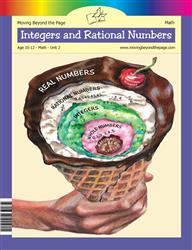
Unit 2: Integers and Rational Numbers
Lesson 4
Negative Numbers and Integers
Students view number line diagrams and read statements that negative numbers lie to the left of zero and positive numbers to the right, and that opposites are equal distances from zero (examples: +3 and (−)3). Students mark and label pairs of opposites (+4 and (−)4) on a foldable number line and color positive and negative sides. Students are taught the term additive inverse, see examples (the opposite of (−)4 is 4; the opposite of 4 is (−)4), and answer problems finding additive inverses (e.g., additive inverse of (−)32 is +32).
Lesson 5
Absolute Value and Inequalities
Students plot and compare positive and negative numbers on number lines (multiple number line images and plotting tasks guide this). Activity questions explicitly ask "What is the opposite of −12?", "What is the opposite of 18?", "What is the opposite of the opposite of −9?", and "What is the opposite of zero?", with answer keys showing 12, −18, 9, and 0. Parent notes define the opposite as the additive inverse and state that zero is the opposite of zero. The Absolute Value and vector tasks ask which sign shows left/right direction, reinforcing that negative and positive signs indicate opposite sides of zero.
Lesson 6
The Coordinate Plane
Students plot pairs like 6 and -6 on a number line, draw segments from zero to each, and fold the number line at zero to observe that the opposite numbers match up and are the same distance from zero (Activity 3). The lesson asks students to plot and label opposites on number lines (Student Activity Page Problems 1 and the Opposites answer key shows opposites such as (-4) -> 4 and 3.5 -> -3.5). Explanatory text explicitly states that opposite numbers are the same distance away from zero and are reflections across zero.
Lesson 7
Coordinate Problem Solving
Students plot and identify points with positive and negative coordinates in all four quadrants (multiple activities and the "Coordinate Pictures" task). Images and activities show reflections across axes (e.g., (2,5) reflected to (−3,5) and (5,3) to (5,−3)), which places opposite-signed coordinates on opposite sides of an axis. The Basic Skills Review asks for the additive inverse of a negative number (answer: 19) and a number-line distance problem uses absolute value (|−3| + |5| = 8), providing practice with opposites and absolute value.
Lesson 8
Unit 2 Test
The Parent Plan explicitly lists "Recognize opposite signs of numbers as indicating locations on opposite sides of 0 on the number line" and "Show that a number and its opposite have a sum of 0 (are additive inverses)." Student activities ask students to plot positive and negative numbers on number lines and coordinate planes (e.g., plotting 2, -1, 4, -3; identifying which is closest to zero) and to name additive inverses (e.g., 6 → -6, -3.5 → 3.5, 0 → 0). A contextual problem labels 9 feet underground as -9 and asks what zero represents, reinforcing negative/positive locations relative to 0.
Final Project
Coordinate Game
Students work with a coordinate grid labeled from -12 to 12 on both axes and are instructed to plot and call out x-y coordinate pairs to place and find game pieces. The Parent Plan explicitly states that students should "understand signs of numbers in ordered pairs as indicating locations in quadrants of the coordinate plane" and tasks require choosing a quadrant and placing all pieces there. The activities have students mark hits and misses using positive and negative coordinates and refer to the positive directions of the axes.
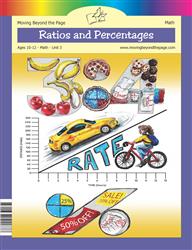
Unit 3: Ratios and Percentages
Lesson 3
Equivalent Ratios
Students practice comparing negative and positive numbers in the Basic Skills Review (e.g., problem asking to place the correct comparison sign for -8 and 2). The Basic Skills Review also includes an item showing |(-)3| = |+3|, which has students reason about negative and positive versions of the same number. One question asks students to identify the quadrant for the point (-5, 3), which requires interpreting a negative x-coordinate on the coordinate plane.
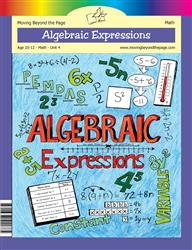
Unit 4: Algebraic Expressions
Lesson 4
Positive and Negative Numbers
Students are asked to identify positive and negative numbers on number lines and the text repeatedly states that positive numbers are to the right of 0 and negative numbers are to the left. The lesson explicitly defines additive inverses as opposites and gives examples such as the opposite of 3 is -3 and the opposite of 1/4 is -1/4. The materials state that the opposite of the opposite of a number is the number itself and provide worked examples and student problems (e.g., find -(-3), -(-(-4)), opposite of the opposite of 10) and explicitly note that zero is its own opposite.
Lesson 7
Unit 4 Test
Students are asked to "change subtraction to 'add the opposite'" and complete problems such as -14 - (-9) and 35 - (-7), demonstrating work with additive inverses. The Skills list explicitly tells students to "Understand subtraction of rational numbers as adding the additive inverse, p - q = p + (-q)" and to "Understand that positive and negative numbers are used together to describe quantities having opposite directions or values." Integer practice is supported by linked games (Orbit Integers, Fruit Splat) that let students add and subtract signed numbers.
Final Project
Algebra Think-Tac-Toe
Students are asked to use positive and negative numbers in word problems (Make a Quiz example: 14 - 16 = -2) and to write problems showing adding and subtracting positive and negative numbers (Design a Book Cover). The skills list explicitly requires students to "understand subtraction of rational numbers as adding the additive inverse, p - q = p + (-q)" and to "use positive and negative numbers to represent quantities in real-world contexts." Several tasks and worked examples (Prove It! steps) have students change subtraction to adding the opposite and combine negative coefficients.
Unit 5: Algebraic Equations
Lesson 8
Unit 5 Test
Students graph solution sets on number lines that run from -8 to 8 for multiple inequalities, including solutions with negative endpoints (e.g., graphs showing open or closed dots at -2, -5, 2). Students create tables and plot points on coordinate grids that include negative x and y values (e.g., table with (0, -8), (4, -4), (8, 0) and a rewritten equation y = 2x + 1 graphed). Students solve and interpret inequalities that produce negative boundary values (e.g., n > -5, n ≠ 2, n > -2) and then represent those solutions visually on number lines.
Unit 7: 3D Geometry
Lesson 2
Surface Area
Students are asked to graph an inequality on a number line (Basic Skills Review problem 3) and to plot points with positive and negative coordinates on a coordinate plane (Basic Skills Review problem 5a), giving practice with locations on number lines and axes. Students evaluate an expression involving a subtraction of a negative (problem 6: n^2 - (-5) with explanation "change subtraction to add the opposite"), which requires recognizing that subtracting a negative becomes addition. The lesson also includes plotting symmetric points such as (3, 2) and (-3, 2), which places positive and negative values on opposite sides of an axis.
Lesson 5
Problem Solving With Solids
Students work with negative numbers in the Basic Skills Review when they simplify 8 + (-15) + 4 - 7 + 10, requiring them to interpret and combine a negative term. A coordinate geometry problem asks students to reflect point A(3, 2) over the y-axis and the answer key shows the reflected point as (-3, 2), which requires changing the sign of the x-coordinate. The answer keys explicitly include the negative coordinate and arithmetic with negative numbers.
Unit 8: Statistics
Lesson 2
Populations and Samples
The Basic Skills Review includes Problem 4: 4 + 7 - 13 + 1 - (-2) =, and the answer key shows students convert -(-2) to +2 (change subtraction to add the opposite). Problem 7 provides a number line (from -5 to 5) and asks students to solve and graph an inequality, so students practice placing values on a number line. The answer key explicitly evaluates -(-2) as +2, demonstrating that students compute the opposite of an opposite in at least one exercise.
Lesson 8
Making Inferences
Students work with negative coordinates in the Basic Skills Review (#10), where points A(3, -2) and B(-4, 2) are given and students compute horizontal and vertical distances. The coordinate question requires students to interpret and use numbers with opposite signs when finding distances between points on the grid. Several activities include coordinate-plane style tasks (distance between points) that present numbers on both sides of zero.
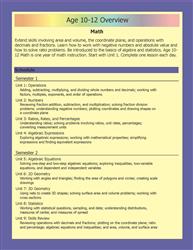
Unit 9: Skills Review
Lesson 1
Decimals, Factors, and Multiples
The Parent Plan lists "Understand ordering and absolute value of rational numbers," and the Wrapping Up section directs students to play a web game to practice "ordering positive and negative numbers." The Wrapping Up also directs students to an online exercise titled "Ordering and Absolute Value," which would have students work with negative numbers and distance from zero.
Lesson 2
Fractions, Ratios, and Coordinates
Students plot points with negative coordinates and perform reflections that change signs (e.g., plot (−2, 4) and reflect it over the y-axis to get (2, 4) and reflect over the x-axis to get (−2, −4)). Students play a graphing game that requires plotting points in all four quadrants and complete coordinate tasks asking them to move between points with positive and negative coordinates. The parent plan and activities explicitly direct students to plot coordinates, reflect points, and work with points in all four quadrants.
3: Math
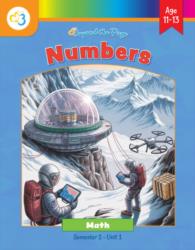
Unit 1: Numbers
Lesson 1
Positive and Negative Rational Numbers
The lesson presents a horizontal number line centered at 0 and explicitly states that numbers to the right of zero are positive and numbers to the left are negative, and students are asked to draw movements on number lines for scenarios (e.g., scuba diver, jellybeans). Activity 1 has students write equations like 3 + (-3) = 0 and identify zero pairs, circle zero pairs in drawings, and decide whether opposites combine to make zero. Multiple activities ask students to represent situations with one positive and one negative number and to use number-line diagrams to show how opposites relate to zero.
Lesson 2
Fractions and Decimals
Students are asked to compute with positive and negative numbers on the Review Quiz (e.g., "What is the result of adding a positive number and its negative counterpart, such as 5 + (-5)?" and a scuba diver context with descent as negative and ascent as positive). Students also answer items about multiplication of negatives (e.g., rule for multiplying a negative by a negative and (-3)×(-4)). These tasks require students to work with opposite-signed numbers and to reason about their arithmetic effects.
Lesson 4
Square and Cube Roots
Students work with positive and negative numbers in the Review Quiz (Part 1) where they compute 5 + 8, 7 - (-3), -4 × 6, and -24 ÷ 4. The answer key explicitly shows 7 - (-3) = 7 + 3 = 10 and evaluates products and quotients involving negative numbers. Real-world problems include a temperature question that uses negative change (temperature drops) with answer choices that include -12°F, requiring students to interpret negative results.
Lesson 8
Unit 1 Test
Students are asked to compute sums of opposites (e.g., "What is the sum of -6 and 6?" and "sum of -12 and 12") and to explain why the sum is 0, with the answer key stating that adding a number to its negative results in zero. Students solve contextual position problems involving depths below sea level (submarine/diver) that require working with positive and negative quantities to find new positions relative to sea level. Students multiply and divide negative numbers (e.g., -4 × -3, (-5)×(-2), -20 ÷ 4) and the parent notes include explanations about multiplying signed numbers and examples like (-1)(-1)=1.
Final Project
Mars Station Test Mission
Students work with negative numbers in context: temperature entries such as -10°C, -4°C, and days below -20°C appear in the data tables and are used in Task 1 to compute temperature differences and energy needs. Students perform calculations that involve signed values when converting those temperatures into temperature differences and heat energy (Task 1 answer key shows using negative temperatures to find positive differences). The Skills section explicitly lists understanding rules for signed numbers and gives examples such as ((-)1)((-)1) = 1 and (-)(p/q) = ((-)p)/q = p/((-)q), indicating students are expected to apply properties of negative signs in arithmetic.
Unit 3: Expressions
Lesson 5
More Graphing Proportions
Students work with negative slopes and negative unit rates in several activities: Activity 3 presents the equation y = -3x and a graphed line with points (0,0), (1,-3), (2,-6), (3,-9) and asks what the negative unit rate indicates about direction. Notes and answer keys explicitly state "The slope for this equation is (-)3. The negative sign means the line slopes downward instead of upward." Students also identify slopes from equations such as y = -3x in practice problems.
Lesson 7
Rise Over Run
Students are instructed to mark direction with signs: "Moving up or to the right is positive. Moving down or to the left is negative," and are told to write a "+" or "–" when counting squares. Activity problems include negative coordinates and negative rises/runs (e.g., Rise: (–)3, Run: 3) and students compute slopes using those signed values. Several tasks require students to interpret and record negative and positive movements on the coordinate grid.
Lesson 8
y = mx + b
Students graph and compare lines that have positive, negative, and zero slopes (Activity 3) and plot y-intercepts that are positive, negative, or zero (Activities 2 and 6). Students work with equations showing negative signs, e.g., y = -3x + 5 and y = 2x - 2, and answer questions about how a negative y-intercept affects the graph. Activities ask students to note what happens when the y-intercept is negative versus positive and to graph lines that cross negative and positive values on the axes.
Unit 5: Functions
Lesson 1
What Is a Function?
Students compute opposites when working with rules that multiply by -1 (e.g., Exercise 10: "The sum of six and the opposite of a number" shows -1 × (input) and examples: -1×(-3)=3 and -1×0=0). In Function 3 work pages students explicitly evaluate expressions like -(-2) and -(-1) when finding y = -x + 3, showing that the opposite of a negative input gives a positive result. Multiple graphing activities and images use coordinate grids labeled with negative and positive values (e.g., axes from -5 to 5 and -12 to 12) where students plot points with negative and positive x-values.
Unit 6: Geometry
Lesson 2
Translations
Students apply translation rules that include negative values (e.g., T_{-3,3}, T_{-4,1}) and compute new coordinates by adding negatives, as in the example M(6, -2) with T_{-5,3} where students compute 6 + (-5) = 1 and (-2) + 3 = 1. Students plot points that move across zero (for example X(0,0) → X'(-4,1) and Y(2,0) → Y'(-2,1)) and are instructed that the 'a' value indicates left/right and the 'b' value indicates up/down. Several activities require students to count steps left/right and up/down and to express moves as T, including rules with negative a or b that indicate direction on the coordinate axes.
Lesson 3
Reflections
Students plot and reflect specific points such as A(3,0) → A'(−3,0) and A(4,−2) → A'(4,2), practicing how changing a coordinate sign moves a point to the opposite side of an axis. The lesson includes a coordinate-rule chart showing (x,y) → (x,−y) for the x-axis and (x,y) → (−x,y) for the y-axis and multiple exercises where students produce B(−3,5) → B'(3,5) and similar sign-change examples. A digital activity explicitly notes that when a point lies on an axis its image overlaps the same point, demonstrating that a zero coordinate does not change under that reflection.
Lesson 4
Rotations
Students apply coordinate negation rules such as (x,y) → (−x,−y) and (x,y) → (−y,x) in multiple examples and problems (e.g., A(1,2) → A' = (−1,−2); M(6,−2) → M' = (2,6) where (−)y = 2). The Algebraic Rotations notes and practice problems require students to compute and write new coordinates after sign changes (answers show D' = (−4,−2), E' = (5,−3), etc.). Several activity problems have students rotate points with negative coordinates and evaluate expressions that involve negating negative numbers.
Lesson 5
Sequences of Rigid Transformations
Students work with coordinates that change sign when reflected: e.g., the example showing triangle A(2,1),B(4,1),C(3,3) mapping to A'(-2,1),B'(-4,1),C'(-3,3) explicitly notes that the x-coordinates have "changed sign," indicating a reflection over the y-axis. Several activities require reflecting shapes over the x- or y-axis and translating using rules with negative values (for example T2,-1), and students plot and interpret points with negative and positive coordinates on the coordinate plane.
Lesson 7
Sequences of Transformations
Students are asked to perform reflections across the x- or y-axis and to "tell" whether a reflection happened by noting that one coordinate changes sign (e.g., "If the x-values change sign, it was a reflection over the y-axis"). Multiple activity problems require plotting points and reflecting them, and the answer key shows coordinates with sign changes (positive to negative and vice versa). The rotation rule in an example is written using a negative sign (e.g., (x,y) → (y, (−)x)), so students apply and see negative signs used when transforming coordinates.
Lesson 11
Unit 6 Test
Students plot and transform points on coordinate grids for reflections across the y-axis and the line y = x, and for rotations and translations (e.g., problems asking to reflect triangle ABC across the y-axis, reflect across y = x, and use T_{5,-3}). The rotation rules and answer key explicitly show coordinate sign changes (examples: rules like (−x, −y), (−y, x), and transformed coordinates listed with negative signs). Several exercises require writing image coordinates after transformations, so students practice changing signs of coordinates to produce mirrored or rotated points.
Unit 7: Linear Equations
Lesson 5
Intersection and Graphing
Students substitute the point (1, −2) into equations (2x − y = 4 and 4x − 2y = 8) and compute 2(1) − (−2) = 4, which shows a double-negative turning into a positive in arithmetic. Graphs and axes in multiple activities are labeled with negative and positive coordinates (axes from −9 to 9 and −10 to 10), and students plot and read points with negative y- or x-values (examples: (1, −2), y = −x + 4, y = −2x + 4).
Unit 9: Semester Exams
Lesson 1
Numbers Review
Students identify zero pairs and write equations such as 9 + (−9) = 0 and 15 + (−15) = 0 in Mission 1, showing opposite quantities that combine to make zero. In real-world problems (hiking, banking, submarine, temperature, gaming, debt) students represent increases and decreases with opposite signs and interpret the meaning of results. In Mission 2 students determine signs and compute products and quotients with negative numbers (e.g., (-3)(-5) and other sign-rule problems) and explain why a product's sign makes sense. The Parent Plan and activities ask students to create and solve real-world problems using positive and negative rational numbers, reinforcing use of opposite signs in context.
Lesson 5
Semester Exam
Students compute with positive and negative integers in several problems (e.g., find the sum of -18 and 27; divide -48 ÷ 6; multiply (-6)(-4) and explain the sign). A submarine word problem asks students to update a position 350 feet below sea level after rising 125 feet, requiring thinking about positions relative to 0. The exam includes coordinate grids and graphing tasks with axes labeled from -10 to 10, so students work with values on both sides of zero.
Lesson 7
Geometry Review
Students reflect a point A(−3, 4) across the y-axis and write A'(3, 4), with a prompt to describe how the x- and y-values changed, explicitly noting the x-value changes sign. Students perform a 180° rotation about the origin that maps points like X(1, 2) to X'(−1, −2), requiring them to apply a sign change to both coordinates. Several transformation tasks require writing and using coordinate rules that include negating coordinates (e.g., reflections and rotations).
Lesson 10
Semester Exam
Students perform coordinate transformations that change sign: for example, students reflect A(5, 10) across the y-axis and record A'(-5, 10). Students plot and interpret points with positive and negative coordinates on coordinate grids (several problems and answer key include points like (1, -5), (2, -3), (3, -1), (4, 1), and x- and y-intercepts such as (0,4) and (4,0)). Students also work with rotations and reflections (e.g., B(-3,4) → B'(4,3)), which require changing signs of coordinates and locating points on opposite sides of an axis.