


Ninth Grade - ELA
• Literacy
1: Semester 1

Unit 1: Lord of the Flies
Lesson 1
The Call
The Option 1 activity asks students to record the titles of two or more dystopian novels or films and to "explore some elements the works have in common." The Student Activity Page explicitly prompts students to compare settings, plot ideas, central struggles, and common elements across works. The Wrapping Up and Homework sections ask students to consider how Lord of the Flies' dystopian vision differs from contemporary dystopian novels and movies.
Lesson 3
Paths in the Jungle
Students read and annotate a published article (Robert McCrum's piece) to identify the author's thesis and supporting points and record their reactions on a graphic organizer. Students are given an optional second article link to gather additional input and are prompted to explain why dystopian literature is popular, which could encourage considering multiple viewpoints. Students also practice point-of-view skills by converting an omniscient narration into a first-person character journal entry, demonstrating understanding of different narratorial perspectives.
Lesson 11
The Film
Students are asked to watch the 1963 film and complete a "Movie vs. Book" chart that records similarities and differences in characters, setting, theme, and plot. Students must answer questions about scenes omitted from the film that may be critical to the novel's major theme and give examples of visuals that differ from their imagination. The lesson also points out that the film has no narrator and asks students to look for subtext to determine how characters' thoughts and emotions are conveyed.

Unit 2: World Religions (600 BCE - 600 CE)
Lesson 1
Rise of Religions
Students are asked to read a Smithsonian Magazine article about Hatshepsut and to "review the readings about Hatshepsut from your textbooks," then answer targeted questions about scholarly interpretations and motivations. Students are directed to find and summarize a modern news article from sources such as The New York Times, Washington Post, BBC, or NPR about religion and conflict. Students also skim multiple National Geographic Almanac sections on different civilizations to record how religion overlapped with government across societies.
Lesson 2
Shamanism, Animism, Ancestor Veneration
The activity options ask students to locate and compare multiple texts about the same topics: Option 1 directs students to find two or three folktales that show animist beliefs and complete a chart asking what animal/object/space is sacred, the moral of each story, and shared themes. Option 2 asks students to research Chinese New Year and Día de los Muertos using multiple sources and fill a chart that compares brief descriptions, the role of ancestor veneration, and the relationship between living people and deceased ancestors. The activities explicitly require students to note similarities and differences across accounts and to explain how the stories or holidays reflect animistic or ancestral beliefs.
Lesson 5
Daoism and Confucianism
Students answer Question #2 asking how Daoism and Confucianism might be described as opposites, which prompts them to compare two perspectives on similar topics. In Option 2 of the homework, students are asked to find at least three other quotations that relate to a chosen Confucian saying and write 1–2 paragraphs highlighting similarities, differences, or subtle shifts in meaning. The discussion prompts also ask students to identify shared ideas and differences between Buddhism, Daoism, and Confucianism, encouraging comparative thinking about how these traditions treat similar themes.
Lesson 8
Islam
Students are asked to choose a story that appears in both the Bible and the Qur'an, read both versions, and complete the provided "Two Versions" activity page. The activity page directs students to summarize shared elements and to identify key differences, including what is omitted, differences in tone and writing style, and how key figures and God/Allah appear differently in the two texts. The homework and parent-plan notes explicitly prompt students to notice which details are added or emphasized in each version (for example, the presentation of Allah and Jesus).

Unit 3: Rise of the Empires (600 BCE - 600 CE)
Lesson 2
Greek Empire
Students are assigned readings from two different authors/sources (National Geographic Almanac of World History, pp. 86-89, and AP World History: An Essential Coursebook, pp. 78–top of 90). Students answer directed reading questions and take notes (Activity 2) using those sources and are asked to save pages for later comparative use. The lesson asks students to review their responses and materials, providing access to multiple accounts of Greek history for student work.

Unit 4: Poetry
Lesson 1
Introduction to Poetry
Students read a Student Activity Page that collects quotations about poetry from multiple authors (Percy Bysshe Shelley, William Wordsworth, Edgar Allan Poe, and others). In Activity 1 students are asked to compare their own definition of poetry to the poets' definitions and discuss which definition appealed to them and why. Multiple activities require reading poems and author quotations on the same topic (what poetry is) so students encounter different author perspectives.
Lesson 4
Voice and Tone
Students read and analyze pairs of poems by different authors (e.g., "Those Winter Sundays" by Robert Hayden and "Yesterday" by W.S. Merwin) and record tone and the specific words or phrases that convey that tone on an activity chart. Students identify speakers and list characteristics for multiple poems ("Mother to Son," "Sick," "Richard Cory") and answer questions comparing voice (for example, how the townspeople's voice functions in "Richard Cory"). Students also write from alternative speakers' perspectives (letters or new stanzas), practicing how changing point of view alters emphasis and details.
Lesson 5
What Does It Mean?
Students identify the speaker and summarize literal meaning in multiple poems (explicit steps ask "Who is speaking?" and to write a brief summary). The lesson has students analyze Whitman's "O Captain! My Captain!" (including author background and symbolism about Lincoln) and Carl Sandburg's "Grass" (noting the grass as speaker and its themes about war and forgetting). Students also examine symbols, tone, and themes in each poem and complete guided questions on imagery and what the poems mean.
Lesson 8
Types of Poems
Students are asked to compare two narrative poems in Activity 3 (e.g., "How is the ballad different from the narrative poem 'The Spellin'-Bee'?" and "How are the two poems alike?"), which requires noting differences in focus, form, and tone. In Activity 4 (Ekphrasis) students fill a chart that asks what the poem says about a work of art and what the poet emphasizes or omits, prompting analysis of how a poet treats a subject relative to another medium. The Parent Plan skills list also includes analyzing the representation of a subject or key scene in two different artistic mediums and noting what is emphasized or absent in each treatment.
Lesson 10
Poems and Poets
Students identify common topics/themes across multiple poems (Day 1 Q1 and Day 2 Q1) and compare formal elements across authors (Day 1 Q2 compares meter of two poems; Day 2 Q2 compares rhyme schemes across several poems). Students are also asked to compare techniques different poets use to convey tone in poems about specific people (Day 2 Q4), noting specific details such as repetition and how names or pronouns are emphasized. These tasks require students to look across works by different authors and note similarities and differences in content and craft.
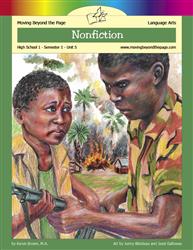
Unit 5: Nonfiction
Lesson 1
Types of Nonfiction
Students are asked to compare the book they select with others: "Write your comparison between the books. Compare themes, view points, thoughts about character identity, and evidence about the book's accuracy. Support your comparison with specific examples." The Parent Plan lists the skill "Assess how point of view or purpose shapes the content and style of a text." Students also read an interview with Patricia McCormick and are asked to consider how McCormick's role in writing I Am Malala affects classification, prompting analysis of author perspective.
Lesson 7
Life in England
Students are asked to watch a documentary segment and explicitly "compare how the book and video's accounts of certain topics differ" (Activity 1). The activity lists targeted comparison prompts asking students to note differences in the role Malala's father played, how his influence is portrayed, the filmmaker's focus versus Malala's focus, why impressions of Malala's mother differ, and which details each medium emphasizes. The Parent Plan reiterates that students should take notes on these questions and be prepared to discuss how the media and memoir emphasize different details and perspectives.
Lesson 8
Civil Rights
Students read primary texts and excerpts from multiple authors (Frederick Douglass, Langston Hughes, Maya Angelou) and complete an "African-American Authors" activity that asks them to match authors to descriptions and write sentences about each author's contribution or how their work speaks about the African-American experience. Students read Martin Luther King Jr.'s "Letter from Birmingham Jail" and complete several analytic activities (double-entry diary, identifying historical references) that ask them to identify arguments, steps of nonviolent campaigns, and persuasive strategies. The Parent Plan explicitly lists skills such as "Assess how point of view or purpose shapes the content and style of a text" and "Determine an author's point of view or purpose in a text and analyze how an author uses rhetoric to advance that point of view."
Lesson 9
Civil Disobedience
Students directly compare Thoreau and King in Activity 1 using side-by-side excerpts and a three-column table labeled Thoreau, Overlapping Ideas, and King, and they are instructed to mark similar phrases and explain areas of agreement. Activity 2 (Opposing Quotes) has students read paired quotes on America, the role of government, and voting and then decide which author they agree with more and explain why. The Parent Plan skills explicitly include determining an author's point of view or purpose and analyzing how an author uses rhetoric, and homework asks students to read Thoreau excerpts and answer targeted questions about his views.
Lesson 10
Learning from the Past
Activity 3 asks students to skim Wiesel's speech, find a statement that is a universal truth, and draft a paragraph considering how Wiesel's view aligns with one or two other human-rights advocates (Malala, MLK, or Thoreau), requiring a quote from each person to support the argument. Activity 2 has students read Thoreau's essay and an excerpt of MLK's speech (and watch MLK) so students encounter multiple authors addressing related themes (civil rights, memory, violence). Activity 4 asks students to synthesize the contributions of Wiesel, Malala, MLK, and Thoreau by creating a museum wall with formal descriptions that link the activists' work to social progress.
Lesson 11
A Boy's Story
Students are asked to "note how the book's style of writing differs from that of I Am Malala" as part of the wrapping-up homework, and a discussion prompt asks, "In what ways do you think this memoir will differ from Malala's memoir?" The Getting Started section frames A Long Way Gone alongside other authors (Malala, Dr. King, Thoreau), prompting consideration of different responses to injustice. The Parent Plan Skills list includes analyzing a particular point of view or cultural experience reflected in a work of literature.
Lesson 13
Child Soldier
The lesson requires students to complete an activity titled "Different Accounts" in which they fill in parallel "Book" and "Video" columns after reading chapters and watching a six-minute video of Ishmael Beah. The activity page asks specific comparative questions (e.g., "Are the boys forced to fight?", "What do the boys think of their commanders?", "Why are the boys given drugs?", and the effect of watching war movies?) that direct students to note which details each source includes and emphasizes. The Parent Plan and Skills sections explicitly state students should "analyze various accounts... determining which details are emphasized in each account" and prepare to discuss differences between the book and the video.
Lesson 14
Rehabilitation
In Activity 2, students re-watch a 1-minute video of Ishmael Beah and read four quotations from Elie Wiesel, then are asked to circle the quotation that best applies to Beah's memoir and "explain how the quote you circled relate[s] to A Long Way Gone," including "specific examples from the book and/or video." The Parent Plan skills also list "Determine an author's point of view or purpose in a text," supporting work on author perspective. The Wiesel activity requires students to cite examples/quotations from Beah and the Wiesel quotes when forming their explanation.
Lesson 15
A New Life
Students are directed to complete a "Comparing Memoirs" student activity page that asks parallel questions about I Am Malala and A Long Way Gone (for example, how education is addressed in each memoir). The homework and wrap-up explicitly ask students to consider authors' style and use of rhetoric and to compare details each book included and whether those details were appropriate for purpose and audience. The Skills and Parent Plan sections list objectives such as assessing how point of view or purpose shapes content and style and determining an author's point of view and how rhetoric advances it, giving students a stated focus on point-of-view analysis.
Semester Exam
Semester Exam
Students are prompted to analyze relationships among nonfiction authors (Day 2), including tasks such as explaining how Malala Yousafzai and Ishmael Beah used their experiences to help others, how Thoreau's writing influenced Martin Luther King, Jr., and how the term "war crimes" applies to both Wiesel's and Beah's experience. Part IV discussion prompts explicitly ask students to explain Thoreau's and King's definitions of civil disobedience and to reflect on how authors' transparency and specificity about war lead readers to learn—tasks that require comparing authors' approaches. Short answer and discussion questions (Part III and Part IV) ask students to identify narrative point of view in works and to compare how authors elicit emotions or emphasize aspects of genres and topics.
2: Semester 2

Unit 1: Ender's Game
Lesson 7
Leaders Motivate
Students read background material on John Locke and Demosthenes and write a journal entry reflecting on why Peter and Valentine adopt those pen names and how their personalities differ. Students complete an activity matching quotations by multiple historical figures about leadership and then choose three novel characters to explain which quote fits each character. The parent-plan notes explicitly link Locke and Demosthenes to differing rhetorical strategies (tolerance vs. agitation), prompting students to consider contrasting viewpoints on public policy and leadership.
Lesson 8
Flies and Self-Loathing
Activity 2 is titled "Lord of the Flies vs. Ender's Game" and instructs students to compare and contrast the two novels using prompts about setting, leadership, and themes. A graphic organizer directs students to record comparisons for categories such as "Setting," "Leadership," and "Theme," and central hexagons focus on "Power," "Responsibilities," "Fears," and "Consequences." The Parent Plan includes a sample diagram that highlights how each book emphasizes different elements (e.g., leadership selection, themes of human nature vs. empathy).
Lesson 11
Thud, Whump, Huut
Students are asked to compare a scene from Ender's Game to its movie adaptation by re-reading the scene, re-watching the film, and taking notes on differences, omissions, and changed dialogue. In the comic-book option, students complete a "Comic Adaptation" activity page that specifically has them list omitted or changed narration/dialogue and judge whether pictures communicate the omitted words. The Getting Started section contrasts the novel's omniscient narration with film and comic techniques, noting that filmmakers and scriptwriters decide what details to include or exclude. The Parent Plan skill statement explicitly asks students to analyze representation of a subject or key scene in two artistic mediums, including what is emphasized or absent.
Lesson 12
Campbell's Comparisons
Students watch a video summarizing Joseph Campbell's 12-step "hero's journey" and record the steps in their journals. Students choose six of those steps and use a graphic organizer to describe specific parallels between Campbell's framework and events in Ender's Game. The parent/teacher notes provide model mappings (e.g., Call to Adventure = Graff recruiting Ender; Trials = Ender's tests in Battle School) that students can emulate when linking Campbell's account to the novel.

Unit 3: Informational Texts
Lesson 6
The Ethnic Theory of Plane Crashes
Students read Malcolm Gladwell's Chapter 7 and a linked critical blog post (Activity 4) so they encounter two authors addressing the same topic. In Activity 5 Option 1 students prepare an oral summary of the blog author's main objections and answer focused questions comparing the blog's claims to Gladwell's. In Activity 5 Option 2 students read Gladwell's response and complete a chart that records each criticism, how Gladwell responds, and an evaluation of the effectiveness of that response, directly engaging them in comparing which details each author includes or omits.
Lesson 9
Writing about History
Students read and compare three secondary summaries of the Sand Creek Massacre and answer questions that require identifying facts the sources agree on and differences in details (e.g., whether the camp flew a white flag or an American flag). Students complete a "Firsthand Accounts" activity that asks them to match secondary-source claims to supporting primary-source testimony and to explain differences/consistencies between firsthand and secondary accounts. In Activity 3, students read pro‑Chivington editorials and either create a split‑perspective magazine cover or write an editorial taking the Indians' side, using facts from the sources to support their points; the Parent Plan also explicitly lists the skill of comparing points of view among authors.
Lesson 12
Logical Fallacies
Students are asked to determine an author's point of view and analyze how an author uses rhetoric (ethos, pathos, logos) to advance that point of view, as listed in the Parent Plan skills. Students read and annotate multiple speeches (e.g., Andrew Jackson's speech, Lou Gehrig's speech) and identify fallacies and rhetorical appeals in those texts. Option 1 presents short political statements from multiple speakers across the political spectrum for students to identify specific fallacies and weak reasoning.
Final Project
Argumentative Research Essay
Students are instructed to find multiple high-quality sources and to note when sources contradict one another, taking notes recording both points of view and which sources they are from (Part 4). The "Present the Evidence" activity directs students to record quotes/ideas from sources and write reactions that lead to a thesis and a clearly stated opposing viewpoint (Part 6). The lesson asks students to evaluate author qualifications, publisher purpose, and bias when assessing credibility (Day 3), and to include a concession/refutation paragraph in the classical argument structure.

Unit 4: Drama
Lesson 7
Fences
Students watch the movie Fences and then complete a Comparison activity page that asks them to compare theme, characters (including goals, attitude, obstacles), plot, and setting between Fences and A Raisin in the Sun. Students fill specific comparison sections for paired characters (Walter and Troy; Rose and Mama; Cory and Beneatha) and write sentences about how the works are alike and different. The Parent Plan also directs students to analyze representation in two artistic mediums, noting what is emphasized or absent in each treatment.
Lesson 13
Tragic Hero
Students read excerpts of Ovid's Pyramus and Thisbe and passages from Romeo and Juliet and complete a two-column activity that asks them to note similarities between the two accounts. Students use the "Pyramus and Thisbe Excerpt" activity sheet to identify parallel plot events (parents separating lovers, a rendezvous at a tomb, mutual deaths) and record corresponding details for Romeo and Juliet. The Parent Plan and skills list explicitly tell students to analyze how an author draws on and transforms source material, linking Ovid's account to Shakespeare's treatment.
Lesson 14
Modern Retelling
Students are instructed to complete a "Two Versions" comparison chart that prompts them to note specific differences in character portrayals, major changes from the original play, use of setting, and use of color between the Luhrmann film and the Globe Theatre performance. Activity 3 directs students to choose three specific areas of difference, write a thesis comparing the two productions in those areas, and use the APE method to answer a question, prove the point with specific examples from both productions, and extend by explaining the significance or effect. The homework checklist requires each paragraph to contain specific information or examples from both productions and to end with an explanation of the significance or effect of those differences.
Semester Exam
Semester Exam
Several discussion prompts ask students to analyze and compare works: one prompt directs students to compare the role of fate in Ender's Game and Romeo and Juliet, and another asks students to examine and compare thematic elements and character perspectives in Ender's Game. Short-answer tasks ask students to give examples of conflicts and static vs. dynamic characters using Ender's Game, A Raisin in the Sun, or Romeo and Juliet, which requires cross-text comparison. A multiple-choice/fill-in item references similarities between Romeo and Juliet and Pyramus and Thisbe, prompting comparison of two accounts of a similar story.