


Sixth Grade - MATH
5: Math

Unit 1: Operations
Lesson 4
Exponents and Order of Operations
Students solve arithmetic word problems that require division to find a unit rate (Dwayne earned $78 for washing 5 cars; the answer key shows $78 ÷ 5 = $15.60). Several activities ask students to fill missing numbers in equations or number sentences (e.g., fill blanks so 8 + __ × (3 + 4) − __ − 2 × __ = 25), which has students manipulate expressions to make an equation true. The quiz and answer key include solving simple numeric equations and finding unknown values by performing inverse operations in contextual problems.
Lesson 5
Factors and Prime Factorization
Students list factor pairs and write multiplication statements (for example, 2 x 20 = 40 and 3 x 12 = 36) when they factor numbers from the Student Activity Pages and answer keys. Students apply factor pairs to real-world arrangement problems such as Sally's 36 piggy banks and Grayson's 60 flower bulbs, using factor pairs to find possible numbers of rows and items per row. The practice and answer keys explicitly show multiplication factorizations for each scenario.
Lesson 6
Greatest Common Factor
Students set up and solve multiplicative equations with a missing factor, for example solving 3 × ? = 24, 12 × ? = 24, and 6 × 7 = 42 when determining how many items go in each bag. Students use division to find the unknown in expressions like 24 ÷ 3 = 8 and 36 ÷ 12 = 3 to answer real-world distribution problems (gumballs, snack bags, key chains). Students also use prime factorization and factor trees to find common prime factors and multiply them to get the GCF, then use that GCF to compute px = q style quantities for each group.
Lesson 7
Least Common Multiple
Students compute and use multiplication to find multiples and pack counts (for example, 3 × 4 = 12 for Paco's shirts and 4 × 3 = 12 for pants, and 8 × 5 = 40 for Suzanne's prize bags). Students practice finding specific multiples (e.g., the ninth multiple of 2 = 18, the fourth multiple of 15 = 60) and use multiplication/division in contexts that yield equations of the form p·x = q implicitly (e.g., determining how many packs produce a target number). Students also use LCM calculations (via listing or prime factorization) to solve real-world packing/grouping problems that can be modeled multiplicatively.
Lesson 8
Unit 1 Test
Students solve many real-world word problems that require multiplication and division (for example, 486 × 75 for total shipping weight; 172 ÷ 12 for snack bags; 42 ÷ 5 for cars needed; $850 ÷ 4 for weekly earnings). Students compute sums and differences in context (for example, adding Landon's scores and subtracting 18,472 to find Brantley's score) and interpret remainders in division problems. Problems and answer keys include operations with whole numbers and decimals, so students practice solving for unknown quantities numerically in cases that correspond to px = q or x + p = q when translated algebraically.
Unit 2: Integers and Rational Numbers
Lesson 4
Negative Numbers and Integers
Students solve contextual numeric problems that can be represented by equations, for example the trivia item with +10/−10 points where Kiara's +40 score implies 10·x = 40 (answer key: 4 questions). Students compute unknowns in real-world integer contexts (Marcus's debt written as −$218.72, Simon owing $10 then paying $6 resulting in −$4) and find additive inverses (what to add to −32 to get zero). Several problems require determining a missing quantity from a given total or difference, which aligns with solving for an unknown in applied situations.
Lesson 6
The Coordinate Plane
Students plot points and compute new coordinates after specified moves (for example, plotting A (3,7) then moving it left 5 and down 3 to find A-2), which requires performing additions/subtractions on coordinate values. Students use number lines and coordinate grids with integers and rational values (e.g., 3.5, 4.5) when finding opposites and plotting points. Activities ask students to reflect points by changing signs and to record resulting ordered pairs, which involves calculating new coordinate values.
Lesson 7
Coordinate Problem Solving
Students plot and move points by specified horizontal or vertical distances (e.g., plotting A (2,5) then a point 5 horizontal units away; plotting O (5,0) and two points 12 horizontal units from O). Students calculate distances between given points by subtracting coordinates and using absolute values (e.g., problems asking horizontal distance between (7,−3) and (2,−3); vertical distance between (−3,5) and (−3,−4)). Students find missing coordinates for rectangular corners by applying horizontal and vertical offsets (e.g., Brett's garden: given (4,2) and (−4,−4) students locate the other two corners).
Lesson 8
Unit 2 Test
Students are asked to "write a number sentence for any word problems before solving them," and several real-world division word problems require finding how many equal servings or groups (e.g., Zoe: 16 1/2 ÷ 1 1/2 = 11; Mary Ellen: 14 2/3 ÷ 1 5/6 = 8). The review and answer key include model problems of the form 6 ÷ 2/3 = 9 and visual models showing how many groups of a fraction fit into a whole, which corresponds to solving equations of the form p·x = q (number of groups x). Students also solve many additive problems with nonnegative rational numbers (mixed-number addition and subtraction) in word-problem contexts.
Unit 3: Ratios and Percentages
Lesson 1
Introduction to Ratios
Students set up and compute multiplicative scaling in real contexts (for example, Danny multiplies paint and water by 2 to get 8/2 from 4/1). Students solve scaling problems with recipes and mixtures: Eduardo's bread recipe uses a factor of 3 to scale ingredients (5 cups flour -> 15 cups), and the floor-cleaner problem is shown as 50 (x) 4 = 200 and 5 (x) 4 = 20. Students also use division to find equivalent ratios (e.g., simplifying 9:6 to 3:2 and finding how many hours correspond in the piano/soccer problem).
Lesson 3
Equivalent Ratios
Students solve ratio-to-total problems using tape diagrams that lead them to compute a common multiplier x (for example, the answer key shows 4x + 3x = 91 for Sam and Lindy and solutions like 5 x 12 = 60 and 7 x 12 = 84 for Jason and Zeke). Students use double number lines and tables to scale ratios multiplicatively (for example, finding cost for 6 sodas from 2 sodas costing $5 and computing 6 sodas = $15). Several problems and answer keys show students finding x by dividing a total by the sum of ratio parts (effectively solving equations of the form p x = q).
Lesson 4
Unit Rates
Students perform division to find unit rates in several examples (e.g., 216 ÷ 4 = 54 miles per hour; 156 ÷ 12 = 13 calories per chip; $5.25 ÷ 3 = $1.75 per quart). Students also multiply a unit rate to find totals (e.g., 13 calories × 25 chips = 325 calories; $2.09 × 10 = $20.90). Several activities and answer keys model forming equivalent ratios and using division or multiplication to solve real-world rate and price problems.
Lesson 6
Percentage Problems
Students are taught and practice writing percentage situations as multiplicative equations using the formula part = percent × whole (for example: n = 90/100 × 300 and 75 = 15/100 × n). The materials include multiple worked examples and problems where students set up and solve equations like x = 0.25 × 600 (Tim read 25% of 600, x = 150) and use variables (n) to find unknowns in equations of the form p·x = q. Students also create double number line diagrams and equivalent-ratio setups that lead to solving multiplicative equations for the unknown.
Lesson 7
Unit Conversions
Students set up and use multiplicative conversion relationships to compute unknown measures (for example, multiplying 28.35 × 5 to get 141.75 grams and multiplying 1,000 × 8.5 to get 8,500 grams). Students use division to find an unknown larger unit (for example, dividing 7,000 by 1,000 to get 7 kilometers). Students solve real-world conversion problems by creating equivalent ratios and using multiplication or division to find the missing quantity.
Lesson 8
Unit 3 Test
Students translate percent word problems into multiplication equations and solve them (e.g., n = 28% × 200; 17 = 85% × n; 37 = n% × 50). Students solve ratio problems by finding a unit value and then using multiplication to find unknowns (e.g., Marco and Stanley: 4x + 3x = 91 leading to 7 × 13 = 91 and x = 13). Several problems require writing and solving equations of the form p·x = q to find whole amounts, parts, or unit rates (e.g., unit price, unit rate, and model/car problems).
Final Project
What's the Best Buy?
Students set up and compute unit prices by dividing total price by number of units (e.g., $3.38 ÷ 13 = $0.26 per ounce), which involves solving for a unit rate. Students write and solve percent/proportion equations in the Answer Key example (n = 10/100 × $200; 10/100 = n/200; n = 20) to find coupon savings. Students multiply a unit savings by months (e.g., $1.50 × 4 = $6.00) and use dimensional analysis to convert currencies and quantities, which requires forming and solving multiplicative equations of the form p · x = q.
Unit 4: Algebraic Expressions
Lesson 1
Introduction to Algebra
Students write and solve simple additive equations such as 20 + n = 35 and 6 + n = 10 and find the unknown (e.g., n = 15, n = 3). Students write equations of the form a + 3 = 8 and solve for a (a = 5). Students also represent multiplicative relationships using px notation (examples: 5 × n = 10, 36n, 20n) and evaluate multiplicative expressions when the variable value is given (e.g., 20n with n = 2 yields 40).
Lesson 3
Working With Expressions
Students translate word problems into algebraic expressions such as 12 + n, n + 3, 3n, 24/n, 50 - n, n - 15, and (n - 3)/2 from Activity 2 and the answer key. Students evaluate expressions by substituting given values for variables in Activity 3 (for example, evaluating 5 + 4y when y = 6, n + 7 when n = 13, and 5x when x = 6). The lesson also presents a simple unknown-box example (3 + 4 = n) that connects early arithmetic unknowns with variables.
Lesson 5
Equivalent Expressions
Students are given a real-world division problem in Basic Skills Review #8 (total weight 23.7 lb for 15 boxes) that requires finding the per-box weight, which can be written and solved as 15x = 23.7 (px = q) and solved for x = 1.58. The Basic Skills Review also lists an algebra item to solve the equation n - 14 = 25, which is a one-step equation of the add/subtract type that students are expected to solve.
Unit 5: Algebraic Equations
Lesson 1
Algebraic Equations
Students translate word problems into one-step addition/subtraction equations (examples: 32 + p = 48, n + 8 = 20, a - 8 = 9, 70 = n + 29) and into one-step multiplicative/division equations (examples: 3x = 24, 5x = 75, p/2 = 85, m/6 = 20). Students solve these equations by substituting candidate values or using guess-and-check on activity pages (examples: finding n = 6 in 36 - 4n = 12; selecting x = 15 for 5x = 75; selecting n = 17 for n + 9 = 26). The lesson presents multiple real-world contexts (muffins, stuffed animals, marbles, sandwiches) where students write the equation from the scenario and then determine the nonnegative numeric solution.
Lesson 2
Solving One-Step Equations, Part 1
Students create and use tape diagrams and hanger diagrams to represent and solve equations of the form x + p = q (examples: n + 60 = 100, 48 = 21 + x, 8 + n = 20). The lesson includes multiple practice problems and word problems where students write equations like 9 + p = 16 and Benton: 8 + n = 20, solve by using inverse operations (subtracting the constant) and check solutions by substitution. Activities and guided steps explicitly teach isolating the variable using addition/subtraction inverse operations and include interactive practice pages and answer keys for those problems.
Lesson 3
Solving One-Step Equations, Part 2
Students solve many equations in the form px = q and x/p = q using tape diagrams and hanger diagrams (examples: 2n = 8, n/2 = 5, 6n = 18, n/3 = 5). Students write and solve real-world equations such as 5n = 40 for the plant problem and other word problems (Alex earning $12 per car, Emma's plates, Harper canoeing). Student activity pages and answer keys give multiple practice problems and checks by substitution for equations like 4x = 24, n/8 = 9, 15y = 90, and p/42 = 2. The Skills list explicitly names solving problems by writing and solving equations of the forms x + p = q and px = q.
Lesson 4
Solving Two-Step Equations
Students solve explicit one-step equations such as z + 6 = 14 and 15 = 4x on student activity pages and checks (Student Activity Page sections include x + p = q and p x = q examples). The quiz and word-problem activities ask students to write and solve real-world one-step equations (for example, 3n = 36 for cupcake batches and n - 23 = 14 for money before shopping). Fraction and decimal sections include one-step forms with rational coefficients (e.g., 1/2 n = 7, x/4 = 5, and decimal examples like 8n + 0.6 = 3 where students isolate and solve for n).
Lesson 7
Independent and Dependent Variables
Students write equations from real-world situations such as Kevin earning $10/hr (10x = y), Ron biking 5 mi/hr (5x = y), and the cookies/eggs recipe (y = 15x). Students solve equations by substituting values and using inverse operations (e.g., 10x = 240 solved to x = 24; 2x - 4 = 6 solved to x = 5) and use input/output tables to compute outputs for given inputs (e.g., 2x - 4 = y table). Students also translate word problems into equations like x + 4 = y for age problems and then solve for the unknown given a numerical value.
Lesson 8
Unit 5 Test
Students set up and solve addition-form equations such as n + 4 = 12, 8 = 3 + n, and x + 3.8 = 9.2 on activity pages and in word problems (e.g., Jenna: n + 4 = 7; Titus: n − 5 = 12). Students also set up and solve multiplicative-form equations such as 6m = 42 and n/3 = 4, and they transform real-world equations (e.g., 3n + 2 = 23 and 3n − 5 = 115) into px = q to solve for the variable. Multiple problems include decimal and fractional coefficients, and students are asked to write equations from context and solve them.
Final Project
All About Me
The Parent Plan explicitly lists the skill: "Solve real-world and mathematical problems by writing and solving equations of the form x + p = q and px = q...," which students are instructed to address. Students must brainstorm personal number facts and create at least 5–7 equations (including examples like n + 3 = 15) and multiplication problems (example: 2x = y and 3x - 4 = 56), write an answer key, and check solutions by plugging answers back into the equations. The project also requires real-world context (personal facts), use of whole-number answers, and modeling with diagrams (tape/hanger) and number-line plots, so students practice writing and solving equations from real situations.
Unit 6: 2D Geometry
Lesson 1
Lines and Angles
Students solve for unknown angle measures by using relations such as complementary and supplementary angles (e.g., 90° - 40° = 50° and 180° - 110° = 70°). Student activity items ask for the measure of an angle given another (e.g., "Angles ABC and DEF are supplementary; what is DEF if ABC = 65°?"). The materials instruct students to compute the missing angle by subtracting the known measure from 90° or 180°, which corresponds to solving an equation of the form x + p = q.
Lesson 2
Working With Angles
Students write and solve equations that model angle relationships such as 126 + n = 180 and n + 2n = 90, and they solve 3n = 90 and 4n = 92 after simplifying expressions like 5n = n + 92. Student activity pages include problems that require writing equations from geometric contexts (e.g., n + 50 = 3n, 2n + 3n = 180, and supplementary/complementary equations) and then solving for the variable. Worked examples show inverse operations (subtracting and dividing) to isolate x and substitute back to find angle measures. Multiple exercises ask students to both write the equation from a diagram/word problem and to solve it.
Lesson 3
Triangles
Students are asked to write and solve an equation for a supplementary angle (Quiz #9 shows the equation 104 + n = 180 and solves n = 76). Multiple places ask students to find a missing triangle angle by computing 180 minus the sum of the other two angles (e.g., 40° + 65° = 105°, 180 − 105 = 75°). The Parent Plan Skills section explicitly states students will "write and solve simple equations for an unknown angle in a figure," indicating practice with one-step additive equations.
Lesson 4
Area
Students set up and solve one-step multiplicative equations in several places (for example, the pavers problem uses 24n = 4320 and solves n = 180). Students write and solve area equations for unknown dimensions using multiplication and division (for example, Omar's parallelogram: 15 × n = 75, and the triangle base problem: 1/2 × b × 5 = 20, then solve for b). The lesson asks students to "write and solve an algebra equation" for missing side problems and shows step-by-step algebraic manipulation for these multiplicative cases.
Lesson 5
Circles
Students are shown algebraic manipulation to solve for circumference from π = C/d by using inverse operations to get C = πd (Activity 2). Students are instructed to use the relationship d = 2r and to find the radius by dividing the diameter by 2 (Activity 2 and Area sections), which is a one-step multiplicative relationship. Students complete many practice problems that require multiplying or dividing by constants (e.g., computing C = 3.14 × d, C = 2 × 3.14 × r, and finding r from d), so they perform one-step multiplicative solution steps.
Lesson 6
Scale Drawings
Students set up and solve multiplicative equations in context, for example solving proportions like 1/3 = x/18 to find x = 6 and using equivalent ratios to find unknowns (Mia's garden, trapezoid and rectangle examples). Students write and solve an explicit equation 28n = 56 to compare perimeters and divide to find n = 2. The Basic Skills Review asks students to solve algebraic equations such as 8 + 3n = 44, requiring them to isolate the variable and compute n = 12.
Lesson 7
Unit 6 Test
Students are asked to write and solve equations for unknown angle measures (e.g., Question 5: n + 2n + (3n + 12) = 180 or 6n + 12 = 180; Question 6: 3n = 2n + 35). The Parent Plan explicitly directs students to "use facts about supplementary, complementary, vertical, and adjacent angles to write and solve simple equations for an unknown angle in a figure." The answer keys show step-by-step equation solving for n (e.g., subtracting like terms and isolating n) in multiple problems.
Final Project
Geometry Stations
The materials include a "Solve the Missing Angle Problem" station that asks students to create problems involving supplementary, complementary, and vertical angles and to provide solution keys. The Skills and Parent Plan explicitly state that students should "Use facts about supplementary, complementary, vertical, and adjacent angles to solve for an unknown angle." The reflex-angle planning example directs students to measure a smaller angle and subtract it from 360° to find the reflex angle, which involves solving for an unknown angle measure.
Unit 7: 3D Geometry
Lesson 1
Three-Dimensional Solids
Students set up and solve an equation using Euler's Formula: they write F + 5 - 8 = 2, rewrite it as F + (-)3 = 2, and add the inverse to both sides to find F = 5. The Activity 3 problems and the "Problem Solving: Polyhedrons" page ask students to use F + V - E = 2 to find a missing quantity (for example, find faces when given edges and vertices or find vertices when given faces and edges). The answer key and worked example show the algebraic steps students are expected to perform to isolate the variable.
Lesson 2
Surface Area
Students are asked to solve the equation 4x + 12 = 24 in the Basic Skills Review and the answer key shows the work leading to x = 3. The solution process in that example requires isolating 4x (yielding a px = q form) and then dividing to find x, so students practice the algebraic steps involved in single-variable linear equations.
Lesson 3
Volume
Students count how many fractional unit cubes fit along each dimension (e.g., find that 1 1/2 in. contains six 1/4-in. cubes, 3/4 in. contains three 1/4-in. cubes, and 4 in. contains sixteen 1/4-in. cubes) and multiply those counts to get total cubes (288). Students multiply the number of cubes by the volume of one fractional cube (288 × 1/64) and use division/multiplication to find volumes (e.g., 112 × 1/8 = 14 in.3). Word problems require students to divide total volume by unit capacity (Kayne's aquarium: total volume ÷ 5 ft3) to determine number of containers, which is equivalent to solving a one-step multiplicative equation.
Lesson 5
Problem Solving With Solids
Students represent unknowns with a variable and set up equations from geometric formulas (e.g., Activity 2: 54 = L × 4 1/2 × 2, then simplify to 9L = 54 and solve L = 6). Multiple missing-dimension problems require writing multiplicative equations and solving by division (e.g., 132 = L × 4 × 11; 1792 = 64 × h). A word-problem in the Basic Skills Review has students write and solve a linear equation with addition and multiplication (5n + 10 = 130 → solve for n). Examples include mixed numbers and fractions, so students work with nonnegative rational numbers in their equations.
Lesson 6
Unit 7 Test
Students write and solve multiplication equations to find unknown dimensions in real-world volume problems: the answer key shows 182 = 6.5 × h and instructs students to divide both sides to find h = 28. Another problem has students use V = B × h with 6300 = 42 × h to solve for the prism length. The answer key also shows students manipulating an equation to solve for a vertex count (5 + V − 8 = 2 → V = 5), demonstrating solving for an unknown using addition/subtraction.
Unit 8: Statistics
Lesson 2
Populations and Samples
Students translate a real-world word problem about video game scores into the equation n + 26 = 102 and solve it to find n = 76, showing work with equations of the form x + p = q. The Basic Skills Review also has real-world multiplication work (85 pieces per minute for 12 minutes → 1,020 pieces), so students practice multiplication with nonnegative numbers in context. Students evaluate expressions (e.g., 4n + 12 when n = 5) and solve a one-step inequality <n + 3 < 5), indicating practice with one-step operations involving an unknown.
Lesson 8
Making Inferences
The Basic Skills Review asks students to "Solve for n" in the equation 4n − 3 = 17, requiring students to perform inverse operations and isolate the variable. Another item presents an additive inequality written as 4 + n ≤ 9, which shows students working with an expression of the form x + p (though as an inequality). Several arithmetic word problems (e.g., the train 600 miles in 8 hours) require students to compute rates that can be modeled by equations of the form px = q.
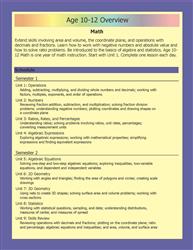
Unit 9: Skills Review
Lesson 3
Expressions, Equations, and Percentages
Students solve several multiplicative equations such as 9n = 63, m/4 = 5, and Pedro's n/3 = 9, which require isolating a variable in equations of the form p·x = q (or equivalent). Students write and solve contextual equations like Naomi's 5n + 3 = 18 and Jayne's 4 + n ≤ 10, translating word problems into equations/inequalities and solving them. Students also solve an equation with subtraction/decimals (x - 1.3 = 5.8) and an inequality n + 2 > 5, practicing the inverse operations needed to isolate x.
Lesson 4
Geometry
Students find complements and supplements (e.g., given 36°, they compute the complement 54° and supplement 144°), which can be represented by equations of the form x + 36 = 90 and x + 36 = 180. Students are asked to "write and solve an equation" for vertical angles (3n = 2n + 16) and solve for n. Scale and enlargement problems ask students to multiply side lengths by a scale factor (e.g., enlarge sides by factor 2 or compute an 800% increase from 2 in to 16 in), and area problems require multiplying decimal and fractional measures (e.g., 3.5 × 2.8 and (9/2) × (9/2)).
3: Math
Unit 1: Numbers
Lesson 2
Fractions and Decimals
Students set repeating decimals equal to x, multiply by 10 or 100 to shift the repeating block, subtract the original equation from the new one, and solve the resulting equation (e.g., 10x - x = 3.3 - 0.3 leading to 9x = 3 and x = 1/3). Activity 5 includes step-by-step examples and practice problems where students perform these algebraic manipulations to convert repeating decimals into fractions (examples: 0.3 → 1/3, 0.̅17 → 17/99). The answer keys and worked examples show students solving multiplicative equations of the form p*x = q to find x as a rational number.
Lesson 5
Irrational Numbers
Students are asked to convert the repeating decimal 0.̃3 to a fraction by letting x = 0.̃3, forming 10x = 3, subtracting to get 9x = 3, and solving x = 1/3. The Review Quiz and answer key show the algebraic steps 10x = 3 and 9x = 3, demonstrating students write and solve a one-step multiplication equation of the form p x = q.
Lesson 6
Scientific Notation
Students solve word problems that require using multiplication or division with numbers in scientific notation (for example, the water-tank problem: 5 × 10^5 liters drained at 2 × 10^4 L/min asks students to find the time, and the construction nails problem asks how many days given production rate 2.5 × 10^4 per day). Multiple activity pages and examples have students multiply coefficients and add or subtract exponents and divide coefficients and subtract exponents to find unknown quantities (e.g., grains-per-pound × pounds, miles per day × days, liters per truck = total ÷ number of trucks). Many practice items require solving for a quantity by performing a single multiplication or division operation with scientific-notation values.
Final Project
Mars Station Test Mission
Students calculate how many fuel cells are needed by converting the fuel cell energy (7 × 10^2 kWh = 700 kWh) and dividing the energy shortfall by that value, which is solving for x in an equation of the form p · x = q. Students compute total energy produced by multiplying per-unit solar and wind outputs by the number of panels/turbines (e.g., 10 panels and 10 turbines), which involves setting up and using multiplicative relationships. The supply and energy tables require students to compute delivery and total supply costs by multiplying rates (cost per kg, distances) and summing results.
Unit 2: Proportions
Lesson 1
Proportional Relationships
Students set up proportions with a variable and use multiplication/division to isolate the variable (for example 3/2 = x/12 leading to 3×12 = 2x and x = 18). Students use cross-multiplication to produce one-step equations such as 2n = 72 and 3x = 600, then divide to solve for n or x. Multiple real-world word problems (beads, tacos, reading rate, distance, cost) require writing an equation that is solved by a single multiplication or division step, producing nonnegative rational answers like 36 or 7.5.
Lesson 2
Unit Rates
Students set up and solve equations in multiplication form when using proportions and unit-rate methods. For example, the proportion method shows 2 × 10 = 4 × n → 20 = 4n → n = 5, and the Word Problems answer key includes 2 × n = 150 × 5 → 2n = 750 → n = 750/2 = 375, and 6×n = 2×15 → 6n = 30 → n = 5. Several practice problems and answer keys require students to write an equation with a single unknown multiplied by a coefficient and then solve by dividing both sides.
Lesson 3
Constant Rate
Students practice writing and using equations in the form y = kx: they find k from tables and graphs (k = y/x), rewrite given equations into y = kx (e.g., 4y = 8x → y = 2x), and solve many real-world problems by substituting x to compute y (e.g., y = 60x, y = 4x, y = (3/4)x). Activities ask students to identify k from tables/graphs and set up equations y = kx for word problems (printer, car, faucet, runner, machine producing parts) and to compute results using those equations. Several items include fractional and decimal rates (e.g., k = 1/2, k = 0.07) so students work with nonnegative rational p/q values in multiplicative contexts.
Lesson 4
Graphing Proportions
Students repeatedly write and use equations of the form y = kx (e.g., Jim's earnings y = 12x, problems with y = 4x, y = 5x, and comparing Pool A: y = 500x, Pool B: y = 750x). Activities ask students to build tables and graphs from these equations, plot points such as (1,k) to identify the unit rate, and compute the constant of proportionality (e.g., Skill Review: k = 24/8 = 3). Many real-world scenarios (earnings, cost per item, speed/distance) require students to translate context into multiplicative equations and use division to find k.
Lesson 5
Proportional Relationship Equations
Students write and use multiplicative proportional equations in the form y = kx (presented as t = p × n, a = r h, c = m × 10, etc.). Students solve multiplicative equations for an unknown (for example, 156 = 10m solved to find m = 15.6 and 100 = 20h solved to find h = 5). Multiple activity pages and the review quiz require students to set up equations like d = 4.5t, a = 15h, c = 8m, and to compute unit rates and solve for missing values.
Lesson 6
Taxes, Tips, and Commissions
Students set up and solve multiplication equations such as 0.012 × V = 2400 to find a home value, 0.20 × I = 9,000 to find income, and 1.08 × x = 212 to find an original price before tax. The activity pages and answer keys repeatedly use the form Commission = Sales × Rate and Commission = Rate × Sales and then solve for the unknown (e.g., 2400 = 0.06 × Sales → Sales = 2400 ÷ 0.06). Students also use and compute additive relationships (Final Price = Original Price + Sales Tax; Total = Original Bill + Gratuity) in examples and practice problems where they compute tax or tip and then add to the original amount.
Lesson 7
Markups and Discounts
Students set up and solve multiplication equations to work backward in pricing problems (e.g., answer key shows x × 1.20 = 72 → x = 72 ÷ 1.20 and x × 0.85 = 255 → x = 300). The materials direct students to 'Let x be the original price' and solve equations such as 50 × x = 20 to find a markup rate. Students also compute selling price by adding a calculated markup (e.g., $12 + $3 = $15) and compute final price by subtracting discount amounts using the formula Final Price = Original Price − Discount.
Lesson 8
Simple Interest and Percent Error
Students are given and use the simple interest equation I = Prt and fill in blanks to identify I, P, r, and t. Multiple problems require solving for unknowns in that equation (for example 250 = 2500 × r × 2 → r = 250/5000 and 108 = 600 × 0.06 × t → t = 108/36). Students compute balances using Balance = Principal + Interest and perform addition in worked examples (e.g., $600 + $120 = $720).
Lesson 9
Unit 2 Test
Students set up and solve multiplicative one-step equations in several real-world problems. For example, they are asked to let the pre-tax price be p and solve 1.06p = 212 (bicycle) and 0.012p = 1,728 (property value), and the Unit 2 Test includes solving similar equations (e.g., finding pre-tax price from total with 7% tax). The answer keys explicitly show solving px = q by isolating p (dividing both sides) for multiple percent/tax problems.
Final Project
Lemonade Stand
Students write and use equations of the form y = kx to model proportional relationships (e.g., y = 2x for tablespoons of lemon juice and y = 1.5x for tablespoons of sugar) and create tables and graphs from those equations. Students set up and solve proportions to find unknown quantities (for example, 1 lemon/3 tbsp = x lemons/36 tbsp to find x lemons for a gallon) and compute unit-rate and total-cost equations such as (number of lemons × unit price) + (amount of sugar × price per pound) = total cost. Students also calculate selling prices and discounts using multiplicative equations (selling price = unit price × 2, ×2.5, ×3; discounted price = original price × 0.7) and divide total cost by 16 to find cost per cup.
Unit 3: Expressions
Lesson 2
Rewriting Expressions
Students set up and solve multiplicative one-step equations such as 31.50 = P(1 + 0.05) to find original price and 54 = P × 0.9 to recover an original price before a discount. Students rewrite percentage situations as p×x = q in the sales tax, discount, and profit-margin activities (e.g., Total = Original × (1 + rate), Discounted = Original × (1 − rate), Selling Price = Wholesale × (1 + markup)). Students also set up and solve additive one-step equations in context, for example 58 = 25 + 3r and then solve 3r = 33 and r = 11 to find the number of rides. Multiple student activity pages and answer keys require writing the full equation from a word problem and solving for the unknown in these real-world contexts.
Lesson 3
Algebraic Expressions
Students set up and solve equations from real-world contexts such as 15 = 4p + 3 (marker packs) and 36 = 2(6 + t) (rides), then isolate and solve to find p = 3 and t = 12. In perimeter problems students write 60 = 2(18 + w), transform it to 30 = 18 + w (an x + p = q form) and solve w = 12. Activity 3 shows students solving 3x + 2 = 11 by subtracting then dividing (3x = 9 → x = 3) and examples like 150 = 15 × w give direct practice with px = q (w = 10).
Lesson 5
More Graphing Proportions
Students repeatedly write and work with equations in the form y = mx (e.g., y = 4x, y = 0.6x, y = 2.5x) and create tables and graphs from those equations. They compute unit rates by dividing y by x (e.g., Jen's speed 95 ÷ 2 = 47.5 mph) and use the Two‑Point Formula m = (y2 − y1)/(x2 − x1) to find slopes from two points. Activities ask students to create equations from real contexts (marbles, books, faucets) and to identify the slope/unit rate from tables, graphs, and equations.
Lesson 6
Intercepts
Students set y = 0 or x = 0 and solve resulting equations in multiple problems (for example, 2x + 4y = 8 leads to 2x = 8 and x = 4). Activity problems such as 3x - 6y = 12, 5x + y = 5, and other listed equations require students to produce and solve one-step equations of the form px = q when finding intercepts. Student pages and answer keys show students solving these multiplicative one-step equations and plotting the resulting intercept points.
Lesson 8
y = mx + b
Students practice isolating a single variable when they solve for b by substituting a point into y = mx + b and using subtraction (e.g., 5 = 2(2) + b → b = 1). Students also isolate y by dividing when converting equations into slope-intercept form (e.g., 3x + 2y = 8 → y = -3/2 x + 4 and 6y = 12x + 18 → y = 2x + 3). Real-world scenarios are written as linear equations (for example, Liam's earnings y = 10x + 50), connecting contexts to algebraic equations.
Lesson 9
Unit 3 Test
Students write equations from real-world contexts such as a phone plan (30 + 10x = 80 → x = 5 GB), a theme-park problem (24 + 3x = 66 → x = 14 rides), and a streaming service (25 + 15x = 100 → x = 5 months). Students also represent proportional relationships from tables (e.g., babysitting: y = 10x; car rental: y = 50x) and are asked to write those equations and interpret/solve them. The answer key and activity prompts require solving for the variable in these contexts and graphing the resulting linear relationships.
Final Project
Planes, Trains, and Automobiles
Students write and solve multiplicative one-step equations such as 500 = 60x, 500 = 80x, and 500 = 400x to find travel time from distance and rate. Students write linear rate equations in the form y = mx (e.g., y = 60x, y = 80x, y = 400x) and solve for the unknown x when given y. Students also write and solve cost equations (for example y = 0.15x + 31.50) and set two cost equations equal to find a break-even distance (solving for x).
Unit 4: Probability
Lesson 3
Probability Models
Students repeatedly compute expected counts by multiplying a probability by the number of trials (for example: 1/2 × 500 = 250; 1/6 × 120 = 20; 1/3 × 90 = 30). In Activity 2 (Roll of the Dice) and Day 3 examples students use p × (number of trials) to make predictions and record results (e.g., 1/6 of 30 = 5; 75 × 1/2 = 37.5). Activity 6 (Probability Models) has students compute probabilities as fractions/decimals and then apply those probabilities to totals to find expected counts (e.g., 16/34 ≈ 0.47 used with totals).
Lesson 4
Compound Events
Students compute probabilities and then multiply a probability by a number of trials to predict expected counts (e.g., 1/6 × 120 = 20 and 0.233 × 1143 ≈ 266.3). Activity pages ask students to build sample spaces, write probabilities as fractions and percents, and then use those probabilities to calculate how many times an outcome would occur if repeated (several problems show probability × total trials). Practice problems and answer keys show students carrying out these multiplicative calculations to make predictions from proportions.
Unit 5: Functions
Lesson 4
Intercepts
Students set one variable to 0 and solve simple equations to find intercepts (e.g., in 2y + 3x = 4 students set y = 0 to get 3x = 4 and solve x = 4/3). Multiple student activities give linear equations (3x + 2y = 6, 4x - y = 8, y = 2x + 3, etc.) where students substitute 0 and solve for the remaining variable. Real-world tasks (the movie-ticket prepaid card and the water-consumption walking problem) ask students to find intercepts that correspond to solving equations such as 10x = 50 to determine how many tickets or miles.
Lesson 5
Slope
Students solve for y by isolating variables in multi-step linear equations (examples show 4x + 2y = -8 rearranged to y = -2x - 4 and y + 2 = -2(x - 3) rearranged to y = -2x + 4). Students identify slope m directly from equations in slope-intercept form (y = mx + b) and practice dividing both sides by a coefficient (e.g., 2y = 6x - 8 → y = 3x - 4). Activity pages ask students to rewrite given equations into y = mx + b and then record the slope and y-intercept.
Lesson 6
Slope-Intercept Form
Students isolate y from standard-form equations (example: 2x + 3y = 6 is rearranged to y = −2/3 x + 2) and perform division to solve for the variable. Students solve for the y-intercept b by substituting a known point and adding both sides (example: 4 = −1·2 + b leads to b = 6). Students also convert table data in a real-world context (time and distance) into an equation y = (1/5)x, showing they compute a rate and write a single-variable formula.
Lesson 7
Creating Functions
Students repeatedly write linear equations in the form output = slope × input + starting value (for example A = 6c + 12 and T = 10n + 20) from real-world stories. They identify rate of change (slope) from descriptions, tables, and graphs (including using the slope formula) and determine the y-intercept by reasoning about the value at input = 0. Several activities have students model contexts (money, reading, rentals, recipes) by assigning variables and forming function rules.
Lesson 9
Unit 5 Test
Students write equations from real-world contexts such as E = 12h and E = 15h for hourly earnings and y = 2x + 17 for Liam's money, showing practice translating situations into algebraic expressions. Students find intercepts by substituting 0 and solving resulting one-step equations (e.g., solving 3x = 12 to get x = 4 and 2y = 12 to get y = 6), which is solving equations of the form p x = q. Several word problems require forming linear equations from verbal descriptions (e.g., "The difference between twice a number and 3 is 5"), so students practice writing equations from real-world and mathematical language.
Lesson 10
Final Project
Students are asked to create Blue Cards that include two ‘‘Solve for x or y (one-step)'' problems and to write equations from real-world scenarios on Yellow Cards (e.g., Emma earns $10 per hour; write an equation and compute earnings). Green Cards ask students to "Complete a missing value" and "Write an equation for the table," which can require solving for an unknown. The gameplay requires players to solve problems on cards and check answers, giving students repeated practice solving single-step equation items during play.
Unit 6: Geometry
Lesson 1
Congruence and Similarity
Students set up and solve one-step multiplicative equations when finding missing side lengths using scale factors (for example: Scale factor = 6 ÷ 3 = 2 and then x = 10 ÷ 2 = 5). Activity prompts ask students to "find scale factor and x" and the answer key shows work like x = 14 ÷ 2 and scale factors of 1/2, 1/3, and 0.4. Several problems require students to multiply or divide given measurements to determine unknown lengths, and some problems label unknowns explicitly as x.
Lesson 2
Translations
Students use the algebraic translation rule Ta,b → (x + a, y + b) to compute new coordinates (for example, M(6, -2) → M' = (1, 1) using a = -5, b = 3). Students apply the x + a and y + b computations on multiple problems (Algebraic Translations and Translation Notes) to find images of points, segments, and triangles. Students also determine translation rules by comparing original and image coordinates (Problems 9–12 and items asking for T), effectively solving for the additive shift a and b.
Lesson 6
Dilations
Students write and use multiplicative equations of the form new length = original length × scale factor (e.g., x = 8 × 2.5) to find unknown side lengths. Students compute scale factors by dividing new length by original length (e.g., scale factor = A'B' ÷ AB) and apply decimal and fractional scale factors (0.5, 2.5, 0.25, 0.33) in problems. Activity pages require students to set up and solve these equations to find new lengths, original lengths, or the scale factor in many practice problems.
Lesson 8
Triangles and Transversals
Students use the triangle angle-sum formula ∠A + ∠B + ∠C = 180° and solve for a missing angle (example: given 55° and 75°, they compute the third angle as 180° − 55° − 75°). Activity pages repeatedly ask students to find missing angle measures by performing subtraction (effectively solving x + p = q in triangle contexts). In the quiz and transformation activities students multiply side lengths by a scale factor and compute scale factors (e.g., 3×2 = 6 and finding scale factor by division), which corresponds to calculations of the form p·x = q or solving for x when q and p are given.
Lesson 10
Volume
Students set up and solve equations where volume equals a constant times an unknown (for example, 314 = 3.14 × 25 × h is reduced to 78.5·h = 314 and solved for h = 4). The cone example 600 = (1/3)·3.14·36·h is written as 37.68·h = 600 and solved by division to find h = 15.92. Activity pages and answer keys include many practice problems where students are given volume and must write an equation of the form p·x = q and solve for the missing height or radius by dividing.
Lesson 11
Unit 6 Test
Students compute unknown side lengths using scale factors in several problems (e.g., determine x for a square with scale factor 3 giving x = 15; dilate DE = 8 by factor 2 to find D'E' = 16; a 0.5 scale factor problem yielding x = 7). Students also work with translations on the coordinate plane (e.g., problems asking for the translation rule T_{a,b} that maps A to A'), which requires finding numeric shifts that satisfy coordinate addition. These activities involve solving simple multiplicative and additive numeric relationships while working with geometric contexts.
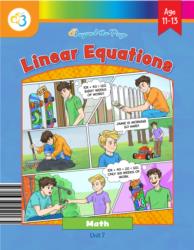
Unit 7: Linear Equations
Lesson 1
Linear Equations With One Variable
Students solve one-step addition and subtraction equations in context (e.g., x + 6 = 14 and x − 9 = 5 in the repair-lab examples) and solve one-step multiplication/division equations (e.g., 4x = 32 and x/5 = 7 in examples). The Student Activity Page provides many one-step practice problems (7x = 42, x − 9 = 21, x/5 = 10, etc.) that students solve and check. Students also solve one-step equations involving fractions and decimals in Activities 3 and 4, demonstrating solving px = q and x + p = q when p, q are nonwhole rational numbers.
Lesson 2
Multi-Step Equations
Students are asked to define variables and write equations from real-world contexts such as Mr. Patel's chicken problem (4(y+2)=16) and the catering problem (50 + 8.75g = 312.50), which are set up and solved. Several activity problems directly reduce to equations of the form px = q or x + p = q (e.g., 1.5d = 36, 3c = 18, and 0.85x + 5 = 42.50 after rearranging). Instructions and worked examples repeatedly model the process: identify what you know, write an equation, solve, and check the solution. Student pages include many one-step versus multi-step examples so students practice solving addition and multiplication equations in real-world settings.
Lesson 3
How Many Solutions?
Students solve and simplify linear equations to reach forms like x = a, a = a, or a = b (examples: 3x + 4 = 10 → 3x = 6 → x = 2; 2x + 3 = 7 → 2x = 4 → x = 2). Students divide both sides by a coefficient to isolate the variable (directions explicitly show "Divide both sides by 3" and similar steps). Activities ask students to create or fill missing coefficients/numbers so both sides match (e.g., 4x+7 = 4x+___) and to simplify equations that reduce to px = q during work.
Lesson 4
Multi-Step Word Problems
Students write equations from real-world contexts (e.g., 25 + 15x = 130 and 18x + 20 = 146) and solve them step-by-step, including subtracting constants and dividing to isolate x. The review quiz includes a pure multiplicative equation 4x = 28 (px = q) and other problems with rational coefficients and decimals (e.g., 0.5x − 3 = 7, (3/4)x + 4 = 10). Word problems require students to define a variable, translate situations into equations, and check solutions in context.
Lesson 6
Substitution and Elimination
Students solve single-variable equations that arise during substitution and elimination (for example, 3x + 1 = 7 is reduced to 3x = 6 and x = 2). Elimination examples produce one-variable equations such as 5x = 20 leading to x = 4, and activity problems require solving results like 2x + 5 = 7 or 2x = 2. Several practice pages include cases with fractions and decimals when isolating a variable, showing students perform the arithmetic needed to solve px = q and x + p = q forms within systems.
Lesson 7
The Point of It All
Students are asked to practice solving one- and two-step equations (explicitly noted in the review instructions) and solve single-variable equations such as x/3 = 7 and x/2 - 7 = 3 on the review quiz. Students also write and solve equations from word problems (delivery fee/per-mile and babysitting flat fee/hourly rate) and record numerical solutions (e.g., 40 miles, 4 hours). The activity pages provide space for students to set up equations and show steps for these one-variable problems.
Lesson 8
Linear Algebra In the Wild
Students set up and solve real-world equations that reduce to one-step multiplication equations (e.g., 30x = 150 leading to x = 5 in the break-even examples and 3x = 15 in the streaming example). In the Sophie and Jake example students form 2J + 5 = 65, subtract 5 to get 2J = 60, and then divide to find J = 30. The activities repeatedly ask students to define variables from real situations (earnings, prices, hours) and to write equations such as y = 20x + 50 and y = 30x before solving for x.
Lesson 9
Unit 7 Test
Students solve numerous one-step equations of the form px = q (e.g., 4x = 28; 6x = 42; (3/4)x = 12; (5/6)x = 15) and one-step equations of the form x + p = q or x − p = q (e.g., x − 7 = 13; x − 5 = 11). The materials explicitly list as a skill to "Solve one-step and two-step linear equations with whole numbers, fractions, and decimals," and include word problems where students set up and solve equations from real-world contexts (e.g., 12h + 50 = 122 for hours worked, 25 + 5c = 60 for gym billing). Practice pages require students to write, manipulate, and solve these equations and to use reciprocals for fractional coefficients.
Final Project
Getting Ready for College
Students write and solve real-world linear equations in multiple activities: in Housing they set 1200m = 1500 + 1050m and solve to get 150m = 1500 → m = 10. In Transportation they set 225 + 0.60x = 1.25x and solve to 225 = 0.65x and find x ≈ 346.15. In Entertainment they set 20 = 5 + 1.5h and solve 1.5h = 15 → h = 10. In Meal Plans they form 80w = 100 + 50w and solve 30w = 100 → w ≈ 3.33. These are concrete, real-world problems where students write equations and solve cases that reduce to px = q or equivalent steps.
Unit 8: Data
Lesson 4
Linear Models
Students write linear equations in slope-intercept form y = mx + b by identifying slope and y-intercept from scatterplots (multiple activities ask students to choose or write the equation that fits a trend line). Students evaluate those equations by substituting numerical x-values to compute y (for example, using y = 2x + 50 and x = 10 to find y = 70). Students interpret slope and intercept in real-world contexts and use arithmetic (multiplication and addition) to make predictions from the equations.
Unit 9: Semester Exams
Lesson 1
Numbers Review
Students write and solve multiplicative/division equations in real contexts (e.g., Question 10: a gamer loses 45 points over 9 rounds is recorded as −45 ÷ 9 = −5; Question 11: a debt of $72 split among 6 friends is recorded as −72 ÷ 6 = −12). Mission 3 asks students to set up and compute a rate-times-time multiplication (−2.5 × 6 = −15) to find total change. The Final Boss task asks students to create and solve a realistic problem using multiplication or division and to include a fraction or decimal.
Lesson 2
Proportions Review
Students write and interpret equations of the form y = kx in multiple activities (Activity 2 and Activity 3 ask students to match tables to equations like y = 10x, y = 3x, and to graph y = 6x). Students compute unit rates and use multiplication/division to find unknown quantities in real-world settings (Activity 1 speed and recipe problems, Activity 4 percent and simple interest problems require multiplying by rates). Some tasks present additive equations in table form (Activity 2 includes y = x + 2 and y = x + 6 for students to match and interpret).
Lesson 5
Semester Exam
Students write and solve equations in multiple places: they solve 4x + 6 = 30 (Question 30) and 5(x + 4) = 45 (Question 29), which require isolating x and producing forms x + p = q and px = q. Students set up and solve real-world equations such as 54 = 2(12 + w) to find the width (Question 32) and write cost and proportional equations like C = 11t + 4 (Question 33) and y = 4x or y = (3/2)x for rate problems (Questions 34 and 18). The answer key and problems require solving for x and interpreting solutions in contextual situations (perimeter, tickets, rates).
Lesson 6
Functions Review
Students write and solve an equation from a verbal problem: "The sum of a number and three times the number is 28," which is rewritten as x + 3x = 28 and solved to 4x = 28 → x = 7. Students also write multiplicative equations to model situations (e.g., y = 18h for earnings, y = 12x + 10 for bike rental) and identify slopes and coefficients that represent rates, showing work with equations of the form px (for example y = 18h or y = 18h interpreted as total earnings).
Lesson 7
Geometry Review
Students set up and solve an equation in Activity 3 Problem 8 where Angle A is twice Angle B and the angles are complementary (students are asked to "Write an equation to represent the situation" and solve 2x + x = 90). In Activity 3 Problem 3 students find the third angle given two angles (they must use x + 38 + 71 = 180, an x + p = q type equation). In Activity 1 (dilations and similarity) students compute scale factors and solve problems such as a triangle with sides 6, 9, 12 where the shortest side becomes 15 (6·k = 15) and similar-triangle problems where students multiply by the scale factor to find missing side lengths (px = q).
Lesson 8
Linear Equations Review
Students solve one-step addition equations such as x + 7 = 19 and one-step multiplication equations such as 9x = 63 as part of Activity 1. Students solve one-step equations with fractional coefficients (e.g., (3/5)x = 18) and multi-step equations that reduce to px = q or x + p = q. Students define variables, write equations from real-world contexts (e.g., 25 + 15m = 100, 12 + 3m = 39, 6 + 2m = 34), and solve those equations in Activity 4.
Lesson 10
Semester Exam
Students are asked to solve one-step equations of the forms x + p = q and px = q (e.g., #23 x + 7 = 19 and #24 9x = 63). They also solve fractional one-step equations like #28 (3/5)x = 18 and multi-step verbal-to-equation items such as #10 ("The difference between twice a number and 4 is 7") and #35 (tutor charges $18/hour plus a $30 fee; total $138). Problem #8 (You earn $10 per hour. Write a function that represents your total earnings.) and #35 require students to write and solve equations from real-world contexts.