


Kindergarten - ELA
1: Letters

Unit 1: A - A Is for Musk Ox
Lesson 1
Day 1
The text instructs an adult to show the child the front cover and ask the child to point to the title, explaining that the title is usually the largest words on the cover. The text also asks the child to point to the names of the author and illustrator and to explain the roles of each. The reading activity has the child locate and discuss cover-based information before reading the book.

Unit 2: H - Hondo and Fabian
Lesson 1
Day 1
Students are asked to look at and discuss the front cover by being prompted to point to the title and to consider how the illustration relates to the title. Students are asked to find the name of the author and illustrator and to discuss the dual role of Peter McCarty, which requires locating the book's credited names (typically on the cover or title area). The reading prompts guide students to identify characters and discuss details tied to the book's cover information.
Lesson 2
Day 2
Students are shown the cover of the book Hondo and Fabian and asked to name the two characters, which requires them to look at and attend to the book cover. Students are also directed to look at the front cover and point to the letter H and describe how the letter looks while saying the name "Hondo," which has them identify and use elements on the front cover for a literacy purpose.
Lesson 3
Day 3
Students are asked to look at the cover of the book to review how to make the letter H and to locate Hondo's name, showing they handle and examine a book's cover. Students are prompted to turn pages to find words like "home," "hungry," and the sight word "he," which requires them to navigate within the book. The activity directs students to point to words on pages and to use the pictures to retell the story, indicating practice with using parts of the book to find information.

Unit 3: I - The Little Island
Lesson 1
Day 1
Students are asked to look at the cover of the book and find the title, read the title aloud, and observe the illustration on the cover. Students are asked to find the names of the author and illustrator and to note whether the same person wrote and illustrated the book. The activity also directs students to notice an award seal (Caldecott) on the cover.
Lesson 3
Day 3
Before reading, students are asked to look at the word "little" on the front cover and compare its capitalization to a sight word card. Students read the title together while an adult points to each word and then practice supplying a missing word when prompted. These activities require students to attend to and read the words on the book's front cover.
Lesson 5
Day 5
Activity 2 directs the child to look at The Little Island and asks what she sees on the front cover (title, names of author and illustrator, illustration, Caldecott medal). The activity asks the child where she thinks the back cover is, has her flip it over to look at it, and talk about what she sees. The child is then asked to open to the title page and discuss the purpose and contents of the title page and to spend several minutes looking at the book.

Unit 4: T - What Do You Do With a Tail Like This?
Lesson 2
Day 2
Activity 2 explicitly directs students to "look at the front cover of the book and help her find examples of the uppercase letter T," and to say the word "tail" and identify the initial /t/ sound. Students are then asked to practice forming the uppercase T while referring to examples found on the front cover. The activity thus has students locate and use the front cover as a feature of the book during a letter-identification and writing task.
Lesson 3
Day 3
Students are directed to look at the sight word on the front cover of the book and to read the title (with the teacher omitting the last word). Students are also shown the same word in other places in the book and asked to practice reading it aloud, which involves attending to and using the book's front cover information.

Unit 5: L - We're Going on a Leaf Hunt
Lesson 1
Day 1
The text asks the child to take a look at the cover of the book and to describe what she notices, including seasonal clues. The text directs the child to read the title and the names of the author and illustrator. The text also directs the child to look at the very first page of the story to answer questions about content.
Lesson 2
Day 2
Students are directed to "look at the front cover of the book, and help him find the uppercase letter L," which requires them to locate and examine the front cover. The activity has students use the front cover as a reference while practicing the letter L (either tracing on a handwriting sheet or creating a large L to decorate), reinforcing attention to the front cover's print.

Unit 6: F - Fireflies
Lesson 1
Day 1
The guidance asks the child to "look at the cover of the book" and to describe what he sees, which directs students to observe and talk about the book's cover. The Questions to Explore include how books use pictures and words to tell a story, which supports attention to parts of the book that present title/cover information.
Lesson 2
Day 2
Students are asked to look at the front cover of the book and help find the uppercase letter F (Activity 2). The instruction has students point out the letter on the front cover and practice forming and writing a capital F using the cover as the reference. The lesson also directs students to look at a middle page of the book to discuss vocabulary, showing that students attend to different pages.

Unit 7: E - But No Elephants
Lesson 1
Day 1
Students are asked to look at the cover of the book and describe what they see and predict the book's content. Students are asked to read the title aloud to the child. The skills list includes understanding basic features of print and following text left to right, top to bottom, and page to page, which supports book-feature awareness.
Lesson 2
Day 2
Activity 2 asks the child to look at the front cover of the book and to find the uppercase letter E there. The instructions have the child practice forming and tracing the letter E using the front cover as a visual reference and then complete related handwriting or tactile activities.
Lesson 3
Day 3
Students are asked to read the title of the book together: "Then read the title of the book together and have her read the word 'no' at the appropriate time." During reading, the adult points to the sight word 'no' and lets the child read it: "When you reach the word 'no,' point to it and let your child read the word." These directions show students practice recognizing and reading the book's title and locating specific words on the page.

Unit 8: C - Millions of Cats
Lesson 1
Day 1
Students are prompted to look at the cover of the book and describe what they see and predict what the book will be about. Students are asked to read the title aloud and discuss its meaning in relation to the story.
Lesson 2
Day 2
Students are prompted to look at the front cover of the book and help find the uppercase letter C (Activity 2). Students use the front cover as a reference while practicing forming and writing the capital C with finger motions and on a handwriting sheet. The activity also directs showing the Cc card and adding it to a review file after using the front cover as the location of the letter.

Unit 9: G - The Real Mother Goose
Lesson 1
Day 1
Students are explicitly asked to "look at the cover of the book" and discuss who Mother Goose is, prompting them to examine the book's front cover. Students are directed to read specific poems by page number and to "look again at 'Little Boy Blue,'" which requires them to open the book and locate particular pages and illustrations.
Lesson 2
Day 2
Activity 2 directs students to look at the front cover of the book and find the uppercase letter G, so students practice locating the front cover. Activity 1 states "The first page will be a title page" and has students number the remaining pages 1–12 and assemble month pages, which requires students to place and recognize a title page as the first page. Students also examine the "Months of the Year" sheet and glue monthly boxes in order, reinforcing page order around the title page.
Lesson 4
Day 4
Students are directed to create a title page for the "Months of the Year" book and to look at the pages they have already created. Students line up the holes in the upper left hand corner and bind the book together using a metal ring, which has them handle and assemble the physical book. Students reread the poem and examine the book pages as part of the activity.

Unit 10: O - Owl Babies
Lesson 1
Day 1
The Reading And Questions section tells the child to "look at the cover of the book and describe what he sees," prompting students to observe and discuss the book's cover. The instructions ask the child to predict whether the book will teach facts or tell a story and then read and discuss whether it is fiction, which requires students to use information from the cover to make that judgment.
Lesson 2
Day 2
Students are shown the book Baby Owl and are asked what they see on the front cover, prompting them to identify and discuss the front. Students are asked to look through the pages and predict whether the book is fiction or non-fiction, then confirm after reading, which has them handling and examining the book's interior. Students are directed to look at the front cover to find the uppercase letter O and to practice forming the letter while referencing the cover image.

Unit 11: S - Seasons of Arnold's Apple Tree
Lesson 1
Day 1
The lesson explicitly instructs the child to "look at the front cover of the book" and to describe what she sees, including examining pictures at the top of the page. The Reading and Questions section prompts the child to analyze illustrations on the cover and to answer questions about what the pictures represent.
Lesson 2
Day 2
The lesson directs the child to "look at the front cover of the book and help him find the uppercase letter S," so students are asked to locate and attend to the front cover. Students practice identifying the letter S on that cover and trace/form the shape using finger or handwriting sheets. The activity therefore requires students to recognize and use the front cover as a reference point for a letter-identification task.

Unit 12: D - Dinosaurs Big and Small
Lesson 1
Day 1
Students are prompted to "Look at the cover of the book" and asked what they see and what the book will be about, which directs attention to the front cover. Students are also asked to identify the author and the illustrator from the front cover and to explain the job of each, which requires using the front cover to locate bibliographic information.
Lesson 2
Day 2
The lesson explicitly tells students to "look at the front cover of the book" and to find the uppercase letter D there, with guided finger tracing and sound practice. The review asks the child to show a dinosaur from the book and Activities refer to specific pages (Pages 10 and 28), indicating students are directed to locate content within the book.

Unit 13: P - Harold and the Purple Crayon
Lesson 1
Day 1
The reading prompt asks the child to "take a look at the cover of the book" and answer what color she sees and what she thinks the book will be about, which requires students to examine and discuss the book cover. The directions also tell the adult to "Read the book to your child," prompting students to handle and view the book and its pages during reading.
Lesson 2
Day 2
Students are asked to look at the front cover of a book and find the uppercase letter P (Activity 2). Students cut out and glue the printed title "Phases of the Moon" into a diagram and work with pages that prominently display the title header. Student activity pages explicitly show a page title at the top, giving practice recognizing and handling a title on a page.

Unit 14: B - Blueberries for Sal
Lesson 1
Day 1
Students are asked to look at the cover of Blueberries for Sal, describe what they notice, and predict the book's subject. Students are asked to find the name of the illustrator on the cover and note that the single name indicates who created the words and pictures. Students are prompted to flip through the book and observe features such as the color used in the illustrations.
Lesson 2
Day 2
Activity 2 directs students to look at the front cover of the book and find the uppercase letter B, have them practice forming the letter while referencing the cover, and add the Bb card to their review. Activity 1 asks students to "look through the book" to find picture clues about the setting, which requires turning pages and inspecting interior pages.

Unit 15: R - Rain
Lesson 1
Day 1
The lesson asks the child to take a look at the cover of the book and tells her that the title is Rain. It directs the child to notice the small words on the cover and to point to the words while reading. The teacher/parent also reminds the child of the book title as part of reading the book.
Lesson 2
Day 2
In Activity 2 students are asked to "look at the front cover of the book" and find the uppercase letter R, which requires them to identify and use the front cover. In Activity 3 students are guided to make their own book and are told that "The first page will be the title page," which requires them to create and recognize a title page when assembling their book.

Unit 16: N - Night in the Country
Lesson 1
Day 1
The lesson directs the child to "look at the cover" of Night in the Country and to describe what is seen, which engages the student with the book's front cover. The lesson tells the adult to "tell your child the name of the book," which exposes the student to the book's title. The child reads the book and answers questions about it, reinforcing recognition of the book as an object with a title and cover.

Unit 17: M - Marshmallow
Lesson 1
Day 1
The lesson instructs: "Have your child look at the cover of the book Marshmallow. Ask her what she sees (a white bunny). Now tell her that the name of the book is Marshmallow. Ask her why she thinks the book is titled Marshmallow." It also directs the adult to "Show your child the page where Marshmallow kisses Oliver on the nose," which has the child look at and discuss specific pages and words. These prompts have the child observe the book cover and discuss the book title.
Lesson 2
Day 2
Activity 2 directs students to look at the front cover of Marshmallow and to find the uppercase letter M there, including guided finger formation and practice. Activity 3 directs students to the very last page of the book to reread and memorize a poem, explicitly locating that final page. Earlier activities also ask students to look at a specific part of the story (where Oliver is about to pounce), which requires locating pages within the book.

Unit 18: U - Umbrella
Lesson 1
Day 1
The lesson explicitly instructs the child to "look at the front cover of the book and ask what he sees [and] thinks the book will be about," so students are directed to observe and use the front cover. The lesson also directs students to look at a specific interior page (page 6) and to recall events after reading, indicating student interaction with book pages and text.
Lesson 2
Day 2
Students are instructed to look at the front cover of the book and find the uppercase letter U. Students use the front cover as a reference while practicing forming the capital U in the air and on a handwriting sheet. Students also practice letter formation using tracing, freehand lines, or a pipe cleaner while reviewing U sounds.

Unit 19: J - Jump Frog Jump
Lesson 1
Day 1
The lesson asks students to "take a look at the cover" of Jump, Frog, Jump! and to identify animals and predict the main character and setting from that cover. The Student Activity Page displays the book title and the author's name at the top, giving students a chance to see and read the title and author information. Students are asked to read the book with an adult, providing practice with looking at book features while reading.
Lesson 2
Day 2
The lesson directs the child to "look at the front cover of the book and help him find the uppercase letter J," which requires the student to identify and use the front cover. The Student Activity Page description notes a prominent title "Uppercase J," so students see and interact with a page that displays a title. The lesson has students trace and form letters on that page, linking the front-cover observation to letter recognition tasks.

Unit 20: K - Kindness
Lesson 1
Day 1
Students are asked to look at the cover of the book and describe what they notice and predict what the book will be about. Students hear and/or read the book's title, "Harry the Happy Mouse," which prompts attention to the book's title. The activities direct children to examine the book's exterior (cover) and respond to the title when predicting and discussing content.

Unit 21: V - Zin! Zin! Zin! A Violin
Lesson 1
Day 1
Students are asked to look at the cover of Zin! Zin! Zin! A Violin and describe what they see. Students are asked specifically about the front cover by identifying the instrument the musician is playing. Students are encouraged to notice and pay attention to elements on the cover before reading.
Lesson 2
Day 2
Activity 2 explicitly asks the child to look at the front cover of the book and to find the uppercase letter V there, and it instructs the child to practice forming V while referencing the front cover. The student activity page and handwriting options reinforce interaction with the book's front cover as the site for finding the target letter.

Unit 22: Y - Little Blue and Little Yellow
Lesson 1
Day 1
Students are asked to look at the front cover of Little Blue and Little Yellow and make observations and predictions about what they see and what the book will be about. Students are instructed to read the book and, when answering comprehension questions, to turn back to the appropriate page and re-read sections, which gives practice locating pages within the book.
Lesson 2
Day 2
Students are asked to look at the front cover of the book and shown the letter y there, prompting them to observe that part of the book. The instructor points out an example of an uppercase Y on the title page where the publisher and city are printed, directing students' attention to that specific page. Students practice forming the capital Y while referring to the letter example found on the title page.
Lesson 3
Day 3
Students are asked to construct a small booklet titled "My Color Book" by folding and inserting pages, which requires them to create and decorate a cover. The instructions explicitly suggest writing the title on the cover page and decorating it, so students practice labeling a book's cover. The activity has students assemble pages in book order, implying practice with a booklike format.

Unit 23: W - George Washington's Birthday
Lesson 1
Day 1
Students are asked to look at the cover of George Washington's Birthday and compare the picture there to the picture on the dollar bill, which requires attending to the front cover. Students are told the full title of the book aloud ("George Washington's Birthday: A Mostly True Tale"), reinforcing recognition of the book's title. Students read the book and are directed to notice labeled informational sidebars and specific words on pages, which engages attention to elements that appear on pages of the book.
Lesson 2
Day 2
Activity 2 explicitly instructs the child to "look at the front cover of the book and help him find the uppercase letter W," which has the child attend to and use the front cover. In Activity 1 the child is asked to read four word boxes, decide which one should be the title box ("Symbols of the United States"), and glue that box at the top of a piece of construction paper, which has the child create and place a title element.

Unit 24: Q - The Quilt Story
Lesson 1
Day 1
The lesson instructs the caregiver to "Look at the cover of the book with your child," asking the child questions about what a quilt is and to make observations about the quilt. The child is then read The Quilt Story, and post-reading questions ask how the child knew when the story took place, which requires attending to elements on the pages.
Lesson 5
Day 5
The text asks the child to look at the picture of the girl Abigail on the front cover of The Quilt Story and to consider her facial expression. The child is also encouraged to spend time alone with the book, looking at the words and the pictures and pointing out expressions that reveal meaning.

Unit 25: X - An Extraordinary Egg
Lesson 1
Day 1
Students are asked to "take a look at the cover of the book, An Extraordinary Egg," and to describe what they see, which has them interact with and recognize the book's front cover. The lesson directs an adult to "tell her the name of the book," prompting students to connect the book's title with the cover. Students are also asked to "page back through the book," which has them handle and view other pages of the book.
Lesson 2
Day 2
Students are asked to look at the front cover of the book and help find the lowercase letter x in the word "extraordinary." They use the front cover to locate letters and practice letter-sound correspondence (for example, pointing to the "x" in "box" and other words).

Unit 26: Z - Greedy Zebra
Lesson 1
Day 1
Students are asked to take a look at the cover of the book and describe what they observe. An adult tells students the title of the book and asks them to predict based on the cover. Students hear the book read aloud after examining the cover.
Lesson 2
Day 2
The lesson explicitly instructs students to "look at the front cover of Greedy Zebra" and to use that front cover to locate and discuss the letter Z. Students are guided to practice the letter Z using the front cover image (zebra) and a letter Zz card is shown and added to a file for review.
2: Holidays

Unit 27: Halloween
Lesson 1
Day 1
Students are asked to look at two books (Goodnight Moon and Goodnight Goon) and to observe what is similar and different about the two covers. The lesson prompts students to compare cover styles, colors, and print and to note cover-specific features (e.g., monster letters on Goodnight Goon).

Unit 28: Thanksgiving
Lesson 1
Day 1
Students are asked to "Look at the cover of the book Thanksgiving Is..." and to describe what they see and what they like, which has them identify and discuss the book's cover. Students are instructed to read the book and to flip through it while locating places, indicating they handle and navigate the pages of the book.

Unit 30: February Celebrations
Lesson 4
Day 4
Activity 3 directs students to create a small stapled "dream book," specifying that one cloud be used as the title page where the child writes or traces "[Child's name] Has a Dream!" Students are instructed to outline and decorate that title page and then staple the pages together to create their personal book.
Lesson 5
Day 5
Students are directed to make a valentine with the message "I love you" on the front of the card and to write TO: and LOVE: on the opposite side, showing they identify and label the front and back of a card. Students are also guided to address and stamp a letter, which involves recognizing the outside surface of an envelope. These directions involve student actions that distinguish a front side from an opposite/reverse side of a paper object.
1: Environment

Unit 1: Habitats and Homes
Lesson 3
Guide to Animal Habitats
The Skills list explicitly includes "Identify the title, author's name, and illustrator's name on a book." The Introduction directs an adult to "Show your child the cover of the book" and asks the child to point to the title and to locate the author's name, which requires students to identify elements on the front cover.
Final Project
Animal Research / My Environment
Students are instructed to create and staple pages together along the left side to "create a book," and each page is given a specific title (e.g., Page 1 "Me", Option 2 Page 1 "The _____" where students draw the animal and write its name). The activity pages include page numbers (1–5) and titled headings that students must fill in and illustrate. The wrap-up asks the child to explain each page of his book and share it with family, which has students present the assembled pages in order.
Unit 2: Weather
Lesson 1
Reading the Skies
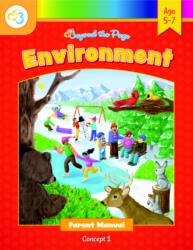
Activity 1 directs students to "Look at the cover of the book, Whatever the Weather" and to discuss what they think the story is about, giving students practice observing and talking about a book cover. Several Student Activity Pages are described with visible titles (for example, the pages are titled "Weather Words" and "Weather Calendar"), so students see and read titles on pages.
Unit 3: Community
Lesson 1
On the Town
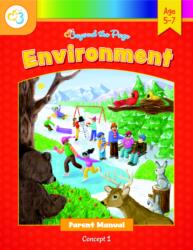
The lesson instructs an adult to "Show your child the cover of the book, On the Town" and asks the child what they think the book might be about, giving students practice looking at and talking about the book's front cover. Activity 3 asks the child to draw a new page for the book, which has students engage with the concept of a book having pages and contributes to awareness of book parts.
2: Similarities and Differences

Unit 1: Amazing Attributes
Lesson 10
Earth Materials: Rocks, Soil, and Water
The lesson instructs an adult to "turn to the back of the book Up in the Garden and Down in the Dirt, and show your child the glossary," explicitly pointing out a feature at the back of the book. It directs the adult to "Show your child the title page of Over and Under the Pond. Let him read the first sentence," providing direct exposure to the title page. The lesson also asks the child to "compare the two covers" and to "cut out and decorate the cover of the book, add his name to it, and glue it to the book cover," which engages the student with the book's front cover.

Unit 2: Senses
Lesson 1
My Five Senses
Students are asked to examine and be shown the cover of My Five Senses and to find and read the title. Students are prompted to locate the author's name and identify its first letter. Students are encouraged to look at important words on each page and to attempt to read beginning letters, reinforcing recognition of title and cover text.
Unit 3: We're the Same, We're Different
Lesson 5
Shapesville
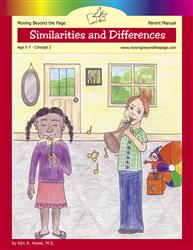
Activity 1 asks the child to look at and be shown the cover of the book, Shapesville, and to guess what the story might be about. The child is asked to point to the title of the story and to sound out the letters in the word, and to identify shapes on the cover. The activities also encourage the child to attempt to read the book aloud to the family.
Lesson 8
Different Holidays and Traditions
Activity 5 directs students to make a Book of Holidays with a Cover Page (students choose the cover color) and to write "A Book of Holidays" by [name] on the cover. Students are instructed to put pages in chronological order, include a page for each holiday with name/date/sentence, and staple the pages along the left side to make the book. The activity therefore has students create and label a book cover and assemble a multi-page book.
Final Project
Differences Make the World Go 'Round
The project directs students to create a cover for their book: "On the cover of the book, your child can draw a picture of herself and the child from the other country." The student pages include a printed title line ("Differences Make the World Go 'Round:") and numbered/page-structured sections, and the final page displays "The End," which students assemble by cutting and stapling pages together to form a book.
3: Patterns
Unit 1: Identifying and Creating Visual Patterns
Lesson 1
What Is a Pattern?
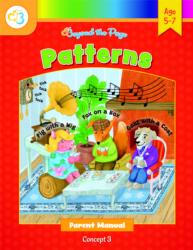
Students are asked to look at the cover of the story Busy Bugs and to identify the title and the author's name. Students are encouraged to read the title aloud and to guess what the story is about based on the cover. Students follow along while the story is read and are later invited to attempt reading the story aloud themselves.
Unit 2: Patterns in Sounds, Words, and Actions
Lesson 2
Making Word Patterns
Students are instructed to fold two pieces of construction paper in half to make pages, glue a sentence and an illustration on each page, staple the book along the binding edge, and "put a title on the book, 'It's Time to Rhyme.'" The instructions also tell students to "name himself as the author," which directs students to add book title/author information.
Unit 3: Patterns in Your World
Final Project
Patterns All Around Lapbook
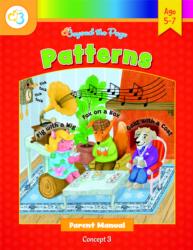
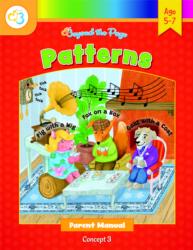
Students are instructed to write titles on covers (e.g., write "Symmetrical Pattern" on the one-page book cover and "Pattern in Nature" on the matchbook front). Students are told to write "Patterns" on the front cover flaps of the lapbook. Students glue the backs of mini-books to the folder and arrange mini-books inside so they still open, which involves handling front and back surfaces of the mini-books.
4: Change
Unit 1: Changes on Planet Earth
Lesson 3
Changing Position
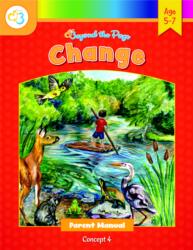
Students are asked to "look at the cover of the book Zoom! Zip! Whoosh!" and discuss what is happening in the picture and what the book will be about, giving direct practice with the front cover. Students are shown the index at the back of Zoom! Zip! Whoosh! and asked to locate words like "gravity" and "inertia" using the page numbers, which requires them to interact with the back portion of the book. The lesson lists skills including "Demonstrate understanding of the organization and basic features of print" and "Know and use various text features...to locate key facts or information," which frames activities that involve identifying parts of a book.
Unit 3: A First Look at History - Change Over Time
Lesson 3
Communities Change
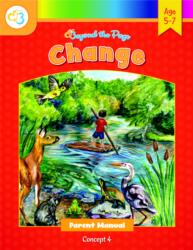
In Activity 1 students are shown the cover of The House on Maple Street and are encouraged to read the title and author's name and describe the pictures on the cover. Activity 3 asks students to look through the book and identify the communities that lived on the land, and Activity 6 has students reread the book and look closely at pictures and artifacts. These tasks require students to handle and inspect the book and to read or identify the book's title and author.
Lesson 5
Exploring the Past
Students are instructed to assemble pages into a book and "on the book's cover page, he can draw an engaging picture or can cut out pictures..." which asks them to create a cover. A Student Activity Page is described as resembling a cover or title page (titled "A Guide to Culture" with a large rectangular area for an image), indicating students will produce a title-like page. The activities have students staple pages along the left-hand margin to form a physical book.
6: Reading

Unit 1: Semester 1
Lesson 1
Letter Sounds Review I
In Activity 5.3 students are shown the Tap and Pat reader and are told, "The front of a book is called the 'cover.' The cover shows the title of the book," while the teacher points to the title. Students are asked to open the book to the first page with text and are told, "We'll start reading here because this is the first page in the book," and they are guided to point to each word as they read.
Lesson 2
Letter Sounds Review II
Activity 5.3 asks the child to read the title of the reader The Pig Can and to describe what is on the cover, including the prompt "What do you think this book is about?" It also instructs the child to begin reading on the first page and in the correct place and to point to each word as she reads it, reinforcing recognition of where reading starts in the book.
Lesson 3
Letter Sounds Review III
On Day 5 (Activity 5.2) students are given the reader The Bug and are asked to read the title and describe the cover. The directions ask the child to read the book aloud while pointing to each word, reinforcing attention to the book's front cover and title. Earlier activities also prompt students to read titles or words aloud (e.g., Weekly Message and reader re-reading), which supports identifying a book's title on the cover.
Lesson 10
Blends with r
Students are instructed to fold and staple five sheets to create a mini-book and to "cut out the 'Beginning Blends' box and paste it to the front cover," which requires them to place content on the front cover. They are also told to "cut out each of the boxes with the two-letter blends and paste one to the top of the first inside page of the book," which has students place material on an interior page that functions like a title or content page.
Lesson 17
Semester Review
In Activity 4.2 students are shown "the front of the book with the staples on the left side" and are told, "this is the cover of the book." Students are asked "What belongs on the cover?" and are instructed to write the title and their name on the cover. The activity also has students look through the pages of the book before they begin writing.