


Eighth Grade - MATH
3: Math
Unit 1: Numbers
Lesson 2
Fractions and Decimals
Students set repeating decimals equal to x, multiply both sides by 10 or 100, subtract the original equation from the new equation, and solve linear equations such as 10x - x = 3.3 - 0.3 (9x = 3) and 100x - x = 17.17 - 0.17 (99x = 17). Students solve for x to produce rational number solutions (e.g., x = 1/3, x = 17/99). The activity pages require students to show algebraic work and simplify resulting rational solutions.
Unit 2: Proportions
Lesson 1
Proportional Relationships
Students set up proportions and use cross-multiplication to form linear equations such as 2n = 72 and 3x = 135, then divide to isolate the variable. The materials show multiple worked examples where students multiply both sides and then divide to solve for x (e.g., 3x = 135 → x = 45; 2n = 72 → n = 36). Students practice solving equations that result from proportions using multiplication and division.
Lesson 2
Unit Rates
Students set up and solve simple equations from proportions and word problems, for example writing 2 × 10 = 4 × n and then solving 20 = 4n to find n = 5. Students translate rate problems into equations such as 2n = 750 and solve by isolating the variable (n = 375). Several examples show students using cross-multiplication and division to solve for an unknown (e.g., 3x = 48 → x = 16).
Lesson 3
Constant Rate
Students rewrite and solve equations in the form y = kx by isolating variables (for example, dividing both sides in 4y = 8x to get y = 2x) and use k = y/x to find unit rates. Students solve proportions and one-step linear relationships in word problems (e.g., find x from 5/8 = x/32 and set up and evaluate y = kx for real-world scenarios). Several activities ask students to convert equations to y = kx, find k, and then substitute to solve for a missing quantity.
Lesson 5
Proportional Relationship Equations
Students write and use equations of the form t = p n and y = k x to model proportional situations (e.g., t = 12n for movie tickets and t = 15n for pizzas). Students set up and solve one-step linear equations with rational coefficients by isolating the variable (e.g., 156 = 10m → m = 15.6; 100 = 20h → h = 5). Quiz and activity items include solving for variables in equations with decimals and fractions (e.g., d = 4.5t, y = 2.5x, and using proportions like 5/8 = 15/x).
Lesson 6
Taxes, Tips, and Commissions
Students set up and solve linear equations with rational (decimal) coefficients in multiple activities: e.g., 0.012 × V = 2400 to find a home's value, 0.20 × I = 9000 to find income, and 1.08x = 212 to find a pre-tax price. The Tax Challenge and Commission problems require students to write equations with variables (let p, v, i, x) and solve by dividing or by using two-step procedures (subtract then divide). Answer keys show students carrying out algebraic solutions such as p = 374.40 ÷ 1.06 and v = 2340 ÷ 0.013.
Lesson 7
Markups and Discounts
Students set up and solve one-step and simple multi-step linear equations with rational coefficients to find unknown prices (e.g., x * 1.20 = 72 → x = 72 ÷ 1.20 = 60; x * 1.60 = 208 → x = 130; x × 0.85 = 255 → x = 300). Multiple answer keys and backward problems ask students to let x represent an original price or markup percent and then solve for x by multiplying or dividing by rational numbers. The review and answer keys show students practice solving equations of the form a·x = b and x·(1 ± p) = b in context.
Lesson 8
Simple Interest and Percent Error
Students set up and solve linear equations from the simple interest formula I = Prt to find missing variables. For example, students solve 250 = 2500 × r × 2 to get r = 250/5000 = 0.05 and solve 108 = 600 × 0.06 × t to get t = 108/36 = 3. Students rearrange equations by dividing both sides and interpret results as rates, times, or balances in context.
Lesson 9
Unit 2 Test
Students set up and solve one-step linear equations with rational coefficients in tax and property-value problems (e.g., 1.06p = 212 solved as p = 212 ÷ 1.06 and 0.012p = 1,728 solved as p = 1,728 ÷ 0.012). The answer keys explicitly show solving for a single variable by isolating it in equations with decimal coefficients. Several problems ask students to write or use proportional equations in form y = kx, reinforcing writing linear equations with rational constants.
Final Project
Lemonade Stand
Students write and use linear equations of the form y = kx to model proportional relationships (for example y = 2x for tablespoons of lemon juice and y = 1.5x for tablespoons of sugar). Students set up and solve proportions such as 1 lemon/3 tablespoons = x lemons/___ tablespoons and 1 lb sugar/36 tablespoons = x lbs/___ tablespoons to find required quantities. Students use arithmetic equations to compute total cost: (Number of lemons × unit price) + (Amount of sugar × price per pound) = Total cost for 1 gallon, and apply formulas like selling price = unit price × 2 (or ×2.5, ×3) to determine prices.
Unit 3: Expressions
Lesson 2
Rewriting Expressions
Students set up and solve one-variable linear equations with rational (decimal) coefficients when they write and solve equations such as 31.50 = P(1 + 0.05) and 54 = P(1 − 0.10) by substituting known values and isolating P via division. Students expand and manipulate expressions using the distributive property in the backpack example: 48.75 = 65(1 − D) → 48.75 = 65 − 65D, then add 65D, subtract 48.75, and divide to find D = 0.25. Students also form and solve equations like 58 = 25 + 3r by subtracting the fixed cost and dividing, and they rewrite Selling Price = Wholesale Price + (Wholesale Price × Markup Rate) as Selling Price = Wholesale Price × (1 + Markup Rate) using distributive reverse.
Lesson 3
Algebraic Expressions
Students solve numerous equations in both forms ax + b = c and a(x + b) = c (e.g., 3x + 2 = 11 and 3(x + 2) = 11) in Activity 3 and on the student pages. Students use the distributive property to expand expressions (e.g., 54 = 2(l + 6) → 54 = 2l + 12) and then collect like terms before isolating the variable. Practice pages and answer keys include solutions that are rational numbers (e.g., x = 7/2, x = 21/4, x = 7/5), showing students solve for fractional results. The review quiz and factoring activities explicitly require expanding, factoring, and combining like terms (e.g., 5(n + 3) + 2n → 7n + 15 and factoring 32a + 8).
Lesson 6
Intercepts
Students set y = 0 or x = 0 and solve for the other variable to find intercepts (Activity 2). Problems require solving linear equations with rational coefficients such as 2x + 4y = 8, 3x - 6y = 12, y = 5x + 10, x + 5y = 10, y = -0.5x + 1, and 5x + y = 5, and students compute x- and y-intercepts from those equations. Student pages ask them to solve for intercepts, plot the resulting ordered pairs, and graph the lines based on those solutions.
Lesson 8
y = mx + b
Students practice isolating y by rearranging equations (for example converting 3x + 2y = 8 into y = (-3/2)x + 4 and 5x - y = 5 into y = 5x - 5). Students solve for a single unknown by substitution (for example plugging a point into y = mx + b: 5 = 2(2) + b, then solving b = 1). Students perform division by coefficients and work with rational (fraction) slopes such as -3/2 when writing equations in slope-intercept form.
Lesson 9
Unit 3 Test
Students set up and solve linear equations from word problems such as 30 + 10x = 80, 24 + 3x = 66, and 25 + 15x = 100, and the answer keys show solutions for x. Students write equations from contexts (e.g., phone plan, gym membership, wages) and solve for unknowns, and instructions explicitly tell students to "Write and solve algebraic equations to find missing values." Several problems ask students to identify slope, intercepts, and write equations in slope-intercept form, reinforcing linear-equation structure and solution practice.
Final Project
Planes, Trains, and Automobiles
Students write and solve linear equations for time using equations like 500 = 60x, 500 = 80x, and 500 = 400x to find x (time). Students write cost equations in y = mx + b form (e.g., y = 0.15x + 31.50, y = 0.20x + 20.75, y = 0.50x + 63.25) and use them to compare costs. Students set two linear expressions equal (0.15x + 31.50 = 0.20x + 20.75) and solve for x to find the break-even distance (x = 215), which requires collecting like terms and solving with rational coefficients.
Unit 5: Functions
Lesson 4
Intercepts
Students set x = 0 or y = 0 and solve resulting linear equations to find intercepts, shown in worked examples such as 2y + 3x = 4 (y = 2 when x = 0; x = 4/3 when y = 0) and y = 2x + 3 (x = -3/2 when y = 0). Student activity pages require solving a set of linear equations for intercepts (e.g., 3x + 2y = 6, 4x - y = 8, etc.) and recording solutions as coordinate pairs, producing rational-number answers like 4/3 and -3/2.
Lesson 5
Slope
Students rewrite linear equations into slope-intercept form by isolating y (for example: 4x + 2y = -8 → y = -2x - 4). Students apply the distributive property and then isolate the variable in examples such as y + 2 = -2(x - 3) where they expand -2(x - 3) to -2x + 6 and then solve for y. The activity set includes problems with rational coefficients (e.g., 0.5 in y + 1 = 0.5(x - 4) and division by 2 or 3) that require students to divide by coefficients to isolate y.
Lesson 6
Slope-Intercept Form
Students isolate y from standard-form equations (e.g., 2x + 3y = 6 → y = (-2/3)x + 2) and practice subtracting terms and dividing to solve for y. Students substitute a known slope and point to solve for the unknown intercept (e.g., 4 = -1(2) + b → b = 6). Students combine like terms in problems such as 5y + 3x - 4y = 12 to rewrite equations in y = mx + b form, and they work with coefficients that produce rational slopes (e.g., -2/3, 1/2).
Lesson 9
Unit 5 Test
Students write linear equations from verbal descriptions (e.g., "The difference between twice a number and 3 is 5" → 2x − 3 = 5; "Liam starts with $17 and earns $2 each time" → y = 2x + 17; E = 12h or E = 15h). Students identify and work with slope-intercept form and intercepts (e.g., find y-intercept of y = 2x + 3 or y = 4x − 2, write y = 3x − 1, determine x- and y-intercepts from 3x + 2y = 12). Students compute slopes and compare rates of change from equations, tables, and graphs (several problems ask for slope or which function has greater rate of change).
Lesson 10
Final Project
The Blue Cards require students to solve equation problems during gameplay, including two cards specifically labeled "Plug in a value and solve" and two cards labeled "Solve for x or y (one-step)." Students must solve the problems on drawn cards and check answers with an answer key during Part 6 (Play Function Junction). The Parent Plan and Blue Cards examples also describe students identifying slope/y-intercept and substituting values into equations, indicating practice with basic equation manipulation.
Unit 6: Geometry
Lesson 6
Dilations
Students set up and solve equations of the form new length = original length × scale factor (for example, x = 8 × 2.5 with solution x = 20). The lesson has students compute scale factor by dividing new length by original length (examples like 2.5 ÷ 5 = k and 3 ÷ 6 = 0.5) and uses rational coefficients (e.g., 2.5, 0.33, 0.25, 0.5) in those equations. Multiple activity pages and answer keys require students to solve for unknown side lengths or scale factors using multiplication and division of rational numbers.
Lesson 10
Volume
Students set up and solve equations for missing measurements using the volume formulas (for example: 314 = 3.14×25×h leading to h = 4), and they work problems that require isolating a variable by dividing both sides by a rational coefficient. Activity sets for cylinders, cones, and spheres include problems where students are given a volume and must solve for height or radius using arithmetic with rational numbers (e.g., 600 = (1/3)×3.14×36×h). Answer keys show step-by-step algebraic manipulations where students substitute known values and perform multiplication and division to find the unknown.
Unit 7: Linear Equations
Lesson 1
Linear Equations With One Variable
Students solve one-step and two-step linear equations with integer, fractional, and decimal coefficients (examples: 4x = 32; x/5 = 7; 3x − 6 = 12; 0.4x + 2 = 6.8). Students practice isolating the variable by undoing addition/subtraction and then multiplication/division, and they use reciprocals to solve equations with fractional coefficients. Problem sets and answer keys include many exercises with rational coefficients (fraction and decimal) for students to solve and check.
Lesson 2
Multi-Step Equations
Students are explicitly instructed to "Distribute through parentheses" and to "Move the variables and constants to opposite sides" and "Isolate the variable," and they work through multiple worked examples that expand parentheses (e.g., 3(a+4)=21, 4(y+2)=16) before solving. Student activity pages contain many linear equations with rational coefficients including decimals and fractions (e.g., 0.5(6y−4)+3y=12, 16−1.2(5p−9)=2.6p) and problems that require expanding both sides and collecting like terms (e.g., 5(2a−1)=3(3a+2), 3(y+4)−2(y−1)=15). Real-world word problems require students to define variables, write linear equations with rational coefficients, expand using the distributive property, combine like terms, and solve (e.g., 50+8.75g=312.50, 0.85x+5=42.50).
Lesson 3
How Many Solutions?
Students perform distribution and combine like terms in multiple places (e.g., the step-by-step example 2(3x + 4) + __ = 6x + 8 + 10 shows distributing 2 and then combining like terms to get 6x + 18). Many student pages require expanding parentheses and simplifying (e.g., 4(x - 3), 2(4x + 1), 3(2z + 4), 10(2x + 4) = 5(4x + __)). Students also carry out the usual solving steps to get x = a (subtracting like terms, dividing both sides) as in worked examples (3x + 4 = 10 → x = 2) and practice identifying solution types after simplifying. Fractional coefficients appear in some problems (for example 3/2 a + (7 - a) = 2a/3), showing work with rational coefficients.
Lesson 4
Multi-Step Word Problems
Students set up and solve linear equations with integer, fractional, and decimal coefficients (examples include 25 + 15x = 130, 0.5x - 3 = 7, and (3/4)x + 4 = 10). Students solve equations that require using the distributive property and collecting like terms, such as 5(2 - 3x) = 2x - 10 and 6(b + 2) - 3b = 15. Students also solve equations with variables on both sides (e.g., 25 + 7x = 10 + 8x) and are prompted to define a variable, write an equation from a word problem, solve algebraically, and check their answers.
Lesson 6
Substitution and Elimination
Students solve one-variable linear equations as part of substitution and elimination steps: Example 1 isolates y and substitutes to get 3x+1=7 then 3x=6 and x=2, with back-substitution to find y. Example 2 explicitly uses the distributive property when substituting y = x+2 into 2x+3y=16, writing 2x+3(x+2)=16, expanding to 2x+3x+6=16, collecting like terms to get 5x+6=16 and solving x=2. Elimination examples produce single-variable equations (e.g., adding 3x+y and 2x−y to get 5x=20 then x=4), and later activities ask students to solve problems involving fractions, decimals, and rearranging before substitution.
Lesson 7
The Point of It All
Students solve systems algebraically using substitution and elimination, which produces and requires solving linear equations in one variable (for example, setting 2x = -2x + 8 to get 4x = 8 and solving 3x = 6). The review quiz and word-problem section require students to solve one-step and two-step equations, including equations with fractional coefficients such as x/3 = 7 and x/2 - 7 = 3. The activities ask students to write equations in slope-intercept form and then isolate variables to find numerical solutions, so students practice solving for a single variable after algebraic manipulation.
Lesson 8
Linear Algebra In the Wild
Students set up and solve one-variable linear equations in examples such as 2J + 5 = 65 (Jake/Sophie) and 30x = 20x + 50 (break-even), showing steps to isolate the variable. Students solve systems that produce decimal solutions (e.g., 2x + 4y = 23.40 leading to y = 3.85), demonstrating work with rational-number coefficients. The worked steps explicitly show combining like terms (J+5+J -> 2J+5) and performing inverse operations (subtracting, dividing) to solve for a single variable.
Lesson 9
Unit 7 Test
Students solve many one-variable equations with rational coefficients (e.g., (3/4)x = 12, (2/3)x = 3, (5/6)x = 15, (4/3)x = 8) and use reciprocals to isolate the variable. Students expand and solve equations that require the distributive property (e.g., 4(2x - 3) = 20; 3[3x - 2] = 21) and then collect like terms (e.g., 5x - 2x + 6 = 12; 2x + 3x = 25). The skills list and answer keys explicitly show step-by-step transformations: distributing, combining like terms, and isolating x to find solutions.
Final Project
Getting Ready for College
Students set up and solve single-variable linear equations with rational coefficients in multiple tasks: e.g., Housing: 1200m = 1500 + 1050m solved for m = 10; Transportation: 225 + 0.60x = 1.25x solved for x ≈ 346.15; Entertainment: 20 = 5 + 1.5h solved for h = 10. In the Phone Plans activity students simplify y = (10x + 40)/2 to y = 5x + 20, which requires distributing the 1/2 across a sum and simplifying like terms.
Unit 8: Data
Final Project
Collecting and Organizing Data
The Parent Plan skills explicitly state that students will "informally fit a straight line" to scatterplots and "use the equation of a linear model to solve problems in the context of bivariate measurement data, interpreting the slope and intercept." Student activities require students to create scatterplots, plot points, draw a line of best fit, and answer analysis prompts about trends and what the linear relationship means in context.
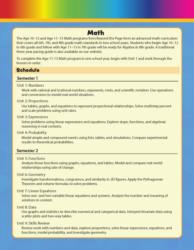
Unit 9: Semester Exams
Lesson 2
Proportions Review
Students write and interpret linear equations in slope form (e.g., y = 6x, y = 4x, y = x + 2) when matching tables, writing equations of proportionality, and graphing lines. Students are asked to "write equations to solve for y" and to label and interpret points such as (0,0) and (1,k), showing practice rearranging relationships to express y. Students solve applied problems that require using linear relationships (for example, using tax = rate × value to find a home value from given tax and rate).
Lesson 3
Expressions Review
Students practice simplifying expressions and using the distributive property (Activity 1) and factor expressions. Students write and solve real-world linear equations for costs and dimensions (e.g., writing 40 + 5x for gym cost, finding w = 12 cm from a perimeter problem, and expressing C = 9t + 6 for ticket cost). Students work with examples that use rational coefficients and equivalent rewrites (for example a + 0.05a = 1.05a), and materials state practice with equations of the forms px + q = r and p(x + q) = r.
Lesson 5
Semester Exam
Students are asked to collect like terms in problem 26 (4x + 9 + 6x + 1) and to apply the distributive property in problem 27 (3(y + 5) - y). Students solve linear equations in problems 29 and 30 (5(x + 4) = 45 and 4x + 6 = 30) with answers provided (x = 5 and x = 6). The answer key and problems show students forming and solving linear equations and performing distribution and combining like terms as steps.
Lesson 6
Functions Review
Students are asked to write and solve a one-variable equation from words: "The sum of a number and three times the number is 28," with the answer key showing x + 3x = 28 → 4x = 28 → x = 7. Students also solve for a y-intercept from standard form 2x + 3y = 12 by setting x = 0 and solving 3y = 12 → y = 4. The answer keys explicitly show these algebraic manipulations and solutions.
Lesson 8
Linear Equations Review
Students practice solving one-step and multi-step linear equations and are explicitly instructed to combine like terms and use the distributive property (Activity 1 directions). Students solve equations that require distribution such as 5(2x - 1) = 45 and combining like terms such as 7x - 3x + 4 = 28. Students solve equations with rational number coefficients and fractions, for example (3/5)x = 18 and (2/3)x - 5 = 7, and are directed to show all steps.
Lesson 10
Semester Exam
Students are asked to solve a sequence of one-variable linear equations in Unit 7, including x + 7 = 19, 9x = 63, and 4x + 3x = 35 which requires collecting like terms. Problem 26 (5(2x − 1) = 45) explicitly requires using the distributive property to expand before solving, and problems 27 and 25 involve combining like terms. Problems 28 and 29 present fractional coefficients (3/5 x = 18 and (2/3)x − 5 = 7), and problems 30–31 ask students to determine special-solution cases (infinite or no solution).