


Ninth Grade - ELA
• Literacy
1: Semester 1
Unit 1: Early Civilizations and Migration (600 BCE)
Lesson 8
Historical Essay
The rubric explicitly asks that "transitions between ideas are smooth," and revision steps direct students to "summarize the main point of each paragraph," check whether paragraphs "flow to the next," and "consider re-ordering your paragraphs and/or rewriting your transitions." Students are instructed to develop a thesis, create topic sentences, and locate specific evidence with parenthetical citations to support their claims.

Unit 1: Lord of the Flies
Lesson 2
Life on the Island
Activity 2 explicitly teaches students about clauses, coordinating conjunctions (FANBOYS), subordinating conjunctions, and comma/semicolon usage. The Independent and Dependent Clauses activity asks students to mark clauses in sample sentences and to write their own sentences that combine dependent and independent clauses, two independent clauses, and a sentence containing both a coordinating and a subordinating conjunction. The parent plan answer key gives example sentences that combine clauses and conjunctions (e.g., using 'since' and 'but') which students can model.
Lesson 3
Paths in the Jungle
Students are asked to identify the author's thesis and supporting points using the Student Activity Page that has spaces for "Author's main argument/thesis" and "Key points that support the thesis" and to record "Your reaction to the thesis." The Parent Plan lists skills including producing clear and coherent writing and explicitly mentions using various types of phrases and clauses. Students must write a response/opinion to the article and evaluate the writer's view, which requires organizing claims and supporting points.
Lesson 8
Defects of Human Nature
Students are asked to choose themes that support Golding's major theme and "support those choices by referring to details from the novel," including writing a 3–4 sentence explanation of how the main theme supports their choice (Option 1 and Option 2). The parent notes repeatedly instruct students to "support your choices with examples from the novel" and to write additional sentences explaining which minor theme has the strongest presence. These prompts require students to state a claim (a chosen theme) and provide textual reasons or evidence to justify it.
Lesson 11
The Film
Students are asked to produce written responses in a journal that require them to state a position (e.g., whether omitted scenes were critical) and support it with reasons. Students complete a "Movie vs. Book" chart that asks them to organize similarities and differences across major sections (characters, setting, theme, plot). The plan also directs students to write a final essay on the book and notes that students should review phrases and clauses for the upcoming unit test.
Final Project
Now You Have the Conch
Students are prompted to include and evaluate transitions in their writing: the Traditional Outline and Essay Organizer explicitly list a line for a transition to the next paragraph and instruct students to "Transition smoothly to the next paragraph." The "You Are the Editor" activity directs students to identify transition words and phrases, evaluate their effectiveness, and mark transitions between main points and paragraphs. The Brainstorming page provides a word bank (including terms like "therefore") to help structure thesis sentences and link ideas, and the editor checklist asks students to check sentence structure and clause placement.

Unit 2: World Religions (600 BCE - 600 CE)
Final Project
Dimensions of World Religions
Students are required to write a 5–7 paragraph essay (Topic 1 or Topic 2) in a timed setting that asks them to make a persuasive argument and explain similarities, differences, and origins of religions. Students must also answer short identification prompts that ask them to identify a term, state its belief-system origin, and explain its significance, which requires linking description to significance. Parent/teacher notes ask that students' essays be accurate, well-organized, and cogently written, implying expectations for coherent organization.
Unit 3: Grammar, Part I
Lesson 1
Parts of Speech
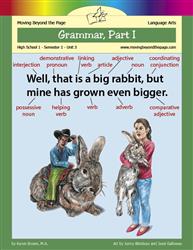
The lesson explicitly teaches conjunctions and conjunctive adverbs: it defines coordinating, correlative, and subordinating conjunctions and states that "Conjunctive adverbs provide strong transitions between two independent clauses" with the punctuation formula. The lesson also shows that relative pronouns "link nouns or pronouns to other parts of the sentence" and discusses prepositions as words that show relationships between nouns/pronouns and other words. Several activities require students to identify and use these linking words and phrases in sentences and to label parts of speech.
Lesson 4
Commas
Students are taught the compound-sentence rule (independent clause + comma + FANBOYS) and complete practice items where they insert commas in compound sentences, showing they practice joining clauses. Students identify and punctuate interrupters such as transitional words like "however" and "on the other hand," learning to set them off with commas. Students learn how to use dashes to clarify or introduce lists and parentheses to de-emphasize parenthetical information, and they practice choosing among commas, dashes, and parentheses on activity pages.
Lesson 6
Colons and Semicolons
The lesson teaches students the formula independent clause + semicolon + conjunctive adverb + comma + independent clause and lists conjunctive adverbs (however, therefore, indeed, furthermore) as strong transitions between independent clauses. Students are asked to write persuasive opening statements for the semicolon and colon in "The Great Punctuation Trial," including explicit requirements to include an example joining two independent clauses and one joining two clauses with a conjunctive adverb. The courtroom hearing prompts students to explain how a semicolon changes the relationship between two ideas and to defend their usage with examples.

Unit 4: Poetry
Final Project
Poetry
Students are asked to write a one-page, double-spaced argumentative response defending whether Bob Dylan deserved the 2016 Nobel Prize, which requires them to state a claim and explain reasons. Students are instructed to consider both sides of the debate and to read articles that support and oppose Dylan's win, which requires them to engage with counterclaims and source-based evidence. Students are reminded to give credit for quotations and other writers' arguments, which requires them to marshal and cite evidence to support their position.
Unit 5: Nonfiction
Lesson 3
The Taliban
Students are explicitly told to "avoid writing a series of short, choppy sentences; instead, use transitional words and phrases to smoothly link your thoughts" when composing the informational paragraph (Option 1), and are directed to consult pp. 159–161 of The Only Grammar Book for transitional words and phrases. The paragraph task requires students to begin with a strong introductory sentence, link supporting sentences, and end with a concluding sentence, which practices creating cohesion across a written text. Option 2 asks students to combine text and visual aids on slides, which requires organizing information across sections.
Lesson 6
A Day Like Any Other
The lesson requires students to use the APE strategy (Answer, Prove, Extend), directing students to answer a question in a complete sentence that includes part of the question, then "Prove" by providing quotations or specific examples from the text (with page numbers), and finally "Extend" by explaining how the evidence supports the answer. The Student Activity Page and Parent Plan explicitly ask students to provide evidence and explain how the quotation or example supports their answer and to be prepared to discuss and explain their opinion. The example walkthrough models restating the question, citing a quotation, and explaining how that quotation supports the claim.
Lesson 8
Civil Rights
Students read and analyze Martin Luther King Jr.'s persuasive "Letter from Birmingham Jail," underlining excerpts and identifying whether they agree with King's reasoning and which arguments they find most persuasive. Students complete a "Just and Unjust Laws" double-entry diary and a "Students in Action" pros-and-cons organizer where they record arguments for and against children marching and then state their considered opinion. Students also write short responses about how authors (Douglass, Hughes, Angelou) contributed to progress and answer journal questions asking them to list the four steps to a nonviolent campaign and explain why a particular argument was effective.
Lesson 12
Running from War
Students are taught three explicit methods for integrating quotations into their writing: introducing a quotation with a complete sentence followed by a colon, using a short introductory phrase with the author's name and a comma, or integrating a small section of the quotation into their own sentence. The Student Activity Page (Part II) requires students to introduce a provided quotation using one of these methods, and Part I asks them to select sentences with correct punctuation for quotations. The homework uses the APE strategy (Answer, Prove, Extend), requiring students to make a claim, prove it with a quotation introduced by one of the taught methods, and then explain how the quotation supports the claim.
Lesson 14
Rehabilitation
Students are asked to write a reasoned response in Option 2 where they "state one of these conclusions (or one of your own) and provide examples or quotations from the text that support your conclusion," which requires forming a claim and supplying evidence. In Activity 1 students complete a comparative analysis ("RUF vs. Government Soldiers") in which they decide whether each side committed specific war crimes and record supporting examples or quotations. In the "Wiesel's Words" activity students select a quotation and explain how it relates to the memoir, citing specific information from the book or video to support their interpretation.
Final Project
Expository Essay
Students are instructed to "use appropriate and varied transitions to link the major sections of the text, create cohesion, and clarify the relationships among complex ideas and concepts" in the Skills list. The Organization criterion on the rubric requires ideas to be "connected with transitional words and phrases," and homework explicitly reminds students to "include clear transitional words and phrases" (with a reference list of transitions). In the Developing Paragraphs activity students are guided to use the APE (Answer, Prove, Extend) structure to present a supporting fact and then "explain the connection between your proof ... and your thesis," which requires students to link evidence to their thesis.
2: Semester 2
Unit 2: Grammar, Part II
Lesson 1
Review of Grammar, Part I
Students identify and match coordinating conjunctions (FANBOYS), subordinating conjunctions, and conjunctive adverbs through the Grammar Matching activity and its answer key. Students insert commas, semicolons, and conjunctive adverbs in the Punctuation and Grammar exercise and correct related errors. Students create their own paragraphs (Option 2) and produce answer keys explaining punctuation and conjunction rules, reinforcing use of linking words and punctuation that create cohesion.
Lesson 8
Parallelism
Students identify coordinating and correlative conjunctions and are prompted to list them and provide examples (e.g., the activity asks students to "List the 3 coordinating conjunctions" and "List the four sets of correlative conjunctions"). Students practice making words, phrases, and clauses parallel when joined by conjunctions and analyze sentence examples (the Rashad sentence and the "not only/but also" example). The parallelism activity page directs students to use information from the webpage and book to record descriptions/examples of how linking words should form parallel structures.

Unit 3: Informational Texts
Lesson 4
The 10,000 Hour Rule
Students are asked to identify and analyze transition words and structural moves (e.g., a question asks which words, phrases, or sentences signal Gladwell will treat Joy's story differently, noting the transition word "however" and other signals). Activity prompts ask students to analyze how Gladwell arranges information across sections and to summarize the focus of each section, which requires noticing cohesion and connections between ideas. The skills list also includes analyzing how an author uses rhetoric and how ideas are introduced and connected, supporting student analysis of linking devices.
Lesson 6
The Ethnic Theory of Plane Crashes
Students read Gladwell's chapter and a critical blog post and are asked to identify the blog author's main objections and Gladwell's responses (Activity 4 and Activity 5). In Option 2, students complete a chart that explicitly links each criticism (claim/counterclaim) to Gladwell's response and evaluate the effectiveness of that response, which requires noting relationships between claims, reasons, and evidence. Several short-answer and discussion tasks (reading questions, journal prompts, and the oral summary option) require students to summarize arguments and cite details from the texts to support their conclusions.
Lesson 8
With Malice Toward None
The Skills section asks students to "analyze how the author unfolds an analysis or series of ideas...and the connections that are drawn between them," and to "analyze in detail how an author's ideas or claims are developed and refined by particular sentences, paragraphs, or larger portions of a text." The Activities require students to identify rhetorical strategies (parallelism, antithesis, allusion) and to explain the intended effect of quoted lines. The Homework asks students to choose three sentences that correspond to background, main message, and forward-looking statement, requiring students to map the speech's major sections.
Lesson 9
Writing about History
Students complete a graphic organizer that requires them to connect secondary-source claims to specific supporting primary-source excerpts, practicing how to link claims and evidence. Students write an editorial option that asks them to persuade readers using facts from the accounts, which requires organizing reasons and evidence and may involve addressing Chivington's motives. The Parent Plan lists skills students are expected to practice, including introducing precise claims, distinguishing claims from opposing claims, and creating organization that establishes relationships among claims, counterclaims, reasons, and evidence.
Lesson 11
Technical Writing
The Parent Plan explicitly lists: "Use appropriate and varied transitions to link the major sections of the text, create cohesion, and clarify the relationships among complex ideas and concepts." The Organize and Revise activity directs students to add headings/subheadings and other navigation aids and to revise steps to ensure clarity and appropriateness for the audience. The homework and Day 1 introduction require students to state a claim about the benefit of a skill and back it up with information from an outside source, which asks students to connect a claim with supporting evidence.
Lesson 12
Logical Fallacies
Students identify non-sequiturs and other gaps in reasoning (the lesson defines "non-sequitur" and tells students to notice when statements are placed side-by-side without a connecting link). Students read and analyze speeches for reasoning and fallacies (Option 2 requires highlighting weak arguments and justifying selections). Students produce persuasive writing or short speeches (final project and speech-writing option) in which they are asked to support claims with examples and to explain appeals (ethos/pathos/logos), which requires relating claims to reasons and evidence in practice.
Final Project
Argumentative Research Essay
The lesson's skills list explicitly includes: "Use words, phrases, and clauses to link the major sections of the text, create cohesion, and clarify the relationships between claim(s) and reasons, between reasons and evidence, and between claim(s) and counterclaims." The Essay Rubric's Content Development criteria require that key points be "strengthened with words and phrases connected with transitions." Activities require students to organize evidence (Present the Evidence), draft a five-paragraph classical argument including a concession/refutation paragraph, and revise their paper using the rubric.

Unit 4: Drama
Lesson 14
Modern Retelling
Students are instructed to write a thesis statement naming three areas of difference and to produce three supporting paragraphs, which requires organizing claims and reasons. The lesson directs students to use the APE method (Answer, Prove, Extend) so students must state a claim, provide specific examples as evidence, and explain the significance of those examples. The checklist requires each paragraph to begin with a topic sentence, include specific examples from both productions, and end with an explanation of the effect, reinforcing structuring of claim → evidence → explanation.
Final Project
Drama
The Parent Plan explicitly lists the skill "Write arguments to support claims in an analysis of substantive topics or texts, using valid reasoning and relevant and sufficient evidence." Several student tasks require written explanations or persuasion: the Commercial requires students to state "What is it? ... Why should people buy it? Why is it a good product?" and to write a script; the Set Design and Costumes tasks require a paragraph explaining why design decisions were made; the Playlist and News tasks require written reasons linking songs/articles to characters/events. Students are also required to cite outside sources and attach a Works Cited page.
Semester Exam
Semester Exam
The Informational Texts review asks students to understand how writers persuade using logos, pathos, and ethos and asks them to explain what a counterargument is and why to include one. Part IV: Discussion requires students to produce 1–3 paragraph answers defending positions (e.g., arguing for or against teaching Shakespeare, or judging whether Outliers is informational or persuasive). The Grammar, Part II review and exam items include tasks on rewriting for clarity and correcting parallelism, which relate to producing coherent writing.