


Seventh Grade - MATH
5: Math

Unit 1: Operations
Lesson 6
Greatest Common Factor
Students practice and use the distributive property to factor sums by identifying a greatest common factor (e.g., factoring 24 + 54 into 6(4 + 9), factoring 28 + 36 into 4(7 + 9), and factoring 15 + 21 into 3(5 + 7)). Activity 2 explicitly shows the distributive property a(b + c) = ab + ac and then reverses it to 'un-distribute' common factors from sums of whole numbers. Students complete problems that require factoring sums of whole numbers and expressing those sums as a common factor times a sum (using the GCF).
Lesson 7
Least Common Multiple
The lesson explicitly shows that students use the LCM to find common denominators for adding fractions (the image with 2/3 + 3/5 rewrites both fractions with denominator 15). Students practice finding LCMs in many activities and are asked to use those LCMs to rewrite quantities (e.g., the hot dog/bun and packing problems, and the GCF/LCM word problems). Several student pages and instructions direct students to "find a common denominator" and to use prime factorization to compute the LCM for use when adding fractions.
Lesson 8
Unit 1 Test
Students complete vocabulary and matching items that name and define the distributive, associative, and commutative properties. Students are asked to model and write undistributed/distributed forms (e.g., grid models and 6(4 + 3)) and to use the distributive property to factor sums (e.g., factor 84 + 120 and 48 + 64). Students also solve many addition and subtraction problems with decimals and whole numbers using algorithms, showing practice with rational-number computations.
Final Project
Planning a Party
Students calculate total item counts using expressions like 12(5 + 3) and expand them as (12 × 5) + (12 × 3) to show totals, explicitly invoking the distributive property (Spending Your Money Q5 and example). Students compute package counts and multiply package counts by price (e.g., 3 × $4.80 = $14.40) and then add decimal costs to find a grand total and check against the $50 budget, practicing addition and subtraction of decimals. The parent/teacher notes and activity sheets explicitly instruct students to use the distributive property and the algorithms for adding and subtracting decimal numbers in these tasks.
Unit 2: Integers and Rational Numbers
Lesson 1
Fraction Addition and Subtraction
The lesson explicitly tells students to use the commutative property when adding mixed numbers: "First, using the commutative property of addition, rearrange the whole number and fraction parts..." and shows students rearranging 3 + 4 + 2/3 + 5/6 to add whole-number parts and fractional parts separately. Students practice strategies for addition and subtraction of fractions such as converting mixed numbers to improper fractions, finding common denominators (ECD and LCD), and regrouping (borrowing) when subtracting mixed numbers.
Lesson 4
Negative Numbers and Integers
Students are taught the additive inverse (opposite) of a number and that opposites sum to zero (definition and practice questions asking for additive inverses). Students plot positive and negative integers on horizontal and vertical number lines and use those lines to see that opposites are equal distance from zero. Students solve contextual addition/subtraction problems with integers (e.g., Paula +8 then -8 → 0, Simon owes -10 then adds +6 → -4, temperature change from -4 to +8) that require combining positive and negative rational numbers.
Lesson 5
Absolute Value and Inequalities
Students practice finding distances on number lines by either counting steps between points or by adding the distances from each point to zero when points lie on opposite sides of zero (e.g., −3 and 2: 3 + 2 = 5). The materials define opposites as additive inverses and state that the opposite of a number is what must be added to that number to get zero. Students also compute sums and differences of rational numbers in word problems and examples (e.g., 47 + 14.5 = 61.5, 73 − 58 = 15, 32.8 + 16 = 48.8).
Lesson 6
The Coordinate Plane
Students plot and move points by adding and subtracting integer amounts (Activity 2 Problem 3 and Problem 4 ask students to move points left/right and up/down and write the new ordered pairs). Activity 3 has students plot pairs of opposites on number lines and observe that opposite numbers are the same distance from zero, showing understanding of additive inverses. Reflecting points across axes requires students to change signs of coordinates (e.g., (a,b) to (a,−b) or (−a,b)), which practices using opposites in an applied context.
Lesson 8
Unit 2 Test
Students solve many addition and subtraction problems with rational numbers and mixed numbers (e.g., 2 1/4 + 3 3/5, multiple subtraction word problems) and complete practice and test items that require adding and subtracting fractions and mixed numbers. Students identify and name additive inverses in several problems (e.g., "Name the additive inverse of each number" and answer key showing a number and its opposite sum to 0). The answer key and worked examples show students converting to common denominators and performing step-by-step addition/subtraction of rational numbers.
Unit 4: Algebraic Expressions
Lesson 4
Positive and Negative Numbers
Students are asked to rewrite subtraction as addition of the opposite and then explicitly use the commutative and associative properties to rearrange and group terms (Activity 2 and Activity 3). An example walks students through changing 3 - 5 + 4 + 2 - 13 into 3 + (-5) + 4 + 2 + (-13), then using the commutative property to move positives together and negatives together and the associative property to group for easier computation. Student practice pages require changing subtraction to "add the opposite" and then regrouping terms to simplify multi-term expressions.
Lesson 5
Equivalent Expressions
Students learn and use the commutative and associative properties to rearrange and group terms (Activity 3 and Activity 4) and explicitly change subtraction to adding the opposite to allow use of those properties (examples showing 6x - 3 + 2x + 7 → 6x + 2x + -3 + 7). Students practice combining like terms and adding/subtracting coefficients (student activity pages with problems such as 8x + 4 + 7 - 3x - 5, 14 - (-8) + 9p - 6p, and multiple combining-like-terms exercises). The skills section and parent notes state students will "apply properties of operations as strategies to add and subtract linear expressions with rational coefficients," tying properties use to addition/subtraction of coefficients.
Lesson 6
The Distributive Property
Students are instructed to "change subtraction to addition of the opposite" and to apply the commutative and associative properties to rearrange and group like terms (e.g., transforming 12a + 20 - 6a - 10 + 2a into (12a + (-6a) + 2a) + (20 + (-10))). Multiple worked examples show students combining like terms and using rules for adding positive and negative numbers to produce simplified results (for example, simplifying to 8a + 10). Student activity pages require students to simplify and evaluate pairs of expressions that involve adding and subtracting term coefficients and to prove equivalence by substitution.
Lesson 7
Unit 4 Test
Students are explicitly told to "change subtraction to 'add the opposite'" and solve problems such as 18 - 5, 20 - 36, and -14 - (-9), applying the additive inverse strategy. The Skills list states "Understand subtraction of rational numbers as adding the additive inverse, p - q = p + (-q)." Students identify and match commutative, associative, and distributive properties and practice rewriting expressions using those properties (for example, rewriting 12n + 5 as 5 + 12n and expanding 12(x + 6) to 12x + 72).
Final Project
Algebra Think-Tac-Toe
Students create Math Properties Trading Cards that require them to write number examples and mini-lessons for the commutative, associative, and distributive properties. In the "Prove It! Equivalencies" activity students use the distributive property, change subtraction to adding the opposite, and use the commutative property to rearrange and combine like terms. Multiple projects (Make a Quiz, GoFish!, Design a Book Cover) require students to add and subtract positive and negative numbers and to combine like terms using properties of operations.
Unit 5: Algebraic Equations
Lesson 2
Solving One-Step Equations, Part 1
Students practice adding and subtracting quantities when they solve one-step equations (for example, using inverse operations to solve n + 60 = 100 and 48 = 21 + x). The lesson explicitly discusses inverse operations (addition and subtraction) and shows students subtracting the same number from both sides to isolate a variable. The text also names the commutative property when explaining that n + 3 is the same as 3 + n and has students reorder terms in examples to subtract a variable from both sides.
Lesson 4
Solving Two-Step Equations
Students practice adding and subtracting rational numbers in dedicated pages for decimals and fractions, with step-by-step instructions (e.g., lining up decimals, finding common denominators) and worked examples. Students combine like terms (5 + 3 = 8) when simplifying expressions before solving 2-step equations. Students apply the distributive property to rewrite expressions with parentheses (e.g., 3(n - 4) → 3n - 12) and then use addition/subtraction to isolate constants.
Lesson 6
Solving Inequalities
Students repeatedly use inverse operations and additive inverses to remove constants and isolate variables (e.g., subtracting 7 from both sides in y + 7 > 10, adding 4.3 in 3n - 4.3 < 10.7). Students work with addition and subtraction of rational numbers including decimals and fractions when solving inequalities (examples: x - 2.6 < 2.4, n/3 ≤ 1 then multiply, 1/2 y + 3/4 ≠ 1/4). The materials instruct students to "use inverse operations to cancel out addition and subtraction" and to "use additive inverses," which students apply when solving and checking inequalities.
Lesson 7
Independent and Dependent Variables
The lesson explicitly names the commutative property when students generate solutions for x + y = 8 and shows students switching the addends (x = 6, y = 2 versus x = 2, y = 6). Students are instructed to use inverse operations (adding or subtracting the same value to both sides) to isolate a variable—examples include adding y to both sides and subtracting 4 to rewrite 2x - y = 4 as y = 2x - 4. Students also work with addition and subtraction involving negative numbers in solution pairs (for example x = -1, y = 9) and in several solving problems that require adding or subtracting to find a missing variable.
Lesson 8
Unit 5 Test
Students solve equations that require adding and subtracting rational numbers (for example, x - 2.4 = 7.6 where students add 2.4 to both sides, and a/7 - 5 = 9 where students add 5). The answer key and activity directions show students use inverse operations and the distributive property to manipulate expressions (e.g., 2(y + 1/2) = 13 rewritten as 2y + 1 = 13). The Parent Plan explicitly lists "Apply properties of operations as strategies to add, subtract, factor, and expand linear expressions with rational coefficients," indicating expected student practice with properties in solving linear problems.
Unit 6: 2D Geometry
Lesson 2
Working With Angles
Students perform addition and subtraction of angle measures in context (for example, 90 - 32 = 58 and 180 - 126 = 54). Students use inverse operations to isolate variables and solve equations (subtracting from both sides in 5n = n + 92, and subtracting 126 from both sides to get n = 54). Students combine like terms in equations (for example, simplifying n + 2n = 90 to 3n = 90 and 2n + 3n = 180 to 5n = 180).
Lesson 7
Unit 6 Test
Students write and solve equations such as n + 2n + (3n + 12) = 180 and 3n = 2n + 35 to find unknown angle measures, and the answer key shows combining like terms (6n + 12 = 180) and subtracting terms from both sides (subtract 2n to get n = 35). Students perform arithmetic subtractions to find complementary/supplementary or reflex angles (e.g., 90 - 23 = 67, 360 - 125 = 235, 180 - 110 - 45 = 25). Several problems require students to compute perimeters and areas by adding and subtracting numeric measures (e.g., perimeter = 12 + 5 + 12 + 5, area decompositions summing component areas).
Unit 7: 3D Geometry
Lesson 1
Three-Dimensional Solids
Students set up and solve an equation using Euler's formula (e.g., F + 5 − 8 = 2) and perform steps that change a subtraction to adding the opposite (F + 5 + (−8) = 2), combine like terms (F + (−3) = 2), and add the inverse to isolate the variable. The activity pages and worked examples ask students to compute unknown values by rearranging and simplifying expressions that include negative integers. Several problems ask students to apply these algebraic steps to find faces, vertices, or edges using numeric substitution and manipulation.
Lesson 2
Surface Area
Students solve fraction addition in the Basic Skills Review (the answer key shows 6 2/3 + 3 1/4 + 2 5/6 rewritten with common denominators and added). The review includes an example that uses the distributive property (5(n + 7) = 5n + 35) and an example showing use of additive inverse when evaluating n^2 − (−5). The lesson also asks students to evaluate expressions at s = 1/2 and to perform arithmetic with fractional values when finding areas (e.g., using s = 1/2 in cube formulas).
Lesson 5
Problem Solving With Solids
Students perform addition and subtraction of rational numbers in the Basic Skills Review: for example, they evaluate 8 + (−15) + 4 − 7 + 10 and add mixed numbers in the Janie punch problem (2 1/2 + 6 1/4 + 3 5/6). The review also has students combine like terms (4x + 3x − 9 + x + 16) and solve linear equations by adding/subtracting and dividing both sides, which requires use of inverse operations. Several activity answer keys show stepwise arithmetic work (finding common denominators, regrouping) that students must carry out to add and subtract rational numbers.
Unit 8: Statistics
Lesson 2
Populations and Samples
Students perform addition and subtraction with integers and fractions in the Basic Skills Review (for example, Problem 4: 4 + 7 - 13 + 1 - (-2) and Problem 2: 8/15 + 4/9). The answer key explicitly tells students to "Change subtraction to add the opposite" when evaluating 4 + 7 - 13 + 1 - (-2), demonstrating use of the additive inverse strategy. Students also solve for an unknown by subtracting both sides (Rico's score: n + 26 = 102, subtract 26), showing use of inverse operations.
Lesson 3
Frequency Tables and Dot Plots
Students are asked to add frequency numbers to find totals (e.g., "To find the total number of campers who answered the question, she just needs to add all the frequency numbers. Eighty campers responded to the question."). Student activity questions require subtraction to compare frequencies (e.g., "How many more campers voted for pizza than spaghetti?" and "How many more visitors voted for monkeys than elephants?"). Several activity pages have tasks where students compute totals and differences from frequency tables and dot plots.
Lesson 5
Histograms
Students compute differences and sums of frequencies to answer questions (for example, the camper example shows 17 - 5 = 12 and students add 17 + 18 + 10 + 5 + 2 = 52 to find total campers). Students create frequency tables (books read, class sizes, employee salaries) and use those counts in calculations. Quiz and activity items require students to count and total values from histograms, dot plots, and frequency tables.
Lesson 6
Measures of Center
Students add many rational numbers to find means (for example, 12 + 12 + 13 + ... = 219 and 219 ÷ 15 = 14.6). Students use multiplication by frequency to compute sums more efficiently (for example, 12 × 2 + 13 × 2 + ... = 219). Students compute sums from stem-and-leaf data (4 + 5 + 10 + ... + 45 = 418) and then divide to find the mean.
Final Project
Statistical Study
Students compute the mean by summing data values and finding their average (Step 4). Students compute measures that require subtraction such as range (maximum minus minimum) and mean absolute deviation (subtracting the mean from each data value and taking absolute values). Students organize and summarize numerical data (lists, frequency tables) that require adding counts and totals to produce summaries and graphs.
Unit 9: Skills Review
Lesson 1
Decimals, Factors, and Multiples
Students practice addition and subtraction of decimal numbers directly (problems such as 632.3 + 87.59 and 847.2 − 37.89 and word-problem totals and leftovers). Students also use the distributive property explicitly to rewrite or compute expressions (factoring 36 + 88 as 4(9 + 22) and using 15(30 + 2) to compute 15 × 32). The unit includes computation with rational-number forms (decimals) and explicit tasks asking students to apply the distributive property.
Lesson 2
Fractions, Ratios, and Coordinates
Students complete multiple problems that require adding and subtracting fractions and mixed numbers (e.g., 11 3/15 + 6 3/4, 18 1/4 − 10 3/5) on the "Operations with Fractions" page. Students solve word problems that require adding fractional quantities (Mario's hours, Bart's fabric) and subtracting to find remainders, with space to show calculations. The answer key shows step-by-step computations converting to common denominators and producing final sums and differences.
Lesson 3
Expressions, Equations, and Percentages
Students simplify linear expressions such as 3(n + 6) + 4n - 10 and x + 2x + 3 + 3x - 7, which requires distributing and combining like terms. Students solve equations that involve adding or subtracting decimals (for example x - 1.3 = 5.8) and perform inverse operations to isolate variables. The skills list explicitly states applying properties of operations to generate equivalent expressions and to add, subtract, factor, and expand linear expressions with rational coefficients.
3: Math
Unit 1: Numbers
Lesson 1
Positive and Negative Rational Numbers
Students explicitly convert subtraction to addition of the opposite (e.g., 3 - 3 = 0 and 3 + (−3) = 0) and write equations using one positive and one negative number in Activity 1. Students draw and use horizontal number line diagrams and circle zero pairs to represent opposites combining to make zero. Multiple student pages ask learners to represent real-world scenarios with equations, number-line drawings, and to solve resulting sums (e.g., jellybeans, scuba diver, charges).
Lesson 6
Scientific Notation
Students are instructed to "ensure the exponents are the same, adjust if needed, then add or subtract the base numbers while keeping the common exponent," and multiple examples show rewriting one term to a common exponent and then adding coefficients (e.g., (4 × 10^5) + (2 × 10^6) → rewrite 2×10^6 as 20×10^5, then 4+20 = 24 → 2.4×10^6). Activity pages include practice problems for addition and subtraction in scientific notation and step-by-step worksheets where students rewrite terms with matching exponents and perform the arithmetic. Student tasks require converting decimals to scientific notation, aligning exponents, adding/subtracting coefficients, and rewriting answers in proper scientific notation.
Lesson 7
Arctic Marine Research
Students compute sums and differences of rational numbers in Phase 5 when they calculate the temperature range (from -15°C to 5°C) and the average daily temperature, and when they determine the submarine's final depth after a -450 m dive and a +175 m rise. The parent plan and wrap-up also state that students practice operations with decimals, fractions, and integers, and the answer key shows numerical additions/subtractions (e.g., final depth = -275 m, average = -5°C).
Lesson 8
Unit 1 Test
Students solve multiple addition and subtraction problems with rational numbers (e.g., sum of -6 and 6; sum of -12 and 12; submarine/diver depth problems that add or subtract signed depths; a company profit minus loss problem). Several items ask students to "explain your reasoning," and the answer key explicitly states that adding a number to its negative counterpart results in zero, showing the additive inverse idea. The Parent Plan and student instructions repeatedly prompt students to work with adding and subtracting fractions, decimals, and integers and to show their work.
Final Project
Mars Station Test Mission
Students compute totals by adding energy outputs (solar + wind) for each location (Task 2 answer key shows daily and yearly solar and wind outputs and a Total Energy Output). Students compute differences by subtracting produced energy from required energy to find an energy shortfall (Task 3 describes using the difference between energy needed and energy produced). Students also add delivery fees and supply costs to find total supply cost (Part 2 Task 3 answer key sums delivery and supply costs).
Unit 2: Proportions
Lesson 6
Taxes, Tips, and Commissions
Students calculate sales tax and gratuities by using formulas like Sales Tax = Price × Tax Rate and Final Price = Original Price + Sales Tax, and they practice adding the tax/tip amount to the original price in multiple problems. In Example 3 students set up and solve an equation written as 1.08 × original price = total to find the pre-tax price, which shows using a single multiplicative factor (1 + tax rate) to represent an addition. Activities require students to compute commission = Sales × Rate and then add commission to base salary, and several problems ask students to work backward by solving multiplicative equations to recover original amounts.
Final Project
Lemonade Stand
Students set up and compute total cost by adding ingredient costs (Step 3: Calculate Total Cost shows (Number of lemons × Unit price) + (Amount of sugar × Price per pound) = Total Cost for 1 gallon). Students compute cost per cup by dividing the gallon cost by 16 and then add the disposable cup cost to get a final per-cup price. In Part 5 students apply discounts, sales tax, and gratuity, performing percentage-based subtractions/multiplications and additions to find adjusted prices.
Unit 3: Expressions
Lesson 1
Equivalent Expressions
Students practice using the Commutative and Associative Properties to reorder and regroup terms when adding and subtracting expressions (Activity 1, Activity 2, Day 2 problems). Students apply the Distributive Property to expand expressions and then use commutative/associative reasoning to combine like terms (Activity 5 and multiple practice pages). Several practice problems require combining positive and negative terms (e.g., 3x - 4y + 2y - 3xy; 3(x - 5) + 2x) so students use properties as strategies to add/subtract algebraic terms.
Lesson 2
Rewriting Expressions
Students are shown and practice using the distributive property in reverse (A + AB = A(1 + B)) to rewrite sums such as a + 0.05a = 1.05a and Total Price = Original Price + (Original Price × Sales Tax Rate) into Total Price = Original Price × (1 + Sales Tax Rate). Multiple examples require students to add and subtract decimal percents (e.g., 40 + 2 → 40(1.05); 80 − 20 → 80 × (1 − 0.25)) and to expand or distribute when solving (48.75 = 65(1 − D) → 48.75 = 65 − 65D). Students set up and solve equations that use addition and subtraction of rational numbers to isolate variables (e.g., 25 + 3r = 58, subtract 25, divide by 3).
Lesson 3
Algebraic Expressions
Students practice and apply the Distributive Property when they factor expressions (Activity 1) and when they rewrite perimeter formulas by factoring out common factors (Activity 2). Students use the Commutative and Associative Properties to rewrite and simplify expressions (Review Quiz problems asking to rewrite 3x + 7 + 2x + 5 and 4 + (6 + y)). Students perform addition and subtraction of numeric terms when combining like terms and when solving equations (e.g., subtracting constants from both sides in Activity 3 and perimeter problems).
Lesson 8
y = mx + b
Students compute slopes using the Two-Point Formula m = (change in y)/(change in x), with explicit subtraction examples such as m = (6 − 2)/(3 − 1) and m = (−1 − 5)/(4 − (−2)). Students isolate y by subtracting terms from both sides (e.g., subtract 3x from both sides, subtract 4) and by dividing by coefficients (divide both sides by 2 or −1) when converting to y = mx + b. Activity problems require students to perform subtraction and addition of integers and fractions when finding slope and solving for b.
Lesson 9
Unit 3 Test
Students are explicitly asked to "Rewrite and simplify expressions using the Commutative, Associative, and Distributive Properties," and the plan gives the example a + 0.05a = 1.05a to show combining like terms. Students complete problems that involve decimals and percentages (discounts, sales tax) where they add and subtract rational numbers (e.g., $120 + 8.25% = $129.90, $90 − 30% = $63). Students write and simplify linear expressions in context (e.g., earning $12/hour plus a $20 bonus → y = 12x + 20), which requires rewriting and combining terms.
Final Project
Planes, Trains, and Automobiles
The Parent Plan explicitly presents rewriting expressions as a skill, giving the example a + 0.05a = 1.05a, which models using a property of operations to combine like terms. Students write and use linear cost equations (y = 0.15x + 31.50, y = 0.20x + 20.75, y = 0.50x + 63.25) and compute taxes, discounts, and totals (e.g., 30 + 5% = 31.50; 16 × 1.15 = 18.40), which requires adding and combining rational numbers in context. Students also add extra time components (stops, layovers, waiting) to base travel times, practicing addition of rational quantities in applied problems.
Unit 4: Probability
Lesson 3
Probability Models
Students compute and simplify rational numbers when they build and use probability models—for example, they simplify fractions like 2/6 to 1/3 and convert fractions to decimals and percentages in the Grouping Events and dice/spinner examples. Students add probabilities to find combined events (e.g., adding band and orchestra probabilities to get 'not choir', or adding cat and dog probabilities) and compute expected counts by multiplying a probability by a number of trials (e.g., 1/6 × 120 = 20). Students calculate experimental probabilities as ratios (counts/total) and perform arithmetic on those rational numbers to compare results to theoretical values.
Unit 5: Functions
Lesson 4
Intercepts
Students set x = 0 or y = 0 and then solve linear equations (e.g., 2y + 3x = 4) by substituting and isolating a variable, including steps that show subtracting 3 from both sides and dividing to get y = 2. Students find x-intercepts and y-intercepts that are negative numbers or fractions (e.g., x = 4/3, x = -3/2), so they perform subtraction and work with rational results. Students scan tables for rows with x = 0 or y = 0, identifying intercepts that involve integers and negative values.
Lesson 6
Slope-Intercept Form
Students compute differences when finding slope using m = (y2 - y1)/(x2 - x1) (e.g., m = 8 - 2 over 3 - 0 = 6/3 = 2). Students perform addition and subtraction to isolate y when rewriting equations (examples show "subtract 2x from both sides," "add 2 to both sides," and dividing both sides to solve for y). Several worked examples require adding and subtracting positive and negative numbers (finding b from 4 = -1(2) + b by adding 2 to both sides).
Lesson 8
Comparing Functions
Students use the slope formula m = (y2 − y1)/(x2 − x1) and perform subtractions such as (261 − 275)/(4 − 0) = −14/4 = −3.5 and (2 − 0)/(30 − 0) = 0.067. Students compute quotients and work with decimals (e.g., 1.5 ÷ 30 = 0.05) and negatives when finding rates of change from tables, graphs, and equations. Multiple activities require students to pick two points and subtract coordinates to find differences before dividing to obtain slope.
Unit 6: Geometry
Lesson 2
Translations
The lesson explicitly gives the algebraic translation rule Ta,b → (x + a, y + b) and models applying it (Example 1 and Example 2) where students compute x + a and y + b (e.g., 6 + (−5) = 1 and (−2) + 3 = 1). Multiple Student Activity Pages require learners to calculate new coordinates after translations (problems with T_{-3,3}, T_{4,-1}, T_{-3,-3}, T_{0,6}, and many others), so students practice adding and subtracting integers to find images. The activities include translating points, segments, and shapes, requiring repeated computation of sums and differences of coordinates.
Lesson 8
Triangles and Transversals
Students compute angle sums and differences in multiple places: the Triangle Sum Rule example shows students calculate the missing angle by subtracting 55° and 75° from 180° to get 50°. The Exterior Angle Rule has students add two opposite interior angles to find an exterior angle (for example, 40° + 60° = 100°). Several activities and quizzes require students to find missing angle measures by adding or subtracting given degree measures (Find the Missing Angles, Transversals practice, and Triangle Angles problems).
Lesson 9
Using the Pythagorean Theorem
Students perform arithmetic steps that include adding squared side lengths (e.g., 3^2 + 4^2 = 9 + 16 = 25) when solving for a missing hypotenuse and subtracting a known square from both sides to isolate a variable (e.g., a^2 + 25 = 169 → a^2 = 144) when solving for a missing leg. In grid and real-world distance problems, students compute a^2 + b^2 to find distances and then take square roots. Several activity pages and worked examples show students carrying out addition and subtraction of numeric values as part of solving Pythagorean equations.
Unit 7: Linear Equations
Lesson 1
Linear Equations With One Variable
Students repeatedly perform addition and subtraction to isolate the variable (e.g., in examples x + 6 = 14 where they subtract 6 from both sides, and x − 9 = 5 where they add 9). Activities instruct students to "undo addition or subtraction first" for two-step equations and provide practice problems with integers, fractions, and decimals that require adding or subtracting constants (Activities 1, 2, 3, and 4). Several worked examples and student pages show students adding or subtracting the same value to both sides to maintain balance and check solutions.
Lesson 2
Multi-Step Equations
Students repeatedly perform addition and subtraction of rational numbers when they move constants and variables across both sides of equations (e.g., subtracting 2x and adding 2 in 2x+3=5x−2, subtracting 12 in 3a+12=21, combining 12+15=27 in the grocery example). The lessons include problems with decimals and fractions (0.5(6y−4)+3y=12, 25(10x−15)=8, fraction and decimal practice problems) where students add or subtract rational values as steps in solving. Activities instruct students to ‘add or subtract values from both sides' and to ‘combine like terms,' requiring students to use addition and subtraction of rational numbers to simplify expressions and solve equations.
Lesson 3
How Many Solutions?
Students repeatedly simplify and manipulate expressions by adding and subtracting terms (e.g., subtract 4 from both sides in 3x+4=10, subtract 3x from both sides in 3x+4=3x+7). Students use the distributive property and combine like terms when working problems such as 2(3x+4)+__ = 6x+8+10 and several Creating Infinite Solutions tasks. Multiple activities require students to fill blanks or choose coefficients so that after distributing and combining like terms both sides match, which involves adding and subtracting numeric terms.
Lesson 4
Multi-Step Word Problems
Students set up and solve equations that use addition and subtraction of rational numbers (for example, 25 + 15x = 130 where they subtract 25 from both sides to isolate the variable). Students combine like terms in word problems (e.g., 3w + 3w + w + w = 64 simplified to solve for w) and solve equations with fractional and decimal coefficients (e.g., (3/4)x + 4 = 10 and 0.5x - 3 = 7). Students also expand using the distributive property in equations such as 5(2 - 3x) = 2x - 10 and then collect like terms, which involves adding and subtracting rational numbers during manipulation.
Lesson 6
Substitution and Elimination
Students add and subtract whole-number, fractional, and decimal terms when they use elimination to cancel a variable by adding or subtracting equations. Students apply the distributive property when substituting an expression (example shows 3(x+2) distributed to 3x+6). Student practice problems include systems with fractions and decimals so students perform addition and subtraction of rational numbers within algebraic contexts.
Lesson 7
The Point of It All
Students are instructed to use elimination by adding or subtracting whole equations to cancel a variable (for example, rearranging y + x = 6 and y - 2x = 0 and subtracting to get 3x = 6). Multiple activities require students to find line equations from two points and then apply substitution or elimination to solve for x and y, with work spaces for showing the arithmetic steps. The answer key and practice problems include solutions that are rational numbers (for example 4/3 ≈ 1.33), so students perform addition and subtraction on rational numbers while solving systems.
Lesson 8
Linear Algebra In the Wild
Students perform addition and subtraction of rational numbers while solving equations (for example, combining like terms in 2J + 5 = 65, subtracting 5 from both sides to get 2J = 60, and dividing to find J = 30). Students carry out decimal addition and subtraction when checking solutions (for example, 12 + 7.7 = 19.70 and 35 = 30 + 5). The Parent Plan and Skills list state that students solve linear equations with rational coefficients and use the distributive property and collecting like terms.
Lesson 9
Unit 7 Test
Students solve equations that require combining like terms (e.g., 5x − 2x + 6 = 12 and 2x + 3x = 25) and use the distributive property to expand expressions (e.g., 4(2x − 3) = 20). Students solve equations with rational-number coefficients and fractions (e.g., (3/4)x = 12, (5/6)x = 15) which requires manipulating and operating with rational numbers. The Skills and Parent Plan sections explicitly state practice with the distributive property, collecting like terms, and solving linear equations with fractions and decimals.
Final Project
Getting Ready for College
Students set and solve linear equations that require adding and subtracting rational coefficients (e.g., housing: 1200m = 1500 + 1050m → subtract 1050m to get 150m = 1500; transportation: 225 + 0.60x = 1.25x → subtract 0.60x to isolate x). In the phone plans activity students simplify y = (10x + 40)/2 to y = 5x + 20, which applies division across a sum (a distributive/division-over-addition reasoning). The entertainment and meal-plan tasks similarly have students subtract constants from both sides (20 = 5 + 1.5h → 15 = 1.5h; 80w = 100 + 50w → 30w = 100).
Unit 8: Data
Lesson 4
Linear Models
Students compute differences using the slope formula m = (y2 − y1)/(x2 − x1) by picking two points and evaluating expressions like 6 − 5 and 1 − 0. Students evaluate linear expressions by substituting values (for example y = 2x + 50 with x = 10, then computing 2×10 + 50 = 20 + 50 = 70). Students work with negative slopes and intercepts in multiple problems (e.g., y = −4x + 20, y = −5x + 50), requiring addition and subtraction of signed numbers.
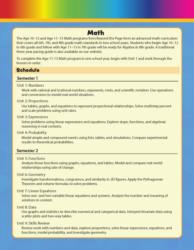
Unit 9: Semester Exams
Lesson 1
Numbers Review
Students identify and write zero-pair equations (for example 9 + (−9) = 0 and 15 + (−15) = 0) and compute sums such as −12 + 7 = −5 in context (hiking, banking, submarine). They solve and interpret addition/subtraction results in real-world scenarios (temperature drop, gaming points, shared debt) and complete problems that require forming and evaluating signed-number expressions. The activity also asks students to create a real-world problem involving rational numbers and to explain their answers, reinforcing use of signed addition/subtraction in context.
Lesson 3
Expressions Review
Students are asked to "Simplify an expression using properties of operations" and to "Use the distributive property to simplify an expression" (Activity 1). The Parent Plan gives the explicit example a + 0.05a = 1.05a, showing combining like terms with a decimal coefficient. Answer keys and problems involve combining terms and simplifying expressions with rational coefficients (e.g., sales tax and cost problems with decimals).
Lesson 5
Semester Exam
Students solve integer addition and subtraction problems (e.g., find the sum of -18 and 27; submarine rises 125 feet from -350) and perform algebraic simplification that uses properties of operations (e.g., rewrite and simplify 4x + 9 + 6x + 1; distribute and simplify 3(y + 5) - y; factor 24m + 12). The answer key and problems require combining like terms, using the distributive property, and factoring, which reflect use of commutative/associative/distributive properties in symbolic contexts.
Lesson 7
Geometry Review
Students apply translation rules such as (x, y) → (x + 3, y − 2) to compute new coordinates, performing addition and subtraction of integers. Students reflect points across axes (for example A(−3, 4) → A'(3, 4)) and describe how x- and y-values change, which requires changing signs and using additive inverses. Students compute scale factors (15 ÷ 6 = 2.5) and multiply side lengths by non-integer factors in dilation problems, using arithmetic with rational numbers.
Lesson 8
Linear Equations Review
Students solve linear equations that include rational-number coefficients and fractions (e.g., (3/5)x = 18 and (2/3)x - 5 = 7) and are instructed to show all steps. Students expand expressions using the distributive property (e.g., 5(2x - 1) = 45) and combine like terms (e.g., 7x - 3x + 4 = 28) when simplifying equations. Students also perform addition and subtraction of numbers as part of isolating variables (adding 5 to both sides, combining constants) while solving equations.
Lesson 10
Semester Exam
Students solve equations that involve adding or subtracting rational numbers (for example problems 28 and 29: (3/5)x = 18 and (2/3)x − 5 = 7) which requires isolating terms by adding or subtracting. Students compute measures such as mean and MAD that require summing decimal or integer data values. Students find slopes and intercepts that require subtracting coordinates and y-values (for example slope from two points).