


Eighth Grade - MATH
3: Math
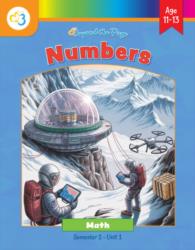
Unit 1: Numbers
Lesson 5
Irrational Numbers
Activity 6 shows students testing decimal guesses (1.4^2 = 1.96 and 1.5^2 = 2.25) to place √2 between 1.4 and 1.5 and then refining to hundredths (1.41^2 = 1.9881). Activity 5 has students identify nearest perfect squares and place square roots on a number line (e.g., √30 between 5 and 6, √50 closer to 7). Activities 3 and 4 require students to use squaring and perfect-square landmarks to compare irrational square roots with integers and to approximate square roots (including practice problems and independent practice to two decimal places).
Lesson 7
Arctic Marine Research
Students are asked to classify specific numbers as rational or irrational in Phase 2, including √2 (as a DNA segment length) and √50 in an environmental-data calculation, and to justify their answers. The answer key and parent plan explicitly identify √2 and √50 as irrational and note understanding decimal expansions (rational numbers have repeating decimals). These tasks require students to identify and reason about irrational versus rational numbers.
Lesson 8
Unit 1 Test
Students are asked to approximate square roots to specified precisions (e.g., approximate √45 to two decimal places; approximate √50 and √75 to the nearest tenth; approximate √10 to the nearest tenth), which requires producing rational approximations of irrational numbers. Students are asked to compare and order irrational roots with decimal numbers (e.g., compare √36, 5.5, and 6.1; compare √49, 6.8, and 7), demonstrating use of approximations to compare sizes. The Parent Plan explicitly states that students should "use rational approximations of irrational numbers to compare the size..., locate them approximately on a number line diagram, and estimate the value of expressions" and gives the √2 truncation example, indicating the intended focus on approximation.
Final Project
Mars Station Test Mission
Students are asked in Task 2 to work "without using a calculator" to determine supply distances that are provided in a square root, and to record those distances to the nearest hundredth of a kilometer. In Task 1 (Drop Zone Radius) students apply the area formula A = πr^2 and compute radii and costs that require using a numeric value for π (answer key shows radii such as 17.83 m and costs computed from areas). The Task 2 answer key shows explicitly computed square-root distances (e.g., 8.37 km, 9.49 km), indicating students produce decimal approximations of square roots as part of their calculations.
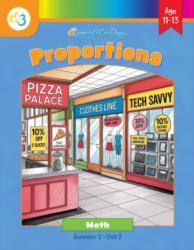
Unit 2: Proportions
Lesson 4
Graphing Proportions
The Skills Review includes problems that require students to compare √5 with 2.2 (answer key gives √5 ≈ 2.236) and to compute/round π² to two decimal places (answer key gives π² ≈ 9.87). The review and other items ask students to classify numbers as rational or irrational (e.g., √10 labeled irrational) and to explain why √2 is irrational (noting a non-repeating, non-terminating decimal expansion). These items show students use decimal approximations and rounding to compare and estimate irrational values.
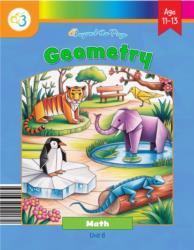
Unit 6: Geometry
Lesson 9
Using the Pythagorean Theorem
Students compute square roots when solving Pythagorean problems and are asked to find numeric lengths that often are nonperfect squares (for example the answer key lists √720 ≈ 26.83, √145 ≈ 12.04, and a cube diagonal ≈ 15.59). The materials permit calculator use and include numeric decimal approximations for distances and 3D diagonals (e.g., grid problems and 3D problems answers give decimals like 6.71, 5.83, 12.04). Students practice producing numerical estimates of square-root results when finding hypotenuses, missing legs, distances on grids, and 3D lengths.
Lesson 10
Volume
Students are repeatedly instructed to use the rational value 3.14 for π (Things to Know; multiple activity instructions). In cylinder, cone, and sphere activities students substitute 3.14 for π and compute numeric volume estimates (examples and student activity pages require using 3.14 and rounding to the nearest hundredth). The design challenge and applied problems require students to calculate approximate numeric values for volumes using that rational approximation.
Lesson 11
Unit 6 Test
Students are asked to perform volume and area calculations using π approximated as 3.14 (e.g., problems asking for radius from a sphere volume or cone volume with the instruction to use 3.14 for π). The answer key and problems show numeric approximations (answers like 3.79 in, 4.47 in, 3 cm) computed using the rational approximation 3.14 for π. Several problems require students to carry out numeric estimates of geometric formulas that depend on π.
Final Project
Abstract Art Gallery
The 3D Sculpture Volume Worksheet directs students to use the value 3.14 for π and to measure radii/diameters and compute volumes for a cylinder, sphere, and cone. Students fill a table with radius, height, and calculated volume and record a total volume for the sculpture. The provided answer key shows numerical volumes computed using π = 3.14.
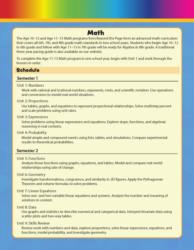
Unit 9: Semester Exams
Lesson 1
Numbers Review
Students classify numbers as rational or irrational (Activity 4 Part 1) and complete tasks that ask them to approximate square roots by identifying the two consecutive integers between which each root lies and indicating which integer it is closer to (Activity 4 Part 4). The answer key explicitly shows students placing √15 between 3 and 4, √20 between 4 and 5, √26 between 5 and 6, and √60 between 7 and 8 and judging proximity to the nearer integer.
Lesson 5
Semester Exam
Students are asked to "Estimate √30 to the nearest hundredth," which requires producing a rational approximation of an irrational number. Students are asked to identify whether a given number (15/18) is rational or irrational, and to compute square roots such as √196, which practices recognizing exact vs. non-exact roots. These items engage students in approximating and classifying numbers related to irrationality.
Lesson 7
Geometry Review
Students are instructed to use 3.14 for π and then compute volumes of cylinders, cones, and spheres (e.g., V = πr²h, V = 1/3πr²h, V = 4/3πr³) and to solve a given sphere volume for the radius using that value. Students write and apply the distance formula (via the Pythagorean Theorem) to find distances between points, which can involve evaluating square roots. The directions explicitly tell students to substitute values and check answers, showing use of a rational approximation for an irrational constant in numerical estimation.
Lesson 10
Semester Exam
Students are asked to use 3.14 for pi in volume problems (Problems 18 and 19), and the answer key gives approximate numeric results (≈113.04 cm^3 and ≈25.12 in^3). These tasks require substituting a rational approximation for an irrational constant and computing an estimated value of an expression that includes pi. The worksheet therefore has students perform numerical estimation using a rational approximation of an irrational number.