


Seventh Grade - MATH
5: Math

Unit 1: Operations
Lesson 2
Multiplication Review
Students are taught and practice the distributive property (a(b + c) = ab + ac) and use it to explain the standard algorithm for multiplication (e.g., 46 × (20 + 7) = (46 × 20) + (46 × 7)). Students solve multiple real-world multiplication problems with rational numbers (decimals and whole numbers) such as costs of uniforms, area of a plot, wages, and weight of candy, interpreting products in context. Students also practice multiplying decimals and powers of ten and create foldables and activity pages that reinforce using properties to compute products.
Lesson 8
Unit 1 Test
Students complete vocabulary and matching items that define and identify the distributive property and other properties of operations. Students practice using the distributive property in tasks that ask them to write undistributed form and to factor sums (e.g., factor 84 + 120, 48 + 64) and to model distributed/undistributed forms with grids. Students solve multiple real-world multiplication problems (shipping boxes, flower beds, snack bags, packs of items) that require computing and interpreting products of whole numbers and decimals.
Final Project
Planning a Party
Students compute products and quotients with decimals and whole numbers to find package counts and total costs (e.g., 3 × $4.80 = $14.40) and calculate cost per goody bag by dividing the grand total by 12. Students are explicitly asked to use the distributive property to show totals of items (example: 12(5 + 3) = (12×5)+(12×3) = 96 items). Students interpret products in real-world contexts repeatedly by converting numbers of items and package prices into total costs and budget comparisons (subtracting totals from the $50 budget).
Unit 2: Integers and Rational Numbers
Lesson 2
Fraction Multiplication
Students practice multiplying fractions, mixed numbers, and whole numbers using the standard algorithm (multiply numerators, multiply denominators, simplify) and convert mixed numbers to improper fractions to multiply. Students solve and interpret several real-world problems involving products of rational numbers (e.g., 2/3 of 6 pounds, pizza portions, biking distance, area of a room). The lesson also has students use the commutative property to recognize order does not affect fraction×whole-number problems.
Lesson 8
Unit 2 Test
Students compute products of fractions and mixed numbers in multiple problems (for example, 5/8 × 3/10; 3/5 × 2/3 × 7/12; and multiplying mixed numbers to find area such as 4 1/2 × 2 2/3). Students solve real-world multiplication problems by finding areas and totals in word problems (e.g., area of a rectangular stand and canvas, and total driving/practice time by adding mixed numbers where multiplication appears in area contexts). The Parent Plan explicitly lists that students should "fluently add, subtract, multiply, and divide fractions and mixed numbers" and "solve real-world and mathematical problems involving the four operations with rational numbers."
Unit 3: Ratios and Percentages
Lesson 4
Unit Rates
Students find and compute unit rates and unit prices using fractions and decimals (e.g., $5.25 ÷ 3 = $1.75 per quart) and then multiply those unit rates by quantities to find totals (e.g., $1.75 × 5 = $8.75; 13 calories per chip × 25 chips = 325 calories). Students use both division and multiplication with rational numbers in real-world contexts (prices, distances, calories) and solve scaled ratio problems (e.g., 32 loaves in 4 days → 8 loaves/day, then 8 × 10 = 80). The activities require forming equivalent ratios and using multiplication to extend a unit rate to find amounts for different quantities.
Lesson 7
Unit Conversions
Students set up and use equivalent ratios and double number lines to compute products for unit conversions (e.g., 3 quarts × 2 = 6 pints; 19 cm × 10 = 190 mm; 5 oz × 28.35 ≈ 141.75 g). The activities require students to multiply whole numbers and decimals to scale unit ratios (examples and answer key show multiplication by 12, 1000, 2.54, 28.35, etc.). Students solve real-world measurement problems by forming and evaluating products that convert quantities from one unit to another.
Final Project
What's the Best Buy?
Students set up ratios and compute unit prices by dividing price by quantity (for example, $3.38 ÷ 13 oz = $0.26/oz) and multiply counts by unit sizes (for example, 12 × 8 = 96 fl oz) to find comparable quantities. Students use equivalent ratios and dimensional analysis to convert units (gallons → quarts → pints → cups → fl oz) and to convert prices into other currencies by multiplying by conversion factors. Students scale quantities in recipes (doubling/tripling) and compute cumulative savings by multiplying differences over time, interpreting these products in real-world shopping contexts.
Unit 4: Algebraic Expressions
Lesson 6
The Distributive Property
Students model and apply the distributive property with numerical and variable expressions using real-world contexts such as area (Penny's Pet Palace and Brandon's playground) where they write 5(4+8) and 5(n+2) and show equivalence to (5·4)+(5·8) and 5n+10. Students use area and cost word problems to interpret products (e.g., 2n+3n → 5n for total cost) and they practice expanding and simplifying expressions using the distributive property (examples: 4(x+5)=4x+20, and 5(x+3)+2x-9 → 7x+6). Students evaluate expressions by substituting real-number values to prove equivalence of original and simplified forms.
Lesson 7
Unit 4 Test
Students practice and identify the distributive property with problems such as 7(x + 4) = 7x + 28 and 12(x + 6) rewritten as 12x + 72, and they use area-model prompts that connect multiplication to expressions (e.g., 3(n + 5), 3n + 15). Students evaluate products involving rational numbers through exponent problems like (2/3)^2 and (0.2)^3, showing repeated multiplication of rational numbers. Students interpret products in real-world contexts by writing and evaluating multiplication expressions for scenarios such as Zane's pay (12n + 5), Jeremiah's earnings (5x + 3), and Alana's beads (12(x + 6)).
Final Project
Algebra Think-Tac-Toe
Students practice and apply the distributive property when simplifying expressions (Prove It! examples show using a(b + c) = ab + ac and step-by-step distributive steps). The Math Properties Trading Cards activity requires students to create examples and explanations for the distributive, commutative, and associative properties. The unit also has activities and rubric items that require students to work with positive and negative numbers in real-world word problems and to combine like terms with positive and negative coefficients.
Unit 5: Algebraic Equations
Lesson 4
Solving Two-Step Equations
Students use the distributive property to rewrite expressions with parentheses (for example, 3(n - 4) → 3n - 12) and then solve the resulting two-step equations. Students solve equations with fractional and decimal coefficients by multiplying by reciprocals or dividing (examples include solving (2/3)n - 2/5 = 1/10 and n/4 + 12 = 20). Visual models and worked examples show students applying inverse operations and the distributive property when simplifying and solving equations.
Lesson 6
Solving Inequalities
Students solve inequalities by multiplying or dividing both sides by integers and fractions (for example, students solve n/3 ≤ 1 by multiplying both sides by 3, and solve (2/3)p ≥ 4 by multiplying both sides by the reciprocal 3/2). Students write and solve word problems that use multiplication in context (for example, "He tripled his number of chickens" is turned into 3n − 5 ≥ 22 and solved). Activity problems require students to manipulate coefficients and interpret solutions in real-world contexts (e.g., 5n ≤ 75 for weekly earnings).
Lesson 8
Unit 5 Test
Students apply the distributive property when solving equations such as 2(y + 1/2) = 13 and 3(y − 4) = 6, with solutions showing rewriting to 2y + 1 = 13 and 3y − 12 = 6. Students solve equations that require multiplying both sides by a rational number (e.g., n/3 = 4, a/7 = 14) and work with fractional and decimal coefficients (e.g., x − 2.4 = 7.6). Several word problems use multiplication by positive scalars (e.g., rides cost three times as much as games) so students set up and solve multiplication equations with rational numbers.
Final Project
All About Me
Students are asked to create equations that include multiplication and division (e.g., requirements: "1 equation with multiplication or division," "Include one example of each operation"), and sample problems use multiplication in real contexts (for example, 2x = y to represent practicing piano twice as long as soccer, and 3x − 4 = 56). The project requires at least one equation with a fraction or decimal and two-step problems that may involve multiplication, so students set up and solve multiplicative equations and interpret at least one product in a real-world scenario.
Unit 6: 2D Geometry
Lesson 4
Area
Students repeatedly multiply lengths and widths to find areas (e.g., A = l × w for rectangles and A = 1/2 × b × h for triangles). Students apply multiplication of fractions and mixed units in real-world problems (e.g., converting feet to inches and computing how many 6 in × 4 in pavers fit in a 10 ft × 3 ft walkway). Students set up and solve multiplicative equations in context (e.g., 24n = 4320 to find the number of pavers) and use multiplication and division to interpret area-related quantities like number of seed packages.
Lesson 6
Scale Drawings
Students set up and use scale-factor ratios (e.g., 8 cm/2 m, 1/3 = x/18) and compute unknown linear measures by multiplying fractions and whole numbers. Students convert scale-factor fractions to percentages (e.g., 3/1 → 300%, 1/4 → 25%) and use percent multipliers (e.g., 200% × dimension) to compute enlarged dimensions. Students compute how area changes by squaring the scale factor (e.g., show area increases by factor 4 when linear scale factor is 2).
Unit 7: 3D Geometry
Lesson 5
Problem Solving With Solids
Students multiply with fractions and mixed numbers to compute area, surface area, and volume in real-world contexts (e.g., using V = l × w × h with a 1 1/2 ft height in the toy box surface-area calculation and converting 4 1/2 to 9/2 when solving 54 = L × 4 1/2 × 2). Students set up and solve algebraic equations that include fractional coefficients to find missing dimensions (e.g., 54 = L × 9 leads to L = 6). The Skills section explicitly lists applying V = l × w × h and V = b × h to find volumes of right rectangular prisms with fractional edge lengths.
Lesson 6
Unit 7 Test
Students set up and compute products of rational numbers when using formulas V = l × w × h and V = B × h with fractional edge lengths (parent plan skills). The answer key and problems include explicit fractional multiplications (for example V = 3/4 × 1/2 × 4 4/5 = 1 4/5) and use decimals and mixed numbers in surface area and volume calculations. Students solve real-world context problems that require multiplying positive rational numbers (e.g., paint coverage, decorative paper, and box surface area).
Unit 9: Skills Review
Lesson 2
Fractions, Ratios, and Coordinates
Students solve multiple problems that require multiplying fractions and mixed numbers (e.g., 1/2 × 3/5 × 5/8, 2 5/6 × 4 4/5) and apply multiplication in real-world contexts (e.g., finding the area of a rug 6 2/3 × 3 1/2 and computing earnings 10 1/8 × $16). The activities include space for students to compute, simplify, and interpret these products in context. The ratio and rate tasks also have problems (e.g., necklaces per minutes, speed) that require students to use multiplication and division to interpret quantitative relationships.
Lesson 3
Expressions, Equations, and Percentages
Students expand and simplify expressions using the distributive property (e.g., Problem 4: 3(n + 6) + 4n - 10 is expanded and simplified to 7n + 8). The skills list explicitly names applying properties of operations to generate equivalent expressions and to expand linear expressions with rational coefficients. Students also evaluate expressions at specific values and manipulate coefficients and terms in several practice problems.
3: Math
Unit 1: Numbers
Lesson 1
Positive and Negative Rational Numbers
The lesson explicitly links sign rules to the distributive property in Activity 2, and students are asked to explain (-3)×(-4) using the distributive property or a number line. Day 3 gives multiple problems where students multiply negative fractions and decimals in real-world contexts (temperature drop, submarine descent) and complete practice problems applying the same sign rules. The Parent Plan Skills section explicitly states students will understand the extension to rational numbers and even mentions products such as (-1)(-1)=1.
Lesson 2
Fractions and Decimals
Students are asked about and practice multiplying signed numbers on the Review Quiz (e.g., "What is the rule for multiplying a negative number by a negative number?" and "What is the product of (-3) x (-4)?"). Students solve a contextual multiplication problem that yields a negative product (temperature drops 2.5°F per hour for 6 hours → -15°F), which requires interpreting a product in a real-world context. The lesson also includes integer addition/subtraction contexts (scuba diver) that reinforce signed-number reasoning.
Lesson 4
Square and Cube Roots
Students practice operations with positive and negative numbers in the Review Quiz (e.g., problems asking for -4 × 6 and -24 ÷ 4) and the answer key explicitly shows (-4) × (-6) = 24. Students solve real-world multiplication problems in Activity 3 that require computing products (for example, 5 × 4^4 and 500 × 3^3) and they practice using a calculator for positive and negative exponents. The materials include exercises where students compute products and apply multiplication in contextual word problems.
Lesson 5
Irrational Numbers
Students complete practice problems that require multiplying rational numbers, including a specific problem multiplying (-2/3) by (3/5) on the review quiz and related items involving negatives and exponents in the answer key. The materials include worked answers for multiplying rational values (e.g., the simplified product (-2/5)) and use negative numbers in applied contexts (scuba diver position, temperature change).
Lesson 8
Unit 1 Test
The Parent Plan explicitly states that students should "Understand that multiplication is extended from fractions to rational numbers... particularly the distributive property, leading to products such as (-1)(-1) = 1 and the rules for multiplying signed numbers." The Introducing the Lesson section reiterates that students should "Multiply fractions and other rational numbers (positive and negative) and understand why the rules work (For example, why does (-1) × (-1) = 1?)." Student activities ask learners to compute and explain products of signed numbers (e.g., -4 × -3; (-5) × (-2)) and to solve real-world fraction multiplication problems (e.g., doubling 0.25 cups, tripling 0.125 cups).
Final Project
Mars Station Test Mission
The Parent Plan Skills list explicitly names the target: it tells students to "understand that multiplication is extended from fractions to rational numbers... particularly the distributive property... leading to products such as ((-)1)((-)1) = 1 and the rules for multiplying signed numbers." Students perform multiplications in real contexts: Task 3 uses 7 × 10^2 kWh (converted to 700 kWh) and students multiply to find fuel cells and room area. Students also compute costs and areas (A = πr^2) and work with negative temperatures when calculating temperature differences for energy needs.
Unit 2: Proportions
Lesson 2
Unit Rates
Students practice multiplying and dividing positive fractions when they simplify complex fractions using Keep-Change-Flip (for example 3/4 ÷ 1/2 rewritten as 3/4 × 2/1 and simplified to 3/2). Students use multiplication of unit rates to scale quantities in real contexts (for example 0.5 cups per person × 10 people = 5 cups; 30 miles per gallon × 15 gallons = 450 miles). Students perform fraction multiplication in several word problems and activity pages that connect products of rational numbers to recipes, distance/time, and rates.
Lesson 5
Proportional Relationship Equations
Students represent and compute products of positive rational numbers in real-world contexts by writing and using equations such as t = p·n, t = c·m, and a = r·h for costs, calories, distance, and area. Students compute unit rates and multiply fractions and decimals in context (e.g., finding run speed from 3/4 miles in 1/2 hour, using 0.75×original price for a 25% discount). Students complete tables and problems that require multiplying a constant rate (k) by a quantity to interpret total cost, total calories, distance, or scaled size.
Lesson 6
Taxes, Tips, and Commissions
Students repeatedly convert percent rates to decimals and multiply by amounts to find taxes, tips, and commissions (e.g., 15% of $50 as 50 × 0.20 = 10 and 15,000 × 0.07 = 1,050). Students set up and solve equations that use multiplication of rational numbers in context, including forward and backward problems (e.g., 1.08x = 212 to find pre-tax price, 0.20 × I = 9,000 to find income). Students interpret the product of a rate and an amount in real-world contexts such as sales tax, gratuity, and commission (Commission = Sales Amount × Commission Rate; Tip = Tip Percentage × Bill).
Lesson 7
Markups and Discounts
Students routinely compute products of rational numbers when they convert percentages to decimals and multiply by prices (examples: 50 × 0.30 = 15; 100 × 0.20 = 20) to find discount or markup amounts. Students apply these products in real-world contexts—calculating discounts, markups, stacked discounts, and selling prices—on multiple activity pages and examples. Problems require students to multiply cost or original price by a fractional/decimal percent to produce dollar amounts and then interpret those products as amounts saved, added, or final prices.
Lesson 8
Simple Interest and Percent Error
Students convert percent rates to decimals and multiply rational numbers when they apply the simple interest formula I = P × r × t (examples show calculations like 600 × 0.04 × 5 = 120). Students compute balances by adding principal and the product (interest) and solve for missing values (rate, time, principal) using multiplication and division. Students also multiply a decimal by 100 to compute percent in percent-error problems (e.g., 0.1667 × 100 = 16.67%).
Final Project
Lemonade Stand
Students set up and use linear equations of the form y = kx (e.g., y = 2x for lemon juice and y = 1.5x for sugar) to scale recipes, directly multiplying fractional and decimal unit rates by quantities. Students calculate costs by multiplying unit prices by quantities (number of lemons, pounds of sugar) and compute markups (selling price = unit price × 2, 2.5, or 3) and percentage adjustments (30% discount as ×0.7; sales tax and gratuity as ×0.07 and ×0.15). Students create tables and graphs that represent these multiplicative relationships and interpret the numeric products in real-world contexts like cost per cup.
Unit 3: Expressions
Lesson 1
Equivalent Expressions
Students apply the Distributive Property through a bake-sale example (3 × (2 + 4) = (3×2) + (3×4)) and practice expanding and simplifying expressions using distribution on multiple student activity pages. Students repeatedly use properties of operations (Commutative, Associative, Distributive) to rearrange, expand, and combine like terms in algebraic expressions. Several activities require students to distribute numeric coefficients across sums and then combine like terms (e.g., 2(n+4)+3n → 2n+8+3n → 5n+2).
Lesson 2
Rewriting Expressions
Students rewrite expressions using the distributive property (A(1 + B) = A + AB and the reverse A + AB = A(1 + B)) when they convert selling-price and markup formulas into one-step forms. Students set up and compute products of rational numbers (decimals like 1.05, 0.75, 1.50) with prices to find totals for sales tax, discounts, and markups. Students also use the distributive property explicitly when solving for unknowns (e.g., 48.75 = 65(1 − D) leading to 48.75 = 65 − 65D).
Lesson 3
Algebraic Expressions
Students practice and use the Distributive Property explicitly (Things to Know; Activity 1 factoring examples) and apply distribution when solving equations such as 2(l + w) = P and 3(x + 2) = 11 (Activity 2 and Activity 3). Students set up and solve word-problem equations that use multiplication of quantities (s = r(m + t), t = cp + s) and obtain rational answers including fractions and negative rational solutions (answer keys show solutions like x = 7/2 and x = -1/3).
Final Project
Planes, Trains, and Automobiles
Students set up and use linear equations of the form y = mx and y = mx + b (for example y = 0.15x + 31.50) and multiply decimals and rates by distances to compute total cost and travel quantities. Students compute products such as cost-per-mile × miles and use percentages (a + 0.05a = 1.05a) to rewrite expressions, and they graph slopes that represent unit rates (m). Students solve contextual problems that require forming and evaluating products of rational numbers to find totals (costs) and rates (distance = rate × time).
Unit 4: Probability
Lesson 2
Observing Probability
Students calculate experimental probabilities as fractions, decimals, and percents and then compute predictions using the formula Prediction = Experimental Probability × 600 (example: 0.59 × 600 = 354). The activity pages require students to convert counts out of 100 into decimal probabilities and to multiply those decimals by 600 to produce predicted counts, and the examples explicitly show these multiplications in a real-world spinner context.
Lesson 3
Probability Models
Students repeatedly compute products of fractions (probabilities) and whole numbers to make predictions: examples include 1/2 × 500 = 250 (coin flips), 1/3 × 90 = 30 (marble draws), and 1/6 × 120 = 20 (die rolls). Activity pages and examples ask students to multiply a probability (a fraction or decimal) by the number of trials to get an expected count (e.g., 75 × 1/2 = 37.5). The lesson asks students to build probability models and use those fractional probabilities in real-world contexts to predict outcomes.
Unit 5: Functions
Lesson 1
What Is a Function?
Students work with operations that produce rational outputs (examples: y = (x+3)/2, y = x/5 + 2, y = 1/4 x - 2) and complete tables using division by 2, 4 and other rational operations. Students compute with negative inputs and multipliers (examples: multiplying by -1 in y = -x + 6, squaring negative numbers such as (-2)^2) and fill input/output tables and graphs that require evaluating those products. Several exercises require students to perform multiplication and to calculate outputs from rules like "multiply by 2, add 6," giving practice with products of numbers including negatives and fractions.
Lesson 5
Slope
Students use the distributive property when they expand expressions such as y + 2 = -2(x - 3) to get y + 2 = -2x + 6, which requires multiplying a negative coefficient by a negative constant. Students perform arithmetic with negative numbers when calculating slopes (for example m = (16 - 2)/(-3 - 4) and slope = -2) and when identifying positive, negative, zero, or undefined slopes from point pairs, tables, and equations. The slope-from-equation activity has students rearrange standard-form equations and distribute factors, showing multiplication of signed integers in algebraic contexts.
Lesson 7
Creating Functions
Students write and use function rules that multiply inputs by rational numbers in real contexts (e.g., F = 0.5s, Su = 0.5s, M = 0.33s in the cooking activity and y = 0.25x in Graph 2). Students identify and work with negative slopes as multiplicative rates in contextual problems (e.g., S = −3f + 30, P = −2s + 50, B = −5h + 100) and interpret those negative rates as decreases in quantity. Students compute slope using the slope formula and substitute the slope (a rational number) into equations (e.g., C = 3h + 5), showing practice multiplying inputs by rational coefficients.
Unit 6: Geometry
Lesson 6
Dilations
Students repeatedly multiply coordinates and side lengths by given scale factors (e.g., 2, 0.5, 2.5, 0.25, 0.33) when performing dilations and complete problems using the equation new = original × scale factor. Students set up and solve for scale factors using division (scale factor = new ÷ original) in the "Solving for Unknowns" activities. Students interpret positive scale factors in a real-world context (the flowers time-lapse) as multiplying sizes by a rational number.
Lesson 7
Sequences of Transformations
Students perform dilations by multiplying both x and y coordinates by given scale factors (examples shown: 2, 1.5, 0.5, 0.25, 2.5), so they practice multiplying by rational numbers to scale shapes. Students apply rotation and reflection rules that change coordinate signs (for example the rotation rule (x,y) → (y, -x) and reflections across axes), exposing them to multiplication by -1 in coordinate changes. Students use these products in worked examples and activity problems to compute new coordinates and interpret how multiplication changes size and position of figures.
Lesson 10
Volume
Students multiply by fractional factors (1/3 and 4/3) when using V = (1/3)πr^2h and V = (4/3)πr^3 and compute those products with π and powers of r in multiple real-world problems (paint can, snow cone, sphere). Students set up and evaluate products of rational numbers expressed as decimals (using 3.14 for π) and use those products to determine volumes in context (e.g., how much soup or paint fits). Students also interpret those numeric products as measures of physical quantity (cubic units) and apply them to design tasks (Flavor Frenzy) and party-planning applications.
Unit 7: Linear Equations
Lesson 2
Multi-Step Equations
The lesson repeatedly teaches and has students use the distributive property (Things to Know: a(b+c)=ab+ac) and includes multiple guided examples and practice problems that require distributing factors through parentheses (e.g., 4(y+2)=16, 3(a+m)=…, 0.5(6y−4)+3y=12). Students solve real-world problems that interpret products of rational numbers as rates or repeated groups (e.g., 3c for cost per pound, 4(y+2) bakers, $8.75 per guest, 1.5 miles per day). Several practice items include negative coefficients and parentheses (e.g., -3(a+m), -6x + 8 - 4 = …) which require students to distribute and combine signed terms.
Lesson 4
Multi-Step Word Problems
Students solve linear equations that include rational-number coefficients and expressions requiring the distributive property (e.g., 5(2 - 3x) = 2x - 10 and 6(b + 2) - 3b = 15). Students set up and solve real-world multiplication situations such as $0.30 per mile × miles, $7 per GB × GB, and monthly fees × months, interpreting those products as quantities in context. The Parent Plan explicitly states students will solve equations whose solutions require expanding expressions using the distributive property and collecting like terms.
Lesson 8
Linear Algebra In the Wild
Students solve equations with rational coefficients and are prompted to expand expressions using the distributive property in the skills list. In problems students multiply an entire equation by -2 (elimination in the Candy Shop example) and divide by negative numbers (dividing by -4 to solve for x). The break-even activities use Total Cost = Rate × Quantity + Fixed Amount, so students multiply rational rates by quantities in real-world contexts.
Lesson 9
Unit 7 Test
Students solve equations that require using the distributive property (for example problems like 4(2x - 3) = 20 and multi-step equations that instruct to expand and combine like terms). Students also solve equations with fractional coefficients and use reciprocals to isolate variables (for example problems such as (3/4)x = 12 and instructions to multiply both sides by reciprocals). The skills list and practice problems repeatedly require multiplying by constants and fractions as part of solving linear equations.
Final Project
Getting Ready for College
The Parent Plan explicitly lists that students "solve linear equations with rational number coefficients, including equations whose solutions require expanding expressions using the distributive property and collecting like terms," so students are asked to manipulate expressions that use the distributive property. In the Phone Plans activity students simplify Plan B (y = (10x + 40)/2) to show algebraic equivalence, demonstrating manipulation of rational coefficients. Several activities require writing and solving linear equations with rational coefficients (e.g., costs with decimals and fractional rates), giving students practice with arithmetic on rational numbers in algebraic contexts.
Unit 8: Data
Lesson 4
Linear Models
Students identify and use slopes that are negative and compute products when evaluating linear models (for example, y = -6×5 + 180, y = -3(5) + 60, y = -10×3 + 100 appear in answer keys and worked examples). Students write equations in y = mx + b form from scatterplots and interpret slope signs in real contexts (e.g., 'Slope (–6): For every hour the car drives, 6 liters of fuel are used'). Several activities ask students to substitute numerical x-values into equations with negative slopes to produce numeric products and predictions.
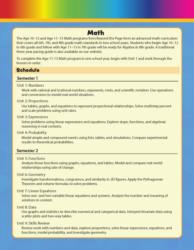
Unit 9: Semester Exams
Lesson 1
Numbers Review
Students practice multiplying and dividing positive and negative integers in the Sign Rules Control Room (e.g., 4 × (−6), (−3)(−5)) and are asked to explain why the sign of an answer makes sense. Students solve and interpret real-world products such as −2.5 × 6 = −15 (temperature drop), −45 ÷ 9 = −5 (points lost per round), and −72 ÷ 6 = −12 (debt per person). Students are asked to create a realistic real-world problem that uses multiplication or division with a fraction or decimal, solve it, and explain the meaning of the result (Mission 4).
Lesson 5
Semester Exam
Students are asked to multiply signed integers in problem 2: "Multiply (-6)(-4). Is the product positive or negative? Why?" with the answer key stating the product is positive because a negative times a negative is positive. Students complete distributive-property tasks such as "Distribute and simplify: 3(y + 5) - y" and factoring tasks like "Factor completely: 24m + 12," which require using and reversing the distributive property. These items give students practice with sign rules and with applying the distributive property to simplify expressions.
Lesson 8
Linear Equations Review
Students expand and simplify expressions using the distributive property (for example 5(2x - 1) = 45) and combine like terms (for example 7x - 3x + 4 = 28) while solving linear equations. Students solve equations that involve fractions, including problems like (3/5)x = 18 and (2/3)x - 5 = 7, and are directed to resources on using reciprocals to isolate variables. Students set up and solve real-world multiplicative situations (e.g., 15 dollars per month, $2 per mile) translating rates into equations and computing positive products to find quantities.
Lesson 10
Semester Exam
Students solve equations such as 5(2x − 1) = 45, which requires applying the distributive property to multiply across parentheses. Students solve fractional equations like (3/5)x = 18 and (2/3)x − 5 = 7, which requires multiplying both sides by rational numbers. Students model real-world multiplication in context by writing y = 10x for $10 per hour and setting up 18h + 30 = 138 for a tutor charge, showing use of multiplication with rational factors.