


Eighth Grade - MATH
3: Math
Unit 2: Proportions
Final Project
Lemonade Stand
Students create tables of cost data for multiple stores and plot a line for each store with number of lemons on the x-axis and total cost on the y-axis. Students write equations modeling proportional relationships in the form y = kx for recipe scaling (lemons and sugar) and calculate unit rates for prices. Students compare lines on the graph by steepness and use the graphs to decide which store offers better value at different purchase sizes.
Unit 3: Expressions
Lesson 8
y = mx + b
Students practice writing lines from two points (Activity 5 and Activity 6) by calculating slope with m = change in y / change in x and solving for b using y = mx + b. Students graph multiple lines on the same coordinate plane in several activities (Activity 1, Activity 2, Activity 3, Activity 4) and compare their positions, slopes, and y-intercepts. Students also convert equations into slope-intercept form and plot lines from equations, giving repeated practice plotting pairs of lines together.
Final Project
Planes, Trains, and Automobiles
Students write linear cost equations for car, train, and plane in the form y = mx + b (e.g., y = 0.15x + 31.50 and y = 0.20x + 20.75). They graph these cost lines on the same coordinate plane and are explicitly instructed to set two cost equations equal to find the break-even point (0.15x + 31.50 = 0.20x + 20.75) and solve for x (x = 215). The materials ask students to interpret which method becomes cheaper beyond that intersection point, connecting the algebraic solution to the real-world context.

Unit 5: Functions
Lesson 8
Comparing Functions
Students compute slopes and starting values from equations, tables, and graphs (e.g., finding Bella's slope from points (0,0) and (30,2); finding Jordan's slope and y-intercept from y = -3x + 100; finding Taylor's slope from a table). Students compare pairs of linear functions across representations to decide which changes faster or which starts higher. Students interpret graphs that show two lines and answer questions about when values are equal (e.g., "When do both gym memberships cost the same?" and "When are both riders at the same location?").
Unit 7: Linear Equations
Lesson 4
Multi-Step Word Problems
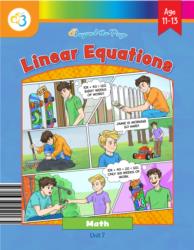
Students set two linear expressions equal in multiple problems (e.g., Lena and Mia: 25 + 7x = 10 + 8x; phone-plan and mowing/weeding comparisons asking after how many hours earnings are equal). The answer key and activity prompts show students writing and solving equations like 15x + 30 = 10x + 60 and 25 + 7x = 10 + 8x. The comic-strip and comparison problems explicitly ask students to find the point at which two cost expressions are the same.
Lesson 5
Intersection and Graphing
Students graph pairs of linear equations on coordinate planes and identify the point of intersection as the solution (Activities 1–5, multiple student pages show equations graphed and labeled intersection points). Students convert equations into slope-intercept form to compare slopes and intercepts to determine one, none, or infinite solutions (Activity 6 and multiple 'How Many Solutions?' pages). Students substitute a found coordinate into both equations to verify it satisfies both (examples show substituting (1,3) and (1,-2) to confirm solutions).
Lesson 6
Substitution and Elimination
Students learn and practice solving systems of two linear equations using graphing, substitution, and elimination, with step-by-step examples (e.g., substitution examples producing (2,3) and (2,4), elimination examples producing (4,0)). Students graph pairs of equations to estimate intersections (activity with 3x - 2y = 7 and x + y = 4 showing (3,1)) and use Desmos to find intersection coordinates. Multiple student activity pages give numerous mathematical systems to solve algebraically and graphically, and students practice choosing an appropriate method.
Lesson 7
The Point of It All
Students graph lines given two points (Activity 2 and multiple Student Activity Pages) by plotting point pairs, writing equations in slope–intercept form, and estimating intersection points (for example, identifying (1,4) or (2,4)). Students set up equations from two given points, compute slopes, write y = mx + b, and then solve the resulting pair of linear equations algebraically using substitution and elimination (Activity 3 and the Intersection Challenge problems). The review quiz and mixed-practice pages require students to solve systems by substitution, elimination, and graphing and to determine whether systems have one, none, or infinitely many solutions.
Lesson 8
Linear Algebra In the Wild
Students repeatedly define two variables, write two linear equations, and solve the systems by substitution or elimination in real-world contexts such as the Dog Walkers and Candy Shop examples, the multiple student activity word problems (earnings, prices, ticket sales, animals), and break-even scenarios (Cleaning Crew and Streaming Showdown). Student work is organized with a four-step flowchart (define variables, write system, solve, conclude), they carry out algebraic solution steps (combine like terms, isolate variables, substitute) and often interpret solutions as coordinate pairs or break-even points. Multiple activity pages require students to set up and solve systems and to state conclusions that compare options based on the solution.
Lesson 9
Unit 7 Test
Students are given multiple problems that require forming and solving two linear equations in two variables: Problems 14–19 ask students to solve systems by substitution and elimination. Problems 24 and 25 (in several versions) ask students to find each line's equation from two given points and then solve the system or classify the solution as one/none/infinite. Problem 23 presents a real-world ticket-cost scenario that leads to two linear equations in two variables, and answer keys and images show intersection points and parallel/no-solution cases.
Final Project
Getting Ready for College
Students set up and solve pairs of linear equations in multiple real-world contexts: housing (C = 1200m and C = 1500 + 1050m), transportation (C = 225 + 0.60x and C = 1.25x), streaming (C = 20 and C = 5 + 1.5h), meal plans (write equations from graph), and phone plans (y = 5x + 20 and y = (10x + 40)/2). The Transportation activity explicitly directs students to solve the system using both substitution and elimination. Students graph both equations in each task, identify intersection points as break-even points, and use the graphs to confirm algebraic solutions. The phone-plan task has students simplify and compare two equations to recognize they represent the same line (infinitely many solutions).
Unit 9: Semester Exams
Lesson 8
Linear Equations Review
Students set up and solve systems from real-life contexts in Activity 4 (e.g., ticket sales and carnival tickets) by defining variables, writing two linear equations, solving them, and interpreting the answers. Students practice solving systems algebraically and graphically in Activity 3, using graphing, substitution, and elimination and identifying intersection points as solutions. Students also find slopes from two points and graph lines in Activity 2, connecting pairs of coordinates to equations of lines.
Lesson 10
Semester Exam
Students are asked to solve systems of two linear equations by graphing (Problem 32: y = x + 2 and y = -x + 6, with intersection (2, 4) shown), by substitution (Problem 33: y = x + 3 and 2x + y = 15), and by elimination (Problem 34: 3x + y = 14 and -3x + y = 2). The exam provides spaces for graphing and asks for the intersection point for the graphing problem, so students practice finding the solution of two linear equations in two variables using standard algebraic and graphical methods.