


Ninth Grade - ELA
1: Semester 1

Unit 1: Lord of the Flies
Lesson 8
Defects of Human Nature
Students complete two vocabulary activities that require working with specific words from Lord of the Flies: one activity asks students to match bolded vocabulary words in sentences to definitions, and another asks students to fill blanks by choosing words from a provided word bank. The lesson also lists that students should "know the definitions" of a set of advanced words and includes word banks and answer keys showing correct word forms.
Final Project
Now You Have the Conch
Students are instructed to edit and proofread as a final step (Activity 7), with the lesson explicitly stating that editing/proofreading involves fixing errors in grammar, spelling mistakes, and other sentence-level mechanical errors. The checklist and homework steps require students to "Proofread" and "read through it to catch any typos" before turning in a typed, printed essay. The rubric's "Grammar and Mechanics" criterion expects correct use of grammar and punctuation, implying attention to sentence-level accuracy during final drafts.
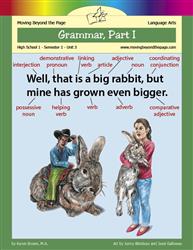
Unit 3: Grammar, Part I
Lesson 2
Subject-Verb Agreement
Students read and record the first several groups of commonly confused words (e.g., a/an; a lot/alot/allot; accept/except; adapt/adopt; advice/advise) and are instructed to copy notes and examples on the "Commonly Confused Words" activity pages. Students complete multiple activity pages that require them to circle the correctly spelled word in sentences (Sets I–VII and Commonly Confused Words, Set I and II). The Subject-Verb Agreement and Commonly Confused Words activities provide answer keys so students can check and correct their responses.
Lesson 4
Commas
Students read and take notes on a set of commonly confused words (all together/altogether, alumni/alumnae/alumnus/alumna, allusion/illusion, altar/alter) and complete an activity page where they circle the correctly used word in sentences. The Parent Plan lists demonstrating command of spelling as a listed skill. Students check their answers against an answer key, reinforcing recognition of correct word forms and spellings for those specific items.
Lesson 5
Review
Students are asked in Part I of the Grammar Quiz to cross out commonly confused words used incorrectly and write the correct word above them, which requires them to produce correct word forms and spellings (e.g., correcting "advise" to "advice," "alot" to "a lot," and "a hour" to "an hour"). The Answer Key for Part I and for Parts II and III shows corrected spellings and word forms, and the homework activity requires students to choose the correct word forms (e.g., among/between, bad/badly, bear/bare), reinforcing correct orthography in context.
Lesson 6
Colons and Semicolons
Students read and take notes on specific commonly confused word pairs (breath/breathe, can/may, capital/capitol, coarse/course) and complete the "Commonly Confused Words, Set V" activity page, circling the correctly used word in each sentence. The lesson gives explicit spelling-related tips for students (e.g., "Breathe (breeth) ends with an 'e'" and "Remember that 'cannot' is one word"). Students are directed to record examples and check answers with an Answer Key, which requires them to recognize correct word forms in context.
Lesson 7
Spelling
Students complete focused spelling exercises such as the 20-item "SPELLING" worksheet and multiple "Commonly Confused Words" activity pages (Sets VI and VII) with answer keys to check work. Students are taught and practice explicit strategies for correct spelling (Read–Say–Copy, mnemonics, spelling journal/highlighted lists) and are directed to read pp. 9–15 of the referenced book for rules. Students also participate in the Spelling Detective activity where they write the correct spelling, underline tricky parts, create clues/mnemonics, spell aloud, write words, and correct misspellings by rewriting them three times.
Final Project
Wrapping Up
Students take a unit test that includes a Part II 'Commonly Confused Words' section requiring them to choose the correct word/spelling (examples: desert/dessert, capital/capitol, complement/compliment). Students are instructed to review and keep their 'Commonly Confused Words' pages and to use those pages when creating a short quiz in Mini-Project Option 2. The answer key provides correct spellings for the test items, and students are asked to assess others' answers and explain missed words.

Unit 4: Poetry
Lesson 9
The Crossover
Students are given a vocabulary list that shows words broken into syllables (e.g., "cross-o-ver," "ca-lam-i-ty," "pul-chri-tu-di-nous") and prompted to compare how the words and definitions appear in the book versus a dictionary. Students are asked to explain differences between the book and dictionary definitions and to use one word as an example of how the book's method aids understanding. In Option 2, students must write a vocabulary poem and create three "As in:" sentences using people and events from their lives, which requires producing the target words in written context.
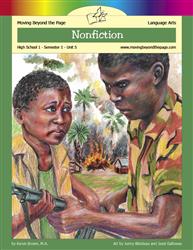
Unit 5: Nonfiction
Lesson 11
A Boy's Story
Students are given a vocabulary activity in which they write definitions in pencil, look up each word in the dictionary, record definitions in their own words, and fill vocabulary words into sentences from the book (e.g., lorry, adage, imam, indelibly). The Parent Plan section provides correct spellings of the vocabulary words and shows those words used in context sentences that students reproduce.
Final Project
Expository Essay
Students are told to "Spell check your paper" and to "run spell check" as part of proofreading (Part 8 and multiple homework steps). Students are instructed to print out and read their work aloud to find misspellings and typos and are given a concrete example illustrating context-based errors that spell-checkers may miss. Multiple homework directions repeat that students should proofread for grammar, spelling, and punctuation before submission.
Semester Exam
Semester Exam
Students are told to "know the spelling words and concepts covered in the Spelling lesson" as part of the Grammar, Part I review. Part VII: Grammar asks students to "Read and correct the spelling errors in the following paragraph," providing a specific activity in which students identify and fix misspellings. The answer key for Part VII shows the corrected spellings and highlights commonly confused/misspelled words, indicating explicit practice and feedback on spelling.
2: Semester 2

Unit 1: Ender's Game
Final Project
Think-Tac-Toe
Students are asked to produce written vocabulary responses on the unit test (e.g., use the word "invective" in a sentence; fill in the blank with "polyglot"). The acrostic puzzle (ENDER'S GAME) and its answer key list specific target words with correct spellings (e.g., Leadership, Convergent, Divergent, Petra, Onomatopoeia). Multiple extended writing tasks (rewrite passages in first person, write a one- to three-paragraph flashback, write two to three paragraphs comparing leadership styles) require students to produce continuous text where correct spelling is necessary for full credit.
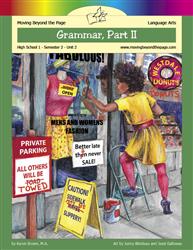
Unit 2: Grammar, Part II
Lesson 1
Review of Grammar, Part I
Students are directed to read Sets I–VII on the "Commonly Confused Words" activity pages and to review the unit review sheet and other materials, which requires attention to correct word forms. In Option 2 (Mad Libs), students must write specific words (e.g., adverb, noun, past-tense verbs) and then copy them into a story, which requires producing word spellings. Homework Option 2 asks students to create paragraphs and answer keys, which requires generating and presenting words and rules in written form.
Lesson 2
Capitalization and Numbers
Students complete a fill-in-the-blank activity that requires choosing the correctly spelled word from a provided word bank (envelop/envelope, everyday/every day, faze/phase, fewer/less, forego/forgo) and write the chosen forms into a letter. Students are instructed to record words, notes, tips, and examples on multiple "Commonly Confused Words" activity pages and to check their answers using the provided answer key. Students also record rules and examples on the "Writing Numbers" page, including guidance to spell out numbers in sentences, hyphenate compound numbers (twenty-two to ninety-nine), and spell or format fractions and large numbers with commas.
Lesson 3
Sentence Fragments and Run-on Sentences
Students are asked to read about and use targeted commonly confused words (foreword/forward, good/well, hear/here, hopefully, imply/infer, in/into, its/it's, lay/lie, loose/lose) and to record notes and examples from pp. 21–23. The Creative Writing Challenge requires students to write a 1–2 page narrative that uses all nine target words correctly and naturally, and students are instructed to "practice spelling both a few times" for difficult pairs (foreword/forward). Several activity pages and an escape-room exercise require students to select or fill in the correct word forms, and parents are directed to check that each word is used accurately in student writing.
Lesson 4
Modifier Errors
Students read about groups of commonly confused words and record notes and examples for Set XI, then complete a Fill-in-the-Blanks activity where they must write the correct word form (e.g., peak/peek/pique; pear/pare/pair; passed/past). Students sort words into meaning categories and identify incorrect common phrases in the "Spot the Fake" section, then check their answers against the provided Answer Key. The lesson also gives explicit usage tips (for example, distinguishing "passed" vs. "past" and explaining "may/might have" vs. "may/might of") that students are instructed to copy and use when completing the activity pages.
Lesson 5
Hyphens and Apostrophes
The Parent Plan lists spelling as a targeted skill, and students complete activities that require producing correct word forms (e.g., rewriting hyphenated compounds such as "a ten-year-old exhibit" and "a twelve-mile hike"). Students divide multisyllabic words at natural syllable boundaries (information, democratic, education, responsibility, extraordinary), which requires attention to accurate letter sequences. The commonly confused-words exercises require students to select and write the correct homophone (real/really, principle/principal, sit/set), demonstrating some application of correct word forms.
Lesson 6
Word Choice
Students practice with sets of commonly confused words (stationery/stationary, than/then, troop/troupe) in Activity 1, including tips that point out letter differences (e vs. a) and contextual uses. The logic puzzle and activity pages require students to choose the correct word forms in context and to check their answers with an answer key. The Skills section explicitly lists "Correctly use frequently confused words," and students are instructed to record notes, examples, and complete exercises to check understanding.
Lesson 8
Parallelism
Students complete multiple activities (Commonly Confused Words, Set XIV and Set XV) that require them to choose and correct among commonly confused homophones (there/their/they're, to/too/two, your/you're, who/which/that, whose/who's). The lesson explicitly tells students to "figure out how [words] are used in the sentence to confirm the correct spelling" and provides an answer key so students can check and correct their responses. The parent plan lists "Demonstrate command of the conventions... spelling when writing" as a skill to be practiced.
Final Project
Wrapping Up
The Parent Plan Skills list explicitly names spelling as a targeted skill: "Demonstrate command of the conventions of standard English capitalization, punctuation, and spelling when writing." The Unit Test Part III asks students to correct paragraphs with errors, and the accompanying answer-key images show corrected misspellings (e.g., "princessees" → "princesses," "souvoniers" → "souvenirs"). The Student Activity Page descriptions state students must "correct capitalization errors, fix commonly confused words," and other exercises require rewriting and correcting sentences, providing direct opportunities for students to identify and fix spelling and word-form errors.

Unit 3: Informational Texts
Lesson 2
Outliers
Students are asked to use a thesaurus and dictionary (including a provided web link) to look up vocabulary from Chapter One and to choose synonyms for words like "arbitrary," "profoundly," "patronage," "beneficiary," and "persist." Students are given Student Activity Pages with spaces to record possible synonyms, notes, and their chosen synonym, and are instructed to try inserting the synonym into the sentence. These tasks require students to produce written word choices, which implicitly involves spelling the vocabulary words and their chosen synonyms.
Lesson 5
Harlan, Kentucky
Students are instructed to underline unfamiliar words as they read and to complete the 'Chapter 6 Vocabulary' activity page by writing each vocabulary word and recording guesses and dictionary definitions. Section 2 explicitly asks students to write additional underlined words and define them, which requires students to write the target words. The lesson notes that students may add challenging words to a spelling journal and recommends using a dictionary link and the answer key (which provides correct word forms and pronunciations) to check their work.
Lesson 6
The Ethnic Theory of Plane Crashes
Students are asked to complete multiple vocabulary activities (matching words to definitions, writing synonyms/antonyms, and using words in context) and are explicitly instructed to use a dictionary (physical or online) and may collaborate with a partner. The Parent Plan skills list includes consulting general and specialized reference materials (dictionaries, glossaries, thesauruses) to determine pronunciation and precise meaning. Several activity pages require students to write vocabulary words and responses on the provided worksheets.
Lesson 11
Technical Writing
Students are instructed to proofread their final guide and ensure it is "free of grammar, punctuation, and spelling errors," as listed on the Guide Checklist. The Organize and Revise section explicitly tells students to proofread and notes that "typos, misspellings, and grammar and punctuation errors can be distracting or even confusing." Students are also asked to produce a final document and a glossary, which requires correct spelling of specialized terms, and to revise their guide after a peer or family member tests it and they take notes on problems.
Lesson 12
Logical Fallacies
Students complete fill-in-the-blank items (Part I of the Common Fallacies page) that require them to produce terms such as "premise," "non-sequitur," and "straw man." Students are asked to look up and record definitions for "hasty generalization" and "false dilemma," and they must write answers on activity pages. Students also write a short speech or a final persuasive essay, which requires composing multi-sentence text where correct spelling would be necessary for clear communication.
Final Project
Argumentative Research Essay
Students are explicitly instructed to "print out the essay and proofread it for grammar, punctuation, and spelling issues" as part of homework on Day 6 and again when finalizing the slideshow. The Essay Rubric's "Grammar & Mechanics" section lists "spelling errors" among the problems students should avoid and uses absence of spelling errors as part of the criteria for a top score. The slideshow and presentation checklists also ask students to ensure their work is "free from grammar and punctuation errors."

Unit 4: Drama
Lesson 8
Shakespeare
The activity sheet's "Word Understanding" step instructs students to use contextual clues or check a dictionary when a word or phrase is unclear, and it includes a note on peculiarities of Shakespearean spellings and meanings. Students are asked to rewrite passages in their own words and to create a timeline that requires writing names and dates from Shakespeare's life. The lesson also directs students to consult print and digital reference materials (dictionaries, glossaries, thesauruses) in the skills list.
Final Project
Drama
Students produce multiple written artifacts (costume descriptions, set descriptions, scripts/podcasts, comic-strip captions, playlists with lyrics, song lyrics, and unit-test short answers) that require correct spelling. Students are evaluated on a 'Mechanics' category in the Drama Project Rubric, which explicitly lists "Spelling, punctuation, and grammar use." Students must also prepare citations and a Works Cited page for projects, which requires accurate spelling of sources and terms.