


Eighth Grade - MATH
3: Math
Unit 1: Numbers
Lesson 2
Fractions and Decimals
Students set repeating decimals equal to x, multiply by a power of 10 to line up repeating blocks, subtract the original equation from the new one, and solve the resulting linear equation (examples: x = 0.3 leads to 10x - x = 3.3 - 0.3 giving 9x = 3 and x = 1/3; x = 0.17 leads to 100x - x = 17.17 - 0.17 giving 99x = 17). Activity pages and worked examples guide students through the algebraic steps that produce an equation of the form x = a. Students practice these steps on multiple repeating-decimal problems and write the simplified fractional answers.
Unit 2: Proportions
Lesson 1
Proportional Relationships
Students set up proportions as equations with a single unknown and perform algebraic steps to isolate the variable (e.g., 3/9 = x/27 leading to x = 9, 2n = 72 leading to n = 36). Multiple activity pages guide students to multiply both sides by a denominator, use cross-multiplication, and divide to obtain a solution in the form x = a. The review and answer keys consistently show final answers as single numerical values (x = 18, x = 36, etc.), indicating practice solving linear equations that yield one solution.
Lesson 2
Unit Rates
Students set up and solve one-variable equations in proportion and unit-rate contexts (for example, 2 × 10 = 4n → 20 = 4n → n = 5; 2 × n = 150 × 5 → 2n = 750 → n = 375; 3x = 48 → x = 16). The word-problem pages guide students to write equations from contexts (e.g., 3 × n = 24 × 7, 6 × n = 2 × 15) and then isolate the variable by dividing both sides. Several answer keys show steps of rewriting a proportional statement as an equation and solving for the unknown.
Lesson 5
Proportional Relationship Equations
Students write and manipulate linear equations in one variable such as t = pn and y = kx and solve them by isolating the variable (for example 156 = 10m -> divide both sides to get m = 15.6, and 100 = 20h -> h = 5). Activity 1 has students form equations like t = 12n and t = 15n and complete tables by multiplying and then use inverse operations to solve for a variable. The Review Quiz and Activity 3 explicitly guide students through step-by-step algebraic transformations to reach solutions of the form x = a.
Lesson 6
Taxes, Tips, and Commissions
Students set up one-variable linear equations from percent situations and solve them by isolating the variable (for example, 0.012·V = 2400 → V = 2400 ÷ 0.012 = 200000; 0.20·I = 9000 → I = 9000 ÷ 0.20 = 45000; 1.08·x = 212 → x = 212 ÷ 1.08 = 196.30). Several student problems ask them to work backward from a total to find the original amount using equations like p × 1.06 = 374.40 and solve for p. The activities repeatedly have students write equations with a single variable and perform successive algebraic steps (convert percent to decimal, multiply, then divide) to obtain a solution of the form x = a.
Lesson 7
Markups and Discounts
Students set up and solve one-variable equations in backward problems that model prices (e.g., Work: Backward Problems and Lesson 7 Review). The Answer Key explicitly shows algebraic transformations such as x * 1.20 = 72 → x = 72 ÷ 1.20 = 60 and x × 0.85 = 255 → x = 300, demonstrating isolating the variable to obtain x = a. Several activities require students to write equations with a single unknown and carry out successive algebraic steps (multiply/divide, simplify) to find the original price.
Lesson 8
Simple Interest and Percent Error
Students manipulate the simple interest equation I = Prt to isolate a single variable (for example, 250 = 2500 × r × 2 → r = 250/5000 = 0.05 and 108 = 600 × 0.06 × t → t = 3). Students complete practice problems that require algebraic steps (division and rearrangement) to find numerical values for r, t, or P from a linear one-variable equation. Students follow step-by-step worked examples and fill-in-the-blank exercises that show transforming an equation into a form that yields a single numeric solution.
Final Project
Lemonade Stand
Students set up and solve proportional equations to find unknowns (for example, using 1 lemon = 3 tablespoons to solve for x lemons and using 1 lb sugar = 36 tablespoons to solve for pounds needed). Students write linear equations in the form y = kx for the recipe relationships (y = 2x for lemon juice, y = 1.5x for sugar) and use those equations with tables and graphs. The materials show solving a proportion that yields a numeric solution (an example solving to approximately 10.6 lemons).
Unit 3: Expressions
Lesson 2
Rewriting Expressions
Students set up and solve one-variable linear equations from real-world contexts, for example solving 31.50 = P(1 + 0.05) to get P = 30 and solving 58 = 25 + 3r to get r = 11. Students transform equations step-by-step using inverse operations and the distributive property, for example expanding 48.75 = 65(1 − D) to 65 − 65D and then isolating D to find D = 0.25. Students rewrite two-step arithmetic situations (tax, discounts, markups, fixed + variable costs) into algebraic equations and carry out sequential algebraic steps that produce solutions of the form x = a on multiple activity pages.
Lesson 3
Algebraic Expressions
Students repeatedly set up and solve one-variable linear equations of the form ax + b = c and a(x + b) = c, e.g., Activity 3 shows 3x + 2 = 11 solved step-by-step to x = 3 and the perimeter example transforms 54 = 2(l + 6) through distribution and inverse operations to l = 21. Multiple student activity pages provide problems like 6x + 4 = 22 and 6(x + 4) = 22 where students subtract and divide to produce explicit solutions (x = a). The lesson asks students to translate word problems into equations (e.g., 15 = 4p + 3) and then successively transform those equations through like-term combination, subtraction, and division until they isolate x.
Lesson 6
Intercepts
Students set one variable to zero and solve the resulting single-variable equations to find intercepts (for example, setting y = 0 in 3x - 6y = 12 to solve 3x = 12 and find x = 4). The lesson includes multiple algebraic intercept problems (e.g., 2x + 4y = 8, y = 5x + 10, x + 5y = 10) where students solve for x or y after substitution. Activity directions explicitly instruct students to find x-intercepts by setting y = 0 and solving for x and to find y-intercepts by setting x = 0 and solving for y.
Lesson 8
y = mx + b
Students practice isolating a single variable when converting two-variable linear equations into slope-intercept form (e.g., subtracting 3x and dividing by 2 to get y = -3/2 x + 4). Students also solve for a single unknown by substitution when finding b from two points (e.g., substituting (2,5) into y = mx + b to get 5 = 4 + b and solving b = 1). Several student activities require algebraic steps of moving terms and dividing to isolate y or b.
Lesson 9
Unit 3 Test
Students solve multiple one-variable linear equations arising from word problems (e.g., 30 + 10x = 100 → x = 7? and in the answer key 30 + 10x = 100 → x = 5 GB is shown as 30 + 10x = 100 → x = 5 and 24 + 3x = 66 → x = 14). The parent plan and activities explicitly ask students to write and solve equations of the forms px + q = r and p(x + q) = r and the answer keys show step-by-step solutions to find a single numeric value for the variable. Several student tasks require writing an equation from a context (e.g., membership fees, hourly wages) and solving for the unknown.
Final Project
Planes, Trains, and Automobiles
Students write and use linear equations in one variable such as y = mx for distance (e.g., y = 60x, y = 80x, y = 400x) and solve equations of the form 500 = 60x, 500 = 80x, and 500 = 400x to find time. Students also write cost equations in the form y = mx + b (for example y = 0.15x + 31.50 and y = 0.20x + 20.75) and set two linear equations equal to each other (0.15x + 31.50 = 0.20x + 20.75) to solve for x (break-even point x = 215). These activities require algebraic manipulation to isolate the variable and produce single numerical solutions.
Unit 6: Geometry
Lesson 10
Volume
Students set up and solve one-variable equations to find missing measurements in multiple worked examples (e.g., Cylinder Example 3: 314 = 3.14×25×h → 78.5h → h = 4; Cone Example 2: 600 = (1/3)×3.14×36×h → 37.68h → h = 15.92). Student activity pages for cylinders, cones, and spheres include problems that require students to rearrange formulas and divide both sides to isolate a single variable (find h or r). The parent/answer-key text repeatedly shows algebraic steps that transform formulas into numeric equations and then into an explicit solution of the form variable = number.
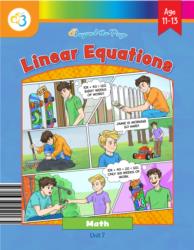
Unit 7: Linear Equations
Lesson 2
Multi-Step Equations
Students repeatedly transform multi-step linear equations step-by-step (Distribute → Move → Isolate) in worked examples and activity pages, culminating in solutions written in the form x = a (e.g., 2x+3 = 5x−2 transformed to x = 5/3 and many worksheet answers listed as x = number). Student activity pages require showing work for solving equations, and answer keys demonstrate solving to a single numerical value. Several examples include distributing, combining like terms, moving variables/constants, and checking solutions by substitution.
Lesson 3
How Many Solutions?
Students are shown step-by-step transformations that produce x = a (e.g., 3x + 4 = 10 → subtract 4 → 3x = 6 → divide → x = 2), a = a (e.g., 5y + 2 = 5y + 2 → simplify to y = y), and a = b impossible statements (e.g., 3x + 4 = 3x + 7 → subtract 3x → 4 = 7). Activity instructions repeatedly require students to simplify equations by subtracting, dividing, distributing, and combining like terms until they reach one of those final forms. Multiple student activity pages ask learners to give, create, and sort linear one-variable equations into one solution, infinite solutions, or no solution categories using these successive transformations.
Lesson 4
Multi-Step Word Problems
The Parent Plan Skills section explicitly lists giving examples of linear equations with one solution, infinitely many solutions, or no solutions and mentions transforming equations until they are of the form x = a, a = a, or a = b. Activity 2 and the Review Quiz prompt students to "recognize special cases (one solution, no solution, infinite solutions)" and include True/False items (e.g., statements about 4 = 4 and 2x + 5 = 2x + 8) that require students to identify infinite- and no-solution cases. Multiple word problems and answer key entries provide concrete examples of one-solution equations that students solve to x = a.
Lesson 5
Intersection and Graphing
Students graph pairs of linear equations and identify when systems have one solution, no solution, or infinitely many solutions from the intersection behavior of lines. Students convert two-variable equations into slope-intercept form and compare slopes/intercepts to decide solution types. Students simplify a pair of equations (for example, 4x−2y=8 and 2x−y=4) to the same equation y=2x−4 to show the system has infinitely many solutions.
Lesson 6
Substitution and Elimination
Students solve systems by algebraically isolating a variable and simplifying to a single-variable equation (for example, substitution examples simplify to 3x = 6 and x = 2). Students perform elimination to remove a variable and simplify to an equation in one variable (for example, elimination yields 5x = 20 and x = 4). The lesson also contains an explicit statement recognizing a no-solution situation (3x + 2y = 5 and 3x + 2y = 6) and has students check solutions by substituting values back into equations.
Lesson 7
The Point of It All
Students practice identifying one solution, no solution, and infinite solutions for systems of linear equations through graphing tasks (Part 2 and graph problems 7–9) and labeled answer keys that mark examples as "One Solution," "No solution," and "Infinite Solutions." Students solve systems algebraically using substitution and elimination (Activity 3 examples and practice problems) and obtain solutions in the form x = a, y = b for intersecting lines. Students also solve single-step equations in word problems (e.g., x/3 = 7, x/2 - 7 = 3), showing experience solving linear equations in one variable for unique solutions.
Lesson 8
Linear Algebra In the Wild
Students repeatedly form and solve single-variable linear equations as part of solving systems (for example, substituting S = J + 5 into S + J = 65 to get 2J + 5 = 65 and then solving to J = 30, then S = 35). In break-even examples, students set expressions equal and simplify to a one-variable equation (e.g., 30x = 20x + 50 → 10x = 50 → x = 5, then find y = 150). Student activity pages and answer keys show multiple instances where students isolate a variable, combine like terms, subtract or divide both sides, and check solutions (Emma/Leo, apple/banana, streaming and cleaning examples).
Lesson 9
Unit 7 Test
Students solve numerous one-variable linear equations that result in a single solution (for example problems that simplify to x = 20, x = 7, x = 5, x = 4, x = 2). Students are asked to "Determine the number of solutions" on explicit items such as 2x+4 = 2x+4 and 3x+11 = 3x+5, and the answer key shows these transformed into an identity (infinitely many solutions) and a contradiction (no solution). Answer steps in the key and worked examples show successive algebraic transformations (collecting like terms, subtracting identical terms, isolating x) that lead to x = a, a = a, or a = b forms or their equivalent statements.
Final Project
Getting Ready for College
Students write and solve single-variable linear equations to find break-even points (for example, 1200m = 1500 + 1050m → 150m = 1500 → m = 10 in the housing activity; 225 + 0.60x = 1.25x → x ≈ 346.15 in the transportation activity; 20 = 5 + 1.5h → h = 10 in the streaming activity). Students set equations equal and manipulate them algebraically (subtraction, collecting like terms, division) to isolate the variable and produce solutions of the form x = a. In the phone-plans activity students simplify Plan B to y = 5x + 20 and recognize that it is identical to Plan A, concluding the system has infinitely many solutions and confirming this by graphing.
Unit 9: Semester Exams
Lesson 5
Semester Exam
Problems 29 and 30 ask students to solve linear equations 5(x + 4) = 45 and 4x + 6 = 30, and the answer key gives x = 5 and x = 6, showing students obtain solutions of the form x = a. Several other items (e.g., 33 writing cost equations and 36–37 identifying slope/intercept and equations of lines) require forming and manipulating linear expressions and equations. The answer key shows stepwise simplified results for those problems, indicating students perform algebraic transformations to isolate the variable in typical one-solution cases.
Lesson 6
Functions Review
Students write and solve a one-variable linear equation in Section 5 (e.g., x + 3x = 28 → 4x = 28 → x = 7), showing they can combine like terms and isolate x. Students also set variables to specific values when finding intercepts (e.g., finding y when x = 0) which involves solving for a single variable in simple cases. These activities demonstrate students practice algebraic manipulation to produce a solution of the form x = a for at least one example.
Lesson 7
Geometry Review
The Angle Relationships & Triangles activity asks students to model complementary angles with an equation (Angle A = 2x, Angle B = x) and to write and solve 2x + x = 90, finding x = 30. This requires students to form a linear equation in one variable and carry out algebraic steps to solve for the unknown. The worksheet spaces students to write the equation and show their work, providing direct practice solving a single linear equation.
Lesson 8
Linear Equations Review
Students are asked in Activity 2 Part A to determine whether given equations have one solution, no solution, or infinitely many solutions (examples: 6x = 5 + 6x = 5 and 4x - 3 = 4x + 9). The answer key for these items explains transformations: it states that identical sides give "Infinitely many solutions" and shows subtracting 4x yields "-3 = 9" to justify "No solution." Activity 1 gives students multiple one-step and multi-step equations to solve where they produce solutions of the form x = a.
Lesson 10
Semester Exam
Students solve one-variable linear equations in problems 23–27 (e.g., x+7=19, 5(2x−1)=45) where they find single solutions (x=a). Students are asked to determine the number of solutions in problems 28–31, which include 6x+4=6x+4 and 8x−2=8x+6; the answer key identifies these as "Infinite solutions" and "No solution." Students also solve systems that produce a single intersection point (problem 32), reinforcing single-solution reasoning.