


Sixth Grade - MATH
5: Math
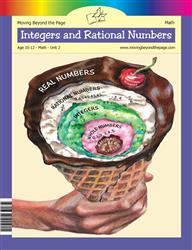
Unit 2: Integers and Rational Numbers
Lesson 4
Negative Numbers and Integers
The Skills list explicitly names "Distinguish comparisons of absolute value from statements about order." Students represent debts with negative numbers (Marcus: -$218.72; Simon: owes $10 → -10) and answer comparative questions about debt (Jasper -$50 vs Patrice -$75) asking which person owes more. Number-line activities ask students to place positive and negative values and note that opposites are equal distances from zero.
Lesson 5
Absolute Value and Inequalities
Students compare numerical value and absolute value using concrete examples such as 7 vs. -12 (identifying 7 as larger by order but -12 as larger by absolute value). The materials explicitly show -7 < 5 while |−7| > |5| and ask students to write inequalities that compare numbers and absolute values (Activity 4 and related practice problems). Practice items ask students to decide whether a given number is greater than or less than the absolute value of another (e.g., Is 9 greater than or less than the absolute value of -16?), and real contexts (scores, depths, temperatures, distances) require interpreting order versus magnitude.
Lesson 7
Coordinate Problem Solving
Students plot points with negative coordinates and compute horizontal and vertical distances between points (for example, finding distances for pairs like (7, −3) and (2, −3) or (−3, 5) and (−3, −4)). Students answer a Basic Skills Review item that finds the distance from −3 to 5 and uses absolute value in that computation (|−3| + |5| = 8). The lesson asks students to explain why distances on a coordinate plane are always positive and links that idea to absolute value.
Lesson 8
Unit 2 Test
Students are asked to find absolute value and use number lines to find distances (listed in the unit learning goals). Several practice and test items require comparing absolute value expressions and using inequality symbols, for example the comparison problems including (-2) < |(-7)| and |4| = |(-4)|. The Parent Plan and skills lists explicitly state use of absolute value to find distances and to understand ordering and absolute value of rational numbers.
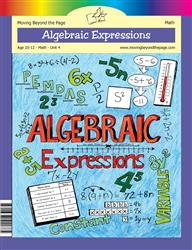
Unit 4: Algebraic Expressions
Lesson 4
Positive and Negative Numbers
Students are taught that absolute value is the distance of a number from zero and practice finding opposites on a number line (several images and activities ask students to compute |6|, |-6|, and opposites like -(-3)). Students use absolute value to decide which number is farther from zero when adding a positive and a negative (the rule "use the sign of the number that is farther from zero" and examples like 4 + -5). Students solve contextual problems involving debts and bank balances (Activity 5 asks students to write expressions for owing money and compares how much more one person owes than another).
Lesson 5
Equivalent Expressions
Students complete a Basic Skills Review item that asks them to use <, >, or = to compare values including absolute values (e.g., problems and answer key showing |(-)16| > (-)16 and |(-)8 1/2| = |8 1/2|). The lesson asks students to compare given values and provides worked answers that explicitly compare absolute value expressions with negative numbers. Several practice items require students to reason about positive/negative numbers and absolute value in numeric comparisons.
Lesson 7
Unit 4 Test
Students practice operations with positive and negative rational numbers (e.g., 20 - 36 = -16, -14 - (-9) = -5, 35 - (-7) = 42) and are prompted to "change subtraction to add the opposite." The Parent Plan skills explicitly state that students should "show that the distance between two rational numbers on the number line is the absolute value of their difference, and apply this principle in real-world contexts." Several activities require evaluating and interpreting integer results and evaluating expressions with negative values.
Unit 8: Statistics
Final Project
Statistical Study
Students are instructed to compute the mean absolute deviation (Step 4) and to record mean, median, mode, minimum, and maximum values for their data sets. Students create number-line based displays (dot plots and box plots) and identify the five-number summary, which requires locating values relative to each other on a number line.
3: Math
Unit 1: Numbers
Lesson 1
Positive and Negative Rational Numbers
Students represent debts and losses using negative numbers in multiple activities (e.g., Special Note: Why Debt is Written as a Negative Number and problems where −60 ÷ 5 = −12). Students solve and interpret real-world problems that produce negative results (e.g., ‘‘Each person owes −$12,'' ‘‘the average daily loss is −12,'' and word problems about losing money or splitting debt). Students write equations and explain results in context for scenarios involving negative balances (Activity 1, Activity 4, Activity 6).
Unit 8: Data
Lesson 1
Statistics Review
Students are instructed to compute Mean Absolute Deviation (MAD) by finding the mean, subtracting the mean from each data value, and taking the absolute value of each difference (e.g., the turtle ages example shows |22−21.25|, |20−21.25|, etc.). The lesson's steps explicitly tell students to "take the absolute value (ignore negative signs)" and then average those distances, and several practice problems ask students to compute MAD for given data sets.