


Sixth Grade - MATH
5: Math

Unit 1: Operations
Lesson 2
Multiplication Review
The lesson defines variables and shows multiplication expressions using letters (for example, "6n is the same as 6 × n or 6 · n or 6(n)") and presents property formulas written with letters (a × b = b × a; (a × b) × c = a × (b × c); a(b + c) = ab + ac). Student tasks explicitly ask students to write or identify variable expressions, for example asking "What are the four ways to represent the multiplication problem '4 times n'?". Practice problems and answer keys show students writing multiplication expressions with numbers and letters (e.g., 4n, 4·n, 4(n); a(b + c) = ab + ac).
Lesson 6
Greatest Common Factor
The lesson presents the distributive property using letters (a(b + c) = (a · b) + (a · c)) and shows equivalent algebraic forms, so students see and read expressions that include letters. Students also rewrite numeric sums in factored form (for example 24 + 54 → 6(4 + 9) and 15 + 21 → 3(5 + 7)), demonstrating translating between two algebraic forms.
Final Project
Planning a Party
Students write and evaluate numerical expressions when they use the distributive property to show totals (example: 12(5 + 3) = (12 × 5) + (12 × 3) = 60 + 36 = 96). Students also write and evaluate expressions using exponential notation in the Exponent Tic-Tac-Toe activity and on the Exponent Problem Sheet. The Exponent Problem Sheet description explicitly allows students to fill in numbers or variables to form exponent expressions.
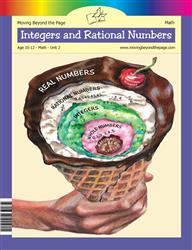
Unit 2: Integers and Rational Numbers
Lesson 6
The Coordinate Plane
Students use letters to stand for numbers in ordered pairs and write new ordered pairs after operations on those letters. For example, Activity 5 and the answer key ask students to take a general point (a, b) and write its reflection across the x-axis as (a, (-)b), across the y-axis as ((-)a, b), and across both axes as ((-)a, (-)b). The lesson repeatedly labels and asks for coordinates using symbolic form (a, b) when discussing reflections and translations.
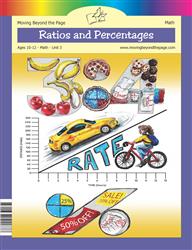
Unit 3: Ratios and Percentages
Lesson 1
Introduction to Ratios
The Parent Plan skills list explicitly uses letter notation: it states students will "Understand the concept of a unit rate a/b associated with a ratio a:b with b ≠ 0," which places letters a and b as placeholders for numbers. The lesson also uses symbolic fraction notation a/b in describing unit rates and equivalent ratios, showing that letters can represent quantities in ratio contexts.
Lesson 3
Equivalent Ratios
Students encounter and use an algebraic expression with a letter in the answer key for the Sam and Lindy bottles problem, where the solution is shown as 4x + 3x = 91. Several worked solutions and answer-key steps show solving by multiplying and adding grouped parts (e.g., using x to represent the size of one part and then performing operations on x).
Lesson 6
Percentage Problems
Students are asked to translate word sentences into number sentences using a variable (n or x) in the "Word Sentence to Number Sentence" chart and activity pages. Multiple student tasks require writing expressions/equations with letters, e.g., "n = 90/100 × 300", "75 = 15/100 × n", and "32 = 0.64x." The answer key and example solutions explicitly show students writing and manipulating expressions that include letters standing for unknown numbers.
Lesson 8
Unit 3 Test
Students are asked to "Translate the word sentence into a number sentence, and then solve," with explicit problems such as "What number is twenty-eight percent of two hundred?" and "Seventeen is eighty-five percent of what number?" The answer key shows algebraic number sentences using a letter to stand for the unknown (for example, n = 28% × 200; 17 = 85% × n; 37 = n% × 50). Several problems require students to write and solve equations that record operations with numbers and a letter representing an unknown.
Final Project
What's the Best Buy?
Students are asked to set up and solve a percent-savings equation using a variable (example: write the math sentence n = 10/100 (x) $200 and solve 10/100 = n/200 to find n = 20). Students also write ratio expressions (price over number of units) and use those fractional expressions to compute unit prices (e.g., $3.38/13 oz → unit price). Several activities require expressing conversions and comparisons using ratios in fraction form (e.g., price per ounce, gallons → fl oz via multiplication of conversion fractions).
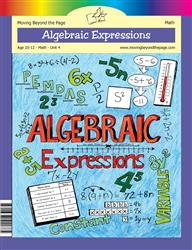
Unit 4: Algebraic Expressions
Lesson 1
Introduction to Algebra
Students are asked to translate word phrases into algebraic expressions (e.g., the Carlee board-games problem: write an expression for 12 plus some unknown n). Activity pages require students to match algebraic expressions to verbal phrases (Part 2 matching) and to write expressions such as 5n, 36n, 3n+4, and x+y from word contexts. The Parent Plan and Skills lists explicitly state that students will "write, read, and evaluate expressions in which letters (i.e., variables) stand for numbers" and include prompts like writing "seven less than a number" as n - 7 and writing expressions for repeated quantities (e.g., 5 pencils in n packs -> 5n).
Lesson 2
Parts of an Expression
Students are given multiple tasks that require writing algebraic expressions from descriptions. In Day 2 Activity 3 (Understanding Expressions) students use clues such as "The expression has two terms joined by subtraction," "The first term is the constant 12," and "The second term uses the variable p with a coefficient of 3" to produce 12 - 3p. Activity 3 problems 5–8 explicitly ask students to write expressions from verbal/clue-based descriptions (e.g., a two-term addition with 6n and 3).
Lesson 3
Working With Expressions
Students translate multiple word problems into algebraic expressions (e.g., Milo: 6 + n; Jade: n - 8; Yuji: 2n + 10). The Student Activity Page requires students to write expressions for scenarios (Damien: 12 + n; Kendyll: n + 3; Martin: 3n; Piper: 24/n; Benjamin: 50 - n; Lindy: n - 15; challenge: (n - 3)/2). The Answer Key and classroom examples explicitly show use of addition, subtraction, multiplication (coefficients like 2n, 3n), division (24/n), and parentheses when writing expressions from words.
Lesson 4
Positive and Negative Numbers
Students rewrite subtraction sentences as addition of the additive inverse (e.g., change 12 - 4 to 12 + (-4)) and practice evaluating those expressions using number lines and rules for combining positive and negative numbers. Students write numeric expressions for real-world situations (e.g., Benjamin has $12 and spends $9 → 12 - 9) and convert those to add-the-opposite forms. Activities and answer keys show many examples where students record and manipulate arithmetic expressions with numbers and evaluate them.
Lesson 5
Equivalent Expressions
Students are asked to replace candy items with variables and write an expression (e.g., 12b + 9b + 5p + 3p + 8g + 10g = 21b + 8p + 18g), which requires recording operations with numbers and letters. The lesson models translating visual representations into expressions (box diagrams that represent 3x + 5 and 2a + 4b) and explains that 4n means "four times the value of n," showing multiplication written with a letter. Several activities have students write or rewrite algebraic expressions (e.g., x + x + 2 + 2 → 2x + 4; rewriting (14 + 2x) + 9 as 2x + (14 + 9)).
Lesson 6
The Distributive Property
Students translate multiple word problems into algebraic expressions (Activity 4 and its student pages ask for expressions such as 18y, 3x + 15, 15p - 18, 2n + 5, 3n + 5, and 2n + 9). The lesson shows numeric and variable examples like 5(n + 2), (5·n) + (5·2), and 2n + 3n → 5n and asks students to rewrite and simplify these expressions. Student activity pages explicitly prompt students to write expressions from scenarios, match area models to expressions, and rewrite expressions using distributive and commutative properties. The parent plan and answer keys provide model solutions and evaluations that use letters standing for numbers and operations recorded with those letters.
Lesson 7
Unit 4 Test
Students are repeatedly asked to translate verbal phrases into algebraic expressions (e.g., "a number decreased by seven" → n - 7; "twice a number plus four" → 2n + 4) and to choose expressions that represent scenarios (e.g., Jeremiah: 5x + 3; Zane: 12n + 5). Multiple word-problem items ask students to write expressions from context (Tasha: n + 7; Kelsey: n - 12; Alana: 12(x + 6)), and the answer key shows the correct variable-based expressions. Several practice sections and the test explicitly require writing, reading, and evaluating expressions with letters standing for numbers.
Final Project
Algebra Think-Tac-Toe
The Parent Plan skills list explicitly includes "Write expressions that record operations with numbers and with letters standing for numbers" and "Write, read, and evaluate expressions in which letters (i.e., variables) stand for numbers." Student tasks require creating and labeling a basic expression on the Show and Tell Vocabulary Poster (including variable, coefficient, constant, exponent, and term). Multiple activities (Make a Quiz, GoFish!, Prove It! Equivalencies, Design a Book Cover, and Exponent Matching) ask students to write algebraic terms and expressions, combine like terms, simplify expressions, and evaluate expressions by substituting numerical values.
Unit 5: Algebraic Equations
Lesson 1
Algebraic Equations
Students translate word phrases into algebraic notation by writing equations such as 5 + n = 12, 3n = 72, and n + 8 = 3n on activity pages. Several activities ask students to write an equation from a word problem and to create a 'Word Form to Equation Form' interactive-notebook page with items like "A number plus ten is sixteen" (n + 10 = 16). Students also use variables to represent unknowns and record operations with letters when they set up equations from real-world contexts (e.g., 32 + p = 48, m ÷ 6 = 20).
Lesson 2
Solving One-Step Equations, Part 1
Students translate word problems and diagrams into algebraic equations using variables (e.g., the tape diagram example 100 = n + 60 and the bake sale example 16 + n = 72). Students write equations from hanger diagrams and are prompted to "write an equation that matches each hanger diagram" and convert visual representations into expressions like n + 3 = 8. Activity pages require students to write and solve equations such as 9 + p = 16, 48 = 21 + x, and several word-problem equations where a letter stands for an unknown quantity.
Lesson 3
Solving One-Step Equations, Part 2
Students are asked to write equations that use letters to stand for numbers in multiple places (e.g., 2n = 8, n/2 = 5, 5n = 40). Activity prompts require students to write an equation from word problems (e.g., "Five times what number is 40" → 5n = 40; Levi's bird seed problem), and several student pages ask students to write the equation shown by hanger diagrams and to create tape/hanger diagrams for given equations. The lesson also has students evaluate expressions by substituting proposed values (e.g., check 2(4) = 8, 10/2 = 5, 5(8) = 40) to verify their work.
Lesson 4
Solving Two-Step Equations
Students translate word problems into algebraic expressions/equations (for example, writing 3n + 4 = 19 for Abby and 5n + 12 = 92 for Marissa) and set up equations such as n/2 + 10 = 35 and 13 + 4n = 33. Students label variables on activity pages and create expressions inside equations (examples include 4n + 8 = 24, 5(n + 2) = 25, and 2/5 x + 4 = 5). Students check solutions by substituting values back into the original equations, which requires reading and evaluating expressions with letters standing for numbers.
Lesson 5
Inequalities
Students match word statements to symbolic inequalities (Part 1 matches "n is greater than seven" to n > 7). Students write and interpret algebraic expressions inside inequalities such as 2x + 6 > 10 and use expressions like p + 1 ≥ 5, 2n ≥ 8< and a/5 + 3 < 10 in practice problems. Students are asked to write inequalities from number-line graphs and to complete a "Writing Inequalities" activity in the Interactive Notebook that requires composing symbolic inequalities from given representations.
Lesson 6
Solving Inequalities
Students are repeatedly asked to translate word problems into algebraic inequalities using a variable n (e.g., "n + 4 < 10", "n + 5 < 12"). The activity pages and answer key show students writing expressions that record operations with letters, such as 3n − 5 ≥ 22, 5n ≤ 75, and n/3 ≥ 25. The lesson explicitly guides students to identify the unknown, determine the operations (add, subtract, multiply, divide), and write the corresponding algebraic expression or inequality.
Lesson 7
Independent and Dependent Variables
Students translate verbal situations into algebraic equations such as d = 45t (distance and time), y = 15x (cookies and eggs), y = x - 2 (Owen and Cindy ages), and 10x = y (hourly pay). Student activities explicitly ask learners to write equations from word problems (e.g., 3D printer: y = 2x; Kelsey/Michelle: x + 4 = y) and to choose or rewrite forms so the dependent variable is isolated (e.g., questions about rewriting y - 5x = 8). The lesson includes tasks that require using addition, subtraction, multiplication, and division when forming expressions with letters standing for numbers.
Lesson 8
Unit 5 Test
Students are asked to translate verbal situations into algebraic statements and write equations such as n + 4 = 7 (Jenna), 3n + 2 = 23 (Heather), and x − 6 = y (Ms. Crisp). Multiple activity pages require students to choose variable symbols and write inequalities and equations from word problems (e.g., n/4 "<5; 25, n − 3 < 6, 3n − 5 = 115). Exercises also include rewriting and rearranging expressions (y + 5 − 2x = 6 rewritten as y = 2x + 1), showing students work with letters standing for numbers.
Final Project
All About Me
Students are asked to brainstorm numeric facts and then turn those facts into at least 5–7 equations and 4–6 inequalities that use variables to represent quantities. The plan and checklist require examples that use addition, subtraction, multiplication, and division with letters (examples in the text include n + 3 = 15, 2x = y, y/5 < 3, and 3x - 4 >= 56). Students must include one independent/dependent variable equation and check solutions by plugging answers into the original equations or inequalities.
Unit 6: 2D Geometry
Lesson 2
Working With Angles
Students write algebraic expressions and equations to represent angle relationships throughout the lesson (for example: 126 + n = 180; n + 2n = 90; 5n = n + 92). Student activity prompts require writing equations from diagrams and descriptions (e.g., 2n + 42 = 90, 2n - 20 = n, n - 25 + n - 65 = 90), and problems include expressions with coefficients and subtraction (2n - 10, n - 25, 4n). The Geometric Equations page lists models a = b, a + b = 90, a + b = 180 and asks students to select or write matching algebraic expressions for given geometric situations.
Lesson 3
Triangles
Students are asked to write equations with letters for unknown angle measures (e.g., the quiz and practice show "104 + n = 180" and ask for Equation = ____ Solution = ____). The triangle rules and student pages use symbolic expressions with letters for side lengths and angles (e.g., a + b > c and ∠1 + ∠2 + ∠3 = 180). Several activities require filling in or using these expressions to solve for unknowns (finding ∠n, using 40 + 65 = 105 then 180 − 105 = 75°).
Lesson 4
Area
Students use letter symbols in area formulas such as A = l × w, A = b × h, and A = 1/2 × b × h, and are asked to place these formulas on an Interactive Notebook chart. Several student problems ask students to write and solve algebraic equations with a letter representing an unknown (for example, 24n = 4,320 for the paver problem and 15 × n = 75 for Omar's parallelogram). Activity prompts and answer keys explicitly show students writing and manipulating expressions and equations with letters to record operations and solve for unknowns.
Lesson 5
Circles
Students are asked to use algebraic notation and inverse operations to rewrite pi = C/d into C = πd and are shown the algebraic relationship d = 2r. The lesson presents and has students use formulas written with letters (C = πd, C = 2πr, A = πr^2) and directs students to substitute numeric values for those letters to compute circumference and area.
Lesson 6
Scale Drawings
Students are asked to use variables in proportions and equations such as 1/3 = x/18 and 1/2 = y/4, and to "use variables to represent the unknown value that you are trying to find." The Basic Skills Review includes algebraic expressions and equations for students to write and solve (for example, 8 + 3n = 44 and n + 4 ≥ 12). Several activities require setting up proportions with letters (e.g., 1 inch/5 feet = 6 inches/n feet) and manipulating expressions to find unknowns.
Lesson 7
Unit 6 Test
Students write and solve algebraic equations that record operations with numbers and letters, for example writing n + 2n + (3n + 12) = 180 and 3n + 35 = 4n to express angle relationships. Problems present and require use of expressions such as 2n - 15, 3n + 35, 4n, and 2n, and students set up equations from diagrams and solve for the variable. The answer key explicitly shows students forming and manipulating these algebraic expressions to find unknown angle measures.
Unit 7: 3D Geometry
Lesson 1
Three-Dimensional Solids
Students write and use the algebraic relation F + V - E = 2 (Euler's Formula) and substitute known numeric values into it. The lesson shows students writing an equation with a letter for the unknown (F + 5 - 8 = 2) and then manipulating that expression to solve for the variable. Student activity problems ask learners to use the formula and solve for unknown faces or vertices by writing and evaluating expressions with letters and numbers.
Lesson 2
Surface Area
Students repeatedly work with formulas that use letters for numbers, for example SA = 2LW + 2LH + 2WH and SA = 6s^2, and are instructed to plug length, width, and height into those formulas. Student work asks them to compute areas using expressions such as 1/2 × b × h and to write numeric area calculations on nets (e.g., 10 × 5, 3 × 4). The Basic Skills Review asks students to evaluate an expression with a variable (n^2 − (−5) when n = 3) and the answer keys show substitution of specific values for variables.
Lesson 3
Volume
Students are asked to write and use formulas with letters representing numbers, for example by filling in blanks such as V = l × w × h, V = s^3, and V = B × h in the flap-book and activity pages. Students substitute numerical, fractional, and decimal measurements for the variables (for example converting 1 1/2 to 3/2 and computing V = 3/2 × 3/4 × 4). Several activity problems and answer keys show students evaluating these variable expressions to find volumes of prisms and cubes.
Lesson 5
Problem Solving With Solids
Students represent unknown dimensions with variables and write algebraic expressions such as 54 = L × 4 1/2 × 2 to model volume and then manipulate that expression to solve for L. Students set up and use formulas with letters, e.g., SA = 6s^2 and 864 = 6 × s^2, to find side length, and they write equations from word problems such as 5n + 10 = 130 to represent a real-world scenario. The materials prompt students to "Plug the information that you know into the volume formula, using the variable L for the missing length," explicitly asking them to write expressions that combine numbers and letters.
Lesson 6
Unit 7 Test
Students are given and use formulas that include letters standing for numbers (for example, V = l × w × h, V = B × h, and SA = 2LW + 2LH + 2WH). In problems students set up and solve equations with a letter as an unknown (for example, 182 = 6.5 × h and then dividing both sides to find h = 28). Several tasks require substituting numeric dimensions into lettered formulas to compute volume or surface area.
Final Project
Building With Solids
Students are given and expected to use formulas that contain letters (for example, V = l × w × h, V = B × h, s³, and SA = 2lw + 2lh + 2wh). The activity pages and answer key show students writing and evaluating expressions with letters and numbers (for example, 6s² = 6(4²) and 2(2 × 7) + 2(4 × 7) + 2(2 × 4)). Students are instructed to measure dimensions and then substitute those numeric measurements into the letter-based formulas to compute surface area and volume.
Unit 8: Statistics
Lesson 2
Populations and Samples
Students evaluate and work with algebraic expressions in the Basic Skills Review (e.g., "What is the value of 4n + 12 if n = 5?"). Students translate a verbal situation into an algebraic equation in the Rico problem by writing n + 26 = 102 to represent "Rico's high score is twenty-six points more than his brother's." Students also manipulate expressions with letters in the inequality task n + 3 < 5.
Lesson 8
Making Inferences
Students are asked to translate a context into an inequality (Josie had 4 fish and now has no more than 9; answer key shows 4 + n ≤ 9), which records an operation with a letter standing for an unknown. Students evaluate and work with algebraic expressions that include letters (Evaluate 6p + 12 if p = 4) and solve equations that use letters (Solve 4n − 3 = 17). The Basic Skills Review problems require students to read expressions with letters and compute or manipulate them.
Unit 9: Skills Review
Lesson 3
Expressions, Equations, and Percentages
Students are asked to translate word phrases into algebraic expressions in Activity 1 Problem 2 (e.g., "four times a number increased by five" and "six decreased by a number"). Activity 1 Problem 5 has students write a real-world expression using a variable (Marie: 9h + 3) and then evaluate it for a specific h. The Skills list explicitly includes "Write expressions that record operations with numbers and with letters standing for numbers," reinforcing the targeted practice.
Lesson 4
Geometry
Students are asked to write and solve an equation for vertical angles labeled 3n and 2n + 16 (students write 3n = 2n + 16 and solve for n). Several area and circumference items use formulas written with letters (A = l × w, A = ½ × b × h, A = s2, C = 2πr, A = πr2) and require students to substitute numeric values for those letters to evaluate the expressions. The scale and ratio problems ask students to set up and evaluate numeric ratios (e.g., 4/12 = 1/3).
3: Math
Unit 1: Numbers
Lesson 2
Fractions and Decimals
Students set a letter equal to a number when they let x = 0.̅ 3 or x = 0.̅ 17 and then write and manipulate expressions such as 10x, 100x, and 10x - x (or 100x - x) to isolate x. Practice problems and worked examples ask students to form these algebraic expressions and solve equations (e.g., 9x = 3 or 99x = 17) to convert repeating decimals to fractions. The step-by-step notes and activity pages require students to record the arithmetic operations using the letter x and numeric coefficients.
Lesson 4
Square and Cube Roots
The Parent Plan Skills explicitly state students will "Use square root and cube root symbols to represent solutions to equations of the form x^2 = p and x^3 = p, where p is a positive rational number," showing students work with letters standing for numbers. Activity pages and answer keys include expressions and equations using letters (x, p) and require students to evaluate and simplify exponent and root expressions (for example simplifying (2^3)^2 and solving x^2 = p). Real-world problems and calculator activities have students set up and compute exponent and root expressions, reinforcing symbolic notation for these operations.
Lesson 7
Arctic Marine Research
Students encounter and work with expressions that include letters: the lesson presents the population model N = 2^t (with t as the number of 20-minute intervals) and a second model 3^t. Students are asked to calculate populations for specified values of t (e.g., after 6 intervals and after 4 intervals) and to compute powers such as 2^10 for DNA replication.
Final Project
Mars Station Test Mission
Students are given and asked to use the formula A = π r^2 to calculate drop zone area and radius, which uses letters to represent numbers. The tasks tell students to "use the equations provided to calculate delivery costs and supply costs," and students work with expressions like the fuel-cell energy written as 7 × 10^2 kWh and distances given under a square-root expression. Several answer-key tables show students substituting numeric values into these formulas to compute area, cost, and energy quantities.
Unit 2: Proportions
Lesson 1
Proportional Relationships
Students set up proportions using letters to stand for unknown numbers, for example writing 3/9 = x/27 and 3 tacos/9 dollars = 9 tacos/x dollars. They write and manipulate equations with variables such as 3x = 27 × 5 and 2n = 3 × 24 when using multiplication/division and cross-multiplication methods. Several activity pages prompt students to label quantities and place a variable in a fraction (x or n) to represent an unknown value in real-world scenarios.
Lesson 2
Unit Rates
Students set up and use letters in equations for proportions and word problems (e.g., "Set up proportion: 2 × n = 150 × 5 → 2n = 750 → n = 375 flyers"). The lesson shows using a variable x in a proportion (3 pounds/6 dollars = 8 pounds/x dollars) and uses n and x when solving for unknown quantities in multi-step problems. Students also write division expressions with labels (e.g., $4.99/6 apples, 300 miles/5 hours) and perform operations on those expressions to find unit rates.
Lesson 3
Constant Rate
Students practice writing relationships using variables in the form y = kx across multiple activities (Activity 3, Activity 4, Activity 5, Activity 6). They convert given equations into y = kx (for example 4y = 8x → y = 2x) and identify k by dividing y by x in tables and graphs. In real-world problems and the 'Build Your Own Problems' activity students write equations to model scenarios (e.g., y = 60x for distance/time) and solve for unknowns.
Lesson 4
Graphing Proportions
Students are asked repeatedly to write equations from scenarios using letters for numbers, for example writing y = kx for proportional situations (Jim: y = 12x; saving: y = 5x; apples: y = 2x). Activity pages prompt students to ‘Write an equation' for hikers, printers, trains, and other real-world contexts and to convert between equations, tables, and graphs. The materials also include examples of non-multiplicative forms (e.g., y = 60/x) and instruct students to build tables from given equations like y = 4x and y = 2x.
Lesson 5
Proportional Relationship Equations
Students write and use equations with letters and numbers in multiple places, for example forming t = p n, t = 12n, t = 15n, a = r h, and c = 8m in activities and examples. Students set up and solve substituted equations such as 156 = 10m to find a value for a variable, and quiz items ask students to write an equation for a proportional relationship (e.g., write y = 5x). Instructions repeatedly prompt students to "write an equation in the form y = kx" and to write equations when a table is proportional.
Lesson 6
Taxes, Tips, and Commissions
Students are asked to define variables and write arithmetic expressions and equations in multiple places (e.g., Activity 2 images: 0.012 × V = $2,400 to find V; 0.20 × I = $9,000 to find I; 1.08 × x = 212.00 to find the pre-tax price). The lesson presents formula templates using letters (Gratuity = Tip Percentage × Original Bill; Commission = Sales Amount × Commission Rate) and student pages/answer keys show steps like "let p = price before tax; p × 1.06 = $374.40." Several student problems require writing these expressions/equations from word problems before solving them.
Lesson 7
Markups and Discounts
Students solve "work-backward" problems where unknowns are represented by a letter (for example: "Let x be the original price: x × (1 − 0.40) = 18 → x × 0.60 = 18 → x = 30"). The answer key also shows equations written with variables such as x * 1.20 = 72 → x = 72 ÷ 1.20 and 50 × x = 20 → x = 20 ÷ 50. Several backward problems (e.g., "What was the original cost price?", "What was the store cost?") require students to set up and use letter-based expressions to record the operations needed to find unknown prices.
Lesson 8
Simple Interest and Percent Error
Students write and use the algebraic formula I = Prt and fill in the meanings of I, P, r, and t. Students set up and manipulate equations with letters, for example 250 = 2500 × r × 2 to solve for r and 108 = 600 × 0.06 × t to solve for t. Students record balances as expressions such as Balance = Principal + Interest (P + I). The activity pages require students to write and compute with these numerical-and-letter expressions in multiple practice problems.
Lesson 9
Unit 2 Test
Students are asked to write equations for proportional relationships, for example Problem 6 asks them to write an equation when k = 2/7 (y = (2/7)x). Multiple tasks require writing or recognizing equations in y = kx form (e.g., y = 4x, y = 7x, y = 3.2x) and the parent notes include examples like t = pn (total cost = price × number of items). Several percent and tax problems prompt students to introduce a letter for an unknown (e.g., let p be the price before tax and set up 1.06p = 212) and solve the resulting equation.
Final Project
Lemonade Stand
Students are asked to write equations in the form y = kx for the recipe scaling activities (e.g., y = 2x for tablespoons of lemon juice and y = 1.5x for tablespoons of sugar). The parent plan and activity pages include algebraic representations such as t = pn and explicit formulas for selling price (Selling price = unit price × 2, ×2.5, ×3). Activity pages prompt students to set up proportions and equations (e.g., 1 lemon/3 tablespoons = x lemons/___ tablespoons and the cost formula: (Number of lemons × Unit price) + (Amount of sugar × Price per pound) = Total Cost).
Unit 3: Expressions
Lesson 1
Equivalent Expressions
Students translate a bake-sale scenario into the expression 3 × (2 + 4) and then rewrite it as (3 × 2) + (3 × 4), showing how a verbal situation is recorded as an arithmetic/algebraic expression. Students work with symbolic multiplication such as 2 · a · b and are guided to write it compactly as 2ab, and they simplify given expressions with variables (e.g., 2(n + 4) + 3n − 6) by writing and manipulating expressions that include letters standing for numbers. Multiple activity pages require students to write, expand, and simplify algebraic expressions that combine numbers and letters (combining like terms, distributing, and reordering terms).
Lesson 2
Rewriting Expressions
Students define variables and write expressions such as Total Cost = 25 + 3r after setting r = number of rides, and they set up formulas like Total Price = Original Price × (1 + Sales Tax Rate) and Discounted Price = Original Price × (1 − Discount Rate). Students write algebraic equations with letters for unknowns and substitute numbers (e.g., 40(1.05) = 42, 25 + 3r, 54 = P(1 − 0.10)). Activities also require students to write and manipulate expressions for markup and profit margin (Selling Price = Wholesale Price × (1 + Markup Rate)).
Lesson 3
Algebraic Expressions
Students define variables and write algebraic expressions from word problems (e.g., Activity 4: t = cp + s for the markers problem and s = r(m + t) for the rides problem). Students set up and use perimeter and area expressions with letters (e.g., P = 2(l + w), 54 = 2(l + 6), and other substitution examples in Activity 2). The Review Quiz and several activity pages ask students to write and solve fixed-plus-variable cost equations (e.g., the gym cost: Total Cost = 40 + 5·classes) and to rewrite/expand expressions using letters and numbers (factoring and distributive property examples).
Lesson 4
Graphing Proportions
Students write and use equations with letters to represent numbers in the form y = kx (examples include y = 3x, y = 2x, y = 1/2 x). Students create tables of values by substituting x-values to calculate corresponding y-values (e.g., x = 0,1,2,3 → y = 0,3,6,9 for y = 3x). Students translate graphs into equations by picking a nonzero point, dividing y by x to find k, and then writing the equation y = kx (several practice problems require this).
Lesson 5
More Graphing Proportions
Students repeatedly write equations in the form y = mx to record proportional relationships (e.g., y = 4x, y = 3x, y = 0.6x, y = 2x) and are asked to create equations from real-world contexts (book stacks, faucets, marbles, earnings). Activity prompts ask students to 'Write the equation representing the proportional relationship' and provide boxes for students to write equations such as y = 7x and y = 10x. Several tasks require students to form, graph, and compare these algebraic equations from described situations.
Lesson 6
Intercepts
Students work with equations containing letters and numbers (e.g., 2x + 4y = 8, y = 5x + 10, 3x - 6y = 12) and are instructed to find x- and y-intercepts by setting one variable to 0 and solving for the other. Activity pages require students to solve for x or y (algebraically) and write intercepts as ordered pairs, and answer keys show solved symbolic steps (e.g., set y = 0 to get 2x = 8, then x = 4). Multiple problems ask students to manipulate algebraic expressions and solve for variables to identify intercepts and then plot the resulting numeric points.
Lesson 7
Rise Over Run
The lesson displays the slope formula m = rise/run = (y2 - y1)/(x2 - x1) and labels m, x, and y, so students see and use letters to represent numbers and operations. Student activity pages ask learners to fill in RISE and RUN and compute slope by simplifying the resulting fraction, which has students write and manipulate expressions of the form rise/run (and numerical instances of y2 - y1 and x2 - x1). The Parent/Answer Key repeatedly shows examples written with letters and signs (e.g., Rise/Run: (+)3/+4 = 3/4), reinforcing use of symbolic expressions.
Lesson 8
y = mx + b
Students are asked to write equations from real-world descriptions (e.g., y = 10x + 50 for Liam's earnings) and to write equations from tables of values (Activity 7). They convert given equations into slope-intercept form y = mx + b (Activity 4) and substitute points into y = mx + b to solve for b (Activity 6). Student activity pages explicitly provide boxes for students to record the slope, y-intercept, and to 'write the equation,' requiring use of letters to stand for numbers.
Lesson 9
Unit 3 Test
Students are repeatedly prompted to translate real-world situations into algebraic expressions and equations (e.g., babysitting and car rental tables where they are asked to write the equation: y = 10x, y = 50x). Multiple word problems require students to write equations from context (e.g., phone plan 30 + 10x = 80; gym membership y = 40x + 35; hourly wage plus bonus y = 12x + 20). Several items explicitly ask students to "write an equation" given verbal descriptions (e.g., "You're earning $12/hour plus a $20 bonus" and "Write the equation with a slope of 3 and a y-intercept of -5").
Final Project
Planes, Trains, and Automobiles
Students are prompted to "Write the Equations" for car, train, and plane using the formula y = mx (Step 3) and to set up and solve equations such as 500 = 60x to find time. Later, students write cost equations in the form y = mx + b for car, train, and plane (Part 3) and are given answer-key examples like y = 60x, y = 80x, y = 400x and y = 0.15x + 31.50. The activities provide spaces for students to produce these algebraic expressions and use the variable x or y to represent unknown quantities.
Unit 5: Functions
Lesson 1
What Is a Function?
Students are asked to write equations from verbal rules in Activity 2 (Section 1: Rules and Equations), e.g., prompts like "The sum of twice a number and three" with space to write the equation. Multiple worked examples show verbal phrases translated to algebraic form (e.g., "Six more than twice a number" → y = 2x + 6) and the answer key lists many translations including subtraction and negation forms (y = 10 − 4x; y = −x − 3). Student activity pages and the challenge require students to produce equations and apply them to tables, reinforcing letter usage for unknowns.
Lesson 5
Slope
Students work routinely with letters standing for numbers (x, y, m, b) and perform operations on those letters. They rewrite and manipulate equations into slope-intercept form (for example, 4x + 2y = -8 is rearranged to y = -2x - 4) and use distribution and arithmetic on expressions with variables (e.g., y + 2 = -2(x - 3) → y = -2x + 4). Students also identify and read off the slope as the coefficient m in expressions of the form y = mx + b.
Lesson 6
Slope-Intercept Form
Students repeatedly write equations in the form y = mx + b (e.g., y = 2x + 2, y = −(2/3)x + 2) by identifying slope and y-intercept from graphs, tables, two points, or a given slope and point. They substitute known numeric values for m, b, x, and y to form algebraic equations and isolate y when rewriting standard-form equations into slope-intercept form. Activities and answer keys show students creating expressions that combine numbers and letters (products like m·x and sums like mx + b).
Lesson 7
Creating Functions
Students define variables for real situations (e.g., let c = number of chores, A = total money) and write equations that combine numbers and letters, such as A = 6c + 12 and T = 10n + 20. Multiple activities ask students to identify a numerical rate and a starting number from stories, tables, or graphs and then write the expression in the form output = slope × input + starting value (e.g., S = −3f + 30, P = −2s + 50). Students also practice renaming x and y to context-appropriate letters and substituting numbers and variables into the equation structure.
Lesson 9
Unit 5 Test
Students are asked to translate verbal rules into algebraic expressions and equations in multiple items (e.g., "The difference between 15 and twice a number is 7" → 15 - 2x = 7; "The output is the difference between four times a number and one" → y = 4x - 1). Contextual scenarios require writing expressions/functions with letters for numbers (e.g., Liam starts with $17 and earns $2 each time → y = 2x + 17; gym membership with $25 sign-up and $15 monthly → y = 15x + 25; earnings E = 12h). The student pages include prompts to write equations and functions from verbal descriptions and to specify variables, showing direct practice writing expressions that record operations with numbers and letters.
Lesson 10
Final Project
Students are asked to write equations from real-world descriptions (Yellow Cards) such as "Emma earns $10 for each hour she babysits" and to "write the equation from the story." Green Cards require students to "Write an equation for the table." Blue Cards include selecting or writing equations that model situations (e.g., choosing y = 15x + 20 for a start amount and per-hour rate). The parent plan and card prompts repeatedly direct students to construct functions and write equations that use letters to represent numbers.
Unit 6: Geometry
Lesson 1
Congruence and Similarity
Students set up and evaluate numeric operations when finding scale factors (for example 6 ÷ 3 = 2) and use multiplication or division to find missing side lengths (for example 5 × 2 = 10 and x = 10 ÷ 2). They use a letter symbol (x) to stand for unknown measurements and write equations involving x to solve for missing values. Students also write equalities and equations with labeled sides and numbers (for example AB = 4, BC = 5) and form multiplicative relationships using a scale factor.
Lesson 2
Translations
The lesson explicitly presents the algebraic translation format Ta,b → P'(x + a, y + b) and asks students to fill in Translation Notes showing P(x,y) → P'(x+a,y+b). Worked examples apply the rule symbolically (e.g., identify x and y, then compute x + a and y + b for M(6,-2) and a = -5, b = 3) so students write and manipulate expressions with letters representing numbers. Multiple student activity pages require using symbolic translation rules (T_{a,b}) and writing resulting coordinates as expressions like x + a and y + b before evaluating them.
Lesson 3
Reflections
Students repeatedly use symbolic coordinate rules that contain letters for numbers, for example the chart and practice problems showing (x,y) → (x,−y), (x,y) → (−x,y), (x,y) → (y,x), and (x,y) → (−y,−x). Activity pages ask students to apply those rules by plugging numeric coordinates into the formulas (e.g., reflect (2,6) across the x-axis → (2,−6)) and to fill in blanks on a "Reflection Notes" chart. Several tasks require students to record reflected coordinates algebraically (apply the mapping to x and y) and to complete tables of original and image coordinates using those expressions.
Lesson 4
Rotations
Students encounter and use algebraic coordinate rules that express operations with letters, e.g., the Rotation Rules chart ((x, y) → (−y, x), (x, y) → (y, −x), (x, y) → (−x, −y)). Examples and exercises ask students to apply those rules to points (e.g., M(6, −2) → M' = (2, 6); D(2, −4) → D' = (−4, −2)), requiring substitution of numeric values for x and y and performing the indicated operations. The Algebraic Rotations Notes and activity pages require students to write the new coordinates in algebraic form and fill in the rule forms using variables.
Lesson 6
Dilations
Students write and solve equations that use letters for unknowns in the "Solving for Unknowns Using Dilations" activity (e.g., examples and answer key show equations like x = 8 × 2.5 and 2.5 ÷ 5 = k). The lesson gives and uses the formula new length = original length × scale factor and the scale factor equation Scale factor = A′B′ ÷ AB, and student pages prompt students to fill in equation, solution, and new length. Multiple answer keys show students setting up algebraic equations with a letter representing an unknown length or scale factor.
Lesson 7
Sequences of Transformations
Students apply and record arithmetic operations on coordinates, e.g., they compute A' = (1×2, 0×2) and A'' = (2+3, 4+1) when performing dilations and translations. The lesson gives and uses a general transformation rule with letters: (x, y) → (y, (-)x) for a 90° rotation, and it uses translation notation T3,1. Multiple activity prompts require students to write the new coordinates after operations, showing operations on numeric coordinates and use of x and y in transformation rules.
Lesson 8
Triangles and Transversals
Students are given and use symbolic angle expressions such as ∠A + ∠B + ∠C = 180° (Triangle Sum Rule) and apply that formula to compute a missing angle (e.g., 180° − 55° − 75° = 50°). The Exterior Angle Rule is presented as an equality between an exterior angle and the sum of two opposite interior angles (students cut out and place angles A and B onto exterior angle D to show D = A + B). Activity pages require students to label angles with letters (A, B, C, etc.) and fill in measures using arithmetic on those lettered quantities.
Lesson 9
Using the Pythagorean Theorem
Students write and use the symbolic formula a^2 + b^2 = c^2 repeatedly and substitute numbers for letters in examples (e.g., 3^2 + 4^2 = c^2; 5^2 + b^2 = 13^2). In word problems (ladder, city blocks, distance between points, pyramid height) students label sides with letters and set up equations such as a^2 + 9^2 = 15^2 or 3^2 + 4^2 = c^2. Activity instructions ask students to "label the sides you know" and "plug in the known numbers," requiring them to write expressions that combine numbers and letter-variables and then manipulate those expressions to solve for a variable.
Lesson 10
Volume
Students are asked to record and use formulas that use letters for numbers (for example V = πr²h, V = 1/3 πr²h, and V = 4/3 πr³) on their "Volume Notes" page. Students plug numeric values into these algebraic expressions in worked examples (e.g., substituting r and h into V = πr²h for the pencil cup and paint can). Students also manipulate these letter-based expressions to solve for missing quantities (e.g., solving 314 = 3.14×25×h for h, and solving 268.1 = (4/3)×3.14×r³ for r). Activity pages require students to write formulas in provided spaces and compute volumes or missing measures using variables.
Lesson 11
Unit 6 Test
Students are asked to find unknown side lengths labeled with letters in dilation problems (e.g., two squares with a smaller 5×5 and a larger square with side x and scale factor 3, yielding x = 15 in the answer key). Several dilation and similarity items require computing image side lengths from given side lengths and scale factors (e.g., DE = 8 with scale factor 2 leads to D'E' = 16; AB = 5 with scale factor 2 leads to A'B' = 10). The answer keys show solutions written with variables (x, A'B', D'E') and arithmetic operations connecting numbers and letters.
Unit 7: Linear Equations
Lesson 2
Multi-Step Equations
Students are repeatedly asked to define a variable and "write an equation" from word problems (e.g., Mr. Patel: 12 + 15 + 3c = 45; cupcake problem: 4(y + 2) = 16). The Challenge Problem explicitly instructs students to "Write the following as an equation and solve for the mystery number" (I am thinking of a number… → 3x − 4 = 2x + 5). Multiple real-world problems (e.g., 50 + 8.75g = 312.50; 29.99 + 0.15t = 47.24) require students to record operations with numbers and letters to represent situations.
Lesson 4
Multi-Step Word Problems
Students are asked to define a variable and "Write an Equation" for word problems, with worked examples such as 25 + 15x = 130 and 18x + 20 = 146 that show numbers combined with letters standing for unknowns. Several activity problems require translating verbal descriptions into algebraic forms (for example, "The difference between twice a number and 5..." leading to 2x − 5 = 3x + 1, and phone-plan comparisons yielding 25 + 7x = 10 + 8x). The comic-strip and student pages repeatedly prompt students to set up expressions like 15x, 2x − 5, and 25 + 15x as part of solving word problems.
Lesson 5
Intersection and Graphing
Students write and manipulate linear equations in algebraic form throughout the lesson (for example, converting 4x − 2y = 8 and 2x − y = 4 into y = 2x − 4). Students record many equations in slope-intercept form y = mx + b (numerous activity pages ask students to write or convert equations to y = mx + b). Students also substitute numerical values for variables to verify solutions (substitution steps showing 3 = 2(1) + 1 and similar examples).
Lesson 6
Substitution and Elimination
Students write and manipulate algebraic expressions such as y = x + 1, y = x + 2, 2x + 3(x + 2), and 3x + 1 = 7 when they isolate variables and substitute. Students perform substitution by replacing a variable with an expression (e.g., substitute x + 1 for y) and use parentheses and the distributive property when expressions are substituted into other expressions. Students set up and solve equations that include letters standing for numbers (for example, 2x + y = 7 and 3x + 3y = 16) and check solutions by evaluating the expressions with numerical values.
Lesson 7
The Point of It All
Students are asked to find and write the equation of a line in slope-intercept form (y = mx + b) from two given points in multiple activities, and they write expressions such as y = 2x, y = -2x + 8, and y = 2x + 2. In worked examples and practice problems students set expressions equal to each other (e.g., 2x = -2x + 8) and use substitution or elimination to solve, and in Part 3 they translate contextual scenarios into equations like x/3 = 7 and (x/2) - 7 = 3 to solve. The activities require students to write algebraic equations that record operations with numbers and variables when forming line equations and when modeling simple word problems.
Lesson 8
Linear Algebra In the Wild
Students routinely define letters as variables and write algebraic relations from words (for example, S + J = 65 and S = J + 5 in the Dog Walkers example, and E + L = 75 with E = L + 15 on the activity page). Several problems require writing linear expressions/equations such as 4a + 6b = 10.40, y = 20x + 50, and y = 30x to represent real situations. The student pages instruct students to "Define the Variables" and "Write the System of Equations," prompting translation of verbal descriptions into algebraic form.
Lesson 9
Unit 7 Test
Students translate real-world descriptions into algebraic expressions and equations in multiple word problems (e.g., 12h + 50 = 122 for Jamie, 25 + 5c = 60 for the gym, and the ticket system 3a + 2c = 34 and 2a + 4c = 32). Students also write equations of lines from two points (e.g., y = 2x + 2 and y = -2x + 6) and record slopes/intercepts as algebraic expressions (several graphing problems and answer key entries show y = mx + b forms). The activity pages and answer key explicitly show students forming and using expressions with letters standing for numbers to model situations and to set up systems to solve.
Final Project
Getting Ready for College
Students are asked to 'Write the Cost Equations' for housing using a variable (e.g., let n represent the number of months) and to record expressions such as C = 1200m and C = 1500 + 1050m. In transportation and entertainment activities students set a variable (x or h) and write expressions like C = 225 + 0.60x, C = 1.25x, C = 20, and C = 5 + 1.5h. In the phone-plans activity students write and simplify Plan A and Plan B equations (y = 5x + 20 and y = (10x + 40)/2 → y = 5x + 20). In the meal-plans task students extract y-intercepts and slopes from graphs and write corresponding linear expressions (e.g., C = 80w and C = 100 + 50w).
Unit 8: Data
Lesson 4
Linear Models
Students repeatedly write equations using letters for numbers in slope-intercept form (y = mx + b); multiple activity pages instruct students to "Write the equation" for scatterplots and to "Find Your Linear Model: calculate the rate of change using two points on the line" and form the equation in y = mx + b. Examples and answer keys show students producing expressions such as y = 5x + 10, y = −8x + 40, and y = 2x + 50 and substituting values (e.g., x = 10) to evaluate the expression. The activities require students to identify slope and intercept and then record those operations as algebraic equations.
Lesson 6
Unit 8 Test
Students are asked to select or write linear equations that fit scatterplots (e.g., Questions 13–14 ask students to choose between y = 2x + 4 or y = 4x + 0 and to write an equation from a plotted line). Students use variables x and y to represent quantities in these graph-to-equation tasks and interpret slope and intercept in contextual linear models in several activities and answer keys.
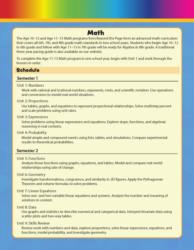
Unit 9: Semester Exams
Lesson 1
Numbers Review
Students write equations for contextual scenarios (e.g., blanks for hiking, banking, submarine movement where they fill in equations like 9 + (−9) = 0 and −12 + 7 = −5). Students set up and compute numerical expressions in several places (e.g., Mission 2 multiplication/division of integers, Mission 3 temperature change written as −2.5 × 6). Students work with a letter symbol in algebraic contexts in the Exponents and Roots activity (e.g., problems that state x^2 = 81 and x^3 = 125 and ask students to determine x).
Lesson 2
Proportions Review
Students are asked to write equations of proportionality such as y = 10x, y = 3x, and y = 4x in Activity 2 and Activity 3. Tasks ask students to "Write the equation" for a table (e.g., x:1,2,3 and y:5,10,15 → y = 5x) and to "Graph the equation y = 6x," requiring writing and using algebraic expressions with letters. Students match tables to equations (including y = x + 2 and y = x + 6) and correct a wrong formula (distinguishing y = 2x + 3 from y = 3x or y = x + 3), which has them work with letters and operations.
Lesson 3
Expressions Review
Students are asked to translate verbal situations into algebraic expressions and equations throughout the activities (e.g., Activity 1: write an equation for gym classes and C = 9t + 6 for a movie ticket; Activity 2: write y = 14x and y = 75x for pay/cost situations). Activity 3 and Activity 4 require students to write linear equations from descriptions (e.g., a $12 flat fee plus $18 per hour → y = 18x + 12; Job A/B → y = 18x and y = 12x + 20). Students also practice rewriting and simplifying expressions (distributive property, factoring), showing use of letters to stand for numbers and recording operations with those letters.
Lesson 5
Semester Exam
Students are asked to write equations from verbal contexts (e.g., problem 33: "Movie tickets cost $11 each plus a $4 fee. Write an equation…" with answer C = 11t + 4). Students write equations for proportional relationships (problem 34 asks for an equation and unit rate; answer y = 4x) and problem 18 asks for an equation given a constant of proportionality k. Students also rewrite and simplify algebraic expressions and use letters for numbers in problems 26–30 (e.g., 4x + 9 + 6x + 1; 3(y + 5) − y; factoring 24m + 12).
Lesson 6
Functions Review
Students are asked to write functions and equations from verbal situations multiple times: Activity 3 (Section 2) has students write y = 18h for a delivery driver who earns $18 per hour. Activity 4 (Sections 1 and 2) asks students to write equations from real-world contexts (y = 18x and y = 12x + 10). Activity 4 (Section 5) requires translating the verbal phrase "The sum of a number and three times the number is 28" into an equation (x + 3x = 28), and Section 6 asks students to write the rule for "Multiply by 2, then subtract 1" as an equation (y = 2x − 1).
Lesson 7
Geometry Review
Students are asked to write the Pythagorean Theorem (a² + b² = c²) and to use it to find a hypotenuse and distances between points, which requires writing and manipulating algebraic expressions with letters. Students are prompted to write volume formulas (V = πr²h, V = 1/3 πr²h, V = 4/3 πr³) and—to solve for a missing radius—use those formulas with letters representing unknowns. Students translate verbal geometric relationships into equations in the angle problem (Angle A is twice Angle B; write an equation 2x + x = 90) and write transformation rules using variables (e.g., (x, y) → (x + 3, y − 2)).
Lesson 8
Linear Equations Review
Students are asked to define variables and write equations from word problems in Activity 4 (e.g., 25 + 15m = 100 for the gym, 12 + 3m = 39 for streaming, 6 + 2m = 34 for the taxi). In the two-number problem students write expressions like x + (x + 10) = 54 to record relationships between quantities. Earlier activities and worksheets present and require manipulation of algebraic expressions (for example 7x - 3x + 4 and fractional-coefficient expressions like (3/5)x = 18), so students work with letters standing for numbers and arithmetic operations throughout the lesson.
Lesson 9
Data Review
Activity 3 includes a web link titled "Write an Equation for a Line of Best Fit," and the Parent Plan explicitly states that students should "use the equation of a linear model to solve problems in the context of bivariate measurement data, interpreting the slope and intercept." The scatterplot activity asks students to interpret lines of best fit and to think about what the line indicates about data relationships. These items explicitly reference writing or using equations that include letters to represent quantities.
Lesson 10
Semester Exam
Students are asked to write algebraic representations from verbal descriptions (Problem 8: "You earn $10 per hour. Write a function that represents your total earnings." and Problem 10: "Write an equation to represent this verbal rule: The difference between twice a number and 4 is 7."). Several word-context problems require forming expressions/equations with variables (Problem 35: tutor charges $18 per hour plus a $30 fee; answer key gives y = 10x and 2x - 4 = 7). Multiple items in Unit 7 require solving for x after forming linear expressions (e.g., x + 7 = 19), showing students create and manipulate expressions with letters standing for numbers.